Read the article below. Interactive reading tools are available when scripts load.
Quick
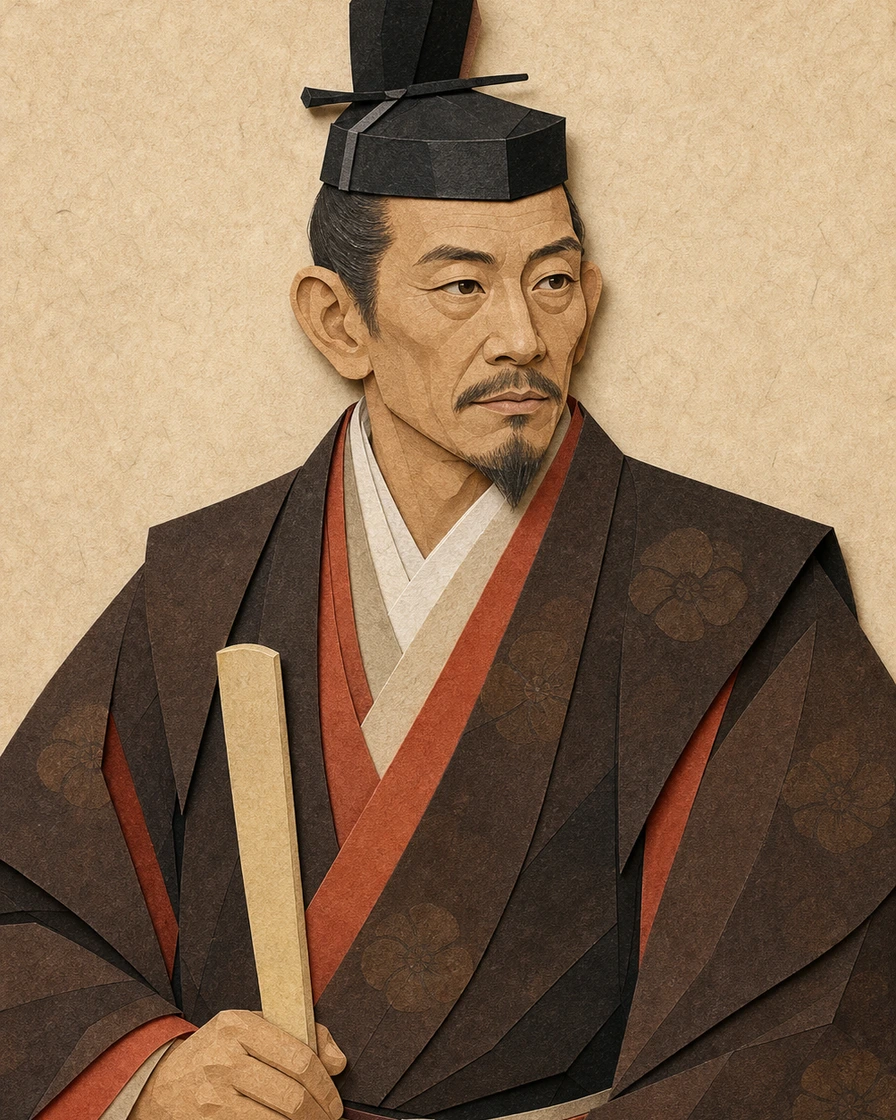
Hideyoshi was born in Owari's Nakamura area, but even his birth year appears as 1536 or 1537 in modern authorities. He did not come from a recognized high warrior lineage. “Peasant's son” captures low status while concealing uncertainty about whether his household combined cultivation, foot-soldier service, craft, or other local work.
Stories of the child Hiyoshimaru, wandering service, Matsushita patronage, carrying Nobunaga's sandals, and the one-night fort at Sunomata created a perfect ascent narrative. Some may preserve fragments of experience; none should be treated as a continuous diary. The first surviving documentary traces belong to his adult service under Nobunaga, when he used names including Kinoshita Tōkichirō Hideyoshi.
Marriage to Nene connected him to a durable household whose relatives and attendants later mattered politically. His rise was exceptional, but not solitary. No first-person voice is supplied for childhood.
As Nobunaga expanded from Owari into Mino, Kyoto, and Ōmi, his organization required commanders who could fight, negotiate, build, collect, and govern. Hideyoshi appears in documents during the mid-1560s and gained responsibility across these functions. Anecdotes about a single brilliant feat should not replace the cumulative record.
After the Azai house fell in 1573, Hideyoshi received substantial former Azai territory and developed Nagahama as a castle center. He adopted the surname Hashiba, traditionally explained as combining characters associated with Niwa Nagahide and Shibata Katsuie; the name itself is secure, while its exact imaginative origin is less important than the new political identity.
His household expanded through Nene, brother Hidenaga, relatives, clerks, local intermediaries, and retainers such as the men later celebrated as strategists. Nobunaga rewarded Hideyoshi's performance, but the Oda regime also created the offices and conquests that made such promotion possible. A capable servant and an expanding institution made one another.
From 1577 Hideyoshi led Nobunaga's campaign through Harima and toward the Mōri sphere. This was not a sequence of open-field victories. Bessho Nagaharu's rebellion made Miki a prolonged siege; Tottori was isolated until starvation forced surrender; at Bitchū Takamatsu in 1582, embankments and seasonal water inundated the approaches.
The methods combined engineering, grain denial, negotiation, intelligence, defection, and terror. Villages supplied labor and food or were stripped of them. People crowded into forts suffered alongside warriors. Exact tales of individual heroism and exact casualty figures vary, but coercive siege was an intentional part of Hideyoshi's command.
The front also depended on Hidenaga, Kuroda Kanbei, Ukita realignment, local guides, engineers, clerks, and communication with Nobunaga. At Takamatsu, Mōri relief forces and Oda attackers were still bargaining when news of Honnōji arrived. Hideyoshi's later national command grew from this administrative warfare, whose effectiveness should not conceal its human cost.
While Takamatsu remained under siege, Hideyoshi learned that Mitsuhide had killed Nobunaga and Nobutada at Honnōji. He completed terms with the Mōri side, disengaged his army, and returned rapidly toward the Kinai.
The celebrated “Chūgoku Great Return” was fast, but exact daily distances, the first messenger, and how fully Hideyoshi concealed the news during negotiation differ across sources. He could not move thousands through willpower alone. Roads, ferries, stored provisions, officers, Himeji resources, marching discipline, and the Mōri decision not to pursue made the return possible.
Speed mattered politically because other Oda commanders were distant, uncertain, or committed on separate fronts. Hideyoshi entered the response as the man who brought a field army against Mitsuhide. Grief may have been real, but the recoverable decision is institutional: he converted a western command into a claim to restore Oda order before rivals could define the aftermath.
Hideyoshi's coalition met Mitsuhide near Yamazaki only days after Honnōji. Niwa Nagahide, Oda Nobutaka, Ikeda Tsuneoki, Hidenaga, and many other officers and troops gave the army more than one author. Mitsuhide failed to secure broad support, and former partners such as the Hosokawa did not make his coup a stable government.
Mitsuhide fled and died soon afterward, although the exact encounter that killed him is source-layered. Later narration makes control of Tennōzan the entire battle; elevation and roads mattered, but victory developed across a broader position and through unequal coalition strength.
Yamazaki gave Hideyoshi the powerful identity of Nobunaga's avenger. It did not transfer the Oda lineage, territories, or every retainer to him. Nobunaga's sons, grandson, and senior commanders remained. The battle opened a succession struggle in which Hideyoshi could speak first from victory; it did not finish that struggle.
At Kiyosu, leading Oda retainers and relatives addressed succession, guardianship, and territorial allocation. Hideyoshi supported Sanpōshi, Nobutada's young son, preserving the direct line while creating a child-centered arrangement in which adult commanders could compete. Oda sons Nobukatsu and Nobutaka retained claims and power; Shibata Katsuie controlled a major northern coalition.
Later drama reduces the meeting to four men dividing Nobunaga's estate and Hideyoshi revealing a child heir. The real process extended beyond one scene and depended on armies, castles, family rank, and subsequent compliance. Hideyoshi did not yet announce a new Toyotomi dynasty.
Conflict with Katsuie and Nobutaka escalated. In 1583 Hideyoshi defeated Katsuie's coalition after fighting around Shizugatake; Katsuie and Oichi died at Kitanoshō, and Nobutaka was forced to die soon after. The famous “Seven Spears” roster helped later houses claim founding valor but does not capture the whole battle.
Hideyoshi began Ōsaka Castle in 1583 on the Uemachi plateau, broadly overlapping the former Ōsaka Honganji complex and temple town. The location joined defensible ground to the Yodo River, Seto Inland Sea trade, and routes toward Kyoto. It was both a claim to Nobunaga's strategic inheritance and a center designed for Hideyoshi's own regime.
Construction continued in phases: the main compound and tower rose first, additional enclosures and the city expanded later. Daimyō, villages, transport workers, quarrymen, carpenters, merchants, and displaced residents supplied materials and labor. Waterways were altered, streets organized, and populations drawn or moved into the new city.
The Place visible today is layered. The Toyotomi castle was destroyed in 1615; Tokugawa builders buried or overlaid much of it, later structures burned, and the present tower is a twentieth-century reconstruction. Toyotomi walls survive mainly underground or through excavation.
In 1584 Oda Nobukatsu allied with Tokugawa Ieyasu against Hideyoshi. At Nagakute, Tokugawa forces defeated an expeditionary column and killed Ikeda Tsuneoki and Mori Nagayoshi; the young Hidetsugu's command suffered badly. Hideyoshi could not erase Ieyasu through battle.
The wider war included fortified lines, regional alliances, raids, letters, and pressure on Nobukatsu's territories. Hideyoshi negotiated a separate peace with Nobukatsu late in 1584, weakening the political basis for Ieyasu's continued campaign. Neither man became the other's simple prisoner.
Submission took further work. Hideyoshi sent his sister Asahi to marry Ieyasu and later allowed or required his mother Ōmandokoro to reside in Tokugawa hands while Ieyasu came to Ōsaka in 1586. These women were political actors and human guarantees, not decorative tokens. Ieyasu entered Hideyoshi's hierarchy while preserving a large eastern power base—an unresolved asymmetry that would matter after 1598.
Hideyoshi became kanpaku in 1585 after affiliation with the Konoe regent line, then received the Toyotomi designation and the office of dajō-daijin in 1586. He did not simply choose kanpaku because a non-Minamoto could never become shogun. The story that Ashikaga Yoshiaki refused to adopt him belongs to later evidence and cannot serve as the sole explanation.
Court office allowed Hideyoshi to rank daimyō through titles, audiences, surname grants, and imperial ceremony. Nene became Kita no Mandokoro and received very high court rank. Jurakudai displayed the new hierarchy when the emperor visited. “Toyotomi” was a court-created clan name or uji, not merely a modern family surname replacing Hashiba in every daily use.
Culture was government. The 1587 Kitano tea gathering publicized inclusion and magnificence, while golden rooms, collections, and tea masters regulated access. In 1591 Hideyoshi ordered Sen no Rikyū to die. The act is established; bribery, statue, aesthetic conflict, or political conspiracy do not form one proven motive.
Hideyoshi extended his hierarchy through the Shikoku campaign of 1585, the Kyushu campaign of 1587, and the Odawara siege of 1590. Chōsokabe and Shimazu rulers submitted under pressure and retained reduced domains; the Hōjō lost theirs. Date Masamune and other northern lords then entered the settlement.
“Unification of Japan” needs limits. Daimyō continued to govern domains with their own retainers. Ezo/Ainu polities, Ryukyu, maritime communities, temples, and local jurisdictions did not become identical units of one modern state. Hideyoshi asserted superior adjudication: private wars and boundary changes increasingly required his permission, while hostages, ranks, land transfers, and campaign attendance enforced compliance.
In Kyushu he also issued the 1587 missionary-expulsion order after having tolerated Christian activity. Enforcement was uneven and trade continued, but the decree shows that conversion, church land, and foreign religious networks could be recoded as threats. Integration combined peace-making claims with siege, dispossession, coerced movement, and religious restriction.
Hideyoshi's government and subordinate daimyō conducted extensive land surveys. Teams measured fields, classified quality, estimated output in grain units, identified recognized cultivators or holders, and produced ledgers. The resulting kokudaka helped compare territories, assign rewards, calculate obligations, and organize military service.
The “Taikō land survey” was not one nationwide measurement completed on a single standard day. Nobunaga and earlier rulers had survey precedents; Toyotomi work unfolded by region, campaign, transfer, and local negotiation. Units and enforcement became more comparable without eliminating variation. Temples, village headmen, cultivators, lords, and commissioners contested which land, yield, tax, and right entered the record.
A ledger did not record literal annual harvest. It established an assessed productive capacity and a legal-fiscal relationship. Registration could protect a cultivator's recognized holding while making tax and labor claims more exacting. The surveys enlarged central capacity because daimyō and villages reproduced the method, not because Hideyoshi personally measured every field.
In 1588 Hideyoshi issued the sword-hunt order, directing the collection of weapons from farming populations and presenting the metal as material for a Great Buddha. The policy sought to reduce revolt and stabilize cultivators as taxpayers. A related maritime order required authorities to identify and control seafaring people and suppress unauthorized violence; it was not literally a universal confiscation of every boatman's weapon.
Implementation varied. Villages surrendered some arms, concealed or retained others, and continued to use weapons for policing, hunting, ceremony, or local defense. Rural elites could be both cultivators and armed leaders. In 1591 further status regulations restricted movement among warrior, farming, and service categories.
These measures pushed society toward more hereditary and residential differentiation, but they did not complete “warrior-farmer separation” in one year. Daimyō castle-town policies, land surveys, labor obligations, and seventeenth-century developments continued the change. Hideyoshi's orders mattered as coercive direction and classification, not magical social transformation. [2]
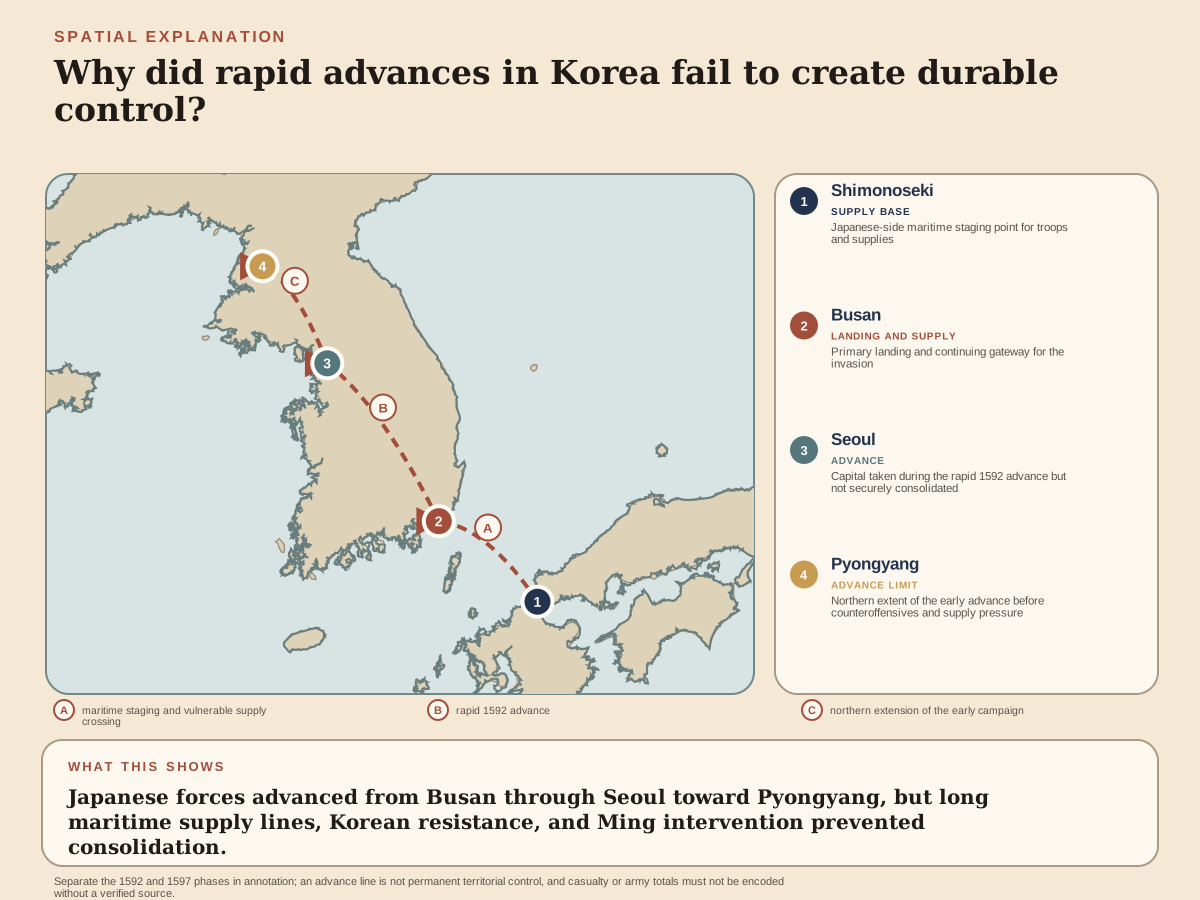
Hideyoshi ordered two invasions of Korea, beginning in 1592 and 1597, with Ming China as a further target. Japanese armies captured Busan, Seoul, and Pyongyang rapidly in the first campaign. They did not convert advance into conquest. Joseon forces reorganized, local righteous armies resisted, Admiral Yi Sun-sin's navy challenged Japanese maritime operations, Ming armies intervened, and supply over great distance became decisive.
Negotiations after 1593 were compromised by incompatible messages: intermediaries represented Hideyoshi as seeking terms acceptable to Ming, while he expected submission, territory, royal kinship, and recognition far beyond what the Ming investiture offered. When this gap became undeniable, he renewed invasion in 1597.
The second campaign produced further destruction, killing, enslavement, forced migration of craftspeople and scholars, and the collection of severed noses as proof of enemy deaths, memorialized at Kyoto's Mimizuka. Exact military and civilian totals remain contested; the scale of catastrophe does not. It was Hideyoshi's central deployment of the national capacity he had built, and its responsibility belongs at the center of his rule.
Hideyoshi's brother Hidenaga and young son Tsurumatsu died in 1591. Hideyoshi transferred the kanpaku office to his nephew and adopted heir Hidetsugu and became known as Taikō, the retired regent. Hidetsugu governed, maintained a court, and appeared to offer adult succession.
In 1593 Yodo-dono gave birth to Hideyori. She was Chacha, daughter of Oichi and Azai Nagamasa, so the new child's maternal line also joined Oda and Azai prestige to Hideyoshi's house. Two years later Hidetsugu was accused or treated as disloyal, removed to Mount Kōya, and died under an order generally understood as compelled suicide. The exact treason case remains disputed.
Hideyoshi then ordered the killing of Hidetsugu's women, children, and close dependents at Kyoto. Later stories depicting Hidetsugu as an indiscriminate murderer do not justify this collective punishment. The purge eliminated a functioning adult branch and concentrated succession on a toddler. It strengthened Hideyori's exclusivity while destroying resilience in the dynasty meant to protect him.
Hideyoshi died in 1598 while Hideyori was a small child and Japanese forces remained in Korea. He had required oaths and arranged great daimyō—conventionally called the Five Elders—alongside administrative officers conventionally called the Five Commissioners to support the heir. These were powerful actors with their own lands, clients, and interpretations, not neutral trustees in a self-enforcing constitution.
Japanese armies withdrew from Korea after his death. Maeda Toshiie died in 1599, disputes sharpened, and Tokugawa Ieyasu used rank, marriages, adjudication, and military superiority within the Toyotomi field. Sekigahara in 1600 and Ōsaka in 1615 were later political events, not an automatic timer set by Hideyoshi's last breath; nevertheless, his purge of adult kin and dependence on competing daimyō left Hideyori vulnerable.
Hideyoshi was deified as Toyokuni Daimyōjin, suppressed under Tokugawa victory, memorialized by Nene at Kōdai-ji, and publicly revived in the Meiji era. By 1912 he could appear as low-born national unifier, imperial loyalist, cultural patron, tyrant, or continental invader.
Classic
The safest origin claim begins with place. Hideyoshi was associated with Nakamura in Owari, now within Nagoya. Local memory later monumentalized the connection, but the broad regional origin is stronger than any surviving birth-room claim.
Even the year requires a double entry. Nagoya museum interpretation commonly uses 1537, while the National Diet Library authority record uses 1536. Both reflect established traditions. A publication gains nothing by hiding one under false certainty.
His family did not belong to the great warrior genealogies that normally legitimated sixteenth-century rule. This negative evidence matters. It explains why later titles, names, adoption, and court affiliation required unusual construction.
“Peasant” is still broader than it sounds. Rural households could cultivate, bear arms, transport goods, serve local warriors, or move between kinds of labor. Later success encouraged genealogists either to deepen Hideyoshi's poverty for dramatic ascent or to discover a respectable military father. Exact paternal biographies remain fragile.
His mother, later honored as Ōmandokoro, is more securely visible in his adult regime than in childhood scenes. Her kinship became politically valuable. His brother Hidenaga and sister Asahi likewise entered the expanding household. The family did not begin as a ready-made dynasty; power transformed relatives into offices, marriage links, and hostages.
The name Hiyoshimaru belongs to tradition rather than an early signed document. Hideyoshi's first known written appearance comes much later, and even that survives in copy. Names such as Kinoshita Tōkichirō and later Hashiba Hideyoshi can be dated from documentary practice more securely than a childhood name.
The Matsushita-service story places him in Tōtōmi before his return to Owari. It may reflect a real early connection, but later biography supplies motives, adventures, and recognition that the contemporary record cannot confirm in sequence.
The sandal-bearer episode condenses low service and attentive intelligence into one image. Its cultural power is obvious. Its evidentiary value is limited. Nobunaga's household included many low-ranking service roles, and someone could rise through them, but the famous warm-sandals scene is not an administrative record.
Sunomata's “one-night castle” performs the same narrative work. Temporary fortification, rapid building, and Hideyoshi's role in Mino operations are plausible or attested in different layers. A fully constructed castle appearing overnight through one man's cleverness belongs to heroic compression.
His marriage to Nene, conventionally placed in the early 1560s, is firmer as household structure than as romance. Her natal and adoptive relations became part of the Kinoshita network. She later held the title Kita no Mandokoro and rank of her own. Treating her only as the supportive wife of genius erases the residence through which service, kin, gifts, and petitions were organized.
Low origin therefore created both opportunity and vulnerability. A rapidly expanding lord such as Nobunaga needed capable men beyond ancient houses. The same absence of ancestry later required Hideyoshi to borrow or construct court lineage, distribute new names, and prove authority through achievement.
The social-mobility symbol is historically valid at the right scale. Hideyoshi traveled from obscure Owari status into the highest court office and command over daimyō. That transformation cannot be explained by normal hereditary succession.
It also cannot be explained by wit alone. War expanded organizations; clerks recorded grants; marriage created a household; patrons assigned tasks; subordinates executed them. Exceptional individual adaptation operated inside these structures.
The responsible opening is thus stronger than the motivational legend. It admits that the early archive is thin, identifies when documentation thickens, and makes the later creation of ancestry part of the political story rather than proof about birth.
A small hereditary house can reserve major commands for a few relatives. Nobunaga's regime could not. Each conquest added castles, taxes, roads, disputes, temples, merchants, surrendered enemies, and garrisons. The demand for managers expanded faster than ancient rank could supply them.
Hideyoshi's mid-1560s documents are therefore more revealing than the isolated sandal tale. They show a named adult performing business within the Oda system. Written orders and reports made service legible beyond face-to-face memory.
Military work included more than the charge. Operations in Mino required inducing castle holders to defect, arranging hostages, securing passages, and turning captured places into supply points. Later stories may allocate every ingenious step to Hideyoshi; the functional combination itself is credible.
Administrative work followed victory. New rulers had to confirm or revise landholding, answer temple and village claims, direct construction, and prevent soldiers from consuming the assets they were supposed to govern. A commander who could move between battlefield and paperwork offered unusual value.
Nobunaga remained the patron who assigned authority. Promotion under him was not a meritocratic civil-service examination. Trust, urgency, faction, marriage, personal access, and success all influenced appointment. Failure could be punished harshly.
Nene's household helped make repeated absence possible. A warrior commanding campaigns needed a residence able to receive gifts, store documents, manage dependents, raise or adopt kin, and communicate with the lord's household. Her later status cannot be retroactively imposed on the 1560s, but the partnership already had institutional consequences.
Hidenaga supplied another form of continuity. As Hideyoshi's brother, he could represent interests that were difficult to entrust to an unrelated retainer. His later prominence in campaigns and government warns against attributing every “Hideyoshi” result to one pair of hands.
Men conventionally described as strategists, including Takenaka Hanbei and Kuroda Kanbei, entered the story through different dates and relationships. Their later legend grew alongside Hideyoshi's. Rather than appointing one secret genius behind each victory, the biography should identify advice, mediation, local knowledge, and command as distributed functions.
The destruction of Azai power in 1573 transformed scale. Nobunaga granted Hideyoshi much of the former Azai territory in northern Ōmi. A man of low origin now had to govern lands with their own warrior families, temple claims, villages, and memory of a defeated house.
Nagahama became the center of this rule. Castle and town building reorganized settlement and route use. The result was not simply a reward residence; it was evidence that Hideyoshi could maintain an Oda frontier and produce resources.
The Hashiba name marked changing political personhood. It associated him with a warrior identity more suitable to high command than Kinoshita Tōkichirō. The popular explanation that its characters honored Shibata and Niwa may be meaningful, but the signed use matters more securely than the private naming scene.
Promotion also produced subordinates whose future depended on him. Grants attracted men of modest background and established families alike. His household became a ladder inside the larger Oda ladder, generating loyalty and rivalry.
Not all flexibility was emancipation. Conquered villagers faced new demands; surrendered warriors might be displaced; building a town drew labor and materials. Social ascent at the top could intensify coercion below.
The synthesis therefore avoids two extremes. Hideyoshi was not an interchangeable product of Oda expansion: many had opportunities and did not reach his scale. Nor did talent create the positions it occupied by itself. He excelled at converting institutional need into personal authority and then turning that authority into a household capable of further expansion.
The Chūgoku campaign stretched supply and authority across unfamiliar territory. Harima lords had their own relationships with Oda, Mōri, temples, and neighboring houses. Formal submission did not guarantee permanent obedience.
Bessho Nagaharu's break with Nobunaga made Miki a fortified center of regional resistance. Hideyoshi could not simply march past it without exposing roads and allies behind him. The siege extended over years.
“Starving Miki” summarizes a policy of blocking provisions, controlling surrounding forts, and waiting for internal capacity to fail. It required patrols, intelligence, allied castles, and the willingness to let hunger work upon everyone inside.
Surrender negotiations eventually concentrated responsibility on leaders, but they did not reverse deprivation. Accounts that celebrate self-sacrificing deaths may preserve political ritual while converting the suffering of unnamed residents into background.
Tottori in 1581 intensified the food strategy. Hideyoshi's forces restricted access after the castle had gathered defenders and nearby population. Stories that he bought regional grain in advance to create scarcity may reflect deliberate market manipulation, but individual transaction details need source testing.
The resulting starvation is not in doubt at the broad level. Extreme descriptions in chronicles require genre caution, yet caution cannot be used to sanitize the choice to weaponize hunger. Combatants and displaced civilians shared an enclosure without equal responsibility for policy.
At Bitchū Takamatsu the following year, terrain offered another instrument. Hideyoshi's coalition built embankments and used water to isolate the low-lying castle. Seasonal rain and local hydrology mattered; the episode was not one man's instant invention of a lake.
Engineering demanded survey, earth, timber, baskets, transport, guards, and enormous labor. Villages and mobilized workers transformed landscape under military compulsion. A famous aerial image of the flooded castle should therefore include the hands that raised the banks.
Mōri forces approached but faced the risk of a larger Oda army expected under Nobunaga. Negotiation proceeded through intermediaries. Shimizu Muneharu's death became the best-known symbol of settlement, yet precise ceremony and speeches belong to narrative layers.
Hideyoshi's success also rested on alliance change. Ukita Naoie and regional lords altered the balance. Kuroda Kanbei's mediation and local knowledge became important, while Hidenaga managed operations elsewhere. “Hideyoshi's siege” names ultimate command, not solitary execution.
Nobunaga remained superior. Hideyoshi reported, requested forces, and operated within Oda strategic goals. The later ruler had not yet become an independent national sovereign.
Administrative capacity grew through these campaigns. Officers had to inventory grain, assign units, manage surrender, take hostages, confirm defectors, and prevent a rear revolt. The same skills later organized surveys and nationwide mobilization.
The violence also anticipated later rule. Hideyoshi learned that controlling resources could force political obedience without destroying every wall. Such methods could reduce his own battlefield losses while increasing suffering among enclosed populations.
The Classic layer should not choose between ingenious commander and cruel besieger as competing portraits. Engineering, logistics, negotiation, and starvation belonged to the same military intelligence. Moral evaluation begins after their connection is made visible.
Honnōji destroyed the command above Hideyoshi while he faced an enemy army in the west. The news created two dangers: the Mōri could exploit Oda collapse, and Mitsuhide could consolidate the capital before any avenger arrived.
Later tradition makes the discovery cinematic. A messenger intended for the Mōri supposedly entered Hideyoshi's lines, revealing Mitsuhide's letter. This may preserve intelligence interception, but the exact carrier and scene are not equally documented across accounts.
Hideyoshi did receive the essential information quickly enough to act. He and his officers restricted circulation, continued settlement, and sought an exit that would not expose their rear.
Negotiation at Takamatsu had already created a framework. The death of Shimizu Muneharu and territorial concessions became part of the agreement.
Evidence and interpretation · News was not complete knowledge
Hearing that Nobunaga had died, understanding the position around Kyoto, and agreeing on a response were different stages. Watanabe Daimon emphasizes the Mōri side’s incomplete information after the coup when challenging reconstructions of advance coordination with Mitsuhide and Yoshiaki. [5]
That argument does not supply the hour at which each Mōri leader learned the news. Nor does the speed of Hideyoshi’s return establish prior knowledge or disclose exactly what he said in every negotiation. The settlement and the successful withdrawal are firmer ground than a fully reconstructed exchange of secrets. [5]
The Mōri side was not passive. Kobayakawa Takakage, Kikkawa Motoharu, and Terumoto's government had to weigh pursuit, unreliable information, exhausted forces, and the terms just accepted. Their decision not to strike the retreat was one cause of Hideyoshi's success.
Marching a large army required more than choosing speed. Units had to be ordered, bridges and ferries crossed, stragglers managed, horses fed, weapons carried, and provisions distributed. An exhausted column that reached Kyoto without cohesion would have had little value.
Hideyoshi's prior control of Himeji and the roads through Harima supplied staging capacity. Garrisons and storehouses built for the western front now supported movement in the other direction. Long preparation produced sudden mobility.
Exact schedules should remain source-specific. Later itineraries can give the impression that every halt and distance was logged contemporaneously. The historical conclusion does not require an athletic record: Hideyoshi returned far faster than the political environment expected.
The return also depended on what other commanders could not do. Shibata Katsuie operated in the north; Tokugawa Ieyasu faced a dangerous journey from the Kyoto region back to his own base; Oda sons and retainers lacked a single surviving command. Opportunity was relational.
Hideyoshi framed the movement as vengeance and restoration. That language joined loyalty to self-advancement. Killing Mitsuhide would answer the betrayal and establish the killer as protector of the Oda house.
No contradiction requires choosing sincere grief or cynical ambition. A retainer could mourn a patron whose expansion created his career and understand immediately that political survival depended on action.
Hidenaga, Kuroda Kanbei, logistics officers, and unit commanders translated decision into movement. The phrase “Hideyoshi's return” should preserve ultimate command without erasing them.
The event also shows how information becomes power. Many people eventually knew Nobunaga was dead. Hideyoshi's advantage lay in receiving credible notice, controlling its immediate distribution, closing one war, and moving before shared knowledge produced shared coordination.
The Classic question is therefore not whether every legend is false. It asks which system made the remarkable pace consequential. Intelligence, negotiation, stored resources, disciplined forces, enemy restraint, and a vacuum at the center allowed time saved on the road to become authority at Yamazaki.
Mitsuhide's coup removed Nobunaga and Nobutada but did not automatically produce recognition. He needed the court, neighboring commanders, former Oda colleagues, and local forces to accept or at least tolerate his new position.
Time worked against him. The attack itself was fast; coalition construction was slower. Letters had to reach people whose safest response was to wait. Some had kin, hostages, or territories exposed on several sides.
The Hosokawa connection illustrates the limit. Mitsuhide had important personal and marital ties to the house, but they did not translate into decisive military backing. Relationship created an opportunity for support, not an obligation to join a vulnerable coup.
Hideyoshi approached with a different claim. He carried a large Oda field army and declared retaliation for the murdered lord. Niwa Nagahide, Oda Nobutaka, and Ikeda Tsuneoki gave the coalition genealogical and senior-retainer breadth.
Those allies were not decorative endorsements. Their troops, local relationships, and names affected who could present the battle as restoration rather than a private Hashiba seizure. Hideyoshi's later dominance should not erase their agency in June 1582.
Geography constrained the encounter. The narrow corridor between mountains and waterways near Ōyamazaki controlled movement toward Kyoto. High ground including Tennōzan offered observation and tactical advantage.
Later sayings make possession of the mountain identical with possession of the realm. The expression is excellent memory and poor complete battle plan. Forces fought across approaches, fields, river edges, and settlements; numbers, timing, and morale mattered with terrain.
Mitsuhide's army had fought at Honnōji and then attempted political consolidation. Some units or potential allies hesitated. Hideyoshi's rapid arrival denied the coup the time in which defections might accumulate.
After defeat, Mitsuhide fled. Accounts of peasants or local men killing him near Ogurusu and of his exact final acts vary. The event core is his death during the collapse, not a confidently dramatized last duel.
The victory gave Hideyoshi control of commemoration. Funerary actions for Nobunaga and public punishment of the coup could present him as the man restoring moral order. Ritual and military success reinforced one another.
Inheritance remained a separate problem. Nobunaga had surviving sons, the child Sanpōshi through Nobutada, assigned territories, and senior retainers with independent armies. No office existed that the Yamazaki victor automatically occupied.
Hideyoshi's own low ancestry made dynastic substitution especially difficult at this stage. He still acted under the Hashiba name within an Oda political field. The move from avenger to supreme ruler required meetings, territorial redistribution, marriage and hostage policy, further wars, and court office.
The distinction protects shared-event architecture. The objective battle does not need duplication.
Yamazaki was decisive because it destroyed the immediate coup regime and gave Hideyoshi initiative. It was incomplete because initiative is not succession. His greatest skill after battle was to make later decisions depend increasingly on the authority created there.
The deaths of Nobunaga and Nobutada left several kinds of claim. Sanpōshi represented the direct line through Nobutada but was a child. Nobukatsu and Nobutaka were adult sons of Nobunaga with territories and followers. Senior commanders possessed forces without genealogical priority.
Kiyosu brought powerful men together because no one could simply issue orders to the rest. Hideyoshi, Shibata Katsuie, Niwa Nagahide, and Ikeda Tsuneoki became the conventional central participants, but Oda relatives, other retainers, messengers, and occupied territories affected what any agreement could accomplish.
Sanpōshi's selection or confirmation served more than Hideyoshi's ambition. Direct descent from Nobutada offered dynastic continuity after the principal adult heir died. Supporting the child could appear more legitimate than allowing one of Nobunaga's surviving sons to displace that line.
It also created guardianship politics. A child cannot inspect castles, direct armies, or arbitrate grants. Whoever controlled residence, seals, ceremonies, and access could claim to act for him.
Territorial redistribution gave the meeting material content. Victory at Yamazaki allowed Hideyoshi to gain or confirm major holdings. Katsuie's northern base and the positions of Oda sons remained substantial. Allocation was not the same as obedience.
Popular retellings stage Hideyoshi entering with Sanpōshi and emotionally defeating his seniors before any battle. The image explains later outcome through one theatrical moment. Documentary history instead follows agreements, appointments, letters, garrisons, and the speed with which alignments changed.
Marriage joined the camps. Katsuie married Oichi, Nobunaga's sister and widow of Azai Nagamasa. Her daughters connected the fallen Azai, Oda kin, and future Toyotomi and Tokugawa houses. They were not merely prizes rescued from a burning castle; their lineage carried political value.
By late 1582 and early 1583, Hideyoshi and Katsuie mobilized. Weather and distance constrained Katsuie's northern forces. Hideyoshi pressured Nobutaka and allied positions while maintaining a wide coalition.
The fighting around Shizugatake became decisive when Hideyoshi rapidly concentrated against Katsuie's forces. Again, speed depended on roads, orders, supply, and subordinate initiative rather than bodily haste alone.
Later families celebrated a list of “Seven Spears” who distinguished themselves. Several named warriors did rise under Hideyoshi, but the roster and equal heroic status were shaped by retrospective house memory. Thousands of unnamed troops, engineers, and messengers made the victory possible.
Maeda Toshiie and other Katsuie-linked commanders made choices during collapse that influenced survival and later service. Their realignment demonstrates that coalitions were not moral blocks. Hideyoshi could incorporate some former opponents while destroying leaders whose continuing claim threatened him.
Katsuie and Oichi died at Kitanoshō. Exact final speeches and the aesthetic of joint self-destruction belong to narrative. Their deaths extinguished a rival headquarters and left Oichi's daughters within a new political environment.
Nobutaka was then compelled to die. This act shows Hideyoshi moving beyond neutral guardianship. He eliminated an adult son of his former lord while continuing to invoke Oda legitimacy through Sanpōshi.
The result was not yet uncontested national rule. Nobukatsu remained, Tokugawa Ieyasu retained independent power, and regional lords watched whether Hideyoshi could convert victory into hierarchy.
Kiyosu therefore worked as both settlement and starting point. It provided a defensible dynastic language, redistributed resources, and exposed who could not coexist. Hideyoshi's regime emerged from inside the Oda framework by using its heir, defeating its commanders, and progressively making its lineage politically secondary.
The Uemachi plateau had already demonstrated its strategic value. Honganji's headquarters and temple town used elevation, waterways, markets, and religious networks to resist Nobunaga for a decade. Hideyoshi did not discover an empty hill.
Construction beginning in 1583 appropriated both place and memory. Establishing his center at or near the former Honganji site linked him to the victory over one of Nobunaga's strongest adversaries while converting a sacred corporate city into a ruler's castle town.
Exact spatial overlap remains debated because Toyotomi and Tokugawa earthworks transformed the plateau. Archaeology has found probable Honganji-period burning and material beneath Toyotomi layers, but it cannot draw every boundary of the temple town from surviving samples.
The Toyotomi project advanced in stages. The central compound and monumental tower were ready early enough to receive political use by the mid-1580s. Secondary enclosures, outer defenses, canals, and urban districts expanded as Hideyoshi's authority and household grew.
The castle combined residence, treasury, arsenal, audience space, ritual, and visual command. Visiting daimyō encountered controlled routes and ranked rooms. Hideyoshi's low birth disappeared behind architecture that made access to him the measure of status.
Water mattered as much as stone. River channels connected supplies from Kyoto and inland provinces to the bay and Seto Inland Sea. Canal and drainage work made new urban land while directing cargo toward the regime.
Merchants gained opportunity in a center consuming grain, textiles, metal, timber, ceramics, weapons, and luxury goods. Some communities were invited or transferred. Growth was not a spontaneous market miracle; assignments, exemptions, compulsory moves, and lordly demand shaped it.
Stone walls make labor visible only in completed form. Daimyō were assigned construction burdens, and their domains mobilized quarrying, shipping, skilled placement, and provisions. Marks on stones can identify work groups more readily than individual workers or the conditions under which they served.
The city also redistributed sacred space. Honganji communities did not vanish; later branches and temple districts reappeared elsewhere under negotiated arrangements. Hideyoshi's control of sites helped shape the institutional separation that would develop into eastern and western Honganji lines under later rule.
Ōsaka did not replace Kyoto as the sole capital. Hideyoshi needed imperial ceremony and built other residences, including Jurakudai and later Fushimi. His government was polycentric, moving courts, officials, hostages, and stores among places.
Modern visitors see a different castle. After the Toyotomi house was destroyed in 1615, the Tokugawa shogunate reconstructed on a new scale, burying Toyotomi features. Fires and modern military use added further layers, and the present tower dates from the twentieth century.
Calling every visible wall “Hideyoshi's” turns Place continuity into architectural falsehood. Excavated Toyotomi stonework and underground strata provide closer material evidence but still represent fragments rather than the whole original complex.
The castle's symbolism outlived its fabric. Ōsaka became attached to Hideyoshi's memory, merchant-city identity, and the final Toyotomi siege. That reception can obscure the earlier Honganji city and the labor that made the ruler's monument.
The strongest interpretation treats Ōsaka as a palimpsest. Hideyoshi used inherited geography, erased and reused structures, organized a new urban economy, and built an extraordinary center. Later victors repeated the process over him.
The war began within the continuing breakup of the Oda order. Nobukatsu, an adult son of Nobunaga, feared or resisted Hideyoshi's dominance. Ieyasu could support Oda legitimacy while protecting his own position against an expanding western ruler.
Hideyoshi possessed more aggregate resources but could not apply them without geography and time. Ieyasu fortified around Komaki, and both sides constructed positions rather than offering one decisive open battle.
The attempt to move a force around the Tokugawa position toward Mikawa created the Nagakute encounter. Ikeda Tsuneoki and Mori Nagayoshi were experienced commanders. Hidetsugu, Hideyoshi's nephew and future heir, held a senior place without equivalent experience.
Tokugawa forces detected or pursued the movement and defeated its components. Ikeda and Mori died. Hidetsugu escaped a disaster that later reputation used to judge his military capacity.
Hideyoshi was not personally directing each contact at Nagakute. Calling it his battle loss is meaningful at command level but should retain the delegated column, its plan, and its separate commanders.
Afterward, the main armies continued to face one another. Ieyasu's success did not provide the means to capture Ōsaka or destroy Hideyoshi's western coalition. Tactical advantage and strategic reach diverged.
Hideyoshi widened pressure against Nobukatsu and his holdings. Regional lords recalculated which coalition could sustain them. War affected villages through requisitions, fortification, crop damage, and shifting prohibitions even where no famous battle occurred.
Late in 1584 Hideyoshi made a separate settlement with Nobukatsu. Because Ieyasu had entered war as his ally, that peace changed the public justification and practical coalition. It did not amount to Ieyasu's immediate unconditional surrender.
Relations remained a cold contest. Hostages, rank, audiences, marriages, and regional adjudication became tools for achieving what the battlefield had not. Hideyoshi needed Ieyasu to appear within his hierarchy; Ieyasu needed to avoid destruction while retaining internal command.
Asahi's marriage in 1586 belonged to this strategy. She was Hideyoshi's sister and was transferred into a marriage with Ieyasu after prior domestic arrangements were overridden. Describing the match only as diplomatic success erases the cost imposed on her.
Ōmandokoro's presence in Tokugawa custody supplied a still stronger guarantee when Ieyasu traveled to meet Hideyoshi. A ruler who had risen through kin networks now risked his mother to secure another ruler's audience.
Ieyasu then accepted court rank and a subordinate relation within Hideyoshi's order. He did not dissolve his house or hand over the eastern military base. Submission was real in ritual and policy while autonomy remained substantial in territorial administration.
This compromise later made competing memories possible. Tokugawa history could emphasize the battlefield victory and Ieyasu's refusal to be conquered. Toyotomi history could emphasize his eventual audience and obedience. Both select a different scale.
The whole event teaches that “winner” must be specified. Ieyasu won Nagakute tactically. Hideyoshi broke the opposing coalition and gained acknowledged supremacy over time. Neither outcome eliminated the other man's capacity, which is why the relationship remained central to succession.
Kanpaku was an office historically monopolized by Fujiwara regent houses. Hideyoshi's military power could pressure court politics, but office still required a genealogical and ceremonial route recognizable within that institution.
His affiliation as an adoptive or quasi-filial member of Konoe Sakihisa's line supplied a Fujiwara connection. The arrangement illustrates that lineage could be politically constructed through recognized kinship procedures rather than simply fabricated in a genealogy.
Hideyoshi became kanpaku in 1585. The appointment placed him in a role of speaking on the sovereign's behalf and supervising court government. It offered a public rank above daimyō that did not depend on descent from the Ashikaga house.
The popular claim that only a Minamoto could be shogun and that Yoshiaki personally denied Hideyoshi adoption compresses later traditions into constitutional law. Warrior titles had flexible precedents, and the alleged exchange lacks the strength required to explain the decision by itself.
In 1586 Hideyoshi received the new clan designation Toyotomi and became dajō-daijin. “Toyotomi” functioned within the classical system of court-recognized clan identity. He and people he favored could still use Hashiba as a surname or title component in documentary life.
Naming became an instrument of hierarchy. Hideyoshi distributed surnames, court titles, and ranks to daimyō, incorporating them into a status order centered on his relationship with the sovereign. A regional lord's local military power now had a place within a national ceremonial scale.
Nene's transformation into Kita no Mandokoro demonstrates that the order included households, not just individual commanders. Her rank and residence enabled audiences, gifts, and ties among daimyō families. She was neither a kanpaku nor a private wife outside politics.
Jurakudai in Kyoto materialized the court-warrior partnership. The imperial visit in 1588 required daimyō to appear in ordered roles and affirm obligations. Architecture, seating, costume, gifts, and oath formed political evidence.
The Kitano tea gathering of 1587 used a different performance. Hideyoshi advertised wide participation while displaying an unparalleled collection and a golden tea space. Openness occurred inside an event whose rules and prestige he controlled.
Sen no Rikyū and other tea practitioners made objects, movements, and small rooms into a language of access. Tea could reconcile, rank, test, and reward. Calling it merely aesthetic leisure ignores its role in elite government.
Rikyū's forced death in 1591 shows the danger of cultural proximity. Hideyoshi issued or enforced the decisive order. Later explanations cite a statue above a gate, commercial misconduct, arrogance, sexual or political refusal, aesthetic conflict, and faction. No single motive is demonstrated conclusively.
The uncertainty should not dissolve responsibility. Whatever the trigger, supreme authority made a leading cultural adviser expendable. Rikyū's later canonization can turn the conflict into pure beauty resisting tyranny, another outcome-biased simplification.
Court and culture also required extraction. Palaces, visits, tea objects, banquets, and ranks drew on land, artisan labor, transport, and gifts. Magnificence redistributed resources while presenting the result as harmonious order.
Hideyoshi's legitimacy was therefore institutional innovation through inheritance. He did not abolish court forms; he entered, stretched, and used them to rank the warrior world. Low origin made this achievement extraordinary, while military coercion made the court's accommodation hard to separate from choice.
The result proved that national warrior supremacy had more than one constitutional language. Hideyoshi became neither Ashikaga shogun nor emperor. He assembled regent office, new clan identity, palace, ritual, and military command into a personal regime whose succession remained a harder problem.
Shikoku illustrates the method. Chōsokabe Motochika had expanded through regional war and sought recognition. Hideyoshi demanded submission to a larger adjudicatory order and sent multiple armies in 1585, with Hidenaga exercising major command.
After defeat, Motochika retained Tosa rather than disappearing. Hideyoshi's regime often preferred reduced and ranked daimyō who could govern locally to the direct occupation of every village. Submission changed the superior, boundaries, and obligations without abolishing the house.
Kyushu involved the Shimazu advance against rivals including Ōtomo Sōrin. Hideyoshi first issued commands to stop private warfare, then mobilized an enormous coalition when they were not obeyed. The 1587 campaign ended in Shimazu submission and territorial reassignment.
Hidenaga again coordinated forces, proving that “Hideyoshi's conquest” rested on delegated theaters. Daimyō from other regions demonstrated obedience by sending troops far from their homes. Campaign service became a test of place in the hierarchy.
Kyushu exposed Hideyoshi to concentrated Christian communities, missionary institutions, Portuguese trade, and lands granted by baptized daimyō. His missionary-expulsion order condemned aspects of foreign religious authority and coerced conversion while distinguishing trade.
The order was not fully enforced. Missionaries remained or returned, Christian daimyō continued in service, and commercial interests constrained persecution. It nevertheless established a precedent of central restriction and rejected the image of Hideyoshi as simply continuing Nobunaga's toleration.
The Hōjō confrontation developed through competing eastern boundary claims and the requirement that Ujinao submit through audience. Hideyoshi circulated orders and summoned daimyō, making Odawara an exhibition of national mobilization as well as a siege.
The Hōjō fortress network had governed the Kantō effectively. Siege and auxiliary castle attacks isolated the center. Hideyoshi's surrounding encampment, entertainments, and monumental temporary installations displayed that time and resources favored him.
After surrender, Ujimasa and a senior retainer were ordered to die, while Ujinao survived with reduced status. Tokugawa Ieyasu received a massive transfer into former Hōjō lands, moving him away from his ancestral base but also giving him a consolidated eastern domain.
Northern lords, including Date Masamune, then had to appear and accept Hideyoshi's decisions. The Ōshū settlement redistributed lands and punished lateness or resistance. Local wars and uprisings continued, requiring new campaigns and surveys.
Historical disagreement · One peace edict or a series of settlements?
Fujiki Hisashi interpreted Hideyoshi’s interventions as a broad peace order: armed disputes were to yield to superior adjudication. Fujii Jōji’s 2010 study challenges that reconstruction. Reading the letters as replies to particular situations, he finds individual settlements rather than a durable order covering the whole region. [1]
The disagreement is about the reach and continuity of the policy, not whether Hideyoshi issued ceasefire demands. His letters document claims to arbitrate disputes; they do not automatically establish one uniform national law. [1]
Daimyō remained indispensable. They collected revenue, judged dependents, fielded armies, and transmitted orders. Hideyoshi unified the political field above them more than he replaced their governments below.
Territorial margins also resist modern borders. Matsumae relations with Ainu communities, Ryukyu's kingdom and tributary ties, and island or maritime authority were not identical to daimyō submission. Calling 1590 the first complete sovereign unification erases those differences.
Civilian experience varied. Some communities gained relief from recurring local war or protection through prohibitions. Others faced siege, confiscation, compulsory transport, new surveys, or transfer to unfamiliar lords. “Peace” was an outcome and an ideology imposed by force.
The 1590 threshold is therefore real without being absolute. No major central Japanese daimyō could openly ignore Hideyoshi's order without expecting a coalition campaign. That was an unprecedented concentration. It remained personal, negotiated, regionally uneven, and dependent upon the very lords it subordinated.
Land surveys predated Hideyoshi. Temples, estates, warrior houses, and villages had long recorded acreage, crop, rent, and rights. Nobunaga's government also surveyed conquered territories. The Toyotomi transformation lay in wider coordination and the relationship between measurement, transfer, and national command.
A survey team did not encounter empty geometric space. Each field might carry claims by a cultivator, village, temple, lord, lender, or absentee right holder. Boundaries could be remembered through ridges and streams rather than standardized maps.
Measurement required local guides. Village headmen and cultivators knew plots and quality; they also had reasons to conceal, divide, combine, or reclassify them. Commissioners possessed coercive authority but could not invent reliable information without those people.
Fields were graded and assigned an estimated yield. Converting different crops and local measures into rice-equivalent koku made territories more comparable for political purposes. It did not mean that every field produced that quantity of rice each year.
Weather, labor, irrigation, soil, and crop choice varied. Kokudaka was an assessed fiscal-military capacity. Treating it as a modern agricultural output statistic creates precision the ledger was not designed to supply.
Names entered in survey books changed legal relationships. A recognized cultivator could appear as the direct bearer of an obligation to the lord, reducing some layered estate claims. That recognition could offer security while exposing the household more clearly to taxation.
Temples and aristocratic estates did not simply vanish. Some rights were confiscated, others confirmed or translated into assessed holdings. The process redistributed jurisdiction and forced older institutions to present claims within the new documentary order.
Regional timing mattered. Surveys followed conquest in Ōmi, Yamashiro, Kyushu, the Kantō, and other areas at different stages. Daimyō conducted work under Toyotomi expectations while adapting it to their territories. Later remeasurement could revise earlier books.
Standard units also changed through use. Measuring rods, area units, and yield rates became more consistent, yet local practices survived inside the records. A claim that every survey used one immutable national formula would confuse program with implementation.
The documents made land transferable. Hideyoshi could move Ieyasu to the Kantō or reassign a defeated domain because assessed totals offered a language for comparing packages of rights. Actual value still differed in infrastructure, loyalty, debt, and strategic position.
Military obligation linked field to army. Kokudaka could guide the troops, supplies, or construction expected from a daimyō. The Korean invasions then tested whether nominal capacity could sustain distant mobilization, exposing the gap between assessment and available men or grain.
Survey work itself imposed burdens. Commissioners and their entourages needed food, guides, paper, and transport. Disputes could result in punishment. Measurement was not a neutral scientific service brought to grateful villages.
Nor was every outcome imposed from above. Communities negotiated, supplied information, appealed errors, and later used the books in disputes. A document created by state expansion could become evidence against a local official.
The administrative achievement was therefore distributed. Hideyoshi authorized a framework; central and daimyō officers organized it; village actors produced crucial knowledge; clerks stabilized it into ledgers. Its endurance arose because later regimes found the records useful.
Land became more legible to rulers without becoming fully transparent. That partial legibility was enough to transform grants, taxes, military service, and status. The Classic layer preserves both increased capacity and the negotiations hidden behind apparently exact numbers.
Weapons in late sixteenth-century villages did not belong only to full-time rebels. Spears, swords, bows, and guns could serve defense, hunting, prestige, policing, factional conflict, and military levies. Some cultivators had fought repeatedly for local lords or leagues.
The 1588 order defined this mixed capacity as a governance problem. Farming populations were to remain engaged in production and avoid uprising; weapons were to be collected through territorial authorities.
The Great Buddha rationale joined violence control to religious merit. Metal was rhetorically redirected from weapons into a monumental image. Whether every surrendered blade physically became construction material is a different and much weaker claim.
The religious frame did not make the order voluntary. Daimyō and officials had to report compliance. Communities faced searches, lists, sanctions, and the unequal bargaining power of recently victorious armies.
Implementation could not be total. A lord needed local policing and might trust village elites. Hunters and frontier populations had practical uses for arms. Guns could be hidden, registered, or retained under permission. Surviving weapons do not prove the order meaningless; they show selective enforcement.
The policy also distinguished arms from the skill and relationships that made men militarily useful. Taking a sword did not erase training, kinship, fortified settlements, or memory of collective action.
The same date saw an order commonly called the anti-piracy edict.
Evidence and interpretation · More than a sword hunt at sea
The surviving provisions make the mechanism more specific than the analogy with collecting swords. Local officials were to identify boatmen, fishers and other people using vessels, obtain jointly signed promises against raiding, and send those documents upward through the provincial lord. Lords who allowed raiding through negligence also faced punishment and loss of holdings. [4]
The order joined a ban on raiding to registration, written undertakings and responsibility for enforcement. Calling it a “sword hunt at sea” can suggest physical disarmament while concealing those distinct instruments of control. [4]
Sea control served trade and mobilization. Hideyoshi needed shipping for Kyushu, national exchange, and soon the Korean invasions. Classifying violence as piracy allowed the regime to monopolize legitimate maritime force while using many of the same crews.
The 1591 status regulation addressed movement among warriors, cultivators, and urban or service populations. It sought to prevent laborers and farmers from abandoning registered roles and warriors from drifting without masters or obligations.
Intent and result must be distinguished. These orders demonstrate a governing direction toward fixed service and accountable residence. They do not prove that every warrior instantly moved to a castle town or that every farmer ceased bearing arms.
Land surveys registered cultivators and obligations. Castle construction and daimyō service arrangements also affected where warrior households lived and how they received support through stipends or assigned land. These measures did not everywhere proceed together or produce the same result.
Historical disagreement · What did warrior–farmer separation mean?
The familiar account treats Hideyoshi’s surveys, weapons collection and status orders as a coordinated separation of warriors from cultivators. Hasegawa Yasuko questions both the timing and the unity of that programme. She distinguishes status from residence and land management: military obligations already marked some medieval differences, while much concentration of warriors in castle towns followed later domain reforms. [2]
Even in the seventeenth century, change was uneven. Some lords replaced direct holdings with rice stipends; others retained holdings or permitted warriors to live outside the castle town. Toyotomi measures were consequential, but one completed separation cannot describe these different processes. [2]
Social classification created winners and losses. Some cultivators gained stronger claims to holdings when layered warrior exactions were reduced. Others lost political autonomy or faced more predictable taxation. Disarmed communities depended more heavily on the lord's peace.
The Great Buddha projects and other monuments reveal a related contradiction. Hideyoshi could promise peace while demanding vast labor, timber, metal, and transport for religious-political display. Conversion of weapons into sacred matter symbolized monopoly, not an end to coercion.
The responsible assessment is neither “the sword hunt created peaceful modern society” nor “it failed because weapons remained.” It changed the legal presumption: rural arms and mobile status increasingly required explanation to territorial authority. That presumption became part of a longer social reordering.
The campaigns required orders, shipping, fortification, troop quotas, grain, arms, clerks, diplomacy, and daimyō cooperation on a scale unavailable before domestic consolidation. They were made possible by the same surveys, status hierarchy, and mobilization that “unification” celebrates.
Hideyoshi had voiced ambitions toward Ming China before 1592. Korea was not simply an accidental target after a border quarrel. He demanded passage, submission, or participation in an order directed against Ming, while Joseon understood its own alliance and tributary relationship differently.
Sō Yoshitoshi and other intermediaries faced incompatible political languages. They had reasons to soften Hideyoshi's demands to prevent war and preserve Tsushima's trade. Diplomatic translation became strategic distortion.
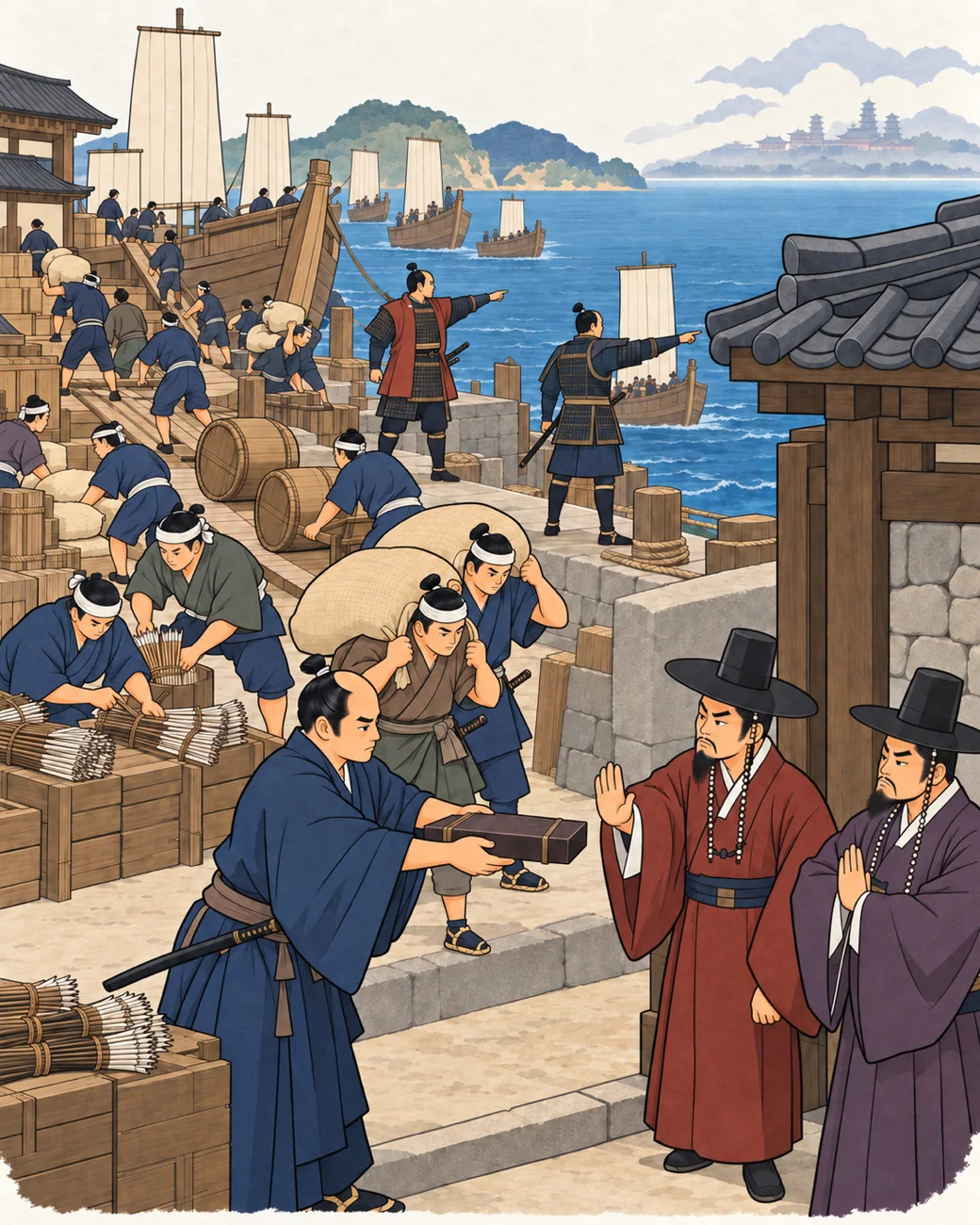
The first Japanese forces crossed from a vast base at Nagoya in Hizen—not the city in Owari—and captured Busan. Experienced armies carrying firearms advanced quickly along several routes. Seoul fell and the Joseon court retreated north.
Speed created the appearance of collapse, but occupation demanded garrisons, food, communication, and political cooperation. Joseon was not an empty corridor. Officials, local forces, monks, and civilian righteous armies reorganized resistance according to regional conditions.
Admiral Yi Sun-sin's fleets won major engagements and constrained Japanese maritime operations. Popular accounts sometimes claim that he single-handedly cut every supply route or exercised continuous total sea control. His documented impact is strong without that absolute claim.
Ming intervention changed the scale. Chinese forces and supplies entered Korea, and fighting around Pyongyang and elsewhere pushed Japanese positions south. Disease, winter, terrain, distance, and contested transport compounded military pressure.
Hideyoshi remained in Japan. He planned to cross at points and issued regulations for overseas forces, but personal absence separated his expectations from conditions reported through competing commanders and negotiators.
By 1593 most Japanese forces contracted toward southern positions and negotiations began. Konishi Yukinaga, Ming envoys, and others constructed messages each side might accept. The Ming court treated Hideyoshi through investiture as “king of Japan,” while his own demands imagined major concessions and recognition of conquest.
The documentary collision in 1596 exposed the mismatch. No settlement had given Hideyoshi the continental order he claimed. Rather than accept failure, he ordered a second invasion.
The 1597 campaign pursued more limited territorial operations in practice but produced extreme violence. Orders and reward systems encouraged proof of killing. Noses were salted and sent from Korea; the mound in Kyoto known as Mimizuka preserves the material afterlife of that policy.
The stated distinction between enemy soldiers and noncombatants did not protect civilian populations reliably. Siege, reprisal, famine, abduction, and the evidentiary economy of body parts made mass abuse foreseeable. Exact numbers should be source-labeled, not used to minimize or inflate.
Korean potters, artisans, scholars, and other captives were taken to Japan. Their later contributions to ceramics and knowledge cannot turn forced displacement into cultural exchange. Benefit to Japanese domains followed coercion.
Japanese soldiers and transport workers also bore prolonged service, disease, hunger, and separation. Daimyō paid enormous costs and acquired conflicting interests in withdrawal, negotiation, or honor. Their hardship does not balance away invasion responsibility.
Explaining the war through Hideyoshi's aging mind alone is inadequate. Personal ambition and declining judgment may matter, but the policy also promised new land, status, continental prestige, and continued mobilization for a warrior coalition. Institutions executed it for six years.
The war ended only after Hideyoshi's death, when Japanese leaders organized withdrawal amid continuing battles. Its failure left no overseas domain commensurate with the devastation. A rigorous biography must judge the ruler not only by what his state could coordinate at home but by what he chose to make that capacity do abroad.
Dynastic weakness did not begin with Hideyori's birth. Hideyoshi and Nene had no surviving biological child together. Adoption, nephews, siblings, and marriage therefore supplied the family structure of an upwardly created house.
Hidenaga had been the most important adult relative in campaigns and government. His death in 1591 removed a mediator and commander whose loyalty rested on brotherhood as well as reward.
Tsurumatsu, Hideyoshi's small son by Yodo-dono, also died that year. The loss reopened the question of who could inherit a regime centered on one man's new court identity.
Hidetsugu was not selected from nowhere. He was Hideyoshi's sister's son, had held commands and domains, and could continue the family through collateral kinship. His military record at Komaki included failure, but he later governed and cultivated scholarship and ceremony.
Hideyoshi transferred the kanpaku office to him in 1591. Retiring as Taikō did not mean surrendering supreme power. The arrangement created a dual structure: an active regent with court functions under the continuing authority of the founder.
This could have offered succession training. It also created separate residences, lands, officers, and information channels. An adult heir with an institutional base cannot remain only a placeholder if the founder later produces a son.
Hideyori's birth in 1593 changed expectations. Yodo-dono, or Chacha, descended from Oichi and Azai Nagamasa. The child joined Hideyoshi's constructed Toyotomi identity to celebrated Oda-Azai lineage.
Maternal status mattered, but no evidence allows Yodo-dono to be made sole author of the purge. Hideyoshi held supreme authority, issued the consequential orders, and bore responsibility for their effects.
In 1595 Hidetsugu was accused of disloyalty or a plot. Surviving sources do not provide a complete transparent prosecution file. His removal to Mount Kōya and death are secure; whether every alleged offense preceded the decision or rationalized it remains debated.
Later narratives called him the “killing kanpaku” and accumulated stories of arbitrary cruelty. Such character assassination made his destruction appear necessary. Modern biography must evaluate those claims independently rather than using a victor's purge as evidence of guilt.
The treatment of his household is less ambiguous. Women, children, partners, and dependents were taken to Kyoto and executed publicly at the Sanjō riverbank. They could not all possess equal agency in any alleged conspiracy.
Collective killing served succession by extinguishing alternative descendants and terrifying potential supporters. It also alienated families connected to the victims and demonstrated that proximity to the Toyotomi house offered no procedural security.
Jurakudai, once a stage for imperial recognition, was dismantled or dispersed in the aftermath. Place and architecture were punished along with the person, erasing an alternative court center.
Hideyoshi then demanded new oaths to Hideyori. The regime began planning councils of great lords and administrative officers around a child. These measures acknowledged that exclusive blood claim could not govern alone.
The purge therefore solved one narrow problem and worsened a larger one. Hideyori no longer faced an adult Toyotomi cousin in office. He also lost a regent-age protector, a collateral branch, and the experience of an orderly transfer.
The Classic layer must preserve agency and uncertainty in proportion. Hidetsugu's exact intentions remain unresolved. Hideyoshi's responsibility for removal and household massacre is strong. The political explanation does not excuse the atrocity; it shows how a dynasty's fear of alternatives made its future more brittle.
Hideyoshi's final years combined illness, overseas war, monumental construction, and succession anxiety. The government still issued orders and gathered information, but more decisions depended on officers interpreting the will of an increasingly unavailable ruler.
Hideyori was the dynastic center after the Hidetsugu purge. His mother Yodo-dono controlled an essential maternal residence; Nene, as Kita no Mandokoro and later Kōdai-in, held another network of rank, kin, and former retainers. Neither woman can be reduced to the stock opposition of ambitious mother and virtuous widow.
From 1595 and especially near 1598, Hideyoshi required sworn commitments to Hideyori. Great territorial lords including Ieyasu, Toshiie, Mōri Terumoto, Uesugi Kagekatsu, and Ukita Hideie occupied one layer of responsibility; administrative figures including Ishida Mitsunari, Maeda Gen'i, Asano Nagamasa, Mashita Nagamori, and Natsuka Masaie occupied another.
Historical interpretation · How fixed were the two councils?
The names Five Elders and Five Commissioners summarize the late succession arrangements. Tani Tetsuya’s research follows the officials’ work rather than starting from those labels. His reconstruction shows accounting responsibilities passing through changing groups before Hideyoshi’s death; the oath of 1595 reflected an existing practice rather than creating all of it at once. [3]
The arrangements of 1598 did not create an administration from nothing. Earlier working relationships and changing assignments help explain how government continued, while the familiar council names can conceal that development. [3]
Their functions differed. Great daimyō supplied military balance and public guarantee. Administrative officers handled documents, accounts, cities, religious institutions, and communication. Some people were also daimyō with their own lands; bureaucrat and territorial lord were not exclusive identities.
Maeda Toshiie offered prestige, military weight, and personal ties to many Toyotomi retainers. Ieyasu possessed the greatest independent territorial base and senior court status. Asking these men to balance one another admitted that no central Toyotomi army independent of them could enforce every rule.
Hideyoshi died at Fushimi on the eighteenth day of the eighth month in 1598. Later accounts transmit final appeals and poetry. The record supports repeated concern for Hideyori more securely than any verbatim deathbed scene. No first-person reconstruction belongs in his final consciousness.
For a time, government continued. Orders were issued, Hideyori remained the formal center, and the overseas withdrawal was coordinated. Collapse was not instantaneous.
Withdrawal from Korea reveals both capacity and failure. Commanders organized evacuation from fortified southern positions while Joseon and Ming forces attacked. Hideyoshi's death allowed leaders to end a war whose declared objective had not been achieved.
Toshiie's death in 1599 altered the balance. Conflict among Ieyasu, Mitsunari, other officers, and military lords intensified. Private marriage alliances and adjudications became constitutional disputes because the founder was no longer present to decide whose interpretation controlled.
Sekigahara in 1600 arose from that dynamic and from the Uesugi crisis, mobilizations, and competing coalitions. It should not be described as Toyotomi versus Tokugawa in a simple family war; actors on both sides invoked Hideyori or the preservation of order.
Ieyasu's victory reduced hostile houses while leaving Hideyori at Ōsaka with great wealth and symbolic status. The Toyotomi house survived another fifteen years. That duration disproves an automatic 1598 collapse while revealing the unresolved duality between Tokugawa government and Toyotomi dynasty.
The 1614–15 Ōsaka campaigns destroyed the house's independent military future. This outcome was not known to Hideyoshi, but the absence of an adult collateral branch and the concentration of followers around a child contributed to structural weakness.
Memory developed through competing institutions. Nene founded Kōdai-ji in 1606 to memorialize Hideyoshi, with Tokugawa assistance—evidence that commemoration and political accommodation could coexist. The Toyokuni cult elevated him after death, was curtailed after Tokugawa victory, and was revived publicly under the Meiji state.
Meiji-era and school narratives found power in the poor boy who unified the realm and used imperial office. The Korea invasions could be celebrated in expansionist frameworks, criticized as destructive ambition, or euphemized. Buddhist, Korean, and local memories preserved different costs.
The pre-1912 judgment therefore remains plural. Hideyoshi built unprecedented mechanisms of territorial comparison, daimyō hierarchy, public peace, and mobilization. He also ordered sieges by starvation, status coercion, household massacre, religious restriction, and a catastrophic foreign invasion.
His succession arrangements were not foolish because they failed later; they were constrained attempts to protect an underage heir using the available great powers. Their weakness was that those guarantors were also the only actors capable of revising the settlement by force. Hideyoshi's personal regime had national reach, but it never solved how authority of that reach would reproduce itself without him.