HO Guides
Shizugatake: An Army Remembered through Seven Names
Orders kept men behind earthworks. Commendations celebrated men who went forward. Between them lies a campaign larger than its famous roll of honor.
Quick · About 2 min
The story in five points
A short route through the argument. Follow a point into Classic for its context and sources.
Seven names belonged to a larger army
Shizugatake's 1583 campaign occupied roughly twenty principal fortifications across more than ten kilometres. Hideyoshi even ordered Hidenaga's men not to cross a ditch for grass cutting: service involved holding positions before celebrated advances.
Read in contextA return required food and people
After Ōiwayama fell during Hideyoshi's absence, his return changed the fighting. The early Shibata taijiki includes villagers supplying rice, placing noncombatant work beside heroic exploits, although its celebratory narrative is not a measured logistical record.
Read in contextAn early account named nine
Ōmura's narrative recognized nine men, including Hidenaga's attendant and a dead warrior whose brother inherited the reward. Replacing seven with nine still would not enumerate all service; selection gave particular deeds names and continuing consequences.
Read in contextRecognition acquired territorial value
Surviving grants to Wakisaka and Hirano each awarded land assessed at three thousand koku. This measured productive yield, not immediately delivered rice. Documents sustained particular households and relationships beyond the battlefield without proving identical rewards for everyone.
Read in contextAn old deed could matter again
After Hirano's holdings fell to one thousand koku, a 1595 award invoked Shizugatake and raised the total to five thousand. Later screens highlighted the Seven Spears, while earthworks and memorials retained other participants and phases.
Read in context
Opening
Early in the fourth month of 1583, Hashiba Hideyoshi sent his younger brother Hidenaga an order about the army confronting Shibata Katsuie in northern Ōmi. Nobody was to go beyond the defensive ditch—not even to cut grass. Historian Owada Tetsuo cites the instruction from a letter preserved at Nagahama Castle Historical Museum.[1]
It is an arresting instruction from a campaign remembered for men advancing with spears. The Seven Spears of Shizugatake—the conventional name for seven warriors singled out for their fighting—became a celebrated group among Hideyoshi's followers. Yet the army that made their actions possible had first occupied a succession of fortified hills, with different contingents responsible for different positions. At one stage, service required remaining inside a boundary; at another, an early attack earned particular recognition.
The surviving battlefield and its documents preserve both kinds of activity. Read together, they explain what the familiar seven names illuminate, what they leave outside the frame, and how a deed at Shizugatake could continue to matter long after the army had gone.
1. The Campaign Had More Than One Front Door
The confrontation followed Oda Nobunaga's death in 1582. Nobunaga had brought extensive territories under his authority; Hideyoshi and Katsuie had both served him. The settlement after his death recognized his young grandson Sanpōshi as head of the Oda house and redistributed territories among its leading men. Hideyoshi relinquished northern Ōmi and Nagahama Castle to the Shibata side, then recovered Nagahama before the year's end. Possession of this district was already part of the struggle before the fighting associated with Shizugatake began.[2]
Ōmi surrounded Lake Biwa in central Japan. At its northern end, Lake Yogo lay among hills along the approaches toward Echizen, Katsuie's base to the north. Shizugatake rose between the two lakes. Its name now identifies the battle, but the occupied ground extended well beyond that ridge.
Nagahama's heritage study describes roughly twenty principal fortifications spread over more than ten kilometres. Hideyoshi's positions ran from the southern side of Lake Yogo toward Tagami-yama; Katsuie's extended northward toward Genbao Castle. Earth banks, ditches, and enclosed or flattened ground survive across the group. Their value lies partly in their belonging to the same relatively brief confrontation.[3]
A line of names on a map can conceal the work of occupying those places. Each position needed people to hold it; an army distributed among hills needed ways to keep its separate contingents within a common plan. The earthworks supplied boundaries that orders could refer to. Hidenaga's instruction concerned precisely such a boundary: the ditch outside which men were not to wander.
The restriction reached an ordinary task, grass cutting. Its inclusion is revealing without requiring an invented account of the camp's daily routine. Activities that took people beyond the defenses came within the commander's concern even when they were not attacks. The army's presence could be regulated at the level of a small departure from an enclosure.
This is the setting in which to place the later spear fighters. They belonged to forces already organized around held positions. A celebrated advance was one kind of action within that organization, not a complete description of how the army spent the campaign.
2. When Holding Ground Became a Different Task
In the fourth month, Hideyoshi went toward Ōgaki in Mino to confront Oda Nobutaka, another participant in the struggle. While he was away, Sakuma Morimasa's Shibata force attacked Nakagawa Kiyohide's position at Ōiwayama. Kiyohide was killed; Takayama Ukon's neighboring force withdrew. Hideyoshi returned, and the subsequent fighting ended in the defeat of Katsuie's army.[4]
The change began at a particular part of the fortified system. Ōiwayama was a defended position with an assigned commander, not simply a place where two moving armies happened to meet. Its loss altered the situation for forces elsewhere. Hideyoshi's return joined men coming back from another front to those who had remained around the lakes.
An early narrative makes the practical consequences especially vivid. In the Shibata taijiki, an account composed by Ōmura Yūko in 1583, the returning troops are followed by an appeal to nearby villages. Hideyoshi asks households to prepare rice and bring it to Kinomoto, promising that their contribution will be remembered in rewards. The author presents the villagers' response as part of what allowed the troops to resume fighting.[5]
Ōmura's work celebrates Hideyoshi, and its account of an extraordinary return march should not be mistaken for a measured transport log. The rice passage nevertheless shows what the narrative itself had to include before reaching the celebrated attacks: returning men required provisions, and those provisions had to come from people outside the military ranks.
The request belongs to the local geography. Kinomoto lay at the southern end of the campaign's fortified zone, where the narrative brings the returning army. Villages appear as places from which food could be gathered toward that concentration. The story gives them an assignment in the operation without naming a village household among its spear-bearing heroes.
That difference will recur in the records of victory. Participation could take several forms, but the accounts did not preserve them with equal specificity. A request addressed to households and a commendation addressed to one warrior create different kinds of record, even when both refer to service in the same campaign.
3. Nine Men in an Early Account
Near the end of his battle narrative, Ōmura names nine men for particular recognition. The group includes the names later gathered as the Seven Spears, along with Sakurai Sakichi and Ishiko Hyōsuke. Sakurai is identified as an attendant of Hidenaga. Ishiko had been killed; the account says his younger brother inherited the reward.[6]
Those two additions do more than complicate a count. Hidenaga's attendant belongs to a different immediate household from Hideyoshi's own men. The dead warrior's reward passes to someone who survives him. The named group thus extends across both household affiliation and the boundary between a fighter's action and its benefit to his family.
Replacing seven with nine as a new definitive roster would miss the point. Ōmura selected men for a passage about exceptional deeds; he did not enumerate everyone whose work contributed to the army's victory. The villages in his preceding account do not disappear because they lack places in this list. Nor do the commanders who had held the fortified positions become unnecessary once the prose turns to personal exploits.
The narrative also supplies a specimen of the commendation language. It associates an early arrival and spear fighting in Hideyoshi's presence with a grant of land. It then turns toward the future: further loyal service may receive further consideration.[7]
The document as presented does two jobs. It recognizes an action already performed and leaves open a continuing relationship between the person granting land and the person receiving it. The battlefield is where the deed acquires its stated occasion. The written recognition gives that occasion a place in dealings that can continue elsewhere.
Ōmura's specimen is not nine individually preserved letters. It even accommodates different grant amounts within its wording. Its significance lies in how a writer close in time to the battle explains recognition: named service, an acknowledged observer, a material award, and an expectation extending beyond the completed engagement.
This is a more particular relationship than a modern honor roll. A name could be attached to a past exploit while the terms surrounding that name remained active. Two surviving grants allow the process to be followed beyond the narrative's generalized example.
4. Giving the Deed a Territorial Value
A document addressed to Wakisaka Yasuharu bears the date of the fifth day of the sixth month of 1583. Nagahama Castle Historical Museum identifies it as Hideyoshi's grant of territory assessed at three thousand koku for Wakisaka's service at Shizugatake. A separate document to Hirano Nagayasu carries the same date and grants the same assessed amount.[8][9]
The unit requires explanation. A koku was a measure of rice, but in a territorial grant it expressed an assessment of productive yield. Three thousand koku did not mean that three thousand units of harvested rice were immediately placed before the recipient. The grant concerned an entitlement attached to land and its resources.[10]
That distinction connects the battlefield to a future household. A commendation could state that a man had served well; a territorial award also assigned resources through which his position could be sustained. Fighting at Shizugatake acquired consequences in places beyond the ground on which the fighting occurred.
The two documents establish this relationship for particular recipients. They do not need to be treated as evidence that every distinguished soldier received an identical award. Nor does their shared date establish a single ceremony at which the grants were handed out. What survives is sufficiently concrete: separately addressed recognition, the battle named as its occasion, and territory specified through an assessed quantity.
The comparison with Ōmura's specimen is instructive. His narrative presents a model letter dated in the following month, while these individual grants bear an earlier date. The specimen conveys a form of acknowledgment; the surviving objects fix separate acts of acknowledgment to their own recipients and dates.[7][8][9]
The place of Hirano's initial award also matters. Tawaramoto's cultural-property account explicitly says that the land granted in 1583 was not the territory he later held around Tawaramoto. The familiar association between a family and a later domain cannot simply be projected back onto its first battle reward.
To follow the material result of Shizugatake, one must therefore allow time between the deed and the map of holdings it eventually helped produce. The battlefield supplied an enduring reference, but the terms and location of the recipient's position could change.
5. The Same Battle Could Be Invoked Again
Hirano's second document makes that change unusually clear. His holding had been reduced to one thousand koku. In 1595, during the comprehensive land survey of Yamato, Hideyoshi again acknowledged his earlier service at Shizugatake and added four thousand koku, bringing the total to five thousand.[11]
The arithmetic is important. This was neither uninterrupted possession of the original three-thousand-koku award nor a fresh grant of five thousand on top of it. A reduction intervened; the later award increased the smaller holding. The commendation recalled an old battle under changed circumstances.
The second document referred to a separate schedule of lands. The original schedule is lost, but a surviving copy lists villages in Yamato, including Tawaramoto. Here the connection with that town belongs to the 1595 settlement, not automatically to the fighting twelve years earlier.[11]
These papers give the phrase “rewarded at Shizugatake” a history rather than a single meaning. There was the service in the battle, the first acknowledgment, a subsequent reduction, and a renewed acknowledgment coupled with a different territorial arrangement. The early deed remained available as a stated reason for a later award, even though it had not protected its beneficiary from every intervening change.
This is also where the commemorative name and the legal document part company. Membership of the Seven Spears preserves a stable association with the battle. The documents record a position whose assessed resources changed. The name makes a career easy to recognize; the papers reveal why recognition alone cannot describe its material course.
Following Hirano briefly away from Lake Yogo is therefore necessary to understand what happened there. The battlefield did not have to be fought again to become consequential again. A dated reference to its service could enter a new act of granting land. The place endured inside the document as the location of an acknowledged deed.
6. A Screen Chooses Its Moments
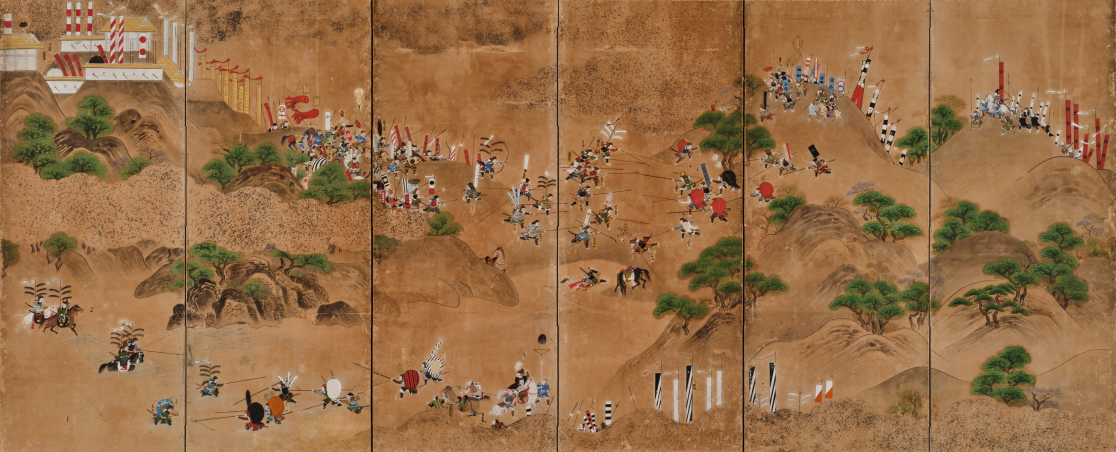
A pair of eighteenth-century folding screens at Nagahama Castle Historical Museum gives the campaign a different shape. The museum's catalog identifies two successive episodes. One screen depicts the attack on Ōiwayama on the twentieth day of the fourth month. The other presents the following day's pursuit, with the Seven Spears prominent in the action. The earlier episode includes Genbao, the northern Shibata headquarters.[12]
This arrangement does not compress the campaign into one instant. It gives the viewer an earlier loss and a later reversal. The positions around the lakes remain part of the story, but they are selected and arranged around moments that can carry recognizable action.
In the reproduced pursuit screen, gold clouds separate groups of figures and pieces of terrain. Fighting and movement occupy different stretches of the painted surface. The viewer is allowed to see an ensemble that no participant could have occupied as a single viewpoint.[13]
That is a pictorial resource, not a defect requiring the work to be discarded. A screen can bring separate actions into relation while giving selected figures enough prominence to be found. Its spatial arrangement serves the story being shown. It cannot be substituted for a measured plan of the surviving earthworks.
The contrast with the grant is equally useful. The letter gives a named recipient a dated entitlement; the screen gives named actions places within a visible battle. Both carry the event beyond its original ground, but they equip it for different uses. One could be retained as part of a household's documentary history. The other made episodes available to people who had no part in the award.
The museum dates the screens well after 1583. Their seven-name emphasis consequently belongs to the battle's later representation, while Ōmura's nine-name passage belongs to a much earlier account. Reading the works together preserves that difference without requiring a claim about the exact moment when the familiar seven became the dominant grouping.
7. The Ground around the Names
The surviving landscape keeps the account from ending with the successful recipients. Nagahama's inventory includes the Ōiwayama position and Nakagawa Kiyohide's grave, the lakeside place associated with the Seven Spears, and graves of the Menju brothers on the Shibata side. Fortifications and memorials belong to the same distributed historical area, but retain different subjects.[14]
At Ōiwayama, a named death returns attention to the position whose loss helped change the campaign. Across the wider network, banks and ditches preserve the framework within which many men served without appearing in a short list. Around the lake, later commemorative places attach particular names to that much larger ground.
None of these forms needs to cancel the others. The Seven Spears make selected men recognizable. The letters explain what particular recognition could confer. The early narrative includes additional names and services. The earthworks restore the campaign's held positions, whose requirements could include an order not to step outside a ditch.
Shizugatake's victory involved a change in what men were required to do: hold, remain, return, supply, attack, pursue. Its records then selected different parts of those activities for instruction, acknowledgment, and remembrance. The famous names become more informative when placed within that changing work, rather than asked to stand for the entire army.
Next topic · HO Guides
The Takeda Sites: What Conquest Left in Use
A residence changed hands, a burned castle became usable ground, and a place of defeat acquired a temple. The dynasty's ending did not give all its sites the same future.
Continue readingSources and NotesView sourcesHide sources
Sources were consulted on 16 September 2026. Numbered-month dates retain the Japanese calendar of the documents, rather than being converted into Gregorian April, June, July, or August. The early narrative is read through a transcription of a public-domain printed edition; individual grants are used through their custodians' descriptions. The argument compares documented forms of service and remembrance. It does not establish an exhaustive merit list, the original coining of “Seven Spears,” or an exact timetable of the battle.
- [1]
Owada Tetsuo, “戦国10大合戦と城 第4回 賤ヶ岳の戦い,” Shirobito, 20 July 2022, paragraph beginning “秀吉は3月17日に木之本に到着し.” The paragraph quotes Hideyoshi's fourth-month, third-day letter to Hidenaga and identifies Nagahama Castle Historical Museum as custodian. The paraphrase retains the explicit prohibition on going beyond the ditch, including grass cutting; the original manuscript was not independently deciphered. https://shirobito.jp/article/1603
Return to the reference ↑ - [2]
Owada, same article, “戦いは秀吉の長浜城攻めからはじまる,” opening two paragraphs. Used for the succession settlement, territorial transfer, and recovery of Nagahama, not its troop totals, reconstructed motives, or character praise. https://shirobito.jp/article/1603
Return to the reference ↑ - [3]
Nagahama City, 長浜市歴史文化基本構想, chapter 4, “エリア③ 賤ヶ岳城砦群と古戦場,” printed pp. 73–74 (PDF pp. 10–11). The approximately twenty principal forts and greater-than-ten-kilometre extent describe the wider group, not the number of separately listed rows in the accompanying inventory. The modern distribution map is used for broad relationships, not precise 1583 deployment. https://www.city.nagahama.lg.jp/cmsfiles/contents/0000008/8691/4s2-1.pdf
Return to the reference ↑ - [4]
Owada, same article, “大岩山砦の陥落と秀吉の『美濃大返し』” and the subsequent return-and-battle discussion. Only the Ōgaki absence, Ōiwayama assault, Kiyohide's death, Ukon's withdrawal, return, and broad result are retained; no exact march duration, reconstructed warning, or private motive is asserted. https://shirobito.jp/article/1603
Return to the reference ↑ - [5]
Ōmura Yūko, Shibata taijiki (柴田退治記), 1583, passage beginning “依之相随無運粮,” through the village provisioning and Kinomoto response. Read in Wikisource's transcription, which identifies its base editions, including Zoku gunsho ruijū, vol. 20, lower part, 1923. This public-domain narrative reports a rice request and promised acknowledgment; its praise, exact speed, quantities delivered, and claim about villagers' feelings are not adopted as independently verified facts. The linked National Diet Library edition viewer did not provide readable page images, so no collation against that scan is claimed. https://ja.wikisource.org/wiki/柴田退治記
Return to the reference ↑ - [6]
Ōmura, same work, concluding reward passage beginning “今度柳瀬表秀吉所切崩之一番鑓者,” including the nine named men, “桜井左吉 秀長近習也,” and the note concerning “石河兵助” and his younger brother. Owada's discussion supplies the modern reading Ishiko Hyōsuke. The essay does not recast the narrative list as an exhaustive official roster or an evaluative ranking of all participants. https://ja.wikisource.org/wiki/柴田退治記 ; https://shirobito.jp/article/1603
Return to the reference ↑ - [7]
Ōmura, same reward passage and the embedded specimen commendation, from the reference to early arrival and spear service in Hideyoshi's presence through the promise concerning future service and the seventh-month, first-day date. The variable grant amounts and generalized presentation are distinguished from individually surviving documents; the specimen's wording is not attributed verbatim to the Wakisaka or Hirano originals. https://ja.wikisource.org/wiki/柴田退治記
Return to the reference ↑ - [8]
Nagahama Castle Historical Museum, exhibition “秀吉、秀長と天下を支えた近江衆―長浜ゆかりの武将と奉行―,” object “羽柴秀吉判物 脇坂安治宛,” dated Tenshō 11, sixth month, fifth day, private collection. The cursive text was not independently transcribed. Used for the recipient, date, battle service, and three-thousand-koku territorial grant. https://nagahama-rekihaku.jp/exhibit/607
Return to the reference ↑ - [9]
Tawaramoto Town, “平野権平(長泰)宛豊臣秀吉感状,” description of document 1 and the object list. Gives the 1583 grant, its three-thousand-koku assessment, the sixth-month, fifth-day date, and the explicit warning that these were not the later Tawaramoto-area lands. The original document image was not successfully inspected; these details follow the municipal catalog. https://www.town.tawaramoto.nara.jp/soshki/kyouikuiinkai/bunkashinko/bunkazai/kanko/bunkazai/shitei/1214.html
Return to the reference ↑ - [10]
Hikone Castle Museum, “歴史質問箱,” explanation distinguishing territorial kokudaka from actual tribute receipts. Used only for the general distinction between assessed yield and rice received, not to project Hikone's later tax rate or administrative arrangements onto Hideyoshi's 1583 grants. https://hikone-castle-museum.jp/history/faq.php
Return to the reference ↑ - [11]
Tawaramoto Town, same page, paragraph beginning “権平は、その後,” and object 2, dated Bunroku 4, eighth month, seventeenth day. A four-thousand-koku increase brought an existing one-thousand-koku holding to five thousand. The accompanying land schedule survives in copy, not as the original referenced enclosure. The cause of the intervening loss of favor is not reconstructed. https://www.town.tawaramoto.nara.jp/soshki/kyouikuiinkai/bunkashinko/bunkazai/kanko/bunkazai/shitei/1214.html
Return to the reference ↑ - [12]
Nagahama Castle Historical Museum, digital collection, “賤ヶ岳合戦図屏風,” accession A34. It dates the pair to the eighteenth century and identifies the two episodes and Genbao's depiction. The left-hand screen's details are reported from this catalog, not independently read from a high-resolution image. https://nagahama-rekihaku.jp/digital-museum/32
Return to the reference ↑ - [13]
Nagahama Castle Historical Museum, reproduction of the Shizugatake battle screen on its history presentation. Only broad compositional features—gold clouds, separated terrain, groups, and movement—are described, not small names, precise deployment, or measurements. https://nagahama-rekihaku.jp/sites/default/files/inline-images/sengoku-nagahama.png
Return to the reference ↑ - [14]
Nagahama City, cultural-property plan, printed pp. 73–74, the fort-and-memorial inventory and map. The listed Ōiwayama grave, Seven Spears site, and 毛受兄弟の墓 are distinct components, not proof that all present markers stand exactly where their subjects fought. The article makes no current access or trail-continuity claim. https://www.city.nagahama.lg.jp/cmsfiles/contents/0000008/8691/4s2-1.pdf
Return to the reference ↑