HO Guides
Komaki–Nagakute: A Base to Come Back To
A well disappeared beneath a new defensive bank. The change helps explain how an abandoned residence became a base for a mobile campaign—and why a victory away from it did not end the war.
Quick · About 2 min
The story in five points
A short route through the argument. Follow a point into Classic for its context and sources.
A reused castle became a base
In 1584 Ieyasu and Nobukatsu refortified Nobunaga's former Komaki-yama castle against Hideyoshi. Banks buried earlier residential features while many upper enclosures changed little. The objective was a usable headquarters, not restoration of Nobunaga's household.
Read in contextDefenses had to permit movement
Banks, outer ditches and controlled entrances formed an extensive perimeter. Connected forts and repaired castles extended the system beyond the hill, allowing an army to hold its base while operating through positions elsewhere.
Read in contextThe standoff produced a moving operation
A substantial Hideyoshi-side force marched toward Okazaki behind Ieyasu's position. Ieyasu moved through Obata to intercept it. Neither commander had committed his entire army, so the coming battle could not settle both headquarters' fate.
Read in contextSeparate engagements had different results
Ikeda's troops captured Iwasaki, the rear force lost at Hakusanbayashi, and Hori repulsed pursuers before withdrawing. The main Nagakute engagement killed Ikeda and Mori commanders; the expedition failed through connected local encounters, not uninterrupted Tokugawa success.
Read in contextVictory left the campaign unfinished
Ieyasu returned to Komaki while Hideyoshi's main force remained. Warfare continued elsewhere until Nobukatsu reached agreement with Hideyoshi under territorial pressure. A failed expedition, surviving bases and a negotiated settlement belonged to different scales of outcome.
Read in context
Opening
At the foot of Komaki-yama, archaeologists found a well beneath the earth piled into a defensive bank. The well belonged to the residential establishment associated with Oda Nobunaga's castle. The bank belonged to the later refortification of the hill. Something useful to an earlier household had been covered by something useful to an army.[1]
The army came in 1584, when Tokugawa Ieyasu and Oda Nobukatsu made the old castle their headquarters against Hashiba Hideyoshi, the man later known as Toyotomi Hideyoshi. Ieyasu subsequently left this position, defeated part of Hideyoshi's forces at Nagakute, and returned to Komaki-yama. Hideyoshi's main army remained in the field.[2]
Those events belong to a single campaign but to different landscapes. Komaki preserves the fortified base; Nagakute preserves fragments of the fighting that developed when armies moved away from the opposing camps. Following the connection explains a result that can otherwise sound contradictory: a battle won, a headquarters reoccupied, and a war still continuing.
1. Reusing a Hill without Restoring Its Castle
Nobunaga established his castle on Komaki-yama in 1563 and moved to Gifu four years later. His residence belonged to an earlier phase in the expansion of his authority across central Japan. By 1584, Nobunaga himself was dead, killed at Honnō-ji in 1582, and men who had served him were fighting over the order that followed.[3]
Nobukatsu, one of his sons, held Owari, the province around present-day Nagoya, and joined forces with Ieyasu against Hideyoshi. The capture of Inuyama Castle by Hideyoshi's side brought an enemy strongpoint into northern Owari. Nobukatsu and Ieyasu established their headquarters on Komaki-yama, while Hideyoshi used Gakuden farther north. Fortifications developed around both positions.[4]
Komaki-yama offered more than height. The former castle had terraces, approaches, and the remains of a developed foothill establishment. Reusing it did not mean restoring that establishment to the condition in which Nobunaga had left it. The army needed a defended place from which to conduct the current campaign, not a complete revival of an earlier lord's residence.
The archaeological interpretation is correspondingly selective. Komaki City's account identifies extensive new banks and ditches around the foot, with additional work at approaches and across parts of the middle slope. Investigation of the upper areas suggests that many existing enclosures received little alteration. The refit strengthened particular boundaries and connections rather than remaking every terrace.[5]
This selection is the important fact behind the often-repeated account of remarkably rapid construction. The city's chronology places the principal works between the eighteenth and twenty-second days of the third month. That is the documented historical schedule adopted by the city, not a duration that can be independently measured from a bank of earth.[6]
What the surviving arrangement establishes more directly is the nature of the task. An army could obtain a usable base by changing the edges of an inherited site. The earth covering the earlier well belongs to that choice: the new boundary took precedence over preserving the old household's arrangement.
2. A Bank Had Two Heights
The earthworks around the lower hill enclosed broad strips of relatively level ground. At the eastern side, excavation recorded banks with ditches outside them and controlled entrances interrupting their course. Older divisions remained unevenly visible inside the new perimeter. Some earlier ditches survived as depressions; others, together with wells, were buried beneath the banks.[7]
A measurement from the investigation makes the defensive relationship especially clear. From the interior ground to the surviving crest, the bank stood about two and a half to three metres high. From the ditch bottom outside, the difference was estimated at about five and a half to six metres. These are reported measurements and estimates of the investigated remains, not proof of the complete original height everywhere around the hill.[7]
The same bank thus presented different problems on its two sides. Its effectiveness did not depend only on piling earth upward. Excavating the outside ground increased the difference an approaching person would have to negotiate, while the interior remained connected to the castle's occupied spaces. Bank, ditch, and inner ground formed one arrangement.
The entrances made that arrangement usable. At the entrance excavators label f, a substantial ditch reached into a space bordered by banks. The opening was on its southern side. This was a directed passage through a defended boundary, rather than a random gap in an otherwise continuous mound.[7]
Such passages mattered to an army that would move out again. Enclosure without access would have frustrated its own users. Access without control would have compromised the boundary. The rebuilding therefore concerned where people could enter and leave as well as the height of the obstacle confronting them.
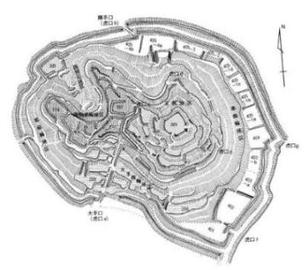
Komaki's published site plan shows these approaches in relation to the summit, lower terraces, and surrounding defenses. It does not identify the path taken by every unit, but it makes clear that the headquarters was an extensive hill-and-perimeter system.[8] The protected spaces below the summit belonged to its military usefulness. An army could assemble within the position without every man having to occupy the highest point.
3. The Headquarters Had Connections
The refortification did not stop at the foot of the hill. Ieyasu's side established a line of forts extending eastward and connected them with a military road. Hideyoshi's side created its own chain of positions north and east of Komaki. Banks linked some of those opposing forts as well. Neither army was simply waiting in an isolated camp.[5]
Taraga, at the eastern end of the Tokugawa line, gives that network a material history of its own. The fort was made by adapting a local warrior’s residence. It did not become a battlefield and ceased to serve its wartime role after a short period. Its plan was poorly recorded, leaving later investigators to work from surviving changes in level and limited traces below ground.[9]
A small excavation in 2023 found bank material and an outer ditch at the edge of a terrace. A grinding-bowl fragment in the bank dated to the later sixteenth century, consistent with the fort's construction period. The ditch, about 1.3 metres deep, lay above a cliff edge; its full width extended beyond the excavation. Together, cliff, ditch, and bank formed the southern boundary identified by the investigators.[9]
This was another adaptation of a place already occupied, but not a copy of Komaki. At the headquarters, an abandoned castle supplied the larger framework. At Taraga, a local residence supplied the starting point for a smaller fort. A chain of defenses could connect sites with different histories and different amounts of construction.
Its function also exceeded the record of fighting at each component. Taraga's not being assaulted does not make the road and position disappear from the campaign. The connected line offered places from which movement could be watched, opposed, or supported. Those are potential uses of the arrangement, not evidence that a particular convoy or messenger followed a route recovered in every detail.
Farther south, older castles at Obata and Hira were repaired as links toward Mikawa and Kiyosu. Komaki's chronology records that work before the movement toward Nagakute began.[6] This connection would become important when Ieyasu left the main position. The place where he next concentrated his forces was already part of the preparation for the campaign.
4. A March around the Standoff
In the fourth month, a large force from Hideyoshi's side moved toward Okazaki in Mikawa, one of Ieyasu's principal centers east of Owari. Its movement took it away from the camps around Komaki and into the country where the Nagakute fighting would develop. The operation addressed something the fortified standoff had left exposed: a headquarters could be held while places behind it remained targets.[10]
Nagakute City's revised account cautions against imagining a small, improvised secret raid. It points to advance construction, the scale of the force, and its pace of movement as evidence of a planned substantial operation. That interpretation does not require accepting the later story of an unwilling Hideyoshi being talked into the expedition by Ikeda Tsuneoki, one of its commanders.[10]
The distinction affects how the march is understood. A large moving force occupied a sequence of places. Its leading troops and its rear could meet different situations before all its components reached their objective. Detection did not have to wait until the entire force appeared in front of Okazaki.
Ieyasu learned of the movement and advanced to Obata Castle, from which a forward force and his main body pursued the opposing troops. The repaired connection south of Komaki had become an operating position in the mobile campaign.[11] The army was changing where it fought without abandoning the larger system from which it had come.
The approaching force likewise remained connected to the unfinished confrontation around Komaki. Hideyoshi had not moved his entire army toward Okazaki. His main position at Gakuden continued to exist while the detached force marched. Consequently, a battle involving that force would decide the immediate operation without necessarily deciding what happened to the army still behind it.
This is where the two halves of the Place begin to explain each other. Komaki's fortifications help account for the standoff from which the movement emerged. Nagakute's dispersed battle locations show what happened when a force sought an objective beyond that standoff. The terrain did not provide one arena into which everybody entered at once.
5. Several Engagements, Different Results
The fighting on the ninth day of the fourth month began with forces in different positions. The leading Ikeda troops attacked Iwasaki Castle, an Ieyasu-aligned strongpoint on their route, and captured it. Farther back, the force commanded by Hideyoshi's nephew, then known as Miyoshi Nobuyoshi, encountered the Tokugawa advance guard at Hakusanbayashi and was defeated.[11]
The outcomes were already diverging. Success against a castle at the front of the movement did not protect the rear. Nor did defeating the rear remove every other contingent from the road. At Hinokigane, Hori Hidemasa's troops took up ground and repulsed the pursuing Tokugawa forward force. Hori subsequently withdrew rather than carrying that local success through to the expedition's original objective.[12]
Keeping those encounters separate is more revealing than assigning the entire day one uninterrupted direction. The Tokugawa pursuit met resistance; part of Hideyoshi's force won an encounter while other parts were being defeated. The differences arose because units occupied different ground and reached it at different moments.
Ieyasu's main body continued into the Nagakute area. The main engagement developed after the Ikeda forces turned back from Iwasaki. Ikeda Tsuneoki, his son Motosuke, and Mori Nagayoshi were killed in the fighting. The operation toward Okazaki had failed.[13]
The protected landscape now consists of selected pieces of that wider ground. The national designation includes the principal battlefield, Mihata-yama, the Kubizuka memorial mound, and Iroganeyama. It does not preserve an unbroken corridor from Komaki or every position occupied during the day's engagements.[14]
Iroganeyama gives the dispersed field a vantage point. Tradition associates a large stone there with Ieyasu's use of the hill; monuments erected in 1706 and 1910 record later attention to that association. The elevation and its relation to the fighting ground can be understood without converting the stone into a verified record of a particular military conference.[15]
These surviving places retain different aspects of the encounter: positions associated with command, named deaths, and subsequent remembrance. Joined to the sequence of engagements, they recover an operation broken into local confrontations. Joined only to a single victory label, they would explain much less about why the column failed to reach its intended destination.
6. Returning Did Not Finish the Campaign
After Nagakute, Ieyasu returned through Obata to Komaki-yama. Hideyoshi moved out from Gakuden toward the fighting but did not bring Ieyasu's returning army into another main engagement. He went back to his own position. The two command centers survived the destruction of the detached force's operation.[16]
The return is the clearest link between the archaeological earthworks and the mobile battle. Komaki remained a position to reoccupy. The force that had left it did not have to make its defeated enemy's ground into a replacement headquarters. Its campaign still had an established base.
There is a limit to what that base explains. The ditches did not win the engagements at Nagakute by themselves, and their survival cannot demonstrate that every choice in the march was predetermined by a fortification plan. They show a capability that the course of events actually used: an army could leave the main position, operate through a repaired intermediate castle, and return.
The result also left the wider contest unresolved. Fighting continued in other parts of Owari and neighboring provinces. Komaki's chronology records the struggle for the Kanie group of castles in the sixth and seventh months, renewed movements later in the year, and unsuccessful peace discussions in the ninth month. The battle in the fourth month had not removed the remaining armies or settled possession of every contested castle.[17]
Nobukatsu's place in the coalition is important here. He was a territorial ruler with positions of his own to defend, not simply an additional commander under Ieyasu. By the eleventh month, Hideyoshi's forces were attacking in northern Ise, where Nobukatsu held Nagashima. Nobukatsu then reached an agreement with Hideyoshi, and the campaign ended. The agreement concerned a ruler under pressure in a different part of his territories from the ground won at Nagakute. It followed continued warfare and negotiation, rather than taking effect when the Ikeda force was defeated.[17]
The difference between battle and campaign is therefore concrete. At Nagakute, an expedition lost commanders and failed to reach its objective. Around Komaki, the opposing headquarters remained. Elsewhere, castles and territories continued to be contested. A result at the first scale changed the situation at the others without bringing them all to an end.
7. What the Two Landscapes Preserve
Komaki-yama's wartime position was not transformed into Ieyasu's permanent residence after the settlement. The castle was abandoned again. During the Edo period, the Owari domain restricted ordinary access to the hill and treated it as a site associated with Ieyasu's victory. Those restrictions helped preserve the earthworks that now reveal how the army had used it.[18]
That later protection gives the surviving evidence a particular shape. Komaki preserves much of the framework of a temporary headquarters; Nagakute preserves selected battle locations and memorials within a landscape that developed around them. The two places cannot be compressed into one intact field, but their separation is part of the history rather than an obstacle to it.
The distinction also prevents the fortified hill from becoming a symbol detached from action. Its perimeter was remade, its older residential ground was partly covered, and its connections extended into a network of other positions. Those preparations made a base that could be occupied while the campaign continued beyond it.
Nagakute shows both the reach and the limit of that arrangement. Ieyasu's army could intercept an operation directed toward his territory and then come back to Komaki. It did not thereby take Hideyoshi's headquarters or end the pressures on Nobukatsu's domains. The headquarters, the field victory, and the eventual agreement answered different problems. Reading their places together restores the steps between them.
Next topic · HO Guides
Nagashino–Shitaragahara: The Battle beyond the Gun Line
An army came to rescue a castle, then prepared to fight several kilometres away. Holding one position and attacking another were connected parts of the relief.
Continue readingSources and NotesView sourcesHide sources
Online material was consulted on 16 September 2026. Archaeological claims follow the municipalities' published investigation accounts; the complete excavation reports were not independently collated. The campaign sequence uses the specified institutional histories, with conflicting numbers, traditional age counts, reconstructed speeches, and unsupported private motives omitted. Dates expressed through numbered months retain the Japanese calendar of 1584. Broad operational inferences concern what the documented arrangement allowed, not a recovered master plan for every subsequent movement.
- [1]
Komaki City, “織田信長の小牧山城,” eastern foothill investigation, subsection “縄張り,” paragraph on the well found beneath bank fill in enclosure 405-1b during the 2000 investigation. The relative sequence supports burial of an earlier residential feature under the later works; the essay does not claim the well was still supplying water when it was covered. https://www.city.komaki.aichi.jp/admin/event_1/events/bunkazai/1/news/hakkutu/kuruwachikutoubu/13389.html
Return to the reference ↑ - [2]
Komaki City, “史跡小牧山の沿革 小牧・長久手の合戦,” opening historical account; Nagakute City, “長久手古戦場物語,” “和睦,” opening sentences on the return through Obata and Hideyoshi's movement from Gakuden. The opening's comparison concerns the two command centers after the battle, not a verdict about which political actor was the campaign's overall winner. https://www.city.komaki.aichi.jp/admin/soshiki/kyoiku/bunkazai/1_1/2/bunkazai/9152.html ; https://www.city.nagakute.lg.jp/soshiki/kurashibunkabu/bunkazaisupo-tuka/4/nagakutenorekisibunnka/3915.html
Return to the reference ↑ - [3]
Komaki City, “史跡小牧山概要版,” “歴史,” entries for 1563 and the move four years later; “‘小牧・長久手の合戦’関連年表,” 1582 entry. The hill's former residential role is distinguished from its later field-fortress use. https://www.city.komaki.aichi.jp/admin/event_1/events/bunkazai/1/news/gaiyou/13371.html ; https://www.city.komaki.aichi.jp/admin/soshiki/kyoiku/bunkazai/1_1/2/bunkazai/9161.html
Return to the reference ↑ - [4]
Komaki City, “小牧・長久手の合戦,” opening alliance and deployment paragraphs. Used for Nobukatsu's alliance, the Inuyama capture, and opposing headquarters, not the page's account of inner feelings, exact troop strengths, later succession shorthand, or an inevitable final confrontation. https://www.city.komaki.aichi.jp/admin/soshiki/kyoiku/bunkazai/1_1/2/bunkazai/9162.html
Return to the reference ↑ - [5]
Komaki City, “史跡小牧山の沿革 小牧・長久手の合戦,” paragraph beginning “このとき、家康軍の榊原,” followed by the description of the hill's zones; preceding historical paragraph on the two fort lines and connecting road. Selective modification of upper enclosures remains the city's archaeological interpretation. The relation between a usable perimeter and military occupation is a limited inference, not a numerical estimate of camp capacity. https://www.city.komaki.aichi.jp/admin/soshiki/kyoiku/bunkazai/1_1/2/bunkazai/9152.html
Return to the reference ↑ - [6]
Komaki City, “‘小牧・長久手の合戦’関連年表,” updated 26 June 2023, entries for the third month, days 18–29, particularly the Komaki works, repairs to Obata and Hira, and Taraga's military road. The compressed construction timetable is attributed to this chronology; no archaeological dating to individual days is asserted. https://www.city.komaki.aichi.jp/admin/soshiki/kyoiku/bunkazai/1_1/2/bunkazai/9161.html
Return to the reference ↑ - [7]
Komaki City, “小牧・長久手の合戦の陣城,” “縄張り” and “発掘概要,” especially the interior/exterior height comparison and entrance f with ditch SD01. Heights concern the reported surviving crest and investigated or estimated ditch profile, not a reconstruction of all original bank tops. The prose, rather than an independent transcription of small plan annotations, supplies the entrance relationship. https://www.city.komaki.aichi.jp/admin/soshiki/kyoiku/bunkazai/1_1/2/bunkazai/9154.html
Return to the reference ↑ - [8]
Komaki City, “小牧山城縄張図,” linked from the history page in note 5. Used for the overall relationship of summit, slope enclosures, perimeter, and approaches; no small labels, dimensions, or exact historical marching route were independently extracted. https://www.city.komaki.aichi.jp/material/images/group/53/73989895.jpg
Return to the reference ↑ - [9]
Kasugai City, “田楽遺跡確認調査,” updated 18 April 2024, investigation dates and complete results paragraphs for the September 2023 excavation. Supports residence conversion, the brief noncombat use, late-sixteenth-century ceramic in the bank, and the newly identified outer ditch by a cliff. The ten-square-metre investigation does not recover the entire fort; dating compatibility is not proof of an exact construction day. https://www.city.kasugai.lg.jp/bunka/bunkazai/sinaihakkutsu/1034403.html
Return to the reference ↑ - [10]
Nagakute City, “長久手古戦場物語,” section “岡崎進軍.” The revised interpretation draws on prior construction, scale, and pace, but this web account does not identify the underlying study; no independent reconstruction of that study or of Hideyoshi's private deliberations is claimed. The essay's argument requires a substantial moving force, not proof of a particular person's authorship of the plan. https://www.city.nagakute.lg.jp/soshiki/kurashibunkabu/bunkazaisupo-tuka/4/nagakutenorekisibunnka/3915.html
Return to the reference ↑ - [11]
Owariasahi City, “白山林の戦い,” updated 6 January 2026, sections “岡崎へ進軍開始” and “白山林の戦い”; compared with the Obata entry in Komaki's chronology. Used for Obata as the intermediate position and the separate Iwasaki and Hakusanbayashi engagements. Speeches, the nephew's exact age, breakfast, lost-horse, and rescue episodes are not needed for the account. https://www.city.owariasahi.lg.jp/page/10926.html ; https://www.city.komaki.aichi.jp/admin/soshiki/kyoiku/bunkazai/1_1/2/bunkazai/9161.html
Return to the reference ↑ - [12]
Owariasahi City, same page, “そして長久手での決戦へ,” first paragraph; Komaki City, “小牧・長久手の合戦,” Hinokigane paragraph. They agree on Hori's repulse of the forward force and subsequent withdrawal but frame the reason differently. The text preserves the action without choosing an unverified private calculation or repeating a precise casualty figure. https://www.city.owariasahi.lg.jp/page/10926.html ; https://www.city.komaki.aichi.jp/admin/soshiki/kyoiku/bunkazai/1_1/2/bunkazai/9162.html
Return to the reference ↑ - [13]
Nagakute City, “長久手古戦場物語,” “仏ケ根の決戦” and the entries for Ikeda Tsuneoki, Ikeda Motosuke, and Mori Nagayoshi. Used for the return from Iwasaki, main engagement, and named deaths, not the exact hour, reconstructed final charge, wound location, or complete deployment. https://www.city.nagakute.lg.jp/soshiki/kurashibunkabu/bunkazaisupo-tuka/4/nagakutenorekisibunnka/3915.html
Return to the reference ↑ - [14]
Agency for Cultural Affairs, National Designated Cultural Properties Database, “長久手古戦場 附 御旗山 首塚 色金山,” record 401/1439, designation fields and complete historical description. Used for the protected components and their different geographical and commemorative roles. The older description's personal-name variants and historical dimensions are not silently substituted for modern identifications. https://kunishitei.bunka.go.jp/heritage/detail/401/1439
Return to the reference ↑ - [15]
Nagakute City, “色金山歴史公園へようこそ,” section “色金山とは?”; compared with the Iroganeyama description in note 14. The natural stone's use by Ieyasu is transmitted tradition; 1706 and 1910 date commemorative inscriptions. Current tea-room access and museum opening announcements are outside the essay. https://www.city.nagakute.lg.jp/soshiki/kurashibunkabu/bunkazaisupo-tuka/4/iroganeyamarekisikouenn/1128.html
Return to the reference ↑ - [16]
Nagakute City, “長久手古戦場物語,” “和睦,” opening return sequence; Komaki City, “小牧・長久手の合戦,” paragraphs on the battle's immediate aftermath. The return to Komaki and Hideyoshi's return to Gakuden are retained without an exact hour or an invented subsequent engagement. https://www.city.nagakute.lg.jp/soshiki/kurashibunkabu/bunkazaisupo-tuka/4/nagakutenorekisibunnka/3915.html ; https://www.city.komaki.aichi.jp/admin/soshiki/kyoiku/bunkazai/1_1/2/bunkazai/9162.html
Return to the reference ↑ - [17]
Komaki City, “‘小牧・長久手の合戦’関連年表,” entries from the sixth through eleventh months, including Kanie, later military movements, failed negotiations, and the Nobukatsu–Hideyoshi agreement; Nagakute City, “長久手古戦場物語,” “和睦,” for the coalition's termination. Different municipal summaries compress the final withdrawals differently; no single exact date is assigned to all troops' departure or to Ieyasu's later formal subordination. No evaluative ranking of political outcomes is adopted. https://www.city.komaki.aichi.jp/admin/soshiki/kyoiku/bunkazai/1_1/2/bunkazai/9161.html ; https://www.city.nagakute.lg.jp/soshiki/kurashibunkabu/bunkazaisupo-tuka/4/nagakutenorekisibunnka/3915.html
Return to the reference ↑ - [18]
Komaki City, “史跡小牧山概要版,” “歴史,” entries for the postcampaign abandonment and Edo-period restrictions. The association with Ieyasu's victory is the domain's commemorative framing, reported by the custodian; preservation does not establish that every surviving feature is untouched 1584 material. https://www.city.komaki.aichi.jp/admin/event_1/events/bunkazai/1/news/gaiyou/13371.html
Return to the reference ↑