Read the article below. Interactive reading tools are available when scripts load.
Classic
Hideyoshi’s victories within Japan gave him the power to demand troops and supplies from many lords. His continental project aimed beyond Korea at Ming China. Korea stood between the Japanese dispatch ports and that intended destination, but Joseon’s king governed a separate country with an established Ming relationship.
Demands conveyed through envoys required Korea to assist or permit the advance. The Korean government refused. Diplomatic contacts had produced conflicting reports about Japanese intentions, and preparations did not prevent the rapid collapse of several early defensive positions.
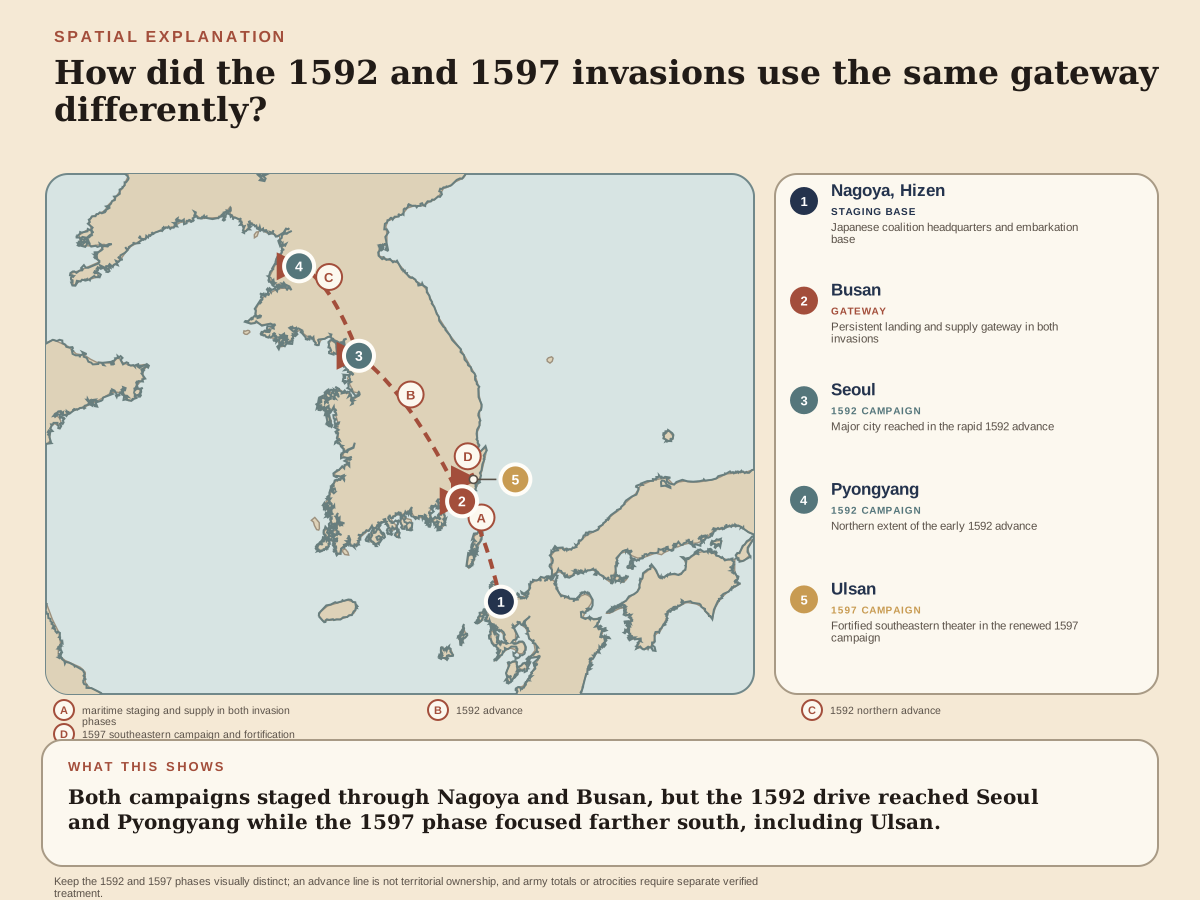
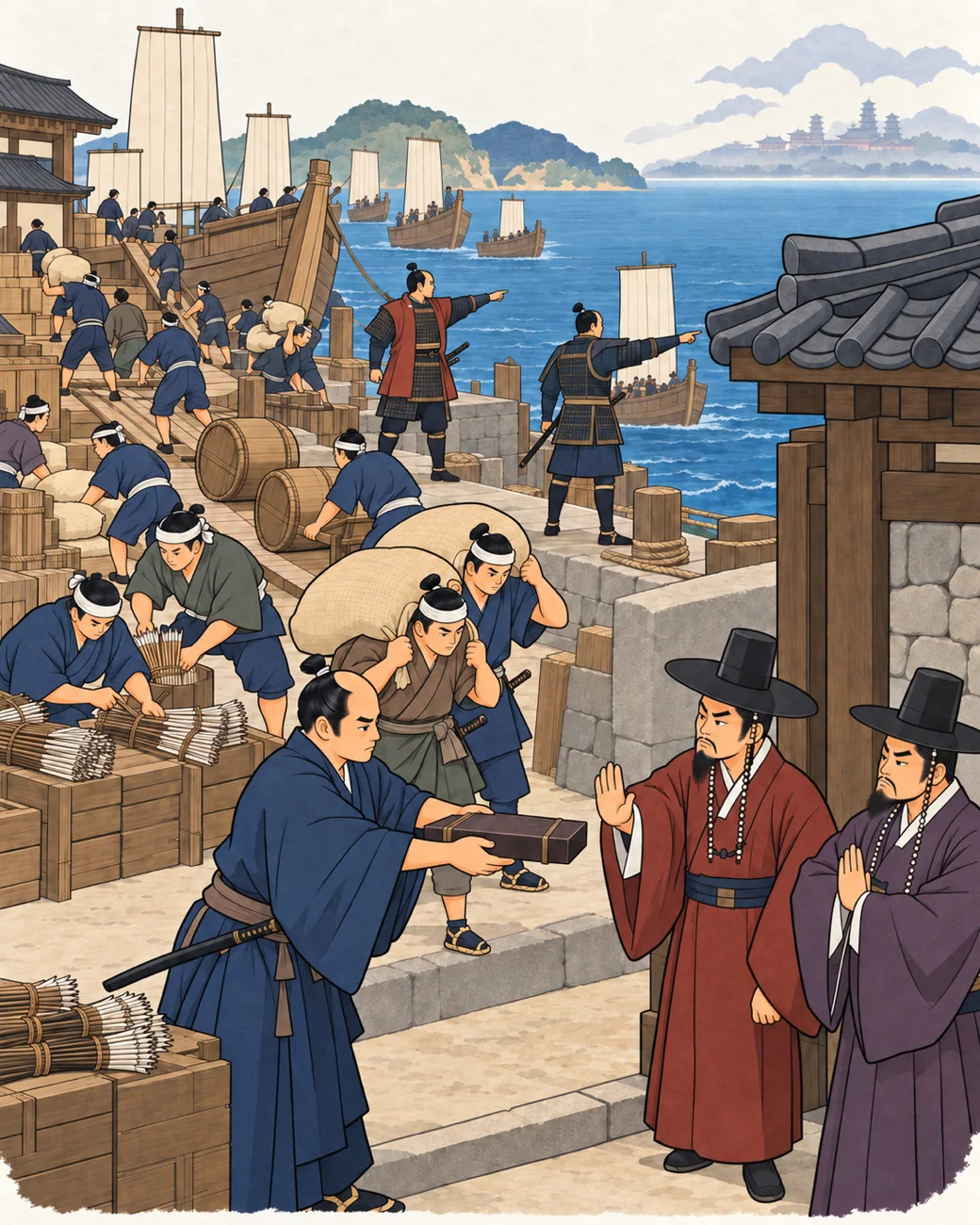
Hideyoshi built Nagoya Castle in northern Kyūshū as a dispatch headquarters. Ships carried contingents across the strait, while orders and provisions connected campaigning lords with officers and households remaining in Japan. A 1592 memorandum from Katō Kiyomasa to his Kumamoto officers included military reinforcement and allowances for lower retainers’ wives and children.
The invading army entered Korea in 1592. Its initial gains depended on taking ports, roads and cities quickly. Holding those gains required continued transport and access to food in a country whose court, provincial forces and local communities continued to resist.
Mobilization reached people who never fought in Korea. Lords' obligations supported castle construction, embarkation, transport and households left behind. Kiyomasa's memorandum makes one of those connections explicit: reinforcing the army and providing allowances for lower retainers' wives and children belonged to the same set of instructions. Ieyasu attended the Nagoya base and assisted Hideyoshi without crossing to Korea. Participation in the Toyotomi mobilization therefore did not give every leading lord the same battlefield experience or expense.
Hideyoshi's demands also required Korea to assist an attack on its Ming ally. Protocol and translation affected what envoys reported, but the separate governments had opposing political interests. The decision to invade, and later to renew the war, remained Hideyoshi's. Explaining the project merely as employment for warriors would remove that choice and the continental objective from its background.
Japanese troops seized Busan and Dongnae, then advanced along separate routes. Defeats at Sangju and Chungju opened the approach to Hanseong. King Seonjo and his court left the capital and moved north; Konishi Yukinaga’s troops occupied Pyongyang while Katō Kiyomasa advanced into the northeast.
Resistance gathered behind the advance. Provincial troops, locally raised warriors and monk soldiers recovered positions or attacked movements between them. Ryu Seongryong’s account names Gwon Eung-su’s recovery of Yeongcheon and describes local forces restricting Japanese travel. Their ability to resist varied sharply between districts.
At sea, Yi Sun-sin and other Korean commanders used cannon-bearing ships against Japanese vessels. Victories around the southern coast obstructed the invaders’ intended westward naval extension. Korean coastal transport continued to carry grain and support communication, although Japanese shipping retained access to southern bases.
Ming intervention added a large army from China. An initial attack on Pyongyang failed in 1592. Li Rusong’s army retook the city in January 1593, then suffered a reverse at Byeokjegwan. Korean resistance, including Gwon Yul’s defense at Haengju, and supply difficulties constrained Japanese forces around the capital. They withdrew south during negotiations, retaining fortified coastal positions.
Talks sought incompatible settlements. Ming officials required withdrawal and offered investiture; Hideyoshi’s demands went much further. Ryu describes Shen Weijing and Konishi withholding or improvising terms as they tried to secure agreement. The investiture embassy of 1596 failed to establish peace, and Hideyoshi renewed the invasion in 1597.
The second campaign brought the fall of Namwon and renewed attacks through the southwest. Won Gyun’s fleet was defeated near Geoje; Yi returned to command and rebuilt a small force around Jindo. Korean and Ming troops attacked Japanese coastal castles, including Ulsan, while naval forces contested approaches to them. The garrisons endured repeated fighting, but the armies achieved no advance into Ming China.
Sea power served both combat and administration. After restoring his command in 1597, Yi issued passage permits for vessels along the coast and required grain contributions according to their size. Ryu describes refugees seeking safe passage, military grain accumulating and people supplying metal and labor for cannon and ships. His praise should not be accepted as proof that every refugee welcomed the arrangements, but the account shows a fleet obtaining resources through surviving communities and transport. It did not sustain itself by winning battles alone.
The land and naval coalitions also faced different decisions. Ryu disputed the Ming commanders' willingness to negotiate and withdraw after their reverse near the capital, while Korean officials still sought recovery of occupied territory. At Ulsan, the attack forced defenders into the inner fortress, but gunfire, cold, supply problems and Japanese reinforcements prevented its capture. These were interactions among Korean, Ming and Japanese forces with separate commands, rather than one hero deciding all fronts.
The renewed invasion included systematic bodily violence. Japanese forces cut noses from soldiers and civilians and sent them to Japan as evidence of military service. At Kyoto's Hōkōji, remains were buried in the mound first called Hanazuka, later Mimizuka, and memorial rites were held in 1597. Receipt documents survive for this practice. The surviving sources cannot establish an exact census or the full composition of the mound, but the use of body parts to record and reward service belongs to the campaign itself.
Hideyoshi died in 1598 while Japanese armies still occupied Korean coastal positions. Senior lords and administrators arranged their withdrawal. A letter sent to Nabeshima Naoshige a week after the death still announced that Hideyoshi was recovering, concealing the change while officers organized the evacuation.
Departure required movement from scattered garrisons to ships. Konishi’s troops at Suncheon faced land and naval pressure. Korean ships under Yi Sun-sin and Ming ships under Chen Lin fought Japanese forces coming to assist the withdrawal. Yi was killed in this final naval fighting, while Japanese contingents continued to leave Korea.
Joseon survived and the occupation ended. Many settlements had lost people, buildings, crops and stores. Ryu describes starving refugees and attempts to distribute grain mixed with pine leaves, with supplies too small to reach everyone. A 1597 Japanese proclamation threatened villagers who had fled with treatment as enemies unless they returned.
Captives carried to Japan remained separated from their homes after the soldiers returned. Those people included skilled workers as well as others taken during campaigning. Withdrawal ended the invading armies’ territorial presence; it left surviving families, local governments and displaced communities to confront the destruction.
Withdrawal did not make the armies vanish at the announcement of Hideyoshi's death. The five administrators' letter continued to claim his recovery while senior leaders arranged departure. At Suncheon, the garrison needed assistance to escape pressure from land and sea. Japanese relief ships and the Korean–Ming fleet fought during the final evacuation, and the retreat continued after Yi's death. The invading armies left without conquering Korea or reaching the intended Ming objective.
The loss of buildings and people also impaired recovery of government and agriculture. Ryu describes capital institutions burned and grain distribution unable to sustain all the refugees who reached it. His sweeping estimates are not a population census, but the destruction and provisioning records identify actual obstacles to return. For captives in Japan, a new workplace or patron did not reverse the initial forced removal, and famous craftspeople represent only part of the people who remained separated from home.
Korea had to restore government and food production in districts emptied or damaged by repeated campaigning. Provincial and naval defenses became objects of renewed attention. Ryu Seongryong wrote his account to explain failures and preserve experience from the war, including his own official responsibilities.
Ming troops had helped preserve an allied kingdom, at the cost of men, transport and military expenditure. Their operations depended partly on Korean provisioning, which increased pressure on already devastated communities. These campaigns were one burden on the Ming state; its later collapse involved further conflicts and cannot be reduced to this war alone.
In Japan, captured Korean craftspeople contributed to industries including ceramics. Their skills developed through new workshops and patronage, while their forced removal remained part of that history. The Saga museum records several different captive lives and also notes Korean involvement in some kilns before the invasions.
Restoring diplomacy required further negotiation. A Joseon mission in 1607 delivered a reply to Japanese approaches and sought the return of captives. Later calls for repatriation show that return was incomplete. The war left naval commanders commemorated, coastal fortifications abandoned and families on both sides of the strait living with losses beyond 1598.
The later repatriation documents distinguish restoration of relations from complete return. The Saga collection includes a 1617 Korean proclamation encouraging captives to come home with promised benefits and citing the earlier mission. Renewed calls were necessary after diplomacy had resumed. The skills associated with pottery, calligraphy or dyeing describe some captives' subsequent work; they do not establish freedom of movement or an uncomplicated exchange of culture.
The Japanese political consequences likewise require their own chronology. Lords and administrators had experienced different duties during the invasion, and Hideyoshi's death left his child dependent on senior leaders' cooperation. The conflicts culminating in 1600 drew on those relationships, but Toyotomi service did not determine a single camp. Ieyasu's later coalition included men with long Toyotomi associations. The war supplied burdens and experience within a succession crisis, rather than automatically causing Sekigahara.
Different names preserve different viewpoints: the Japanese Bunroku–Keichō campaigns, Korea's Imjin and Jeongyu invasions, and an East Asian seven-year war. Nagoya's dispatch ruins, Korean accounts of resistance and refugees, and later paintings of Ming victories preserve different parts of it. Kyoto's 1898 Mimizuka restoration monument praised Hideyoshi's commemoration of the dead; that later wording is evidence of his subsequent celebration, rather than an impartial explanation of the killing. Reading the memorial alongside wartime reward practices makes the difference visible.