HO Guides
Sakai: Choosing What to Bring Out
Buried storehouses, a travelling tea jar, and a letter about tomorrow's guest reveal how a merchant city's possessions became carefully arranged encounters.
Quick · About 2 min
The story in five points
A short route through the argument. Follow a point into Classic for its context and sources.
Tea belonged to a supplied merchant city
Sakai’s houses, stores and trading connections made imported and domestic objects available. Rikyū’s career began in this urban world, but selecting a vessel for a guest required decisions that trade connections alone cannot explain.
Read in contextStorage made selection possible
Excavated adjoining buildings paired a tea reception space with a store of utensils. Their interpreted functions reveal the capacity to keep possessions apart from a gathering, so an arrangement could change without displaying everything or acquiring a new collection.
Read in contextThe same object could enter at different moments
Sōgyū’s diary records the Chigusa tea-leaf jar appearing after tea on one occasion and occupying the alcove from the beginning on another. Examination and replacement made timing and guest participation part of presentation, beyond mere ownership.
Read in contextHospitality extended beyond the drinking bowl
Excavated serving groups and furnishings put food and coordinated reception beside tea. Shared civic and religious settings also hosted gatherings; preparations relied on maintained rooms, reserves and relationships before guests arrived.
Read in contextGifts and later uses changed an object’s role
Rikyū’s letter thanking a giver of sake links preparation to an expected guest. Later mounted as a scroll, the correspondence itself gained another use, illustrating how an existing thing’s history could become part of what a host brought forward.
Read in context
Opening
Two adjoining buildings excavated in Sakai offer a useful beginning for the history of tea. One contained the base of a tea hearth. The other was a small, partly sunken storehouse containing tea utensils. Archaeologists interpreted them as a tea-reception space and a place for keeping the objects that such activity required.[1]
The pairing brings something back into a tea room that a view of its interior alone can conceal: the possibility of choosing from things kept elsewhere. What is brought out matters partly because everything is not brought out at once.
Sakai's history makes that movement unusually traceable. Excavations locate rooms and stores beneath the modern city. Tea diaries record objects being introduced, removed, examined, and replaced. A letter makes the supply for an expected guest a matter of thanks between two people. Together these sources explain how possessions could become hospitality, rather than leaving tea culture as a list of famous objects owned by famous men.
1. The city beneath the birthplace
Sen no Rikyū was born into Sakai's merchant world in 1522. He studied tea with Takeno Jōō and later served Oda Nobunaga and Toyotomi Hideyoshi. His career extended beyond the city, but its starting point was an urban community of trading households and tea practitioners, not an isolated country retreat.[2]
At Shukuin, the traditional residence site is marked by the Tsubaki well and a later shelter. The house is gone. This gives Rikyū's local memory a recognizable address without providing a surviving room from his childhood. Other parts of the tea-culture district preserve different evidence: Nanshū-ji maintains a religious and architectural connection, while archaeology recovers the vanished merchant city beneath its later streets.
Sakai stood at the meeting of maritime and overland routes. Excavated ceramics include wares from China, Korea, and Southeast Asia alongside Japanese products. They occur within an urban fabric of houses, stores, wells, drains, and streets. The circulation of objects had places to stop: households could receive, keep, and use what reached the city.[3]
That last stage is essential to tea history. A shipping connection can explain how an object becomes available. It cannot, by itself, explain why a host selects that object for a guest, places it in an alcove, or decides when it should be examined. Those decisions occur at another scale, inside the city supplied by the trade.
The archaeological deposits discussed here belong to buildings destroyed in the burning of 1615. Rikyū had died in 1591. These are evidence for the broader urban culture continuing around and after his lifetime, not his personal possessions suddenly recovered as an intact collection.[4]
The chronology widens the subject productively. Sakai's tea history includes named masters, but also buildings whose occupants remain unidentified and practices that continued after a master's death. A lost birthplace is only one part of that much larger absence.
2. A reception room beside its reserves
The adjoining buildings were found at the excavation designated SKT39, in Kumano-chō. The smaller store measured approximately 3.3 by 2.7 metres. Its contents included a tea mill, water vessels, jars, and metal implements. The hearth in the neighbouring building helped identify a kurazashiki: a reception or living space incorporated into storehouse architecture.[1]
The combination unsettles an easy division between business premises and cultivated retreat. Here a setting for tea belonged within substantial urban storage architecture. Keeping objects and receiving people could be provided for next to one another, rather than assigned to separate worlds.
A store gives a collection duration between occasions. A reception room gives selected parts of it a relationship with other people. The two functions are complementary. Utensils need not remain on display to remain available; a room need not accommodate the whole collection to offer something worth examining.
The archaeological arrangement cannot recover the order in which a particular host carried things through a doorway. It does, however, establish more than an attractive room in isolation. It gives the household a reserve: a place in which things could remain until they were needed. That is the material condition for changing an arrangement without acquiring an entirely new set of objects each time.
Fire arrested these activities in a very different condition. Among the illustrated finds are small Chinese white-porcelain bowls fused together by heat. Objects meant to be separable became one damaged cluster.[5] Their survival records the destruction of use, not a deliberate display that visitors were intended to admire.
The adjoining room and store consequently preserve capacities rather than a completed tea gathering. They tell us that objects could be held apart from the space of reception. To see how that capacity became an occasion, we need a record made by someone who attended one.
3. The same jar could enter at a different moment
The tea-leaf storage jar named Chigusa supplies such records. Made in China during the thirteenth or fourteenth century, it reached Japan and became a distinguished object of chanoyu, the practice centred on preparing and drinking powdered tea and attending to the utensils involved. It now belongs to the Smithsonian's collection, far from its former Sakai owners.[6]
Its practical identity remained important. This was a substantial container for tea leaves, not the small caddy from which powdered tea was measured into a bowl. A vessel used in preparing for the drink could also become something around which people directed close attention.
In a 1573 diary entry, Tennōjiya Sōgyū records seeing Chigusa at Jū no Sōho's gathering; Rikyū, named Sōeki, was another guest. In 1578, Sōgyū records the jar being brought out after tea and subsequently placed in the alcove. At Kondaya Tokurin's gathering in 1582, it occupied the alcove from the beginning, was taken down for examination, and was returned by a guest.[7]
These are small changes, but they reveal the difference between owning an object and presenting it. In one arrangement, attention to the jar follows the drinking. In another, its presence precedes the examination. The same possession can participate in different sequences without changing its physical identity.
The guest who puts it back also complicates the idea of a display encountered entirely at a distance. Looking could involve an object leaving its position and returning to it. The alcove supplied a place within an occasion, not necessarily a permanent destination from which nothing moved.
There is no need to place Chigusa in either excavated building. The diary and the excavation answer different parts of the question. The buildings establish provision for storage and reception; the diary records deliberate changes within reception. Together they restore an element that a static collection catalogue cannot supply: timing.
The jar's distinction was therefore experienced through acts, as well as possessed through ownership. Being present in a room, being brought forward, and being put away are different relationships between the same thing and its observers.
4. Tea had a meal around it
Another excavated compound, SKT47 in Kai-chō, broadens the material setting. The city's archaeologists identified a furnished storehouse reception building through its structure, red-clay wall material, and interior fittings. Finds included tatami remains, partition handles, screen fittings, and a tea mill. Chinese and Japanese serving vessels occurred in matching groups of five.[8]
A matching group asks to be understood differently from a single celebrated bowl. Its repetition allows several people to be served within a coordinated arrangement. The relation between the pieces is part of their usefulness. Isolating one as an attractive ceramic can obscure the group for which it was selected.
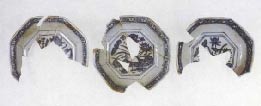
The published photograph of Chinese blue-and-white dishes shows repeated angular outlines, even though some pieces are incomplete. Their shared shape survives damage to individual examples.[9] The objects give the eye an arrangement at a smaller scale than the room: several vessels can belong together within a surface used for serving.
The findings also put food back beside tea. A history concentrated on the whisk, kettle, and drinking bowl can make the surrounding hospitality disappear. Serving vessels, furnishings, and a place to sit supplied other parts of the occasion. A guest was received through a sequence of provisions, not through a bowl hovering independently of a household.
Selection operated at both scales. A distinguished jar might attract individual examination; a set of dishes could establish consistency across several places. Neither use makes the other redundant. The host's task included arranging relations among objects as well as deciding that one object deserved attention on its own.
Nor do the remains provide a complete menu or a fixed number of guests at every gathering. What they preserve is provision for coordinated reception. The point is not to reconstruct an unrecorded dinner but to recover the range of decisions that a tea household had to make. Choosing a famous bowl was one decision among them.
5. A room shared with civic life
Tea could also occupy a setting wider than an individual household. Near Aguchi Shrine, the religious complex known as the Ōdera included Dainenbutsu-ji. Documentary references connect the site with a meeting place for Sakai's merchant council. Records of wall repairs in 1535 include both Jōō and Sen Yoshirō, the young Rikyū, among its donors.[10]
The connection is more concrete than a general statement that merchants supported culture. Contributions maintained a shared institution. People later prominent in tea appear among those involved with a local religious and civic setting, rather than existing only inside biographies devoted to their artistic accomplishments.
Tea records locate gatherings at Nenbutsu-ji in 1564 and 1579. Excavations at the nearby SKT263 site revealed a substantial building, garden, and store. The city proposes that these may belong to the historic council's meeting complex; the identification remains an archaeological interpretation, not a name written on an excavated threshold.[10]
Even with that qualification, the combination gives Sakai's tea spaces a broader social geography. A place maintained for collective purposes could also receive people for tea. The skills of hosting and attending moved through settings that had other reasons to exist.
That does not make every tea gathering a council meeting, or every shared meal an exercise in governing the city. It means that the material and personal resources used in tea were not sealed off from the institutions around them. A donor could help maintain a precinct and participate in tea without those activities becoming identical.
The store beside a reception room and the proposed meeting complex therefore reveal two scales of preparation. One household could hold utensils in reserve; a community could maintain places in which people assembled. In both, an occasion depended on provision made before the guests arrived. The visible gathering was only one stage in the life of the place supporting it.
6. Tomorrow's guest gives a gift its occasion
A letter preserved by Sakai City Museum approaches preparation through a named exchange. Addressed by Rikyū to Funakoshi Gorōemon, it thanks him for a gift of Amano sake. Rikyū says that a distinguished guest is expected the following morning and that the gift will be enjoyed. The museum dates the letter to 1586.[11]
The message joins three people without requiring all three to be present together: the giver, the recipient preparing to host, and the expected visitor. Something sent through one relationship becomes available for another. Hospitality can depend on exchanges taking place outside the room in which it is eventually offered.
The letter's brevity is helpful. It attends to an immediate opportunity rather than presenting a general theory of taste. The expected visit makes the gift timely. An object or provision is not selected solely because it is excellent in the abstract; an occasion gives the host a reason to use it now.
This document does not identify the gathering's location. Its place in the Sakai story is the city's custody of a letter by its tea master, not proof of a visit to the traditional Shukuin residence. The urban excavation and the correspondence should illuminate one another without being forced into a single invented scene.
The letter later acquired a second relationship with tea. It is preserved mounted as a hanging scroll. Words once sent to acknowledge a gift could themselves become an object encountered in a tea setting.[11] The document's use changed, while its original message remained available to be read.
That is a particularly revealing form of selection. A later owner could value the sheet because of who wrote it and what it preserved of his activity. The correspondence did not need to have been composed as a work for an alcove to become suitable for one. Chigusa moved between places within gatherings; the letter moved between kinds of use over time.
Both histories caution against assigning an object one permanent role merely because it now has a museum label. Tea culture could bring an existing thing into a new relation with people. Its accumulated history became part of what was brought out.
7. Rooms made available again
Sakai's standing tea places also have more than one history. Nanshū-ji began in 1557 as the warrior Miyoshi Nagayoshi's memorial foundation for his father. Its association with tea developed within a Zen institution. After the destruction of 1615, it was rebuilt at its present location under the monk Takuan Sōhō. Its buildings are not an unchanged precinct from Rikyū's youth.[12]
The tea room Jissō-an makes the later work of assembling heritage especially clear. Sakai City Library records its relocation from Shioana-ji to Nanshū-ji for the 1876 exposition, followed by wartime destruction and twentieth-century rebuilding. The room now standing is consequently not simply the early modern structure transported intact in 1876.[13]
Relocation made a historical room available within a new institutional setting. Reconstruction later made a replacement available after its loss. Both acts gave Sakai something with which to present tea history, but neither turns the present building into a room occupied by Rikyū.
The modern Sakai Rishō no Mori centre approaches the problem explicitly through interpretation. Completed in 2015 opposite the traditional residence site, it includes Sakai Taian, a reconstruction referring to the Taian at Myōki-an. The architects' account explains that documentary study informed alterations to the model's alcove width and associated ceiling form in order to represent an earlier arrangement.[14]
The reconstruction therefore embodies a reading of evidence. It is not the recovery of a room excavated beneath the centre. Its value is that dimensions and architectural relationships can be made available at full scale, while the explanation identifies what has been newly built and why.
This brings the district's different kinds of evidence into a useful relation. Buried foundations preserve former arrangements; letters and diaries preserve selected actions; a reconstructed room makes a researched interpretation tangible. They offer different access to the tea city's past. No single one can supply everything that the others preserve.
8. What the storehouse kept possible
Sakai's contribution to this history is more particular than the availability of beautiful ceramics. Its households and shared institutions supplied places in which possessions could be kept, selected, and used with other people. The excavated store and reception room locate that provision within the merchant city.
The diary entries add the decisions that the foundations cannot retain. Chigusa could appear after tea or occupy the alcove from the beginning. Serving sets suggest another kind of coordination; the letter about an expected guest shows provision arriving through a personal exchange. An occasion was made by relating things to people and to a particular time.
This gives the apparently spare tea interior a fuller history without filling it with everything its owner possessed. Its restraint could depend on keeping things elsewhere. The storehouse maintained possibilities that one gathering would only partly use.
Rikyū belongs within that history as a practitioner, guest, correspondent, and remembered teacher. The city around him matters because it made such roles material. Tea took place in rooms, but its preparation extended through stores, collections, gifts, and institutions. What was brought out could be few and carefully chosen because a larger world remained available behind it.
Next topic · HO Guides
Enryaku-ji: Twelve Years on the Mountain
A prescribed course of study, paired practice halls, and a fellowship at Yokawa reveal how withdrawal could prepare a monk for responsibilities beyond himself.
Continue readingSources and NotesView sourcesHide sources
Sources consulted 16 September 2026. Excavated buildings destroyed in 1615 are not assigned to Rikyū personally. Historical Japanese month and day references are source locators, not converted Gregorian dates. The district is a group of related places, not a walking route.
- [1]
Sakai City, Cultural Properties Section, “2.蔵座敷と茶道具蔵,” 出土品から探る堺の茶の湯, updated 19 December 2012, SKT39 discussion of SB301 and SB302: https://www.city.sakai.lg.jp/kanko/rekishi/bunkazai/bunkazai/tenjikai/chanoyu/kurazashiki.html. Complete archaeological summary read. The functions are the city's interpretations of the hearth, structure, and finds. Its cited 1991 excavation report was not independently read; no room owner or actual movement of utensils is identified.
Return to the reference ↑ - [2]
Sakai Tourism and Convention Bureau, “千利休屋敷跡,” Japanese historical introduction: https://www.sakai-tcb.or.jp/spot/detail/92. Used for Rikyū's 1522 merchant-family origin, study with Jōō, career connections, and the commemorated residence/well. The house is not claimed to survive, and the shelter's traditional material associations are not independently authenticated. The Japanese entry is followed rather than an inconsistent date in the English version. The body does not adopt judgments about political patrons' character or the motives behind Rikyū's death.
Return to the reference ↑ - [3]
Sakai City, “堺環濠都市遺跡,” updated 29 July 2025, sections “豪商の屋敷,” “都市のようす,” “華やかな出土遺物,” and opening of “中世都市・堺”: https://www.city.sakai.lg.jp/kanko/rekishi/bunkazai/bunkazai/isekishokai/kangotoshi.html. These support trade connections, imported and domestic ceramics, and the urban structures. The essay's distinction between availability and selection is its own analysis; it does not identify the cargo of a particular ship or treat all ceramics as tea utensils.
Return to the reference ↑ - [4]
Sakai City's SKT39, SKT47, and SKT263 accounts, notes 1, 8, and 10, identify the 1615 destruction horizon. Rikyū's 1591 death is given in the Japanese biography, note 2. The date boundary is maintained throughout: the assemblages belong to the tea city's continuing history, not an authenticated household inventory of Rikyū. No unchanged medieval moat or modern street plan is inferred.
Return to the reference ↑ - [5]
Sakai City, SKT39 illustration captioned “中国白磁小碗(火事により癒着する),” note 1; image: https://www.city.sakai.lg.jp/kanko/rekishi/bunkazai/bunkazai/tenjikai/chanoyu/kurazashiki.images/bid16.jpg. Its small reproduction supports the fused cluster, while the caption identifies heat damage. No precise firing temperature, original shelf arrangement, or exact vessel count is inferred.
Return to the reference ↑ - [6]
Louise Allison Cort and Andrew M. Watsky, “Chigusa and the Art of Tea in Japan,” Princeton University Art Museum, 22 October 2014, opening object history and discussion of Sakai owners: https://artmuseum.princeton.edu/art/stories-perspectives/chigusa-and-art-tea-japan. Used for Chinese manufacture, tea-leaf storage, chanoyu, and later custody. The Smithsonian object photograph: https://asia.si.edu/wp-content/uploads/2024/07/Chigusa.jpg. Neither the original vessel nor the complete 2014 research volume was examined. The jar is not assigned to any Sakai excavation.
Return to the reference ↑ - [7]
Tennōjiya Sōgyū, guest diary entries for 1573/1/24, 1578/12/9, and 1582/10/7, translated by Andrew M. Watsky as items 2, 3, and 5 in “Sixteenth-Century Textual References to Chigusa,” Smithsonian National Museum of Asian Art: https://asia.si.edu/whats-on/exhibitions/chigusa-and-the-art-of-tea/. They cite Tennōjiya takaiki, annotated by Nagashima Fukutarō, Chadō koten zenshū 7, pp. 185–186, 289–290, and 392. The translator corrects the last entry's published year to 1582. The complete diaries were not read; timing analysis is the writer's comparison of these excerpts.
Return to the reference ↑ - [8]
Sakai City, “3.数奇屋壁が自慢の蔵座敷,” SKT47/SB04 discussion, updated 19 December 2012: https://www.city.sakai.lg.jp/kanko/rekishi/bunkazai/bunkazai/tenjikai/chanoyu/jiman.html. Complete summary read. The reception-space attribution follows the excavation interpretation. The finds support coordinated furnishings and serving groups, not a recovered menu, regular attendance of five, or an identified master's ownership. The underlying 1987 report was not read.
Return to the reference ↑ - [9]
Sakai City, same entry, illustration of Chinese blue-and-white serving dishes: https://www.city.sakai.lg.jp/kanko/rekishi/bunkazai/bunkazai/tenjikai/chanoyu/jiman.images/fd5.jpg. Observation is limited to repeated angular form and surviving/incomplete pieces. The text, not the number of pieces visible in this cropped illustration, supplies the evidence for groups of five. The relationship between coordinated service and a set's repetition is the writer's inference.
Return to the reference ↑ - [10]
Sakai City, “4.会合衆の会所・書院跡,” SKT263, updated 19 December 2012: https://www.city.sakai.lg.jp/kanko/rekishi/bunkazai/bunkazai/tenjikai/chanoyu/kaisho.html. It reports the 1535 donor record, 1564 and 1579 tea references, and a proposed identification of excavated buildings with the council complex. The original donor document, complete tea diaries, and the cited 2004 excavation report were not independently read. This local Dainenbutsu-ji is not silently substituted by the separate Osaka temple of the same name. The archaeological identification remains qualified.
Return to the reference ↑ - [11]
根來孝明, “千利休《舟越五郎右衛門宛書状》,” さかい利晶の杜 学芸だより 12, 31 March 2026, p. 7: https://sakai-rishonomori.com/files/libs/4775/202605311136195897.pdf. See the complete object discussion, published original-text transcription, and actual p. 7 image. The museum dates the letter to 1586; its identification of the expected “宰相様” as Hidenaga is tentative and omitted. The letter's location is not stated. The mounted scroll is later treatment of correspondence, not proof of its original use as tea-room art.
Return to the reference ↑ - [12]
Sakai Tourism and Convention Bureau, “南宗寺,” historical introduction: https://www.sakai-tcb.or.jp/spot/detail/121. Used for the 1557 Miyoshi memorial foundation, Zen affiliation, 1615 destruction, and rebuilding at the current location under Takuan. The temple is included as a distinct component of the city's tea landscape; neither its entire history nor unrestricted interior access is claimed. The unrelated Ieyasu death legend is not used.
Return to the reference ↑ - [13]
Sakai City Library, Web版『堺大観』写真集, “南宗寺内 利休の茶室,” full explanatory text: https://www.lib-sakai.jp/kyoudo/sakai_taikan/sakaiTaikan_11.htm. It records Jissō-an's 1876 transfer from Shioana-ji, wartime loss, and rebuilding in 1963. The body uses the secure broader twentieth-century replacement chronology; it does not claim a surviving Rikyū original or an intact prewar relocated structure. The earlier books named by the library were not independently read.
Return to the reference ↑ - [14]
Tōhata Architects & Engineers, “さかい利晶の杜,” project data, “設計主旨,” and “聞き書き『さかい利晶の杜』の茶室”: https://www.tohata.co.jp/works/?mode=show&seq=695. The creator's account identifies 2015, the residence-site frontage, the Myōki-an model, and the reconstructed alcove/ceiling changes informed by documents. These are reported design decisions, not an independent authentication of every reconstructed detail. The architect's general claims about national character, architectural firsts, and universal tea-room usage are not adopted. The centre's room image was viewed, but no measured plan or historical gathering is reconstructed from it.
Return to the reference ↑