HO Guides
Hizen Nagoya Castle: Building a Court for a War Overseas
Palaces, performances and a letter about peace reveal how a temporary headquarters joined domestic rule to an invasion—and received its consequences.
Quick · About 2 min
The story in five points
A short route through the argument. Follow a point into Classic for its context and sources.
A court beside the sea
Hideyoshi began building Hizen Nagoya in 1591 as headquarters for invading Korea. Separate daimyo compounds accommodated households, reception and military obligations: this temporary assembly required substantial palaces and walls, not merely places to sleep.
Read in contextReception travelled with the ruler
Hideyoshi brought his portable golden tea room to Nagoya in 1592. Together with excavated tea spaces and a Noh stage, it shows how ceremonial hospitality operated inside a headquarters directing an overseas war.
Read in contextResistance changed the headquarters’ work
Korean resistance and Ming intervention checked the Japanese advance. After Pyongyang was retaken in 1593, withdrawal and negotiations altered the business reaching Nagoya; occupation and fighting nevertheless continued while envoys discussed terms.
Read in contextPeace terms did not end occupation
In a letter to O-ne, Hideyoshi described negotiations alongside further construction in Korea. His account presented the envoys’ arrival on his own terms; their presence did not establish that Korean or Ming authorities accepted his demands.
Read in contextThe war returned in other forms
Letters discussed by historian Kizaki Braddick report enslaved Korean arrivals at Nagoya. Forced displacement belongs beside courtly display in its history. Hideyoshi left in 1593, but the war continued until 1598 and the castle’s dismantling came later.
Read in context
Opening
At Hori Hideharu's camp outside Hizen Nagoya Castle, excavation identified the remains of a palace and a Noh stage. The second finding adds something unexpected to the word “camp”: a place for formal dramatic performance, with its music, movement and audience. This was a residence prepared for more than sheltering troops before embarkation.[1]
Hori's compound belonged to the settlement gathered around Toyotomi Hideyoshi's headquarters for the invasions of Korea. Building began in 1591; the wars lasted from 1592 to 1598.[2][16] Around the principal castle, lords from across Japan established separate compounds. Within this concentrated landscape, people could be summoned, entertained, instructed and sent onward.
Why did an overseas invasion require so much of a domestic court? The ruins offer part of an answer, but letters and records of people crossing the sea supply the rest. Nagoya was where a military assembly became a place of residence and reception. It was also where events in Korea arrived as diplomatic problems, captives and claims of victory.
1. A headquarters before a crossing
The castle occupied a coastal position in Hizen, in northwestern Kyushu. Here Hideyoshi established a headquarters from which to launch armies against Korea. This was the Nagoya of the invasion, not the later Tokugawa castle in the central Japanese city of the same name. The distinction matters geographically: its sea-facing setting put the new headquarters near the routes toward the Korean peninsula.[2]
The main castle covered about seventeen hectares. Construction responsibilities were divided among the daimyo, the territorial lords serving Hideyoshi. Saga's cultural-property account describes an initial building effort of only a few months. The scale was achieved by imposing separate building obligations, rather than by allowing a small local residence to grow gradually into a regional centre.[2]
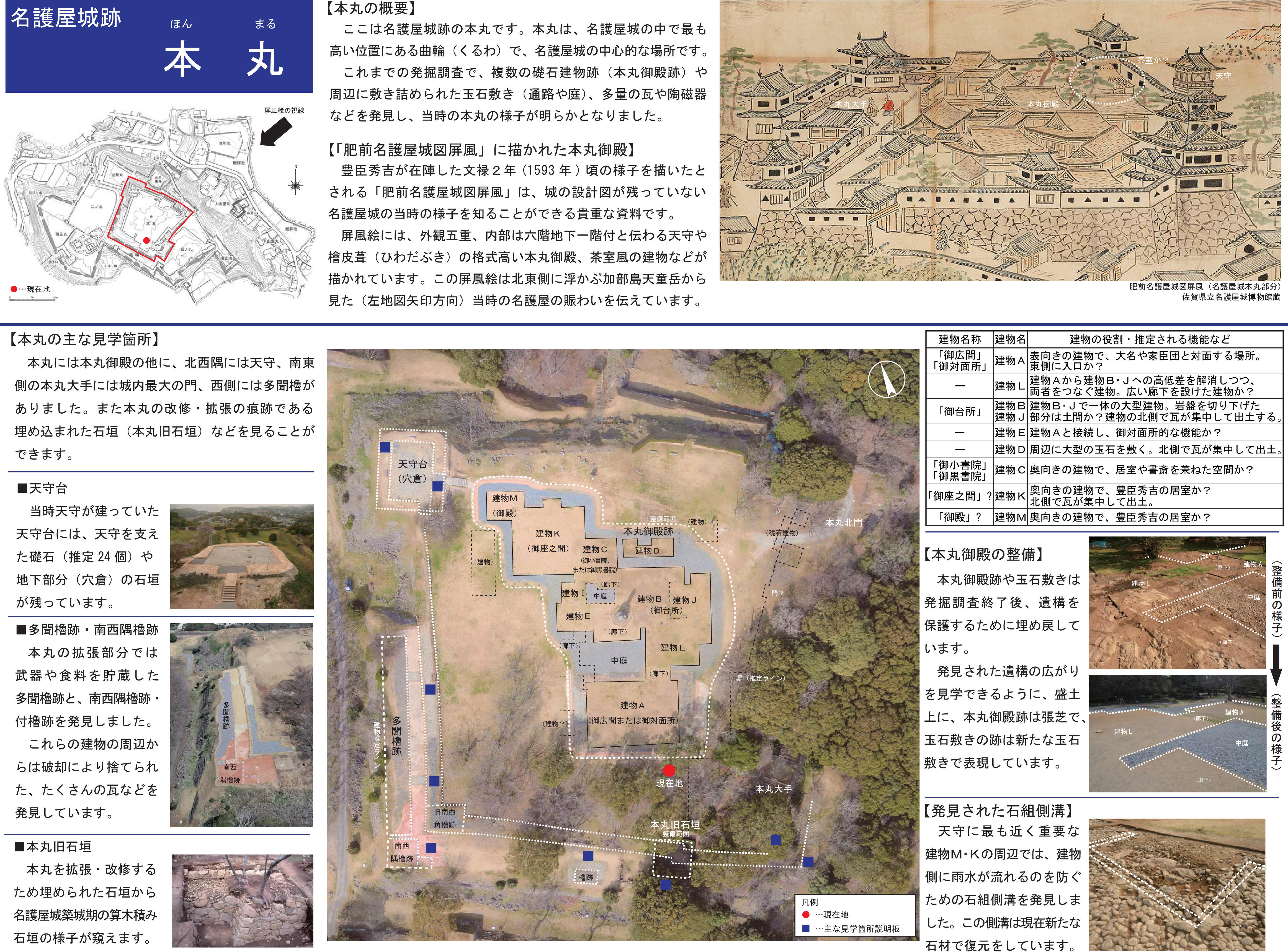
Speed did not freeze the layout. In the main enclosure, or honmaru, archaeologists found a wall that had been buried when the enclosure was enlarged. Building continued to reshape a site that was already being made useful. The earlier masonry survived because expansion covered it, preserving one stage of construction inside another.[3]
That material sequence gives “temporary” a more precise meaning. Nagoya's role as a great headquarters was short-lived, but its builders committed themselves to stone walls, palaces and alterations. A building need not be flimsy to serve a temporary concentration of people. What made the settlement temporary was the eventual departure of the activities and obligations that had brought them together.
Hideyoshi himself stayed for a little over a year during the first invasion; he did not spend the whole war here. While he was present, the headquarters had to support both the dispatch of forces and the routines of a ruler's residence. The castle's layered platforms supplied the central setting, while the camps accommodated the separate households and retinues assembled around it.[3]
2. An assembly that kept its separate households
More than a hundred camp sites have been identified around the castle. Their remains include enclosing walls, ditches, gates and buildings. The landscape was not one enormous shared barracks. It preserved distinct compounds belonging to different lords, each occupying a position in relation to the headquarters.[4]
Two examples explain different jobs within that arrangement. Kinoshita Nobutoshi's camp occupied a location guarding the main approach. At Tokugawa Ieyasu's compound, investigators found stonework and a ditch. Hori's palace and stage, meanwhile, show provision for residential and ceremonial life. The camps did not all have to reproduce the main castle to form part of its operation.[1]
Bringing lords together therefore meant bringing more than their names onto a roster. A lord needed somewhere for his household to function while his relationship with the ruler continued. A guarded entrance regulated access; a palace accommodated residence and reception; a stage made a particular kind of gathering possible. These different facilities explain why the camps belong in the history of the headquarters, rather than serving merely as markers of which famous men appeared nearby.
The concentration also attracted commerce. In a study of Nagoya, historian Kizaki Braddick draws on the diary of Ōwada Shigekiyo, a retainer serving the Satake house. His 1593 entries describe shopping in the settlement, including purchases of chopsticks and ceramics. The account gives the temporary town a scale below the great lords: people staying there needed ordinary goods as well as military supplies.[5]
The palace in the principal enclosure occupied the centre of this assembly. Excavation recovered foundation stones and pebble paving; modern ground markings present its plan over protected remains.[6] A gathering at the ruler's residence required people to leave their own compounds and approach his. That movement connected separate households without dissolving them into a single institution. Nagoya concentrated a political hierarchy in space while retaining the organizations through which men and resources had been summoned.
3. The court could be carried to the coast
Hideyoshi had a particularly portable means of conducting reception. In 1592, he had his golden tea room brought to Nagoya. Already used elsewhere, it could be moved into a new setting rather than rebuilt as a permanent room of every palace. The castle museum identifies its use here with tea gatherings and the reception of foreign envoys.[7]
The merchant Kamiya Sōtan's record describes a room of three tatami mats, with gold-covered architectural elements and red textiles. Such a confined setting organized an encounter very differently from the open spaces and large approaches outside. The room placed host, guests and the preparation of tea within a small, deliberately furnished interior.
Its mobility is the revealing feature. The ruler could change location while retaining a recognizable setting for hospitality. Transporting the room joined the new coastal headquarters to forms of reception already practiced at other centres. The assembly did not have to wait for Nagoya to acquire generations of residential tradition before it could conduct such occasions.
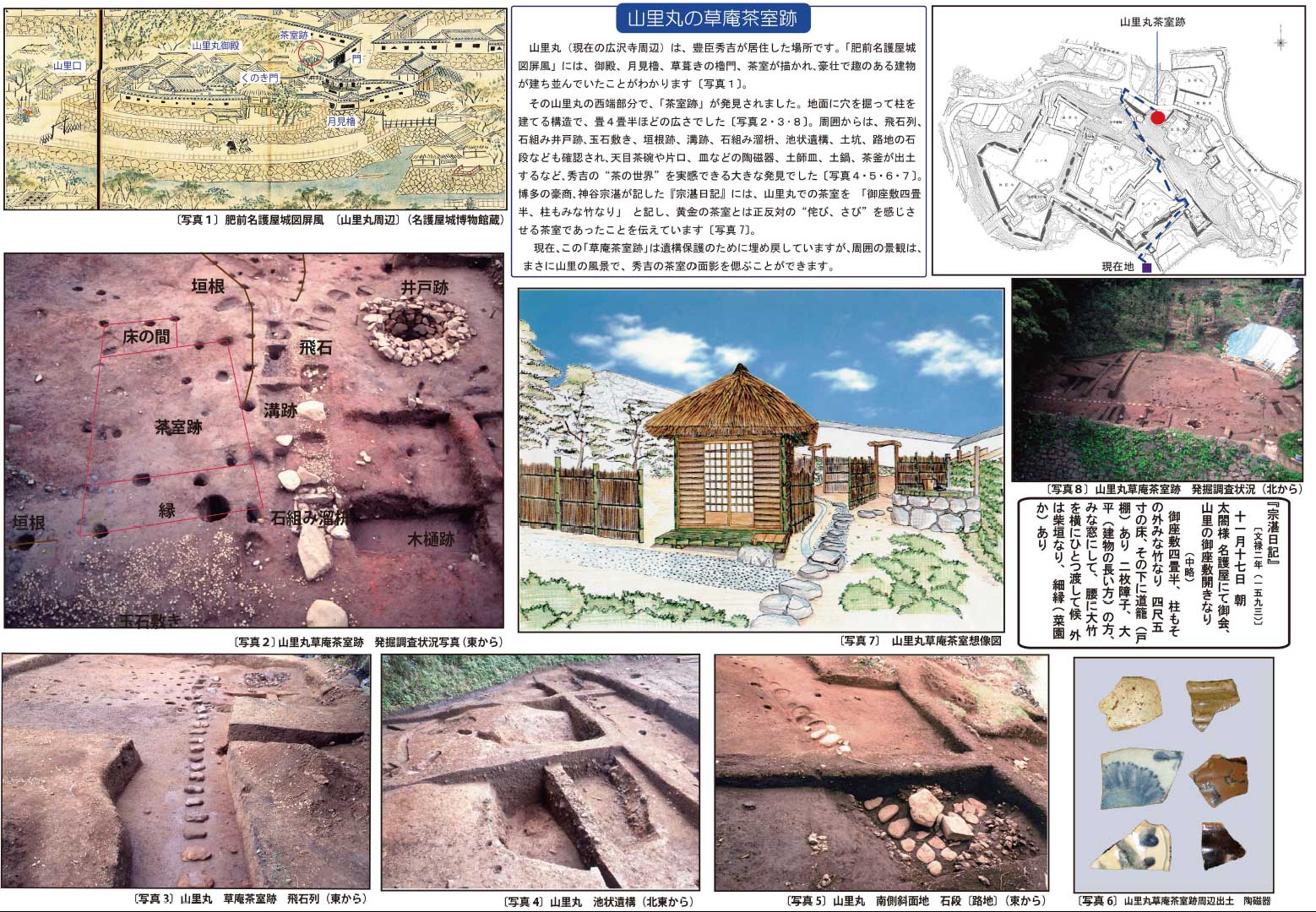
Elsewhere in the castle, excavation disclosed another kind of tea space. At Yamazato-maru, the residential area below the main enclosures, investigators identified a small rustic tea-room site, with associated garden features. The museum's archaeological panel records postholes, paths and surrounding features rather than a surviving furnished hut.[8]
The contrast is between settings, not between a peaceful place and a military one. Both belonged to the headquarters. Tea required preparation, implements and arrangements for attendance; Hori's stage similarly required a place where a performance could occur. These facilities show that residence at Nagoya included organized occasions beyond the issuing of marching orders.
4. Korea changed the business at Nagoya
In 1592, Japanese armies landed in Korea and advanced rapidly, taking Seoul and reaching Pyongyang. The Korean court sought help from Ming China. Korean resistance and Ming intervention checked that advance. Hideyoshi's campaign aimed beyond Korea toward Ming China, but the fighting first subjected the Joseon kingdom to invasion and occupation. The war involved its defense as well as the response of the Ming state to an attack on its ally.[9]
Resistance had local actors and local objectives. Jinju National Museum identifies Gwon Eungsu with a volunteer force that recovered Yeongcheon Castle. Such forces sought to regain places within Korea, rather than simply to obstruct a Japanese campaign plan. Naval operations and fighting on land also challenged the invaders' movement and occupation.[10]
Ming and Korean forces retook Pyongyang in 1593. Japanese armies subsequently withdrew from Seoul and concentrated farther south, while negotiations developed. These events changed the questions reaching the headquarters across the sea. A place established to launch an advancing army now had to deal with occupied positions, withdrawals and possible terms of settlement.[9]
The distance was not just geographical. A lord summoned to a Japanese compound and an envoy arriving from the Ming side did not occupy equivalent positions. The first belonged to the domestic structure through which Hideyoshi had mobilized the expedition. The second represented a negotiating relationship formed by an ongoing war. Attendance at Nagoya could mean service in one case and an attempt to secure different terms in the other.
Nor did the opening of negotiations make the peninsula peaceful. Japanese forces retained positions in Korea, and fighting continued during the intervening years. The people negotiating were addressing the continuation or removal of an occupation, not merely choosing the language for a completed Japanese victory.[11]
Nagoya's palaces and camps remained the domestic setting for these problems, but Korean and Ming action had helped produce them. A history confined to the speed of construction or the number of assembled lords would miss why the headquarters' business changed after it had been built.
5. A letter about peace—and more construction
One surviving letter brings that changed business into focus. In the fifth lunar month of 1593, Hideyoshi wrote from Nagoya to his wife O-ne. The castle museum preserves the letter and identifies it with the peace negotiations then under way. Alongside the negotiations, its account notes his orders for Japanese castle construction in Korea.[12]
In an English translation of the relevant passage, Hideyoshi says that representatives from the Ming empire have arrived and that he has given them his conditions. He makes acceptance conditional: agreement to all his terms would permit a settlement and his return. In the same passage, however, he reports that he has ordered further work in Korea.[13]
The juxtaposition is more informative than a simple division between wartime and peacetime. Negotiation and military construction were proceeding together. While terms were being discussed at the headquarters, orders continued to concern positions held across the sea. An audience with envoys did not suspend the practical business of occupation.
The letter also shows how events were being represented within the ruler's household. Hideyoshi describes the visitors in the language of an apology to him. That was his characterization, not evidence that the Ming government had conceded every demand or that the Korean court accepted the proposed outcome. His own conditional wording leaves the agreement unfinished.
Read beside the Korean and Ming counteroffensive, the letter reveals two different relationships to the same place. Nagoya could be a setting in which Hideyoshi presented terms and anticipated his return. For the people coming to negotiate, the journey addressed a war that had not yielded the results his armies initially sought. The presence of envoys made the castle a diplomatic venue; it did not give the host control over what their arrival meant to every participant.
6. Other arrivals from Korea
Diplomats were not the only people carried across the sea. Braddick's research cites letters by Hiratsuka Takitoshi, another Satake retainer, reporting the regular arrival at Nagoya of enslaved Korean men and women.[14] Their presence adds a different kind of movement to the castle town's history. They had not assembled to perform service as daimyo or come to negotiate a settlement.
That testimony locates forced displacement within the headquarters' own settlement. A description of the population as soldiers, merchants and attendants would leave out people brought there through capture. The account does not provide their individual histories, but their status changes the meaning of the crowd: residence near the castle could follow compulsion as well as employment or political obligation.
A later campaign history also places human remains at Nagoya. Historian Rebekah Clements discusses a seventeenth-century account in which heads taken after fighting at Jinju were sent to Hideyoshi for inspection at the headquarters, then forwarded to Kyoto.[15] The account describes a procedure by which violence overseas was presented to the ruler in Japan. Its later date needs to remain attached to the claim; it is not a surviving eyewitness report from the inspection itself.
The castle museum's wider war collection includes a hana uketorijō, a receipt for noses taken during the invasion. Such records belong to the accounting of violence, alongside objects that document residence and display.[16] They cannot all be assigned to the same arrival or room at Nagoya. They do establish why the war's documentary remains must be read with the palace foundations, rather than kept outside the castle's history.
The regional consequences also lasted beyond the temporary assembly. The museum records the life of Hong Ho-yeon, taken from Korea as a child during the invasion and subsequently employed by the Nabeshima house in Saga. His route through Nagoya is not established by that catalogue, but his later life belongs to the displacement the expedition produced. It cannot be explained as a freely chosen cultural visit simply because written work and service followed captivity.[16]
7. The residence ended before the war
Hideyoshi left Nagoya in 1593. The headquarters' most conspicuous resident had departed, but the war continued. The prolonged negotiations did not produce a lasting settlement, and a renewed Japanese invasion followed in 1597. Withdrawal came in 1598, after Hideyoshi's death and further fighting involving Korean and Ming forces.[17]
These dates separate three endings that are easily compressed into one: the end of Hideyoshi's residence, the end of the war, and the dismantling of the castle. His departure did not immediately remove Japan's forces from Korea. Their eventual withdrawal did not instantly produce every broken wall visible at Nagoya.
The museum identifies extensive deliberate damage to the masonry with the early Edo period. No original castle building survives. Some walls preserve earlier construction covered during expansion; others bear the effects of dismantling, subsequent decay and modern conservation.[18] A buried wall inside an enlarged enclosure and a damaged outer face thus point in different directions—one toward continued investment, the other toward the undoing of the complex.
The camps help explain why the loss of function reached beyond the main castle. Their households had gathered in relation to the headquarters and the expedition. Once that concentration ended, a network of palaces, gates and residential compounds no longer served the assembly for which it had been made. The settlement's short life need not imply that its buildings had been intended as disposable from the beginning.
What remains is a place from which several kinds of action can still be reconstructed. The castle and camps show the accommodation of a political gathering. Tea-room records and archaeological traces show how residence included reception. The letter to O-ne places negotiation beside orders for continuing construction in Korea. Accounts of captives and the processing of human remains connect the headquarters with consequences carried back across the sea.
Nagoya brought a court close to an invasion without bringing the invaded country under the court's control. Korean resistance, Ming intervention and unfinished negotiations changed what the headquarters had to do. Its history lies in that encounter between a place assembled to direct a war and the war that repeatedly altered the purpose of the assembly.
Next topic · HO Guides
Hakata Bay Genkō Bōrui: A Coast Built in Shares
How obligations measured in land became adjoining lengths of defensive wall—and changed the work of defending a bay.
Continue readingSources and NotesView sourcesHide sources
- [1]
Saga Prefectural Nagoya Castle Museum, “諸大名の陣跡” [Daimyo camp ruins], full page, entries for Hori Hideharu, Kinoshita Nobutoshi and Tokugawa Ieyasu. Supports the excavated palace/stage, approach position and masonry/ditch respectively. It does not identify a specific performance on Hori's stage. https://saga-museum.jp/nagoya/nagoya-castle/jinato.html
Return to the reference ↑ - [2]
Saga Prefecture, “国指定(史跡の部)01,” updated 25 April 2023, entry “特別史跡 名護屋城跡並陣跡.” See the complete Nagoya entry: invasion headquarters, divided construction, 1591 commencement and approximately seventeen hectares. The reported few-month initial completion is not used to date every component. https://www.pref.saga.lg.jp/kiji0031658/ ; geographical distinction also checked against the museum's location and site account: https://saga-museum.jp/nagoya/nagoya-castle/nagoya.html
Return to the reference ↑ - [3]
Saga Prefectural Nagoya Castle Museum, “名護屋城跡” [Nagoya Castle Ruins], introductory bullets and “埋められた石垣(本丸).” The short residence and construction sequence are separately documented. The essay does not take temporary use as proof of an original intention to abandon the castle. https://saga-museum.jp/nagoya/nagoya-castle/nagoya.html
Return to the reference ↑ - [4]
Saga Prefecture's Nagoya historic-site entry, note 02, and the museum's camp account, note 01. Published counts differ by source: the prefectural entry says more than 120, the museum around 150. “More than a hundred” avoids pretending that these are a synchronized inventory or a count of simultaneously occupied camps. https://www.pref.saga.lg.jp/kiji0031658/ ; https://saga-museum.jp/nagoya/nagoya-castle/jinato.html
Return to the reference ↑ - [5]
Kizaki Braddick, “The Life and Afterlife of Hizen Nagoya Castle,” Transactions of the Royal Historical Society, First View, published online 19 May 2026, “The life of Hizen Nagoya Castle,” discussion of the town and note 32, citing Ōwada Shigekiyo's diary, 1593.4.24, manuscript fol. 4b. See the relevant scholarly discussion; the complete diary was not examined. No exact population estimate is adopted. https://doi.org/10.1017/S0080440125100546
Return to the reference ↑ - [6]
Nagoya Castle Museum, “本丸御殿跡の発掘調査・遺構整備” [Excavation and presentation of the Honmaru palace], enlarged site panel linked from the castle page. Panel text and plan actually inspected. It distinguishes archaeological remains, protection by reburial and modern plan markers. No historical meeting is placed in a particular reconstructed room. https://saga-museum.jp/nagoya/images/2fee4b90e4dc760e820727ca9e50aef3.jpg
Return to the reference ↑ - [7]
Nagoya Castle Museum, “黄金の茶室” [Golden tea room], historical paragraphs beginning “この茶室が初めて史料に登場するのは…” and “そして天正20…”. Used for transport to Nagoya in 1592, reception and the museum's account of Kamiya Sōtan's description. The full diary was not independently read. The museum's broader promotional claim that Nagoya originated subsequent Japanese cultural development is not adopted; its modern reproduction is not the original room. https://saga-museum.jp/nagoya/exhibition/permanent/golden-tea-room.html
Return to the reference ↑ - [8]
Nagoya Castle Museum, “山里丸草庵茶室跡” [Yamazato-maru rustic tea-room site], site page and enlarged archaeological panel. Panel text, plan and photographs actually inspected. The diary excerpt on the panel was not used to infer an unchecked Gregorian date for a particular tea gathering. No ancient hut or furnished interior survives. https://saga-museum.jp/nagoya/nagoya-castle/img/about/souan2.jpg ; https://saga-museum.jp/nagoya/nagoya-castle/nagoya.html
Return to the reference ↑ - [9]
Joshua Batts and Barend Noordam, “Legacies of the Imjin War (1592–1598) in and beyond East Asia,” Transactions of the Royal Historical Society, 2026, introductory campaign overview; Jinju National Museum, English “Imjin War” exhibition account, opening historical sections; Yiming Ha, A Clash of Perceptions: Deceit in the Ming-Japan Negotiation During the Imjin War, UCLA History departmental honours thesis, 2015, printed pp. 11–13, for the Pyongyang-to-Seoul sequence. These specific sections were read, not all archives cited by their authors. https://doi.org/10.1017/S0080440126100620 ; https://jinju.museum.go.kr/eng/html/sub02/020101.html ; https://escholarship.org/content/qt2jt011ng/qt2jt011ng.pdf
Return to the reference ↑ - [10]
Jinju National Museum, English Imjin War exhibition page, Gwon Eungsu and volunteer-force material, and sections on land and naval resistance. Used for the specific recovery of Yeongcheon and the plurality of Korean resistance, not to infer that this one action alone determined the course of the war. See the museum's object descriptions; no illustrated battle scene is treated as an eyewitness image. https://jinju.museum.go.kr/eng/html/sub02/020101.html
Return to the reference ↑ - [11]
Rebekah Clements, “Hegemony, Hunting and Human Trophies in the East Asian War of 1592–1598,” Past & Present 270, no. 1 (February 2026), pp. 66–104; online 31 December 2024. Relevant passage: campaign chronology in section IV, paragraph beginning “The records of their hunts…,” explaining continued occupation and fighting during negotiations. https://doi.org/10.1093/pastj/gtae045
Return to the reference ↑ - [12]
Nagoya Castle Museum, “北政所宛豊臣秀吉自筆書状” [Hideyoshi's autograph letter to Kita-no-Mandokoro], complete object entry in “収蔵品.” Identifies sender, recipient, Nagoya origin and Bunroku 2, fifth month, twenty-second day (1593). The date is kept lunar rather than silently presented as 22 May. The museum's summary and the translated passage in note 13 differ in how they phrase the presentation of conditions; the essay follows the translated speaker's explicit agency. https://saga-museum.jp/nagoya/exhibition/collection.html
Return to the reference ↑ - [13]
Hideyoshi to O-ne, 1593.5.22, English extract from Adriana Boscaro, 101 Letters of Hideyoshi (1975), p. 56, reproduced in Ha, A Clash of Perceptions, printed p. 16, note 35. Boscaro's complete book and the autograph's full Japanese transcription were not independently examined. Only the short translated passage is used; the thesis author's psychological assessments and its identification of a separate seven-condition document are not adopted. https://escholarship.org/content/qt2jt011ng/qt2jt011ng.pdf
Return to the reference ↑ - [14]
Braddick, “The Life and Afterlife,” “The life of Hizen Nagoya Castle,” paragraph beginning “Life at Hizen Nagoya was not all fun and games, however…” and note 57, citing Hiratsuka Takitoshi shojō Nagoya jin yori shokan, Tokyo University Historiographical Institute manuscript copy, fols. 2a–2b. Read the scholarly discussion and source reference, not the complete manuscript. The attribution concerns reported arrivals at Nagoya, without an invented headcount or individual itinerary. https://doi.org/10.1017/S0080440125100546
Return to the reference ↑ - [15]
Clements, “Hegemony, Hunting and Human Trophies,” section V, paragraph beginning “For example, heads from the battle for Chinju Fortress…” and note 66. The note cites Seikan roku, edited by Shimazu Hisamichi in 1671, reprinted in Shimazushi shiryō, ed. Kitagawa Tetsuzō (1966), pp. 203–204. The later source date is retained in the essay. No victim total, specific palace room or disputed identification of an individual head is asserted; the underlying 1671 account was not independently collated. https://doi.org/10.1093/pastj/gtae045
Return to the reference ↑ - [16]
Nagoya Castle Museum, “3. 歴史の中の名護屋城” [Nagoya Castle in history], opening collection overview naming “鼻請取状” and entry on 洪浩然 (Hong Ho-yeon; Japanese reading Kō Kōzen). The catalogue establishes the collection's receipt and the Korean captive's later association with the Nabeshima house; it does not establish his personal passage through Nagoya. No numerical statement from an unexamined receipt is reproduced. https://saga-museum.jp/nagoya/exhibition/permanent/02.html
Return to the reference ↑ - [17]
Braddick, “The Life and Afterlife,” residence chronology in “The life of Hizen Nagoya Castle,” for departure in 1593; Batts and Noordam, opening war overview, for renewed invasion and the 1598 outcome; Jinju National Museum, late-war account. These sources distinguish an individual's departure from the end of hostilities. https://doi.org/10.1017/S0080440125100546 ; https://doi.org/10.1017/S0080440126100620 ; https://jinju.museum.go.kr/eng/html/sub02/020101.html
Return to the reference ↑ - [18]
Nagoya Castle Museum, castle-page introduction and conservation sections, for extensive deliberate damage attributed to the early Edo period and the absence of surviving buildings. No single demolition year, universal material-reuse story or unverified commander's intention is imposed on all damaged sections. https://saga-museum.jp/nagoya/nagoya-castle/nagoya.html
Return to the reference ↑