Map: GSI Japan The Battle of Yamazaki in 1582 ended Akechi Mitsuhide's brief control of Kyoto after the Honnō-ji Incident and made Hashiba Hideyoshi the strongest claimant to lead Nobunaga's former coalition. The famous phrase about deciding Tennōzan can misplace the action. Ōyamazaki Town explains that the principal fighting occurred in constrained lowland east of the mountain and along the Yodo River, while later memory turned the summit into a symbol of decisive advantage. The Place therefore joins battlefield topography, modern interpretation on the mountain, the post-battle ruins of Yamazaki Castle, and Mitsuhide's retreat to Shōryūji Castle. Much of the lowland has been transformed by transport, industry, river engineering, and housing.
The bottleneck between mountain, wetland, and river
山崎の地峡
Attraction
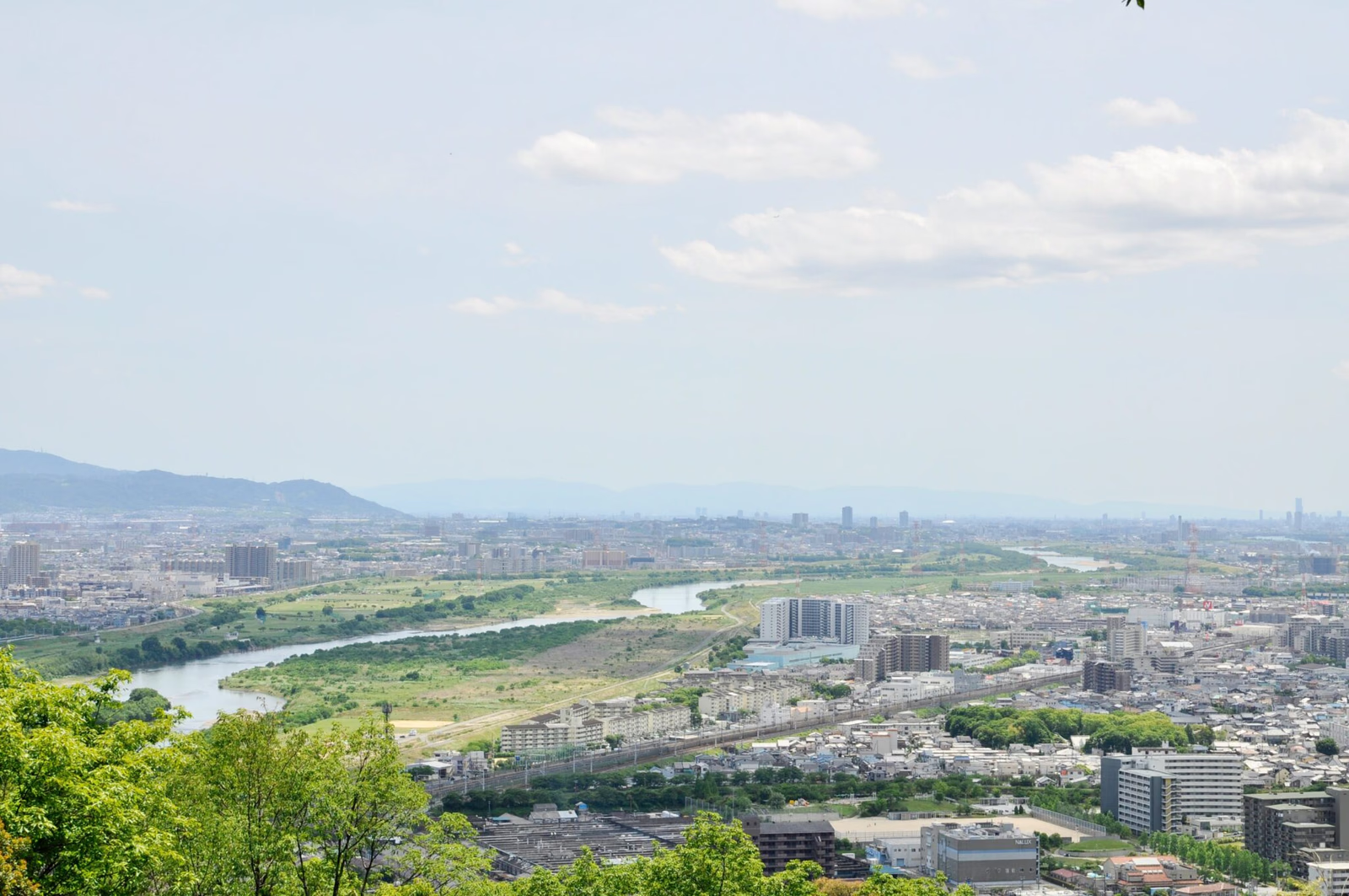
Yamazaki controlled the narrow passage between Tennōzan and the Yodo river system at the southwestern entrance to Kyoto. In 1582, marshy lowland and waterways restricted how Mitsuhide's line and Hideyoshi's arriving forces could deploy. Ōyamazaki's account places the main fighting east of the mountain and identifies pressure along the river flank as decisive. Railways, roads, channel engineering, industry, and housing now cover much of that ground, so the battlefield is read through relative positions rather than intact surface remains. The mountain is essential topography, but the battle should not be moved wholesale onto its summit.
Current visibility
The mountain–lowland–river bottleneck remains geographically legible, but the battlefield surface has been extensively urbanized and engineered.
Why Tennōzan became the language of decision
天下分け目の天王山
Attraction
Tennōzan later became a Japanese metaphor for the critical point in a contest. The phrase gives the mountain cultural importance, yet it can also imply that physically seizing the summit decided the battle. Municipal interpretation corrects that simplification: the hardest fighting developed below, especially where marsh and river compressed the fronts. Viewpoints on the mountain now offer a valuable overview of that relationship. They should be used to compare terrain and later memory, not to stage an unsupported summit duel. The gap between the famous phrase and the battlefield geography is itself one of the Place's strongest historical themes.
Current visibility
Mountain viewpoints offer modern overviews; vegetation, buildings, and altered waterways change the historical sightline.
Yamazaki Castle was a consequence, not the key to victory
山崎城跡
Attraction
Earthworks near Tennōzan's summit belong to Yamazaki Castle, which Ōyamazaki identifies with Hideyoshi's construction immediately after the battle. Platform remains, a gate trace, well, earthworks, foundation stones, and other features survive in wooded ground. They show how victory was converted into occupation of the Kyoto–Osaka gateway and a temporary political base. Their sequence is crucial: the visible castle should not be described as the fortress from which Hideyoshi won the 1582 battle. It materialized the result of Yamazaki and the new authority that followed, while later abandonment left archaeology rather than an intact building.
Current visibility
Wooded earthworks and structural traces survive near the summit; no castle building remains and ongoing investigation may refine interpretation.
Shōryūji Castle and Mitsuhide's retreat
勝龍寺城跡
Attraction
After his line collapsed, Mitsuhide withdrew toward Shōryūji Castle. The present park is a modern reconstruction and interpretation facility, but part of the North Gate stonework, foundation stones, earthwork, and moat archaeology preserves genuine castle fabric. This makes Shōryūji more than a biographical ending: it marks the battlefield's northern depth and the failure to convert retreat into a stable defense. The story that Mitsuhide escaped through the North Gate is identified as tradition and should remain qualified. From the castle area, Tennōzan also becomes visible as one element in a broader lowland battlefield rather than an isolated summit.
Current visibility
The park buildings are modern interpretation; selected stonework, foundation stones, earthwork, and moat traces are historical or archaeological.
Ceramic battle panels as modern public history
秀吉の道 陶板絵図
Attraction
Six large ceramic picture panels installed along the Tennōzan trail narrate the Honnō-ji Incident, Hideyoshi's return, Yamazaki, and his later ascendancy. Their scale and mountain sequence make a complicated political transition easy to visualize, but they are modern public history, not contemporary battle images. The panels emphasize Hideyoshi's rise and culminate in retrospective sovereignty; the actual outcome in 1582 opened a contest rather than completing unification. Reading the panels critically adds value: their location shows how the mountain became the preferred stage for memory even though municipal research places the decisive fighting in the lowland.
Current visibility
The outdoor ceramic panels are modern interpretive works; trail condition and temporary closures require a current check.
The museum bridge between altered ground and evidence
大山崎町歴史資料館
Attraction
Ōyamazaki Town Historical Museum connects the heavily altered battlefield with documents, objects, models, video, and a dedicated Yamazaki battle section. That indoor evidence is essential because transport construction and river change make many tactical positions difficult to identify on the ground. The museum also sets the battle within the longer history of a gateway community shaped by Tennōzan, the Yodo system, commerce, and tea. Exhibitions and object availability can change, so it should be treated as an interpretive Extension rather than a guaranteed list of artifacts. Its strongest role is to keep landscape claims accountable to evidence.
Current visibility
The museum is an active facility with changing exhibitions, opening days, and object availability.