Read the article below. Interactive reading tools are available when scripts load.
Quick
Oda Nobunaga was born in 1534 to Oda Nobuhide and Dota Gozen. Traditions place the birth at Shōbata or at a castle in the Nagoya area, but the surviving record does not justify treating one commemorative site as certain. More important than the room of birth is the political map around it.
Nobuhide was a successful warrior with castles, revenues, commercial connections, and armies, yet he did not rule a finished domain called Owari. Shiba authority, senior and junior Oda lines, local lords, temple estates, and retainer houses overlapped. A son could inherit claims, people, and enemies without inheriting the province. Later stories about the strangely dressed youth retrospectively announce an innovator. They are not a substitute for evidence about the child.
After Nobuhide's death, conventionally dated to 1551, Nobunaga inherited a contested household rather than unquestioned rule. Senior retainers divided; his brother Nobuyuki, also called Nobukatsu in some sources, became an alternative center. Shibata Katsuie and Hayashi Hidesada initially supported or accommodated the rival before political and military reversals brought them under Nobunaga.
Nobunaga captured Kiyosu and expanded through Owari while managing the Saitō alliance created by his marriage to Kichō. Nobuyuki rebelled, was pardoned after one defeat, and was killed in 1558 after a renewed plot was reported. The exact deception and speeches belong to narrative layers, but the fratricidal consolidation is not a legend. By the end of the decade Nobunaga possessed a much stronger Owari base. It had been assembled through retainers, kinship, castles, submission, and killing—not automatically transferred by a father's funeral.
In 1560 Imagawa Yoshimoto advanced west into Owari and his forces attacked frontier positions. Nobunaga moved from Kiyosu, gathered intelligence, and struck near Okehazama. Yoshimoto was killed and the Imagawa army withdrew.
Much else is less stable. Conventional totals contrast an Imagawa army of roughly twenty-five thousand with only a few thousand Oda, but records do not produce exact modern muster rolls. Whether a storm concealed the approach, where Yoshimoto's command group rested, and how terrain shaped the assault remain debated. Yoshimoto's advance should not automatically be called a march to conquer Kyoto; nearer regional objectives are also plausible. Victory depended on scouts, guides, dispersed Imagawa units, and the ability to find a command center. It raised Nobunaga's standing and helped Matsudaira Motoyasu emerge from Imagawa dependence, but did not instantly make Nobunaga master of Japan.
After Okehazama, Nobunaga spent years breaking the Saitō position in Mino. Victory came through campaigning, castle pressure, and the defection or recruitment of Mino warriors, not one uninterrupted assault. In 1567 Saitō Tatsuoki lost Inabayama Castle. Nobunaga moved his center there and the place became Gifu.
Documents from the new regime encouraged displaced peasants and townspeople to return. Nobunaga continued a rakuichi policy at Entokuji's market, yet also confirmed exclusive commercial rights in other cases. The combination matters: he competed for population and trade while allocating privilege selectively. It was regulation, not a universal abolition of regulation.
The red seal Tenka Fubu appears in documents from this phase. It linked Nobunaga's authority to the ordering of “the realm,” but tenka did not simply mean a modern nation-state or a detailed plan to conquer every island. Gifu gave him a route and base toward Kyoto; the seal announced enlarged political claims whose exact reach developed with events.
In 1568 Nobunaga escorted Ashikaga Yoshiaki to Kyoto, where Yoshiaki became shogun. Yoshiaki's name, court appointment, and Ashikaga networks gave Nobunaga's intervention legitimacy that an Oda army alone could not supply.
The arrangement soon became restrictive for both men. Nobunaga issued regulations limiting which initiatives Yoshiaki could take and asserted control over military and political decisions. Yoshiaki corresponded with regional powers and resisted subordination. Their overlapping government became open conflict, and Nobunaga expelled him from Kyoto in July 1573.
That expulsion conventionally marks the bakufu's end, but the office-person distinction matters. Yoshiaki continued to claim the shogunal title until 1588 and operated from exile as a focus for correspondence and opposition. Nobunaga controlled Kyoto without becoming shogun himself. Central authority was being recomposed through court rank, military command, documents, and occupation rather than transferred in one constitutional instant.
Nobunaga's advance into central Japan created enemies whose interests sometimes converged. In 1570 Azai Nagamasa broke with him during the campaign against Asakura Yoshikage, forcing an Oda withdrawal at Kanegasaki. Nobunaga and Tokugawa Ieyasu then defeated Azai–Asakura forces at Anegawa, but the victory did not end the conflict. Honganji, Enryakuji, Ashikaga Yoshiaki, and later Takeda Shingen exerted pressure at different moments.
Historians often describe a “Nobunaga encirclement network.” The phrase is useful for the danger, not proof of one headquarters coordinating every campaign. Azai defended regional and marital interests; Asakura protected its house; Honganji mobilized religious and territorial networks; Yoshiaki claimed shogunal autonomy; Shingen pursued Takeda strategy. Timing, communication, and commitment varied. Nobunaga survived by withdrawing when necessary, maintaining the Tokugawa alliance, keeping routes through the capital, negotiating pauses, and defeating components at different times. Shingen's death and the collapse of Azai and Asakura in 1573 transformed the balance, not one master stroke.
In 1571 Nobunaga's forces attacked the Enryakuji complex on Mount Hiei and the associated settlement and sacred landscape around Sakamoto. The institution held land, political relationships, and military capacity and had supported or sheltered Oda enemies. It was not a powerless monastery outside war.
That fact does not turn everyone on the mountain into a combatant. Accounts describe extensive burning and killing that reached clergy, townspeople, women, and children. Specific totals vary and should not be repeated as audited counts; archaeology and later reconstruction clarify destruction without mapping every death. Present halls largely belong to post-1571 rebuilding and cannot be treated as untouched witnesses to the attack.
Nobunaga used extreme collective violence to remove a strategic and symbolic obstacle. Explaining Enryakuji's territorial power prevents the event from becoming inexplicable anti-religious rage. Preserving noncombatant death prevents strategic explanation from becoming exoneration. Both belong to the same objective event.
Nagashima in the Ise river delta resisted Nobunaga through a network of fortified communities, local warriors, Honganji affiliation, and river or sea access. Oda attacks in 1571 and 1573 failed to end the resistance and cost the lives of Nobunaga's relatives and soldiers. In 1574 he returned with greater forces and tighter control of movement.
As the enclosed defenders sought terms or withdrawal, Oda forces attacked escape routes and burned fortified positions. Many combatants and noncombatants died. Chronicles provide enormous totals, but the exact number is not securely recoverable. The sequence is still severe: repeated resistance ended in collective destruction after a peace or evacuation process began.
Nagashima was not simply “Buddhism” opposing a secular ruler. Religious allegiance enabled communication and commitment, while villages, local elites, waterways, land, and protection made the organization durable. Nobunaga's objective was to eliminate autonomous military mobilization. That political description cannot excuse the methods used.
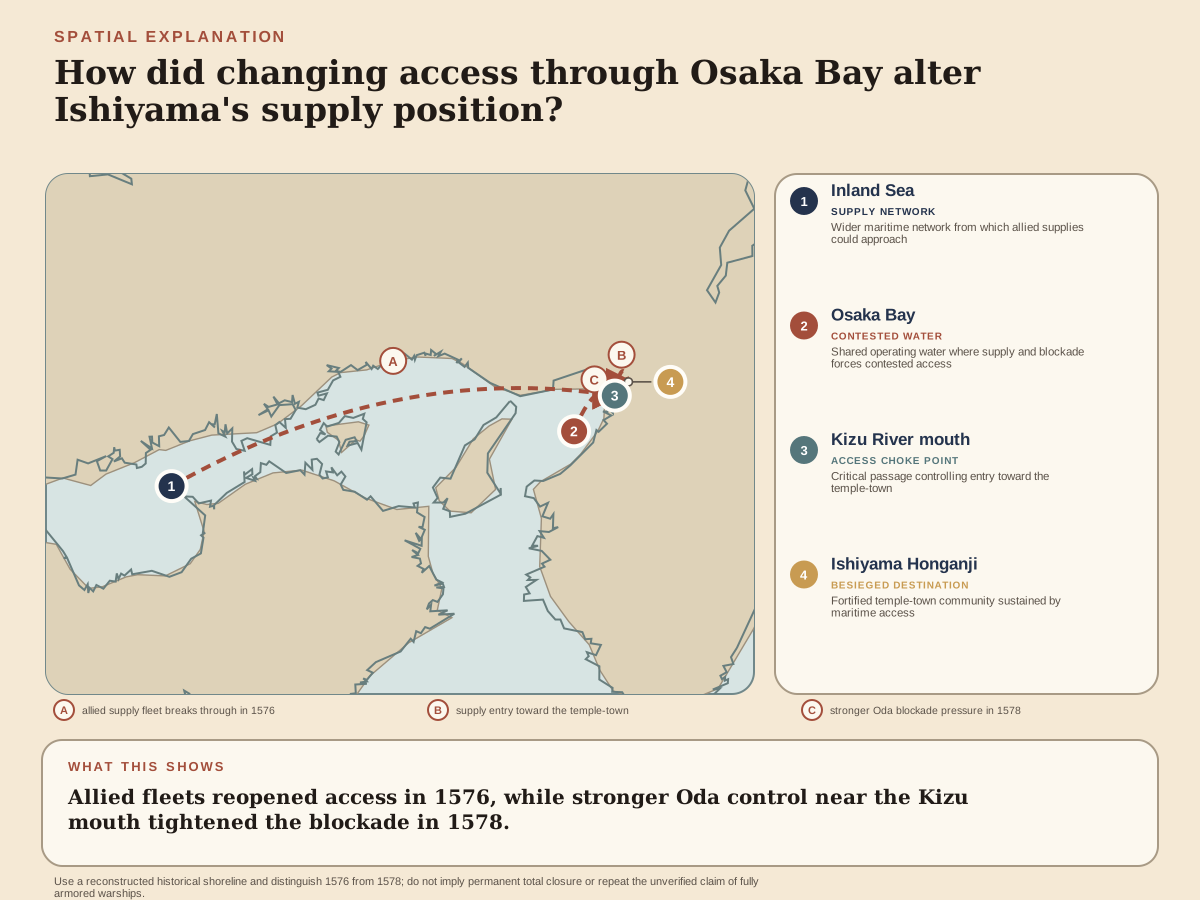
Under Kennyo, Honganji was a religious headquarters, fortified urban settlement, communications network, and alliance partner. Access through Osaka Bay and Mōri maritime support allowed Ishiyama to survive pressure that would have reduced an isolated castle.
Oda forces fought on land and at sea. Mōri-supported ships broke supply restrictions in 1576; Oda naval forces reversed the balance in 1578. Later stories describe revolutionary iron-plated vessels, but their construction and tactical character remain disputed. The war ended through imperial mediation and an agreement in 1580. Kennyo withdrew, while Kyōnyo's party remained briefly; the site then burned amid transition.
Nobunaga prevailed, but the ten-year span reveals limits. Fighting was not continuous every day, and neither side was a single block. Siege, negotiation, branch disagreement, supply, and distant allies repeatedly altered the conflict. Later Osaka Castle occupied the broader area, but the exact phases of temple, town, fire, and new castle should not be collapsed into one unchanged Place.
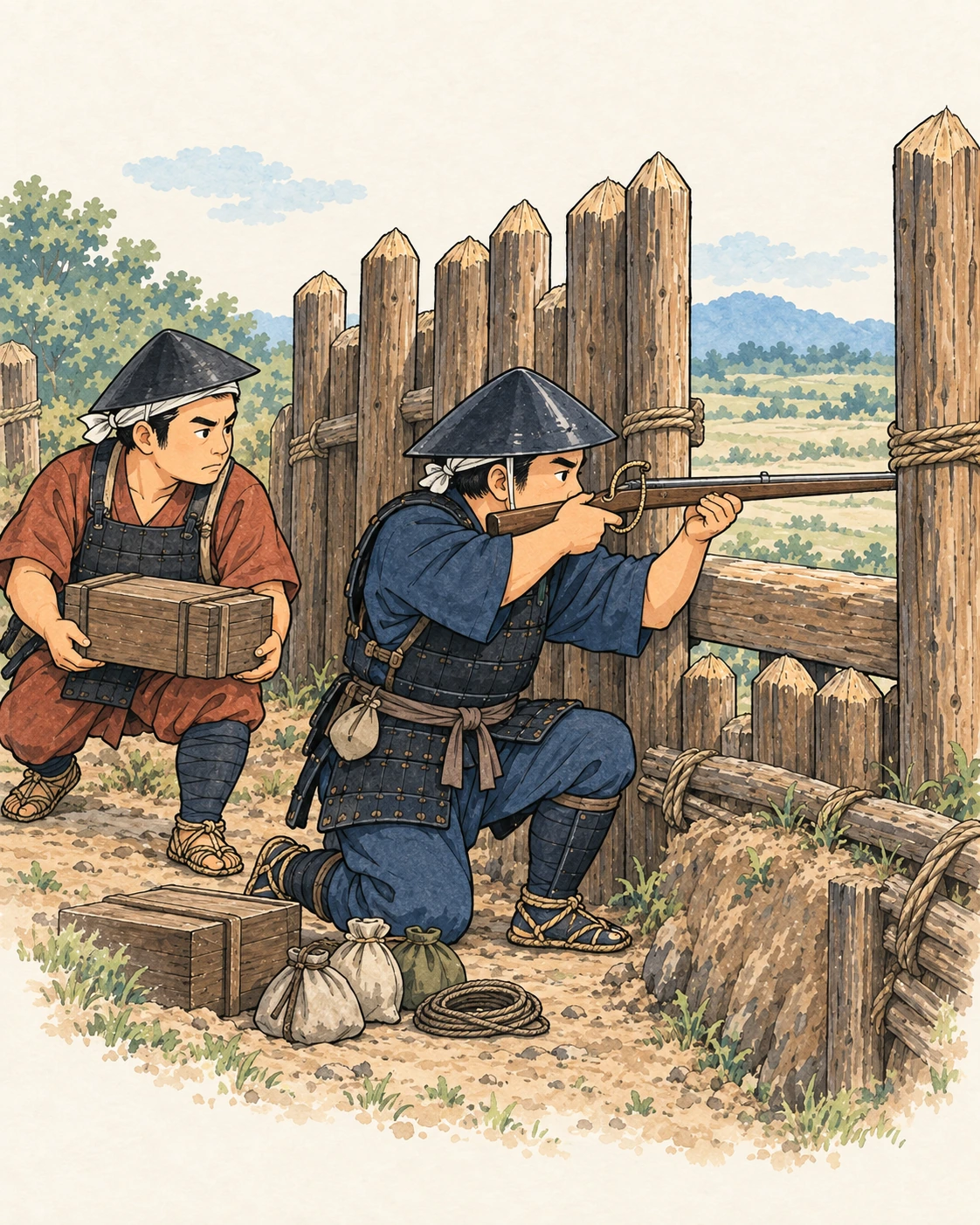
At Nagashino in 1575, Tokugawa-held Nagashino Castle resisted Takeda Katsuyori until a large Oda–Tokugawa force arrived. The allied army fought at Shitaragahara behind fieldworks. Firearms played a major role, but so did the castle defense, palisades, terrain, ammunition, superior coalition resources, and Sakai Tadatsugu's attack on Takeda positions behind the siege.
An early Oda account describes one thousand guns. The famous image of three thousand gunners firing in perfectly rotating three ranks comes from later and more complicated source layers. It should not be presented as an eyewitness diagram. The Takeda army was not a medieval cavalry mass ignorantly charging modern technology; it combined mounted and foot troops and made decisions under pressure.
Ieyasu, the Okudaira defenders, Sakai, engineers, loaders, and gunners cannot be reduced to instruments of Nobunaga's invention. The victory damaged Takeda leadership and relieved the Tokugawa front, but did not eliminate the Takeda house until 1582.
Nobunaga began Azuchi Castle in 1576, with Niwa Nagahide supervising major work. Positioned beside Lake Biwa routes, Azuchi became a residence, command center, ritual stage, religious landscape, and castle town. Its tall central building and stone-lined approaches made hierarchy visible, while retainers and visiting lords were assigned places around the complex.
The castle was not created by design alone. Quarrying, transport, carpentry, roofing, food supply, land seizure, and compulsory or negotiated labor connected the monument to surrounding communities. Sōkenji and other ritual spaces further complicate the idea that Azuchi announced a purely secular state.
Records and archaeology confirm an extraordinary complex but leave important uncertainty. Full-color reconstructions, exact room programs, and claims that the building encoded a plan to replace the emperor exceed surviving evidence. After Honnōji, Nobunaga's descendants still used Azuchi symbolically; the castle burned soon afterward and materials were reused. Today's ruins, museums, and replicas belong to later Place phases, not a complete frozen survival of Nobunaga's residence.
Nobunaga is often credited with inventing rakuichi-rakuza, but earlier rulers and institutions had used related measures. His importance lies in deploying and adapting market rules within expanding castle-town government.
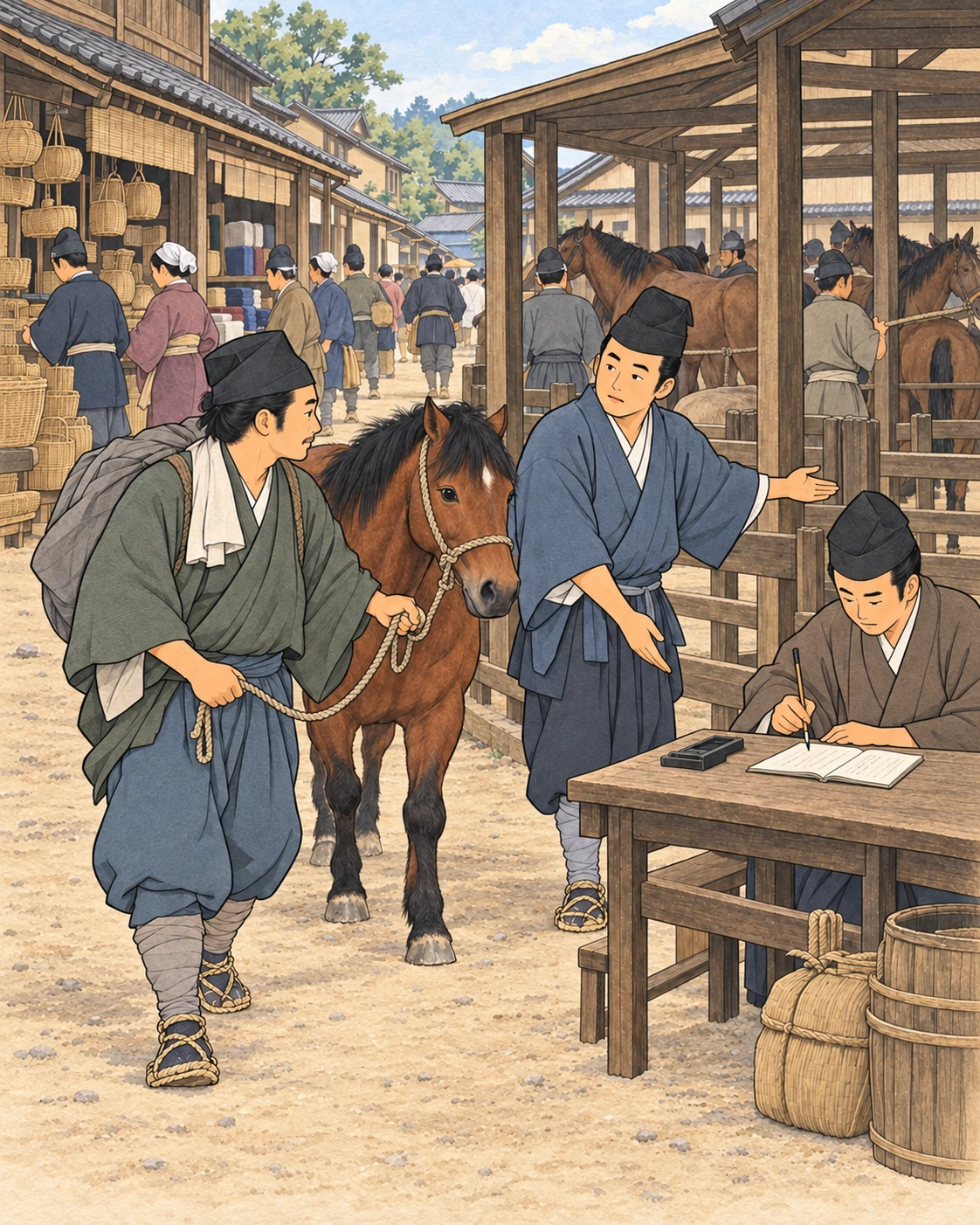
At Gifu he continued freer-market provisions in a specific town while confirming exclusive rights elsewhere. Azuchi regulations in 1577 removed selected guild restrictions and offered protections or exemptions, but they also compelled travelers on the Nakasendō to lodge in the town and concentrated horse trading there. Freedom for entrants and coercion of traffic could appear in the same charter.
These measures sought population, supplies, information, and revenue for a new political center. They did not abolish taxation, private privilege, official inspection, or lordly direction. Merchants gained opportunities while residents and rival towns could bear costs. Nobunaga's economic significance is stronger when described as competitive institutional engineering than when he is cast as the inventor of modern capitalism.
Jesuits gained access and protection in Nobunaga's domains. Missionaries such as Luís Fróis and Organtino worked in and around Kyoto; a church known as Nanbanji was established there, and Nobunaga permitted a church and seminary project at Azuchi. He received Valignano in 1581 and took the African man later called Yasuke into his service after an encounter within that mission world.
Protection did not mean conversion. Nobunaga was not baptized, and no secure evidence makes Christian belief his personal creed. Missionaries offered foreign information, objects, education, and connections; their presence could also counter Buddhist opponents. Yet motive cannot be reduced to one calculation, and Nobunaga continued to use Japanese religious institutions and rites.
Jesuit letters and histories are indispensable eyewitness-connected sources but not neutral mirrors. They sought support, interpreted Japanese conduct through Christian categories, and reported to superiors and patrons. Yasuke's service is documented; precise modern status labels and his later life remain disputed.
In the sixth month of 1582, conventionally 21 June, Akechi Mitsuhide turned the troops under his command toward Kyoto and attacked Nobunaga at Honnōji. Nobunaga had only a small entourage because major forces were deployed elsewhere, including in support of Hideyoshi's western campaign. His heir Nobutada died in a related attack at Nijō.
Nobunaga's body was not securely identified. Accounts of his suicide, last words, and actions inside the burning temple belong to layered reports. The motive for Mitsuhide's decision is also unresolved. Personal grievance, ambition, fear of losing position, changes in Shikoku policy, restoration of Yoshiaki, and court involvement have each been argued; no surviving confession decides among them.
The present Honnōji is not the unchanged 1582 building or exact site: Kyoto was later reorganized. Evidence establishes the surprise, attack, death, and political rupture—not his final consciousness.
Honnōji did not hand Nobunaga's realm intact to Hideyoshi. Hideyoshi negotiated an exit from the western front, returned rapidly, and defeated Mitsuhide at Yamazaki. Oda leaders then bargained at Kiyosu over the child Sanpōshi, the claims of Nobukatsu and Nobutaka, territories, and command. Shibata Katsuie and Hideyoshi became rivals; further war, not designation by Nobunaga, made Hideyoshi dominant.
Nobunaga's institutions partly survived through people, cadastral knowledge, castle towns, weapons systems, market policies, and redistributed lands. Others depended on his personal arbitration and fragmented. Hideyoshi and Ieyasu adapted this inheritance while creating different regimes. The familiar sequence “Nobunaga, Hideyoshi, Ieyasu” is retrospective periodization, not a planned relay.
Before 1912, chronicles, domains, schools, imperial-national history, art, and popular performance repeatedly recast Nobunaga as brutal destroyer, heroic innovator, loyal restorer, or precursor of unification. He did not invent firearms, castles, market freedom, or secular government, yet he accelerated their combination with territorial coercion.
Classic
The year 1534 provides a stable opening, but the familiar phrase “born lord of Owari” imports a later territorial map into his infancy. Owari was not a compact possession waiting for one boy. Court-derived provincial titles, the Shiba governor's residual legitimacy, competing Oda deputy lines, castle holders, religious estates, commercial communities, and armed retainers created several kinds of authority at once.
Nobuhide had risen impressively within that field. He fought beyond Owari, extracted revenue, cultivated shrines and merchants, and controlled important strongpoints. Those achievements made his household formidable. They did not erase every rival Oda or convert service relationships into an impersonal provincial bureaucracy.
The distinction changes the meaning of inheritance. A castle was not merely a stone asset; it contained soldiers, storehouses, dependents, roads, and negotiated relations with surrounding villages. A retainer did not necessarily serve the family name in the abstract. He might be attached to a particular head, estate, marriage, or expectation of reward. When a leader died, those relationships could be renegotiated.
Nobunaga's mother, conventionally called Dota Gozen, and the women of the household belonged to this political economy. They bore and raised possible heirs, maintained residences, linked kin, supervised attendants, and acquired posthumous reputations shaped by later succession conflict. Their presence does not license invented intimate scenes, but excluding them would make inheritance look like a transaction among men alone.
Marriage already connected regional strategy to the young heir. Nobunaga's later marriage to Kichō, a daughter of Saitō Dōsan, joined the Oda to the ruler of neighboring Mino. The record supports the diplomatic function much more securely than popular stories in which she arrives as a secret assassin or supplies decisive intelligence years later.
Childhood anecdotes require a source boundary. Shinchō Kōki and the traditions built around it depict eccentric clothing, irreverent conduct, and the insulting label often rendered “great fool.” Such material may preserve how retainers remembered or explained him. It cannot be read as a transcript of his psychology, nor does unconventional dress explain military success.
The same caution applies to Hirate Masahide, whose death later storytellers connected to despair over the youth's behavior. Masahide was a real senior retainer and his death mattered to the household. A single moral lesson causally reforming Nobunaga is a narrative design, not a securely documented turning point.
Geography further complicates destiny. Owari's plains and commercial routes could support armies, but neighboring Mino and Mikawa created pressure rather than a guaranteed corridor to Kyoto. The Imagawa to the east, Saitō politics to the north, and internal branches constrained every outward move.
The infant therefore inherited no program called “unification.” He entered a competitive house whose recent gains depended heavily on Nobuhide's personal leadership. Future power would require succession, marriage, defections, sieges, taxation, and repeated settlement with people not born owing him obedience.
This opening also prevents outcome bias in the opposite direction. Nobunaga was neither an inevitable genius nor merely a fortunate provincial youth. His household possessed unusual resources, and he later used them with consequential skill and violence. Historical explanation begins by identifying those resources and their instability, not by making the child foresee Azuchi or Honnōji.
Nobuhide's death exposed the household's construction. Conventional chronology places it in 1551, although early dates are not equally secure in every surviving tradition. Whatever the precise day, no provincial institution simply certified a sole heir and compelled every warrior to obey.
Nobunaga held advantages: recognition as an important son, access to castles and retainers, and marriage to Kichō. Yet his brother Nobuyuki—whose personal name appears in variant forms—could attract men who doubted Nobunaga, preferred another maternal or household alignment, or expected better reward.
Shibata Katsuie and Hayashi Hidesada matter because they show that later loyal service did not erase earlier choice. A retainer could support one branch, lose, submit, and become useful to the victor. Consolidation therefore produced a recombined elite, not a purge of everyone who had once hesitated.
Castle taking supplied physical leverage. Kiyosu connected administration, roads, storage, and claims to senior Oda authority. Possessing it meant more than winning a picturesque fortress: it allowed Nobunaga to redistribute land, receive submissions, control movement, and present himself as the household center.
The Saitō marriage added external support but also dependence. Kichō's father Dōsan had made himself ruler in Mino through a contested process of his own. His death in 1556 weakened one ally and changed the northern frontier. Popular tradition sometimes gives Kichō a dramatic intelligence role. Her political value as a marriage link is established; her private operations are not.
The conflict with Nobuyuki passed through more than one phase. After defeat in 1556, the brother was spared, reportedly through family intercession. In 1558, reports of another plan led Nobunaga to draw him into a vulnerable position and have him killed. Later narrative supplies theatrical illness, hidden weapons, and exact dialogue. The central fact is stark enough without them: Nobunaga secured his house partly through the deliberate death of a brother.
That act should neither be normalized as meaningless Sengoku custom nor isolated as proof of an inborn monster. Rival heirs could endanger every dependent attached to the winning branch. Pardon could recruit supporters, but renewed conspiracy could appear intolerable. The political logic explains the decision; it does not remove moral responsibility.
Expansion across Owari also depended on lesser actors. Scouts described roads, village leaders supplied or withheld provisions, castle garrisons chose resistance or surrender, and clerks turned victory into grants. Household women mediated kinship; hostages embodied agreements. A biography centered only on Nobunaga's temperament obscures the work by which a region became governable.
Nor was “unification of Owari” a single dated ceremony. Control thickened unevenly. Some rivals were eliminated, others incorporated, and frontier relations continued. The label is useful for describing the stronger base visible by the later 1550s, not proof that every jurisdiction became uniform.
The outcome gave Nobunaga a political laboratory. He learned which retainers could return after opposition, which castles controlled routes, and how marriage and execution could serve the same consolidation. These were not yet national policies. They were regional practices formed under immediate risk.
The adult voice that can responsibly be reconstructed is therefore tactical rather than prophetic. Nobunaga could know that his authority was disputed and that a divided house could not meet larger enemies. He could not know that later generations would make every early victory a rehearsal for ruling Japan.
The event does not need miraculous choreography to matter. Yoshimoto was a major regional ruler whose forces entered Owari, reduced or threatened Oda frontier forts, and created an immediate danger. Nobunaga concentrated what he could, attacked, and emerged with Yoshimoto dead. The Imagawa advance collapsed.
The date is securely placed in the fifth month of 1560, conventionally converted to 12 June in official local interpretation. Conversion is useful for comparison, but the participants organized time by a different calendar. Treating the Western date as an eyewitness timestamp can create false precision.
Army numbers are the first layer of legend. A huge Imagawa figure and tiny Oda figure communicate asymmetry, and asymmetry is credible. Exact totals vary with whether attendants, transport workers, dispersed fort detachments, and local auxiliaries are counted.
Yoshimoto's intention is another boundary. Later national history often says he was marching on Kyoto. He may have held larger ambitions, but the immediate campaign operated in a regional contest involving Mikawa and Owari. No demonstrated operational order makes conquest of the capital the only possible objective.
The geography is likewise contested. Several present sites preserve Okehazama memory, and modern municipal boundaries do not settle the 1560 position of every unit. Valleys, low ridges, settlements, roads, and the location of temporary headquarters matter more than attaching the battle to one tourist marker.
Weather appears dramatically in later retellings. A sudden rainstorm may have affected visibility and readiness, but sources do not permit a frame-by-frame reconstruction in which thunder hides every Oda footstep. Surprise could result from speed, terrain, false assumptions, dispersed troops, and the sudden collapse of command even without perfect meteorological camouflage.
Nobunaga's decision still required nerve and preparation. Scouts identified movements. Local knowledge guided routes. Soldiers had to maintain formation, distinguish the command group, and continue after contact. The popular lone-genius version consumes these contributors while pretending that daring alone kills an opposing general.
Yoshimoto also deserves more than the role of complacent victim. His house had built durable institutions in Suruga, Tōtōmi, and Mikawa. His army had already achieved objectives before the attack. Defeat came through vulnerability in a particular deployment, not cultural backwardness.
The death of a commander had political effects beyond battlefield casualties. Imagawa detachments withdrew, dependents reconsidered allegiance, and Matsudaira Motoyasu—later Tokugawa Ieyasu—gained room to establish independence in Mikawa. The subsequent Oda–Matsudaira relationship developed over time; it was not signed into existence at the instant Yoshimoto fell.
For Nobunaga, victory transformed reputation and strategic possibility. It did not provide Mino, Kyoto, or a centralized state. He still faced the Saitō and had to secure his eastern flank. Later success makes Okehazama look like destiny's announcement, while contemporary actors experienced it as an extraordinary survival followed by new negotiations.
The Classic layer should therefore preserve three truths together: the Oda won against a stronger invading force; the attack and Yoshimoto's death were consequential; and the neat script of exact numbers, storm, unsuspecting banquet, and straight march to Kyoto exceeds the evidence. Historical rigor does not shrink the victory. It reveals why command, information, terrain, and coalition change mattered more than a miracle.
Mino was not awarded to Nobunaga because Okehazama revealed him as Japan's future ruler. The campaign lasted years. The death of his former father-in-law Saitō Dōsan had left a hostile Saitō regime under Tatsuoki, and river crossings, forts, local houses, and the loyalties of Mino warriors shaped each advance.
Defection was as important as assault. Men later presented as Nobunaga's naturally loyal generals had to decide when Saitō authority no longer protected their interests. Their castles and local connections enabled Oda movement. Calling every transfer “betrayal” hides the reciprocal grants and security calculations that made a new lord governable.
In 1567 Inabayama fell and Tatsuoki was expelled. Nobunaga moved from Komaki to the captured mountain castle. The name Gifu is securely associated with the new center, although elegant stories assigning the choice to a particular Zen adviser belong to a more specific source layer than the institutional change itself.
The move altered geography. Mino joined Owari to create a broader resource base and opened routes toward Ōmi and Kyoto. The castle overlooked a settlement that had suffered through war. Governing the conquest therefore began with people returning, fields being worked, roads made usable, and disputes settled.
Orders from the months after the takeover encouraged peasants and townspeople to come back. Protection was an economic instrument: a lord needed taxable production and a populated castle town. Security promises also communicated that submission to the new regime could be safer than continued flight.
Market rules reveal the same combination of invitation and control. Nobunaga continued rakuichi provisions for the Entokuji town, reducing specified barriers and privileges to attract trade. In other transactions he recognized exclusive rights, including access to valuable materials. These policies are inconsistent only if “free market” is imposed as a universal ideology. A territorial ruler could weaken one corporate privilege while granting another that served supply or allegiance.
The Tenka Fubu seal emerged in this administrative setting. Its characters are material evidence: Nobunaga selected and impressed a slogan concerned with ordering or governing tenka through military authority. The seal should not be diminished into decoration.
It should not be expanded into a complete constitution either. In sixteenth-century political language, tenka could center on the realm ordered from Kyoto and on the public authority surrounding emperor and shogun. It did not necessarily carry the cartographic content of a modern sovereign Japanese nation. Its implications could broaden as Nobunaga's capacity broadened.
“Fubu” also risks translation into a doctrine of pure conquest. A seal authenticated letters issued within a world of negotiation, protection, market settlement, religious patronage, and war. Military force sustained the claim, but documents and incorporated intermediaries made it work day to day.
Kichō's Mino connection deserves bounded treatment. Her marriage embodied an earlier Oda–Saitō alliance and could help contemporaries interpret legitimacy. No strong evidence shows her secretly delivering Inabayama or manipulating every former Saitō retainer. Erasing her makes diplomacy male-only; romanticizing her invents operational authorship.
Gifu was thus both practical base and political statement. It concentrated a court, garrison, roads, settlement policy, commercial competition, and a seal with wider language. None proves that every later conquest had already been planned. Together they show a regional ruler deliberately creating the capacity and vocabulary to intervene in central politics.
Ashikaga Yoshiaki possessed something Nobunaga could not manufacture at Gifu: a recognized place in the shogunal lineage. After the killing of Yoshiteru and the contested succession that followed, Yoshiaki sought a military sponsor capable of bringing him to Kyoto. Nobunaga gained a claimant whose authority could summon, appoint, and legitimate.
Akechi Mitsuhide and other intermediaries connected these worlds. Their later careers should not be projected backward into a single conspiracy. In 1568 their immediate work helped convert an armed march into a restoration recognized by the court.
Yoshiaki received the shogunal office after entering the capital. The court remained necessary because warrior command and imperial rank were not interchangeable. Nobunaga's troops could defeat resistance, but ceremonial and documentary recognition made the resulting government intelligible to provinces, temples, and officials.
The arrangement initially served both parties. Yoshiaki obtained force; Nobunaga obtained Ashikaga legitimacy and a reason to order rivals to comply. Nobunaga did not take the shogunal title, nor did he issue a founding declaration for a wholly new state.
Conflict arose from the success of the partnership. A restored shogun could seek to exercise shogunal discretion, while the sponsor who supplied decisive troops could refuse independent appointments or diplomacy. Regulations issued in 1569 and 1570 restricted Yoshiaki's ability to confer favors and act without Nobunaga's approval. The texts show an attempt to define hierarchy inside overlapping institutions.
They do not prove that Yoshiaki was merely a powerless puppet. He maintained household officers, issued letters, cultivated regional lords, and used the title as a political resource. His correspondence could turn distant dissatisfaction into pressure on Nobunaga even when coordination remained imperfect.
The rupture developed through war, alliance, and mutual distrust. By 1573 Yoshiaki took armed action and lost. Nobunaga expelled him from Kyoto in the seventh month. This was a decisive destruction of the bakufu's local governing capacity in the capital.
Textbook periodization often ends the Muromachi bakufu on that date, which is useful if “bakufu” means an effective Ashikaga government based in Kyoto. It becomes misleading if it means that Yoshiaki ceased to exist politically. He retained the shogunal title for years, corresponded with anti-Nobunaga powers, and remained a legitimating focus in exile.
The distinction matters for Person–Event reuse. One could see restoration and rightful shogunal initiative where the other saw sponsored office bounded by military responsibility. The same objective event supports both positions without duplicating the fact core.
Nobunaga's own institutional position remained unusual. He accepted court ranks and used imperial mediation while declining the simplest available story of becoming shogun. Control flowed through his army, land grants, appointments, court relationship, and commands to existing officers.
Kyoto was not an empty prize. Residents, temples, aristocrats, merchants, and the court needed order and imposed costs on an occupying power. Violence outside the capital, supply demands, and competing jurisdictions made central rule a continuous task.
The 1568–73 sequence therefore records cooperation becoming domination and resistance. It is stronger history than a predetermined abolition plot. Nobunaga used the old office because it remained valuable, constrained it because value could become autonomy, and expelled its holder when armed coexistence failed. The institutional afterlife shows why conquest and constitutional replacement were not the same act.
The label “encirclement” captures Nobunaga's exposure. His territories and routes could be threatened from several directions, while enemies near Kyoto offered refuge or legitimacy to one another. A biography that dismisses the danger because the coalition lacked a formal commander would be equally false.
Yet the actors did not enter the conflict for one reason. Azai Nagamasa had married Nobunaga's sister Oichi, but marriage did not extinguish older ties to the Asakura or guarantee agreement over Nobunaga's campaign. When the Azai changed sides during the 1570 move against Asakura Yoshikage, the Oda force at Kanegasaki risked being trapped.
The withdrawal is important because it contradicts the image of uninterrupted advance. Rear guards, messengers, allies, route knowledge, and disciplined retreat preserved the army. Later stories assign spectacular heroism to individual retainers; the strategic fact is that survival required collective withdrawal rather than glorious refusal.
At Anegawa, Oda and Tokugawa forces defeated the Azai and Asakura. Even this famous victory did not dissolve their fortifications or political networks. Battle success and territorial conquest had different clocks. Nobunaga still had to contain movement around Lake Biwa and routes into Kyoto.
Religious institutions entered the field through material power, not a single category of “faith against modernity.” Enryakuji controlled land and routes and interacted with Azai–Asakura forces. Honganji under Kennyo could send letters, mobilize affiliated communities, fortify sites, and draw on maritime support. Their doctrinal differences mattered less to alliance than shared resistance to Oda pressure.
Yoshiaki's position supplied another kind of coordination. A shogun could correspond with lords and give opposition a public vocabulary. But a letter asking several houses to act does not prove that their armies accepted a common timetable or command.
Takeda Shingen's western movement increased the danger in 1572–73 and pressed Nobunaga's Tokugawa ally. Shingen was not merely a unit in Yoshiaki's organization. Takeda objectives arose from their own eastern and central contests. His death in 1573 removed a major pressure through contingency that Nobunaga did not cause.
Communication itself imposed limits. Messengers crossed contested roads; seasonal campaigning and harvest requirements shaped movement; a lord could promise help and arrive late. Modern arrows surrounding a central dot erase those logistical gaps.
Nobunaga responded with mixed methods. He negotiated when multiple fronts were dangerous, cultivated imperial or shogunal mediation when useful, fortified routes, punished defection, and concentrated force against vulnerable houses. “Divide and defeat” describes an effect, but enemies also divided themselves through different priorities and accidents.
The destruction of the Azai and Asakura houses in 1573 was a severe victory. It followed years of war and included the deaths of political families and dependents. Oichi and her daughters survived into later succession politics, a reminder that a defeated house did not vanish from the human graph.
Periodization should preserve phases. The 1570 danger after Kanegasaki was not identical to the 1572 Takeda pressure or the 1573 Yoshiaki rupture. Treating all as one fixed network gives Nobunaga a single puzzle whose solution proves genius. Treating them separately shows repeated decisions under changing information.
The Classic question therefore concerns coalition ontology. A coalition can be historically consequential without becoming a unitary actor. Nobunaga faced intersecting commands, each able to intensify the others. His survival depended on recognizing both the intersection and the seams.
Mount Hiei carried immense religious authority. Enryakuji's Tendai lineages, halls, ritual communities, estates, and ties to court and warrior patrons had developed over centuries. The mountain was also positioned above routes between Kyoto and Lake Biwa. Spiritual prestige and material geography reinforced one another.
Sixteenth-century monastic institutions were not modern private associations confined to worship. Enryakuji exercised estate rights, negotiated with armed houses, protected dependents, and could employ force. Its connections with Azai and Asakura made it relevant to Nobunaga's struggle around Kyoto.
Popular interpretation often swings between two simplifications. In one, Nobunaga massacres peaceful monks because he hates religion. In the other, everyone at Enryakuji is recoded as a warrior and the attack becomes an ordinary battle. Neither survives attention to the institution's population.
The complex included ordained specialists of different ranks, servants, laborers, merchants, residents of Sakamoto, pilgrims, women, and children as well as armed men. A broad order to burn and kill did not distinguish them according to later legal categories of combatancy.
The 1571 assault devastated halls and associated religious sites, including the Hie shrine environment, and extended into the settlement below. Contemporary narrative emphasizes comprehensive destruction. Later histories repeat totals in the thousands, but the exact numbers depend on texts written for different purposes and on what area they include.
Archaeology can locate burning, abandoned structures, and rebuilding. It cannot convert excavated samples into a complete casualty register. Conversely, an unburned patch does not disprove large-scale violence elsewhere. Text and material evidence answer different questions.
Place phases are essential. Much of the Enryakuji visible today was rebuilt under later rulers, especially from the late sixteenth through seventeenth centuries. A visitor can stand within the same sacred mountain system without standing before buildings that survived Nobunaga's flames. HO should distinguish location continuity, institutional restoration, and architectural date.
Strategically, the attack announced that religious prestige would not shield a power center supporting Nobunaga's enemies. It also secured routes and punished perceived collaboration. Terror was not incidental to that message; the breadth of destruction made future resistance calculate the cost.
Political rationality is not moral innocence. Nobunaga chose means that exposed people whose agency in alliance decisions was minimal. The categories “collective punishment” and “mass killing” are historically appropriate even while exact numerical and intentional gradations remain debated.
The event also complicates the myth of simple secularization. Nobunaga did not abolish Buddhism. He patronized or protected other temples, used ritual, and negotiated with religious actors. His violence fell unevenly on institutions that opposed his control. Pragmatism could coexist with sacrilege and atrocity.
Enryakuji sources and Oda-centered sources also distribute blame differently. A victory chronicle may emphasize the mountain's defiance; institutional memory may emphasize desecration and innocent death.
The responsible account holds four propositions at once: Enryakuji had political and armed capacity; its alignment affected war; Nobunaga ordered a devastating attack; and the victims cannot all be reduced to soldiers. Refusing either pair would be a form of apologetics.
Nagashima's landscape shaped its power. The Kiso river system, islands, embankments, marshes, channels, and access toward Ise Bay made conventional siege difficult. People who knew the water could move supplies and fighters around armies designed for roads and fields.
The label Ikkō-ikki identifies connection to Shin Buddhist mobilization, especially Honganji. It does not describe one homogeneous class. Local warriors, temple leaders, village congregations, boatmen, cultivators, and refugees could participate for different reasons. Faith supplied institutions and language; territorial defense and local autonomy supplied immediate stakes.
Nobunaga's first major campaign in 1571 failed disastrously. Oda forces struggled in the terrain and suffered attacks during withdrawal. Later Oda memory counted close relatives among those killed. Such losses helped make the conflict personal within the ruling house, although personal grief cannot be measured directly.
A renewed campaign in 1573 also failed to impose final control. The repeated ability to remobilize taught Nobunaga that battlefield victory over one group would not end resistance while waterways, fort clusters, and congregation networks remained functional.
In 1574 he assembled a larger operation designed to isolate the delta. Forces attacked multiple positions, naval or river units restricted supply, and enclosures reduced escape. This was a campaign against infrastructure as much as an opposing line of soldiers.
The end is the central evidence problem. Sources report requests for peace or permission to withdraw, movement out of fortified areas, Oda attacks on those leaving, and the burning of people enclosed in remaining compounds. Exact order and total differ, but no responsible synthesis can turn the outcome into a clean negotiated surrender.
The dead included armed resisters and their families or dependent populations. Medieval forces did not separate them through modern evacuation systems. Yet that absence does not make indiscriminate destruction historically neutral. Nobunaga deliberately used enclosure and fire after previous defeats.
Large casualty figures express how contemporaries and later chroniclers understood the scale. They should be marked as claims rather than repeated with false arithmetic. The strongest conclusion is mass death, not a particular round number.
Nor should Oda relatives' deaths function as moral permission. They explain escalation inside the household and the desire to prevent another uprising. Retaliation remained a choice whose burdens fell far beyond the individuals who had killed those relatives.
Calling the war anti-Buddhist also fails comparatively. Nobunaga negotiated with Buddhist institutions, protected some, attacked others, and could use temples within his own order. The decisive issue at Nagashima was an armed jurisdiction capable of refusing him and regenerating after defeat.
Calling it purely secular territorial war would fail in the other direction. Congregational trust, clergy, doctrine, and Honganji correspondence mattered to mobilization. Religious identity could create solidarity powerful enough to survive enormous material pressure.
The event therefore belongs in a history of state formation from below as well as above. Nobunaga's territorial order expanded by extinguishing a competing capacity organized through villages and belief. The efficiency of that consolidation and the horror of its final means are not rival interpretations; they are two dimensions of the same process.
Ishiyama Honganji combined several kinds of strength that castle-centered military stories separate. It was a sacred center under Kennyo, a fortified settlement with residents and stores, the node of a wide communications network, and an ally able to receive aid by water.
Honganji letters and local organizations could mobilize followers in multiple provinces. Affiliation did not produce perfect obedience, but it carried information, authority, and a moral vocabulary of defense. Kii and other regional communities could continue resistance even when the main site negotiated.
The position near Osaka Bay transformed logistics. An army controlling roads around a fort did not necessarily control ships entering from the west. The Mōri had their own contest with Nobunaga and could support Honganji without submitting to temple command.
In 1576 maritime forces associated with the Mōri broke through Oda restrictions and carried supplies toward Ishiyama. Nobunaga's coalition then developed or assembled a stronger naval response. The 1578 battle helped restrict the route.
Later accounts call some Oda vessels ironclad warships and make them ancestors of modern naval technology. Contemporary descriptions support heavily constructed, fire-resistant, and heavily armed ships more securely than a standardized iron-plated design. The evidence should keep innovation without turning metaphor or partial protection into a complete engineering blueprint.
The siege also required labor not visible in commander biographies. Boat crews, carpenters, artillery teams, port communities, merchants, messengers, and farmers supplied both sides. Control of grain and timber could matter more on a given day than a celebrated duel.
The conflict was not an uninterrupted exchange of fire lasting ten years. Campaigns intensified and paused. Negotiation occurred alongside military preparation. Other fronts changed how much force Nobunaga could commit, while Honganji's supporters recalculated risk.
Imperial mediation helped produce the 1580 settlement. This is important for understanding Nobunaga's government: even at high power, he used the court as an institution capable of authorizing or stabilizing an agreement. Force and inherited legitimacy remained connected.
Kennyo accepted withdrawal, while his son Kyōnyo resisted or delayed. That divergence reveals that “Honganji” was not a single will. Followers also differed over compliance. A settlement with the recognized head did not instantly empty every position.
Fire followed the final occupation and transition. Sources dispute responsibility and sequence. It is safer to record burning than to assign a fully proven arson plan. The later construction of Osaka Castle under Hideyoshi reworked the broader site, making current spatial claims especially sensitive.
Nobunaga's objective was control of a strategic center and the end of autonomous armed mobilization near Kyoto. His victory removed a profound obstacle. It did not eliminate Shin Buddhism; Honganji institutions survived and later developed under different political arrangements.
The war therefore resists both triumphal and victim-only scripts. Honganji exercised political and military agency; its dependents suffered siege and displacement. Nobunaga adapted logistics and used negotiation; he also applied destructive coercion. Mōri support prolonged resistance without turning the war into a simple three-command hierarchy.
Its deepest lesson concerns territorial rule. A lord could defeat armies yet fail to govern a bay, a congregation, or a supply route. Ishiyama endured because those systems overlapped. Nobunaga finally won only when his coalition could separate them and offer a mediated exit.
The battle began before Nobunaga arrived. Nagashino Castle, held for Tokugawa Ieyasu by Okudaira forces, resisted Katsuyori's siege. Its survival bought time. Messengers and local knowledge connected the garrison to relief forces, though individual messenger legends require their own source checks.
Nobunaga and Ieyasu assembled a much larger coalition army. At Shitaragahara they used fieldworks commonly described as palisades. Barriers did not form an impenetrable modern trench by themselves; they organized space, slowed assault, protected shooters, and supported units positioned in broken terrain.
Firearms were essential. Matchlocks required powder, shot, dry match, maintenance, loaders, and trained coordination. Their effectiveness was institutional and logistical, not magical. A commander who purchased guns but failed to supply them would not reproduce the result.
Source chronology matters. Shinchō Kōki, grounded in Oda retainer knowledge though preserved in composed versions, gives a figure of one thousand selected guns. Later materials magnified the number to three thousand and popularized three ranks firing in rotation. Concentrated or repeated fire is credible; a perfectly standardized three-line drill is not securely demonstrated.
This correction does not remove tactical organization. Nobunaga allocated firearm units, prepared the field, and expected attacks. It prevents an attractive later diagram from becoming the only possible mechanism of victory.
The Takeda were not exclusively cavalry. Their contingents included foot soldiers, missile troops, and mounted warriors whose battlefield roles differed from a European mass cavalry charge. Describing them as brave but obsolete preserves a progress myth in which Nobunaga represents modernity arriving fully formed.
Katsuyori's decision deserves contextual analysis. He faced a resistant castle, a relief army, pressure on his positions, and internal commanders with different views. Withdrawal also carried political costs. None proves that continuing attack was wise; it explains why caricatured technological ignorance is insufficient.
Sakai Tadatsugu's force attacked the Tobinosu fortifications and the Takeda rear associated with the siege. That action helped relieve Nagashino Castle and narrowed Katsuyori's options. A narrative that shows only Nobunaga watching volleys excludes one of the event's operational pivots.
Losses among prominent Takeda commanders weakened the house. Exact body and head counts remain shaped by victory reporting. The defeat did not cause immediate extinction. Takeda rule continued for several years, adapting and fighting until the combined Oda–Tokugawa invasion of 1582.
The battlefield is also a Place with phases. Modern memorials and reconstructed palisades help visitors grasp relative positions but are interpretive installations, not surviving 1575 woodwork. Topography has changed through agriculture, roads, and river management.
Nagashino affected reputation because it displayed Nobunaga's ability to concentrate equipment and cooperate with Ieyasu. Yet coalition implies negotiation over who protected which territory, paid which forces, and received strategic benefit. Tokugawa survival was not a side effect of an Oda technology exhibition.
The modern-versus-medieval contrast also hides continuity. Firearms had been used in Japan for decades, including by Nobunaga's enemies. Fortifications, bows, spears, mounted action, and close combat remained relevant. Innovation lay in scale, supply, deployment, and combination.
The historically stronger account is therefore more complex and more impressive. Nobunaga did not discover a button that made old warfare disappear. He helped organize a coalition system able to sustain a castle, build a position, concentrate gunners, attack a rear, absorb assaults, and exploit an enemy's losses.
Azuchi occupied a strategic and communicative landscape. Lake Biwa linked eastern routes, Kyoto, Ōmi, and northern movement. A residence there could receive men and materials from several directions while remaining distinct from the capital's inherited institutions.
Construction began in 1576. Niwa Nagahide is strongly associated with supervision, reminding us that authorship was distributed. Nobunaga selected, financed, commanded, and used the project; surveyors, master builders, stone workers, carpenters, roofers, painters, transport crews, and local suppliers made it material.
The site rose above a planned settlement and an approach that organized movement. Wide or straight routes, gateways, terraces, retainer residences, and the central tower assigned visitors a sequence. The experience of climbing toward Nobunaga was itself political communication.
The tall structure conventionally called the tenshu departed in scale and display from many earlier compounds. Contemporary descriptions support multiple levels and rich decoration. They do not preserve architectural drawings sufficient to determine every façade, room, painting, or color.
Modern reconstructions therefore embody hypotheses. A model can combine archaeology, written description, and comparison responsibly, but it cannot become retrospective evidence for its own choices. Competing schemes should remain visible in the site's visual presentation.
Interpretations that turn particular rooms into a demonstrated claim to divinity or an imminent usurpation of the imperial throne need special restraint. Architecture can stage supremacy among warriors, host ceremonies, and borrow cosmological imagery without supplying a private constitutional manifesto.
Azuchi also contained Sōkenji and other religious elements. Nobunaga used sacred forms, patronage, and ritual even after attacking Enryakuji and fighting Honganji. The castle therefore resists the label “secular capital” if secular means exclusion of religion.
The castle town joined display to economy. Officials encouraged settlement, regulated merchants, assigned residences, and controlled travel. A central place needed markets and artisans as surely as walls. Nobunaga's household consumed goods at a scale that could attract opportunity and impose extraction.
Labor brings the monument's underside into view. Stone had to be quarried or taken from existing contexts, timber cut, cargo moved, and food supplied. Some service followed obligations enforced by lords. The surviving beauty does not tell us which worker consented or which community bore disproportionate cost.
The 1581 mounted parade in Kyoto and other great displays belong to the same politics of ranked visibility, although they were not simply extensions of the castle. Nobunaga placed retainers, foreign visitors, court observers, costume, animals, and controlled movement before audiences able to circulate the spectacle.
Azuchi's life after Nobunaga refutes the idea that it vanished in the instant of his death. His son Nobukatsu and grandson Sanpōshi could be associated with the site as succession symbols. The complex then burned during the unstable aftermath; cause and exact sequence require care.
Stone and land entered later uses. Archaeology reconstructs terraces and routes from what remained after fire, dismantling, erosion, and cultivation. Present visitors encounter a ruin shaped by all those phases.
Azuchi mattered because it concentrated command, residence, ritual, economy, and representation without permanently replacing Kyoto. It offered a center for Nobunaga's personal regime. Its dependence on him also made its future fragile.
The responsible biography allows the monument to be radical without making it a solved code. Its scale, placement, labor, and staged hierarchy are strong evidence. Every painted screen and secret throne room supplied by a modern artist must remain a research hypothesis.
The paradox disappears when rakuichi is returned to sixteenth-century purposes. “Free” referred to specified tolls, privileges, guild constraints, or entry barriers. It did not define an economy independent of territorial authority.
Nobunaga was not the first ruler to attract settlement by suspending obligations. Temples, towns, and daimyō before him had issued exemptions or market protections. Innovation should therefore be measured in scale, combination, and political context rather than assigned through a heroic first.
At Entokuji's town in the Gifu area, Nobunaga continued a rakuichi framework after conquest. Continuation mattered: merchants had to believe that a change of lord would not destroy every arrangement on which trade depended.
Yet Gifu documents also preserve grants of exclusive access, including rights related to lumber. A ruler rebuilding and supplying a new center might prefer a protected provider in one sector while inviting broader competition in another. There was no requirement that all decisions obey one abstract market doctrine.
Azuchi's 1577 regulations make the governing logic unusually clear. Clauses reduced designated guild or market privileges and promised protections. Other clauses drew traffic into the new castle town, required travelers on a major route to lodge there, and concentrated horse transactions.
The town therefore competed by altering the legal geography of commerce. A merchant could gain relief from an old corporate barrier but lose the choice to bypass Azuchi. The same order could be liberating relative to one institution and coercive relative to another.
Security was part of the bargain. Roads and lodging needed protection from violence and arbitrary seizure. Lords who could guarantee safe passage made exchange more predictable. Protection also increased surveillance and made merchants legible to officials.
Castle demand drove policy. Armies and residences required grain, cloth, metal, timber, horses, weapons, paper, sake, and skilled labor. Concentrating sellers reduced search costs for the household and increased the town's political value.
Revenue need not take the form of a simple market tax. A populated town raised rents, supported services, enlarged supply, and strengthened control of transport. Exempting one levy could yield other forms of income or capacity.
The social effects were unequal. Mobile merchants able to enter a protected market might benefit. Older guild members could lose inherited claims. Rival settlements might lose traffic. Peasants could face transport duties or price changes. Artisans might receive protection while becoming more dependent on castle demand.
Nobunaga's charters also required enforcement by local officials. Rules did not execute themselves. Disputes over status, debt, weights, violence, and jurisdiction persisted, making economic policy a stream of adjudication rather than a single reform proclamation.
The modern phrase “free market” carries ideas of impersonal competition and limited state interference that obscure this structure. Nobunaga's state did not withdraw. It entered more deeply by redefining who held privilege and where transactions should occur.
Nor should the correction be used to deny change. Weakening entrenched corporate barriers could widen participation and accelerate castle-town growth. Redirecting routes could create new commercial centers. The results helped reshape regional urban networks.
The Classic layer therefore asks not whether Nobunaga was “for” or “against” freedom. It identifies which actor was freed from which obligation, who was compelled, and how the change served territorial rule. That claim is historically specific and more consequential than an anachronistic label.
Christian missions entered central Japan through fragile permissions. Priests needed residences, interpreters, local converts, protection from opponents, and the ability to travel. A powerful patron could make preaching possible without accepting the teaching.
Luís Fróis became an especially important observer of Nobunaga's world. His writings preserve encounters, places, objects, and sequences unavailable elsewhere. They also belong to an institution explaining its progress to an international religious network. Praise for a protector and condemnation of rival temples were not disinterested language.
Nobunaga allowed missionaries to work in Kyoto and supported the establishment associated with Nanbanji. The church's visibility made toleration material. It also made the mission dependent on political favor and exposed it to the instability of regime change.
At Azuchi, Organtino and the Jesuit program received permission for a church and a seminary intended to educate Japanese youths. Valignano's adaptation strategy valued language and local formation. The school shows more than curiosity about exotic gifts: Nobunaga permitted an institution capable of reproducing Christian leadership.
Permission still did not transfer sovereignty. The Jesuits operated under conditions and could lose protection. Nobunaga controlled land and public order around them. A protected network was not necessarily an uncontrolled one.
Political balance is a plausible motive because some Buddhist institutions opposed Nobunaga and missionaries celebrated his actions against their rivals. It would be too simple to say that Christianity was only a weapon against Buddhism. Nobunaga dealt differently with different temples, and missionaries supplied knowledge and prestige independent of domestic conflict.
Material encounters mattered. Clocks, textiles, weapons knowledge, maps, music, paintings, and accounts of distant regions could enter elite exchange. Not every object produced a policy, but the circulation widened what a ruler and his attendants could compare.
Valignano's 1581 visit brought the African attendant whose later Japanese name is conventionally rendered Yasuke. Sources record Nobunaga's intense interest and eventual service relationship. They do not settle every modern question about formal samurai status, exact rank, marriage, or full biography.
Yasuke should therefore appear neither as a curiosity stripped of agency nor as the hero of a complete career assembled from gaps. His presence demonstrates that Nobunaga's household could incorporate a visibly foreign man through patronage and service. What he thought about that incorporation is not directly recoverable.
Nobunaga never received baptism. He also supported ritual performances and institutions that do not fit conversion. Missionary claims that he rejected gods or regarded himself in extraordinary terms require genre and translation analysis rather than immediate acceptance as inner confession.
Religious debates reportedly staged before him reveal another political use: a ruler could judge, enjoy, or exploit argument between communities. The missionary account of such a debate naturally favors its own side. A verdict described in a Jesuit narrative is not a neutral transcript.
The Azuchi seminary's vulnerability after Honnōji exposes the arrangement's limits. Institutional growth tied to one protector could be displaced when that protector died. Mission networks survived through relocation and other patrons, not because Nobunaga had created permanent toleration.
The best synthesis is therefore plural. Nobunaga permitted genuine Christian expansion; missionaries gained real converts and institutions; he valued some combination of utility, knowledge, spectacle, and counterweight; and he remained unconverted. Evidence can establish behavior more securely than belief.
Fróis's admiration, Buddhist fear or resentment, Japanese converts' commitments, and Nobunaga's strategic toleration can attach to the same events. None should be rewritten as the objective voice of religious history.
By 1582 Nobunaga had distributed his armies across a widening war. Hideyoshi faced the Mōri in the west; other commanders operated on separate fronts; Tokugawa Ieyasu was traveling in the central region. The dispersion reflected strength and created vulnerability.
Nobunaga lodged at Honnōji in Kyoto with an entourage too small to resist a full command unexpectedly turned against him. His son Nobutada remained nearby with his own group. Neither treated Mitsuhide's force as an approaching enemy because it belonged to the Oda system.
Mitsuhide redirected troops and attacked before dawn. The operational fact is unusually clear compared with the psychology behind it. Honnōji burned, Nobunaga died, and no secure chain of custody produced an identifiable body.
That absence allowed narrative to fill the interior. Accounts describe defense, withdrawal into the building, self-killing, and remembered phrases. Some may preserve informed testimony; none gives direct access to a dying man's mind. The famous performance verses associated with Nobunaga's life are especially vulnerable to literary framing.
Nobutada responded at Nijō rather than escaping and died with many followers. His death was structurally as important as his father's. Had the adult heir survived, succession might have been less open even after the attack.
Mitsuhide did not leave an extant manifesto that resolves motive. Later Tokugawa-period grievance stories supplied accumulated insults and a morality of justified resentment. Their narrative completeness is precisely why source criticism is necessary.
Ambition is possible but too general. Every coup can be labeled ambitious after success is attempted. The question is what opportunity, threat, alliance expectation, or policy conflict made action seem viable at that moment.
Historical disagreement · What lay behind the Honnōji attack?
Research on Shikoku points to Nobunaga's changing relationship with Chōsokabe and Mitsuhide's role as intermediary. If policy reversal endangered his credibility or household, self-preservation could combine with grievance. The evidence establishes a relevant network more securely than a single causal command.
Other scholarship has connected Mitsuhide to Ashikaga Yoshiaki and a possible restoration program. Newly identified documents can strengthen the plausibility of contact without proving that Yoshiaki ordered the attack or that restoration was the sole aim.
Court-conspiracy theories face a similar problem. Court actors had interests in Nobunaga's offices and demands, and they communicated with warriors. Interest, proximity, or benefit is not proof of authorship. No demonstrated court order commands Mitsuhide to kill him.
Mitsuhide may have expected rapid recognition from Oda retainers, court figures, or regional lords. His subsequent difficulty securing broad support suggests that expectation, if held, was not fulfilled. Failure afterward does not reveal exactly what he expected beforehand.
Place also requires phases. The Honnōji standing in present Kyoto occupies the result of later urban reorganization. Memorial stones and museum displays interpret the event; they do not constitute surviving rooms in which Nobunaga died.
The strongest event core is therefore concise: entrusted commander, redirected army, surprise attack, deaths of ruler and heir, uncertain remains, and immediate succession crisis. Multiple motive hypotheses may attach with explicit status and provenance.
There is no need to force a verdict for narrative satisfaction. Honnōji changed Japan whether Mitsuhide acted from one grievance, a coalition expectation, fear, ambition, or several causes. Preserving the unsolved motive is not a failure of publication; it is the honest boundary of the archive.
The first answer is not “Hideyoshi.” At Honnōji, Nobunaga and his adult heir Nobutada died nearly together. That double death removed the line most capable of issuing continuous commands to the Oda coalition.
Hideyoshi was campaigning against the Mōri at Takamatsu. He arranged a settlement or disengagement whose exact knowledge conditions remain debated, then moved east with exceptional speed. At Yamazaki he defeated Mitsuhide before the coup leader could consolidate a durable coalition.
Military victory gave Hideyoshi leverage as avenger, not automatic inheritance. Other Oda commanders retained armies, territories, kinship claims, and their own accounts of service. The Kiyosu meeting allocated authority inside that contested field.
Sanpōshi, the child son of Nobutada later known as Oda Hidenobu, represented the direct line. Nobunaga's sons Nobukatsu and Nobutaka had adult claims but disputed support. A child heir could preserve dynastic legitimacy while powerful adults governed around him.
Shibata Katsuie possessed seniority and northern power. Hideyoshi possessed a victorious field army, growing alliances, and control over the response to Mitsuhide. Their rivalry developed into war, culminating in Hideyoshi's victory in 1583. Nothing in Nobunaga's lifetime constituted a legal relay baton appointing this outcome.
The Oda house did not disappear. Branches, descendants, former retainers, and place memories continued. But the command that had coordinated them broke into competing jurisdictions. This difference between lineage survival and regime survival is central.
Some practices traveled through personnel. Survey knowledge, castle construction, firearm supply, hostage relations, land grants, urban regulation, and methods of large-scale mobilization could be adopted by new masters. Continuity belonged to clerks, engineers, merchants, warriors, and communities as well as famous successors.
Other elements were less portable. Nobunaga's particular mixture of personal audience, court relationship, fear, reward, and rapidly reassigned command depended upon access to him. Honnōji removed the arbiter before an impersonal central institution could guarantee succession.
Hideyoshi did not merely complete a design. He created new titles, redistributions, survey programs, status rules, monumental centers, and eventually continental war. Ieyasu later built a hereditary shogunate from a different coalition and a different victory. Adaptation should not be confused with execution of Nobunaga's plan.
The “three unifiers” sequence is useful for teaching change across the late sixteenth century. It becomes teleology when each man is made to prepare knowingly for the next. Nobunaga sought continuation through his own house, not replacement by a former retainer and then an allied rival.
Reception assigned him roles according to later needs. Oda-centered writing could celebrate military decisions and house origins. Buddhist institutional memory preserved destruction. Tokugawa history could place dangerous innovation safely before stable rule. Nineteenth-century imperial narratives could emphasize his relationship with court and the weakening of the bakufu.
Words such as revolutionary and modernizer must be broken into claims. Nobunaga expanded firearms logistically but did not introduce them to Japan. He issued powerful market charters but did not invent rakuichi. He built an extraordinary castle but did not invent stone fortification. He tolerated Christians but did not create religious freedom or a secular constitution.
The correction does not reduce his importance. He concentrated resources across provinces, displaced old houses, subordinated or destroyed armed religious jurisdictions, reshaped central politics, constructed new urban centers, and made extreme violence an instrument of consolidation. The combination and tempo were historically transformative.
His legacy therefore contains capacity and cost together. Administrators and merchants could find new openings; rivals, townspeople, congregations, laborers, and defeated households could experience dispossession or death.
The pre-1912 boundary closes with layered memory rather than a final verdict. Nobunaga was neither the sole inventor of a modern Japan nor only an irrational destroyer. He was a ruler whose regime reorganized inherited institutions with unusual speed and violence, then proved unable to reproduce itself after his sudden death.