HO Guides
Okehazama: Making a Place for the Defeated
A monument attracted offerings intended for a grave. The new marker that followed reveals how commemoration helped create the battlefield that survives today.
Quick · About 2 min
The story in five points
A short route through the argument. Follow a point into Classic for its context and sources.
A defeat acquired later destinations
Nobunaga killed Imagawa Yoshimoto in the 1560 campaign, but Okehazama's visible landscape combines older castle occupation with later death markers, burial traditions, temple objects and parks. No small memorial enclosure contains the whole military event.
Read in contextArchaeology recovers life before battle
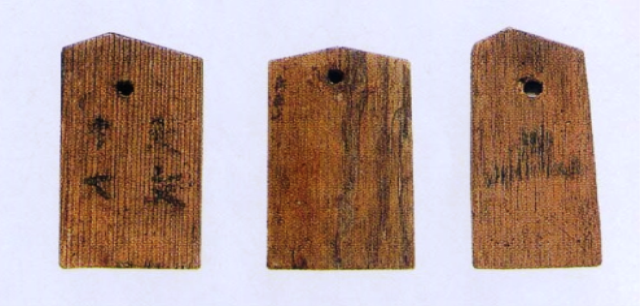
Kutsukake excavations revealed changing residences, a garden pond, defenses and household objects. Wooden tags include 1548 writing. These finds document an occupied castle before its famous association with Yoshimoto, rather than one frozen campaign moment.
Read in contextStones gave unequal recognition
Toyoake's Seven Stones name Yoshimoto and Matsui Munenobu while leaving five officers unnamed. Their inscriptions record later commemoration and claims about death places; eighteenth-century marking does not establish a contemporary battlefield survey.
Read in contextRemembrance changed through use
An 1809 inscription encouraged mourning and future attention. A manuscript added reading aids; travelers treated the stone as a grave. Their offerings prompted an explicitly named Yoshimoto grave monument in 1876, adding another commemorative purpose.
Read in contextProtection did not certify every location
National designation retained the term traditionally identified site. Nagoya's later park gathered relocated features. Burial and temple traditions remain meaningful, but a moved memorial cannot independently establish where its associated sixteenth-century action occurred.
Read in context
Opening
In 1876, Yamaguchi Masayoshi of Arimatsu erected a grave monument for Imagawa Yoshimoto at Okehazama. The explanation recorded on its reverse began with a mistaken identification. Travelers had been offering flowers and incense at an earlier stone, believing it to be Yoshimoto's grave. Yamaguchi responded by arranging the surrounding ground and providing a new, explicitly named grave marker.[1]
The earlier stone was a monument about the past. The visitors had treated it as a place to address the dead. A new monument gave that activity a different focus without removing the old one.
Yoshimoto had died more than three centuries earlier, when Oda Nobunaga defeated his force in 1560. The long interval is not an obstacle to understanding the place. It is part of the explanation. At Okehazama, surviving earthworks, named stones, temple objects, and an urban park preserve different stages in the creation of a commemorative landscape. How did the defeated commander and his men acquire places to which later people could return?
1. A Battle Larger Than Its Death Site
The fighting took place in a district already divided by castles and opposing garrisons. Yoshimoto's Imagawa forces were advancing into Owari, the province around present-day Nagoya, where Nobunaga was establishing his authority. Ōdaka Castle belonged to the Imagawa side; the Oda forts of Marune and Washizu stood nearby. Both forts fell during the campaign. Nobunaga's attack at Okehazama then killed Yoshimoto himself.[2]
That sequence matters. Fighting over the fortified positions and the assault on Yoshimoto's force were connected events, but they did not occupy one small enclosure. A monument identifying the commander's death cannot contain the entire geography of an army advancing, supplying garrisons, and meeting resistance.
Nor does the result provide a complete itinerary. The familiar account of Nobunaga's long detour to attack from behind was strongly disseminated by the Japanese General Staff's 1899 history of the battle. Later scholarship challenged that reconstruction by returning to the sequence of places in the Shinchō kōki, the chronicle of Nobunaga. The disagreement concerns how the attack developed, not whether Yoshimoto died in Nobunaga's victory.[3]
The surviving places present a related problem at ground level. Toyoake preserves a nationally designated traditional battlefield site, while neighboring Nagoya maintains another battlefield park. Kutsukake Castle's remains, the Senninzuka memorial mound, and Chōfuku-ji's religious traditions extend beyond either compact center. Their modern boundaries enclose different evidence, not two separately preserved versions of the whole battle.[4]
One can begin with a more manageable distinction. A castle used during a campaign, a place later identified with a death, and a monument erected to commemorate that death each has its own history. Following those histories reveals how Okehazama became visible after the military event had ended. The first of them begins before Yoshimoto's final campaign.
2. What the Castle Had Already Contained
Kutsukake Castle stands on the end of a low ridge in Toyoake. Local tradition associates it with Yoshimoto's arrival before the battle. Archaeological investigation gives the site a longer and more material history: excavations in 1981–1986 identified successive arrangements within the principal enclosure, including a residence with a garden pond, later ditches and banks, and eventual leveling of the defenses.[5]
The pond is especially useful. The city's account describes deposits containing ceramics, wooden objects, and metalwork, with household goods prominent among them. Small wooden tags included examples bearing the era notation Tenbun 17, corresponding to 1548—twelve years before the battle. The illustrated examples are modest pieces of wood, with ink writing and holes near their upper ends.[6]
These objects belong to the castle's occupied life. Containers, writing, discarded materials, and changes to the grounds all belong to its history. The later military association did not create that entire establishment for one commander's stop. It attached a famous event to a place with existing buildings and routines.
The excavated sequence also shows change within the site. An earlier pond was filled, and the arrangement of buildings and defenses was reworked. The recovered deposits therefore require a history of construction and disposal, not simply a date taken from the battle. A fragment below ground and an account of Yoshimoto's arrival need not describe the same moment to contribute to the same place.
Kutsukake establishes an important starting point for the memorial landscape. Some of Okehazama's evidence survives because people lived and worked here before the battle; other evidence survives because later people wanted the battle remembered. The wooden tags belong to the first process. The named stones at Toyoake belong to the second.
3. Seven Stones, Unequal Names
The group known as the Seven Stones places the Imagawa dead at the center of the Toyoake site. One stone identifies the place associated with Yoshimoto's death; another identifies Matsui Munenobu, a commander in his service. The remaining five refer to officers without preserving their personal names.[7]
The national cultural-property description makes a small but important observation about their dates. The Yoshimoto and Matsui stones carry inscriptions dated 1771. The other five lack a date, although they record the people involved in making them. Toyoake's account treats the group collectively as a project of two Owari retainers in 1771.[7] The difference is between the history assigned to the ensemble and what is individually inscribed on each stone.
For someone arriving later, the group made a set of recognitions possible. Yoshimoto was no longer only the commander named in a narrative of Nobunaga's victory. He had a particular place indicated for him. Matsui stood within the same remembered event while remaining separately named. The five other stones acknowledged deaths without supplying identities that the inscriptions did not possess.
This combination is distinctive. It does not distribute remembrance only to the best-known commander, but neither does it recover everyone equally. Personal names, rank descriptions, and location claims do different work within the group. Their unevenness preserves something of the knowledge available to the commemorators.
The stones also fixed that knowledge in the landscape. An inscription identifying a death place asks later readers to connect a name with this ground. Its date tells us when that connection was publicly marked, not when a contemporary surveyor verified it. Here the gap is more than two centuries. The stones are authentic evidence of an eighteenth-century act of commemoration, even where the sixteenth-century location they assert remains uncertain.
That act supplied a setting in which later patrons could do more than add another name. The next major monument explained why people should care for the place at all.
4. The Inscription That Asked People to Return
In 1809, the shrine priest Himuro Toyonaga commissioned a monument with a text by Hata Kanae, a Confucian scholar serving the Owari domain. Nakanishi Tōru supplied the calligraphy. The result was the Okehazama chōko-hi: a stone commemorating—and mourning—the past.[8]
Hata's text begins with a viewpoint. Its speaker looks across the old battlefield from higher ground and reflects on the defeat. It then retells the clash before turning toward the people who continued to act on Yoshimoto's behalf: men who returned to fight and men who sought their dead lord's body. The account is an 1809 interpretation of 1560, not an additional eyewitness report.[9]
Its shift of attention is nevertheless clear. The reader is invited to consider what happened to the defeated side and what obligations survived its commander's death. Nobunaga's victory supplies the event, but the dead and those attached to them supply much of the monument's reason for existing.
The closing movement looks forward rather than backward. Hata places his own writing roughly two and a half centuries after the battle and imagines later people experiencing a similar response. The verse joins the old ground to an act of mourning, then asks people living in an ordered age not to forget warfare. The stone is presented as something future visitors should consult.
On the reverse, Toyonaga explains the undertaking in a more personal voice. The text associates his concern with the men described on the front and states a wish that the traces of the past should not simply become overgrown. It envisages later people sharing that concern.[10] The front narrates and reflects; the reverse explains why this patron wanted a durable object placed here.
Together, the two faces set out a modest mechanism of preservation. A place prompts an account; an account is cut into stone; the stone asks later people to attend to the place. This was a declared intention, not a measured survey of how many readers answered it. Yet it gives the monument a task beyond identifying a point on a military map.
The involvement of a shrine priest and a Confucian scholar also prevents the project from fitting neatly into one modern category. It combined inherited attachments, literary reflection, and concern for an old site. The Aichi Prefectural Library's catalog identifies Toyonaga as a descendant of Matsui Munenobu.[11] That cataloged connection helps explain the personal emphasis without requiring us to reconstruct every step of the family's genealogy. Here remembrance of a defeated army could begin with particular ties and still address people who did not share them.
5. A Copy on Paper, an Offering at the Stone
The monument's words acquired a life away from the battlefield. A manuscript in the Aichi Prefectural Library copies both its front inscription and its reverse. The colophon dates the copy to 1816 and identifies the writer as a ten-year-old child. It also records the stone's dimensions.[11]
The copy was not simply a picture of the lettering. The library notes reading marks and kana supplements absent from the stone itself. These helped turn the classical Chinese text into something that could be followed in Japanese reading order. The writer preserved the inscription while adding assistance for its use.
That small alteration offers a concrete example of transmission. On the stone, the account belonged to a fixed place. On paper, it could travel without the monument, and its language could be made more accessible. The copy carried information about the physical object as well as its words, keeping the absent stone in view through its recorded measurements.
Back at the site, another kind of response developed. The account on Yamaguchi's 1876 marker says that travelers had treated the earlier monument as Yoshimoto's grave and presented offerings. The new grave monument followed that practice.[1] It changed the arrangement through which the dead commander was addressed, rather than merely correcting a sentence in a history book.
Commemoration accumulated: it did not proceed by removing every earlier object when a new one arrived. Yoshimoto could be identified by a death-place stone, discussed in a historical inscription, and addressed through a grave monument within the same small setting.
The manuscript copy and the travelers' offerings answered different possibilities in Hata's monument. One preserved and equipped the words for reading. The other treated the location and its association with Yoshimoto as sufficient grounds for a devotional act. Neither response can be reduced to the monument's military information. Both helped give the remembered defeat an existence beyond the original commission.
6. The Dead beyond the Named Commanders
The Senninzuka mound gives collective burial a separate place in Okehazama's landscape. Tradition associates it with a monk of Sōgen-ji directing the collection and burial of battle dead. The monument on the mound is said to date to a memorial observance in 1739. The national designation includes this place alongside the traditional battlefield site.[12]
The two forms of commemoration do not answer quite the same need. The named stones distinguish particular commanders; the mound gathers the dead into an account of burial and religious care. That collective purpose remains intelligible without converting the tradition into an excavated headcount. The evidence consulted here identifies a burial tradition and a later memorial, not an archaeological demonstration of the number interred.
Chōfuku-ji, on the Nagoya side, carries another account of service after defeat. Municipal descriptions associate its precinct with the inspection of Yoshimoto's severed head. They relate that an attendant called Rin'ami, spared after identifying the head, later offered an image of Amida Buddha for Yoshimoto's commemoration. The temple also preserves wooden images of Yoshimoto and Matsui and a memorial tower.[13]
This is temple tradition, not a forensic reconstruction of the aftermath. Its emphasis nevertheless differs from a story ending at the fatal blow. The remembered attendant performs another service for his dead lord, and a Buddhist image gives that service a continuing religious setting. The identity of the deceased is carried into an institution capable of maintaining objects and observances.
A commemorative landscape could therefore contain more than historical labels. It offered places and objects through which concern for the dead could be expressed. Burial, a named monument, and a Buddhist dedication were different practices, even when they referred to the same defeat.
7. Moving a Memorial Does Not Move a Battle
Modern protection gave some of these places a formal boundary. In 1937, the Toyoake site and Senninzuka were nationally designated under a name that explicitly includes densetsuchi, a traditionally identified location. The wording preserves the difference between protecting a historically significant place and certifying the exact location of every event associated with it.[7]
Nagoya's battlefield park has a different history of assembly. The city records that features were relocated during land readjustment and gathered into the park created in 1988. Its elements include a battlefield marker, a mound associated with Yoshimoto's tethered horse, and a water feature linked to local tradition.[14]
That operation preserved things capable of carrying the area's historical associations through urban change. It also altered their relationship with their surroundings. A feature whose story names a particular action can remain an object of remembrance after relocation, but its new position cannot independently establish where the action happened. Moving a memorial and moving the historical event are not the same operation.
The contrast with Kutsukake is useful. There, the sequence of buried features helps explain how the castle occupied and altered its ground. At the park, the documented act of gathering features helps explain the present arrangement. Each has a material history; the questions asked of that history must differ.
Toyoake's older stones and Nagoya's newer park consequently need not be forced into a single, seamless battlefield. The distributed places preserve a battle's earlier setting and its later destinations: a castle, claimed death sites, a burial tradition, temple objects, and grounds deliberately arranged for remembrance.
Yamaguchi's monument brings that process down to the scale of an offering. An intended place of historical reflection had become a place of devotion, and the response was another act of building. A visitor's understanding could help shape the site even when it differed from the monument's original purpose. Okehazama's remembered defeat acquired new places through those acts of attention.
Next topic · HO Guides
Sekigahara: Promises across the Battlefield
The armies occupied different hills. The commitments passing between them followed a less visible geography—and helped determine which troops would fight.
Continue readingSources and NotesView sourcesHide sources
Online material was consulted on 16 September 2026. The essay distinguishes the 1560 military event from archaeological occupation, eighteenth- and nineteenth-century inscriptions, religious traditions, and modern relocation. See the 1809 public-domain inscription in a published transcription and compared with its modern Japanese rendering; the English discussion is a paraphrase, not a purported contemporary English quotation. No new excavation, site visit, complete genealogy, or independent decipherment of every weathered character is claimed.
- [1]
Toyoake City, “桶狭間古戦場伝説地,” section “史跡内の石碑等,” entry “今川治部大輔義元墓.” The municipal description reports the 1876 monument's reverse inscription: travelers offered incense and flowers at the older commemorative stele, prompting Yamaguchi's new grave monument and arrangement of the grounds. This is an inscription-based account transmitted by the custodian, not a set of independently recovered travelers' diaries or proof that human remains lie below the new marker. https://www.city.toyoake.lg.jp/2001.htm
Return to the reference ↑ - [2]
Agency for Cultural Affairs, Cultural Heritage Online, “大高城跡 附 丸根砦跡 鷲津砦跡,” record 190952, historical description; “桶狭間古戦場伝説地 附 戦人塚,” record 161408, opening historical identification. Used for the opposing fortified positions and Yoshimoto's death, not the older record's assignment of each fort's attacker or its claim concerning Ieyasu's first campaign. Toyoake's battle overview supplies the Owari setting; its precise numbers, speeches, weather, timing, and reconstructed route are not adopted. https://online.bunka.go.jp/heritages/detail/190952 ; https://online.bunka.go.jp/heritages/detail/161408 ; https://www.city.toyoake.lg.jp/2001.htm
Return to the reference ↑ - [3]
Idei Nobuhiro, Shigakkan University, “『桶狭間の戦い』の学術研究と社会科教育の接点,” section comparing the General Staff's 1899 日本戦史 桶狭間役 with Fujimoto Masayuki's later reading of the 信長公記. This education scholar's discussion is used only to identify the history of the familiar detour reconstruction and the existence of a competing reading, not to determine Nobunaga's exact march. Fujimoto's complete monograph and the full chronicle were not read for this essay; no conclusion is attributed to an unseen chapter. https://navi.sgk-u.net/tidbit/「桶狭間の戦い」の学術研究と社会科教育の接点/
Return to the reference ↑ - [4]
The national Okehazama record in note 2; Toyoake City, “豊明市指定文化財,” “沓掛城址”; Nagoya City, “緑区史跡散策路・有松の町並みと桶狭間古戦場コースの紹介,” points 12–13. Used to identify the distributed components and municipal settings, not to prescribe a modern walking route as the battle's path. https://online.bunka.go.jp/heritages/detail/161408 ; https://www.city.toyoake.lg.jp/3356.htm ; https://www.city.nagoya.jp/midori/miryoku/1024793/1024794/1024796.html
Return to the reference ↑ - [5]
Toyoake City, “豊明市指定文化財,” “沓掛城址,” opening location/tradition paragraphs and the three excavation phases. The 1981–1986 investigation and physical sequence are the city's archaeological synthesis, not a direct reading of the complete excavation report. The account of Yoshimoto's stay is introduced as local tradition; no precise room or overnight routine is reconstructed. https://www.city.toyoake.lg.jp/3356.htm
Return to the reference ↑ - [6]
Same municipal page, “沓掛城址出土の『天文十七』墨書木札等 附 出土陶磁器一括,” full description and linked photograph of three tags. The catalog identifies 18 small pentagonal tags among the wooden finds, with three bearing “天文十七” or “天文”; the essay does not claim all tags carry a complete 1548 date or assign an unproved use to their holes. Deposit context is distinguished from the exact date of every object. https://www.city.toyoake.lg.jp/3356.htm ; https://www.city.toyoake.lg.jp/secure/3347/kifuda_s_s_s.png
Return to the reference ↑ - [7]
Agency for Cultural Affairs, “桶狭間古戦場伝説地 附 戦人塚,” record 161408, full designation description and date field. The description explicitly distinguishes the two 1771 inscriptions from five undated markers. Compared with Toyoake City's “七石表(一号碑),” which dates the ensemble to 1771. The 21 December 1937 designation is not presented as an archaeological certification of Yoshimoto's exact death spot. https://online.bunka.go.jp/heritages/detail/161408 ; https://www.city.toyoake.lg.jp/2001.htm
Return to the reference ↑ - [8]
Aichi Prefectural Library, digital archive, “桶陝弔古碑,” object 000230, authorship and content fields; Toyoake City, “桶狭弔古碑.” Hata Kanae also used the name Sōrō, and Nakanishi Tōru another name recorded in the catalog. The article uses one name for each rather than implying multiple authors. Toyonaga's conflicting birth-year data in modern descriptions are not needed and are not reproduced. https://wwwb7.musetheque.jp/aichi_pref_library_archives/detail?cls=collect11&pkey=000230 ; https://www.city.toyoake.lg.jp/2001.htm
Return to the reference ↑ - [9]
Hata Kanae, 1809 “桶陜弔古碑,” front inscription, as transcribed by Tamazusa Cultural Properties Research Institute, object study 0052_2409, published 30 September 2024, amended 2 November 2024. Historical transcription, modern rendering, and relevant annotations; The essay discusses the inscription's subjects and proposed relation to later visitors, not the truth of all its battle details, numerical claims, or judgments about rulers. Its discussion of returning soldiers and retrieval of the body remains explicitly within the 1809 text. https://tamazusabunka.jp/0052_2409/ ; https://tamazusabunka.jp/wp-content/uploads/2024/09/IMG_4519-683x1024.jpg
Return to the reference ↑ - [10]
Himuro Toyonaga, reverse inscription of the same monument, Tamazusa's “翻刻,” “現代語訳,” and annotations on “願不使前跡徒蕪.” Several letters are weathered, and the reading uses the published transcription rather than pretending the photograph alone resolves them. The stated wish to prevent neglect is evidence of the patron's expressed purpose, not a quantitative measure of preservation achieved. https://tamazusabunka.jp/0052_2409/ ; https://tamazusabunka.jp/wp-content/uploads/2024/09/IMG_4525-683x1024.jpg
Return to the reference ↑ - [11]
Aichi Prefectural Library, “桶陝弔古碑,” object 000230, full catalog entry, especially “内容” and “序・跋・奥書等.” It describes the 1816 copy, identifies the copyist as 仙田善 through a colophon describing him as ten, records added reading marks, and associates Toyonaga with Matsui's descendants. The manuscript's image viewer was not independently inspected; these features are reported from the custodian's description. The essay does not convert the traditional age to a modern birth date, reconstruct a school lesson, or claim to have checked the genealogy. https://wwwb7.musetheque.jp/aichi_pref_library_archives/detail?cls=collect11&pkey=000230
Return to the reference ↑ - [12]
Toyoake City, same page, “戦人塚(国指定史跡)”; Agency for Cultural Affairs, record 161408, final sentence. Collection and burial of bodies are an attributed local tradition; the mound's monument is said to date to a 1739 observance. Neither source is an excavation report establishing the contents or number of burials. https://www.city.toyoake.lg.jp/2001.htm ; https://online.bunka.go.jp/heritages/detail/161408
Return to the reference ↑ - [13]
Nagoya City, “緑区史跡散策路・有松の町並みと桶狭間古戦場コースの紹介,” updated 17 October 2025, point 13, “長福寺.” The municipal account reports head inspection, Rin'ami's subsequent dedication, the Buddha image, wooden portraits, and a memorial tower. It is used as evidence of transmitted temple tradition and the described objects, not independent contemporary testimony or a promise that interiors are open. https://www.city.nagoya.jp/midori/miryoku/1024793/1024794/1024796.html
Return to the reference ↑ - [14]
Nagoya City, route description in note 13, point 12, “桶狭間古戦場跡(公園).” Used for relocation during land readjustment, creation of the park in 1988, and the named interpretive features. The present park arrangement is not backdated to 1560; the same paragraph's assertions about Yoshimoto's ultimate campaign objective are not adopted. https://www.city.nagoya.jp/midori/miryoku/1024793/1024794/1024796.html
Return to the reference ↑