Read the article below. Interactive reading tools are available when scripts load.
Classic
The Hatakeyama succession divided cousins Yoshinari and Masanaga. The Shiba house also had rival successors, backed by different retainers and provincial interests. Recognition by the shogun affected appointments and access to income, so disputes inside a house could draw other military governors into its struggle.
Ashikaga Yoshimasa designated his brother Yoshimi as heir in 1464. The birth of Yoshihisa in 1465 complicated that arrangement. The uncertainty intersected with existing rivalries; it did not create two fixed parties overnight.
Hosokawa Katsumoto and Yamana Sōzen had large provincial networks. In 1466 they cooperated against Yoshimasa’s favored advisers, Ise Sadachika and Kikei Shinzui, who fled Kyoto. Their cooperation against those advisers preceded the war between their alliances.
Yoshimasa subsequently restored favor to Yoshinari at Masanaga’s expense. The shogun had his own retainers and officials, but could not compel all the assembled military houses to accept a settlement. A court decision was about to be tested by armed men in the city.
The Hatakeyama dispute had already outlasted successive rulings. Yoshinari had lost the shogun's recognition in 1460 and resisted forces sent against him from a base in Yamato. His return to Kyoto in late 1466 reopened the position Masanaga had secured. In the Shiba house, Yoshitoshi and Yoshikado competed for the succession, which also affected governorships in Echizen, Owari and Tōtōmi. Recognition of one claimant changed the offices and expectations of the retainers supporting the other.
A ruling therefore had consequences beyond the shogunal household. Katsumoto and Sōzen could connect rival claimants to forces drawn from their provincial networks. Their earlier cooperation against Sadachika and Shinzui demonstrates that the later eastern and western alliances were assembled through changing disputes. Hino Tomiko's concern for Yoshihisa's position belongs within that succession problem; it cannot by itself explain why the Hatakeyama rivals were already fighting over offices and provincial control.
The court was also exposed. The reigning and retired emperors would soon move into the shogunal residence for protection. Access to that political center offered formal recognition as well as a defended position. Yoshimasa's officials and direct retainers remained resources of government, but their existence did not let him disarm all the governors bringing troops to Kyoto.
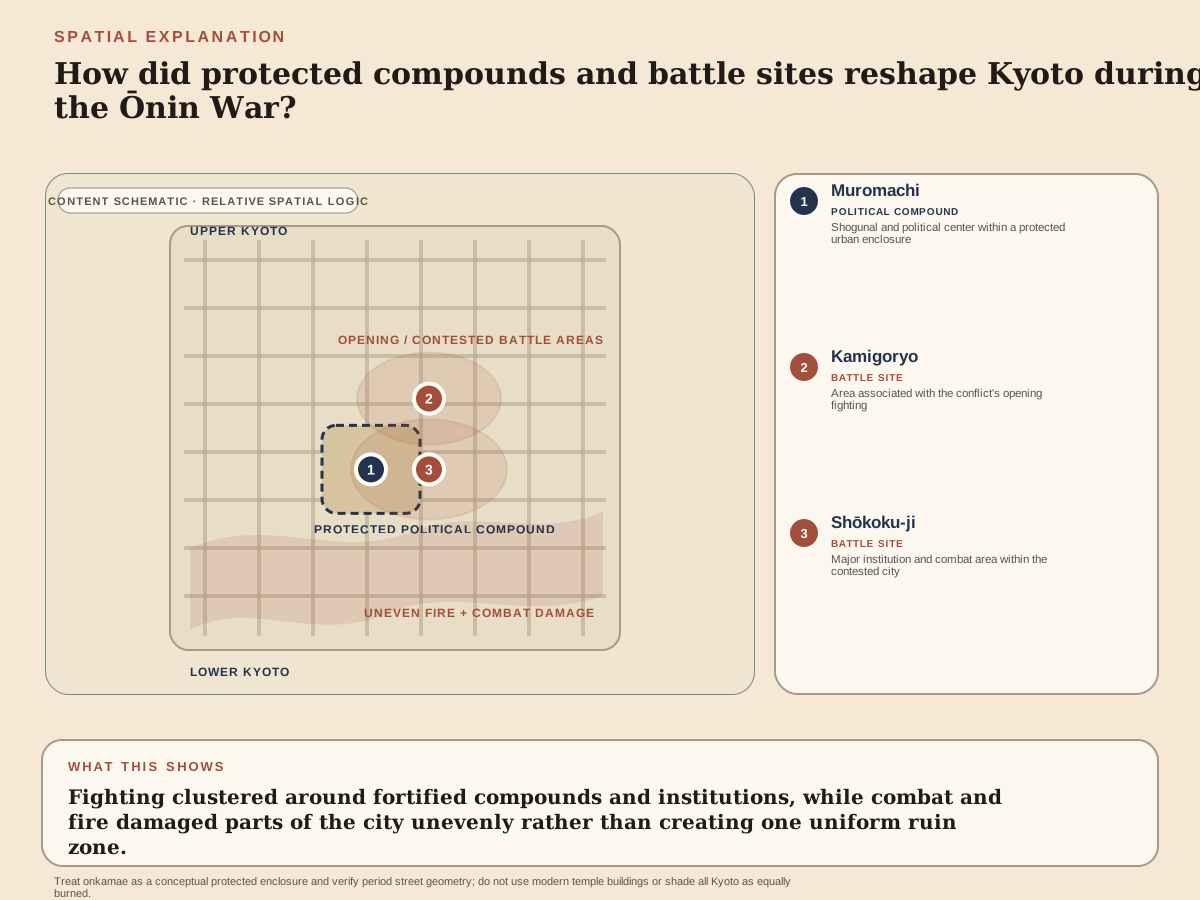
In the first Japanese month of 1467, Masanaga burned his residence and moved to Kamigoryō Shrine. Yoshinari attacked the next day with help from Asakura Takakage and Sōzen’s side. Katsumoto withheld military support. Masanaga’s defeat changed the balance within the Hatakeyama dispute before the general urban war began.
Larger armies gathered over the following months. In the fifth month, attacks around Ichijō and Ōmiya opened sustained fighting between eastern and western coalitions. Katsumoto secured the Hana no Gosho, Yoshimasa’s residence. The reigning Go-Tsuchimikado and retired Go-Hanazono moved there, putting the court and shogun within the eastern camp’s defenses.
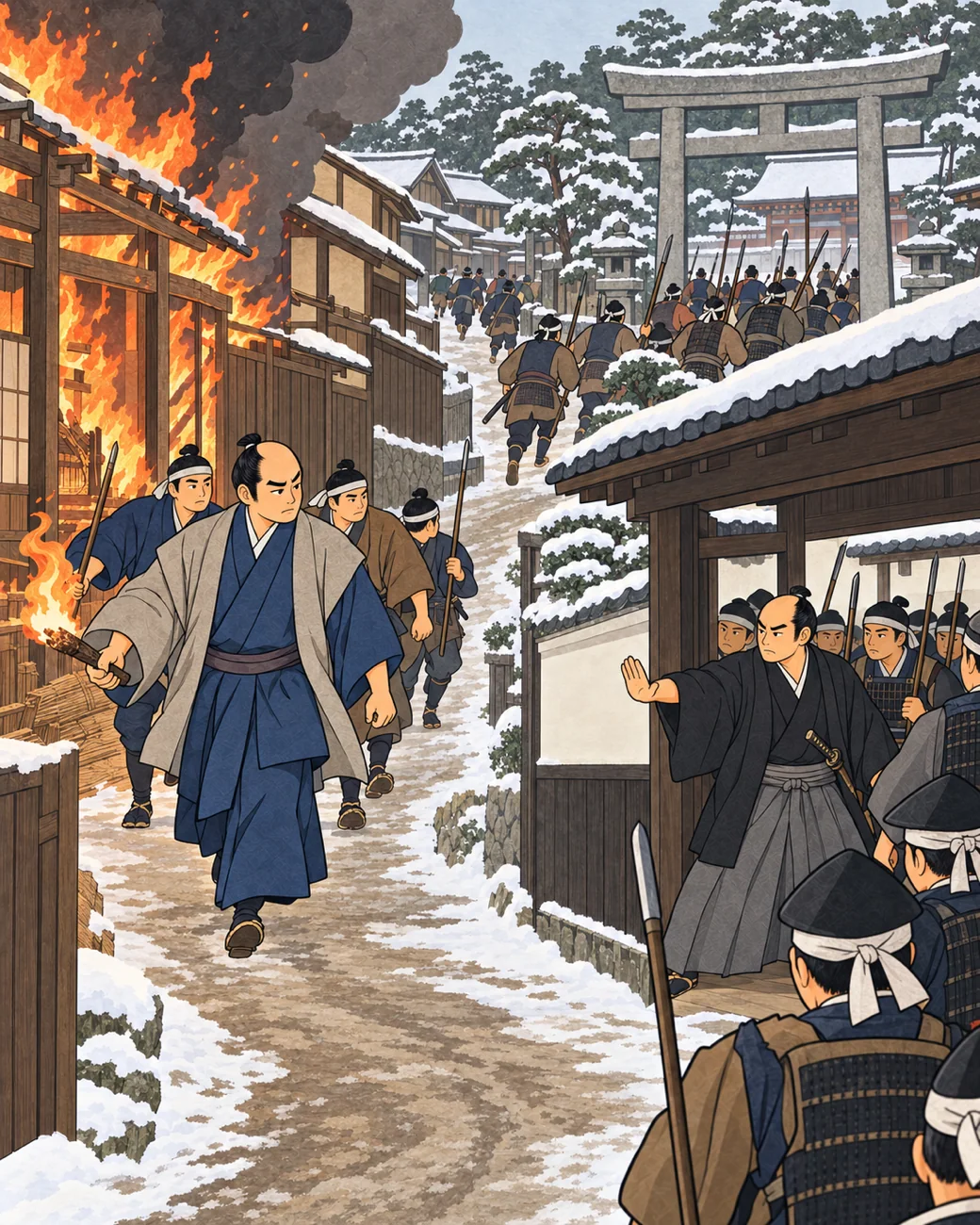
Ōuchi Masahiro entered Kyoto with western reinforcements in the eighth month. Attacks reached the area around Shōkokuji, where major fighting and fire in the tenth month destroyed the temple complex. Residences and religious sites became military positions, while ditches and defensive compounds obstructed movement between districts.
The western side fought around Funaokayama in the following year. Yoshimi joined that alliance in 1468 after earlier flight from Kyoto. His presence gave the western leaders a shogunal candidate as well as their separate family claims.
Ōuchi correspondence preserves part of the machinery behind these campaigns. A 1467 letter commended Niho Hiroari for service at named Kyoto positions. Related correspondence discussed hiring Yamato foot soldiers in Settsu. Recruiting, rewarding and moving followers linked the city’s battles to provincial networks.
The fronts and alliances changed. Asakura Takakage moved to the eastern side in 1471 as his provincial position developed. Fighting spread outside the city, and the struggle required supplies and continued cooperation from followers whose own lands and rivals lay elsewhere.
The eastern and western designations described the position of these coalitions in Kyoto. They did not give every participating house a common political programme. Katsumoto also attacked the western alliance through its provinces: Akamatsu Masanori struck Yamana holdings in Harima, Bizen and Mimasaka, while other eastern allies challenged western governors elsewhere. Pressure on provincial resources could alter the balance inside the capital. Kyoto was a command and recognition center within a war whose recruitment and territorial disputes extended beyond it.
Possession of the shogunal center still carried institutional advantages. Western leaders could be deprived of governorships and replacements appointed from the eastern side. The displaced governors resisted with military forces, so a new appointment did not ensure entry into the province concerned. Orders remained useful to claimants, but holding a title and making its authority operate were different tasks. This helps explain why control of the shogun mattered without bringing a quick settlement.
Defensive construction also changed daily movement. The archaeological lecture's reconstruction describes houses enclosed by ditches about three metres wide, with the shogunal compound fortified. Digging and maintaining such works required labour as well as commanders. Ōuchi letters add evidence of hired foot soldiers and acknowledgement of service at particular positions. They show how recruitment, paid work and military recognition sustained operations; they do not provide a complete roster of those who carried supplies, built defenses or fought.
The same evidence needs limits. The lecture compares excavated ditches and burnt deposits from several periods with maps and the written chronology. A defensive feature may illuminate the changing city without identifying the unit that dug it or the person responsible for a fire. The heavy fighting of 1467, later provincial campaigns and successive changes in occupied space should not be flattened into one uninterrupted battle or one definitive map of destruction.
Sōzen and Katsumoto died in 1473. Their deaths removed the two leading coalition organizers, but did not settle the claims of the Hatakeyama and Ōuchi houses. Yamana Masatoyo and Hosokawa Masamoto made peace in 1474; renewed fighting later that year demonstrated the agreement’s limited reach.
In 1477, Yoshinari left for Kawachi and Masahiro returned toward his western provinces. With those withdrawals, the principal western positions in Kyoto were dismantled. The main urban campaign ended after roughly a decade.
The shogunal government survived. Yoshihisa had received the shogunal commission during the war, and the court continued to appoint rulers and officials. Survival of those institutions did not restore Yoshimasa’s earlier ability to restrain the military governors.
For Kyoto, the result included destroyed buildings, displaced institutions and areas reorganized around defensive positions. Surviving maps, records and archaeology illuminate different phases of occupation; their dates vary, so a later burnt feature cannot automatically be assigned to the opening battles.
The withdrawals did not yield the same result for every western leader. Masahiro regained his provincial appointments, but Yoshinari was not pardoned and continued to build his position by force in Kawachi. The Hatakeyama contest then drew troops into neighboring Yamato and southern Yamashiro. A negotiated end to the main Kyoto positions could coexist with a continuing campaign by a claimant whose status had not been settled.
For people working in the city, displacement interrupted production as well as residence. Kyoto's history of weaving describes artisans from Ōtoneri-chō fleeing to Sakai and other places during the war. Their later return is evidence of recovery and regrouping, rather than proof that every district was ruined throughout the decade. A family could resume a trade while political and military disputes continued elsewhere.
Yoshimasa's later Higashiyama residence belongs to another stage. He began its construction in 1482 on the site of Jōdoji, which had burned in the war and had earlier housed his brother Yoshimi. Building the residence, and later the pavilion known as Ginkaku, drew on continuing ties to Zen clergy and artistic work. This was a dated reuse of damaged religious ground after the main urban campaign, rather than evidence that artistic patronage suddenly replaced government when the opening battles began.
War continued in Kawachi and southern Yamashiro after the armies left Kyoto. The Hatakeyama rivals drew on local support and imposed competing military demands. In 1485, Yamashiro’s provincial league demanded the departure of both armies, responding to a conflict that the end of the Kyoto campaign had not resolved.
Provincial retainers gained opportunities to bargain, change allegiance and consolidate local positions. Asakura Takakage’s trajectory in Echizen shows one connection between service in the wider conflict and a stronger provincial base. Such changes proceeded at different speeds across the country.
Kyoto residents and religious institutions bore the costs of armies occupying an inhabited city. Temple compounds could shelter displaced communities and also become targets. The surviving evidence follows particular locations and institutions rather than establishing one identical experience for every district.
The war is commonly used to mark the beginning of the Sengoku age. Its specific contribution was a prolonged failure to settle powerful houses’ disputes through shogunal decisions, followed by continuing provincial warfare. Earlier conflicts had already weakened central coordination, and later governors still sought appointments and recognition from Kyoto.
The weaving district gives a particular history of rebuilding. Returning artisans formed the Nerinuki guild near the former eastern headquarters at Hakuun village and the Ōtoneri guild around Ōmiya near the former western headquarters. Their rivalry accompanied renewed production. Nishijin, literally 'western camp', survived as a place name recorded in a diary in 1487; the present spread of weaving businesses is wider than that fifteenth-century military position. The name preserves a connection to the war without making today's district a surviving camp boundary.
Cultural networks likewise changed through movement and patronage. Courtiers and monks left Kyoto for provincial bases. Ichijō Norifusa's move to Nakamura in Tosa and the presence of Kyoto Zen clergy in Yamaguchi are specific examples identified by the historical synthesis. Regional patrons gained access to people and learning displaced from the capital. Meanwhile Yoshimasa's later building project in Higashiyama continued to involve Zen advisers and artistic specialists. These developments account for cultural continuity and redistribution; they did not restore the homes or income lost by other residents.
Political fragmentation also concerned who could enforce a decision. Asakura's rise and the Yamashiro league demonstrate different responses: a retainer strengthened a provincial position, while a local coalition demanded that competing armies leave. Neither followed automatically for every province in 1467. Governors, deputies and local warriors continued to use titles and relationships with Kyoto as they sought control on the ground. The war changed the conditions under which those claims could be pursued, leaving the capital's institutions active but increasingly unable to settle the armed disputes around them.