Read the article below. Interactive reading tools are available when scripts load.
Quick
Yamana Sōzen was born in 1404 and originally named Mochitoyo. Before his birth, the Ashikaga shogunate, Kyoto’s military government, had reduced Yamana power in the Meitoku conflict of 1391. In 1433, he inherited leadership from his father Tokihiro and provincial military governorships including Tajima. [1]
Tajima, in what is now northern Hyōgo on the Sea of Japan, was an important Yamana base. As a shugo, a provincial military governor appointed by the shogunate, Sōzen relied on deputies and local warriors to exercise authority. Appointments in several provinces gave him resources for Kyoto politics, but each province also brought disputes of its own.
In 1441 Akamatsu Mitsusuke assassinated Shogun Ashikaga Yoshinori. Sōzen joined the government’s punitive campaign against the Akamatsu. Their defeat and confiscation enlarged Yamana provincial power. He gained resources by serving the shogunate, though displaced Akamatsu interests continued to contest the settlement. Advancing from Tajima, his forces took Kinoyama Castle in Harima, around modern Tatsuno. He gained Harima’s military governorship, extending his authority toward the Inland Sea coast.
Hosokawa Katsumoto married Sōzen’s adopted daughter and became his son-in-law. As kanrei, the shogun’s chief deputy, he sometimes cooperated with Sōzen.
In 1450, Mochitoyo passed household leadership to his son Noritoyo and took Buddhist vows, first as Sōhō and later Sōzen. He remained politically influential. Aka Nyūdō, the ‘Red Monk,’ was his familiar nickname; these names refer to the same man, not successive heads of the household.
In 1458, however, Katsumoto helped restore the Akamatsu house, threatening the settlement that had enlarged Yamana authority. Their kinship did not remove this political dispute.
Hatakeyama Yoshinari and Hatakeyama Masanaga contested leadership of a great warrior house. Sōzen supported Yoshinari; Katsumoto supported Masanaga. The shogun’s changing decisions failed to reconcile their followers. Backing an heir gave each patron an ally, but also tied his standing to a dispute that could be pursued by force.
In the Shiba house, Sōzen supported Yoshikado and Katsumoto supported Yoshitoshi. Yoshitoshi’s restoration to provincial offices in 1466 did not eliminate Yoshikado’s resistance with Yamana backing. Two major house successions—the Hatakeyama and Shiba—therefore brought rival patrons into disputes over recognition and provincial authority.
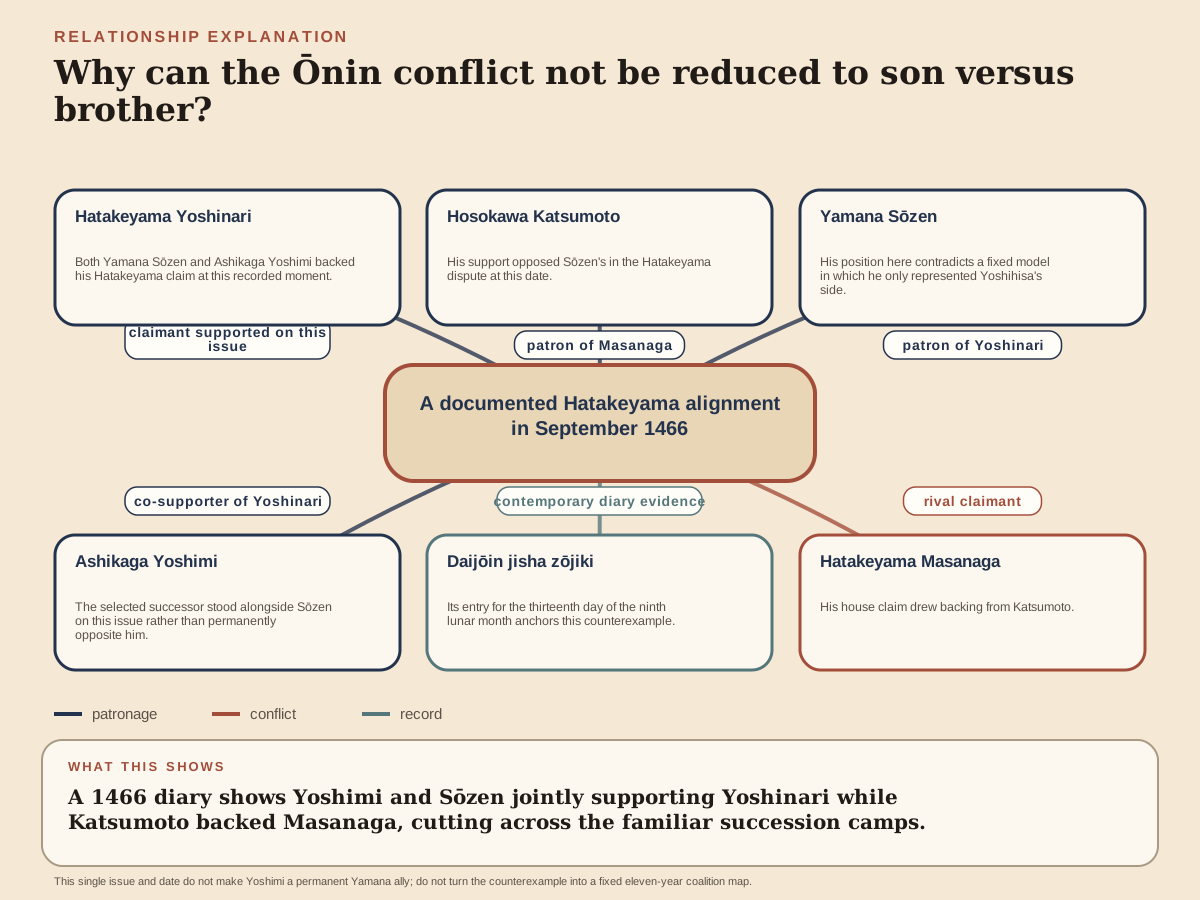
In 1465, Hino Tomiko, wife of Shogun Ashikaga Yoshimasa, bore their son Yoshihisa after Yoshimasa had designated his brother Yoshimi as successor. The familiar story puts Sōzen behind the son and Katsumoto behind the brother. Ienaga Junji challenges that explanation: a 1466 diary instead places Yoshimi alongside Sōzen in supporting Hatakeyama Yoshinari against Katsumoto’s claimant. The child’s birth mattered, but the initial camps were not a fixed son-versus-brother division.
In the grove of Kyoto’s Upper Goryō Shrine, Hatakeyama Yoshinari's side, supported by Sōzen, defeated Masanaga after Katsumoto initially withheld direct aid. The battle did not automatically define eleven years of war. Its significance lay in the armed alignments already assembling and the rapid transition to fortified Eastern and Western coalitions across Kyoto.
Sōzen’s Kyoto residence became headquarters of the Western coalition. Katsumoto’s Eastern coalition gathered around the shogunal position to its east; the labels did not divide all Japan into two territories. Nishijin, ‘western camp,’ survives as the name of Kyoto’s weaving district. The Yamana residence itself was destroyed during the war.
Ōuchi Masahiro brought substantial forces into Kyoto in 1467 and joined the Western side. His powerful western provincial house had resources independent of the Yamana. Sōzen gained military support, while negotiations within the coalition acquired another leader whose concerns extended well beyond Kyoto. Sōzen led a combination of households, each with its own claims, rather than a force whose political terms he could set alone.
Fighting burned neighborhoods, displaced residents and damaged temples and warrior residences. Holding fortified positions let the coalitions continue without settling their political disputes. The residents and institutions of Kyoto bore costs that recognizing an heir could not immediately repair.
Sōzen died in 1473, as did Katsumoto. Surviving commanders continued fighting over claims that neither patron’s death resolved. The Ōnin War conventionally ends in 1477, when major forces withdrew from Kyoto. Provincial conflicts and the city’s recovery continued beyond that date.
Classic
Yamana Sōzen was born in 1404 and was originally named Mochitoyo. He belonged to a warrior house with provincial appointments in the Ashikaga shogunate, the military government based in Kyoto alongside the imperial court. [1]
The Yamana had already experienced expansion and shogunal intervention. In the Meitoku conflict of 1391, before Sōzen’s birth, Shogun Ashikaga Yoshimitsu curtailed the family’s provincial governorships. That was an earlier generation’s defeat, not a punishment imposed on the infant or future Western commander. [2]
In 1433, Mochitoyo succeeded his retiring father Tokihiro and inherited provincial military governorships including Tajima. This gave his leadership an identifiable starting point within the household, decades before the Ōnin War.
Tajima, on the Sea of Japan side of what is now northern Hyōgo Prefecture, was an important base of Yamana power. Sōzen’s influence also extended through appointments and relationships in other provinces. Distance from Kyoto gave his household resources outside the capital and required agents able to act locally. [1]
A shugo was a provincial military governor appointed by the shogunal government. The title mattered, but exercising its authority depended on cooperation from deputies and local warriors. These people had followers and interests that could not be replaced by the wording of an appointment.
In 1441, Shogun Ashikaga Yoshinori was assassinated by Akamatsu Mitsusuke. The shogunal government organized a campaign against the Akamatsu house. Sōzen took part in the punishment that followed. [1]
Sōzen’s force advanced from Tajima into Harima and took Kinoyama Castle, in the area of modern Tatsuno. After the Akamatsu defeat, he received Harima’s military governorship. The appointment extended his authority into the province along the Inland Sea coast south of his Tajima base. His expanded resources came from helping punish the shogun’s assassin. [1]
Redistribution also left displaced interests. Former followers and claimants could seek recovery, and an appointment awarded after victory still required enforcement in the province concerned. The enlargement of Yamana power consequently brought both resources and new points of contention.
Hosokawa Katsumoto married Sōzen’s adopted daughter, making him Sōzen’s son-in-law. Katsumoto headed the leading Hosokawa branch and repeatedly served as kanrei, the shogun’s chief deputy. The two households sometimes cooperated in the central government. [3][4]
In 1450, Mochitoyo passed household leadership to his son Noritoyo and took Buddhist vows. He first used the religious name Sōhō and subsequently Sōzen. Passing the formal leadership and taking vows did not end his political influence. [1]
The change of name is important for following the life. Accounts of earlier campaigns may call him Mochitoyo, while descriptions of the Ōnin War usually use Sōzen. They refer to the same leader at different points in his career.
He also became known as Aka Nyūdō, the ‘Red Monk,’ a nickname associated with his appearance. It supplied later narrators with a vivid character, especially when contrasted with Katsumoto. Physical description, however, cannot explain a decision to support an heir or sustain a coalition. [8]
The partnership deteriorated over the Akamatsu as well as other households. In 1458, Katsumoto helped restore the Akamatsu house whose destruction had enlarged Yamana power in 1441. The restoration threatened the settlement from which Sōzen had benefited. Their marriage connection did not make their interests identical.
The Hatakeyama were a great warrior house whose succession affected provincial appointments and a possible holder of the kanrei office. Yoshinari and Masanaga represented competing claims to its leadership. Each had followers whose standing depended on the outcome.
Sōzen supported Yoshinari. Katsumoto backed Masanaga. The two patrons’ commitments brought larger household resources into a dispute that the shogun was expected to settle. [1][3]
A favorable judgment could authorize a claimant to exercise office and distribute benefits. It could also leave the rejected side with armed supporters and little reason to abandon its claim. Shogunal reversals encouraged another attempt to recover recognition.
The Shiba succession brought a second great house into the dispute. Sōzen supported Shiba Yoshikado, while Katsumoto supported Yoshitoshi. The house held provincial military governorships and belonged to the families eligible for the chief deputyship, so choosing its head affected office and provincial authority together. [1][5]
In 1466, Yoshitoshi was restored to the provincial appointments, but Yoshikado resisted with Sōzen’s support. Ienaga Junji’s research follows this episode as part of a crisis inside the government. The shogun’s ruling did not settle the rejected claimant’s ability to resist when a powerful patron remained behind him. [5]
These disputes overlapped in Kyoto. Sōzen’s protection of Yoshinari and Yoshikado connected the Yamana to two contested successions. A compromise with Katsumoto therefore had to account for allies whose claims could survive a decision against them.
Shogun Ashikaga Yoshimasa had looked to his brother Yoshimi as a successor before his wife Hino Tomiko gave birth to their son Yoshihisa in 1465. A familiar account makes this change the origin of the war: Sōzen would protect the son’s claim, while Katsumoto would support the brother. Some official place descriptions still use that concise narrative. [1][6]
The difficulty is that early political alignments were not so stable. The Hatakeyama and Shiba disputes had already drawn the patrons into conflicts with histories of their own. Yoshimi’s relationships also changed during the war.
Historical disagreement · How did Sōzen’s alliances shape the Ōnin crisis?
Ienaga Junji challenges the story that Tomiko recruited Sōzen to secure Yoshihisa’s succession. One counterexample appears in the Daijōin jisha zōjiki, a contemporary temple diary, for the thirteenth day of the ninth lunar month of 1466. As quoted in his study, Yoshimi and Sōzen supported Hatakeyama Yoshinari while Katsumoto supported Masanaga. Yoshimi was thus alongside Sōzen on this issue, rather than simply the candidate of an opposing camp. [5]
The birth changed succession prospects, but the diary evidence complicates the familiar son-versus-brother explanation. Ienaga’s reconstruction follows commitments within the government; the concise family rivalry story still appears in Kyoto’s public monument descriptions.
The scholarly reconstruction and the commemorative explanation should not be presented as a single agreed account of the outbreak.
In early 1467, the Hatakeyama quarrel erupted in the grove of Kyoto’s Upper Goryō Shrine. Yoshinari’s side, supported by Sōzen, defeated Masanaga. Katsumoto initially withheld direct assistance from the claimant he backed. [7]
The episode exposed the danger of bringing an unresolved inheritance into a city where powerful patrons and armed followers stood close to the shogunal center. A judgment excluding a claimant from office could become a confrontation over the place from which he could still resist.
The encounter conventionally marks the opening of the Ōnin War. It did not instantly settle every participant’s alignment or produce all the later battles. Over the following months, larger coalitions gathered and fortified positions across the city. [7]
Sōzen’s Kyoto residence became a center of the Western army. The location stood west of the shogunal position around which Katsumoto’s Eastern coalition gathered. The names of the armies described this urban geography, rather than two continuous territories covering Japan. [6][8]
The Western headquarters drew allied houses into a densely occupied part of the capital. Their presence gave Sōzen a coordinating role, but each household retained its own leadership and reasons for participating. A residence could provide a common center without creating a single chain of command.
The surrounding area became associated with the name Nishijin, ‘western camp.’ That name survives in the district now famous for weaving. It records the war’s effect on Kyoto’s geography long after the armies themselves disappeared. The Yamana residence itself was destroyed during the war.
The Western army brought together Sōzen’s household, other provincial houses, and succession claimants with followers of their own. It was large because it combined these resources. The same combination limited what its most visible leader could decide for everyone. [1]
An allied lord could have troops in Kyoto while disputing a possession in his province. A claimant might accept no settlement that excluded him from the inheritance he had come to recover. Sōzen’s willingness to negotiate could not erase those objectives.
Ōuchi Masahiro joined the Western side in 1467, bringing substantial forces and connections to western provinces. He headed a powerful house with resources independent of the Yamana. His participation altered the military balance in Kyoto. [1]
Western strength grew through this addition, while the coalition’s political requirements grew with it. Masahiro was not simply a reinforcement that Sōzen could dismiss when his own objective was satisfied. He remained an important participant even after the leading Yamana and Hosokawa patrons died. The later history of the conflict depended on such surviving leaders and on the settlements they could accept.
Fighting damaged large areas of Kyoto without giving either coalition an enduring decision over the political disputes. Temples and warrior residences became defended positions. Fire and violence reached the neighborhoods around them, displacing inhabitants who had no part in choosing the rival heirs. [8]
The capital’s density made military endurance costly to the surrounding society. Securing a position could help a coalition survive while damaging the city whose government its leaders sought to influence. Religious and court institutions faced losses that could not be repaired simply by recognizing a claimant.
Sōzen bears responsibility for leading a side in this conflict. Responsibility does not require attributing every action of every allied household to his personal order. The coalition’s dispersed leadership helps explain both its ability to persist and its difficulty in reaching a conclusive settlement.
Sōzen died in 1473. Katsumoto died in the same year, removing the two leaders most closely associated with the Western and Eastern armies. Their successors and surviving allies continued to confront the disputes that had brought them into the war. [1][8]
Neither death canceled provincial occupations, inheritance claims, or the commitments of independent commanders. The coalitions lost senior coordinators, but their participants still possessed followers and objectives.
The sustained confrontation conventionally known as the Ōnin War continued until 1477. Its end marked the departure and dispersal of the major forces in Kyoto, not the immediate recovery of the city or the resolution of every regional struggle.
His historical importance therefore reaches beyond the image of an elderly commander. Sōzen shows how provincial power, recognized and rewarded by the shogunate, could later be used to resist decisions inside its capital. He led that transformation while remaining dependent on allies he could not control completely.