Map: GSI Japan Shōkoku-ji was founded by Ashikaga Yoshimitsu at the end of the fourteenth century as a major Zen monastery beside the imperial palace. It stood near the center of shogunal religion, Zen administration, Five Mountains scholarship, and ink painting, but repeated fires and warfare erased its original buildings. The current precinct is a layered reconstruction: a 1605 Dharma Hall, a bathhouse dating to around 1596, nineteenth-century abbatial and founder halls, active subtemples, archaeological traces of a much larger complex, and the Jōtenkaku Museum. The site is also a battlefield of the Ōnin War, not only a serene survivor of Muromachi culture.
Yoshimitsu's Great Zen Foundation beside the Imperial Palace
Attraction
Ashikaga Yoshimitsu initiated Shōkoku-ji in the 1380s and completed its formal foundation in 1392, naming Musō Soseki as founding master. The monastery stood immediately north of the imperial palace and occupied an enormous area said to contain more than fifty subtemples. Its proximity to court households and the admission of aristocratic sons helped bind shogunal, monastic, and court society. No foundation-period building survives, so the scale must be recovered through documents, archaeology, street pattern, and the much reduced modern precinct. The surviving institution nevertheless preserves Yoshimitsu's deliberate attempt to place disciplined Zen practice and shogunal patronage at Kyoto's political center.
Current visibility
The active monastery occupies part of the former precinct; the original late-fourteenth-century buildings and full extent do not survive above ground.
Five Mountains Rank, Monastic Administration, and Cultural Production
Attraction
Shōkoku-ji became one of Kyoto's leading Five Mountains monasteries and housed the Sōroku office that supervised important parts of Zen administration. Its monks operated in diplomacy, literary composition, education, and the circulation of Chinese learning as well as religious training. The monastery and its subtemples also nurtured figures associated with ink painting, including Josetsu, Shūbun, and Sesshū, and preserved works tied to Five Mountains poetry and calligraphy. This institutional network matters more than treating Zen art as decoration isolated from politics. Texts and paintings emerged from trained communities that moved between monastic discipline, shogunal service, elite patronage, and international cultural exchange.
Current visibility
The institutional history is interpreted through the living monastery and museum collections; historic offices and workshops are not continuously open exhibits.
Shōkoku-ji as an Ōnin War Battlefield
Attraction
In 1467 the monastery stood inside the military geography of the Ōnin War. Hosokawa forces used the area, and fighting at Shōkoku-ji destroyed most of the complex. The loss was not a background accident separate from Kyoto politics: a large, walled, strategically placed institution could provide space, shelter, and a defensible position within the capital. Archaeology in the former precinct has helped recover the scale and burned history of land now divided among temple, university, streets, and later buildings. Reading the site as a battlefield corrects the peaceful image of an unbroken Zen enclave and links its subsequent reconstruction directly to the fragmentation of Muromachi authority.
Current visibility
Battle damage and former precinct extent are known from records and archaeology; no 1467 defensive structure remains as a standing exhibit.
The 1605 Dharma Hall and Kanō Mitsunobu's Dragon
Attraction
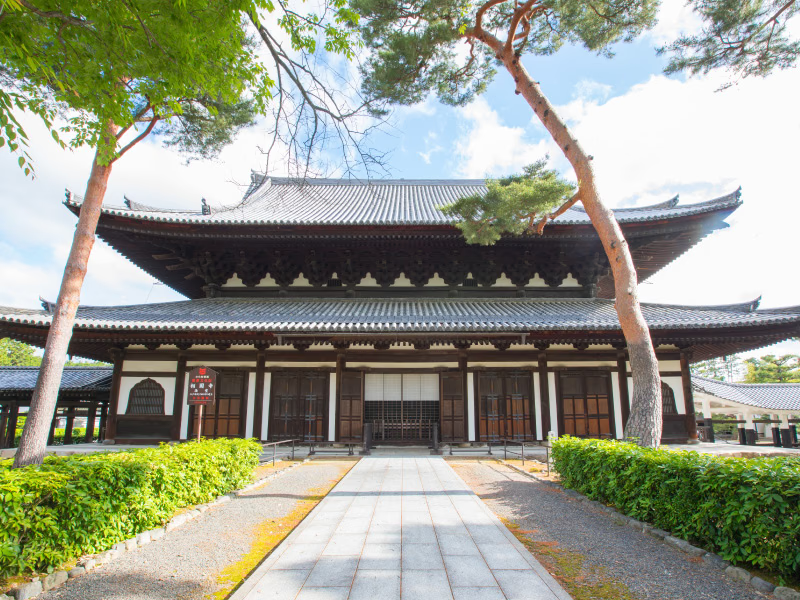
The Dharma Hall, or Hattō, was rebuilt in 1605 with patronage from Toyotomi Hideyori and is regarded by the temple as Japan's oldest surviving Hattō. It is also the oldest standing major building at Shōkoku-ji, not a remnant of Yoshimitsu's foundation. Kanō Mitsunobu painted the large coiled dragon within a circular field on the ceiling. The hall's acoustics helped create its popular identity as a 'crying dragon,' but the work is more than an acoustic novelty: painting, architecture, ritual voice, and the authority of a rebuilt Zen teaching hall meet in one space. Interior viewing is normally tied to announced special-opening periods.
Current visibility
The exterior stands in the precinct; access beneath the ceiling painting and into the hall is generally associated with special viewing periods and current temple rules.
The 1807 Hōjō, Founder Hall, and Reused Court Architecture
Attraction
After the Tenmei fire of 1788 spared the Dharma Hall but destroyed much of the precinct, Shōkoku-ji rebuilt its Hōjō, kitchen, and Founder Hall in the early nineteenth century. The present Hōjō dates to 1807 and is unusually large, with gardens that combine dry landscape design and practical drainage. The Founder Hall incorporates a former palace building of Empress Dowager Kyōrei-mon'in, transferred and adapted for images of Musō Soseki, Yoshimitsu, and other figures. These are not generic old halls. One represents abbatial and communal space rebuilt after urban disaster; the other shows the conversion of court architecture into a monastic memorial interior.
Current visibility
The buildings stand, but their principal interiors and gardens are normally viewed during announced special openings rather than assumed to be continuously accessible.
Senmyō, the Zen Monastic Bathhouse
Attraction
Shōkoku-ji's bathhouse is called Senmyō, a name tied to Song-dynasty models of Zen monastic architecture. The present building dates from around 1596 and was restored in 2002. A bathhouse in a Zen monastery was part of regulated communal life, joining bodily cleanliness, work, fuel, water, and ritual discipline; it was not a leisure spa. Its survival adds an often overlooked institutional function to the better-known teaching and abbatial halls. Because the building is not a continuously open public facility, its value lies in the exterior and the monastic system it represents rather than in promising that visitors can enter or see historic bathing equipment on demand.
Current visibility
The bathhouse stands in the precinct, but interior access is limited to selected openings and it is not an operating public bath.
Jōtenkaku Museum and the Collections of a Wider Temple Network
Attraction
Jōtenkaku Museum was founded in 1984 to preserve, research, repair, and exhibit treasures associated with Shōkoku-ji and its temple network, including Kinkaku-ji and Ginkaku-ji. Its holdings range across calligraphy, Five Mountains literature, ink painting, tea utensils, and early-modern artists such as Itō Jakuchū, Maruyama Ōkyo, and Hasegawa Tōhaku. This concentration makes the museum an essential counterpart to the reduced precinct: movable works preserve relationships that repeated fires erased from architecture. Displays rotate, however, and the existence of a famous object in the collection does not mean that it is on view. Exhibition dates and changeover closures must be checked directly.
Current visibility
The museum is a public facility, but exhibitions rotate and temporary closure for installation occurs; specific objects require a current check.
A Working Head Monastery, Not a Fully Open Monument
Attraction
Shōkoku-ji remains the head temple of a Rinzai Zen branch, and its precinct includes training, offices, active subtemples, worship, and periodic public programs. The main path and building exteriors can be encountered without assuming that every doorway leads to an exhibition. Special openings typically make selected combinations of the Dharma Hall, Hōjō, Founder Hall, or bathhouse available, while the museum follows its own calendar. This access pattern is part of the site's meaning. The monastery has not been converted wholesale into a tourist museum; public interpretation operates alongside religious use, residential privacy, conservation, and a living institutional hierarchy.
Current visibility
The outdoor precinct is generally legible, but interiors, subtemples, programs, and museum galleries operate under separate current schedules.