Read the article below. Interactive reading tools are available when scripts load.
Quick
Hino Tomiko was born in 1440 into a Kyoto court family whose daughters married Ashikaga shoguns, the military rulers appointed by the emperor. Her father was Hino Masamitsu. Hino property near the commercial Shijō and Rokkaku areas connected the family with sake brewers and dosō, storehouse financiers who lent money against pledged property. Her brother Hino Katsumitsu would gain unusually high court rank and represent shogunal interests. Tomiko could obtain influence through marriage, property and household contacts without holding a government office. [1][2][3][12]
Tomiko married the reigning eighth shogun, Ashikaga Yoshimasa, in 1455 as his principal wife. A child born in 1459 did not survive; accounts differ about its sex and whether it was stillborn or died soon afterward. A curse accusation attached the loss to the influential attendant Ima-mairi no Tsubone, followed by her removal and death in differing accounts. The accusation does not establish supernatural harm or a murderous order by Tomiko. The household still lacked a surviving son to settle its succession. [1][9]
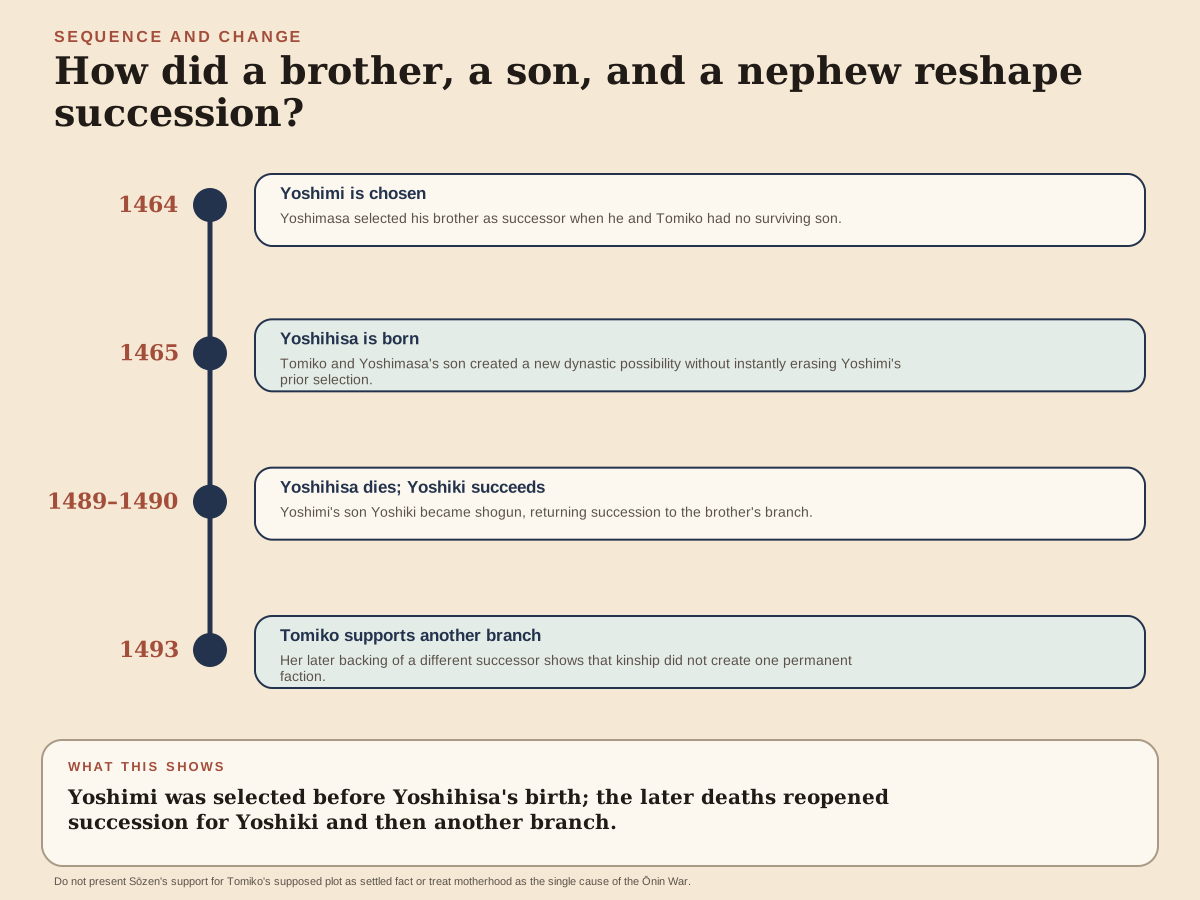
Yoshimasa recalled his brother Yoshimi from religious life as a successor in 1464. Yoshimi married Tomiko's full sister Yoshiko. Tomiko then bore Yoshihisa in 1465, making the future of both sisters' households part of the succession. [1][3][8][11]
An influential version of Ōninki, a later war narrative, says Tomiko enlisted the powerful provincial lord Yamana Sōzen against Yoshimi for her son. Historian Ienaga Junji instead interprets Yoshimi as a possible transitional ruler before the next generation inherited, emphasizing the continuing marriage and succession arrangements. This source-based challenge makes the maternal conspiracy a disputed explanation, not an established cause of war. [3][7]
In 1466 Yoshimasa's household administrator Ise Sadachika urged action against Yoshimi, but pressure from major provincial military governors forced Sadachika out. A diary report also connects Tomiko with a change of documentary official; its purpose remains open to interpretation. [1][3][13]
Rival claimants in the Hatakeyama and Shiba houses had their own provincial interests. Hosokawa Katsumoto and Yamana Sōzen supported competing forces. Fighting in Kyoto in 1467 became the Ōnin War, with Hosokawa's eastern coalition holding the shogunal center against Yamana's west. Yoshimi initially stood in the east before joining the west; the east protected Yoshihisa. The camps were not a permanent division arranged by Tomiko. [3][7][9][13]
During the war, Tomiko lived at the eastern-controlled Muromachi Palace. Earthworks sheltered the court and elite households, but crowding, disease and fire affected even the defended area. Residents outside it had less protection. [9][13]
Yoshihisa became shogun in 1473 while still a child. Tomiko and Katsumitsu handled household political business. Historian Torii Kazuyuki interprets much of it as representation of Yoshimasa, who retained powers after giving up the title. Katsumitsu died in 1476; the palace burned that year, and mother and son moved to Ogawa. Forces withdrew from Kyoto in 1477 without restoring stable central authority. [1][2][9]
In 1477 the Kōfukuji monk Jinson recorded Tomiko's exceptional cash holdings and loans at interest to military lords. Borrowers gained resources while becoming indebted to her household. [1]
Rice-warehouse activity has competing readings: private speculation, or work directed by shogunal authority. Takagi Tokurō's commentary proposes a possible role in provisioning armies returning home, without establishing that purpose conclusively. Kyoto toll gates invoked imperial-palace repair, but a 1480 report accused Tomiko of appropriating revenue; townspeople destroyed the gates. The resistance exposed a conflict between the government's demands for revenue and the people required to pay. [9][10]
Ichijō Kaneyoshi prepared Shōdan Chiyō, a guide to government, for Yoshihisa in 1480. Tomiko supported court learning but did not author the work. She also participated in poetry; Jinson's 1477 entry records Sōgi carrying assessments of poems by her and Yoshimasa. [1][5]
In 1482 Yoshimasa announced his son's personal administration. Torii reconstructs a phased transfer of property and financial jurisdiction from 1483, leadership by 1486 and remaining powers around the 1487 campaign. Tomiko retained property and contacts as her administrative role narrowed. The cultured-husband, greedy-wife contrast obscures the financial and political responsibilities of both households. [2][12]
Yoshihisa marched into Ōmi, the province around Lake Biwa east of Kyoto, in 1487. Rokkaku Takayori was accused of taking lands of temples, courtiers and shogunal clients; restoring them would demonstrate the young ruler's authority. His Magari headquarters became a mobile center of government, but resistance prevented a quick settlement. [6]
Yoshihisa died there in 1489, described in reference biographies as ill rather than killed in battle. He left no child. Tomiko lost her strongest dynastic connection to government but retained wealth and kinship with possible successors. [6][10]
Tomiko supported her nephew Yoshiki, son of Yoshimi and her sister Yoshiko. After Yoshimasa's death in 1490, Yoshiki became the tenth shogun. Biographies describe her taking Buddhist vows after these losses; later political action shows that vows did not end her influence. [3][8][9][10][11]
She also maintained Ogawa connections with Seikō, a cleric from another Ashikaga branch favored by the military leader Hosokawa Masamoto. Yoshimi had much of Ogawa demolished and Tomiko's estates seized or restricted. Supporting her nephew had not protected her household. Yoshimi died in 1491; the conflict helped prepare a change of alliance. [9][11]
In 1493 Yoshiki campaigned in Kawachi, around present-day eastern Osaka, with Hatakeyama Masanaga. His absence let a Kyoto coalition replace him. Tomiko joined Hosokawa Masamoto and Ise administrative officials in elevating Seikō, who became shogun Yoshizumi. [4][8][11]
Attacks on Tomiko's property help explain her participation, but Masamoto supplied the essential military force and had interests of his own. Masanaga was defeated and died; Yoshiki was captured, then escaped. Rival Ashikaga lines continued contesting the title. Tomiko had helped depose her sister's son a few years after supporting him. [8][9][11]
Tomiko died on the twentieth day of the fifth month of 1496 in the traditional Japanese calendar, in her mid-fifties, or fifty-seven by the inclusive count. Her estate attracted comment for its treasures, without establishing a reliable later valuation. [1][10][11][12]
Her image hardened after death. Thomas Conlan's study identifies the 1893 History of the Empire of Japan and the 1912 Ashikaga jūgodaishi as histories following Ōninki's influential account. Maternal ambition became a compact explanation for war. Her documented lending, contested tolls and participation in the 1493 coup give a fuller account of influence and its costs. [4][7]
Classic
Hino Tomiko was born in 1440 into a Kyoto court family whose daughters repeatedly married Ashikaga shoguns, the military rulers appointed by the emperor. Her father was Hino Masamitsu. The Hino ranked below the greatest aristocratic houses, yet court service and marriages gave them access to the warrior government. The mother of her future husband, Ashikaga Yoshimasa, was Hino Shigeko, a member of the same extended family. Tomiko's eventual marriage would continue an established connection. [1][12]
The family's resources reached beyond court rank. Hino property lay around Shijō and Rokkaku, commercially active parts of Kyoto where sake brewers and storehouse financiers did business. These financiers, called dosō, lent money against pledged property as well as storing valuables. Relations with them helped court households obtain cash when income from landed estates was irregular. A palace ceremony or the upkeep of a residence depended on people collecting rents, arranging credit and delivering goods. [1][12]
Her brother Hino Katsumitsu would rise to unusually high court rank and become an intermediary in shogunal business. Tomiko's route to influence was different. A principal wife could hold property, maintain attendants and receive people seeking access to her husband. Becoming mother of an heir could make that residence a center of political negotiation. These activities did not give her a province to govern or a military office of her own. [1][2][3]
The family supplied opportunities and obligations together. Tomiko would depend on relatives and household agents even when wealth gave her considerable room to act. Her sister's later marriage would extend the Hino connection into another Ashikaga branch, creating relationships that could survive a succession dispute. Nothing in the surviving account of her childhood establishes a private ambition to rule. What it does establish is the setting from which a court family's daughter could enter the shogunal household. [1][3]
In 1455 Tomiko married Ashikaga Yoshimasa, the reigning eighth shogun. As his principal wife, she entered the household from which the next head of the military government might come. The marriage gave her precedence among its women, but it did not make the residence a modern exclusive marriage. Yoshimasa had other attendants and partners; the standing of a child's mother, recognition by the father and survival all mattered to succession. [1]
Four years later, accounts record the loss of a newborn. Their details differ: some describe a boy, others a girl, and the distinction between stillbirth and death soon after birth is not consistently preserved. The secure biographical point is that Tomiko did not emerge from the episode with a surviving heir. The absence of a son continued to trouble the shogunal succession.
A curse accusation attached the loss to Ima-mairi no Tsubone, a woman with longstanding influence over Yoshimasa. Accounts connect the accusation with her removal and death, though they differ over punishment, exile and the sequence of events. Ritual harm was taken seriously in this society; an accusation could also remove a rival source of access to the ruler. It should not be accepted as the cause of the infant's death. [9]
Tomiko's responsibility is harder to establish than the accusation's existence. Biographical retellings sometimes turn her into the author of a murderous household plot. They do not provide a secure basis for reconstructing an order or a private conversation. Yoshimasa's authority over his household also disappears when the episode is told solely as a quarrel between jealous women. The loss left Tomiko's position as principal wife intact, but no surviving child supplied a clear successor. By the early 1460s, another Ashikaga branch had become a practical answer to that problem. [9]
With no surviving son, Yoshimasa recalled his younger brother Yoshimi from religious life in 1464 and brought him into the succession. Yoshimi had been attached to Jōdoji, a Buddhist temple. Returning to secular life meant acquiring the household and relationships of a prospective warrior ruler. Tomiko's full sister Hino Yoshiko became his wife, joining the two brothers' residences through the Hino sisters. Their son Yoshiki, later known as Yoshitane, would eventually become another candidate for the shogunal title. [3][8][11]
Tomiko gave birth to Yoshihisa in 1465. The child created a direct maternal interest in the next generation, but his birth did not immediately settle what would happen to Yoshimi. An adult successor and a future generation of children could still be accommodated in more than one sequence. The sisters' marriage ties made this a connected dynastic problem, rather than two unrelated households confronting one another. [1][3]
Historical disagreement · How did Tomiko figure in the succession dispute?
There are competing explanations of that succession. An influential version of Ōninki, a later war narrative surviving in different textual forms, says Tomiko sought the support of the powerful provincial lord Yamana Sōzen against Yoshimi to secure her son's future. That account helped establish her reputation as the woman who started the Ōnin War. Historian Ienaga Junji instead reads contemporary succession arrangements as allowing Yoshimi a transitional tenure before a younger generation inherited. He also emphasizes Yoshimi's connections with Sōzen and the marriage to Yoshiko, relationships that sit awkwardly with a plan for Sōzen to destroy him.
Decisions by Yoshimasa and powerful lords soon entangled the succession with disputes over offices and other warrior houses.
Ise Sadachika, a close household administrator of Yoshimasa, helped bring the succession crisis into the open in 1466. He urged action against Yoshimi, alleging misconduct serious enough to justify removing him. Major provincial military governors opposed that course. Sadachika lost his position and left Kyoto, demonstrating that proximity to Yoshimasa could not overcome every coalition around the designated successor. [3][13]
Tomiko's involvement can be located more precisely than a secret plan to start a war. Ienaga examines a diary report connecting her request to the replacement of an Iio family documentary official by his elder brother after Sadachika's fall. He interprets the change in the context of Yoshimi's protection and overlapping Hino and Yamana ties. The reported intervention establishes a particular personnel action; its motive remains a reconstruction. [1][3]
Meanwhile, the Hatakeyama and Shiba houses had succession struggles of their own. Hatakeyama Masanaga and Yoshinari contested leadership in one house; Shiba Yoshitoshi and Yoshikado in the other. These were provincial powers with armies and clients. Hosokawa Katsumoto and Yamana Sōzen supported competing interests, drawing their disputes into the center of government. Katsumoto's position as a leading deputy to the shogun did not enable him to make Sōzen's clients submit. [3][13]
Fighting in Kyoto in 1467 developed into the Ōnin War. The Hosokawa-led eastern coalition held the shogunal center; the Yamana-led western coalition challenged it. Yoshimi initially remained with the eastern center and attempted mediation, but suspicion and changing alliances eventually brought him to the west as its alternative shogunal authority. The east came to protect Yoshihisa. These alignments cut across the familiar picture of Sōzen defending Tomiko's son against a permanently Hosokawa-backed Yoshimi. The succession was now part of a struggle whose participants had their own armies, provincial interests and reasons to continue fighting. [3][7][9][13]
Tomiko spent the war at the eastern-controlled shogunal center in Kyoto. Earthworks and a moat enclosed the area around the Muromachi Palace. The emperor, retired sovereign and other elite households found shelter there, alongside wealthy townspeople. Protection was unequal: outside the defended zone, many residents lost houses or had to flee, while armed men disrupted the routes carrying food into the capital. [9][13]
The enclosure itself offered no complete refuge. Crowding, disease and fires affected the people within it. Tomiko's household continued to require attendants, provisions and funds, and her property income depended on a city being damaged around her. Credit and household administration could help keep a governing center in operation. They did not give her command over all the eastern armies. [13]
Historical disagreement · Whom did the Hino administration represent?
In 1473 Yoshimasa gave the shogunal title to the still-young Yoshihisa. Adults continued receiving petitions and conducting business. Tomiko's position as the child's mother made her an important point of access; Katsumitsu added public rank and representation. The historian Torii Kazuyuki interprets the Hino administration as largely representing Yoshimasa, who retained practical powers after surrendering the title, rather than simply acting as regents for Yoshihisa.
This distinction leaves room for Tomiko's substantial activity without assigning every governmental function to her. [1][2][12]
Katsumitsu died in 1476. In the same year the Muromachi residence burned, forcing Tomiko and Yoshihisa to move to Ogawa, another Kyoto residence. She lost an important male intermediary as the household reassembled its affairs at a new site. Documents, attendants and property claims could move with a ruling family; many city residents had far fewer means of recovering from a fire. [9][13]
The war ended in 1477 as major forces withdrew from Kyoto. It left the shogunal household functioning, but did not restore the central government's former ability to impose decisions throughout the provinces. Recovery would bring requests for money and restored property to a household whose own resources and relationships had been altered by a decade of fighting.
In 1477 Jinson, a monk of Kōfukuji in Nara, recorded Tomiko's extraordinary holdings of cash and her loans at interest to military lords. He was a connected observer writing from a temple with property interests of its own. His entry helps locate her financial power at the end of the war, when a lord might need money before he could collect revenue from damaged or contested estates. [1]
Cash lent from her household gave borrowers resources to act and left them owing interest. Clerks and agents were part of such business; her wealth did not operate apart from the relationships that enabled repayment. Public and household purposes could overlap when money supported shogunal clients or court recovery while strengthening her own financial position. [1]
Historical disagreement · What was Tomiko’s rice warehouse for?
The same diary material has produced different readings of a rice warehouse. Older accounts treat it as evidence of private speculation. Takagi Tokurō's commentary notes wording indicating an instruction from Yoshimasa or the shogunal authority, and proposes that the grain might have helped provision armies returning home.
That possible peace-related purpose remains an interpretation, not an established account of every shipment or sale. The disagreement matters because the same activity can look quite different when its directing authority changes. [1][12]
Toll collection around Kyoto brought a more visible confrontation. Gates raised revenue for purposes including imperial-palace repair. A 1480 diary report accused Tomiko of appropriating the proceeds, and townspeople destroyed the gates. Repair tolls were not her invention, but their claimed public purpose did not make the burden acceptable to those required to pay. [9][10]
Tomiko also used money to support shogunal business and court recovery. Her public spending did not remove the burden imposed on the people paying tolls. Later estimates of sixty or seventy thousand kan, units of monetary account, should likewise not be treated as a verified inventory of her fortune. Her access to cash was consequential enough without converting it into a sensational modern valuation.
The court scholar Ichijō Kaneyoshi prepared Shōdan Chiyō, a guide to government, for Yoshihisa in 1480. The young shogun's request gave an experienced aristocrat an opportunity to explain rule after civil war. Tomiko's support for court learning formed part of the patronage setting. Kaneyoshi remained the author, addressing the young shogun's responsibilities rather than setting out a program in Tomiko's name. [1][5]
Tomiko's household also belonged to the city's literary world. Jinson's 1477 entry, discussed by Takagi, records the poet Sōgi bringing assessments of poems by both Yoshimasa and Tomiko to Nara. Her financial and family responsibilities did not exclude participation in learned culture. Yoshimasa's celebrated Higashiyama residence, meanwhile, depended on revenue and other people's work. The later pairing of an artistic husband with a culturally empty, greedy wife obscures their intersecting responsibilities. [1][2][5][12]
The practical division of government changed as Yoshihisa grew older. In 1482 Yoshimasa announced that his son would take personal responsibility for administration. Torii reconstructs a phased transfer: broad property jurisdiction, apart from specified Zen Buddhist temple matters, and finance from 1483; leadership duties by 1486; remaining powers around the military expedition of 1487. Land disputes and appointments required officials, documents and enforcement as well as a title. [2][12]
That sequence shows how much authority Yoshimasa had retained. It also explains the narrowing of the administrative role conducted through the Hino household. Petitioners could increasingly approach Yoshihisa's own officials. Tomiko nevertheless still held property, outstanding loans and relationships that did not disappear when a function moved elsewhere. [2]
Husband and wife could maintain partly separate accounts and operate from different residences while both drawing on shogunal relationships. The record supports cooperation and competing interests more readily than a private drama of an artist escaping a grasping spouse. By the time Yoshihisa left on campaign, the household that had sustained his childhood government was facing a ruler with powers and clients of his own. [12]
In 1487 Yoshihisa led an expedition into Ōmi, the province around Lake Biwa, east of Kyoto. Rokkaku Takayori was accused of encroaching on lands belonging to temples, courtiers and shogunal clients. Restoring those rights would demonstrate the young shogun's authority over a provincial lord. The campaign followed the transfer of responsibilities that had made Yoshihisa more than a titleholder. [6]
At Magari, his headquarters became a mobile center of government. Audiences, documentary business and ceremonies continued while the army remained in the province. Campaign-site research describes cultural gatherings there as well. The ruler had brought the work of government into the field, where cooperation from other warrior houses still mattered. [6]
Rokkaku resistance prevented a quick settlement. As elsewhere in the late Muromachi government, assembling a coalition did not ensure lasting control over a lord's local networks. Money and supplies from Kyoto mattered to the campaign, but Tomiko's general financial position does not establish that she personally directed each payment. Yoshihisa now had administrative resources of his own.
He died at Magari in 1489, leaving no child to follow him. Reference biographies describe illness in the camp, rather than death in battle. For Tomiko the loss ended the direct succession she had helped sustain from infancy. [6][10]
Yoshimasa was still alive. His brothers' descendants offered alternatives, including Yoshiki, the son of Yoshimi and Tomiko's sister Yoshiko. Another possibility was Seikō, a cleric from the branch of Yoshimasa's brother Ashikaga Masatomo. Their eligibility gave Tomiko continuing dynastic connections, though none restored her position as mother of the reigning shogun. Property, credit and experience remained resources she could bring to the choice of a new ruler. [9][11]
Tomiko supported Yoshiki after Yoshihisa's death. Her nephew's father, Yoshimi, had once been Yoshimasa's designated successor; his mother was Tomiko's full sister. Elevating him could preserve the Ashikaga succession through the other Hino marriage. The family connection that had complicated the earlier succession now offered a way to continue it. [3][8][9][11]
Yoshimasa died in the first month of 1490, and Yoshiki became the tenth shogun later that year. Biographical accounts describe Tomiko taking Buddhist vows after these losses. Religious status did not extinguish her property or end her participation in Ashikaga politics. She remained a senior household figure with assets and kinship the new government could not simply disregard. [8][9][10][11]
Seikō represented another eligible branch. He was Masatomo's son and would later take the name Yoshizumi. Hosokawa Masamoto, a powerful military leader, favored him. Tomiko also provided space or protection associated with the youth at Ogawa. Such an arrangement could keep a possible successor available while appearing to threaten the branch already in office. [9][11]
Yoshimi reacted against that alternative center. Accounts describe the demolition of much of Ogawa, while distinguishing Tomiko's own quarters, and the seizure or restriction of her estates. The residence had housed her and Yoshihisa after the 1476 fire. Attacking it and the income supporting it threatened more than a building: it put pressure on her ability to sustain a household and maintain clients. [9][11]
The new succession had therefore not guaranteed security for its supporter. Yoshimi died in 1491, but Tomiko's relationship with her nephew's government remained vulnerable. The material conflict helps explain her later alliance with Masamoto without establishing a single private motive for every decision. Kinship supplied a route to influence; it could not ensure that an appointed ruler's branch would protect all her interests. [9]
In 1493 Yoshiki was campaigning in Kawachi, a province around what is now eastern Osaka, alongside Hatakeyama Masanaga against a rival branch of that house. His absence gave opponents in Kyoto an opportunity to replace him. Tomiko joined the coalition only a few years after supporting her nephew's succession. Her involvement in this coup is more securely documented than the familiar claim that she secretly engineered the origins of the Ōnin War. [4][8][11]
Hosokawa Masamoto supplied the essential military power. He opposed Yoshiki's policy and had long favored Seikō. Ise Sadamune and associated officials brought administrative connections; Tomiko contributed seniority, resources and household relationships. The Kyoto coalition elevated Seikō, who emerged from religious life as the shogun Yoshizumi. [4][8][9][11]
Property conflict helps explain Tomiko's change of alliance. Yoshimi's branch had attacked Ogawa and her estates. Supporting Yoshiki had not protected her material base, while Masamoto offered another route into the succession. Those circumstances do not establish that the coup was solely her revenge. Masamoto had his own clients and concerns about the Hatakeyama balance, and officials had interests in the government they were helping install. [9][11]
Recognition at the center changed the prospects of Yoshiki's forces. Men reconsidered their allegiance; Masanaga was defeated and died. Yoshiki was captured and confined, then escaped. Losing Kyoto did not erase his dynastic claim. The result was a division between rival Ashikaga lines: Yoshiki, later called Yoshitane, would return to office, while Yoshizumi's branch also supplied successors. [8][11]
Tomiko died in 1496, on the twentieth day of the fifth month in the traditional Japanese calendar. Reference works give her age as fifty-seven by the inclusive count, which counted a child as one at birth; she was in her mid-fifties by elapsed years. Contemporary comment drew attention to the treasures of her estate and the question of who would receive them. Wealth left obligations and succession questions behind it, rather than a securely demonstrated modern balance sheet. [1][10][11][12]
Different kinds of writing preserved different Tomikos. Jinson's entries in Daijōin Jisha Zōjiki, the diary record of Kōfukuji's Daijōin residence, locate lending and political business alongside reports and accusations. The surviving series also includes entries by later heads of the residence. Its testimony is important, but a report about toll appropriation is not automatically a complete account of where every receipt went.
Historical disagreement · How did Tomiko become blamed for the Ōnin War?
The transmitted versions of Ōninki supplied a more compact story of maternal ambition and the origins of war. That story could be repeated without the difficult work of reconstructing changing offices, family ties and military alignments. Its influence continued long after Tomiko's death.
Thomas Conlan's 2020 study identifies dated examples of how that image entered modern histories. He shows how The History of the Empire of Japan, prepared for the Chicago exposition of 1893, attributed the war to Yoshimasa's ambition and Tomiko's greed. The Kokushi Kenkyūkai's Ashikaga jūgodaishi, compiled in 1912, likewise followed the war narrative into its account of Kyoto's destruction and subsequent disorder. These are later interpretations of her career, not contemporary testimony about her intentions.
Her financial and political responsibilities remain substantial without that caricature. Interest and toll collection imposed costs; credit and patronage sustained households and learned work; the 1493 coalition displaced her nephew. Treating her either as the sole destroyer of government or as an unqualified financial savior obscures the people who paid, borrowed or lost through those choices. [4][7]