Read the article below. Interactive reading tools are available when scripts load.
Quick
Ashikaga Yoshimasa was born in 1436, a son of the sixth shogun Yoshinori and Hino Shigeko. His future did not begin as an obvious march to office. In 1441 Akamatsu Mitsusuke killed Yoshinori during a banquet. Yoshimasa's older brother Yoshikatsu succeeded but died in 1443. Only through those deaths did the younger child become head of the Ashikaga house.
His survival and education depended on a household. Court noble Karasuma Suketō and the woman commonly called Ima-mairi no Tsubone appear in accounts of his upbringing, alongside his mother, nurses, attendants, clerics, and officials. Later narratives often arrange these people as moral influences upon a weak ruler, but their more basic function was institutional: they protected a minor, controlled access, transmitted etiquette, and kept a succession usable after violent rupture. The assassination proved that shogunal rank did not make a body safe; the rapid successions proved that an office could outlive its holders only because other people carried it.
Yoshimasa was formally appointed eighth shogun in 1449. The six years between family succession and appointment were not an empty regency. Hatakeyama Mochikuni, Hosokawa Katsumoto, Ise administrative officials, the bugyō documentary corps, court officers, and other senior warriors kept government operating around him.
His early adult regime still possessed real tools. After urban uprisings disrupted taxation on Kyoto's moneylenders and storehouses, officials attempted new revenue arrangements. A 1454 plan to collect a one-percent levy proved ineffective; collection improved under Ise Sadachika from 1455. In 1456 provincial levies helped fund imperial-palace reconstruction, while Yoshimasa's ceremony as right general displayed cooperation between court and shogunate. These measures did not restore Yoshimitsu's concentrated authority, and they depended on intermediaries who could resist or redirect policy. They do show that the central government was more than a powerless title before 1467. The young shogun entered a functioning but negotiated institution.
In the 1450s and early 1460s, Yoshimasa intervened repeatedly in disputed leadership of the Hatakeyama and Shiba houses. Recognition from the shogun still mattered: it could authorize a family head, a provincial office, residence in Kyoto, or access to government. But changing recognition did not erase the rejected claimant's kin, lands, or allies. Each reversal could bring a provincial conflict closer to the capital.
The same years brought debt-cancellation uprisings, epidemic disease, bad harvests, and the Kanshō famine of roughly 1459–61. The Zen diary Hekizan Nichiroku records refugees and bodies in Kyoto and also credits the performer Gan'ami with organizing relief. Later chronicles and moral histories juxtapose suffering with Yoshimasa's building and spending. That indictment captures a real distributive question, but its scenes and numbers require genre labels. Evidence supports severe famine, uneven relief, and elite consumption; it does not make one ruler the sole cause of weather, disease, markets, warfare, or administrative failure.
By 1464 Yoshimasa had no surviving son. He recalled his younger brother Yoshimi from religious life at Jōdoji and positioned him for succession. In 1465 Hino Tomiko gave birth to Yoshihisa. The birth created new interests inside the shogunal household, but it did not mechanically void the earlier arrangement or divide every lord into fixed camps.
Sources and later retellings differ on the exact promises, adoption formulas, and patrons. More important, alliances changed after war began: Yoshimi eventually entered the western coalition, while Hosokawa's eastern side supported Yoshihisa. That chronology warns against treating the 1465 nursery as a complete map of the 1467 battlefield. Yoshimasa faced a genuine problem—how to preserve a brother's recognized future while leaving room for a son—but the Ōnin War required the convergence of Hatakeyama and Shiba conflicts, shugo military networks, household rivalries, and contested decisions. A succession adjustment was one shared Event, not a single-cause explanation.
Yoshimasa married Hino Tomiko in 1455. The Hino had long supplied wives and court connections to the Ashikaga house. Tomiko was therefore not an outsider who suddenly invaded warrior politics. As principal wife and later mother of Yoshihisa, she had interests in residence, property, appointments, succession, and the staff who would serve her son. Her brother Hino Katsumitsu and other kin linked the household to court and administrative networks.
Later war tales and national histories often blamed Tomiko's jealousy, greed, or maternal ambition for the Ōnin War. Those judgments turn a multi-house conflict into a moral story about one woman. Tomiko's actions require scrutiny, including her finance and factional bargaining; they do not release Yoshimasa, Katsumoto, Sōzen, the Hatakeyama and Shiba claimants, or armed retainers from agency. Household politics was governmental politics because the next shogun would inherit servants, assets, access, and legitimacy as well as a title. Tomiko's motherhood created real power and real constraints, not sole causation.
Hosokawa Katsumoto and Yamana Sōzen became the best-known centers of the eastern and western armies, but neither began with a ready-made national party. Both were major shugo with relatives, provincial offices, marriage ties, and clients. They became involved in the rival Hatakeyama and Shiba successions as Yoshimasa and his close official Ise Sadachika changed or defended recognitions.
In 1466 accusations around Sadachika and a proposed attack on Yoshimi forced the household official from power. That crisis revealed how a decision at the shogun's residence could be reframed as a threat to the succession and answered by shugo coordination. The coalitions that followed linked disputes that had distinct local histories. Their leaders could mobilize many troops but could not fully control every ally, and later shifts—especially Yoshimi's movement—altered what each camp claimed to defend. Yoshimasa needed Katsumoto and Sōzen to sustain central order while fearing that their networks could become alternative centers. His repeated judgments helped create the field in which their rivalry armed itself.
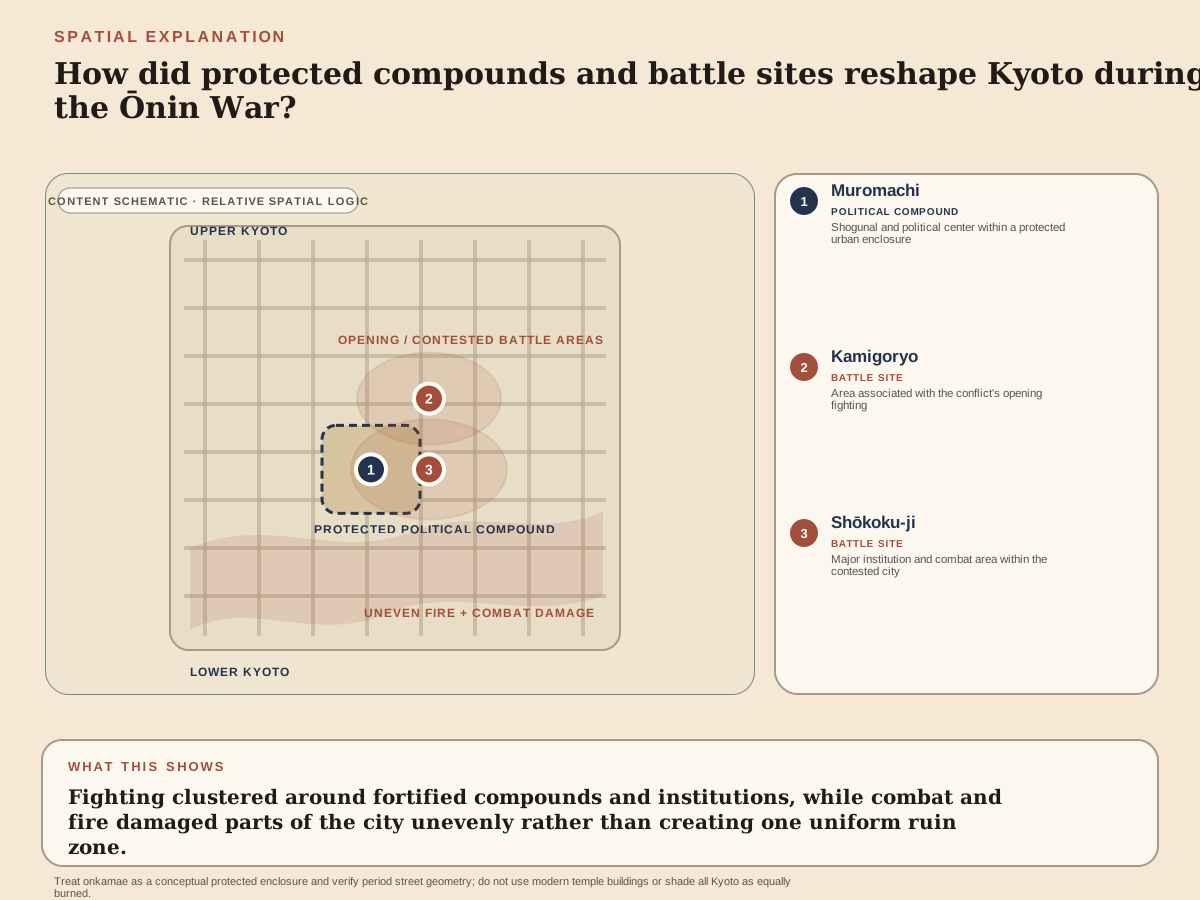
In January 1467 Yoshimasa excluded Hatakeyama Masanaga from formal service and recognized Yoshinari. Masanaga burned his own residence and fortified at Kami-Goryō Shrine, where the rival forces fought. Yoshimasa attempted to restrict intervention, but the settlement did not contain the conflict. By summer large eastern and western coalitions occupied fortified zones in Kyoto.
Yoshimasa remained the recognized shogun and tried at moments to impose neutrality or mediation. He lacked a force independent of the very lords whose armies he needed to control. His order therefore mattered enough for both camps to seek favorable classification, yet not enough to disarm them. The war began when arbitration and armed coalition ceased to be separable.
The Ōnin War turned Kyoto into several different spaces at once. The eastern coalition enclosed the Muromachi Palace in a fortified onkamae, sheltering the emperor, retired sovereign, nobles, warriors, servants, and wealthy residents. Congestion worsened sanitation and exposure to fire and epidemic. Western and eastern forces fought around Shōkokuji, Nanzenji, Funaokayama, and residential streets. Ashigaru cut routes, burned structures, and sought provisions.
Upper Kyoto suffered enormous damage, while parts of Lower Kyoto retained greater continuity and organized neighborhood defense. Tōji's archive history records documents moved for safety and then lost when their shelter burned. Such losses changed what later historians can know. The city was not a single empty ash field: people fled, hid, traded, rebuilt, guarded blocks, preserved records, and sometimes profited. Yoshimasa witnessed the material destruction produced around the government that claimed to protect the capital. His inability to stop it is central, but the acts of soldiers and the survival work of residents must remain visible.
Yoshimasa did not cease to be shogun when fighting began. The court remained near the eastern position; documents, ranks, succession recognition, audiences, and attempts at settlement continued. His brother Yoshimi's movement to the western coalition in 1468 transformed the succession map, while the eastern side increasingly protected Yoshihisa's future.
The contradiction defines Yoshimasa's wartime office. Both camps wanted legitimate appointments and favorable classification, so the shogun was not irrelevant. But he depended on Hosokawa and other armed houses to protect the center and lacked an independent force able to compel their enemies—or allies—to disarm. Later portrayals of withdrawal into art capture disillusionment and avoidance only partly; aesthetic work did not make documents stop, and office activity did not equal effective peace. Yoshimasa's decisions retained distributive power while his capacity to end the war collapsed.
In 1473 Yoshimasa transferred the shogunal office to his son Yoshihisa. Hosokawa Katsumoto and Yamana Sōzen also died that year, yet the war continued. The coincidence demonstrates that neither changing the shogun nor losing two leading commanders resolved the disputes carried by their coalitions.
Yoshihisa held a real office, but he was still a child. Research on the postwar government shows that former shogun Yoshimasa remained active and that Tomiko and Hino Katsumitsu could represent his interests rather than merely serve as regents for Yoshihisa. Formal title, household authority, and practical administration were divided among living actors. Yoshimasa reduced one public burden and established his son's claim; he did not leave politics in a single ceremony, and the younger shogun did not instantly inherit an undivided state.
The Ōnin War conventionally ended in 1477 when Ōuchi Masahiro and other western forces withdrew from Kyoto and Hatakeyama Yoshinari returned to continue his contest elsewhere. The date marks the end of the principal capital war, not a nationwide peace. Provincial struggles among shugo, deputies, local warrior leagues, temples, and estate holders continued, often with greater autonomy from Kyoto.
The city also began rebuilding before politics became stable. Weavers returned to the northern area later associated with the name Nishijin, neighborhoods strengthened collective institutions, and merchants helped restore circulation. Yoshimasa did not simply become a private retiree: government after 1477 involved Yoshihisa, the former shogun, Tomiko, Hino Katsumitsu, and surviving officials. The shogunate had lost coercive reach but retained titles, documents, court relations, and the ability to arbitrate some conflicts. Describing 1477 as the exact birth of a uniform “Sengoku Japan” makes a useful period boundary look like a simultaneous transformation in every province. The evidence shows uneven reconfiguration.
In 1482 Yoshimasa began Higashiyama Palace on the former site of Jōdoji, a temple and residence associated with Yoshimi that had been destroyed during the war. He moved there in 1483, took Buddhist vows in 1485, and used the religious name Dōkei. Construction followed the garden and villa precedent of Saihōji while adapting it to a retired shogun's household.
The site was not merely an escape into beauty. Residences, meeting rooms, devotional buildings, water, gardens, kitchens, stores, and service quarters supported guests and continuing influence. Timber, stone, plants, wages, corvée, transport, and land claims connected the villa to a recovering city and wider estates. Gozan monks advised; household attendants organized objects; craftspeople and garden workers made the setting. Yoshimasa's patronage concentrated expertise, but it also commanded scarce resources after war. The palace became a cultural center precisely because it remained embedded in political and material networks.
Tōgūdō was completed in 1486 as a devotional building with a small study space later important to architectural history. Work on the two-story Kannon Hall began in 1489, drawing on the precedent of Yoshimitsu's relic hall at Kitayama. Yoshimasa fell ill and died before seeing the Kannon Hall completed.
The hall was not covered in silver. Claims that war or poverty merely prevented an intended silver coating lack secure contemporary evidence. “Ginkaku,” the Silver Pavilion, became a later Edo-period name formed in contrast with Kinkaku; the temple's formal name is Jishōji. Place history also continued after its founder: a 1550 fire destroyed most of the compound while Tōgūdō and the Kannon Hall survived, and large-scale restoration around 1615 helped shape the present grounds. The surviving buildings carry medieval design and material history through repair, not an untouched frozen palace. Correct interpretation separates Yoshimasa's project, later temple identity, and the modern visitor's name.
“Higashiyama culture” is a later historical category for developments broader than Yoshimasa's villa or lifetime. At Higashiyama, dōbō attendants such as Nōami and Geiami evaluated and arranged objects; Gozan monks advised on language, ritual, and buildings; painters, carpenters, metalworkers, textile makers, merchants, tea practitioners, and garden workers supplied distinct expertise.
One name needs special care. Zen'ami, associated with garden work, was not Zeami, the earlier Noh playwright. Some translations and summaries confuse them. Traditions also connect tea master Murata Jukō directly to Yoshimasa, sometimes through Nōami, but the exact service relationship is less secure than later tea-lineage memory. Yoshimasa's patronage changed which practices and objects gained elite visibility. It did not make him their sole author. Collections could be assembled through gifts, purchases, inheritance, requisition, or pressured transfer; taste therefore had property and power behind it. The culture's durability belongs to creators and later transmitters as well as to its patron.
Yoshihisa died of illness in 1489 while campaigning against Rokkaku Takayori from a military headquarters at Magari in Ōmi. He left no heir. The shogunal succession returned to the branch of Yoshimasa's brother Yoshimi: Yoshimi's son Yoshiki, later known as Yoshitane, was adopted or designated within the Ashikaga succession and became tenth shogun in 1490.
Yoshimasa fell ill while the Kannon Hall was still unfinished and died on the seventh day of the first month of 1490—conventionally 27 January in the Gregorian calendar—aged fifty-four in elapsed years, fifty-five by traditional count. No diagnosis or final private verdict is securely recoverable. His record cannot be reduced to “bad ruler, great artist.” He exercised real fiscal, documentary, and patronage capacity; repeatedly changed dangerous succession rulings; failed to prevent or end catastrophic war; remained active after resignation; and built a multi-creator cultural center whose fame later obscured its labor and politics. Institutions survived him, but none restored the concentrated authority his reign had lost.
Classic
Yoshimasa entered a house whose title was powerful but whose succession was contingent. His father Yoshinori had been selected for the shogunate after years in religious life, and his rule combined aggressive intervention with punishments that made enemies. That history matters, but it should not be reduced to a character lesson supposedly absorbed by an infant.
Hino Shigeko, Yoshimasa's mother, belonged to a court family repeatedly connected by marriage to the Ashikaga. Such women linked the warrior household to court ceremony, kinship, residence, and information. The archive describes far more appointments and battles than feeding, nursing, or arranging a child's daily security; silence about those acts does not make them politically empty.
The crisis came in 1441. Akamatsu Mitsusuke invited Yoshinori to a gathering and had him killed. The act exposed how a shogun who could appoint and punish provincial lords could still be physically vulnerable inside elite sociability. The killers then withdrew to Harima, and the regime had to organize military punishment while also preserving a recognizable center in Kyoto.
Yoshikatsu, an older son, became seventh shogun. He was himself a child, so officeholding and government were immediately divided. Kanrei, senior shugo, documentary officials, maternal relatives, guards, and court officers could maintain commands and ceremonies around a minor who could not independently conduct them.
In the disturbance after Yoshinori's death, Kyoto debtors and neighborhood forces also pressed for debt cancellation. That Kakitoku-era uprising was not simply caused by palace assassination, but the concurrence shows how elite rupture opened opportunities below the governing household. Creditors, pawnbrokers, sake brewers, temples, borrowers, and armed urban groups all understood that succession affected enforcement.
Yoshikatsu died in 1443. Later accounts sometimes supply an exact dramatic cause, but the secure consequence is more important: the expected line narrowed again. Yoshimasa became Ashikaga family head while still a child, though formal shogunal appointment would come later.
The household around him therefore carried public value. Karasuma Suketō is associated with his guardianship and training. A female attendant known as Ima-mairi no Tsubone held unusual proximity and influence in the young lord's residence. Nurses, pages, guards, clerks, and monks made the routine by which a vulnerable body could be presented as dynastic continuity.
Later moralizing biographies blame particular attendants for Yoshimasa's tastes or decisions. Those judgments must be separated from the stronger institutional evidence that access to a minor mattered. A guardian might protect him and cultivate clients at the same time. A court relative might teach precedent while advancing a family. Care and politics were not mutually exclusive.
Nor should later failure be read backward into childhood. The boy did not yet choose the Hatakeyama and Shiba succession judgments that would divide Kyoto. He did not design the Ōnin War. He inherited a government in which selection, assassination, child officeholding, and factional guardianship had already shown that authority never belonged to one person alone.
What survived from 1441 to 1443 was not a stable ruler but a process: recognize an heir, secure his residence, issue documents through adults, obtain court rank, and keep major houses from converting temporary custody into permanent ownership. Yoshimasa's first political reality was thus neither luxury nor art. It was the labor required to keep the Ashikaga name attached to an office after two holders vanished in two years.
Formal appointment matters because several identities had to converge. Yoshimasa was already head of the Ashikaga house, but the title of shogun came through the court. In 1449, at thirteen in elapsed years, he became the eighth holder. The ceremony made succession public; it did not suddenly remove the adults who had governed during his minority.
Hatakeyama Mochikuni held the kanrei position for important stretches and possessed his own provincial and kinship base. Hosokawa Katsumoto was another young but increasingly powerful shugo. Ise officials, including Sadachika, worked closer to the shogunal household and document process. Bugyō families received petitions, checked precedent, and drafted decisions. Court officers supplied rank and ritual. Government was a layered practice rather than the shogun issuing personal commands into a vacuum.
The distinction corrects two misleading images. Yoshimasa was not already the isolated aesthete of later caricature. Nor was he an absolute prince thwarted only by disobedient lords. He learned rule through councils, access, documentary validation, provincial enforcement, and bargains with men whose armies were not his permanent force.
Fiscal history makes the institutional capacity visible. Kyoto's pawnshops, sake brewers, and storehouse financiers supplied credit and taxable wealth. Debt-cancellation uprisings could destroy records, close businesses, and make a tax claim unenforceable. The assassination crisis of 1441 had already demonstrated how urban action could coincide with elite weakness.
In 1454 the government attempted a bun'ichisen, a levy calculated at one percent in connection with debt settlements. The mechanism did not collect as intended. That failure is evidence of administrative limits, not evidence that no administration existed. It identifies a problem—how to capture revenue when political promises cancelled obligations—and an attempted solution that lacked compliance.
Collection improved from 1455 under Ise Sadachika. Close household access, managerial experience, and networks among creditors gave Ise officers leverage different from that of great shugo. Their rise also generated rivalry: fiscal competence could become a factional resource and make other warriors fear that household officials were monopolizing the shogun.
Imperial-palace reconstruction in 1456 further reveals the center's claims. Provincial contributions were requested, materials and money moved toward Kyoto, and the project linked warrior taxation to court restoration. Yoshimasa's installation as right general added public ceremony. The court needed funding and protection; the shogunate needed ranks and a capital order in which its precedence could be displayed.
None of these achievements should be inflated. A provincial levy on paper might be negotiated, delayed, or refused. The center did not have a uniform bureaucracy assessing every village. Great houses converted public tasks into patronage. Urban taxpayers could bargain collectively or resist. The gap between authorization and receipt was itself political.
Yet later catastrophe creates outcome bias. Because Yoshimasa ultimately failed to stop armies from burning Kyoto, it is tempting to describe every earlier order as meaningless. The fiscal reconstruction scholarship instead reveals an office capable of experimenting, learning from failure, mobilizing a court project, and cultivating household administrators.
This capacity also carried danger. By accepting the services of Mochikuni, Katsumoto, and Sadachika, Yoshimasa acquired tools and dependencies. Every official who made government work accumulated clients; every shugo asked whether a rival was being strengthened; every succession decision affected the coalition sustaining the center.
The early shogunate was therefore neither lost golden age nor prelude without substance. It was a negotiable central authority with documents, taxes, ranks, audiences, and prestige. Yoshimasa's later responsibility lies partly in how he used those tools, but accurate judgment begins by admitting that he possessed them.
The shogun's recognition was valuable because great houses were not merely private families. Their heads held provinces, commanded retainers, attended councils, and sometimes served as kanrei. When succession divided a house, each claimant needed genealogy, armed support, property, and a judgment that others would accept.
The Hatakeyama dispute developed through competing lines around Mochikuni's adopted heir Masanaga and his son Yoshinari. Details shifted, including the names by which Yoshinari was known, but the structural problem persisted: recognizing one did not dissolve the other's local base. Yoshimasa's interventions redistributed legitimacy while leaving two organizations capable of fighting.
The Shiba house produced a comparable conflict involving Yoshitoshi and Yoshikado, with senior retainers and provincial interests shaping their claims. Yoshimasa and close official Ise Sadachika changed support as alliances and accusations changed. A decree could remove a title from one claimant, yet the losing group might seek a stronger patron rather than submit.
These rulings were not irrelevant. If they had been, men would not have competed so fiercely for them. The problem was the mismatch between juridical recognition and coercive enforcement. The center could identify a head more easily than it could make every vassal, estate, and provincial deputy abandon the rival.
Reversal deepened mistrust. A claimant favored today could fear tomorrow's hearing; a shugo asked whether a rival's case was being decided on law, household access, military pressure, or gifts. Bringing disputes to Kyoto increased central prestige while importing armed networks into the city.
Urban and environmental crisis intensified the stakes. Successive harvest failures, cold and wet conditions, disrupted distribution, poverty, and epidemic produced the Kanshō famine. Refugees came into Kyoto seeking food and alms. The diary known as Hekizan Nichiroku preserves observations of hunger, dead bodies, and a mother and child from Kawachi. Such entries are invaluable, but they are located testimony: what a literate Zen observer recorded from a particular institutional position.
The record also credits Gan'ami, a performer with elite connections, with relief work. Food distribution did not come only from an abstract state. Temples, performers, patrons, neighborhoods, creditors, and officials could mobilize grain or charity. Their action reveals both social capacity and the inadequacy of response relative to need.
Exact death totals vary by source and copying history. Large round numbers convey catastrophe but should not be presented as a modern census. The secure conclusion is mass mortality accompanied by epidemic and visible corpse disposal, not an arithmetically precise count.
Later narrative sharpens the contrast between famine and Yoshimasa's construction. The moral force is understandable: resources assigned to ceremony or residence were unavailable elsewhere, and rulership invited judgment about allocation. Yet chronicles written with hindsight may compress several projects, dates, and accusations into an exemplary story of a heedless shogun.
Responsibility must therefore be specified. Yoshimasa did not cause climate anomalies. He did govern a center whose taxation, debt policy, estate rights, transport security, and elite expenditure shaped who bore scarcity. His office could not feed the whole realm, but neither was its choice of revenue and display politically neutral.
The intersection of succession and famine also matters. Military households spent on armed readiness while refugees entered the capital. Debt cancellation could help borrowers and ruin credit channels. Taxing storehouses might fund government while discouraging reopening after attacks. Every intervention shifted risk among groups with unequal voice.
This was the world immediately before the shogunal succession crisis. Yoshimasa had learned that he could validate claimants, change administrators, and commission works. He had not built a means to make rejected claimants disappear or to shield the city from the compounded effects of hunger, disease, debt conflict, and armed household competition.
Yoshimasa's lack of a surviving son created uncertainty because the Ashikaga office required a candidate before illness or death. Waiting indefinitely would encourage great houses to cultivate different relatives. Recalling Yoshimi was therefore a rational attempt to define continuity.
Yoshimi had lived in a Buddhist institution. Leaving religious status for warrior succession was not unprecedented in the Ashikaga family—Yoshimasa's own father had come from clerical life. The transfer required changes of name, residence, dress, household, and political association. Monastic affiliation was not an inner identity that could be switched off without institutional work.
Later accounts frequently say that Yoshimasa adopted his brother and swore that any future son would enter religious life. The general designation of Yoshimi is strong; the precise formula and enforceability of every reported promise are less uniform. An English narrative should not turn a later summary into a verbatim contract whose breach alone explains civil war.
Hino Tomiko gave birth to Yoshihisa in 1465. A biological son altered the interests of mother, maternal kin, attendants, estate managers, and families considering long-term service. It also altered Yoshimasa's position as father. None of this proves a secret scheme by Tomiko or an instantaneous decision by Yoshimasa to dispossess Yoshimi.
Medieval succession could accommodate stages. Yoshimi might inherit the office first; Yoshihisa might follow later; one could be adopted by another; religious placement might be reconsidered. Such arrangements required trust about timing, patronage, and survival. The problem was not that two males physically existed but that powerful networks could attach different futures to them.
Hosokawa Katsumoto and Yamana Sōzen are often cast immediately as guardians of the two candidates. That tidy diagram confuses later coalitions with initial patronage. The two shugo already competed through Hatakeyama, Shiba, marriage, and provincial networks. Their eventual camps did not remain identical to a simple Yoshimi-versus-Yoshihisa division.
The later movement of Yoshimi is decisive evidence against the nursery map. After the fighting began, he moved from the eastern setting toward the western coalition. The eastern side then became associated with Yoshihisa's succession. An alliance system capable of such reversal cannot have been predetermined solely by childbirth.
Yoshimasa nevertheless bears responsibility. He had created expectations around Yoshimi and now presided over a household with a natural son. Ambiguity could postpone confrontation, but it also encouraged every faction to seek private assurance. A clear settlement might have reduced one danger, though it could not by itself resolve the Hatakeyama and Shiba wars.
Yoshimasa was officeholder, brother, and father. Tomiko was mother and household power-holder. Yoshimi was an adult whose public status and security were at issue. Yoshihisa was an infant around whom others organized; he cannot be assigned an infant political will.
The evidence supports interests more strongly than private speech. Tomiko had reason to protect her son's future. Yoshimi had reason to demand that recognition mean something. Yoshimasa had reason to avoid both a vacant succession and an immediate breach. Great lords had reason to use uncertainty in wider contests.
War was not inevitable in 1465. But the settlement needed credible sequencing, and the regime lacked an authority outside Yoshimasa's own contested judgment to guarantee it. When other disputes armed the city, succession became another language through which coalitions classified friend and enemy.
The Hino family had connected court culture and Ashikaga succession across generations. Marriage gave shoguns aristocratic kin who understood rank, writing, ritual, and access to the palace. It also gave Hino relatives a stake in appointments and in the children born to those unions.
Tomiko's 1455 marriage to Yoshimasa placed her in a residence that was simultaneously domestic and governmental. Audiences passed through household gates. Gifts, petitions, servants, wet nurses, physicians, clerics, and messengers carried information. Control of access could shape a decision without appearing as a public office.
The birth of Yoshihisa ten years later expanded that structure. An infant heir needed property, attendants, ritual recognition, and adult protectors. Tomiko's desire to preserve his future was neither mysterious nor uniquely corrupt. A father, uncle, kanrei, or shugo who defended a line is normally described as exercising dynastic policy; a mother doing so is more readily reduced to emotion.
That correction does not require idealizing her. Tomiko later displayed formidable economic agency. She managed wealth, extended or controlled credit, negotiated with warriors, and sought political outcomes. Such acts affected who could fight and who could govern. The point is to evaluate them as policy and interest rather than proof of a gendered defect.
Her brother Hino Katsumitsu also mattered. A narrative that names Tomiko alone can hide the men of her natal house who represented interests, drafted communications, and held court position. Maternal kinship operated through a group, not one isolated wife whispering to a ruler.
Historical disagreement · How did war narratives shape blame for the Ōnin War?
War literature had reasons to personalize disaster. A city destroyed by intersecting succession cases, provincial rivalries, debt, and armies is hard to narrate. A wealthy woman allegedly overturning a promise supplies motive, villain, and moral decline in a compact plot. Later official histories could repeat that plot as national explanation.
Thomas Conlan's source-critical work demonstrates how Ōninki and modern historiography shaped blame before and after the succession story was standardized. The lesson is not that every hostile claim is false. It is that genre and reception determine which actions become emblematic.
Tomiko's support for Yoshihisa did not automatically align all later camps. Yoshimi's eventual movement to the western side and eastern support for Yoshihisa confound the familiar claim that Tomiko simply recruited Yamana against a Hosokawa-backed Yoshimi from the start. Relationships changed as the war changed.
Yoshimasa cannot be made passive in order to restore Tomiko's agency. He had married into the Hino network, designated Yoshimi, responded to his son's birth, issued rulings in other house disputes, and allowed armed actors to continue seeking his recognition. Husband and wife did not occupy equal formal offices, but both acted inside the succession system.
Nor were only elites affected. Household assets derived from estates, taxes, credit, and labor. Securing a child's future could redirect those resources. The people producing rice, transporting goods, keeping accounts, and lending money bore the material underside of dynastic policy without entering most narratives by name.
Tomiko's exact private marriage with Yoshimasa is not recoverable from hostile anecdote. Political disagreement does not prove lovelessness; cooperation does not prove intimacy. Evidence can locate the interests they shared and the interests that diverged without inventing a domestic drama.
The rigorous conclusion is demanding because it refuses both scapegoat and absolution. Tomiko was a consequential political and economic actor. She was not the author of every grievance that reached Kyoto, not the commander of every army, and not an adequate single explanation for a war whose participants repeatedly changed sides.
Hosokawa Katsumoto and Yamana Sōzen possessed the scale needed to connect quarrels. Their families held multiple provincial governorships, maintained Kyoto residences, married into other houses, and could bring retainers from outside the capital. Scale did not give either man complete command over every branch or ally.
The Hatakeyama conflict offered one bridge. Masanaga and Yoshinari each sought recognition and possessed armed support. Katsumoto favored one configuration; Sōzen supported another. The dispute mattered because the Hatakeyama also had a claim to the kanrei office. A family lawsuit was therefore a contest over who could sit close to the shogunal center.
The Shiba succession supplied another bridge. Yoshitoshi and Yoshikado were associated with different senior retainers and provincial stakes. Yoshimasa's changes of recognition could elevate one while making the other seek protection from a larger coalition. The facts do not require imagining that the shogun maliciously created conflict; they show that inconsistent or coercively revised arbitration multiplied distrust.
Ise Sadachika represented a different form of power. He belonged to the close shogunal administrative household rather than the highest shugo tier. Fiscal and documentary access made him useful to Yoshimasa and suspect to great lords. A skilled household official could look like an instrument of centralization to the shogun and a private favorite overturning warrior precedence to his opponents.
In 1466 Sadachika was accused in a crisis involving Yoshimi. Sources describe a plan or charge that the designated successor would be attacked. Powerful warriors pressed against Sadachika, who fled or was removed. The event's exact secret intentions are less secure than its public consequence: the shogun could not keep a close official when shugo opposition successfully classified that official as a threat to succession.
The episode also weakened confidence in Yoshimasa's protection. Yoshimi could conclude that a formal designation did not guarantee bodily safety. Tomiko's household could conclude that a brother with armed patrons threatened Yoshihisa's future. Great houses could conclude that sufficient coordination could reverse a palace decision.
Katsumoto and Sōzen are sometimes described as personal enemies destined to clash. Their relationship had included kinship and cooperation as well as rivalry. Coalitions formed through changing cases, not primordial hatred. A lord might join because of a provincial opponent, family succession, office dispute, or need for protection, not because he endorsed a unified platform.
That distinction explains why command later proved weak. Each contingent expected reward for its own grievance. If the central succession issue changed, Hatakeyama enmity remained. If a commander sought truce, a client who had lost land might continue. The camps were federations of disputes capable of sustaining war after the original leaders died.
Yoshimasa was not outside this construction. The value of his recognition drew claimants to Kyoto. His reversals changed relative strength. His inability or unwillingness to enforce a durable settlement made armed preparation rational. Yet saying this is different from claiming that he ordered the war he failed to prevent.
Nor were Katsumoto and Sōzen independent sovereigns. They still used shogunal, court, and family titles. They competed for custody of the legitimate center, not merely for territory. That is why Kyoto and the shogun's residence mattered so much as fighting approached.
The coalition model preserves distributed agency. Sadachika, Yoshimi, Tomiko, the two Hatakeyama lines, the two Shiba lines, senior retainers, shugo, and Yoshimasa each occupied a position. No one person needed to foresee the whole catastrophe. Repeated attempts to win one dispute created a network in which losing any single decision could feel existential.
The January hearing over Hatakeyama leadership placed Masanaga and Yoshinari before a center already crowded with alliances. Yoshimasa's decision to exclude Masanaga from service and receive Yoshinari was a legal-political act. Because the Hatakeyama had troops and competing patronage, it also altered the military balance.
Masanaga did not submit. He burned his residence, denying its use and announcing rupture, then fortified at Kami-Goryō Shrine north of the central city. A sacred precinct became a defensive position. The transformation shows how Kyoto's temples and shrines were not outside warfare; walls, open ground, storehouses, and neighborhood routes gave them military value.
Yoshimasa ordered or sought neutrality from other lords. The instruction attempted to isolate the Hatakeyama fight rather than turn it into coalition war. Hosokawa Katsumoto did not openly rescue Masanaga at the decisive moment, and Yoshinari prevailed. The order therefore had an effect, but not the intended finality.
Masanaga survived, and his network did not disappear. The settlement convinced actors that recognition could be imposed by armed presence and reversed by future force. It also made Katsumoto's clients fear the widening advantage of Sōzen-associated claimants.
Troops accumulated in Kyoto over the following months. The eastern coalition established itself around Hosokawa and the shogunal zone; the western coalition formed around Yamana positions. Residences became compounds. Barricades narrowed streets. Watch posts, trenches, gates, earthworks, and commandeered buildings converted a capital into connected fortifications.
The labels east and west describe spatial and coalition identities, not ideological programs. Each side contained lords with separate disputes. A provincial contingent might be present because its enemy had joined the other side. Warriors fought near the court, markets, and monasteries, but their supply and reinforcements stretched into provinces.
Yoshimasa remained inside the crisis. The emperor and retired sovereign would also come under the protection of the eastern enclosure. Possession of the shogunal and court center allowed the eastern side to claim legitimacy. The western side did not simply reject government; it cultivated alternative relationships and later held Yoshimi.
The distinction between relevance and control is essential. Yoshimasa's decision over Masanaga helped trigger the January confrontation. His title made custody of him valuable. His orders influenced whether allies intervened. Yet he could not order a standing national army to remove every private force from the city.
Responsibility cannot be dissolved into institutional weakness. Yoshimasa knew that previous recognition changes had armed consequences. He still made a high-stakes reversal without securing a settlement that the losing side could survive. His political method relied on balance after trust in arbitration had already eroded.
Nor should the combatants disappear behind his failure. Lords transported troops into residential neighborhoods; retainers burned and looted; commanders protected supplies; rivals chose escalation. The war required thousands of decisions beyond the palace.
For Yoshimasa it is the collapse of containment. For Tomiko it is a threat to her son's household. For Yoshimi it becomes a contest over safety and succession. For Katsumoto and Sōzen it is coalition warfare. The event is the same; perspectives differ.
By the time the fortified camps faced one another, a new condition existed. A judgment no longer ended a dispute; it assigned each claimant to an army. The capital that gave the shogun central relevance also gave every coalition a reason to fight in the streets around him.
The eastern army's onkamae was not merely a battlefield camp. It enclosed the Muromachi shogunal residence and a crowded political population. The reigning emperor Go-Tsuchimikado, retired emperor Go-Hanazono, nobles, warrior households, servants, artisans, and affluent refugees came within a defended perimeter.
Fortification protected bodies while producing new hazards. Gates controlled movement. Barricades and walls concentrated people and animals. Waste and stagnant water increased disease risk. Kitchens and wooden buildings multiplied fire danger. The enclosure depended on a northern supply route that opponents could threaten.
Major fighting in September and October 1467 spread near Nanzenji, Shōkokuji, and Funaokayama. Shōkokuji stood close to the Ashikaga center and suffered burning. Temples offered walls, halls, open ground, and stores; their religious identity did not prevent military occupation or destruction.
Ashigaru appear prominently in accounts of arson and looting. The label covered foot soldiers of varied origin and organization, not a single criminal class. Commanders used mobile men to disrupt food routes and enemy cover. Those men also pursued survival or plunder in a war whose elite causes offered them little security.
Fire was tactical and uncontrolled. Burning a residence could deny shelter; burning a neighborhood could open a field or punish an enemy. Wind and dense wooden construction carried flames beyond intended targets. The result was loss of homes, workshops, temples, aristocratic archives, tools, and stored food.
Tōji's Hyakugō archive gives the abstraction a documentary body. Temple records were packed and moved to what seemed a safer place; that refuge then burned, destroying part of the collection. Preservation was an action under danger, and failure removed evidence that no later scholar can recover by confidence alone.
The city did not suffer uniformly. Official Kyoto history distinguishes devastation in much of Upper Kyoto from stronger continuity in Lower Kyoto. Neighborhood groups there organized self-defense, negotiated passage, and developed forms of collective government. Survival cannot be used to minimize destruction; destruction cannot be generalized so completely that survivors vanish.
Markets and production changed rather than simply stopping. Routes moved, scarcity altered prices, and craftspeople relocated. People with stores, armed protection, or credit had options unavailable to refugees. Some elites could shelter inside compounds while poorer residents faced exposure, recruitment, or flight.
Yoshimasa's location gave him knowledge but not omniscience. Reports reached the palace through commanders, monks, officials, and residents, each with incentives. Seeing smoke did not reveal who started every fire. Later war tales select emblematic scenes and speeches; they cannot be read as a continuous neutral camera.
His responsibility was institutional and personal. The shogunate claimed to protect Kyoto and drew armies there through its succession and arbitration. Yoshimasa could issue truces and recognitions but did not construct enforcement strong enough to secure streets. Yet saying “Yoshimasa burned Kyoto” would wrongly transfer the agency of commanders and soldiers to one figure.
The devastation changed politics below the elite. Residents who had defended blocks and managed supplies did not simply return to dependence. Lower-city organization and later reconstruction increased the visibility of merchant and neighborhood institutions. War weakened central order while eliciting other capacities.
An event model that records only shugo names and a 1477 end date reproduces elite vision. Kyoto was a Place relationship for rulers, fighters, refugees, temple archivists, craftsmen, lenders, and neighborhood defenders at the same time.
The imperial court's presence near the eastern enclosure gave Yoshimasa's position exceptional legitimacy. Protecting the emperor and retired sovereign allowed the eastern side to present itself as defender of central order. Court ranks and shogunal documents still carried consequences beyond the walls.
Petitions did not cease. Officials recorded claims, titles were assigned, and religious institutions sought confirmation. A warrior might ignore an unfavorable ruling in the field while still needing recognition to stabilize a later settlement. This temporal difference made the office weak in immediate coercion but valuable in classifying outcomes.
Yoshimi's path exposes the changing structure. Initially positioned near the shogun and eastern leadership, he fled or moved away amid suspicion and eventually became associated with the western side in 1468. His decision was not merely personal betrayal; it reflected fear about Yoshihisa's succession, Ise household hostility, and the search for armed protection.
Once Yoshimi stood with the west, the familiar story of Katsumoto defending Yoshimi against Tomiko's Yamana-backed infant becomes chronologically impossible. The camps reclassified the Ashikaga candidates. Eastern forces could uphold Yoshihisa, while western leaders used Yoshimi as an alternative center.
Yoshimasa attempted negotiations and issued instructions, but a truce required commanders to believe that stopping would not sacrifice their separate claims. Hatakeyama, Shiba, provincial, and property conflicts persisted even if the shogunal family reached an accommodation. No single treaty clause could satisfy them all.
The shogun also depended on eastern military protection. Ordering Hosokawa Katsumoto to dissolve his force would expose the palace and court unless western armies did the same. Neutrality was no longer an available physical position. Yoshimasa's legitimacy had been enclosed inside one coalition's fortification.
This dependence did not make him Katsumoto's decorative prisoner in every matter. Yoshimasa controlled access, could recognize Yoshihisa, communicate with court and temple networks, and influence pardons and offices. He and Tomiko maintained household resources. The center kept functions that armies alone could not reproduce.
Later stories emphasize pets, poetry, gardens, or indifference while the city burned. Some behavior may reflect genuine withdrawal and the cultivation of spaces less exposed to councils. But anecdotes gathered as moral explanation must be dated and sourced. “He preferred art” is not an institutional account of why thousands of armed retainers refused peace.
Nor should institutional explanation become an excuse. Yoshimasa had helped assemble the succession landscape, protected changing favorites, and failed to create credible arbitration. During the war he sometimes treated office transfer and retirement as solutions to a conflict already larger than the office. Failure of means and failure of judgment can coexist.
The war also altered how authority was perceived. Provincial deputies and local warriors learned that Kyoto could not promptly settle their claims. Court and shogunal confirmation remained useful, but local force and negotiated coalitions became more necessary. Central weakness was a process reproduced through repeated noncompliance.
Yoshimasa's wartime power is therefore best described by function. He could validate, distribute, shelter, communicate, and symbolize. He could not compel synchronized demobilization. Calling him omnipotent is absurd; calling him nonexistent erases why both coalitions fought around him.
The distinction matters for the Person–Event model. It is the same prolonged event attaching Yoshimasa's shrinking coercive reach to Yoshimi's alternative claim, Tomiko's household defense, shugo military bargaining, court survival, and city residents' exposure.
Installing Yoshihisa answered one question publicly. The natural son now held the shogunal office. Court appointment and ceremony made his position more than a private maternal claim. Yoshimi's alternative future correspondingly weakened at the center.
The new shogun was a child. As in Yoshimasa's own minority, documents and audiences required adults. But the configuration differed: his father was alive, his mother had built a strong household position, her brother Katsumitsu served as an intermediary, and war had fractured the great shugo order.
Yoshimasa's transfer can be read as dynastic continuity, personal withdrawal, or an attempt to remove succession from the causes of war. It contained elements of all three. None alone explains the outcome. Once Hatakeyama and Shiba conflicts possessed armies, changing the name on the shogunal appointment could not settle their land and leadership claims.
Katsumoto and Sōzen died in the same year. Later narratives treat their deaths as the exhaustion of a personal feud. Their coalitions, however, were composed of houses whose grievances and military costs persisted. Successors inherited positions; commanders who had sacrificed men and property sought terms; local enemies remained.
Office transfer did redistribute access. Petitioners could orient themselves toward Yoshihisa's household. Tomiko gained public weight as mother of the reigning shogun. Officials had to determine whether an order expressed the child officeholder, the former shogun, the maternal household, or a coalition protecting them.
The categories “regent” and “retired shogun” can mislead if used mechanically. Tomiko did not hold a standardized regency office equivalent to a Fujiwara imperial regent. Yoshimasa did not cease agency because he resigned. Hino Katsumitsu did not merely speak for his sister. Their authority arose from relationship, access, property, and the ability to obtain documentary action.
Academic study of the government after the war argues that Tomiko and Katsumitsu often represented Yoshimasa's side within the regime. This finding complicates the image of a husband who simply fled from a wife governing in their son's name. Household alliances could cross the formal father–son division.
Yoshihisa also should not be made a blank seal. Childhood constrained independent control, but education, ceremonies, retainers, and gradual formation of his own judgments gave the office a future center. His later campaign in Ōmi shows that he attempted a form of active shogunal command different from pure maternal custody.
For Yoshimasa, resignation changed accountability without eliminating influence. He could conduct cultural and religious projects, negotiate through close officials, and position himself as an experienced figure above daily office. Critics could still hold him responsible because his person continued to shape decisions.
The court had its own stake. A formal succession prevented vacancy and preserved the ritual relation between Ashikaga house and sovereign.
It should link the office to Yoshihisa while keeping Yoshimasa, Tomiko, Katsumitsu, court officials, and war coalitions active. A database that closes the father's political record in 1473 would reproduce the formal fiction the evidence corrects.
The title passed. The government remained a household, documentary, court, and military network with overlapping centers. That complexity was not a temporary formatting problem; it was the substance of late Muromachi authority.
Ōuchi Masahiro's withdrawal removed one of the western coalition's strongest remaining armies from Kyoto. The decision involved negotiation, recognition, and the calculation that continued occupation offered diminishing returns. It did not mean every western participant accepted every eastern claim.
Hatakeyama Yoshinari left the capital to continue struggle in Kawachi. Masanaga remained his rival. Their departure demonstrates why the capital war could end while a component conflict survived. Moving the battlefield changed the Event's place relationship; it did not erase the grievance.
Other provinces had their own sequences. Shugo deputies had mobilized resources and learned to act without immediate central supervision. Local warriors formed leagues or supported competing superiors. Temples and estate holders defended revenues. The result was not one uniform collapse but many negotiations over who could tax, judge, and command.
Period labels make this complexity manageable. Historians often connect the Ōnin War to the Sengoku age, and with reason: coalition warfare accelerated local autonomy and exposed the shogunate's limits. But no bell in 1477 transformed every vassal into an independent lord. Institutions persisted differently by region.
The Ashikaga shogunate itself survived. Yoshihisa held court-appointed office. Shogunal documents still confirmed land and titles. Warriors who ignored orders could nevertheless seek later authorization. Kyoto officials preserved forms and precedents. The center had become less able to synchronize force, not incapable of every governmental act.
Yoshimasa remained part of that center. Research on the postwar administration identifies a government headed through both Yoshihisa and the former shogun. Tomiko and Hino Katsumitsu represented interests associated with Yoshimasa as well as the young officeholder. Formal retirement cannot be used to delete him from operational history.
Yoshihisa, meanwhile, grew toward personal rule. His household accumulated retainers and goals distinct from his parents'. A succession initially protected by maternal and paternal networks became a political actor with its own future campaign. This development limits the claim that the ninth shogun remained a permanent puppet.
Kyoto's recovery also had multiple authors. Residents returned to damaged areas, rebuilt workshops, reopened routes, and defended neighborhood rights. The weaving activity associated with Nishijin—the “western camp” area—became one durable marker of how wartime geography entered urban economic identity.
Merchants and craftspeople were not simply beneficiaries of peace granted from above. Their credit, skills, stores, and collective organization made rebuilding possible. They also bore new taxes and risks. A house that could not protect them might still seek their money for restoration and ceremony.
Physical recovery was uneven. Some aristocratic estates and temples never recovered prior wealth. Burned documents could not be rebuilt with walls. Displaced people did not necessarily return. The city that re-emerged preserved institutional names while changing ownership and social balance.
For Yoshimasa, 1477 relieved the immediate siege but did not restore the world of 1449. He could now invest in residences, religious affiliations, and collections without daily battles at the Muromachi gates. Those projects were made possible by postwar resources and remained political choices in a damaged city.
The end date should therefore be used precisely. It does not declare the country peaceful, the shogunate dead, or Yoshimasa absent.
The chosen ground already had a history. Jōdoji had been connected with Yoshimasa's brother Yoshimi and was damaged or destroyed in the Ōnin fighting. Building there after the war placed Yoshimasa's new household over a site marked by the succession conflict. The Place cannot be treated as vacant scenery.
Work began in 1482. The word “villa” can suggest a private country retreat, but Higashiyama lay within Kyoto's political and religious environment. Moving there shifted access rather than ending it. Officials, artists, monks, suppliers, and petitioners could still reach the former shogun.
Yoshimasa moved into a completed residential portion in 1483 while the larger complex remained under construction. This phase distinction prevents a common visual error: there was no single moment at which the full Jishōji ensemble appeared exactly as tourists know it.
In 1485 he took Buddhist vows and used the name Dōkei. Tonsure changed ritual position, dress, and forms of address; it did not erase family authority or property. Retired warrior rulers frequently combined religious status with political agency. “He became a monk” is therefore not equivalent to “he left government.”
Saihōji offered an important model. Its garden, pond, buildings, and routes demonstrated how movement through a landscape could structure contemplation and sociability. Yoshimasa did not copy a fixed plan mechanically. Site conditions, resources, advisers, and changing construction produced a new compound.
Gozan Zen monks supplied more than spiritual atmosphere. Figures named in temple histories advised on buildings, inscriptions, collections, and ritual. Their learning connected Higashiyama with institutions that trained writers, diplomats, and administrators. Patronage reinforced both devotion and elite knowledge networks.
Construction required labor that aesthetic history often hides. Trees had to be cut and transported; earth graded; stones selected and placed; ponds supplied with water; roofs tiled or shingled; food prepared for crews. Estate managers obtained funds and materials. Carpenters, plasterers, metalworkers, gardeners, carriers, and servants converted sketches and commands into space.
The terms of that labor are unevenly recorded. Some specialists received patronage and status; some obligations may have been imposed through estate or provincial relationships. Without account books for every worker, the narrative should neither romanticize universal artistic fellowship nor invent a complete story of coercion.
The timing creates an unavoidable distributive question. Kyoto was recovering from famine and a decade of war. Money and materials assigned to Higashiyama could not be assigned elsewhere. Elite construction also employed craftspeople and sustained workshops. Both effects can be true; neither settles whether the allocation was just.
Tomiko and Yoshihisa remained politically active elsewhere. Yoshimasa's new residence was thus one node in a divided family government, not the replacement for every shogunal office. Messages and intermediaries connected the households even when interests diverged.
The complex also made cultural selection possible. Objects could be viewed together, rooms arranged for display, tea served under controlled etiquette, poems and paintings discussed, and artisans summoned. “Taste” became an institutional practice involving catalogues, judgments, and access.
It should not reduce the Event to “Yoshimasa built the Silver Pavilion,” a phrase that gives an anachronistic name to one later building and makes a multi-year palace disappear.
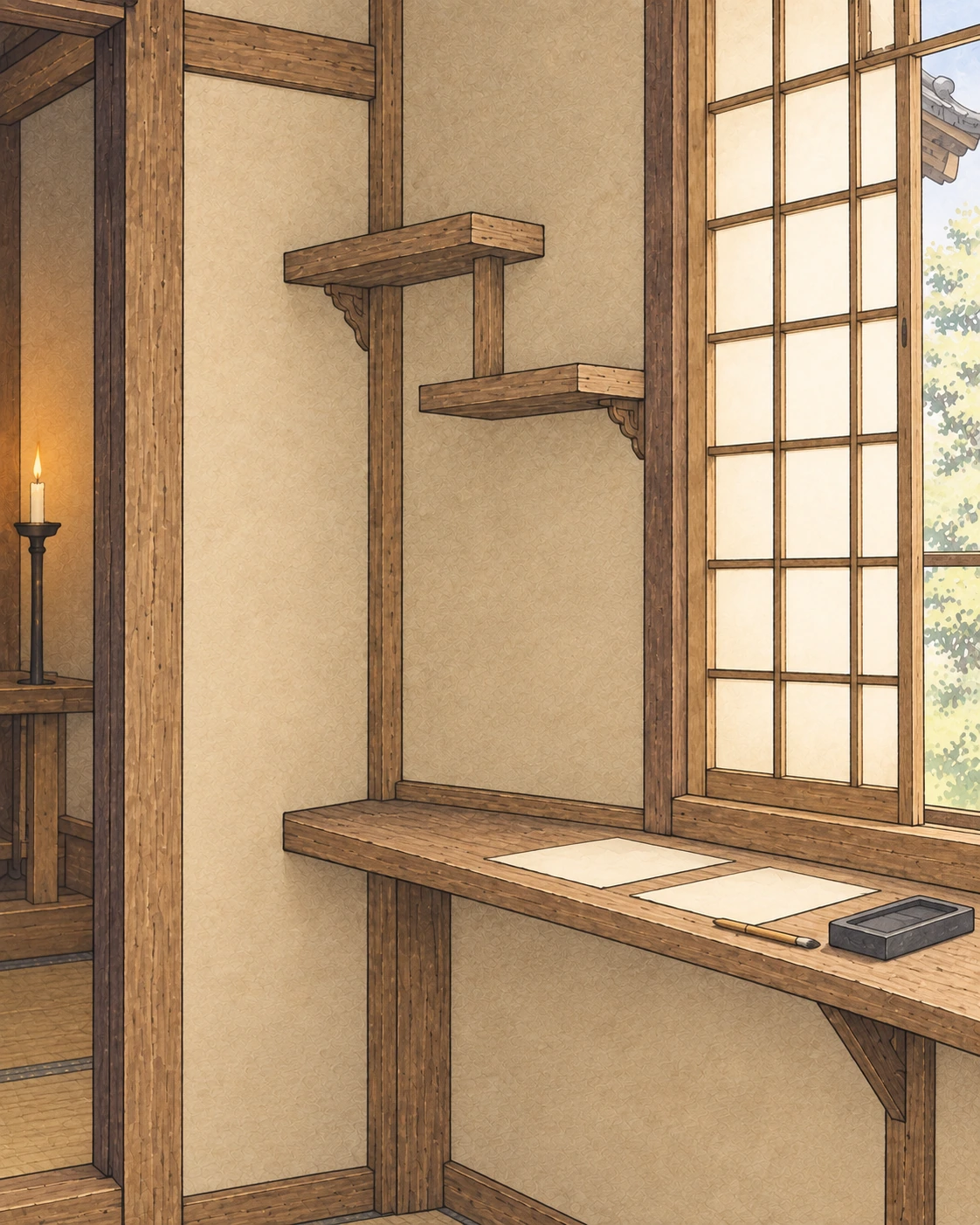
Tōgūdō entered the palace sequence in 1486. Its Amida devotion joined religious practice to residential architecture. Within it, the small room commonly called Dōjinsai became influential in later accounts of study and tea-space development. That later importance should not be projected backward as though Yoshimasa announced a complete modern design movement.
The room's scale, built-in desk, shelves, light, and relationship to ritual space supplied precedents that later practitioners could select. Architectural influence works through preservation, imitation, reinterpretation, and retrospective naming. A surviving element can be both a product of its 1480s setting and a source for later forms.
In 1489 construction began on a two-story Kannon Hall. Official temple history relates it to the pavilion at Yoshimitsu's Kitayama complex and to buildings at Saihōji. Citation of a prestigious ancestor was political as well as aesthetic: Yoshimasa could place his retired household within an Ashikaga lineage of monumental patronage.
The familiar contrast of gold and silver is later. No secure contemporary evidence establishes that Yoshimasa planned to sheath the hall in silver and failed only because the war exhausted his finances. The absence of silver is not a missing final step whose intention historians may invent.
The name “Ginkakuji” also requires dating. The temple is formally Jishōji, created from the palace after Yoshimasa's death. “Ginkaku,” in contrast to Kinkaku, became current in the Edo period. Using it for visitor orientation is reasonable; placing the term unmarked in Yoshimasa's mouth is anachronistic.
Yoshimasa did not see a completed building. Temple chronology records the start of work, his later illness, and death in the first month of 1490. Construction and conversion continued through survivors. Authorship must therefore include builders, officials, and monastic successors who finished or repurposed what the patron initiated.
The palace became Jishōji, named through Yoshimasa's posthumous identity. That conversion changed residential rooms and gardens into a religious institution with land, clergy, memorial functions, and its own preservation choices. A Place relationship after death cannot be treated as the dead patron's continuing decision.
In 1550 fire destroyed most of the complex. Tōgūdō and the Kannon Hall survived, an extraordinary but selective continuity. Other structures known from records vanished. Their absence means the two famous buildings can falsely stand for the whole palace if textual evidence is ignored.
Restoration around 1615 reshaped buildings and grounds after prolonged disruption. Garden elements have multiple phases, and present compositions should not all be assigned to one fifteenth-century instant. Even an old building contains replacement roofs, structural repairs, and materials renewed to keep it standing.
This phase model protects historical accuracy without emptying the visitor experience. A person at Jishōji can encounter structures that genuinely descend from Yoshimasa's project while understanding that the institution, name, garden, and repairs accumulated later.
It also corrects the moral fable of an unfinished silver luxury. Yoshimasa unquestionably commanded resources for an elite complex in a recovering city. That decision can be assessed without adding imaginary metal. The actual hall—its devotional program, labor, model, and incomplete state at his death—is historically richer than the myth.
One Event cannot flatten those phases into a postcard.
The label “Higashiyama culture” is useful because it gathers connected changes in architecture, ink painting, gardens, linked verse, flower arrangement, incense, tea, and interior display. It is dangerous when it makes a villa look like the sole birthplace of all of them.
Many practices predated the 1480s. Zen monasteries had long produced painting, calligraphy, diplomacy, and learned exchange. Warrior and court households collected Chinese objects. Tea had ritual, medicinal, commercial, and social histories. Building crafts carried knowledge through workshops rather than waiting for a shogun's idea.
Yoshimasa's distinctive role was concentration and selection. A powerful residence could bring objects together, commission rooms, invite advisers, and turn judgments into prestige. When the former shogun preferred one arrangement, other elites had reasons to imitate it.
Dōbō attendants were essential. Nōami and Geiami are associated with identifying, cataloguing, displaying, and evaluating paintings and utensils in Ashikaga collections. Their proximity let expertise become household authority. They were not transparent instruments of Yoshimasa's eye; their classifications helped produce what counted as his taste.
Gozan monks added textual and ritual competence. They composed inscriptions, advised on names and buildings, interpreted continental models, and connected patronage to temple institutions. Their work complicates any division between aesthetic leisure and governmental knowledge.
Zen'ami belongs to the history of garden labor and expertise. He must not be confused with Zeami, the Noh playwright and theorist associated with an earlier Ashikaga generation. Similar romanization and faulty translation can turn two people, occupations, and periods into one false relationship.
Painters and workshops also require names and boundaries. Sesshū's career intersected with the wider world of Zen and ink painting, but every celebrated work near the period was not produced at Yoshimasa's command. Attribution and patronage must be made object by object.
Later tea tradition places Murata Jukō near Yoshimasa and sometimes has Nōami recommend him. That relationship may preserve important memory, yet direct service is less firmly documented than the later lineage's desire to connect tea development to an authoritative patron. The safe account distinguishes influence and tradition from proven daily attendance.
Objects carried economic histories. Some were gifts designed to win favor; some were bought through merchants; some came from inheritance or temple networks; some could be requisitioned from owners unable to refuse. A catalogue that records beauty may omit the loss experienced by the previous household.
Craft production likewise involved unequal status. A master might gain fame and protection. Apprentices, carriers, miners, potters, woodcutters, and servants rarely entered elite diaries. Their anonymity is a feature of the archive, not proof that the patron physically created the work.
The palace provided controlled sociability. Seating, sequence, lighting, object placement, and who was invited turned art into hierarchy. A small room did not necessarily democratize access; intimacy could make exclusion more exact.
Later centuries transmitted these practices through temples, merchant tea circles, workshops, manuals, restoration, and collecting. That afterlife explains why Higashiyama became a period name. It cannot be attributed to Yoshimasa's posthumous plan.
His patronage nevertheless mattered greatly. He commanded resources, sustained specialists, selected models, and gave an elite center to converging practices. The correction is not to remove him but to define authorship: Yoshimasa was a powerful patron and participant in a multi-creator system whose category and fame continued to be remade.
Yoshihisa's final campaign shows that the younger shogun sought more than ceremonial office. In 1487 he led a large force into Ōmi against Rokkaku Takayori over resistance and contested control of lands. The headquarters at Magari became a prolonged political and military court rather than a temporary battlefield tent.
The campaign did not produce a decisive restoration of central command. Rokkaku resistance used local terrain and networks. Great warriors present with the shogun retained their own interests. Yoshihisa died from illness in the camp in 1489, not securely as a warrior killed in battle.
His death without a child reopened the succession that his birth had complicated a generation earlier. Yoshimi was still alive, and his son Yoshiki offered an Ashikaga male line. Yoshimasa adopted or designated the nephew within the succession process, though sources and later summaries vary over the exact adoptive relation to Yoshimasa or Yoshihisa.
Formal appointment of Yoshiki as tenth shogun came in 1490. The timing matters. Hino Tomiko and other actors remained important; the result was not a solitary last command obeyed automatically.
At Higashiyama, the Kannon Hall was still under construction. Temple chronology records Yoshimasa's illness in late 1489 and death in the first month of the next Japanese year. Using both traditional and converted dates prevents a one-day discrepancy from looking like conflicting evidence.
No first-person death scene is warranted. Sources can record rituals, visitors, dates, and posthumous treatment. They do not provide a reliable transcript of Yoshimasa surveying his reign or hearing the last construction sounds. Later writers supply fitting conclusions because biographies seem to demand them.
The posthumous comparison between political failure and aesthetic achievement is powerful but incomplete. Yoshimasa did not merely neglect a functioning state. He participated in decisions that repeatedly changed claimant status and failed to control their armed consequences. Kyoto's destruction belongs centrally to the evaluation.
Yet the same record includes early fiscal reconstruction, court funding, document administration, and continuing postwar government. These capacities make the failure more, not less, serious: he was not a man with no instruments, but a ruler whose available instruments could not or did not produce durable arbitration.
Higashiyama cannot compensate victims as a moral balance sheet. A garden does not restore a burned home or archive. Nor does condemnation of war make the buildings and practices historically unreal. Cultural patronage and governmental failure were produced through overlapping resources and relationships.
The phrase “great artist” also misstates his role. Yoshimasa was a selector, commissioner, collector, and patron. Nōami, Geiami, Zen monks, gardeners, builders, merchants, object owners, and later transmitters made the cultural system. Attributing everything to him repeats the concentration of credit that patronage itself enabled.
Institutional survival supplies another measure. The Ashikaga office continued under Yoshiki/Yoshitane, documents remained valuable, and the court still appointed shoguns. But succession would again become contested, and central military command never simply returned to its prewar condition. Yoshimasa's personal network was not a transferable constitution.
His biography therefore ends with paired limits. Moral caricature cannot explain a multi-causal war, but structural explanation cannot absolve the officeholder. Aesthetic appreciation cannot redeem suffering, but political indictment cannot justify false stories about silver, idleness, or sole authorship.
The most responsible evaluation preserves those tensions. Yoshimasa mattered because his judgments had consequences even when his commands failed; because his patronage concentrated culture without creating it alone; and because the institutions that outlived him carried both continuity and the damage of choices they could not reverse.