Read the article below. Interactive reading tools are available when scripts load.
Quick
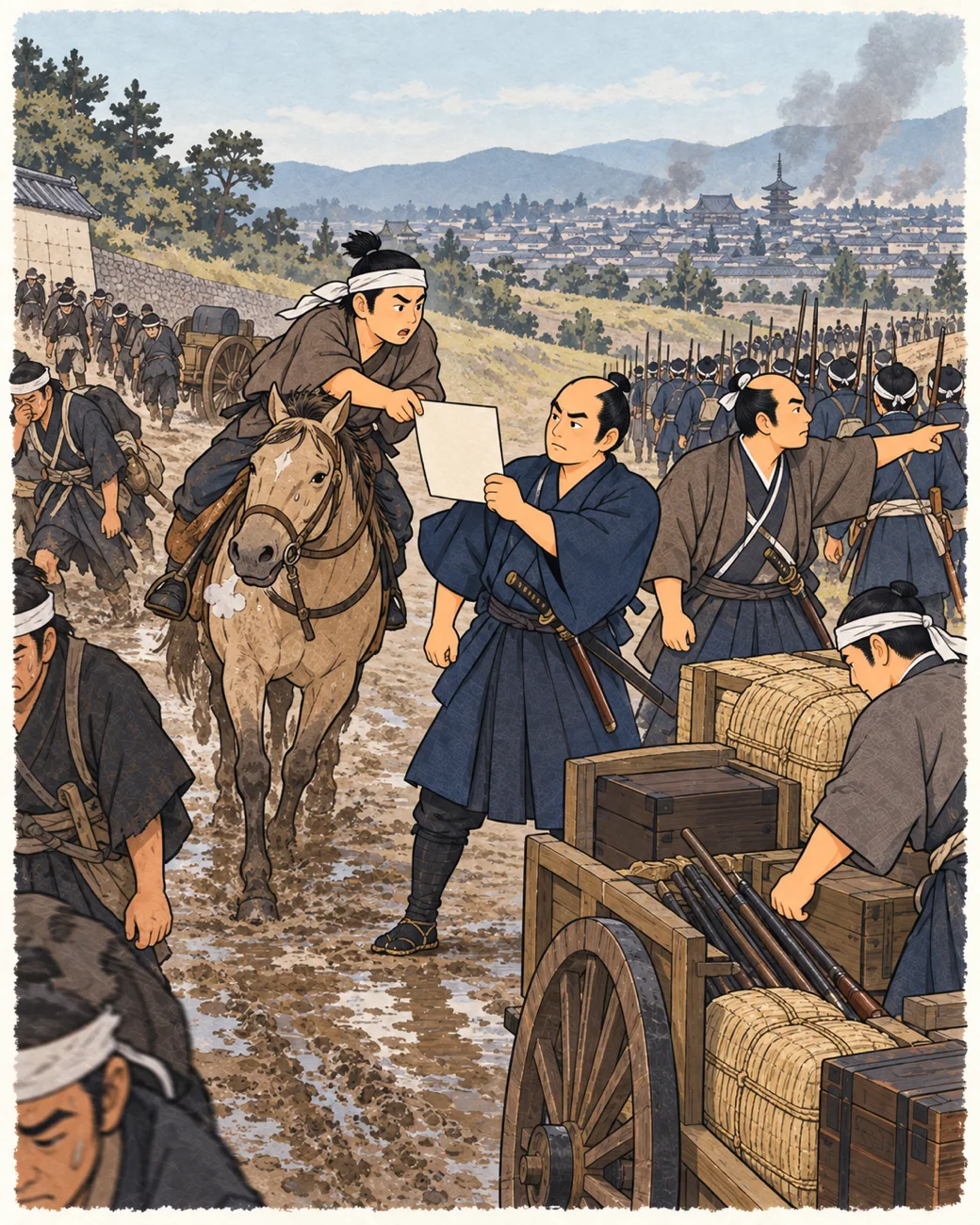
Returning governing authority had not settled the Tokugawa house’s lands, forces or place in the next government. After the restoration coup, former shogunal troops advanced toward Kyoto and fought government forces at Toba and Fushimi in January 1868. Defeat sent Yoshinobu back to Edo, and an imperial pursuit order authorized action against him.
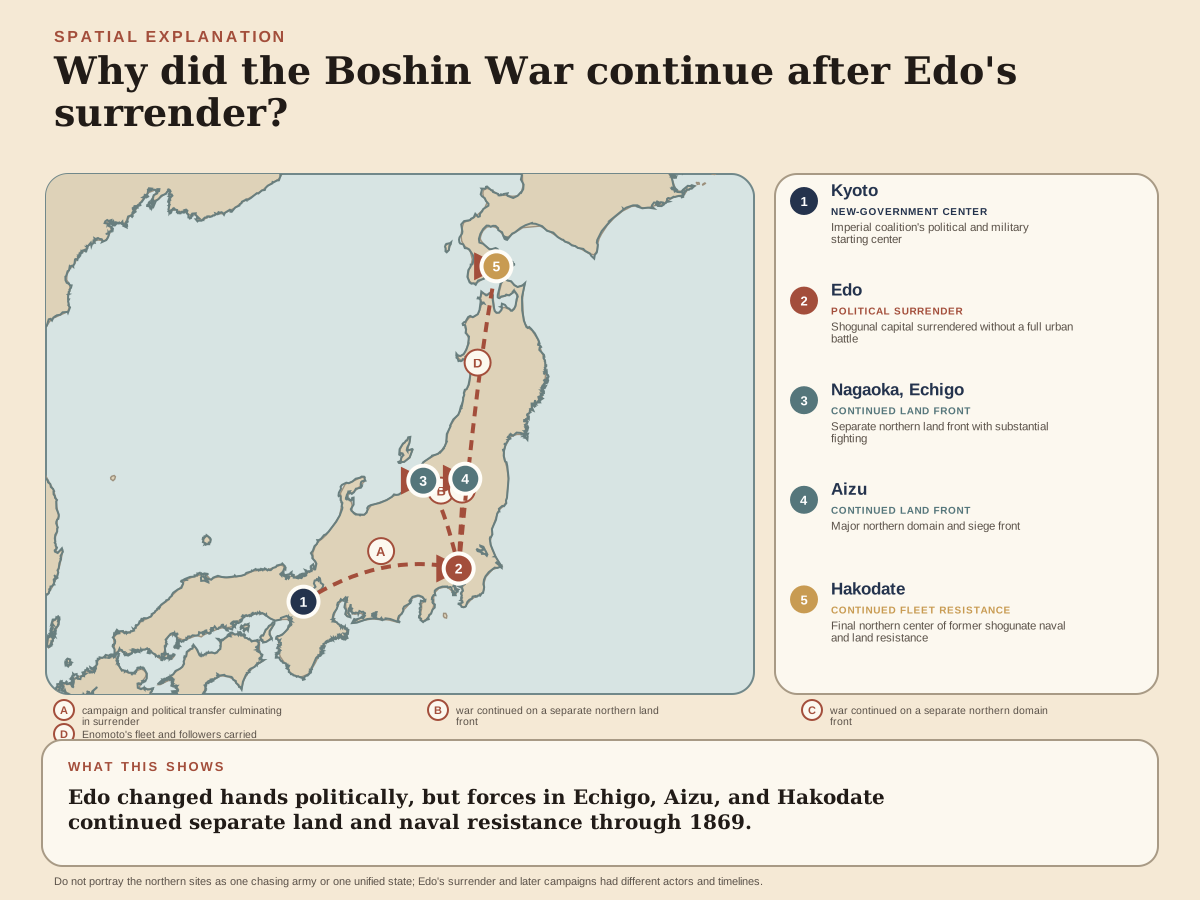
The government’s army moved east. Yamaoka Tesshū contacted Saigō Takamori at Sunpu before Katsu Kaishū’s talks with Saigō in Edo. The castle was surrendered on May 3 without the planned general assault. Other forces continued fighting: the Shōgitai at Ueno and armies in Echigo and the northeast were not brought to submission by the castle agreement.
Nagaoka’s Kawai Tsugunosuke sought armed neutrality, but failed talks at Ojiya preceded the domain’s entry into the northern alliance. The castle changed hands, and the defeated force withdrew toward Aizu. Government troops entered Aizu through Bonari Pass; a month-long siege ended with surrender in November. Houses burned and fields were damaged in the regional campaigns.
Enomoto Takeaki refused to hand over the whole former shogunal fleet and sailed north in October. His forces reached Ezo in December and occupied Goryōkaku. Officers elected leaders in January 1869 and created a provisional government. It issued orders for village military work and sought revenue from marine-products trade. Its proposal to obtain territory for Tokugawa retainers was rejected.
Government troops landed at Otobe in May 1869, advanced on separate routes and attacked Hakodate by land and sea in June. Enomoto surrendered on June 27, the Japanese calendar’s fifth month, eighteenth day. Defeated leaders were imprisoned, and some later entered government service. Aizu families settled in Tonami after the house’s restoration. Military victory left relief, revenue collection and the futures of defeated retainers to further decisions.
Classic
The restoration proclamation abolished the shogunate, but the Tokugawa house and allied domains retained armed forces. Demands for Yoshinobu’s office and lands raised the practical question of who would control those resources.
The former shogunal advance toward Kyoto failed at Toba and Fushimi. The government’s pursuit order accused Yoshinobu of deceiving the court and beginning hostilities. It connected control of lands and people to the establishment of imperial government, supplying its stated grounds for the eastern campaign.
Armed capacity was dispersed among domain armies, former shogunal formations and the navy. Transferring one castle could not automatically dispose of units elsewhere. Provincial leaders would have to negotiate, submit or fight under their own local circumstances.
The order proclaimed relief from warfare as an imperial purpose. Its implementation required campaigns through inhabited places. Fushimi’s burned residential areas already showed how the new government’s military advance could impose immediate losses on communities.
The northern coalition did not begin as a uniform commitment to restore the shogunate. Domains continued petitioning for Aizu's relief and met at Shiroishi before organizing an alliance. They later established a council and brought the Rinnōji prince into their political arrangements. These efforts claimed a place within imperial government even as the government's armies treated resistance as grounds for campaigning against them. Domain allegiance was a developing decision, rather than a permanent identity fixed at Toba–Fushimi.
Recognition abroad also required a separate sequence. Foreign representatives proclaimed neutrality during the fighting near Kyoto; Britain's minister subsequently obtained an audience at court, and British credentials formally recognizing the new government were delivered in May 1868. Victory, access to the court and diplomatic acknowledgment were distinct steps. Foreign recognition could support the government's national claim without placing northeastern armies or the former shogunal fleet under its command.
After victory near Kyoto, the government sent forces east. Yamaoka Tesshū met Saigō at Sunpu before Katsu Kaishū’s negotiations in Edo. The two days of talks in April preceded the castle’s surrender on May 3. Avoiding the general assault transferred the main bakufu seat without deciding every armed group’s response.
The Shōgitai resisted at Ueno and was defeated in July. Farther north, domains formed an alliance that extended into Echigo. Regional campaigns continued after the Edo transfer, bringing separate castles and armies into the war.
At Nagaoka, Kawai Tsugunosuke’s neutrality effort ended in failed Ojiya talks and alliance participation. Fighting spread into surrounding villages. The domain briefly recovered its castle before losing it again, and its force retreated toward Aizu; Kawai died after being wounded.
Government troops entered Aizu through Bonari Pass and reached the castle town. Katamori’s reorganized forces resisted in and around Wakamatsu Castle. Bombardment continued through a siege of about a month, ending in surrender in November 1868.
Enomoto’s fleet sailed north in October and gathered further former shogunal forces before reaching Ezo in December. His army took Goryōkaku and positions around Matsumae and Esashi. The loss of Kaiyō Maru at Esashi reduced its naval strength. Officers subsequently selected leaders and established provisional offices.
In May 1869, government troops landed at Otobe and advanced toward Hakodate along separate routes. The defenders’ earlier attempt to seize the government’s ironclad at Miyako had failed. The June land and naval assault reduced their positions; Enomoto and his remaining force surrendered at Goryōkaku on June 27.
The regional fighting changed what surrender meant. Edo's negotiators could hand over a castle while avoiding its general assault; Aizu's defenders endured a siege after fighting reached their town. Houses burned, fields were damaged and civilians of different ages died alongside soldiers. In the north, village orders demanded military service through headquarters and also provided a route for complaints against unlawful demands. People supplying an army, sheltering dependants or losing a harvest experienced the war through these local encounters, not only through changes of commanders.
The Ezo organization likewise needs a precise description. Officers selected their leaders, and a provisional government sought territory and livelihoods for former Tokugawa retainers. Its elected offices did not amount to a nationally representative, independent republic. The proposal was rejected, and possession of ships and forts could not compensate indefinitely for their loss and the government's coordinated advance. Western arms were used by opposing forces; their availability alone does not explain which coalition could replace losses, hold routes and obtain a settlement.
The Hakodate surrender ended the civil war’s final major organized resistance. The government recovered the northern headquarters. The date was the eighteenth day of the fifth month in the Japanese calendar, corresponding to June 27, 1869.
The returning Hakodate government announced where it would resume conducting affairs. Its original notice told town and rural inhabitants that business would be handled at the customs office from the following day. Recovering a fort was followed by re-establishing the place and authority for routine administration.
Enomoto and other leaders were taken into custody. Ōtori Keisuke’s journey diary recorded the escort toward Tokyo and damage observed along the route. Enomoto was pardoned in 1872 and entered the Development Commission; release and later employment were decisions made after surrender.
Aizu’s defeated house was permitted restoration in 1869 and established Tonami in northern Mutsu. Former retainers and families settled there, while the end of domains in 1871 brought further dispersal. The military defeat thus continued into decisions about where a house and its dependants could live and work.
Tonami's restoration of a house did not restore the living conditions of its dependants. In 1870, groups travelled north by sea from Shinagawa and overland toward their assigned settlements. Mutsu's local history records severe weather, difficulties obtaining lodgings and inadequate housing after arrival. With farming settlements slow to establish, many households depended on grain allowances. Poor food and winter cold made relocation a continuing struggle for subsistence; accounts describe seaweed mixed into gruel to stretch the available rice. The administrative grant of a new domain and the material experience of its households were different outcomes. The evidence establishes hardship among migrants, without proving that every former Aizu family moved or that all moved under the same compulsion.
Matsudaira Katamori carried the defeat as lord of Aizu. His surrender and confinement belonged to the settlement of the Boshin War, while later memorial narratives in Aizu preserved a different view of loyalty from the victorious imperial account.
In 1867 Tokugawa Yoshinobu, the shogun, returned governing authority to the imperial court. The act left open how much power the Tokugawa house would retain. Its armies and lands still mattered, and court leaders disagreed over Yoshinobu's place in a new government.
The war brought successive regional armies and headquarters under government control. Its pursuit order made national rule a matter of securing lands and people as well as accepting Yoshinobu’s resignation. Campaigns and settlements supplied the enforcement that the January proclamation alone had lacked.
The provisional northern government’s original notices show what soldiers demanded from villages. One required compliance with military duties through Furuya Sakuzāemon’s headquarters at Mori, while forbidding unlawful borrowing and directing complaints there. Another required marine-products transactions to pass through a products office. War involved local labor, complaints and revenue as well as battles.
After Hakodate’s recovery, officials investigated losses and supplied relief through rice distribution or cheaper sales, assistance and tax remission. In Nagaoka, relief rice helped fund a school, while new work in silk production aided former retainers. Reconstruction and livelihood measures followed destruction at particular places.
Selective incorporation also followed punishment. Enomoto’s later diplomatic and ministerial service drew on expertise associated with the defeated regime. Such appointments did not reverse the losses of communities or restore every retainer’s former position. The postwar government chose where to offer relief, employment and rehabilitation.
The later changes affected soldiers on the winning side too. The abolition of domains removed the territorial governments that had raised coalition armies; the 1873 conscription ordinance recruited men outside the hereditary warrior establishment. Its exemptions meant service was not imposed equally on every man, but military duty was no longer defined simply by belonging to a warrior house. Those who had fought for the new government could therefore help establish a center that subsequently changed their own basis of service.
The surviving documents also distinguish political justification from everyday authority. The pursuit order represented the eastern campaign as action against an enemy of the court; the northern government's notices instructed villagers about duties, payments and complaints. Reading both does not make their claims equally valid. It reveals the different tasks their language performed, and keeps the defeated force's administration, the victors' justification and household losses visible in the account of national unification.