Jonangu and the Opening Shots at Toba
Attraction
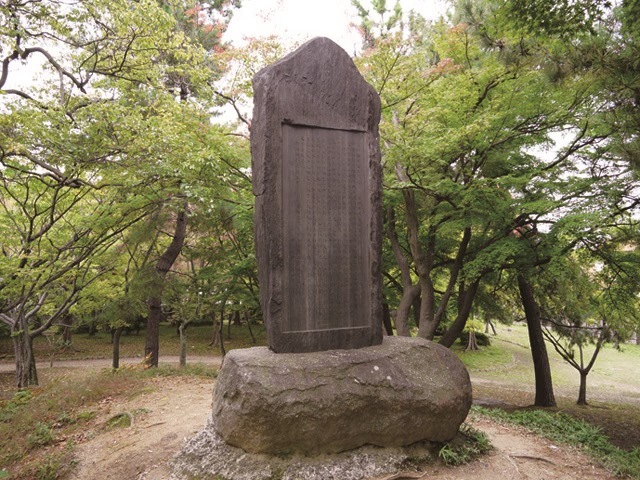
Near Jonangu and the Toba road, forces loyal to the former shogunate met Satsuma troops blocking the approach to Kyoto in January 1868. Fighting here helped turn a political confrontation into the Boshin War. The modern road environment no longer resembles an open nineteenth-century battlefield, so markers, old route alignments and the relation to the Kamo River must carry the interpretation. Tokugawa Yoshinobu was in Osaka rather than commanding on this ground; Aizu, Kuwana and shogunal units advanced within a coalition whose objectives were not identical. The Place matters because a road junction forced political claims into armed contact. It also cautions against treating the Restoration as an uncontested proclamation already completed in Kyoto.
Current visibility
At Toba-Fushimi Battlefield, “Jonangu and the Opening Shots at Toba” is grounded in present on-site evidence—the road and path, the battlefield terrain, and the ground markers—without implying that every historical layer survives as fabric.
Fushimi, Gokonomiya and an Urban Front
Attraction
At Fushimi, pro-imperial forces occupied positions around Gokonomiya Shrine while fighting spread through a town shaped by roads and water transport between Kyoto and Osaka. Buildings and commerce made this an urban front, not empty terrain. Fire destroyed structures including the contemporary Teradaya, and surviving bullet damage at local buildings is interpreted within the battle's memory. The two fronts at Toba and Fushimi should be read together: pressure and retreat on one route affected the other. Modern reconstruction and later buildings require careful labels, but the street network still explains why Fushimi was strategically valuable. Control here affected communication with Osaka and access to the capital.
Current visibility
“Fushimi, Gokonomiya and an Urban Front” can still be read at Toba-Fushimi Battlefield through the road and path, the surviving building, and the reconstructed building; the visibility claim concerns that setting, not a past moment preserved intact.
The Imperial Banner and a Change in Political Legitimacy
Attraction
The appearance of an imperial banner with the pro-court army changed how participants understood the conflict. It did not mechanically decide every exchange of fire, but it made continued resistance appear to be opposition to the emperor and affected morale and domain choices. Better firearms, command decisions and the former shogunate army's retreat also shaped the result. Following the roads south shows how defeat expanded beyond one battlefield and drove Yoshinobu's withdrawal from Osaka. Toba-Fushimi is therefore a Place of political reclassification as well as combat: troops who had marched under Tokugawa authority became identified as enemies of a new imperial government during the fighting itself. The 1868 battlefield makes legitimacy visible as something produced through symbols, movement and force.
Current visibility
The surviving setting at Toba-Fushimi Battlefield anchors “The Imperial Banner and a Change in Political Legitimacy”; its physical context is the road and path and the battlefield terrain.