Read the article below. Interactive reading tools are available when scripts load.
Quick
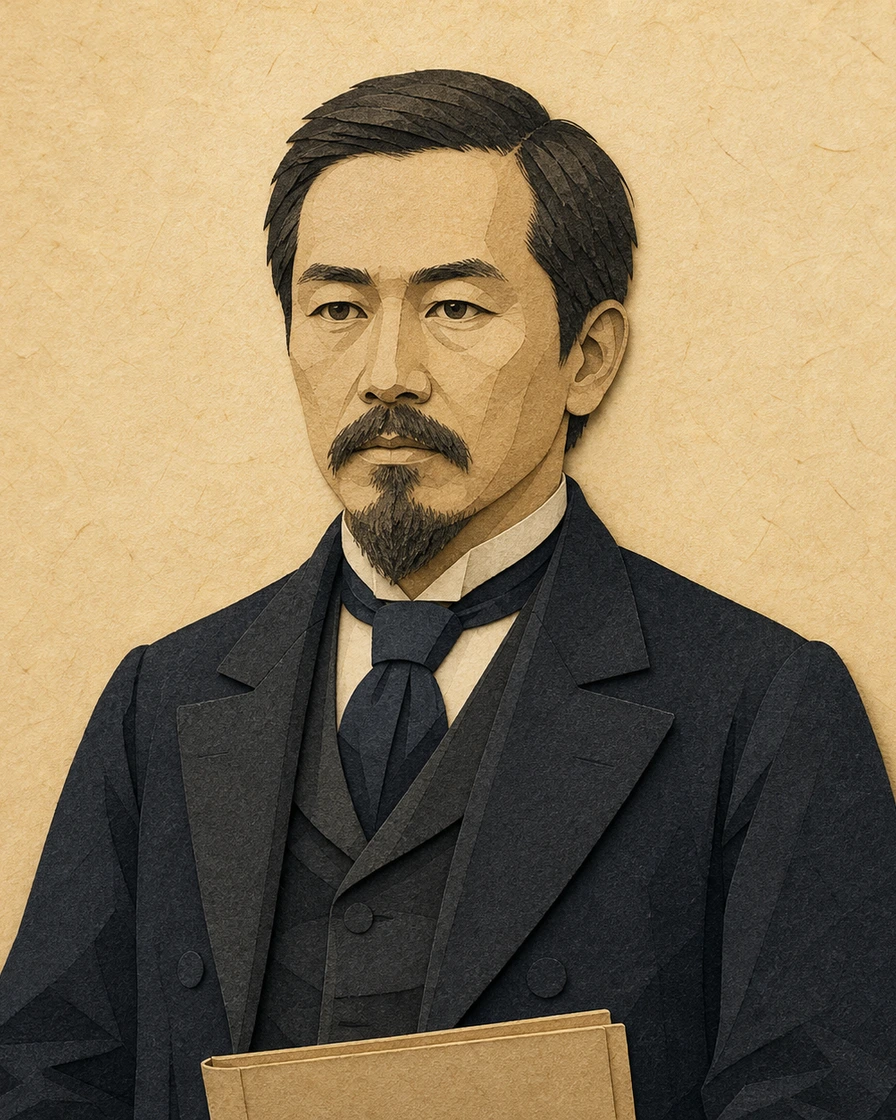
Ōkubo was born in Kagoshima on 26 September 1830, the tenth day of the eighth month of Tenpō 1. His father, Toshiyo, served Satsuma as a lower-ranking retainer. The household possessed warrior status and literacy but not the security of the domain's senior houses.
In 1846 Ōkubo entered the domain record office as a junior assistant. The appointment placed him among documents, superiors, and routines before it placed him near national politics. The succession struggle later called the Oyura disturbance then struck his family. His father was punished, and Ōkubo himself was confined and removed from office in 1850 before returning to service in 1853.
The episode did not teach one inevitable political lesson. It showed materially that a domain's factions could govern employment, household income, and reputation. Later administrative discipline should not be projected backward as an inborn vocation. What survives is a young retainer's early entry into clerical service and his family's exposure to power exercised through office.
Restored to service in 1853, Ōkubo advanced through modest offices while cultivating ties among Satsuma retainers concerned with court politics, foreign pressure, and reform. The network later called Seichūgumi included Saigō and men who did not agree on every tactic. It was not a modern party with permanent membership and a single manifesto.
After Ii Naosuke was assassinated outside Sakurada Gate in 1860, some Satsuma activists hoped the domain would move militarily. Ōkubo pressed for action, but Hisamitsu did not simply obey. The failed initiative demonstrated both the network's ambition and its dependence on a leader controlling troops, appointments, and legitimacy.
Ōkubo then gained access to Hisamitsu's circle and helped turn activist communication into authorized domain policy. Promotion did not mean that he had captured an empty ruler. Hisamitsu brought dynastic standing, resources, and his own priorities; senior officials and fellow activists converted proposals into action.
In 1862 Ōkubo helped organize Hisamitsu's armed journey to Kyoto. The expedition aimed to make Satsuma indispensable to a court-bakufu settlement and to force reforms at Edo. Its scale depended on domain finance, commanders, transport, and more than a thousand retainers—not on one planner alone.
The movement exposed conflict inside Satsuma. Radical retainers gathered at the Teradaya inn and contemplated immediate action. Hisamitsu ordered their suppression. On 23 April Satsuma men fought Satsuma men; several were killed and others punished. Saigō, who had moved without authorization and challenged Hisamitsu's direction, was exiled again.
Ōkubo remained within the authorized command and advanced. Hisamitsu escorted an imperial envoy to Edo, where the bakufu accepted reforms including the appointment of Hitotsubashi Yoshinobu and Matsudaira Yoshinaga to leading roles.
Success therefore carried an internal cost. Domain discipline made Satsuma credible to external partners by demonstrating that its leader could control—and kill—his own activists.
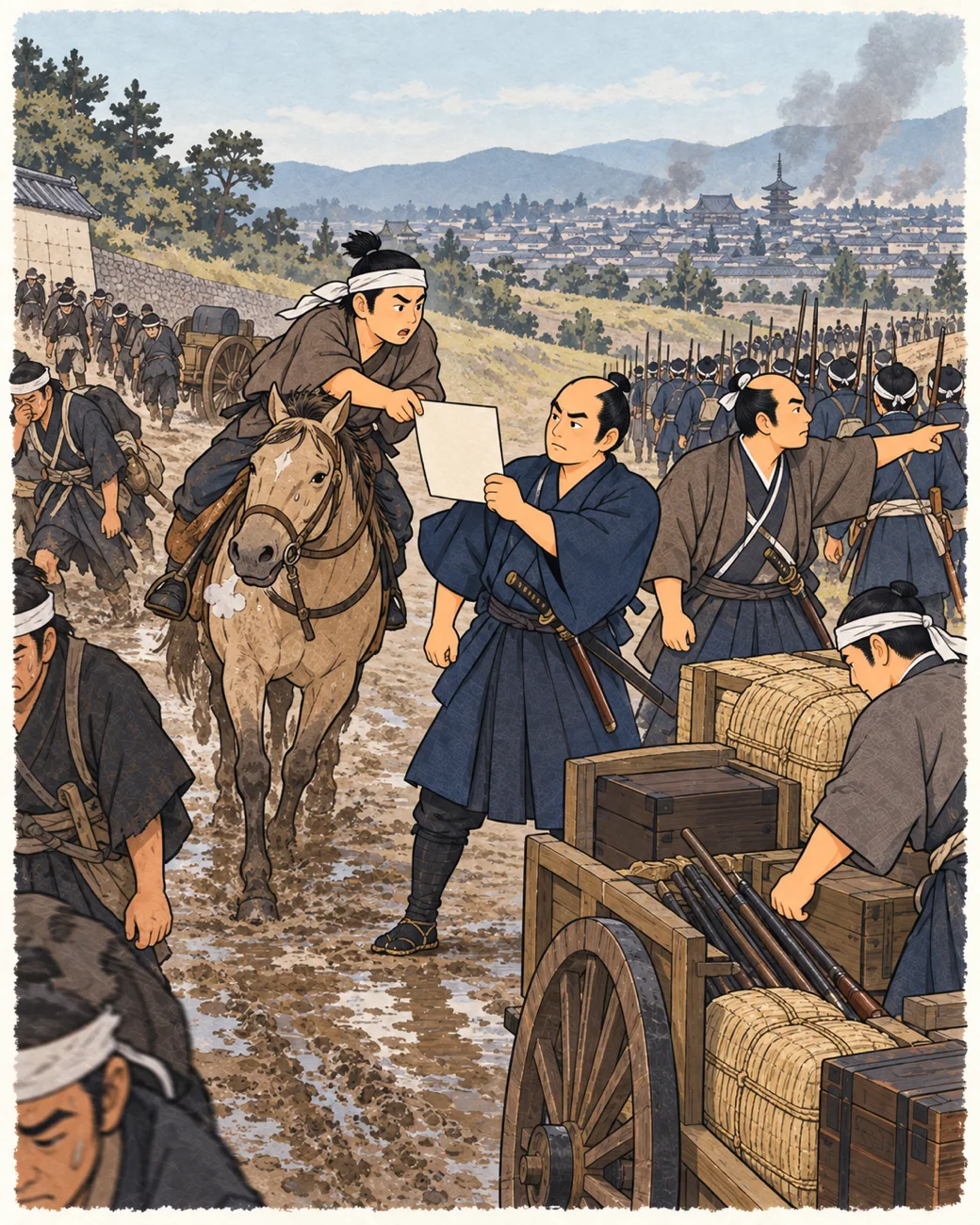
Satsuma did not move directly from reform to alliance with Chōshū. In 1864 its forces helped defend the imperial palace against Chōshū troops in the Kinmon conflict. Saigō held an important military role, while Ōkubo worked through the domain and court political network.
The settlement did not stabilize Kyoto. Tokugawa Yoshinobu's court position, bakufu pressure on domains, foreign-policy disputes, and plans for another campaign against Chōshū altered Satsuma's calculations. Hisamitsu's expected influence within a cooperative order repeatedly met resistance.
Ōkubo's politics shifted with these failures. Opposition to the bakufu grew from conflicts over who would control court sanction, military operations, and national reform. It was not proof that every earlier compromise had been a disguise.
By 1865 Satsuma leaders increasingly sought a wider coalition capable of blocking bakufu coercion. The domain that had fought Chōshū now had reasons to communicate with it. Reversal required explanation and intermediaries; it did not erase the casualties of 1864.
In early 1866 Satsuma and Chōshū reached an understanding that reduced their mutual hostility and committed Satsuma to political support if the bakufu attacked Chōshū. Kido Takayoshi negotiated for Chōshū; Saigō was central on the Satsuma side. Sakamoto Ryōma and Nakaoka Shintarō helped sustain communication.
Ōkubo and Komatsu Tatewaki supported the policy within Satsuma's governing network. The result is often called an alliance, but its surviving terms were recorded through participants rather than preserved as one modern treaty signed by all supposed architects.
The agreement worked because interests converged. Chōshū needed relief from isolation and access to arms; Satsuma wanted to prevent the bakufu from defeating one domain at a time and monopolizing national command. Trust remained conditional.
When the bakufu's second expedition failed, the balance changed sharply. The understanding had helped make coordinated resistance possible, but Chōshū fighters, local administration, merchants, suppliers, and divisions inside the Tokugawa coalition determined the campaign's outcome.
In 1867 Ōkubo worked with Iwakura Tomomi, Saigō, Satsuma leaders, and Chōshū partners to replace Tokugawa government. Tokugawa Yoshinobu returned governing authority to the court in November, but resignation did not settle the structure of the new order. Yoshinobu could still dominate a council of lords.
On 3 January 1868, allied forces secured the Kyoto palace while court figures proclaimed the restoration of imperial rule and created new offices. Ōkubo helped prepare this seizure of initiative. It was legally voiced in the young emperor's name and politically enforced by armed domains.
Fighting at Toba-Fushimi days later opened the Boshin War. Saigō and military commanders directed forces; Ōkubo served the forming government and pressed institutional plans. Tokugawa surrender at Edo did not end resistance in the northeast and Hokkaido.
Restoration was therefore decree, coalition, coercion, negotiation, and civil war. Ōkubo helped build it, but no individual possessed the whole event.
The government created in 1868 repeatedly changed its councils, ministries, titles, and chains of command. Ōkubo served as participant, adviser, and then councillor. He argued for a capital at Osaka, but the court and government instead moved progressively toward Edo, renamed Tokyo.
The new state claimed national authority while depending on domain troops, domain remittances, loans, and inherited local administration. War expenses and the costs of court and office pressed hard on weak revenues. Officials translated broad oaths and decrees into appointments, registers, budgets, and provincial instructions.
Ōkubo's strength lay in connecting political decisions to machinery. That did not make the machinery impersonal. Satsuma, Chōshū, Tosa, Hizen, court households, and individual patrons competed over posts. Farmers and townspeople financed changes they had little role in designing.
Administrative construction was therefore contested work performed before the government's survival was assured. Efficiency was one aim; political control and coalition management were equally present.
In 1869 the lords of Satsuma, Chōshū, Tosa, and Hizen offered their registers and governing rights to the emperor. Other domains followed. The government accepted, but most former lords remained in place as appointed governors. The first measure changed the legal claim more quickly than local administration.
Ōkubo and Kido were prominent advocates of stronger central rule. By 1871 they and their allies prepared a more decisive abolition. Saigō helped secure the military foundation by organizing an imperial guard from leading domains.
On 14 July the government summoned domain governors and announced replacement of domains by prefectures. Former lords were ordered to Tokyo; their administrations, troops, debts, and revenues had to be sorted. The operation was bold, collective, and backed by force.
It did not instantly create one uniform country. Prefectures were consolidated in stages, former domain personnel remained essential, and financial liabilities passed unevenly into new arrangements.
Ōkubo left Japan in December 1871 as one of the Iwakura Mission's vice ambassadors. The mission included senior delegates, secretaries, specialists, interpreters, attendants, and students—roughly 150 people whose routes and work did not all coincide. [2]
In the United States, delegates moved beyond their original brief and attempted treaty revision. Ōkubo and Itō returned to Japan to obtain fuller credentials, but negotiations still failed. The failure exposed unequal diplomatic power and the mission's own procedural misjudgment.
Travel through the United States and Europe nevertheless provided sustained observation of ministries, factories, schools, armies, transport, finance, and constitutional systems. Ōkubo returned convinced that state capacity and domestic production required long preparation.
He did not import a complete Western model. Countries differed, hosts curated what visitors saw, and Japanese students, interpreters, women, technicians, and officials carried knowledge through separate channels. Meanwhile the left-behind government continued reforms that the travelers had to confront on return.
When Ōkubo returned in September 1873, the government was divided over relations with Korea. Saigō proposed going as envoy amid disputes over recognition and diplomatic language. Supporters treated the mission as a way to open relations and defend national dignity; opponents feared it could trigger war.
The council provisionally approved dispatch on 15 October. Ōkubo resigned two days later as part of an effort to prevent implementation. After Sanjō fell ill, Iwakura carried the opposing case to the emperor. On 24 October the emperor accepted indefinite postponement. Saigō, Itagaki, Etō, Gotō, and Soejima left government.
Ōkubo argued that domestic finance and institutions were unready for another crisis. This was not a pacifist victory. The government used force in Taiwan in 1874 and against Korea in the 1875 Ganghwa incident.
The crisis reorganized power through procedure, personal access, and resignation. It also broke the governing partnership of men whose earlier cooperation had made the Restoration.
The government created the Home Ministry in November 1873 to gather industrial promotion, police, and local administration under a powerful central department. Ōkubo became its first minister, but his tenure was interrupted: Kido and then Itō held the office during parts of 1874 before Ōkubo resumed it in November.
The ministry fostered agriculture and manufacturing, supervised prefectures, developed policing, and collected information. Its projects included experimental institutions and the First National Industrial Exhibition at Ueno in 1877. Officials hoped display, prizes, and comparison would connect imported methods with existing skills.
This was not growth produced by one ministry. Farmers, craftspeople, merchants, engineers, translators, workers, local officials, and foreign advisers carried knowledge and bore costs. State enterprises could fail or later pass to private owners.
Capacity and coercion grew together. The same administrative center that encouraged production strengthened surveillance and control over local dissent. “Internal development” described both material investment and political consolidation.
In early 1874 former councillor Etō Shinpei joined a revolt in Saga that combined incompatible groups demanding action toward Korea, government reform, or restoration of former privilege. Government forces retook Saga Castle by 1 March. In April thirteen leaders, including Etō, were executed. Ōkubo served as Home Minister and a leading government representative in the campaign.
That same government sent troops to southern Taiwan, citing the killing of Ryukyuan castaways in 1871. Saigō Jūdō commanded the expedition against Indigenous communities. Ōkubo traveled to Qing China as plenipotentiary and negotiated an October settlement followed by Japanese withdrawal. The agreement became part of Japan's claim over Ryukyu.
Domestic opposition also took constitutional form. At the 1875 Osaka Conference, Ōkubo, Kido, and Itagaki agreed on gradual institutional change. An imperial edict created the Genrōin and Great Court of Cassation and promised movement toward constitutional government.
Suppression, foreign coercion, and managed concession were not separate personalities. They were tools used by the same unsettled state.
By 1876 the government had commuted hereditary stipends and prohibited most former samurai from wearing swords. These measures strengthened fiscal and legal uniformity while destroying recognized income and status. Several rebellions broke out in western Japan.
In Kagoshima the Private Schools formed an armed political society around Saigō's prestige. After students seized government arsenals, Saigō joined their movement north in February 1877. The resulting Satsuma Rebellion became the largest test of the new state.
Ōkubo was a central political organizer of the government response, not the army's field commander. Prince Arisugawa held supreme command; Yamagata, Kawamura, other officers, conscripts, police, transport workers, and medical staff carried the war.
Government victory at enormous cost demonstrated the center's military and fiscal reach. Saigō died at Shiroyama in September. The conflict ended a friendship, but it was also civil war produced by institutional transformation, regional power, and contested legitimacy.
On the morning of 14 May 1878, Ōkubo traveled by carriage toward the imperial palace. Near Kioichō and Shimizudani, commonly remembered through the “Kioizaka Incident,” six former samurai led by Shimada Ichirō attacked. They killed the carriage driver and assaulted Ōkubo, who died at the scene.
The attackers carried a written indictment accusing him and the government of monopolizing power, suppressing public discussion, wasting resources, and mishandling national affairs. The document is direct evidence of their political self-justification, not an impartial audit of Ōkubo's rule.
The murder followed a decade of coups, rebellions, repression, and status displacement. Context explains why armed opposition existed; it does not convert assassination into lawful judgment. The six attackers were arrested and later executed after trial.
The evidentiary boundary is part of the account.
Ōkubo left no opportunity to interpret his own posthumous reputation. Successors continued the Home Ministry, prefectural supervision, police, industrial policy, and constitutional planning. The 1889 Constitution and later Meiji institutions were built by people who inherited part of his state but made choices he did not live to approve.
Official memory honored an architect of Restoration and central government. Critics remembered an oligarch who defeated former allies, restricted political participation, and concentrated coercive power. Saigō's posthumous popularity sharpened the contrast between warm rebel and cold administrator.
Both portraits select evidence. Ōkubo was a powerful organizer, not the sole maker of the state. His centralization supported national law, infrastructure, and production while enabling surveillance, extraction, repression, and external coercion.
Through 1912, biography, monuments, institutions, and political debate continued to classify him. The canonical life ends with those contested Meiji receptions, not later film or television character types.
Classic
Satsuma's warrior order was a hierarchy rather than a single privileged class. Lower retainers held recognized status, learned the forms of service, and could seek appointment, yet they depended on stipends, superiors, household reputation, and factional protection. The Ōkubo family therefore stood inside domain rule without commanding it. That combination—access joined to vulnerability—matters more than a later legend of poverty overcome by genius.
The record office did not resemble a modern neutral civil service. Documents served a lord's household government. Clerks copied, registered, routed, and preserved instructions; rank determined whose words became decisions. Even junior work could reveal how an order acquired an authenticated form and how delay, error, or exclusion altered its effect. It did not prove that Ōkubo already dreamed of central ministries.
The domain itself drew strength from unequal territories and fiscal arrangements. Castle-town offices rested on the production of cultivators, merchants, artisans, Ryukyuan intermediaries, and the heavily controlled sugar economy of the Amami islands. A clerk could become skilled in administration without seeing every burden that made administration possible. Later celebration of Satsuma's reform capacity must retain this wider social base.
The succession conflict exposed the political nature of service. Supporters of Shimazu Nariakira clashed with forces associated with the sitting lord Narioki and the possible advancement of Hisamitsu. Rumours of curses and later melodrama can obscure the documented punishments: executions, confinement, dismissal, and exile reached more than fifty people. Ōkubo's father was implicated and punished; the son's own confinement and loss of post followed.
Household consequences were not symbolic. Removal from office reduced income and narrowed marriage and patronage prospects. Women and other dependants absorbed shortages while official records foregrounded male retainers. The punishment of one officeholder could discipline an entire network without holding a public trial in the later sense.
Ōkubo returned to work in 1853 after Nariakira had secured the lordship. Restoration did not erase what happened or make him immediately powerful. It re-opened a route whose closure he had experienced. His subsequent caution with documents, appointments, and command can be interpreted in light of this history, but interpretation is not access to his adolescent thoughts.
Calendar practice also needs care. The Japanese year Tenpō 1 and the converted Gregorian date 26 September 1830 describe the same birth, while traditional age reckoning differs from completed years. Precise conversion prevents a trivial-looking discrepancy from becoming a false conflict.
Later biographies often make Shita-Kajiya a nursery of inevitable Meiji founders because Saigō, Ōkubo, and other figures lived nearby. Neighborhood training and peer ties were real, but youths followed divergent paths, and most did not become national leaders. The place supplied relationships, not destiny.
The strongest conclusion is institutional. Ōkubo first encountered authority as a hereditary insider of modest rank, a clerk dependent on authenticated orders, and a son whose household could be punished through faction. That beginning helps explain his later attention to control without converting control into his natural essence.
The political shocks of the 1850s created overlapping circles of debate. Foreign warships, treaty controversy, shogunal succession, and court intervention made information from Edo and Kyoto unusually valuable. Lower and middle retainers exchanged letters, met through neighborhood and office ties, and attached themselves to patrons. “Seichūgumi” is a useful retrospective label, but it can falsely imply a disciplined organization that existed unchanged across crises.
Its participants differed. Some favored immediate violent action; others sought a lord-led intervention; still others shifted as circumstances changed. Kinship and friendship did not eliminate rank. A proposal required someone with access to carry it upward, a superior willing to receive it, and an official chain capable of moving money and men.
The Sakuradamon assassination illustrates these differences. Mito-linked attackers and Satsuma-born Arimura Jizaemon killed Ii Naosuke in March 1860. The act did not represent a fully authorized Satsuma campaign. Ōkubo and associates urged the domain to seize the political moment, but Hisamitsu declined to mobilize on their schedule. Their inability to command him is evidence against later claims that Ōkubo already directed Satsuma from below.
Approach to Hisamitsu required careful mediation. Ōkubo used contacts, memorials, and service performance to become useful to the lord's father and effective political leader. Hisamitsu, despite later depictions as merely conservative or manipulable, possessed the dynastic claim and coercive capacity that activists lacked. He could promote a retainer, suppress a faction, or take a thousand men toward Kyoto.
This partnership contained a historical irony. The Oyura conflict had punished Ōkubo's family partly within a succession struggle associated with Nariakira and Hisamitsu. After Nariakira's death, Ōkubo served the very power center once cast as the rival side. That was not necessarily betrayal. Domain politics changed, Hisamitsu's position changed, and a retainer seeking effective action had to work with living authority rather than a frozen factional memory.
Saigō's absence after 1858 also matters. While Saigō was concealed and exiled on Amami, Ōkubo built influence under Hisamitsu. The domain did not wait for one famous friendship to resume. Komatsu Tatewaki, senior retainers, court intermediaries, radical activists, messengers, and household officers contributed distinct resources.
The network's social reach remained limited. Most domain subjects did not participate in these deliberations, even though policy would draw on their taxes and expose them to military risk. Activist language about realm and emperor often moved through male warrior circles whose access was structured by status.
What Ōkubo mastered was not an abstract science of bureaucracy. He learned how informal trust, formal appointment, written proposals, and a patron's authority could be joined. The joining was unstable. An unauthorized faction could be suppressed; an authorized expedition could suddenly turn yesterday's comrades into obstacles.
Appointments trace the transition without proving private intention. He became a foot inspector in 1857 and entered Hisamitsu's small private office in 1861. Titles gave defined access and duties; they also left him removable. His influence accumulated through the domain's hierarchy even when informal meetings supplied the initiative.
Hisamitsu's expedition joined two forms of power. Court connections could confer legitimacy, while an armed domain contingent made requests difficult to ignore. Preparing it required schedules, lodging, provisioning, security, and political messaging. Ōkubo helped coordinate these elements, but Komatsu Tatewaki, senior officers, court nobles, and the transport labor of unnamed people made the column function.
The goal was initially kōbu-gattai: a stronger arrangement between imperial court and Tokugawa government, not the immediate destruction of the bakufu. Later overthrow makes it tempting to read the expedition as an early stage of one uninterrupted revolution. In 1862, however, restoring authority through reforming the existing order remained a live Satsuma strategy.
Radical activists interpreted the crisis differently. At Teradaya in Fushimi, men associated with the broader Seichū current prepared action against figures they considered obstacles. Hisamitsu treated the gathering as insubordination and sent domain retainers to stop it. Arima Shinshichi and others died in the clash; survivors faced confinement. The violence occurred within a group later remembered as united Restoration patriots.
Ōkubo's position cannot be reduced to secret approval of every blow. He belonged to the political machinery that made Hisamitsu's intervention possible and remained useful after the suppression. That institutional location separated him from men who insisted that sincerity authorized independent violence. It also implicated his ascent in a discipline enforced with blood.
Saigō's renewed exile presents another contrast. Recalled for his ability, he moved toward Kyoto against instructions and disparaged Hisamitsu's leadership. The domain sent him through Tokunoshima to severe confinement on Okinoerabu. Ōkubo and other actors continued policy without him and later helped secure his return when circumstances changed. Friendship did not erase command.
The expedition then accompanied the imperial envoy Ōhara Shigetomi to Edo. Bakufu reforms elevated Hitotsubashi Yoshinobu as guardian and Matsudaira Yoshinaga as political affairs president. These appointments mattered, but they did not settle treaty legitimacy, domain rivalry, or court radicalism. A coercive success produced another temporary arrangement.
The work of movement remained socially distributed. Porters, boatmen, innkeepers, cooks, stable workers, and local officials sustained the contingent. Their labor appears less often than memorials exchanged by elite men. Villages along the route experienced an armed procession as requisition and disruption as well as national politics.
Teradaya also warns against moral sorting by later outcomes. Men killed as disorderly retainers became martyrs in Restoration memory. Hisamitsu, whose command enabled Satsuma's rise, became an awkward conservative. Ōkubo could be praised as disciplined or condemned as calculating. The event itself supports no simple verdict. It shows a domain converting an activist network into state-directed force by defining who could act and punishing those who rejected the definition.
That discipline made Ōkubo more powerful. It also established a political habit: legitimate transformation would be decided by those able to occupy institutions, while unauthorized violence—even in the name of the same emperor—could be met with coercion. The habit would recur under the Meiji government on a much larger scale.
The Kinmon conflict of July 1864 is essential because it resists a tidy alliance story. Chōshū forces entered Kyoto seeking to reverse their exclusion from court politics and clashed with defenders that included Satsuma and Aizu. Fire devastated large areas of the city. Combatant decisions therefore imposed consequences on townspeople whose homes, shops, and workshops were not factional headquarters.
Satsuma's participation followed its current alignment. The domain claimed a role in protecting the court and sustaining a reformed political order. Saigō's military service and Ōkubo's political work belonged to the same policy even though their functions differed. Chōshū was then an adversary, not an inevitable future partner.
Victory produced no durable settlement. The bakufu launched a punitive expedition against Chōshū, while Yoshinobu and other leaders competed over court access and policy. Satsuma's support could strengthen a Tokugawa-centered machinery that might later constrain Satsuma itself. Hisamitsu's vision of cooperative leadership among major lords did not receive the stable authority he expected.
Ōkubo's changing position should be reconstructed through decisions rather than an invented conversion scene. Memorials, meetings, and alliances show growing resistance. They do not give one date on which he privately ceased believing in kōbu-gattai. Political categories themselves were changing as actors tested arrangements under pressure.
Foreign relations intensified the problem. The bakufu had signed treaties and faced demands that affected all domains; coastal defense and trade required resources beyond local control. Yet no accepted national institution could distribute costs or settle legitimacy. Reform within Tokugawa rule might still produce capacity, but it also protected officials whose authority Satsuma increasingly distrusted.
The proposed second Chōshū expedition forced a choice. Supporting another campaign could exhaust domains and consolidate bakufu command. Refusing it could make Satsuma appear disloyal to the order it had recently defended. Communication with Chōshū offered a way to prevent isolation, provided past hostility could be managed.
Komatsu Tatewaki, Saigō, court nobles, merchants, and intermediaries mattered. Ōkubo did not change national alignment by solitary insight. Sakamoto Ryōma and Nakaoka Shintarō later helped bridge distrust, while arms procurement and shipping provided practical incentives for cooperation. Hisamitsu and domain officers still had to accept the risk.
The dead and displaced of 1864 do not vanish because the combatants later allied. A shared future purpose could coexist with responsibility for earlier conflict.
Ōkubo's significance lies in willingness to revise means while pursuing Satsuma influence and a stronger central order. Flexibility can be praised as realism or criticized as opportunism. The records establish adaptation, not a final moral label.
By 1865, cooperation had not merely failed in theory. It had repeatedly placed Satsuma's ambitions inside institutions controlled by others. Changing the order began to look less dangerous than allowing those institutions to command another war. That calculation prepared alliance; it did not yet guarantee revolution.
The phrase “Satsuma–Chōshū Alliance” suggests a document, a ceremony, and a moment of completed reconciliation. The surviving evidence is more relational. Kido recorded points reached in Kyoto discussions, and Ryōma endorsed their accuracy. Commitments concerned Satsuma's conduct if the bakufu attacked and its help in restoring Chōshū's position at court. This was a political understanding built through repeated contact.
Recent war made distrust rational. Satsuma troops had fought Chōshū at the imperial palace, and the first punitive expedition had compelled Chōshū submission. Leaders could not create confidence by invoking patriotism alone. Intermediaries carried proposals, tested language, and reassured parties who feared betrayal.
Kido and Saigō deserve central credit for direct negotiation. Komatsu's senior standing helped provide Satsuma authorization and commercial reach. Ōkubo's influence under Hisamitsu connected the arrangement to broader domain strategy. Ryōma and Nakaoka contributed cross-domain access. Removing any of these functions makes the story falsely simple.
Material exchange supported political words. Satsuma channels assisted Chōshū acquisition of weapons and shipping while Chōshū could provide grain. Merchants, crews, financiers, brokers, and port workers enabled transactions. “Alliance” therefore included logistics that elite reminiscence often compresses into handshakes.
Hisamitsu's position still mattered. Ōkubo could advocate policy, but Satsuma's name and resources derived from domain authority. The understanding was not an independent conspiracy by two heroic lower retainers floating above their governments. Nor did every Satsuma retainer support it.
The bakufu expedition in 1866 tested the arrangement. Satsuma declined to commit forces to suppress Chōshū. Chōshū's reformed units resisted successfully on several fronts, while the death of Shogun Iemochi and weaknesses among participating domains undermined the campaign. Victory cannot be assigned to diplomacy alone.
The failure altered national expectations. If the bakufu could no longer compel major domains, its claim to coordinate the realm weakened. Satsuma gained a partner rather than a dependent. Chōshū gained room to re-enter national politics. Neither outcome required emotional reconciliation.
Shared opposition also concealed future competition. After the Restoration, Satsuma and Chōshū leaders would cooperate inside a central government while arguing over offices, armies, budgets, and policy. The alliance did not fuse them into a permanent faction with one will.
Ōkubo's role is best described as institutional sponsorship and strategic integration. He helped make an alliance acceptable inside Satsuma's policy and connected it to the effort to block bakufu coercion. Saying that he “created” it alone erases negotiators and authorization; excluding him because he was not the only man in the room erases the domain machinery that gave promises effect.
Chōshū's capacity also had its own history. Military reorganization, mixed-status units, local financing, and leadership struggles preceded the agreement. Satsuma could help end diplomatic isolation, but it did not manufacture the force that later resisted the expedition.
The agreement became decisive because subsequent choices activated it. An alliance is not an event outside time; it is a structure of expectations that survives only when participants act under pressure. In 1866 those expectations held sufficiently to prevent another isolated defeat and opened the road toward a different central authority.
Yoshinobu's return of governing authority was a major concession and a strategic move. It ended the shogunate's old claim to rule while leaving open a political assembly in which the Tokugawa house, with immense land and prestige, might remain dominant. Satsuma and Chōshū leaders therefore did not treat resignation as completed revolution.
Court politics supplied legal language. Iwakura and allied nobles worked with domain actors to secure orders, appointments, and access to the palace. On 3 January armed forces controlled gates while a proclamation abolished older offices and announced a new government. Calling the action a coup identifies the seizure of decision-making; calling it an imperial restoration identifies its legitimating claim. The two descriptions need not cancel each other.
Emperor Meiji was fifteen by completed years. Decrees attributed sovereign will to him, but senior nobles and domain leaders framed alternatives and controlled information. Avoiding the fiction of a solitary adolescent designer does not make the throne irrelevant. Imperial authorization enabled a coalition to present its victory as restoration of rightful unity rather than the conquest of one set of domains by another.
Ōkubo's contribution was political preparation. He communicated with Iwakura, coordinated Satsuma policy, and supported excluding Yoshinobu from immediate control. Saigō managed armed pressure and later negotiation; Kido and Chōshū leaders brought another essential domain; court nobles authenticated measures. Komatsu's illness and declining role also remind us that coalition personnel changed.
The first assembly included court nobles, lords, and retainers with different aims. Some wanted limited reform, some stronger imperial centralization, and some punishment of Tokugawa power. The new structure had no settled taxation, army, territorial administration, or constitution. Its declarations outran its administrative reach.
Toba-Fushimi converted political exclusion into war. Imperial banners and court recognition affected morale and allegiance, but soldiers, artillery crews, suppliers, and commanders decided ground outcomes. The conflict then moved through Edo, the northeast, and Hokkaido. Communities paid through requisition, displacement, property loss, and death.
The negotiated surrender of Edo under Saigō and Katsu Kaishū limited urban destruction, yet the war's continuation prevents “bloodless Restoration” language. Defeated domains were punished and reorganized. The coalition's claim to national legitimacy expanded because it could defeat opponents and distribute offices, not because one proclamation instantly transformed obedience.
Ōkubo's Osaka-capital proposal in early 1868 shows active institutional imagination and its limits. He argued that a new seat could escape Kyoto's old habits and suit defense and foreign affairs. The proposal did not prevail; Edo became Tokyo through subsequent decisions and imperial movements. Even a powerful planner could lose a major design question.
The Restoration event must therefore remain reusable across lives. Meiji's accession, Iwakura's court intervention, Saigō's military work, Kido's coalition, Yoshinobu's withdrawal, and Ōkubo's institution-building are perspectives on one shared transformation. Duplicating separate realities for each person would conceal their dependencies and disagreements.
The Charter Oath of 1868 promised deliberation and broad pursuit of knowledge, but a principle did not collect tax or settle jurisdiction. The new government inherited fragments: court offices, bakufu bureaus, domain administrations, treaty ports, and military commands. It renamed and reorganized central bodies several times because authority had to be invented while being exercised.
Ōkubo's Osaka proposal reveals what “capital” meant in this unsettled moment. He argued for distance from Kyoto convention and access suited to commerce, defense, and foreign relations. The government instead renamed Edo as Tokyo, established a prefecture, used the former castle as imperial residence, and moved the main court and offices east through a sequence rather than one simple relocation decree.
Losing the proposal is historically useful. Later portrayals of Ōkubo as the state architect can turn every institution into his executed design. Here his reasoning entered debate, and another geography prevailed. Tokyo's formation depended on Edo's population, infrastructure, former Tokugawa facilities, eastern political importance, and decisions by many actors.
Central finance remained precarious. The government issued paper money, borrowed, appropriated former bakufu assets, and sought contributions. Military campaigns consumed resources. Domain authorities still assessed and collected much land revenue; local officials knew households and fields. A national order could circulate without a national administrative network capable of independently verifying it.
Coalition politics filled the gap. Men from the leading Restoration domains entered high office, but their domain identities remained sources of trust and suspicion. Court nobles supplied status and continuity. Former bakufu specialists were sometimes retained because expertise could not be generated by proclamation. Translators and foreign advisers mediated technical knowledge.
The government's reforms also redistributed insecurity. Status distinctions were renamed, domain monopolies disrupted, and officials moved. Farmers faced tax demands and military requisitions; urban trades adjusted to the relocation of households and offices. “Modernization” is too smooth a word if it hides people required to finance experiments or absorb their failure.
Administrative records present another bias. Ōkubo's memorials survive because he held office and his family papers were preserved. Clerks who copied them, local interpreters who implemented them, and petitioners whose objections were summarized are less visible. The archive makes a central statesman appear even more solitary than he was.
His political method was nonetheless distinctive. He pressed to clarify command, reduce competing jurisdictions, and create a center able to act beyond voluntary domain cooperation. Such goals could support predictable government, but they could also narrow participation and concentrate coercion. Capacity has no automatic democratic content.
Early deliberative bodies show the same tension. Assemblies and councils invited selected domain and court representatives, yet eligibility, agenda, and implementation remained controlled from above. Consultation could gather information and legitimate decisions without making ministers answerable to a national electorate. The vocabulary of public discussion therefore exceeded the institutions then available.
By 1871 the central government had survived war and acquired stronger claims, yet the domains still controlled territory. The decisive step would require their elimination as governmental units. Early office-building prepared that act, while dependence on domain forces made it dangerous.
The 1869 petitions used the language of restoring land and people to imperial authority. By initiating the process, the four leading domains turned what might have looked like confiscation into loyal submission. The act strengthened the new government's legal claim and made refusal by other lords politically difficult.
Yet continuity was built into implementation. Former daimyō became governors of the territories they had ruled. Existing offices continued to assess taxes, police communities, and manage retainers. The government lacked enough centrally trained personnel to replace them. Thus legal sovereignty shifted while administrative knowledge remained local.
Two years exposed the limits. Domain budgets and military forces complicated national finance and conscription. Separate regulations obstructed uniform policy. Some governments pursued their own reforms; others carried debts the center feared inheriting. A second transformation was required if central authority was to become operational.
Ōkubo and Kido pressed the case, but their partnership contained different priorities and constituencies. Iwakura and Sanjō provided court-government authority. Saigō's participation helped keep Satsuma troops and retainers from resisting. Yamagata and others formed an imperial guard whose existence signaled that the announcement could be enforced. No lone administrator abolished hundreds of governments with a memorandum.
The July 1871 decision was kept within a narrow circle before domain governors were summoned. Secrecy reduced coordinated opposition but also excluded the governed from deliberation. Former lords received status and financial treatment; many former retainers faced greater uncertainty. People whose tax obligations were being reassigned did not vote on the arrangement.
Transfer involved more than names. Domain treasuries held claims and liabilities; arsenals contained weapons; schools and workshops employed specialists; retainers expected stipends; local offices held registers. The center assumed some debts, rejected or transformed others, and reorganized territories. Over three hundred prefectural units were soon consolidated to seventy-two, with further changes later.
Local continuity complicates the image of a clean break. Officials who had served lords now worked for prefectures, sometimes carrying old networks into new titles. Villagers could encounter the same clerk under a different authority. Uniformity was an aspiration enacted through uneven inherited practices.
The reform opened routes to a national tax base and army, but its coercive foundation should remain visible. The imperial guard was not used in a great battle against resisting daimyō because the political surprise succeeded. The credible availability of force helped make resistance unattractive. Absence of battle does not mean absence of coercion.
For Ōkubo, the operation demonstrated that political timing, elite compensation, administrative continuity, and military preparation could achieve a structural change. It also concentrated responsibility in the center. Once domains disappeared, crop failure, tax protest, policing, and military recruitment could no longer be treated only as local problems.
The event is a shared node rather than a personal achievement. In different lives it appears as a lord's surrender, a soldier's transfer, a clerk's reappointment, a farmer's new prefectural demand, and an oligarch's centralization. Canonical history must preserve all those relationships.
The embassy departed soon after domain abolition, when the new state was still reorganizing revenue and offices. Its formal purposes included presenting credentials, examining treaty revision, and observing institutions. Sending many senior leaders abroad created opportunity and risk: they gained comparative experience while colleagues in Japan governed without them.
The party's familiar group portrait can make it look homogeneous. It contained delegates of different rank, secretaries, translators, technical observers, attendants, and students, including girls sent for long-term education. Some remained abroad; others returned early. Interpreters did not merely repeat words. They mediated legal categories and institutional comparisons on which policy judgments depended.
In Washington, the leadership attempted to open treaty negotiations beyond the authority initially carried. Ōkubo and Itō crossed the Pacific back to Japan for credentials. Even after this extraordinary detour, revision did not succeed. Western governments linked jurisdiction and tariff autonomy to judgments about Japan's laws and institutions, while pursuing their own interests.
This failure punctures the image of perfect planners. Delegates misread procedure and negotiating conditions. The result encouraged attention to legal and administrative change, but it should not be narrated as foreign powers neutrally setting a syllabus for civilization. Unequal treaties preserved advantages for those powers.
Observation was selective. Officials toured factories, schools, parliaments, arsenals, mines, farms, courts, museums, and welfare institutions. Hosts displayed achievements and sometimes concealed conflict. Workers, colonized populations, women, and the poor appeared through the mission's social assumptions. Europe and America were not one “West”: constitutional arrangements, industrial structures, and state-church relations varied sharply.
Ōkubo paid particular attention to how governments fostered industry and coordinated administration. Later policy drew on these observations, but translation required local resources. A British institution could not be detached from capital markets, empire, class relations, and law and then installed unchanged in Japan. His own proposal would emphasize staged state guidance rather than imitation as spectacle.
The mission also moved through an imperial world. Railways and manufacturing wealth were connected to colonies, raw materials, and military power. Japanese leaders could interpret this as warning, model, or both. Fear of subordination could justify defensive capacity while also encouraging coercive policy toward neighbors.
At home, the left-behind government established prefectural practices, schools, conscription plans, and other reforms. Agreements made before departure had not prevented expansion of policy. Returning delegates therefore did not simply bring knowledge to a waiting country; they entered a conflict over who had authority to define the pace and direction of change.
Ōkubo's lesson was consequently double. Institutional capacity required more work than symbols of Western dress or architecture, and even senior statesmen could exceed their competence abroad. Learning came through error, translation, comparison, and dispute. That is a stronger historical claim than sudden enlightenment before foreign machinery.
The itinerary also imposed costs and limits. Steamship and rail schedules, diplomatic receptions, translation, illness, and prolonged absence shaped what could be studied. Official diaries and reports organize a collective record; they should not be mistaken for a transparent transcript of what every traveler noticed or later used.
Relations with Korea had become entangled with the new government's language of sovereignty. The Korean court rejected communications that used titles and forms associated with Japan's imperial transformation. Japanese officials disagreed over whether patience, negotiation, military pressure, or an envoy of exceptional rank should answer the impasse.
Saigō proposed that he go. Later shorthand calls the dispute seikanron, a “debate on conquering Korea,” but participants’ immediate proposals and expectations differed.
Historical disagreement · What did Saigō intend in Korea?
Namihira Tsuneo’s review describes the conventional war-oriented reading: Saigō’s letters to Itagaki envisaged an attack on the envoy providing grounds for war. It also sets out Mōri Toshihiko’s contrary argument that Saigō hoped to settle relations peacefully, and that the alarming language was a device for persuading Itagaki. [1]
The disagreement concerns how to read the letters and the envoy’s intended outcome. Namihira does not settle it. Opponents could fear escalation even if Saigō expected negotiation to succeed; postponing his mission did not commit the government to a general peace policy. [1]
The left-behind council had carried much of the discussion before Iwakura's group returned. Returnees did not possess automatic veto power. On 15 October a council decision provisionally favored dispatch, subject to imperial process. Ōkubo's resignation on 17 October was strategic pressure as well as personal conviction.
Sanjō Sanetomi's illness altered the route of authority. Iwakura became acting chief minister and submitted an opposing memorial. On 24 October Meiji accepted postponement. Imperial decision supplied constitutional closure in a system whose procedures were still unsettled, but the alternatives reaching the young sovereign had been shaped by senior actors and a cabinet rupture.
Ōkubo's argument stressed sequence. Land-tax reform, conscription, industry, law, and finance were already disrupting society. A foreign crisis could drain revenue and open unpredictable war before institutions were consolidated. Experience abroad reinforced his estimate of the material power Japan faced.
That reasoning should not be romanticized as peace policy. Within months the government approved an expedition to Taiwan. Ōkubo himself joined planning and later negotiated its settlement with Qing officials. In 1875 a Japanese warship's armed encounter at Ganghwa led to coercive treaty diplomacy. “Internal government first” ordered instruments of power; it did not renounce their external use.
The defeated councillors were not merely reckless feudal remnants. Etō had built judicial institutions, Itagaki would organize constitutional opposition, and Saigō retained broad prestige. Their resignations removed alternative power centers and allowed Ōkubo greater influence. Policy principle and power consequence operated together.
The split also widened regional and status grievances. Former retainers confronting stipend reform could interpret the departure of prominent leaders as proof that a narrow court around Ōkubo had captured government. Opposition then took parliamentary, journalistic, petitioning, and violent forms. The crisis did not itself cause every later rebellion, but it reconfigured who could act inside the state.
Friendship makes the rupture emotionally compelling, yet personal tragedy cannot substitute for institutional analysis. Saigō and Ōkubo represented different strategies at a specific moment. Their disagreement was processed through provisional votes, resignations, illness, memorial, and imperial sanction—not through one private quarrel.
The responsible conclusion is bounded. Ōkubo helped prevent Saigō's immediate dispatch because he judged domestic consolidation prior. That decision postponed one possible confrontation while strengthening a government that soon used coercion elsewhere. Both facts belong to the same political record.
The Home Ministry's scope reflected an early Meiji concept of internal government broader than a later cabinet portfolio. Industry, roads, geography, local administration, public order, and policing were treated as connected means of making territory legible and productive. Gathering them promised coordination, but it also concentrated authority over everyday life.
Ōkubo's ministerial chronology prevents a personal-state fiction. He served from 29 November 1873 to 14 February 1874, again from 27 April to 2 August, and then from 28 November 1874 until his death. Kido and Itō led the ministry between those terms. Departments, clerks, prefectures, and projects continued through changes at the top.
Industrial policy drew lessons from the Iwakura Mission and earlier bakufu and domain experiments. Model farms, factories, schools, geological surveys, exhibitions, and imported machinery were intended to demonstrate techniques and generate taxable production. Yet demonstration could not solve shortages of capital, skilled maintenance, transport, or appropriate local conditions.
The First National Industrial Exhibition opened at Ueno in 1877 after preparations begun through the ministry. It rejected the idea of a mere spectacle and classified products for comparison and prizes. Exhibitors brought regional technologies into a national frame; judges and catalogues defined what counted as improvement. Visitors encountered both imported methods and refined existing crafts.
An exhibition is not a factory. Its displays can encourage emulation while hiding labor discipline, raw-material extraction, and commercial risk. Women participated in textile and household production but were less likely to appear as named policy authors. Artisans whose work became “national industry” did not thereby gain equal control over its classification or profit.
Police development had a parallel logic of information. Tokyo's Metropolitan Police was established in 1874, and Kawaji Toshiyoshi became a central organizer after study abroad. Patrol, registration, and reporting could prevent crime and standardize enforcement; they could also monitor political meetings, newspapers, and populations labeled dangerous. Order was not a politically neutral commodity.
Prefectural supervision linked the center to diverse localities. Governors transmitted policy and reported conditions, but many were appointed outsiders and could meet resistance. Land-tax reform converted assessment toward monetary payment based on land value. Predictable central revenue came with exposure to price fluctuation and disputes over valuation. Protest reveals the reform's burden, not administrative misunderstanding alone.
The ministry's production record was mixed. Government initiatives supplied infrastructure and training that private capital did not yet provide. Some enterprises proved expensive, technically troubled, or unsuitable; later transfer to politically connected private operators raised questions about who absorbed losses and received assets.
Ōkubo therefore deserves credit for building a durable center and responsibility for the coercive relations it strengthened. His policy was not simply “economy” beside a separate “politics.” Industrial classification, tax capacity, local command, and police intelligence formed one architecture of state power.
Jurisdictional breadth also produced friction with the Finance, Justice, Army, and Education ministries. Budgets, police authority, courts, and technical schools could not be assigned by logic alone; officials bargained over them. The Home Ministry was powerful because boundaries were unsettled, not because it already possessed every later function in a finished design.
The Saga rebellion followed the 1873 resignations but cannot be reduced to one “samurai revolt.” The Seikan faction and the more restorationist Patriot faction joined under leaders including Etō and Shima Yoshitake. Their programmes differed, while anger over status, policy, and central interference created common action. Rebels occupied Saga Castle before government forces recovered it.
Ōkubo went west with exceptional authority. Military operations involved government troops and local officials; the subsequent court tried captured leaders rapidly. Thirteen were executed in April. Etō had recently served as Justice Minister and promoted judicial reform, which made the abbreviated proceedings especially charged. It is safer to identify Ōkubo's political responsibility and presence than to attribute every judicial act to a private personal order.
The rebellion also produced information control. Government restrictions on reporting limited how newspapers described the fighting. A state building modern communications could use them selectively, expanding circulation of orders while constraining rival accounts.
Taiwan makes “internal government first” impossible to equate with peace. The expedition invoked fifty-four Ryukyuan survivors killed after shipwreck in 1871. It also turned their ambiguous political status into a claim that they were Japanese subjects. Indigenous Paiwan communities were not empty “barbarian territory,” and Qing officials disputed Japan's right to send troops.
Saigō Jūdō's force landed in May 1874, fought at Stone Gate and elsewhere, burned settlements, and suffered heavily from disease. Indigenous resistance and local geography shaped the campaign. Calling it a punitive expedition states the Japanese rationale, not a neutral judgment on collective punishment.
Ōkubo reached Beijing as plenipotentiary in September. Negotiations involved Qing ministers and the mediation of British minister Thomas Wade. The October agreement provided money for bereaved families and Japanese-built facilities, used language Japan treated as validating its action, and set withdrawal. Diplomacy ended immediate escalation while converting force into leverage.
The settlement also advanced Japan's incorporation of Ryukyu. Defining the murdered castaways as Japanese subjects supported later demands that the Ryukyuan kingdom end relations with Qing China. Victims' deaths thus became material in a sovereignty contest they had not designed.
At home, former officials pursued petitions and associations. The 1874 memorial for an elected assembly argued that a narrow group monopolized power. Ōkubo did not simply ignore this pressure. Political isolation after Saga, the Taiwan crisis, and Kido's resignation made coalition repair useful.
At Osaka in early 1875, Ōkubo, Kido, and Itagaki negotiated a return to government and gradual constitutional measures. The April edict established the Genrōin, Great Court of Cassation, and a conference of local governors. These bodies offered institutional openings while keeping pace and appointment under central control.
The pattern was not inconsistent. Ōkubo treated authorized, staged participation as governable and armed challenge as rebellion. Critics could answer that the government itself had seized power through armed coalition and now defined legitimacy to protect its monopoly. Taiwan further showed that restraint at home did not limit coercion abroad. The contradiction belongs in the biography rather than being solved by a label.
Personal history gives the war emotional force. The two men had shared a neighborhood, Satsuma networks, alliance politics, and Restoration government. Their split after 1873 was real. Yet tens of thousands fought, supplied, treated, sheltered, or fled the campaign. Reducing them to supporting figures in a friendship story repeats the elite concentration the war itself contested.
Status reform created the immediate social terrain. Commutation of stipends converted hereditary claims into bonds, and the 1876 sword prohibition removed a public marker of warrior distinction. The reforms relieved the treasury from continuing payments and advanced formal equality, but many former retainers lacked profitable new work. Their grievances varied from material loss to political exclusion and ideological rejection of the new order.
Kagoshima was unusually difficult for the center. Saigō had returned there, and the Private Schools educated and organized armed men while prefectural leadership remained sympathetic. The central government attempted surveillance and removal of munitions. Students' seizure of arsenals escalated the crisis. Whether Saigō initiated rebellion or was drawn into a movement he then led matters; neither version makes him a passive symbol after the march began.
The rebels moved north toward Kumamoto. Their siege failed to secure the castle, whose garrison included conscript soldiers. Government forces arrived by land and sea and fought a long attritional campaign. Battles such as Tabaruzaka consumed lives and ammunition. Naval transport, telegraphy, taxation, arsenals, and national recruitment allowed the center to replace losses in ways one regional movement could not.
Ōkubo coordinated at the political level, dealt with reports, resources, and the broader stability of government. He did not personally direct every battlefield operation. Prince Arisugawa served as commander, while Yamagata, Kawamura, Nozu, police units, and many lesser-known officers made operational decisions. Naming them prevents administrative leadership from absorbing military labor.
Conscription did not make the imperial side socially neutral. Many soldiers were farmers' sons serving a state whose taxes and draft had prompted resistance elsewhere. Police units included former samurai. Rebel ranks also contained differences of status and purpose. “Samurai versus peasants” is too clean.
Civilians faced requisitions, burned property, interrupted planting and trade, forced guides, and the risk of accusation by either side. Women maintained households, carried information, nursed, and suffered displacement. Their experiences rarely fit the moral opposition between loyalty and progress.
Government victory validated institutions built since 1868, but cost strained finance and contributed to inflation. It showed that the center could defeat a leading Restoration coalition from its own founding region. Such capacity could protect a national legal order; it also confirmed that policy defeat could not be reversed by regional arms.
Saigō's death quickly became legend. Ōkubo's reported grief is plausible and supported through recollection, but no intimate sentence should substitute for the public consequences. The victorious government inherited responsibility for reconciliation, commemoration, debt, veterans, and surveillance.
The war's deepest relationship is thus between former revolutionary legitimacy and a new monopoly of legitimate force. Ōkubo defended the institution he had helped build against men who invoked their own service to the Restoration. Victory made the state's definition prevail, not morally uncontested.
Ōkubo's route on 14 May connected residence, ministry, and palace—the geography of concentrated government. At Kioichō near the ascent known as Kioizaka, attackers blocked or reached the carriage. The attendant and driver Nakamura Tarō was killed, and Ōkubo received fatal wounds. Naming Nakamura matters because “Ōkubo was assassinated” can make another death disappear.
The six assailants were former samurai from Ishikawa and related western networks, led by Shimada Ichirō. They acted after the Satsuma Rebellion but were not simply its surviving battlefield unit. Their grievance text placed the killing within a claim of punishing corrupt authority.
Such a document answers one question securely: what arguments the attackers wanted attached to their act. It listed concentration of office, constraint of speech, misuse of public resources, neglect of popular welfare, and inadequate national strength. It cannot by itself prove those charges. Political murder gives its authors a powerful incentive to arrange facts as a sentence already passed.
Some complaints overlapped with wider criticism. Freedom and People's Rights activists also condemned oligarchic monopoly and restrictions on expression, but petitioning for assemblies was not equivalent to assassination. Former samurai faced real economic and status losses, yet millions subject to the same state did not authorize Shimada to act for them.
The government Ōkubo led had used coercion. Saga leaders were rapidly executed, newspapers were restricted, police capacity grew, and rebellions were defeated by military force. Taiwan policy extended coercion beyond Japan. A responsible account need not sanitize that record in order to reject the attackers' self-appointed jurisdiction.
The scene is vulnerable to literary invention. A bloodstained letter, a last word about Saigō, premonitions recorded after the fact, and precisely staged gestures circulate in biographies. Individual objects or recollections may possess provenance, but none grants direct access to consciousness under assault.
Official reaction likewise shaped memory. The state mourned a senior minister and prosecuted attackers under its emerging legal order. Funeral and commemoration presented Ōkubo as national servant, while opponents could see the rites as proof of elite power. Both are reception, not transparent measurement of his achievement.
His death interrupted active policy. He had continued work on industrial and former-samurai employment measures. Saying unfinished papers reveal exactly what Japan would have become under his longer rule exceeds evidence. Colleagues inherited departments whose routines no longer depended entirely on their founder.
The assassination exposes both the personalization and institutionalization of power. Attackers believed killing one minister could punish or redirect the state. Yet the Home Ministry, prefectures, police, fiscal system, and army continued under successors. Ōkubo had become a symbol of concentrated rule precisely as that rule was becoming larger than him.
The canonical boundary is therefore firm: date, route, attackers, two deaths, grievance document, arrest, and prosecution are factual. Final interiority is not.
Death simplified a political network into three great men. Saigō, Kido, and Ōkubo could be remembered as the Restoration's “three heroes,” even though their roles, deaths, and constituencies differed. The label made national history teachable while excluding Iwakura, Komatsu, Sanjō, Itō, Ōkuma, women, soldiers, clerks, and millions whose labor sustained reform.
State commemoration emphasized service and sacrifice. Funeral ritual, rank, monuments, collected documents, and early biographies placed Ōkubo inside a legitimate national lineage. His assassination allowed government to portray political murder as an attack on orderly transformation.
Oppositional memory used another compression. Saigō became a figure of sincerity and local loyalty; Ōkubo became calculation and central betrayal. Their 1873 split and the 1877 war support conflict, but personality types cannot explain land tax, conscription, stipend conversion, police, regional inequality, or disagreement within each camp.
Institutions continuing after 1878 demonstrate both his impact and his limits. The Home Ministry remained powerful under Itō and later leaders. Prefectural administration, police, industrial exhibitions, and surveys expanded. Survival means Ōkubo helped create durable machinery; it also means later coercion cannot automatically be treated as his personal decision.
The constitutional trajectory complicates the autocrat image. Ōkubo advocated a “joint rule of ruler and people” adapted to Japanese conditions and participated in the Osaka Conference's staged reforms. These positions did not make him a democrat. He sought controlled development from above and opposed immediate transfer of decision-making to a popularly elected assembly. The 1889 Constitution emerged under later leadership and contained both representative institutions and strong imperial-executive authority.
Economic change also resists single paternity. State sponsorship mattered, but private merchants, former domain enterprises, foreign engineers, wage workers, rural producers, women in textile labor, and overseas markets built industrial capacity. Land-tax revenue financed government while transferring risk to landholders. Calling Ōkubo the father of industry removes both collaborators and payers.
External policy darkens a purely defensive portrait. Taiwan intervention and its use in the Ryukyu sovereignty process belonged to his government. Later Meiji expansion followed contexts and decisions beyond his life, so it should not be backdated as his completed design. The record supports participation in early coercive statecraft, not authorship of the empire through 1912.
Archive formation further shapes judgment. Ōkubo family papers, official records, and collected correspondence make his administrative voice unusually recoverable. The governed often appear as numbers, petitions, police subjects, or rebels. Provenance tells us not only what Ōkubo thought but why his thoughts occupy more shelf space than those affected by them.
His most defensible historical importance is relational. He repeatedly connected faction to domain, domain to coalition, coalition to central offices, and offices to territorial command. Each connection required other actors and produced exclusions. He was neither a machine outside society nor a visionary standing above it.
By Emperor Meiji's death in 1912, the state Ōkubo helped initiate had a constitution, parliament, national military, industry, colonies, and a powerful bureaucracy. That outcome should not be treated as the fulfillment of a plan fixed in 1830. It is the accumulated, contested result through which Meiji society remembered him.