Read the article below. Interactive reading tools are available when scripts load.
Quick
Enomoto Takeaki was born in Edo on 5 October 1836 into a shogunal-retainer family. His childhood name is commonly given as Kamajirō. The household connected him from birth to Tokugawa administration rather than the politics of a powerful outside domain. That position provided education, service routes, and dependence on the bakufu (a warrior government headed by a shogun). It did not predetermine resistance at Hakodate. The government he later defended was itself funding surveying, languages, steam navigation, gunnery, overseas study, and imported warships; “shogunal retainer” did not mean automatic hostility to technical change. [1][8]
Enomoto entered the Nagasaki Naval Training Center in 1856 after earlier study at Nakahama Manjirō's school. Dutch learning connected foreign manuals to instruments and shipboard practice through teachers and interpreters. Katsu Kaishū belonged to the training network. The bakufu invested in naval modernization because foreign pressure made navigation and military technique urgent. Students retained different government affiliations; shared professional skills did not guarantee political unity or the shogunate's survival. [1][8]
The bakufu sent Enomoto to the Netherlands in 1862 on an official naval mission connected to building Kaiyō Maru. He studied navigation and international law, then returned in 1867 and entered senior Tokugawa naval service. The ship embodied public expenditure, Dutch construction and crew training, not his private property. As the political order unraveled, technical capacity could not settle who would command the fleet after a change of government. [1][3]
After Tokugawa Yoshinobu, the last shogun, submitted, Enomoto refused to surrender the entire fleet. On the nineteenth day of the eighth month of the traditional Japanese calendar in 1868, he led eight ships from Shinagawa with former bakufu personnel and French advisers. Correspondence criticized domination by a small victorious coalition and sought a future for Tokugawa retainers. The ships preserved the capacity for organized resistance, turning a disputed asset transfer into further armed action north of the capital. [1]
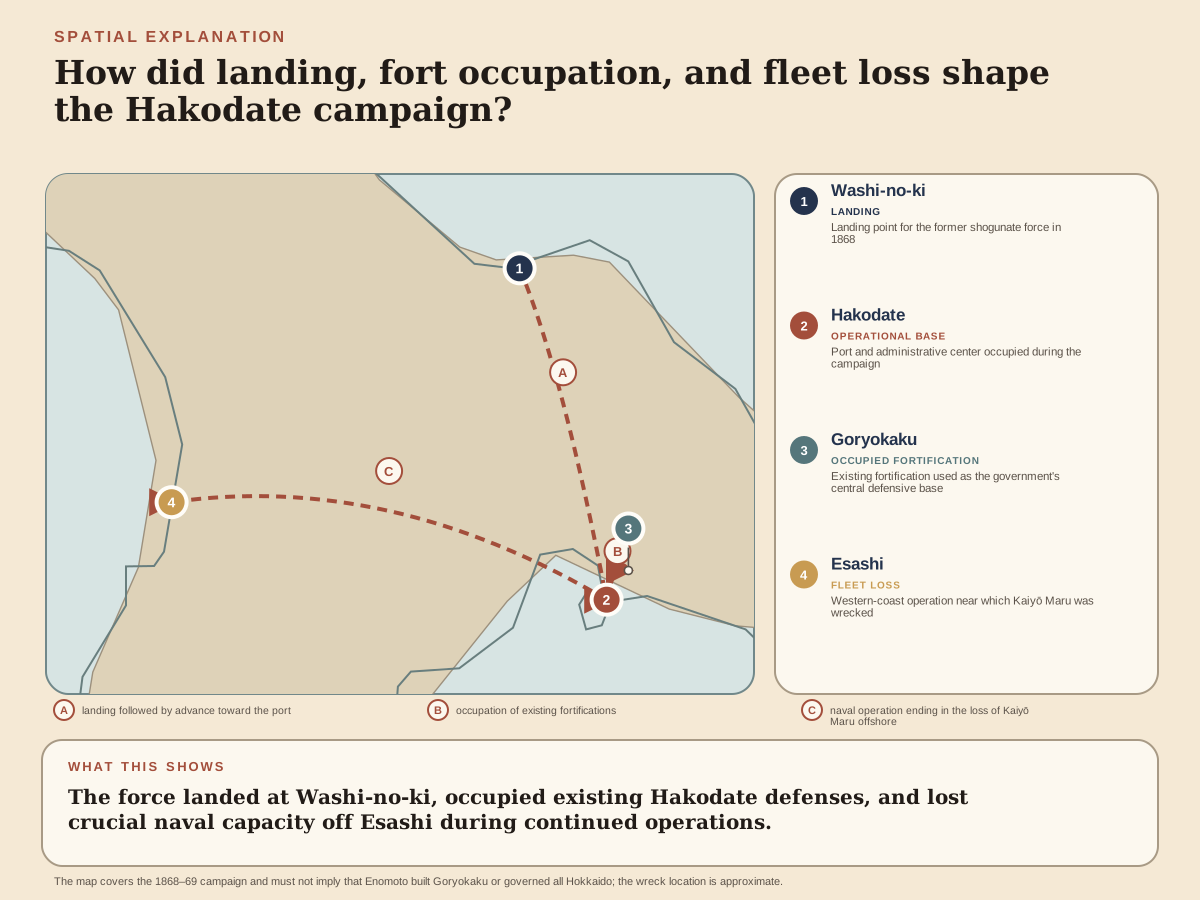
The force landed at Washinoki in Ezo in the tenth month of the traditional Japanese calendar in 1868 and advanced toward Hakodate. Ezo was the northern region later administered as Hokkaidō, with Ainu Indigenous communities and Japanese settlers. Goryōkaku was an existing star-shaped fort and administrative center built by the bakufu. Enomoto's forces occupied it after new-government personnel withdrew, then extended control toward Matsumae and Esashi. Hakodate's port and revenue helped sustain the occupation. [4]
In the twelfth month of the traditional Japanese calendar in 1868, the occupying force organized a provisional government. Officers selected Enomoto as Ezo-shima sōsai, chief administrator of Ezo Island. The wider population did not vote. Often called the Republic of Ezo, the regime retained a provisional connection to the Tokugawa house while seeking territory for former retainers. Hakodate's city history rejects the republic label as misleading. Administration proceeded without secure central or foreign recognition. [2]
The war turned against Enomoto after Kaiyō Maru was lost in a storm off Esashi. New-government forces brought greater resources north in 1869. Hakodate City's account records that Goryōkaku's guns largely failed to reach the harbor, while fire from Kōtetsu struck inside the compound. Surrounding positions and naval control were lost. Enomoto's side surrendered on the eighteenth day of the fifth month of the traditional Japanese calendar. The fort could not compensate for the defenders' shrinking force and supply. [4]
Enomoto was imprisoned after surrender. Meiji official Kuroda Kiyotaka advocated clemency and the use of his technical knowledge. Pardon in 1872 preceded employment in the Kaitakushi, the Hokkaidō Development Commission. He held a commission appointment and opened a farm at Tsuishikari in 1873, then became naval vice-admiral and Japan's diplomatic representative in Russia in 1874. These were successive stages of rehabilitation, not instant cabinet reward. His treatment was selective, requiring service to the authority he had resisted. [1][3][6][7][8]
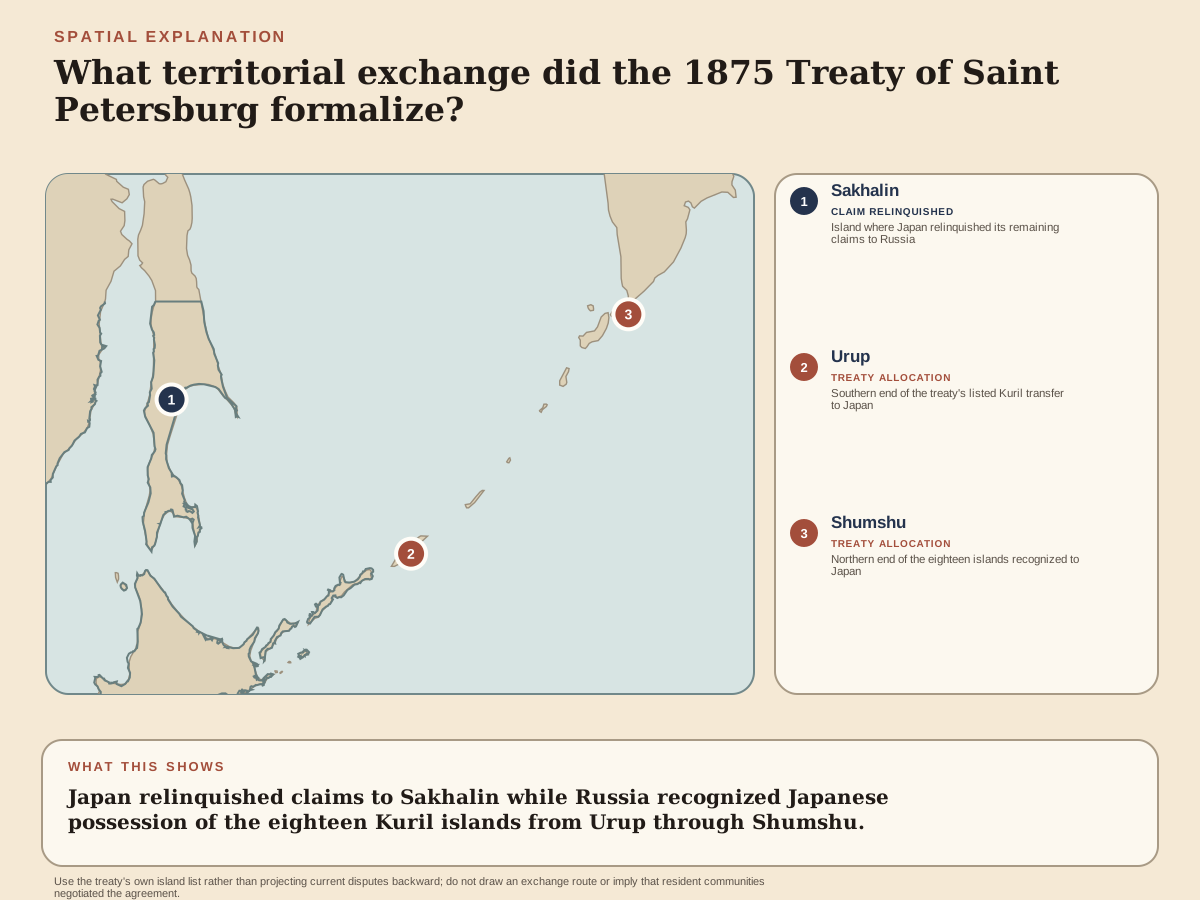
As minister to Russia, Enomoto negotiated with Russian officials. On 7 May 1875 he and Alexander Gorchakov signed the Treaty of Saint Petersburg. Japan relinquished Sakhalin claims in exchange for eighteen specified Kuril islands from Shumshu to Urup. This interstate settlement changed jurisdiction without giving Ainu communities an equal role in designing it. Sakhalin Ainu later moved from Sōya to Tsuishikari in 1876; that does not establish that Enomoto personally ordered the move. [5]
Enomoto served as navy minister in 1880–1881 and minister to Qing China, ruled by the Qing dynasty, from 1882. He joined Itō Hirobumi's first cabinet as communications minister in December 1885, followed by education minister in 1889, foreign minister in 1891, and agriculture and commerce minister in 1894. Repeated appointment showed sustained political trust as well as transferable administrative experience. Each office worked through specialist staff within the changing structure of Meiji government. [3]
As foreign minister in 1891, Enomoto established an immigration section. An account reporting his views in the Chōya newspaper promoted permanent settlement abroad rather than temporary contract labor. He argued that stable property and employment would improve migrants' livelihoods and Japan's standing. The article distinguished settlement from territorial annexation and answered critics questioning its prospects. This was an overseas program, not Hokkaidō administration; the plans alone do not establish success or local consent. [3][6][7]
Enomoto died on 26 October 1908. By 1912 his biography already joined two striking identities: naval leader of the last major former-bakufu resistance and senior servant of the Meiji state that defeated him. Goryōkaku, Kaiyō Maru, the treaty with Russia, and cabinet office offered different memory entry points. The career demonstrates that regime change could destroy an alternative government while selectively absorbing its experts. It does not prove that political conflict had been a misunderstanding or that technical service erased occupation, war, and colonial policy. [4][8]
Classic
Enomoto Takeaki was born in Edo on 5 October 1836, the second son of the shogunal retainer Enomoto Enbei. His childhood name was Kamajirō. The family belonged to the Tokugawa service world in the capital, giving him access to education and advancement within the shogunate. That government maintained technical offices as well as warrior hierarchies. Foreign pressure increased demand for navigation and other practical knowledge, creating a route that would carry him from household education into naval service. [1][8]
Household affiliation tied education to public service. Enomoto would enter institutions funded by the bakufu, the warrior government headed by the shogun. Selection for advanced study was a privilege unavailable to most residents of Edo. It also created an expectation that training would be used for Tokugawa service. Those obligations would become a practical problem when the government sponsoring him lost authority and a successor claimed its trained personnel and assets.
Enomoto's learning included instruction at Nakahama Manjirō's school. Manjirō had experience of American maritime life and helped transmit foreign knowledge within Japan. Such teaching joined earlier literacy to skills sought by the shogunate. Household access and individual competence worked together: technical ability could advance a retainer, but entry still depended on selection and state resources. The government defended inherited status while developing forms of expertise that could complicate its rank order.
In 1856 Enomoto entered the Nagasaki Naval Training Center. The port brought classroom and harbor together. Dutch instructors and Japanese intermediaries joined written instruction to shipboard practice, giving students opportunities to compare calculations with observations and commands with the difficulty of coordinating crews. Katsu Kaishū belonged to the same training network. [1][8]
Dutch learning, or rangaku, meant the study of foreign knowledge through Dutch-language texts and contacts. For naval students, a translated term had to become a usable measurement, instrument or order. Reading a manual and operating a vessel were related skills, but one did not automatically supply the other. Interpreters helped move instruction between languages; sailors and technical workers helped make practice possible. [1]
The bakufu supported this training because reliable navigation and naval technique had become urgent matters of government. Ships required expenditure on crews and maintenance as well as their initial purchase. Education therefore belonged to an administrative system that had to find personnel, money and workable arrangements with foreign instructors.
Students retained their shogunal or domain affiliations even while sharing technique. A domain was a territorial lord's jurisdiction within the Tokugawa order. Professional cooperation could bring people together at Nagasaki without deciding whom they would serve in a later political conflict. The center expanded technical capacity; it did not secure unity among the authorities represented by its students.
Nor did expertise remove every distinction of status. Enomoto entered with household access unavailable to many other people, while practical knowledge also belonged to workers who did not receive an officer's standing. The training institution made his skills useful within Tokugawa service. Its knowledge and personnel would later move into other institutions, surviving changes that the sponsoring government could not control.
The bakufu sent Enomoto to the Netherlands in 1862 as part of an official naval mission. He studied navigation and international law within an overseas program connected to the procurement of Kaiyō Maru, a warship being built for the shogunate. Shipyards joined the students' instruction to the industrial work needed to turn a commission into a vessel. [1][3]
The mission required selection, travel arrangements and sustained public expenditure before its students could bring any knowledge home. Dutch institutions, Japanese colleagues and correspondence with the sponsoring government shaped the work. Enomoto acquired rare experience, not mastery of every European institution. Its application would still depend on trained people and resources in Japan.
He returned in 1867, closely associated with Kaiyō Maru, and entered senior Tokugawa naval service. The vessel embodied years of state payment, foreign construction and crew training. Engineers, navigators and other specialists remained essential to keeping it operational. Pairing its name with a famous commander can obscure that larger chain of responsibility. [1][3]
The return came as Tokugawa political authority unraveled. A modern ship could strengthen a navy without settling who would legitimately command it after a change of government. The bakufu saw an investment in its service; the emerging government claimed resources for a new national authority. Officers' obligations and the control of crews could not be transferred simply by renaming the state.
Enomoto's senior naval position gave him influence over an important asset and responsibility for the orders attached to it. The ship was not his private possession. Disagreement over its transfer would connect his overseas training to a new political choice: whether to accept the authority claiming the shogunate's fleet.
After Tokugawa Yoshinobu submitted to the new government, Enomoto refused to hand over the entire fleet. Yoshinobu had been the last Tokugawa shogun; his submission did not make all former retainers accept the same future. On the nineteenth day of the eighth month of the traditional Japanese calendar in 1868, Enomoto led eight ships from Shinagawa, the anchorage off Edo. [1]
National Archives materials preserve correspondence to former Tokugawa officials, including Katsu Kaishū, and a political protest against rule by a small victorious coalition. These arguments establish Enomoto's contemporary claim, not proof that his forces represented the nation more broadly. Seeking terms for Tokugawa retainers joined professional interests to the problem of households facing uncertain livelihoods. [1]
Withholding the fleet also sustained armed resistance. Ships gave the coalition a means to move, negotiate and fight beyond the capital. Protecting former retainers and resisting the successor government could operate together; the former aim did not make the departure a neutral evacuation.
French advisers accompanied the force as individuals. Their technical work mattered, but participation was different from recognition by the French state. Correspondence over their treatment later became a separate diplomatic matter. Enomoto remained a Japanese commander leading a coalition whose members did not all share identical obligations.
The northward movement required ports, supplies and judgments about weather. Severe conditions could separate vessels, making the eight ships at departure different from the force available at a later destination. Communication with submitted Tokugawa figures continued despite disagreement over resistance. A former allegiance supplied channels for negotiation without guaranteeing endorsement.
Enomoto's decision preserved leverage at a cost. The new government faced a navy outside its control, while northern communities would face the war carried by men seeking a territorial future.
The fleet reached Washinoki in Ezo in the tenth month of the traditional Japanese calendar in 1868. Landing turned the naval coalition into a force advancing overland toward Hakodate. Ezo was the northern region later administered as Hokkaidō, home to Ainu Indigenous communities as well as Japanese settlers. It was neither uninhabited nor waiting for Enomoto to give it a history. [4]
Goryōkaku was an existing star-shaped fort and administrative center built by the bakufu. Enomoto did not design or construct it. His forces occupied the compound after new-government personnel withdrew, then extended control toward Matsumae and Esashi. The initial entry and the later fighting around the fort were different stages, not one continuous siege. [4]
Hakodate's established port connected local residents to foreign consuls, merchants and ships. Its administration and commercial activity made occupation more viable. Revenue could be gathered because earlier officials and residents had already created an economy and administrative arrangements. Foreign representatives could communicate with whoever controlled the port without recognizing a new sovereign state. [4]
Expansion beyond Hakodate involved armed conflict. The Matsumae house and local communities retained interests distinct from those of the occupying coalition. Plans to settle Tokugawa retainers presumed access to land already used by others; the promise of a livelihood to defeated households did not establish consent from all inhabitants.
Winter increased the practical burden of transport and supply. The coalition redirected an existing administrative center while trying to make its occupation durable. Its possession of Goryōkaku gave it a headquarters, but neither the port's revenue nor the fort's walls settled the legitimacy of the government it would announce.
The occupying force organized a provisional government in Ezo. On the fifteenth day of the twelfth month of the traditional Japanese calendar in 1868, a declaration of possession accompanied the selection of officials. Enomoto became Ezo-shima sōsai, chief administrator of Ezo Island, through a vote restricted to officers. [2]
The procedure departed from simple hereditary appointment, but it was not an election by the region's population. Hakodate's citizens and Ainu communities had no equivalent voice in selecting the leadership. The city history also records differing accounts of the ballots and incomplete information about the exact method, limiting reconstruction of the whole process. [2]
Often called the Republic of Ezo, the regime retained a declared connection to the Tokugawa house. Its leaders presented the arrangement as provisional while seeking permission for a territorial role and the arrival of a Tokugawa prince. Hakodate's city history rejects the republic label as misleading for this restricted military organization. The documented electorate and provisional aims distinguish it from a modern popular republic, regardless of the familiar name. [2]
Departments attempted administration, revenue collection, diplomacy and defense under wartime occupation. Announcing those responsibilities did not guarantee the resources to carry them out. Former Kaiyō Maru personnel were assigned to development work, but the city's account does not establish completed results before renewed fighting intervened.
Foreign consuls could deal pragmatically with officials controlling the port while withholding sovereign recognition. The regime's appeal on behalf of Tokugawa retainers sought a place for one displaced group by asserting authority over an inhabited region. Its voting procedure reveals the political community its officers imagined; its territorial claims reached well beyond that electorate.
Kaiyō Maru was lost in a storm off Esashi before the final campaign. The coalition's strongest ship disappeared through weather rather than capture in a decisive duel. The loss reduced its naval capacity, though other ships, personnel and positions remained. Enomoto's government still had to defend its occupation against forces drawing on the new state's broader resources.
New-government troops returned north in 1869. Fighting took place at the harbor and surrounding positions as well as at Goryōkaku. The fort's star-shaped geometry belonged to an artillery system whose effectiveness depended on guns, range and control of approaches. Its outline could not compensate for the disappearance of support beyond the compound. [4]
Hakodate City's account describes a sharp range mismatch in the final fighting. Guns at Goryōkaku largely failed to reach the harbor, while fire from the government warship Kōtetsu struck the fort's administrative building. The difference made the compound vulnerable despite its defensive form. [4]
Harbor control and surrounding positions were lost. During the fifth month of the traditional Japanese calendar, the defenders at Benten battery surrendered on the fifteenth day. The position at Chiyogaoka was overwhelmed on the sixteenth, with most of its remaining defenders killed. Further resistance offered diminishing means to restore its position. [4]
Negotiation followed the narrowing of those options. Enomoto's side surrendered on the eighteenth day of the fifth month of the traditional Japanese calendar in 1869. Goryōkaku passed to the new government, ending the provisional regime. Surrender ended the commander's armed alternative, not the life of the town around it. Occupation and combat had disrupted local society, and the transfer of authority did not itself complete the work of recovery. [4]
After surrender, Enomoto was imprisoned. Kuroda Kiyotaka, an official connected to the Meiji government's northern program, advocated clemency and the use of his skills. Naval training, languages and legal knowledge were expensive to reproduce. Preserving a defeated specialist offered the new state a possible return on expertise originally developed with Tokugawa resources. [1][3][8]
Pardon in 1872 changed Enomoto's legal status. Employment was a further step, not an automatic consequence of surrender. He entered the Kaitakushi, the Hokkaidō Development Commission, the government body charged with administering and developing the northern region. In 1873 he held a commission appointment; Ebetsu's chronology also records his opening of a farm at Tsuishikari that year. [1][3][6][7]
Enomoto now worked within the central government's claims to a region where he had earlier led an occupation. Settlement projects operated in Ainu homelands as well as in districts inhabited by Japanese settlers. His entry into official service did not remove that larger unequal setting.
In 1874 he became a naval vice-admiral and minister to Russia. Here “minister” meant a diplomatic representative, not yet a cabinet department head. Rank and appointment rebuilt official standing through successive responsibilities. Kuroda's sponsorship helped connect the former prisoner to those opportunities. [3][8]
Enomoto's case was selective. Other defeated people had suffered death, punishment or exclusion; one highly trained officer's pardon cannot establish general tolerance. His subsequent service became durable while requiring obedience to the authority he had resisted. The government absorbed technical continuity without accepting the political alternative his forces had attempted to maintain.
Enomoto went to Russia as Japan's diplomatic representative in 1874. Sakhalin, the large island north of Hokkaidō, had remained a place of overlapping Japanese and Russian claims and settlement. Fisheries, travel and Indigenous use did not fit a single clean boundary, while both states sought greater security for their positions.
Japanese officials had differed over policy. One approach favored retaining all or part of Sakhalin; Kuroda supported relinquishing it. The instructions Enomoto carried pursued the latter course in exchange for islands in the Kurils. His negotiations therefore operated within government decisions as well as through his own knowledge and discussions with Russian officials.
On 7 May 1875 Enomoto and Alexander Gorchakov signed the Treaty of Saint Petersburg. Japan relinquished its Sakhalin claims in exchange for Russian transfer of the eighteen specified Kuril islands from Shumshu to Urup. Those named islands matter: “the Kurils” in a summary does not mean that every island in the wider chain was newly transferred by this agreement. [5]
Diplomacy turned overlapping claims into an interstate settlement. Enomoto represented the state whose authority he had rejected only a few years earlier. Other diplomats, translators and officials participated in work whose result required approval and implementation beyond the negotiators.
The agreement also changed jurisdiction for residents. Ainu communities on Sakhalin and in the Kurils had distinct local histories; state signatures did not give them an equal role in designing the settlement. Ebetsu's chronology records Sakhalin Ainu moving from Sōya to Tsuishikari in 1876. That later event is separate from Enomoto's opening of a farm there in 1873 and does not establish that he personally ordered the move.
Calling the treaty a compromise describes a bargain between governments. It does not measure an equal exchange for every community affected or determine the settlement's meaning through twentieth-century territorial conflicts.
Enomoto's appointments moved from naval and diplomatic work into the cabinet. He served as navy minister in 1880–1881 and became minister to Qing China in 1882. Qing was the dynasty then ruling China. The two posts carried different responsibilities: one directed a government department, while the other represented Japan abroad. [3]
In December 1885 he joined Itō Hirobumi's first cabinet as communications minister. Itō headed the new cabinet organization as prime minister. Enomoto's earlier rehabilitation had become sustained acceptance within the governing elite, bringing a former Tokugawa officer into a central administrative office. [3]
Further appointments followed: education minister in 1889, foreign minister in 1891, and agriculture and commerce minister in 1894. They show repeated political trust and experience that could be transferred between departments. They do not establish that Enomoto personally originated every program or mastered each specialist field. [3]
Ministries worked through bureaus and professional officials. Engineers, administrators and other staff drafted proposals and carried them into practice, while a minister sought resources and defended policy within government. The constitutional changes around 1889 and the opening of the Imperial Diet altered the setting for budgets and decisions.
Naval learning, translation and technical administration had not begun with the Meiji regime. The new government reorganized capacities developed under the bakufu and entrusted some of them to people trained in its service. Enomoto's recurring appointments make that continuity visible, though the purposes were now set by different political authorities. One project during his foreign ministry gives a more specific view of how he proposed to use state organization.
The story returns to Enomoto's foreign ministry in 1891. He established an immigration section and argued for permanent Japanese settlement abroad. An account published in the Chōya newspaper that August reported his views, distinguishing them from the temporary contract labor through which some migrants sought work overseas. [3][6][7]
The proposal joined livelihoods to national standing. Enomoto argued that settlers needed stable property and employment, rather than lives dependent on successive employers. He identified Mexico and parts of Central and South America as possible destinations. This was an overseas migration project, not a new measure for governing Hokkaidō.
Terminology was contested at the time. The newspaper account addressed objections that “colonization” implied acquiring territory and subordinating it to Japan. Enomoto's argument instead emphasized settled emigrants purchasing or leasing land and working with Japanese capital. Critics also questioned the destinations' practical prospects. The account records these contemporary objections and Enomoto's reply.
The account reveals the promoter's priorities and assumptions. His explanation of discrimination partly blamed migrants' lack of stable property and conduct; that explanation is evidence of his viewpoint, not an established account of all racial exclusion. Nor does distinguishing permanent settlement from annexation establish consent or favorable results for every local community.
The article was presented as a report of remarks heard from Enomoto, not a surviving signed manuscript. Its plans describe an intended program. It contains no account of later settlement results or the experiences of migrants and existing residents. The foreign-ministry initiative shows a concrete use of his later office without making its publication proof of success.
Enomoto died on 26 October 1908. His career had crossed from Tokugawa naval command through defeated resistance into senior Meiji service. Overseas study and technical administration linked those phases even as the authority he served changed. Kuroda's sponsorship and the state's demand for expertise helped make the passage possible. [8]
Reading later service simply as betrayal misses the successive decisions between captivity, pardon, employment and cabinet office. A story of effortless national reconciliation misses the armed alternative that was destroyed and the selective nature of the rehabilitation. Neither description alone explains what the governments preserved, rejected and put to new purposes.
Goryōkaku's material history also changed. Most internal buildings were dismantled in 1871, and the grounds served as an army drill field from 1873 to 1897. Those uses followed the provisional government's defeat rather than preserving its headquarters unchanged. The reconstructed magistrate's building visible today and the park opened in 1914 belong beyond HO's principal account through 1912. [4]
Documents, photographs and biographies preserve different phases of Enomoto's life. Kaiyō Maru, Goryōkaku, treaty diplomacy and cabinet service offer distinct points of remembrance, while later replicas and reconstructions are not original objects from his command. [4]
The career reveals a state consolidating power by defeating an alternative armed government and absorbing some of its specialists. Technical continuity supported new authority, including its northern expansion. Enomoto's usefulness and rehabilitation belong in the same history as the war and the unequal projects through which governments used that knowledge.