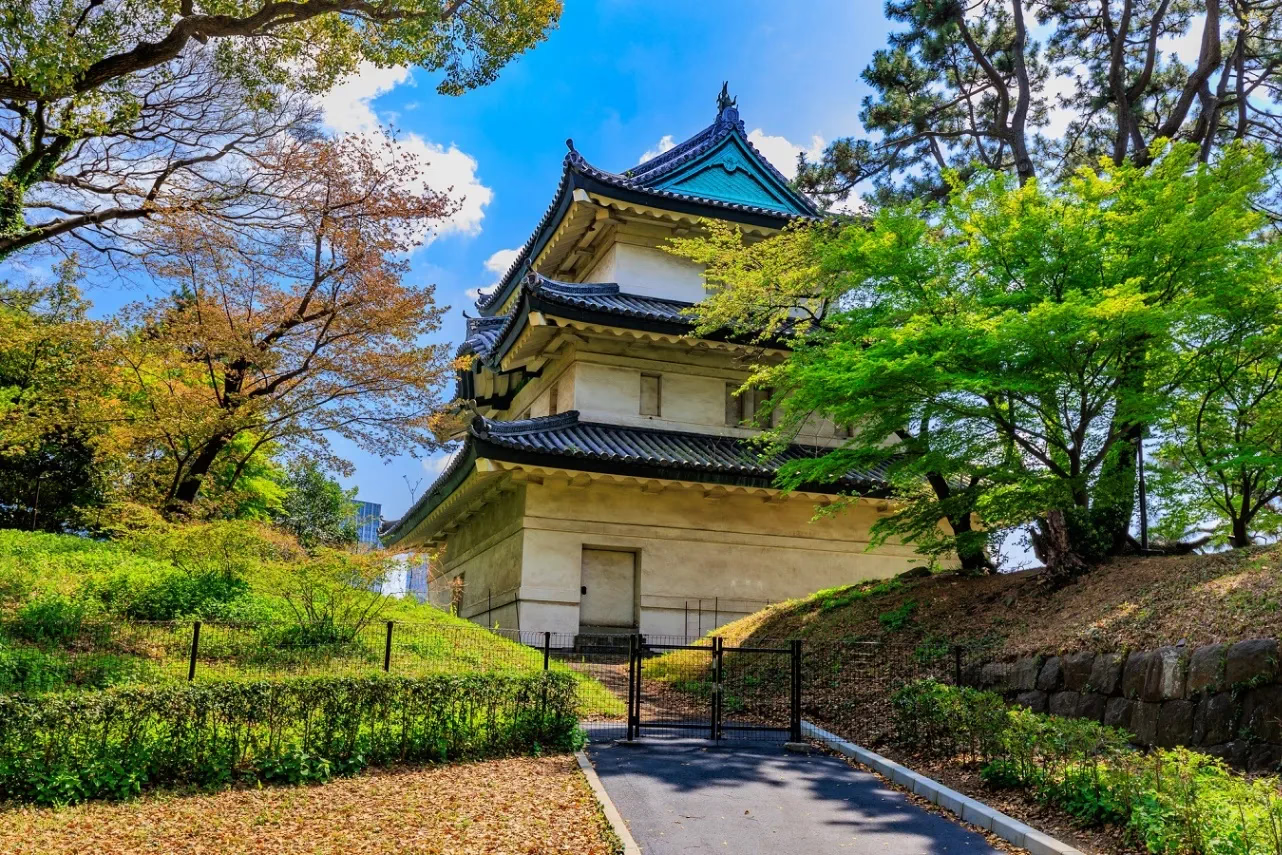
Otemon and the Governmental Scale of Edo Castle
Attraction
Otemon was the principal entrance for daimyo and officials approaching the shogun's castle. Its gate complex, guardhouses, stone walls and moats introduce Edo Castle as a governmental city within the city, not merely a fortified residence. Much architecture was lost to fire, earthquake, war and later transformation, while surviving elements have also been repaired or reconstructed. The approach still makes controlled access visible. Retainers were sorted, watched and directed through successive spaces before reaching inner compounds. That organization complements the written history of alternate attendance and shogunal administration: daimyo authority was displayed and constrained through repeated movement into Edo. The present garden entrance is public, but it occupies a threshold designed for hierarchy rather than leisure.
Current visibility
The feature discussed as “Otemon and the Governmental Scale of Edo Castle” is visible at Edo Castle and the Imperial Palace East Gardens in reconstructed form; the castle compound, the gate sequence, and the stone walls explain what was recovered without implying original fabric.
Honmaru, Tenshudai and the Meaning of an Empty Center
Attraction
The East Gardens preserve the former Honmaru and Ninomaru compounds. In the Honmaru, the shogun's residence and principal administrative rooms once stood; those buildings are gone. The massive Tenshudai was rebuilt by 1658 after the 1657 Meireki Fire destroyed the keep, but the replacement tower was never built. Its emptiness corrects the assumption that political power required a permanently visible tower. For most of the Edo period, government operated through sprawling palace buildings, offices, archives and audiences rather than from a keep. Lawn and paths now occupy the vanished residential complex, so maps are necessary to recover room sequences and scale. The contrast between huge foundations and missing superstructure makes destruction, deliberate non-rebuilding and modern reuse part of the Place's historical meaning.
Current visibility
The Tenshudai and excavated Honmaru plan remain legible, but the shogunal residence and administrative buildings are gone; lawns and paths now occupy the former core.
From Shogun's Castle to Imperial Palace
Attraction
In 1868 the Tokugawa government surrendered Edo Castle to the new imperial regime after negotiations associated above all with Katsu Kaishu and Saigo Takamori. Emperor Meiji subsequently moved from Kyoto, and the former shogunal center became the imperial palace. This was both political transfer and spatial appropriation: the new state occupied the most powerful address of the old regime. Sakuradamon also retains the memory of Ii Naosuke's assassination in 1860, showing that the castle boundary had already become a site of violent crisis. Today the active palace limits access to many areas, while the East Gardens open former inner compounds. Restricted and public zones together express the castle's continuing state function rather than an incomplete museum experience.
Current visibility
The surviving setting at Edo Castle and the Imperial Palace East Gardens anchors “From Shogun's Castle to Imperial Palace”; its physical context is the castle compound, the garden, and the museum display.