The Tenpō famine had exposed the human cost of crop failure, market disruption and inadequate relief. Mizuno inherited a government facing debts and security anxieties. Reformers interpreted this complex crisis through an older language of frugality and proper status.
Famine, fiscal stress, rural protest and foreign pressure framed Mizuno Tadakuni's rise as senior councillor. The shogunate answered with a program of economy and regulation that treated high prices, privileged commercial groups and urban consumption as symptoms of weakened order.
Mizuno Tadakuni was born in 1794 in his family’s residence in Edo, now Tokyo. His father, Mizuno Tadaakira, ruled Karatsu in present-day Saga; his mother Jun was a concubine. The shogunate, Japan’s warrior government, formally recognized Tadakuni as heir in 1805, and he succeeded to the domain in 1812. Such recognition connected family succession to the warrior government’s authority over its lords. Tadakuni’s early declaration of reform also stressed the lord’s direct decision-making. He entered government with experience of a household whose income, staff and policies depended on the management of an assigned territory.
In 1817 Tadakuni secured a transfer from Karatsu to Hamamatsu, now in Shizuoka, despite strong resistance from retainers who feared reduced income. The domains were assigned the same formal assessment in rice, but their actual incomes differed. A transfer favorable for a lord’s appointment could therefore be unfavorable for the people employed beneath him. Hamamatsu was an advantageous base for advancement among lords eligible for shogunal service. Tadakuni accepted the fiscal disadvantage and became temple and shrine magistrate, an office concerned with religious institutions and their affairs. His pursuit of office already required a choice over how his household’s resources would serve it.
Appointments as Osaka castellan in 1825 and Kyoto deputy in 1826 gave Tadakuni responsibilities at two major administrative centers. The Kyoto deputy represented the shogunate near the imperial court; the Osaka post concerned its castle and regional authority. While at Osaka, Tadakuni studied Japanese poetry and classical texts with Murata Harukado. These interests belonged alongside administrative work, rather than replacing it. The subsequent move into the senior council would bring this educated domain lord into government at Edo, where succession, patronage and financial pressure determined the scope of possible reform.
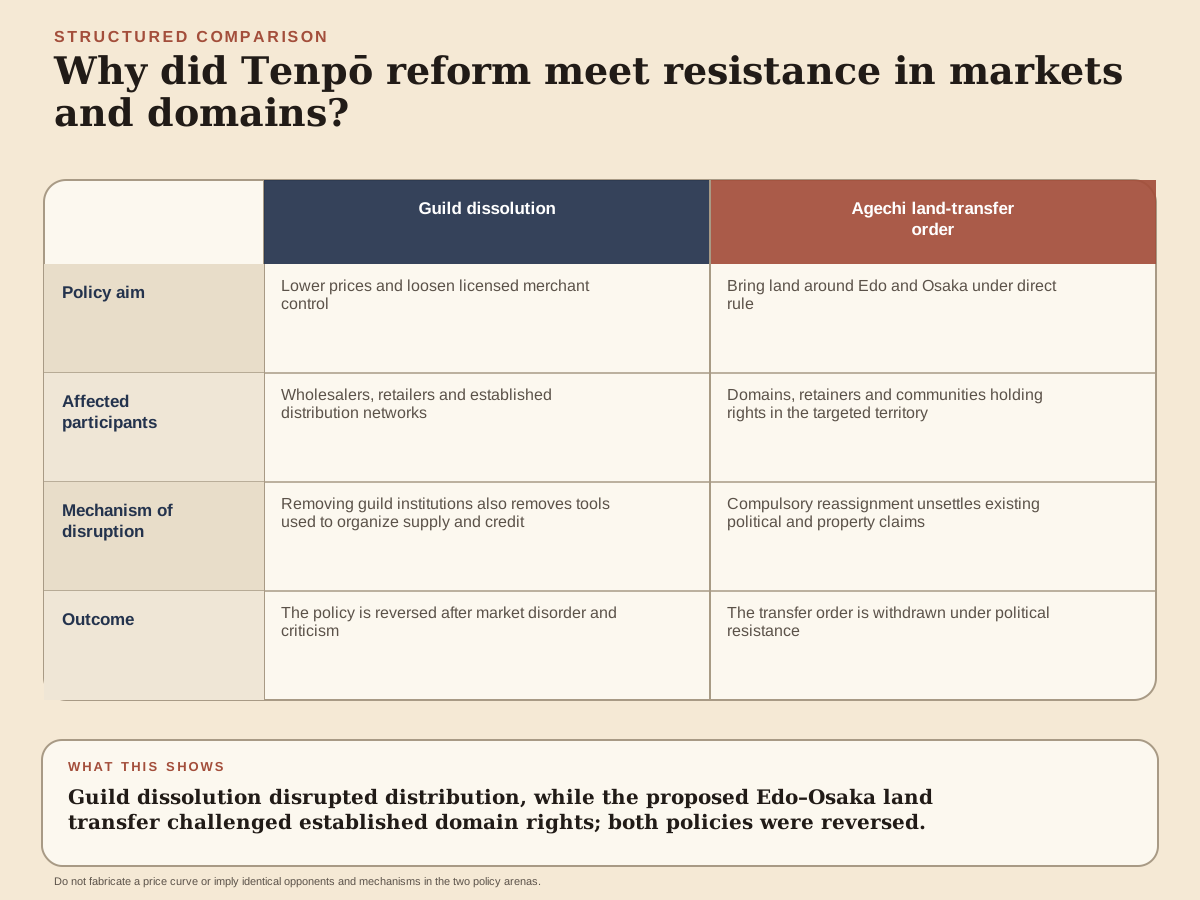
Orders reached commerce, theater, clothing, migration and landholding. Dissolving guilds was meant to lower prices by breaking monopoly privilege; in practice it also disrupted established distribution. The Agechi plan challenged domain rights close to the two great cities and created a coalition against the program.
The government dissolved licensed merchant associations, restricted entertainments and display, and ordered people without approved urban livelihoods to return to villages. Its most ambitious land measure, the Agechi order, sought to bring territory around Edo and Osaka under direct shogunal control. Domain lords and others whose holdings were threatened resisted.
Price policy did not work as intended, the land-transfer plan was withdrawn, and Mizuno lost office in 1843. The reforms demonstrated the shogunate's willingness to intervene widely but also its limited ability to command markets, domains and city life on the eve of the treaty-port crisis.
In 1828 Tadakuni became a senior councilor attached to Tokugawa Ieyoshi, then the heir housed in Edo Castle’s western enclosure. Appointment to the main council followed in 1834, and leadership of that council in 1839. The rōjū were senior officials responsible for major shogunal affairs, working through magistrates, inspectors and domain lords. The succession of posts distinguished service to an heir from participation in the reigning shogun’s central government. Tadakuni’s authority grew through these appointments; it did not amount to an independent power to command every other lord.
The shogunate abandoned the Agechi order and removed Mizuno. Many measures were relaxed. The speed of reversal showed that issuing an order from Edo was different from sustaining cooperation among domains, officials, merchants and urban residents.
Tokugawa Ienari and the senior councilor Mizuno Tadanari had supported Tadakuni’s rise. Ienari transferred the shogunal title to Ieyoshi in 1837 but retained substantial influence as retired shogun. Tadakuni thus owed his position partly to relationships that constrained a break with existing practice. Ienari’s death in 1841 allowed the removal of his associates and the gathering of a reform coalition under Ieyoshi. This opening depended on a particular change at the top of government, as well as on Tadakuni’s programme. The chief councilor needed the shogun’s support and workable cooperation among officials.
The Tenpō famine and unrest had exposed the vulnerability of livelihoods and administration; the 1837 uprising led by Ōshio Heihachirō in Osaka made that pressure especially conspicuous. Foreign ships posed another problem of defense and response. In 1841 Tadakuni’s government invoked the earlier Kyōhō and Kansei reforms as models of discipline, frugality and restored order. Its reach extended from officials’ conduct to urban consumption, trade, rural movement and territory. Each initiative required action through officials, town organizations or domain administrations.
Tenpō became the last of the conventionally named Tokugawa reform eras. Its significance lies less in a durable institutional settlement than in the exposure of a gap between expansive central policy and the political means available to enforce it.
The Tenpō Reforms were a major test of late shogunal capacity. They joined economic regulation, moral discipline and territorial centralization in a program whose rapid reversal exposed political limits.
Their failure did not by itself cause the fall of the shogunate, yet it narrowed confidence in the center just as foreign-policy pressures intensified.
Tadakuni practiced plain dress and supported a campaign against luxury and improper conduct. Rules affected consumption and entertainment as well as the behavior of officials. For a townsperson, an order concerning respectable life could also restrict a business dependent on customers’ spending. The government treated these controls as part of restoring discipline after the excesses associated with Ienari’s period. Enforcement required officials to decide which activities to prohibit and how severely to act. The language of frugality linked household behavior to the state’s troubles, but the effects fell unevenly on those whose income came from regulated trades.