Read the article below. Interactive reading tools are available when scripts load.
Quick
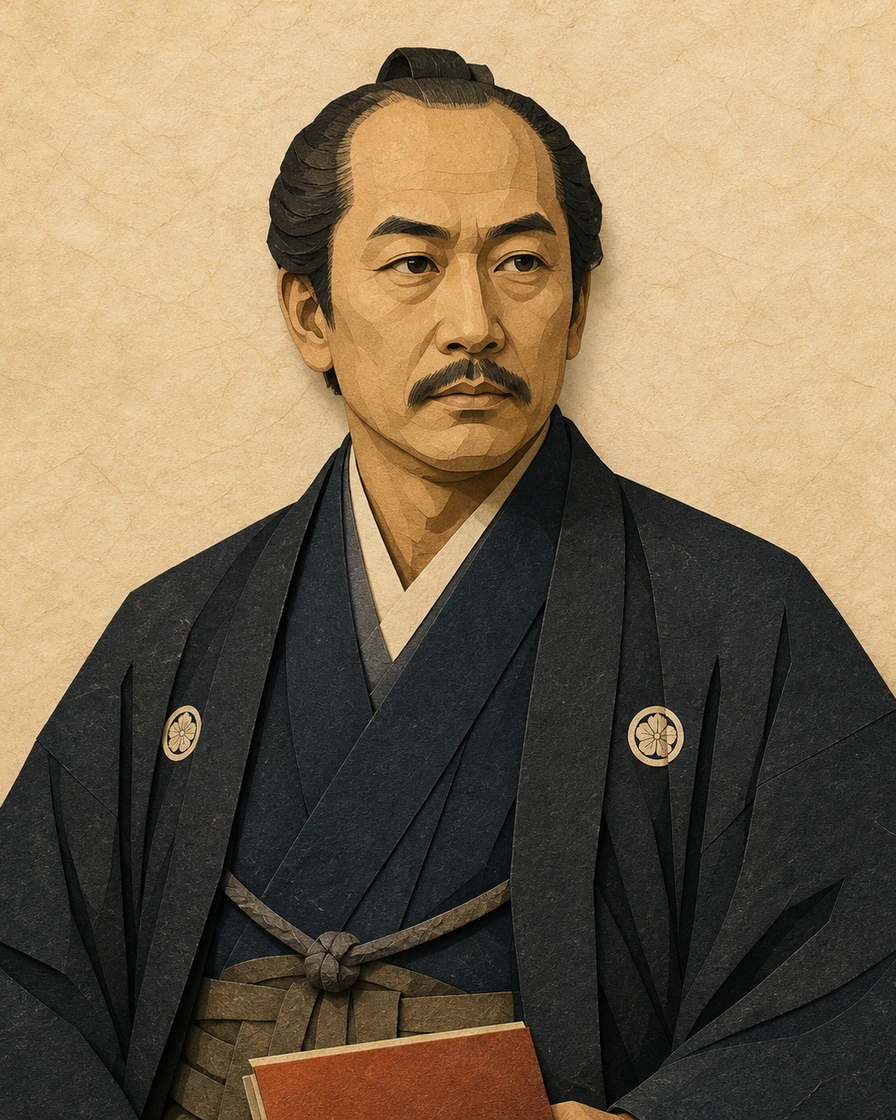
Katsu Kaishū was born in the Honjo Kamezawa district of Edo, today's Tokyo, on 12 March 1823. He was the son of Katsu Kokichi, a hatamoto (a direct retainer entitled to an audience with the shogun, Japan's warrior ruler). His childhood name was Rintarō. “Kaishū,” the name by which he is now best known, was a later sobriquet rather than the name of the infant. Hatamoto status placed the family inside the shogunate's hereditary service order, but it did not make every household wealthy or politically powerful. Kokichi's irregular conduct and the family's restricted means gave Rintarō a very different base from that of senior councillors or great lords. [3][4][6]
He inherited household responsibility after his father retired in 1838. Status gave him a route to service, but advancement required skills and official recognition. Study became his way to enlarge those limited prospects. He married Tami, an adopted daughter of Okano Magoichirō, in 1845. [3][4]
As a young adult Kaishū studied swordsmanship, Dutch, and Western military knowledge. Around 1845 he learned Dutch under Nagai Seigai. By about 1850 he had established a private school known as Hyōkai-juku, where language and military learning could become both intellectual work and a source of professional standing. Books were scarce and might have to be copied by hand. In 1847 he began copying the Dutch–Japanese Doeff–Halma dictionary, finishing the following year. Understanding a naval term still required learning how the equipment worked. [2][6]
He pursued this learning as a Tokugawa retainer seeking useful work. When Perry arrived in 1853, officials urgently needed the defense knowledge he had been accumulating. Kaishū now had a chance to bring private study into government service. [2][6]
The American naval commodore Matthew Perry's squadron entered Edo Bay in 1853 and delivered the American president's demand for relations. The senior councillor Abe Masahiro's government asked a wide range of lords and retainers for opinions. Kaishū answered with a coastal-defense memorial. His proposals emphasized ships, trained personnel, and the use of capable men beyond narrow inherited placement. The document showed that a low-income hatamoto with specialized learning could enter a policy debate opened by emergency. It also matched concerns raised in other domains and offices. [4][6][10]
His advice joined proposals from other domains and officials. A navy still required ships, funds and trained crews. The emergency gave Kaishū's earlier study official value and helped open a route into technical service, though senior officials retained control of policy. [4]
In 1855 Kaishū entered translation work for the bakufu, the Tokugawa shogunal government, and was sent to the new Nagasaki Naval Training Center. Dutch officers and technicians taught Japanese trainees navigation, gunnery, seamanship, engineering, and related subjects. Kaishū moved from interpreting military texts toward work with ships, instruments, routines, and crews. Nagasaki concentrated expertise that the bakufu could not create by purchasing a vessel. Dutch instructors such as Pels Rijcken and later Willem Huyssen van Kattendijke worked through language barriers with interpreters and Japanese students drawn from the shogunate and participating domains. [1][2][3][6]
Sailors, mechanics, servants, and local suppliers made instruction possible. Kaishū's earlier learning gave him value, but it did not remove those dependencies. A translated term had to become a practiced action; a trainee had to learn watches, maintenance, discipline, and cooperation under difficult conditions. By 1859 Kaishū held a leading teaching position in the bakufu's naval training system. Nagasaki made him an official naval educator, not a fully autonomous commander. The institution's significance lay in collective transfer: Japan was building groups capable of continuing technical work after the foreign instructors left. [1][2][3][8]
The Kanrin Maru was a Dutch-built warship combining sail with a steam-powered screw propeller delivered to the bakufu in 1857. It became a training platform and later the ship strongly associated with Kaishū. That association can obscure how many people, systems, and earlier lessons stood behind it. Before the Pacific crossing, its crew had to coordinate sail and steam operation and learn to keep navigation watches. Kimura Yoshitake held overall responsibility for the 1860 voyage. Kaishū served in the captain-equivalent ship command role, while Ono Tomogorō, Akamatsu Noriyoshi, engineers, sailors, servants, and others carried specialized work. [2]
Possession of a foreign-built vessel did not prove naval independence. Manuals, spare parts, trained personnel, and practical judgment remained limited. The bakufu used voyages to turn equipment into experience. Kanrin Maru later became a national symbol of Japan crossing the Pacific under its own power. The preparation record supports a more demanding achievement: a developing institution assembled a crew capable of attempting a demanding trans-Pacific voyage, while still needing outside expertise. Kaishū was important within that institution, not a substitute for it. [2]
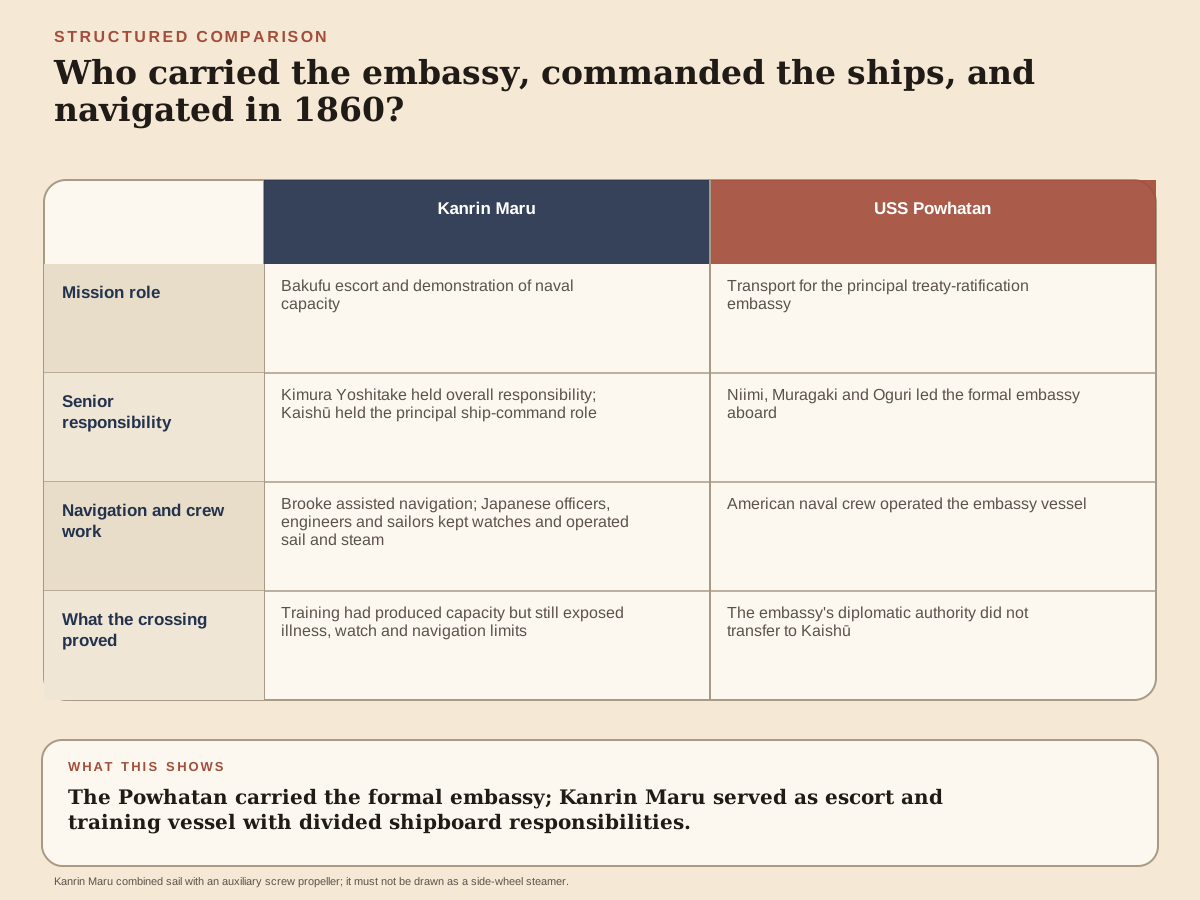
In 1860 Kanrin Maru crossed the Pacific to San Francisco while Japan's principal treaty embassy traveled separately aboard the American ship Powhatan. The Japanese mission was led by Niimi Masaoki, Muragaki Norimasa, and Oguri Tadamasa. Kanrin Maru was an escort and training achievement, not the embassy's main transport. Kimura held overall command and Kaishū the principal ship-command role. A small American party led by Lieutenant John Mercer Brooke accompanied the Japanese crew. Brooke's diary shows that his navigation experience materially assisted the crossing. [2][8]
It also records weaknesses in watch organization. Kaishū suffered illness or severe seasickness and could not personally perform every function later legend assigned to him. The ship reached San Francisco after a difficult voyage. Japanese personnel observed the port, facilities, people, and institutions at first hand before returning across the Pacific. The achievement survives these corrections. A Japanese bakufu crew carried a Japanese-commanded vessel across an ocean while learning under real conditions. Acknowledging Brooke, Kimura, other officers, and ordinary sailors replaces a national miracle with an institutional milestone. Kaishū gained experience and prestige, but the voyage demonstrated both new capacity and unfinished training. [2][8]
After returning from America, Kaishū continued in bakufu naval service. In 1862 he became an assistant warship magistrate. He worked through warship offices and training centers that depended on crews, workshops and foreign purchasing arrangements. Buying vessels was faster than producing a stable navy. Crews required repeated training; machinery needed coal and repairs; officers disputed rank and jurisdiction; the shogunate competed with domains for skilled men and money. Foreign suppliers could deliver hardware without solving command. [1][2][3]
Kaishū advocated broader recruitment and long-term education. Such views made use of his voyage experience, but they were implemented through other officials and laborers. Naval development did not move along one line from his memorial to a national fleet. The bakufu's project was also political. A stronger navy might defend treaty ports and the capital, support central authority, or become a school in which men from different domains built connections. Each possibility attracted different allies and fears. Kaishū's rise placed him closer to policy while exposing him to officials who saw cross-domain organization as a threat to Tokugawa control. [2]
Kaishū proposed a naval training center at Kobe, where access to the Inland Sea could support practical instruction. Shogun Tokugawa Iemochi accepted the proposal in 1863. The center opened in May 1864 and used vessels including Kankō Maru and Kokuryū Maru. Its students included sons of hatamoto and of lower-ranking direct retainers called gokenin, as well as young men from western domains. That mixed enrollment suited Kaishū's belief that maritime skill should not be confined to one house. It also created a political problem: men trained under bakufu authority might keep domain loyalties or join movements the bakufu regarded as hostile. [3][6]
Sakamoto Ryōma, a mobile activist from Tosa, helped organize and finance the project. His private 1863 letter to his sister Otome identifies him as Kaishū's disciple. It supports a continuing relationship, not the later story that he came to kill Kaishū and changed his mind in one conversation. Kaishū remained a shogunal officer; their shared naval interest did not make their obligations identical.
Political suspicion around cross-domain contacts and the Chōshū crisis contributed to Kaishū's dismissal in late 1864. The school closed in March 1865. Its students carried experience into other projects, but the center did not become a permanent national academy. [1]
In 1864 Kaishū briefly held the higher office of warship magistrate. He traveled west as the shogunate tried to manage the crisis created by Chōshū's attacks on foreign shipping and the allied bombardment of Shimonoseki. His reporting criticized the shortage of ships and the incoherence of policy. That same year political conditions turned against him. The bakufu was preparing to punish Chōshū and distrusted networks that crossed domain lines. Kaishū's Kobe project included men whose affiliations could not be contained by ordinary retainer discipline. [1][10]
He was dismissed; the training center closed in March 1865. The dismissal should not be reduced to Ryōma or to one bold statement. Kaishū's technical program had become entangled with conflict over who could organize national capacity. A school open enough to gather talent was also open enough to alarm a government seeking clear loyalties. Kaishū did not respond by declaring himself an anti-bakufu revolutionary. He remained a Tokugawa retainer available for recall. His removal shows both the regime's suspicion and its continuing need: when the next Chōshū campaign failed, the government again turned to an officer whose criticism it had recently silenced. [1][10]
The second Chōshū campaign went badly for the bakufu in 1866. Shogun Iemochi died at Osaka, domain support was uneven, and shogunal forces failed to impose the expected settlement. Kaishū was recalled as warship magistrate and sent to negotiate. On the second day of the ninth month—10 October 1866 in the Gregorian calendar—he met Chōshū representatives Hirosawa Saneomi and Inoue Kaoru at Daiganji on Miyajima. Acting within an intention associated with Tokugawa Yoshinobu, Kaishū sought a halt to fighting and asked that withdrawing bakufu troops not be pursued. [1][10]
The meeting contributed to a ceasefire. It did not make Kaishū the independent author of peace. Chōshū leaders had to accept terms, Yoshinobu and bakufu offices defined Kaishū's authority, commanders controlled troops, and Iemochi's death changed the political situation. The negotiation confirmed Kaishū's usefulness as an intermediary who understood military limits. It also demonstrated a deeper collapse: the government that had launched a punitive campaign needed a recently dismissed critic to arrange withdrawal from a domain it could no longer defeat. [1]
Tokugawa Yoshinobu returned governing authority to the emperor in November 1867. Kaishū did not author that decision. Tosa leaders, Yoshinobu, court actors, senior councillors, and domain coalitions shaped the transition. Tokugawa offices, lands, troops, ships, and retainers nevertheless remained. After the Restoration proclamation and the battle of Toba–Fushimi, Yoshinobu returned to Edo. The new government classified Tokugawa resistance as opposition to an imperial army. Kaishū rose to senior military responsibility, including army director, within a defeated organization that had not yet been dismantled. [1][9][10]
His problem was not simply “save Edo.” Officials debated resistance, foreign mediation, submission, disposition of Yoshinobu, and the survival of the Tokugawa house. Troops did not all accept one command; the navy retained mobility; former offices still administered a vast city. Kaishū's naval and negotiating experience made him central, but his authority came from the Tokugawa structure whose future was at issue. He could advocate settlement, prepare defense as leverage or contingency, and assign representatives. He could not assume that the advancing government, Yoshinobu, every retainer, and every military unit shared the same outcome.
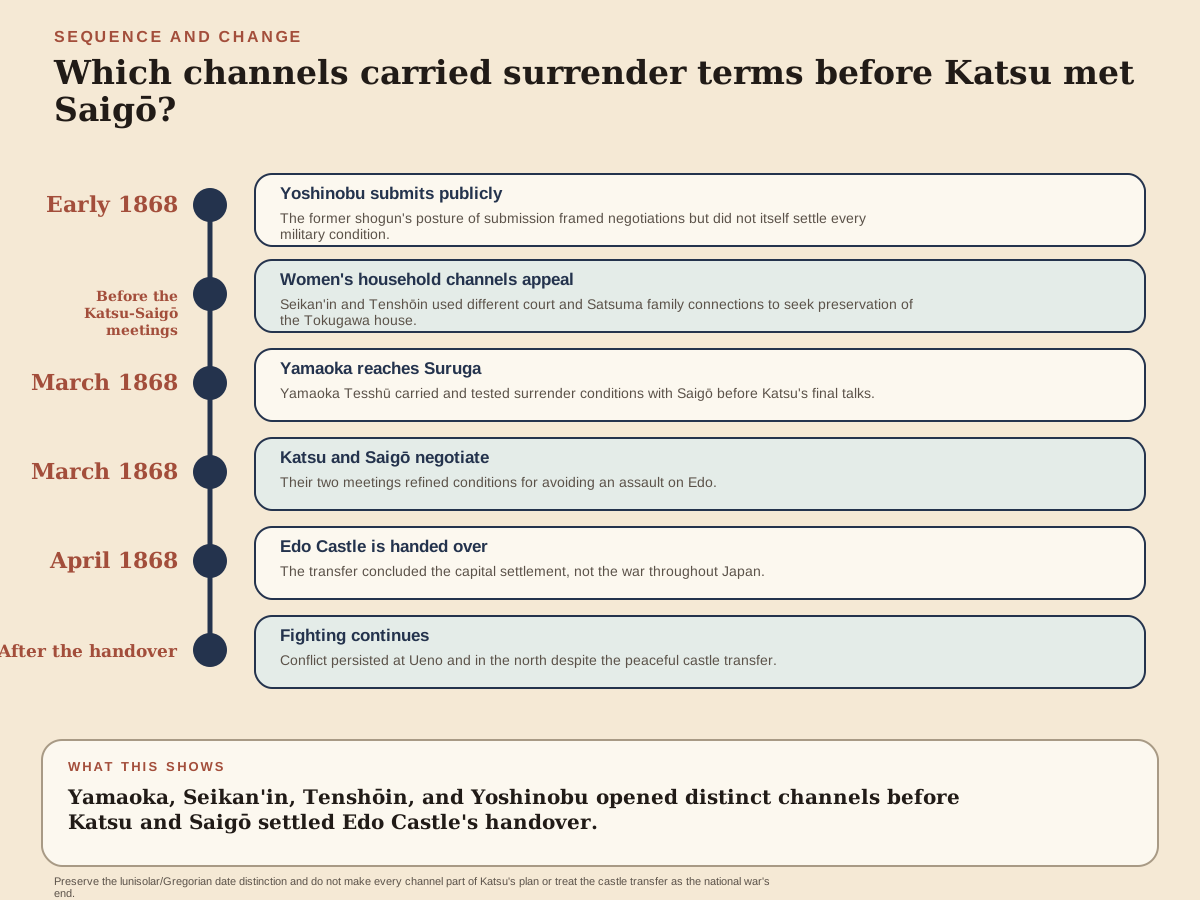
As the new government's army advanced, negotiation proceeded through multiple channels. Yoshinobu publicly submitted and withdrew to Kan'eiji, a Buddhist temple in Edo, making his posture visible. Seikan'in, the imperial princess and widow of Shogun Iemochi, petitioned through court connections. Tenshōin, Shogun Iesada's widow from Satsuma's ruling family, used a different household channel. Tokugawa Yoshikatsu and other senior figures acted separately. Within the old-bakufu command, Takahashi Deishū recommended Yamaoka Tesshū as an emissary. Yamaoka crossed the lines and met Saigō Takamori, a Satsuma commander in the new imperial army, at Sunpu in Suruga province on 1 April 1868—the ninth day of the third month in the Japanese calendar— before Kaishū's direct meetings in Edo. [5][9][11][12]
He argued for Yoshinobu's submission and carried conditions back. Kaishū meanwhile managed troops, information, city risks, and contingency plans. Edo contained far more than a castle. A general assault threatened residents, warehouses, waterways, temples, and surrounding settlements. Yet the prospect of destruction was not his private discovery; both sides faced military, political, and diplomatic consequences. Later “Three Boats” memory grouped Kaishū, Yamaoka, and Takahashi as coordinated Tokugawa saviors. Their distinct roles were real, but the label and its polished unity developed later. The settlement emerged from overlapping actions rather than one prewritten plan. [5][9]
Kaishū and Saigō met on the thirteenth and fourteenth days of the third month—5 and 6 April 1868 Gregorian. Evidence places the first meeting at the Satsuma residence in Takanawa and the second at a Satsuma facility in Tamachi. They refined terms for Yoshinobu, weapons, the castle, and the Tokugawa house. The planned general assault on Edo was cancelled. Edo Castle was transferred on the eleventh day of the fourth month. Yoshinobu left the political center; the young Tokugawa Iesato became head of a reduced house. [1][9]
Officials implemented the agreement across the castle, troops and stores. The transfer took place on 3 May 1868. "Bloodless surrender" describes the avoided general assault on Edo, not an end to all fighting. War at Ueno followed on 4 July 1868, and Tokugawa supporters continued resisting in northern Japan and Hokkaido. Kaishū and Saigō had negotiated a city handover that many others then had to carry out. [7][9][10]
Kaishū served the new Meiji state while assisting people displaced by the old one. He held posts including vice-minister of the navy, councillor, navy minister, and member of the Genrōin (a legislative-review council). His service did not mean complete identification with every new-government policy. In 1877 officials monitored him because of sympathy for Saigō Takamori and financial aid to former bakufu retainers. The surveillance reveals a man incorporated into the state yet not fully trusted. He became a count in 1887 and a privy councillor in 1888. [1][4]
Kaishū wrote, dictated, preserved records, and judged the people of the Bakumatsu, the late Tokugawa period. Works connected with him are indispensable for the period, but they are interested sources. He defended choices, elevated some relationships, diminished others, and wrote after outcomes were known. He maintained a household in Tokyo and bought land by Senzoku Pond in 1890 and built the Senzokuken retreat there in 1891. [1][3][4][6]
His naval-history compilation Kaigun Rekishi preserved the old service's records. In 1892 he answered Fukuzawa Yukichi's criticism of former Tokugawa men accepting Meiji office. Kaishū died on 19 January 1899, aged seventy-five by completed years. The exchange was published in 1901, after his death: the public debate outlived the participant. [1][3][4][6]
Classic
Katsu Kaishū was born on 12 March 1823 in Honjo Kamezawa, a district of Edo, today's Tokyo. His childhood name was Rintarō. His father, Katsu Kokichi, belonged to a hatamoto household: a hereditary line of direct retainers entitled to an audience with the Tokugawa shogun, Japan's warrior ruler. This status offered access to service, but the family's means were limited and Kokichi's irregular conduct complicated its reputation. His later autobiography helped make the household famous. Rintarō began with a recognized place in the Tokugawa order, though not the money or influence of a senior official. [3][4][6]
Honjo stood within the capital of Tokugawa administration, among warrior residences and the waterways and workshops sustaining a great city. Proximity to the castle did not guarantee a hearing there. Household obligations and instruction shaped Rintarō's prospects before government needed his expertise. He later used other personal and official names; Kaishū, the sobriquet by which he became famous, was acquired during his career.
Hereditary service gave him a route to instruction and appointment inside the regime. In 1838, after Kokichi retired, he inherited responsibility for the household. He would later challenge the narrow allocation of technical work by status, but he first had to acquire skills and persuade Tokugawa officials to employ them. His rise depended on enlarging the resources of an existing service identity. In 1845 he married Tami, an adopted daughter of Okano Magoichirō, while pursuing the studies that would support his household. [3][4]
A hatamoto household could continue through retirement or adoption even when one member lost office. Rintarō inherited its obligations as well as its standing. His later advancement was not a rise from commoner status: it was the career of a direct retainer who made specialized learning useful to superiors. [3][4]
Around 1845 Kaishū studied Dutch under Nagai Seigai, alongside swordsmanship and Western military learning. Dutch was the principal European language through which licensed foreign knowledge reached Japan. Nagasaki interpreters and private teachers connected pupils to books that could be expensive to obtain and slow to copy. Military translation presented an additional difficulty: a word for a ship's equipment referred to something a reader might never have seen. A dictionary and a diagram could explain a term without teaching anyone how to maintain an engine or organize a crew. [2][6]
Around 1850 Kaishū opened Hyōkai-juku, a private school for Dutch and military learning. Teaching gave him an institutional base and a way to support a household while building a reputation. The preparation was laborious. In 1847 he began copying the Dutch–Japanese Doeff–Halma dictionary, completing the work the following year. A scarce reference book could become useful to a school only through sustained access, copying and explanation. Swordsmanship and foreign study both belonged to the education of a serving warrior who sought practical employment. [2][6]
Steam warships increased the urgency of coastal defense, but translated books could not supply trained crews or dockyards. Kaishū's studies began before the American commodore Matthew Perry arrived. The 1853 crisis changed their value: officials who had regarded Dutch and military learning as a specialization now needed advice on a national emergency. His school, contacts and growing command of difficult texts made him available when that opening came. [2][6]
Access remained uneven. Imported books were costly; borrowed copies might contain errors or lose their diagrams. Teachers and fellow learners helped explain unfamiliar equipment. Kaishū's sustained work gathered usable references in one place and made them available through teaching. Expertise became a professional asset partly because few households could provide the time, materials and instruction it required.
The American naval commodore Matthew Perry's arrival challenged more than coastal artillery. His steam-assisted warships could move through waters the shogunate regarded as a defensive approach to Edo. The demand for diplomatic relations arrived with a visible capacity for force. On 14 July 1853 the American letter was handed over, but no immediate answer settled the problem. The squadron's departure created time and uncertainty rather than safety. Abe Masahiro, the shogunate's chief senior councillor, solicited opinions. His initiative widened political participation because the existing government lacked a confident answer. Daimyō, the territorial warrior lords, and other contributors submitted memorials. This process generated information and shared responsibility, but it also exposed disagreement. Some emphasized refusal and coastal fortification, some controlled concessions, some stronger ships and training, and many combined positions. Kaishū's memorial belongs inside that archive. [4][6][10]
Its importance is not that he alone foresaw a navy. Domains and offices of the bakufu, the Tokugawa shogunal government, had already encountered Western weapons, ship models, Dutch texts, and coastal alarms. His contribution linked naval capacity to personnel policy: ships would be useless without people able to operate them, and expertise could not be confined entirely by inherited rank. For a hatamoto seeking office, this was analysis with personal consequences, though that does not reduce it to opportunism. The memorial addressed superiors and proposed remedies; submitting it did not give Kaishū the power to implement them. [4]
Abe's government gathered proposals but retained control over appointments and expenditure. Kaishū's earlier study, his memorial and a shortage of skilled Dutch readers helped make him useful for technical service. Turning advice into a navy required procurement, training and the approval of officials above him. The emergency opened the policy debate to more contributors without handing them command of it. [4][6]
For Kaishū the crisis gave private specialization an official use. His school and Dutch study had prepared him to contribute advice; the next step was work within a government training institution. That would bring him into contact with equipment and foreign instructors, testing knowledge he had acquired largely from texts.
In 1855 the shogunate assigned Kaishū to translation work and sent him to the new Nagasaki Naval Training Center. The Dutch government supplied officers, technical personnel, ships, and teaching. The bakufu selected trainees, financed activity, assigned interpreters, and decided how learning would fit existing ranks. Nagasaki officials regulated a port already experienced in controlled foreign exchange. Participating domains sent men whose future service might lie outside direct bakufu command. Training therefore increased national capacity while distributing it. Instruction linked navigation to observation and record-keeping, and gunnery to drill and maintenance. Steam machinery added a need for mechanics and fuel. Trainees learned specialized tasks while depending on other members of a working crew. [1][2][3][6]
Language was an operational problem. Dutch teachers could demonstrate actions, but technical explanations passed through interpreters and learners with uneven vocabulary. Notes and manuals had to stabilize terms. The later Kanrin Maru diaries show that Dutch words continued to circulate where established Japanese equivalents were lacking. Translation was not a preliminary stage completed before practice; it accompanied practice. His Dutch study and memorial helped make him a useful trainee and translator. By 1859 he held a leading instructional post. That is substantial advancement for a hatamoto of limited means. It does not make him the founder, sole head, or best technician in every branch of the center. The Dutch instructors also possessed different authority from Japanese officials. [1][2][3][8]
They could recommend methods and evaluate performance, but the bakufu determined appointment and policy. Japanese trainees could learn foreign command procedures without ceasing to occupy Tokugawa ranks. When techniques crossed institutions, they were adapted rather than copied intact. Nagasaki's domain mixture had political consequences. Men learned alongside people whose primary loyalties and salaries came from different houses. Shared technical vocabulary could support later cooperation, yet it did not dissolve domain competition. The government faced a recurring choice: restrict training to protect control or widen it to obtain enough ability. Material constraints accompanied pedagogy. Ships deteriorated, engines required repair, coal had to be supplied, and equipment could be scarce. A lesson completed once did not create sustainable capacity. Japan would need dockyards, workshops, accounting, recruitment, and repeated voyages. [2][3]
Delivered to the bakufu in 1857, the Dutch-built Kanrin Maru became a platform for naval training. It combined sail with an auxiliary steam-powered screw propeller. Sail offered range and economy; steam helped movement and maneuver but consumed fuel and required maintenance. The crew had to learn both systems. For the 1860 voyage, senior naval official Kimura Yoshitake held overall responsibility. Kaishū's ship-command role belonged within that hierarchy, alongside officers responsible for navigation and machinery. [2]
Kaishū's command role operated alongside officers who handled navigation and machinery. Training had produced uneven expertise: experience in coastal sailing did not automatically confer skill in ocean navigation, and knowledge of mathematics did not supply an engineer. Ordinary sailors kept watches, handled sail and pumped water. Their coordinated work would matter especially when illness or bad weather disrupted the officers' plans. [2]
Shared drills had to make those differences workable. A ship is an unforgiving test of institutional coordination because one person's mistake may become everyone's emergency. The voyage's later political meaning can also distort its earlier purpose. Kanrin Maru did not begin as a monument to national modernization. It was a bakufu vessel in a regime responding to foreign pressure, treaty implementation, and the need to demonstrate maritime capacity. Domain initiatives existed alongside it. “Japanese navy” at this stage contained overlapping shogunal and domain projects rather than one centralized service. The officers' diaries would record some of the practical difficulties that official command titles cannot explain. [2]
The vessel linked foreign procurement to domestic training. Crews practiced with imported machinery and carried experience into subsequent assignments. Kaishū could use it for command and instruction only with other officers and working sailors. Keeping that group supplied and coordinated mattered as much as the ship's acquisition. The planned Pacific voyage would test the result far beyond familiar coastal waters. [2]
In 1860 Kanrin Maru crossed the Pacific to San Francisco. Japan's principal treaty embassy, led by Niimi Masaoki, Muragaki Norimasa and Oguri Tadamasa, traveled separately aboard the American warship Powhatan; the bakufu vessel accompanied it as escort and a demonstration of maritime capacity. Kimura held overall responsibility and Kaishū the principal ship-command role. Lieutenant John Mercer Brooke, an experienced American naval officer whose own vessel had been wrecked, joined the Japanese crew with a small American party. The distinction between the ships matters: Kaishū did not lead the treaty-ratification embassy. [2][8]
Brooke's diary describes navigation assistance from Uraga to San Francisco and criticizes the assignment of watches. The Japanese officer Akamatsu Noriyoshi's diary shows the same training gap from another position. In his diary entry for 24 February 1860, he used Dutch words when describing the ship's motion and pumping water; after the voyage had been underway for about two weeks, his entries began naming watch officers. Technical vocabulary and the organization of duty were still being learned at sea. Kaishū suffered seasickness and was not continuously able to perform all command tasks. This left more work to other officers and the American party. It does not establish that he contributed nothing to the voyage. In San Francisco the visitors observed port facilities and public institutions before preparing for the return voyage. [2][8]
The return crossing also belonged to the achievement. Repairs and provisioning preceded another ocean passage, with weather and health still affecting the crew. Travelers brought home experience that books could not provide, but the voyage also exposed weaknesses in watches and command organization. Whether the government could remedy them depended on continuing instruction and funds. Arrival in San Francisco was a milestone in training, not the completion of it.
The crossing later became entangled with rivalry. Fukuzawa Yukichi's unfavorable recollections contrasted with Kaishū's growing public standing. Those judgments need to be distinguished from Brooke's and Akamatsu's daily entries about shipboard work. A developing Japanese crew reached America with foreign assistance and brought home practical experience. The voyage showed both what training had achieved and where command organization needed improvement. [2][8]
A functioning service had to coordinate things Tokugawa government had traditionally distributed. Coastal defenses belonged to bakufu and domain jurisdictions. Ship procurement involved foreign merchants and diplomatic channels. Training drew on Dutch and increasingly other knowledge. Artisans and dockworkers held material skills that did not map neatly onto warrior rank. Accounts had to pay for fuel, wages, stores, and repair. Warship offices tried to turn these activities into repeatable administration. Kaishū's appointment in 1862 as assistant warship magistrate gave him formal authority within that effort. It did not give him a unified ministry in the later Meiji sense. Senior officials could countermand plans, funds could be redirected, and a change in political coalition could remove personnel. Human capital was the slowest resource. A purchased ship arrived more quickly than a navigator able to teach others. [1][2][3]
Training a mechanic did not produce an officer capable of managing crews, and an officer's inherited standing did not prove technical competence. Kaishū's argument for using capable people challenged status habits, but the regime could not simply abolish the service relationships that supplied salaries and obedience. Domains complicated the picture. Satsuma, Chōshū, Saga, and others pursued their own military and naval learning. Sharing students could widen skill; concentrating them under bakufu direction could strengthen Edo; withholding them could preserve domain autonomy. “Japan's navy” remained a future category contested through present institutions. The 1860 voyage produced prestige but also evidence of deficiencies. Watch organization, navigation practice, health, and command continuity could be reviewed. Whether reviews became reforms depended on records, teaching, and funding. [2][3]
Foreign contracts continued to shape readiness. Ships and spare parts arrived on schedules affected by cost and diplomacy, while domestic repair capacity developed slowly. Kaishū worked as an advocate, officer and teacher within these constraints. The crossing had supplied experience, but using that experience repeatedly required records, instructors and dependable funds. His authority over one office did not centralize every domain's naval project. [2][3]
The developing service accumulated ships and people that would outlive the shogunate. It remained vulnerable to funding and factional change. Kaishū's proposals for wider recruitment sought more capable men, while Tokugawa officials worried about command over people whose obligations lay elsewhere. That tension became especially visible in the training project at Kobe. [2]
In 1863 Kaishū proposed a naval training center at Kobe. Shogun Tokugawa Iemochi accepted the proposal, and the center opened in May 1864. The harbor opened onto the Inland Sea and sat near routes connecting Osaka, western domains, and the approaches to Kyoto. It could support ship exercise and movement without reproducing Nagasaki's particular foreign-trade administration. The same accessibility that made it useful also made it politically porous. Authorization belonged to Iemochi and the bakufu, not Kaishū alone. He proposed and led, but the shogun's acceptance, official funding, ship allocation, recruitment orders, and cooperating offices gave the school legal existence. His openness to recruits depended on permission and resources supplied within the regime. Recruitment crossed status lines without eliminating them. Hatamoto sons and sons of lower-ranking direct retainers called gokenin arrived through shogunal channels; domain youths through their own sponsors and networks. [3][6]
Students brought unequal education, stipends, and obligations. Technical drills could place them on one deck, but their careers would still be decided by different authorities. Ships made the curriculum practical. Kankō Maru and Kokuryū Maru allowed instruction in movement, maintenance, watches, navigation, and command. A vessel also consumed resources. Fuel, repairs, berthing, equipment, crew labor, and weather determined what could be taught. “Training center” should not be imagined as classrooms detached from a harbor economy. Kaishū's network included figures later famous in Restoration politics, among them Sakamoto Ryōma, his disciple, and Mutsu Munemitsu. Their later careers make the school look like a deliberate nursery of anti-bakufu leaders. That is outcome bias. Participants in 1863–1864 held changing affiliations. Kaishū sought broad maritime capability and political communication while remaining a bakufu officer. [3]
The school needed financial support as well as official authorization. Students and intermediaries pursued funds through domain patrons and personal contacts. That helped keep activity moving when official resources lagged, but raised questions about control. Ryōma was especially useful in these wider networks. Born into a Tosa retainer family and later detached from his domain, he had more freedom to travel than a serving shogunal officer, though less security. Kaishū offered naval experience and official access; Ryōma brought contacts that could extend the project beyond Edo's normal service channels.
In a private letter to his sister Otome in 1863, Ryōma identified himself as Kaishū's disciple and expressed enthusiasm for his maritime work. The letter supports the relationship at that time, rather than furnishing a transcript of their first meeting. Later accounts describe Ryōma arriving to kill Kaishū and becoming his pupil after a single conversation. That dramatic origin is not securely documented. Correspondence about the school and funds points instead to a continuing association with practical obligations.
The association did not make Kaishū a covert opponent of the shogunate. He continued to receive its salary and orders, while Ryōma moved through activist and commercial networks. Their shared interest in maritime capacity could aid the school without making their political purposes identical. Other students and sponsors likewise retained obligations to their own houses. Technical drills brought them onto the same deck without creating a single political loyalty.
Chōshū's fighting in Kyoto and against foreign forces in 1864 made cross-domain contacts more threatening to Tokugawa officials. Kaishū was dismissed late that year, and the center closed in March 1865. Ships and students could be reassigned, but the school had not obtained protection independent of its leader. Participants carried their learning elsewhere; the organized training experiment itself did not survive. [1]
In 1864 Kaishū briefly became warship magistrate and traveled west during the Chōshū crisis. Kaishū's naval knowledge was valuable when the bakufu wanted ships, training, or negotiation. The relationships required to use that knowledge became liabilities when senior officials defined the crisis through loyalty and punishment. A technically rational network could be politically irrational from the viewpoint of central control. Shimonoseki exposed several failures at once. Chōshū batteries had fired on foreign shipping in an attempt to enact imperial expulsion. Foreign powers responded with superior naval force. The bakufu had treaty obligations but incomplete authority over the domain. Kaishū's mission and memorial writing addressed the gap between policy claims and usable ships, money, and command. He did not arrive as commander of the allied fleet or as the sole Japanese negotiator. [1][10]
Evidence places him in a bakufu effort to understand, delay, or manage consequences, including activity near Himeshima after the bombardment. His analysis was situated: a naval officer evaluating policy through capacity. Other officials faced court demands, treaty enforcement, domain discipline, and reputational cost. The wider 1864 sequence intensified suspicion. Chōshū forces had fought in Kyoto; the court authorized punitive action; domains were mobilized. Students and activists could no longer be classified merely as curious young men. Connections to western domains and political travelers appeared as possible channels of disobedience. Kaishū's removal therefore cannot be explained by a single anecdote that officials discovered he taught Ryōma. The school's mixed personnel, his broad political contacts, his criticism of policy, and changing senior coalitions formed the relevant field. [1][10]
Kaishū lost office late in 1864 but remained a Tokugawa retainer. His house and service standing survived removal, leaving him eligible for recall. The government distrusted his wider contacts while still having use for his knowledge. Its decision also deprived the Kobe project of a powerful official sponsor. The school's closure followed in March 1865, and the next Chōshū campaign would show how urgently naval and negotiating ability were still needed. [1][10]
On 10 October 1866—Keiō 2, ninth month, second day in the Japanese calendar—Kaishū met Chōshū representatives Hirosawa Saneomi and Inoue Kaoru at Daiganji on Miyajima, an island near Hiroshima. The second punitive campaign had gone badly for the bakufu, and Shogun Tokugawa Iemochi's death had unsettled its leadership. Recalled to naval office, Kaishū negotiated under Tokugawa authority and asked that withdrawing troops not be pursued. The request showed how far the campaign had changed: the side sent to punish Chōshū now needed room to disengage. [1][10]
Calling the event “Kaishū's truce” should not erase the people whose assent made it possible. Tokugawa Yoshinobu, Iemochi's successor as head of the main Tokugawa house and subsequently shogun, also shaped the mission. Evidence connects Kaishū's mission to Yoshinobu's intention to end the campaign. The negotiator could exercise judgment in the room without becoming a private sovereign. Military conditions supplied leverage. Chōshū forces had reorganized, obtained arms, and fought effectively on several fronts. Many domains gave limited support to the bakufu campaign; logistics and morale were uneven. The government still possessed ships and troops, but a command to punish no longer guaranteed national compliance. The ceasefire did not solve every claim. It managed withdrawal and stopped immediate fighting under changed circumstances. [1]
Chōshū was not returned to the prewar position envisioned by punitive policy. The bakufu did not formally announce that its general authority had ended. Negotiated ambiguity allowed both sides to move toward the next political contest. Kaishū's later image as the man who understood the futility of civil war is supported by his repeated preference for political management over unsupported force. Yet moral foresight alone does not explain the mission. The bakufu needed negotiation because military operations had failed and leadership had changed. Principles became effective when circumstance and authorization aligned. Sources also differ in proximity. Kaishū's diary is direct evidence of his recorded actions and wording choices, but it remains his record. Chōshū biographies, domain documents, campaign reports, and later histories show the other side and wider military field.
The meeting helped arrange withdrawal rather than restore the punitive terms originally sought by the bakufu. Commands still had to reach forces and be obeyed. Kaishū had negotiated from a Tokugawa position after military failure, preserving some capacity for the government while accepting that further coercion was impractical. This experience made him useful when the survival of the Tokugawa house itself became the question in 1868. [1]
In November 1867 Tokugawa Yoshinobu, the last shogun, returned governing authority to the emperor. This transferred a claim to govern; it did not instantly dissolve the bakufu's material body. Edo offices still processed petitions and revenue. Tokugawa retainers still expected stipends. Warships still had crews. Yoshinobu still headed a powerful house. Foreign diplomats still needed to know who could perform treaty obligations. Kaishū's earlier proposals were distinct from the decision Yoshinobu took in 1867. Tosa's proposal, Gotō Shōjirō's work, Yamauchi Yōdō's sponsorship, and Yoshinobu's submission belong to that event. Later memory sometimes gives every peaceful transition idea to the man associated with Edo's surrender. These actors, rather than Kaishū, arranged taisei hōkan, the return of the shogun's governing authority to the emperor. The Restoration proclamation of 3 January 1868—Keiō 3, twelfth month, ninth day in the Japanese calendar— abolished the shogunate and old court regencies under military pressure in Kyoto. [9][10]
Demands that Yoshinobu return rank and lands followed. Negotiation did not prevent armed movement. Old-bakufu, Aizu, and Kuwana forces advanced toward Kyoto and fought Satsuma and Chōshū at Toba and Fushimi. Defeat transformed classification. The imperial banner and court authorization allowed the new coalition to identify its forces as the emperor's army and opponents as enemies of the court. Military weakness and political legitimacy reinforced each other. Yoshinobu's departure from Osaka with senior allies disorganized resistance, but it did not automatically place every unit under Kaishū's command. Back in Edo, Yoshinobu considered alternatives before publicly choosing submission. Kaishū's promotion reflects emergency rather than a stable portfolio. “Army director” gave responsibility over forces whose loyalties, locations, and expectations differed. Naval officers could take ships away; hard-line units could reject surrender; city officials faced fire, food, policing, and population movement. [1][9][10]
Foreign mediation was conceivable because treaty powers had interests in stability and commerce. It was not a neutral international court capable of imposing Kaishū's preferred solution. British, French, American, and other representatives had divergent relationships with the old and new governments. Seeking foreign help could also make domestic settlement look illegitimate. Defense preparations do not prove an intention to fight to destruction. Fortifications, troop positioning, fires as contingency, and naval assets could deter assault or strengthen negotiation. They also created risks that preparation would become combat through local initiative. A settlement advocate responsible for military command had to plan for outcomes he hoped to prevent. The Tokugawa house was not identical with the bakufu. One possible transition was to preserve a reduced house under a new sovereign government while ending its national rule.
Preserving a reduced Tokugawa house required agreement over its head, territory and retainers while national government passed elsewhere. Kaishū could connect the defeated center's remaining forces with proposals for negotiated disarmament. Reports from the west arrived late, and not every unit would obey surrender. He therefore prepared contingencies while seeking terms. Before a meeting with Saigō could settle anything, Yoshinobu had to make his submission credible and channels had to open to the advancing army.
Yoshinobu's conduct came first. After returning from Osaka, he moved from considering resistance and mediation to a public posture of submission. His confinement at Kan'eiji, a Buddhist temple in Edo, was political communication: the former shogun separated himself from command and presented punishment of his person as unnecessary. Skeptics could still doubt sincerity, but the visible act changed what intermediaries could argue. Women of the Tokugawa household used different authority. Imperial Princess Kazunomiya, now Seikan'in and the widow of Shogun Iemochi, retained her court connections. Tenshōin, the widow of Shogun Iesada, came from the ruling family of Satsuma. Their petitions did not command armies, and they should not be reduced to sentimental appeals. They supplied kinship channels capable of translating surrender into obligations recognizable to Kyoto and Satsuma actors. Tokugawa Yoshikatsu and other senior lords also communicated. [9][11][12]
These routes could reinforce one another without forming a formal committee. Messages arrived with different proposed terms, information, and credibility. The new government had to decide whether apparent submission reflected coordinated compliance or tactical delay. Yamaoka Tesshū's mission corrects the simple chronology. Takahashi Deishū recommended him; Yamaoka obtained access, traveled toward the advancing headquarters, and met Saigō Takamori, a Satsuma commander in the new imperial army, at Sunpu in Suruga province on 1 April 1868, the ninth day of the third month in the Japanese calendar. He disputed conditions he believed impossible and carried the negotiation into a form Kaishū could continue. Describing him merely as “Kaishū's confidant” erases Takahashi's intervention and Yamaoka's own agency. Kaishū's military planning ran alongside diplomacy. He considered how to organize remaining forces and what might happen if negotiations failed. Later accounts include dramatic plans to burn or evacuate Edo; exact scope and executability require caution. [5][9]
Securely, he possessed responsibility and contemplated contingencies, not passive faith in Saigō's generosity. Urban administration made delay valuable. Officials had to manage police, firefighting, food and commercial movement, weapons, and the potential flight of residents. Edo's built environment could turn combat into spreading fire. A “million-person city” is a useful scale indicator, not a precise census for one day. The stakes were collective regardless of exact count. New-government forces also had constraints. Assaulting a visibly submitting Yoshinobu could damage claims of imperial justice. Occupying a vast city required discipline and administration after victory.
Historical disagreement · How much did British intervention affect Edo’s surrender?
Foreign representatives cared about treaty access and the treatment of a former ruler. Historians differ over the weight of British intervention. Iechika Yoshiki's 2017 account, as discussed by Iwashita Tetsunori in 2020, includes British minister Harry Parkes's opposition among the factors averting an assault. Iwashita questions the evidence for an earlier account of an envoy's meeting with Parkes.
These interpretations should not be collapsed into a proven British order directing the settlement.
Kaishū's meetings with Saigō followed these separate approaches. They were a decisive stage in negotiations whose conditions had already been altered by Yoshinobu's submission, Yamaoka's mission and household petitions. The later label "Three Boats" grouped Kaishū, Yamaoka and Takahashi Deishū as Tokugawa peacemakers. Their distinct contributions are documented, but the polished trio belongs more clearly to late-Meiji commemoration than to a formal coordinating body in 1868. The label leaves out other channels that helped make surrender negotiable. [5][9]
Muketsu kaikō, "bloodless surrender," became the memorable name for Edo Castle's handover. It identifies a real outcome: Edo Castle changed hands without the new-government army launching the expected general assault on the metropolitan center. Residents avoided the destruction that sustained urban fighting and fire could have caused. The phrase becomes misleading when expanded into a claim that Kaishū and Saigō peacefully ended the civil war. The two-day structure matters. On 5 April 1868, the thirteenth day of the third month in the Japanese calendar, Kaishū met Saigō at the Takanawa Satsuma residence; on 6 April, the fourteenth day, discussion continued at a Tamachi Satsuma facility, according to the commonly supported location record. Terms could be checked against information from Yamaoka's mission, Yoshinobu's submission, and the authority each man possessed. Negotiation contained coercion. New-government forces were advancing and could attack.
Kaishū had defensive capacity and contingency plans but represented a defeated political center. Saigō's willingness to modify or carry terms was consequential because he stood within a coalition, not above it. Neither side participated as equal private citizens discovering humanitarian agreement. Implementation widened the cast. Castle buildings, arsenals, documents, treasury items, and gates required inventories and officers. Troops had to surrender, relocate, or be disbanded. Retainers and households faced loss of income and status. City administration had to continue while jurisdiction changed. The agreement's success depended on hundreds of acts less memorable than the meeting. The Tokugawa house also required reconstruction. Yoshinobu's personal treatment was separated from the house's continuity. The young Tokugawa Iesato became head of a reduced line, and lands and residence were reassigned. [9]
This solution allowed the former ruling family to survive as a subject house while removing its national government. Kaishū's responsibility increasingly concerned the people attached to that transformation. Resistance did not vanish. The Shōgitai and other forces remained armed around Ueno; fighting there on 4 July 1868 caused deaths and destruction. Enomoto Takeaki and ships of the old bakufu later went north. Aizu, northeastern domains, and forces in Hokkaido continued war. These actors had their own reasons and were not automatically controlled by Kaishū's signature. Peace in Edo could even redistribute military attention. Once the capital and main castle transferred, the new government could concentrate legitimacy and resources against remaining resistance. A humane outcome for one city coexisted with coercive consolidation elsewhere. [7][9][10]
Historical disagreement · Who deserves credit for Edo’s negotiated surrender?
Historians also differ over which Tokugawa intermediary deserves greatest credit. The Katsu-centered account summarized from Matsuura Rei's 2010 biography treats Yamaoka's mission as an opening to negotiations that Kaishū would complete. In his 2020 reassessment, Iwashita Tetsunori makes Yamaoka's earlier discussion at Sunpu the decisive turning point and gives Takahashi's recommendation greater weight.
Neither account makes the later castle transfer happen automatically: Saigō had to secure the new government's approval, and officials had to carry out the terms. The disagreement concerns how much had been settled at Sunpu before the Edo meetings; credit cannot simply be assigned to one exclusive peacemaker.
Edo Castle was handed over on 3 May 1868, the eleventh day of the fourth month in the Japanese calendar. The interval after the April meetings was used to turn negotiated terms into orders and practical transfer. The avoided general assault spared the metropolitan center, while resistance elsewhere carried the civil war onward. [9]
The end of the bakufu did not eliminate its expertise. The Meiji government needed administrators, diplomats, engineers, naval officers, translators, and records. Kaishū's maritime knowledge and ability to mediate with former Tokugawa networks gave him practical value. Appointments in the navy and central councils converted service to the shogun into service under imperial government without pretending the two states were identical. Office chronology prevents symbolic labels from swallowing work. Kaishū returned to office as navy vice-minister in 1872, then served as councillor and navy minister from 1873 to 1875; he later served in the Genrōin (a legislative-review council). Tenure, authority, and day-to-day involvement varied. Calling him simply a “founder of the Imperial Navy” would erase ministries, former domain navies, foreign advisers, shipyards, and officers who built the new service. [1][4]
Former retainers created another obligation. The transition reduced or transformed stipends and moved Tokugawa personnel. Kaishū used influence and money to aid some of them. Such assistance could be read as social relief, household loyalty, political networking, or all three. It made him useful as an intermediary and suspicious as a possible center of old allegiance. The 1877 Satsuma conflict sharpened that ambiguity. National Archives evidence records surveillance motivated by his sympathy toward Saigō and support for former bakufu people. Sympathy does not prove participation in rebellion. Surveillance does prove that state authorities distinguished formal office from unquestioned loyalty. Peerage and council appointment later marked incorporation. The countship of 1887 placed Kaishū within the modern nobility; appointment as privy councillor in 1888 recognized senior advisory status. [1][4]
His writings formed a second career. Kaigun Rekishi assembled naval history; Kaikoku Kigen dealt with the origins of Japan's opening to foreign relations. These compilations and his diaries helped preserve records of the old government. Recollections also advanced his account of responsibility, sometimes in disagreement with other participants. An explanation of Edo's survival written after the event could emphasize his preparation and judgment more strongly than other people's contributions. Preserving documents and remembering conversations were related activities, but they did not have the same evidentiary value. [1][4]
His Akasaka Hikawa household represented continued elite life in Tokyo. In 1890 he bought land by Senzoku Pond, and the following year built the Senzokuken retreat there. The place recalled his association with the surrender era; the residence itself came much later. In January 1892 Fukuzawa Yukichi sent him a critical essay questioning the loyalty of former Tokugawa officials who accepted Meiji service. Kaishū responded during his lifetime. Fukuzawa published the exchange in 1901, after Kaishū's death, so the later public controversy should not be mistaken for a new statement by him. Kaishū died on 19 January 1899. Japanese accounts sometimes give seventy-seven by traditional age-counting; he was seventy-five by completed years. He left both records of a defeated government and an interpretation of how its servants should live after defeat. [3][6]