Skip to content
Chronicle

Search History Omakase

Start typing to search.

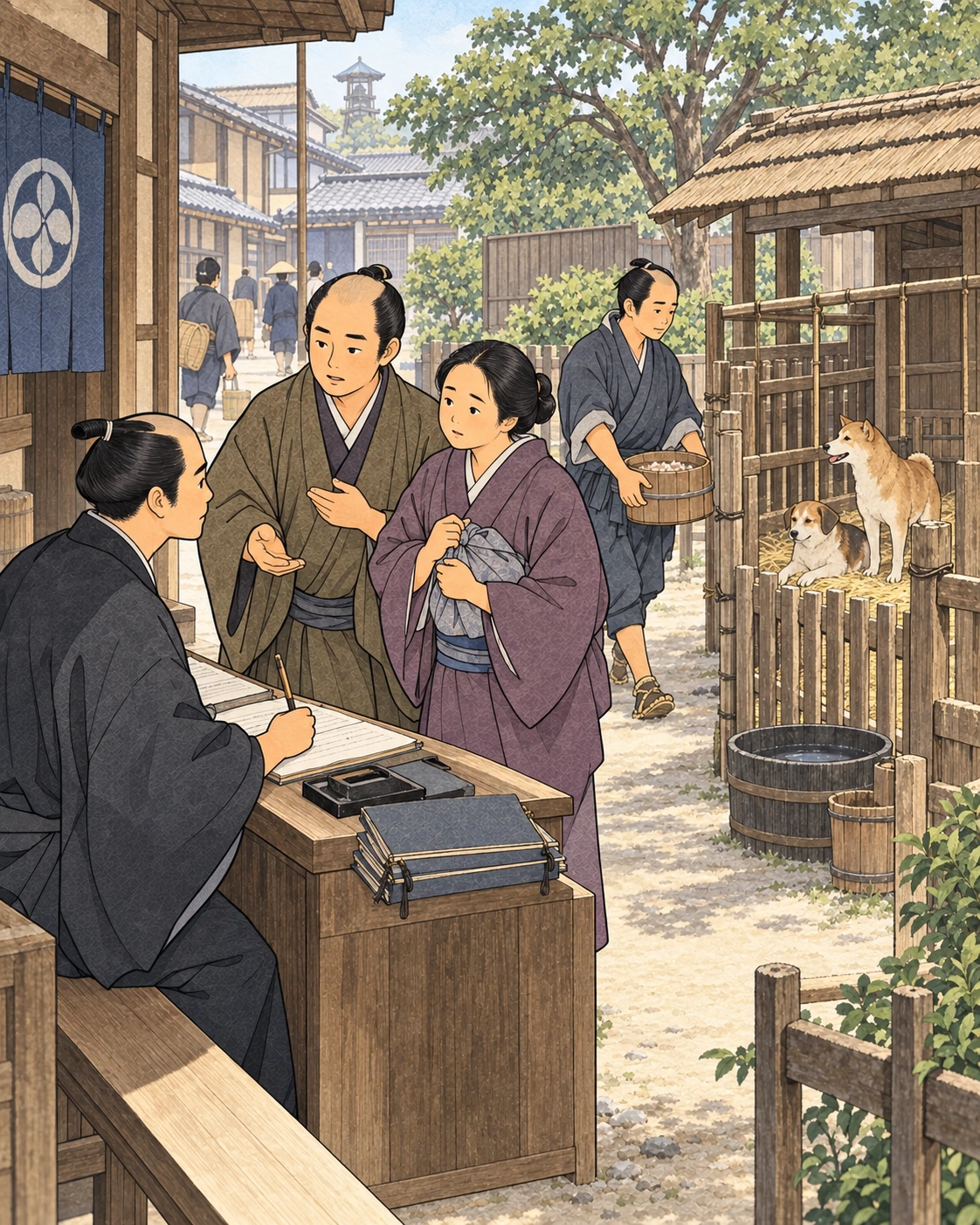
    Illustration for The Laws of Compassion and Genroku Government

    1685–1709 | Edo period

    The Laws of Compassion and Genroku Government

    生類憐みの令と元禄の政治

    Choose a reading depth

    Overview

    The measures grouped later as the Laws of Compassion began with orders concerning the treatment of animals and the abandonment of children, sick people and livestock. They accumulated across Tsunayoshi's government through repeated instructions, revisions and local enforcement; there was no single statute carrying the familiar collective title.

    Officials, village leaders and urban neighborhoods had to report, shelter or transport living beings covered by the orders. Dog management became especially visible in Edo, including large kennels at Nakano. Enforcement imposed labor and expense, and surviving cases helped later critics turn the whole program into a story of arbitrary rule by the 'dog shogun.'

    The orders were largely ended after Tsunayoshi's death. Their history nonetheless belongs to the development of early modern policing and welfare as well as animal protection. Compassion was translated into compulsory administration, with uneven burdens and uncertain outcomes.

    Read The Laws of Compassion and Genroku Government

    Read the article below. Interactive reading tools are available when scripts load.

    Quick

    The Laws of Compassion and Genroku Government

    The measures grouped later as the Laws of Compassion began with orders concerning the treatment of animals and the abandonment of children, sick people and livestock. They accumulated across Tsunayoshi's government through repeated instructions, revisions and local enforcement; there was no single statute carrying the familiar collective title.

    Officials, village leaders and urban neighborhoods had to report, shelter or transport living beings covered by the orders. Dog management became especially visible in Edo, including large kennels at Nakano. Enforcement imposed labor and expense, and surviving cases helped later critics turn the whole program into a story of arbitrary rule by the 'dog shogun.'

    The orders were largely ended after Tsunayoshi's death. Their history nonetheless belongs to the development of early modern policing and welfare as well as animal protection. Compassion was translated into compulsory administration, with uneven burdens and uncertain outcomes.

    Tsunayoshi was born in 1646 at Edo, present-day Tokyo, within the house of the reigning shogun Iemitsu. He was a fourth son, and his mother Keishōin had entered the household as a concubine. Iemitsu’s death in 1651 left his eldest surviving son Ietsuna as the next shogun, head of the warrior government. Tsunayoshi received land and retainers as a younger member of the dynasty. Those resources gave him a household distinct from the main ruling house.

    The shogunate issued many orders over more than two decades. Their subjects and enforcement changed over time. Communities had to identify violations and provide care, while officials created facilities and procedures. A humane principle thus became a compulsory local workload.

    The new shogun entered a government with powerful serving families. Sakai Tadakiyo had held the senior position of tairō under Ietsuna. Tsunayoshi removed him and promoted Hotta Masatoshi, a senior councillor who supported the succession, to that leading rank. The change placed a trusted adviser near the center of government. Tsunayoshi also settled the unresolved house dispute at Takada, in present-day Niigata, by dissolving its Matsudaira lordship. Even a prominent branch related to the dynasty could lose its domain through the shogun’s judgment.

    Classic

    Conditions behind Laws of Compassion and Genroku Government

    Tsunayoshi's government promoted a moral image of rule grounded in learning, ritual and benevolence. Orders protecting life emerged within that broader program. Later memory narrowed them to dogs, but early measures also concerned abandoned children, sick people, horses and other animals.

    The measures grouped later as the Laws of Compassion began with orders concerning the treatment of animals and the abandonment of children, sick people and livestock. They accumulated across Tsunayoshi's government through repeated instructions, revisions and local enforcement; there was no single statute carrying the familiar collective title.

    Tsunayoshi was born in 1646 at Edo, present-day Tokyo, within the house of the reigning shogun Iemitsu. He was a fourth son, and his mother Keishōin had entered the household as a concubine. Iemitsu’s death in 1651 left his eldest surviving son Ietsuna as the next shogun, head of the warrior government. Tsunayoshi received land and retainers as a younger member of the dynasty. Those resources gave him a household distinct from the main ruling house.

    In 1661 his holdings expanded to an assessed two hundred fifty thousand koku, a measure of rice revenue, and he became lord of Tatebayashi in present-day Gunma. His household maintained its own servants, officers and estate income. Nobuko, whom he married in 1664, belonged to the Takatsukasa family of Kyoto court nobles. That marriage connected his branch of the warrior dynasty with a family of high court standing. It was part of the adult position he held before becoming shogun.

    In 1680, while Ietsuna was gravely ill and had no son to continue the main line, Tsunayoshi was adopted as his successor. After Ietsuna died, Tsunayoshi received appointment to the shogunate that year. Adoption maintained the recognized dynastic line while bringing a different household into central service. Men who had served him at Tatebayashi accompanied the change; Yanagisawa Yoshiyasu was among them. Their prospects now depended on the new ruler’s dealings with officers whose families had served earlier shoguns. Succession changed both the ruler and the people with access to him.

    Laws of Compassion and Genroku Government in motion

    The shogunate issued many orders over more than two decades. Their subjects and enforcement changed over time. Communities had to identify violations and provide care, while officials created facilities and procedures. A humane principle thus became a compulsory local workload.

    Officials, village leaders and urban neighborhoods had to report, shelter or transport living beings covered by the orders. Dog management became especially visible in Edo, including large kennels at Nakano. Enforcement imposed labor and expense, and surviving cases helped later critics turn the whole program into a story of arbitrary rule by the 'dog shogun.'

    The orders were largely ended after Tsunayoshi's death. Their history nonetheless belongs to the development of early modern policing and welfare as well as animal protection. Compassion was translated into compulsory administration, with uneven burdens and uncertain outcomes.

    The new shogun entered a government with powerful serving families. Sakai Tadakiyo had held the senior position of tairō under Ietsuna. Tsunayoshi removed him and promoted Hotta Masatoshi, a senior councillor who supported the succession, to that leading rank. The change placed a trusted adviser near the center of government. Tsunayoshi also settled the unresolved house dispute at Takada, in present-day Niigata, by dissolving its Matsudaira lordship. Even a prominent branch related to the dynasty could lose its domain through the shogun’s judgment.

    The immediate settlement

    By the end of the reign, the dog kennels and punishments had become prominent symbols of the policy. After Tsunayoshi died, the successor government revoked most measures quickly, revealing how closely the system depended on the shogun's authority.

    Territorial lords governed their own domains under the shogun’s authority, while local officers administered the government’s direct estates. Tsunayoshi’s early measures addressed both. He punished lords for poor administration and disciplined local officers over negligent service or failures involving revenue. The appointment of account examiners supplied another means of scrutinizing financial work. Land income had to reach the government through people entrusted with collection and reporting. Tightening those relationships could protect revenue while exposing established officers to removal.

    Hotta was murdered in Edo Castle in 1684. His death changed the circle around Tsunayoshi. Makino Narisada and then Yoshiyasu became prominent attendants; Yoshiyasu’s appointment as soba-yōnin in 1688 made him a direct intermediary for the ruler’s business. Successive promotions raised his standing above many regular councillors. His equivalence in rank to a senior office should be distinguished from appointment to that office. Personal access became a powerful resource within government, carrying the shogun’s wishes through men whose advancement remained closely attached to him.

    The event's longer afterlife

    The 'dog shogun' caricature preserved popular resentment but flattened a larger history of welfare, animal treatment and police administration. The episode asks how a state can compel compassion, who pays for it, and how selective memories turn a long policy sequence into one moral anecdote.

    Treating the policy as a series rather than a single eccentric decree reveals how Genroku government extended reporting and care obligations into households, streets and villages.

    The program cannot be reduced either to humane progress or irrational tyranny. It joined ethical claims to coercive enforcement and created costs borne by commoners and officials.

    Tsunayoshi lectured territorial lords and direct retainers on the Four Books, a group of Confucian classics, from 1690 to 1693. The surviving lecture text uses commentary by the Chinese scholar Zhu Xi, with reading marks added by the Hayashi family of government scholars. Its small format allowed listeners to carry the volumes. From 1693 to 1700 he also gave repeated lectures on the Book of Changes. The National Archives counts two hundred forty occasions. Teaching occupied recurring time in the ruler’s relations with serving men.

    Sources and notes

    1. 徳川綱吉 · Tsuji Tatsuya 辻達也 / Yamakawa / Britannica / Kōdansha
    2. 柳沢吉保 · Tsuji Tatsuya 辻達也 / Yamakawa
    3. 四書集註 · National Archives of Japan 国立公文書館
    4. 周易本義 · National Archives of Japan 国立公文書館
    5. 昌平坂聖堂総差図 資料解説 · Tokyo Metropolitan Library 東京都立図書館
    6. 護国寺略縁起・境内案内 · Gokoku-ji 護国寺
    7. 生類憐みの令 · Tsukamoto Manabu 塚本学 / Tsuji Tatsuya 辻達也 / Yamakawa
    8. 生類憐みの令はどのような法令か · Edo-Tokyo Museum 江戸東京博物館
    9. 犬の生死書付町触 · Yamanashi Prefectural Library 山梨県立図書館
    10. 日本貨幣史 元禄・宝永の改鋳 · Bank of Japan Institute for Monetary and Economic Studies, Currency Museum 日本銀行金融研究所貨幣博物館
    11. 常設展示図録 金貨の改鋳 · Bank of Japan Currency Museum 日本銀行貨幣博物館
    12. 赤穂事件と忠臣蔵 事件はどう語りつがれてきたか · Sumida Local History Museum すみだ郷土文化資料館
    13. 宝永4年(1707)富士山噴火 過去の災害に学ぶ第11回 · Shimojū Kiyoshi 下重清 / Cabinet Office disaster-history expert study 内閣府
    14. 1707 富士山宝永噴火報告書 おわりに · Cabinet Office disaster-history expert study 内閣府
    15. 徳川家宣 · Tsuji Tatsuya 辻達也 / Yamakawa
    16. 常憲院贈大相国公実紀 · National Archives of Japan 国立公文書館
    17. 将軍綱吉と元禄の世 泰平のなかの転換 · Edo-Tokyo Museum 江戸東京博物館
    18. 第4代将軍/徳川家綱の生涯 · Nagoya Sword Museum / 名古屋刀剣博物館

    About these sources

    Reading preferences

    Text size
    Glossary intensity

    Choose how much explanation appears as you read.

    Saved on this device. All terms remain available in the glossary.

    Browse the glossary →
    History Omakase

    Opening reading…