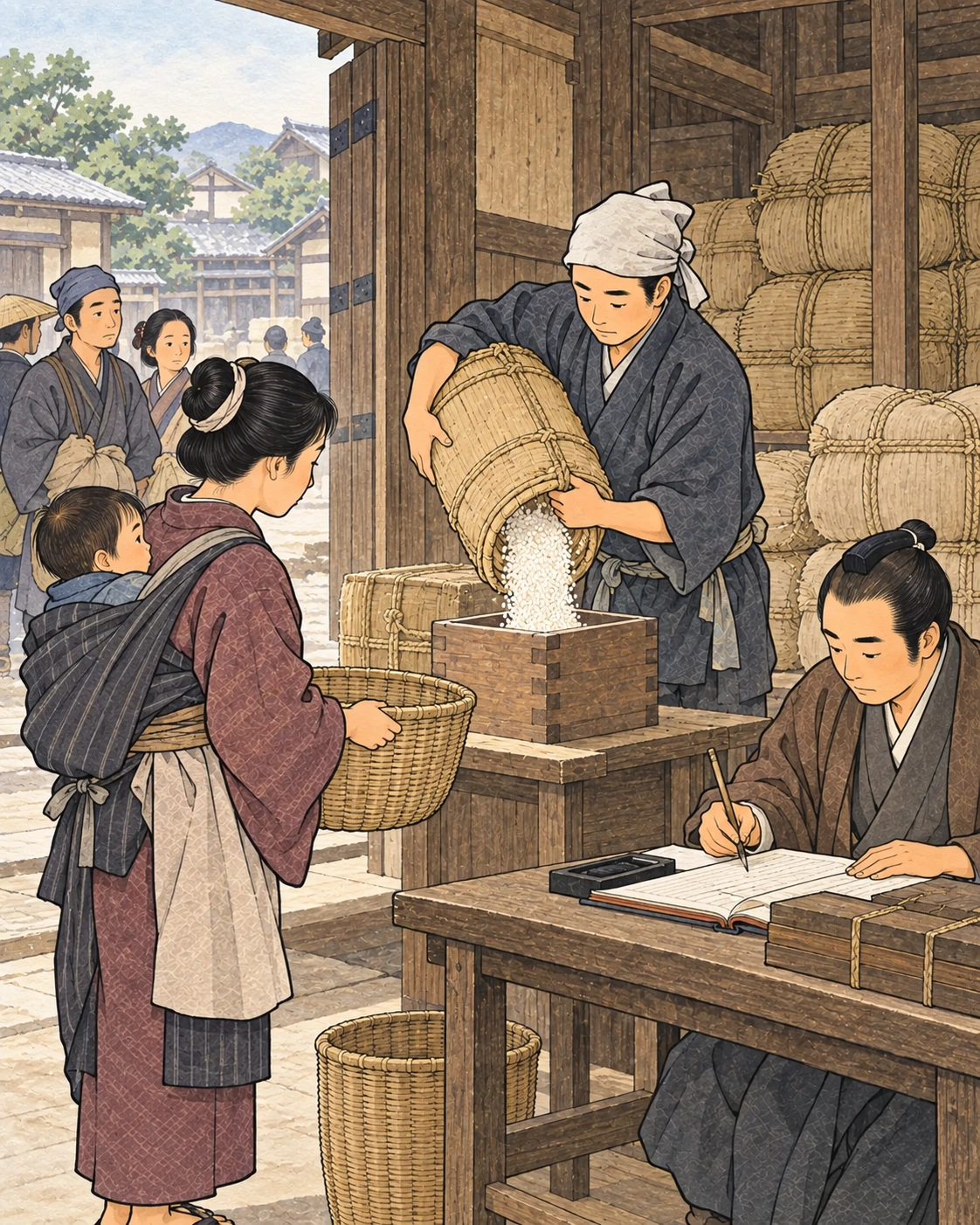
The Tenmei famine and urban disturbances made government legitimacy inseparable from food supply and price. Tanuma Okitsugu's fall created an opening for a program that blamed luxury and laxity, yet the crisis also demanded stores, money and administrative capacity.
The reforms followed crop failure, famine, unrest and criticism of Tanuma-era government. Sadanobu came to the senior council from Shirakawa domain with a reputation for emergency administration. His program sought to rebuild reserves and reduce expenditure while presenting frugality as moral government.
Matsudaira Sadanobu (1759–1829) was born in Edo, now Tokyo, to Tayasu Munetake, Yoshimune’s son. Yoshimune had ruled as shogun, the head of the Tokugawa warrior government. Munetake was a poet and scholar, and Sadanobu learned from the household scholar Ōtsuka Takasue. Early instruction introduced Chinese classics that discussed conduct, obligation and government. Sadanobu’s later writing in both Japanese and Chinese grew from this formation.
References describe an early work setting out standards for his own conduct, followed by political arguments, essays, poems and antiquarian studies over a long life. Study also included martial skills. The writings and training belonged to the preparation of a warrior-household member whose conduct could carry responsibilities for dependents and territory. Political texts included Kokuhonron, an account of principles for rule.
In 1774 Sadanobu entered Matsudaira Sadakuni’s house as adopted heir to Shirakawa, a domain in northeastern Japan, now Fukushima. The transfer supplied a route to domain rule while changing his place within the Tokugawa succession network. In his later recollection, the minister Tanuma Okitsugu’s influence helped divert him from possible shogunal succession. That account preserves the judgment of someone who later opposed Tanuma’s government. The secure institutional result was the adoption and, in 1783, inheritance of Shirakawa. He acquired a ruling position with immediate territorial obligations.
Shirakawa’s assessed holding was 110,000 koku, a conventional rice measure used to describe territorial resources. Such an assessment did not mean that the household held that amount as readily spendable grain. Crop failure, transport and purchasing arrangements determined what food could be obtained. As Sadakuni became ill and the Tenmei famine struck the domain, Sadanobu began directing relief before formal succession. The distinction matters: the first response was undertaken for the governing household he was about to inherit.
Sadanobu connected austerity at the center with village and city measures. Relief reserves, migration controls, debt intervention and academy policy were parts of one attempt to discipline resources and conduct. Their effects differed between peasants, townspeople, publishers and shogunal retainers.
Measures addressed debt, village population, urban relief and the conduct of retainers. The shogunate supported granaries and emergency funds, tried to return migrants to the countryside, and intervened in obligations owed by its direct retainers. It also tightened controls on publishing and made Zhu Xi learning the preferred orthodoxy at the shogunal academy.
Sadanobu left office in 1793. Some institutions survived and some immediate finances improved, but the program could not reverse long changes in markets, debt and urban culture. Its mixture of relief and coercion explains both its reach and its limits.
Shirakawa’s famine response began while Sadakuni was ill. In 1783 food shortages reached the castle town, where attacks on property exposed distress. Sadanobu sought grain from the domain’s less affected holdings in Echigo, now Niigata. A domain’s territory could consist of separated pieces. That distribution offered access to a harvest elsewhere, but also made relief dependent on moving goods across land governed by another household. The existence of grain at a distant holding was the beginning of a solution.
The reform strengthened some reserves and left institutional precedents, but political conflict and the difficulty of remaking a commercial society narrowed Sadanobu's position. His departure in 1793 ended the concentrated program before its ambitions were fulfilled.
Aizu lay between the supply territory and Shirakawa. Sadanobu negotiated its cooperation in transit and arranged purchases of rice and other grain. The response therefore used both territorial resources and outside exchange. Food procurement required agreements among governments and the capacity to buy and convey supplies. The case makes relief concrete: households in the distressed territory needed a delivery arrangement linking grain beyond their immediate reach to a place where it could be distributed.
Retainers persuaded Sadakuni to retire, and Sadanobu became lord in 1783. Immediate procurement was followed by an effort to restore the domain’s resources. Reduced household expenditure, grain reserves, encouragement of production and measures aimed at rebuilding population belonged to that work. Sadanobu’s administration prohibited infanticide, while later measures included allowances for raising children. Government treated surviving families and cultivated land as connected elements of territorial recovery. The objective was a domain capable of sustaining its people and its ruling household’s obligations.
The relief response became a major basis for Sadanobu’s reputation among other lords and for his later appointment in Edo. Shirakawa’s modern account transmits a tradition of no famine deaths, while also describing damage as substantially reduced compared with other domains. A literal zero requires evidence beyond the procurement narrative. The attested response already explains why the reputation mattered: Sadanobu had faced shortage with purchases, negotiated transit and expenditure restraint. It provided a practical credential when central government confronted hunger and urban unrest.
Later governments remembered Kansei as one of the shogunate's major reform eras. That label can make it look more coherent than implementation was. Its lasting value lies in showing how fiscal policy, welfare, censorship and intellectual authority were made to support one claim of restored rule.
The Kansei Reforms show the late Tokugawa state trying to solve economic crisis through moral language, administrative repair and social discipline at the same time.
Sadanobu's reputation for austerity should not obscure the program's practical relief measures or the burdens placed on publishers, debt relations and mobile people. The reform was a governing experiment, not a simple return to an older order.
The shogun Ieharu’s death in 1786 ended the ruler’s support for the senior councillor Tanuma Okitsugu. Removing Tanuma did not end the famine or restore urban confidence. Attacks in Edo in 1787 exposed a continuing inability to keep food affordable and order secure. A new administration inherited those conditions. Sadanobu’s ancestry connected him to Yoshimune’s reputation, while the Shirakawa response gave practical substance to a claim that he could govern through shortage. Both helped make him a candidate for central responsibility.