Read the article below. Interactive reading tools are available when scripts load.
Quick
Born in 1846 at the Kii Tokugawa house’s Edo residence, the future Iemochi was first called Kikuchiyo. His father Nariyuki had died before his birth. Kii, centered on Wakayama in western Japan, was one of three senior Tokugawa branches eligible to supply a shogunal heir. A shogun headed Japan’s warrior government. [3][4]
In 1849 Kikuchiyo became the thirteenth lord of Kii, aged four by the traditional Japanese count. Senior retainers, including Mizuno Tadanaka and Matsudaira Yorisato, administered the domain around the child. His coming-of-age ceremony in 1851 gave him the name Yoshitomi, although he was only about five in modern age. In 1858 Mizuno promoted him for a much greater office. [4][6][16]
Shogun Iesada had no surviving son in 1858. Yoshinobu, the adult head of the Hitotsubashi branch, competed with twelve-year-old Yoshitomi of Kii. Yoshinobu’s supporters wanted an able ruler and greater influence for powerful domain lords. Yoshitomi’s sponsors defended established lineage and the shogunal household’s right to choose. [6][14]
Ii Naosuke, the tairō or great elder with exceptional authority over the senior council, helped secure Yoshitomi’s position. Iesada formally adopted the boy. Accounts of private interventions by women in the Ōoku, Edo Castle’s women’s residential and service quarters, vary in certainty. The outcome depended on wider lobbying, not one collective household choice. Naosuke’s Ansei Purge punished opponents and embittered the settlement. [6][13]
Yoshitomi became the fourteenth shogun in late 1858 and took the name Iemochi. He was twelve. Naosuke and senior officials directed the government around him. [3][13]
The commercial treaty with the United States had been signed in July while Iesada was still shogun. Iemochi’s government inherited obligations to open ports, accept consular jurisdiction over foreign nationals and limit its tariff control. Four further treaties extended the commitments. [13]
The Ansei Purge also continued through officials exercising shogunal authority. Iemochi had not personally negotiated the treaty or investigated those punished, but criticism fell upon the government he now headed. His later scope for action would widen as he matured and his advisers changed. [13]
Former Mito samurai and one former Satsuma samurai killed Naosuke outside Edo Castle’s Sakuradamon gate on 24 March 1860. Senior councillors Andō Nobumasa and Kuze Hirochika took leading roles afterward. They continued a marriage plan already explored under Naosuke. [1][13]
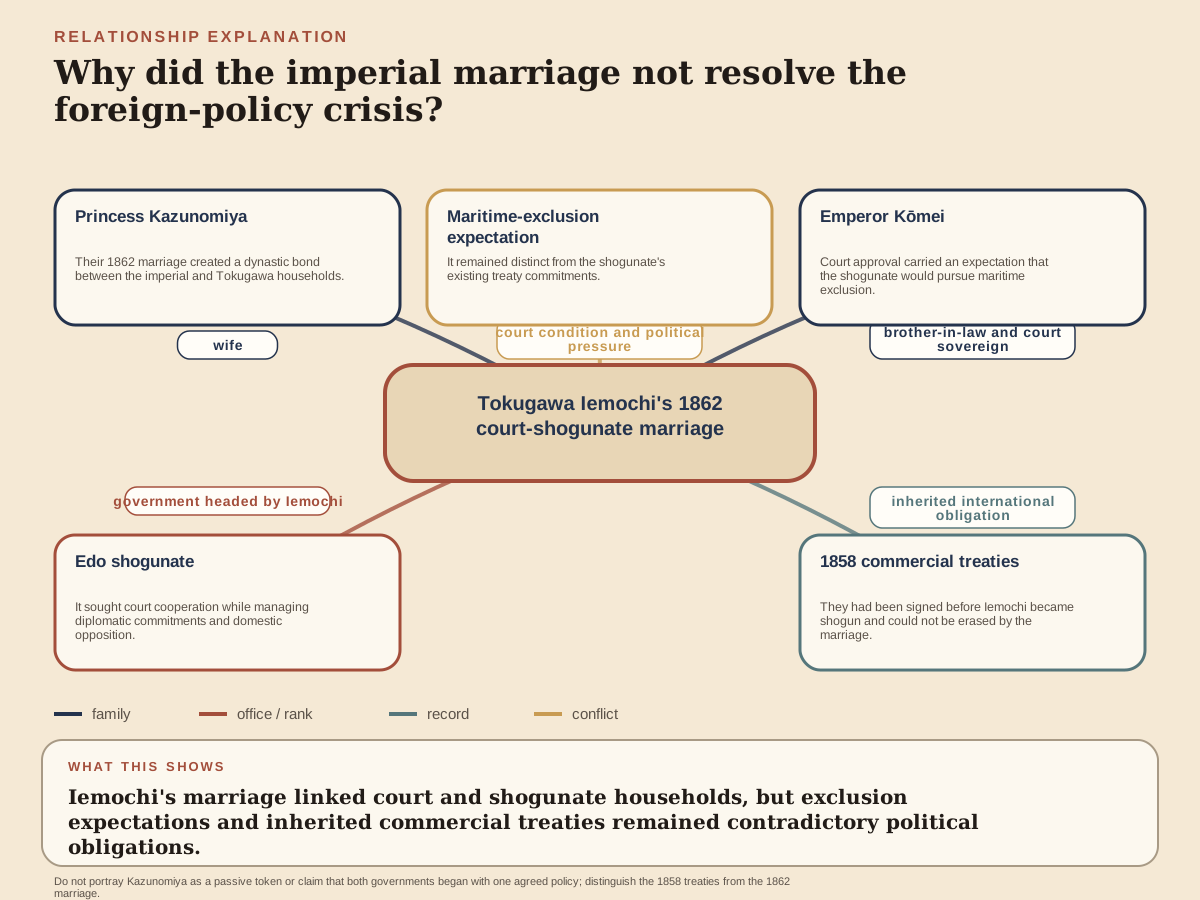
The bride was Kazunomiya, Emperor Kōmei’s younger sister. Kōbu gattai meant cooperation between the imperial court and warrior government; marriage would make Iemochi the emperor’s brother-in-law. Ii family letters report his wish to settle the match soon, though they convey it through intermediaries.
Kazunomiya’s previous betrothal to Prince Arisugawa Taruhito was broken. Kōmei’s approval depended on a pledge to move toward maritime exclusion. Edo accepted that promise despite its existing foreign treaties. [3][6]
Kazunomiya left Kyoto in the tenth month of 1861 by the Nakasendō, the inland post road to Edo. Her mother Kangyōin and court attendants accompanied her. Communities along the route supplied lodgings, transport and provisions. [3][6]
She reached Edo in the eleventh month, stayed at the Shimizu Tokugawa residence and entered Edo Castle in the twelfth. These are Japanese calendar months. Her attendants carried court practices into the Ōoku, where Iesada’s widow Tenshōin held senior standing. [3][6]
Titles and greetings could express the respect owed to the imperial and Tokugawa houses. Accounts indicate friction followed by accommodation, rather than a permanently hostile relationship. The wedding approached while the foreign-policy pledge remained unfulfilled.
Iemochi and Kazunomiya married on the eleventh day of the second month of Bunkyū 2, a Japanese calendar date in 1862. She became midaidokoro, the shogun’s principal wife. Letters, waka poems of thirty-one sound units, and gifts suggest consideration between them without making the politically arranged marriage voluntary from the start. [12][13]
Imperially backed reforms widened participation in government. Yoshinobu became the shogun’s guardian, Matsudaira Yoshinaga president of political affairs, and Katamori of Aizu Kyoto protector. Shimazu Hisamitsu of Satsuma, in southern Kyushu, helped press these changes. [6][14]
Relaxing alternate attendance reduced residence obligations for daimyo, or territorial warrior lords, in Edo. The reforms relieved domain burdens while weakening a means of keeping their households near the shogunate. Iemochi now governed among more competing advisers. [6]
In 1863 Iemochi traveled west by the Tōkaidō coastal post road and entered Nijō Castle in Kyoto. He was the first shogun to visit since Iemitsu in 1634. Emperor Kōmei wanted him to remain; Yoshinobu’s letter credits Tokugawa Yoshikatsu’s mediation in securing the continued stay. [10][13]
Iemochi joined the emperor’s prayers for expulsion at the Kamo shrines. He missed a planned Iwashimizu visit on grounds of illness. A later institutional description records a tradition of feigned illness and an intended presentation of an expulsion sword; that tradition does not establish his medical condition. [15]
He returned through Osaka using shogunal steam transport. His visit increased the expectation that the ruler would appear personally when court politics demanded it.
The shogunate announced the tenth day of the fifth month of Bunkyū 3 as an expulsion deadline in 1863. It was not Gregorian 10 May. Edo officials tried negotiation, including proposals to close Yokohama, the treaty port near Edo, rather than beginning a coordinated war against the treaty powers. [13]
Chōshū, in western Honshu, fired on ships at the Shimonoseki Strait. American and French retaliation followed; four powers attacked there together in 1864. The government faced consequences from domain action it could not securely control. [13]
Satsuma fought Britain at Kagoshima in 1863 over demands arising from a British merchant’s killing at Namamugi the previous year. It later expanded British procurement links. The two domains had followed different paths, exposing the limits of a single national deadline. [13]
Iemochi visited Kyoto again in 1864 but returned east before the palace fighting. Chōshū had been excluded from court influence in 1863. After security forces raided the Ikedaya inn in the sixth Japanese calendar month of 1864, its armed contingents advanced on the palace in the seventh. [13]
Aizu and Satsuma helped defend the gates, with Yoshinobu present. Iemochi was absent, although officers appointed by his government remained involved. Fire spread through Kyoto, destroying civilian homes and businesses beyond the fighting. [13]
The Kinmon conflict, also called the Hamaguri Gate Incident, led the court to order punishment of Chōshū. The shogunate would need separately governed domains to supply the expedition’s forces. [6][13]
The first expedition against Chōshū in 1864 was commanded by Tokugawa Yoshikatsu, former lord of Owari, a senior Tokugawa domain. Satsuma’s Saigō Takamori helped negotiate submission instead of a full invasion. [6]
A conservative government in Chōshū accepted demands including the suicide of three senior retainers. The domain survived, but the deaths made the settlement far from bloodless. Iemochi’s government accepted compliance obtained through military threat and bargaining. [6]
Activists led by Takasugi Shinsaku and their allies soon displaced that conservative faction. Military reorganization continued, and the new domain leadership would not remain bound by its predecessors’ submission. The shogunate prepared another expedition.
Iemochi left Edo on the sixteenth day of the fifth Japanese calendar month of 1865 and established himself at Osaka Castle. The renewed Chōshū campaign assembled slowly as domains questioned its cost and purpose. [7][13]
Four foreign powers sent ships into Osaka Bay to press treaty and port-opening questions. Kōmei sanctioned the existing treaties but withheld immediate approval for opening Hyōgo. Senior councillors associated with the decisions faced removal. [11][13]
In a copied memorial dated the second day of the tenth month, Iemochi pleaded weak health and offered to resign, cede the office to Yoshinobu and return to Edo. The emperor refused. This was an 1865 political proposal, not a deathbed will from 1866. Iemochi remained at headquarters. [11]
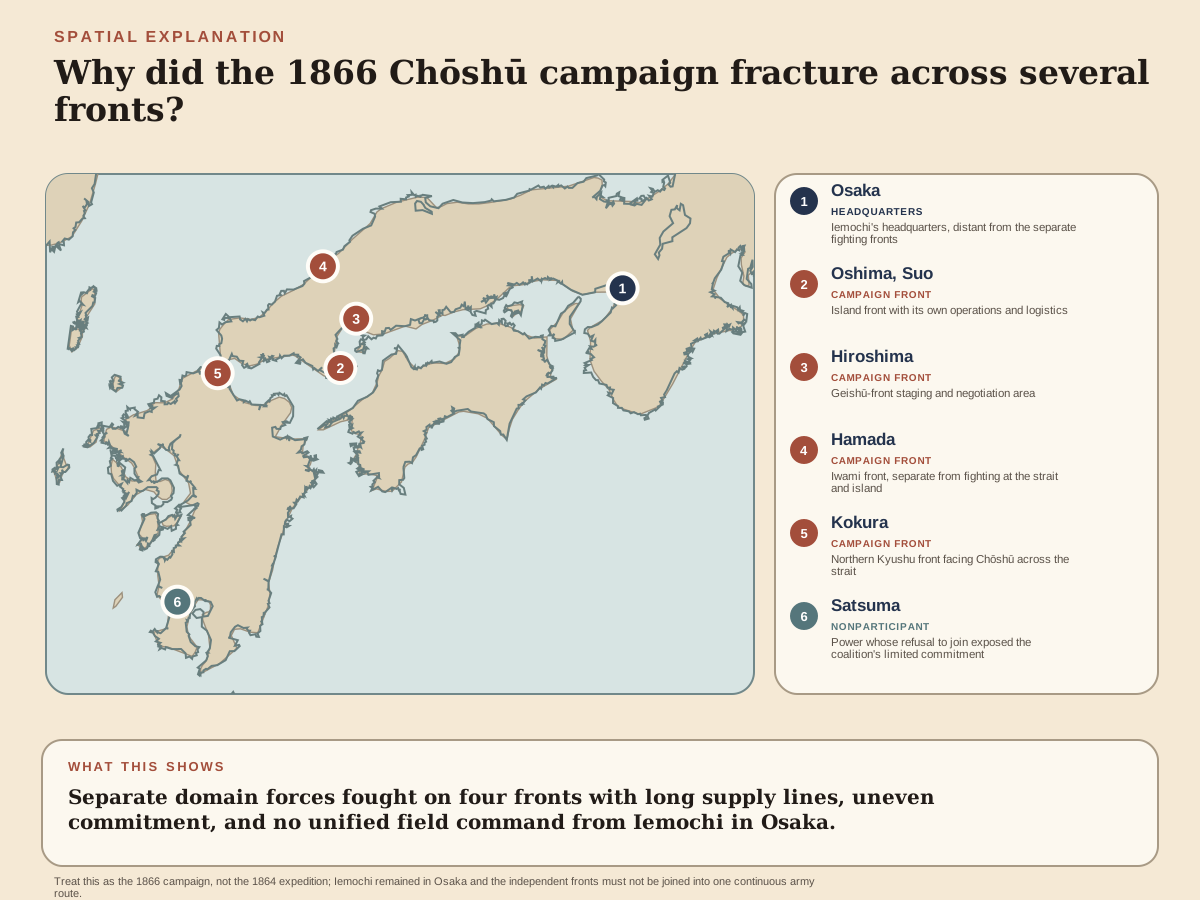
Fighting in 1866 spread across Ōshima, Geishū, Iwami and Kokura, different approaches to Chōshū. The domain’s reorganized forces resisted a coalition divided by command, provisioning and commitment. Satsuma refused cooperation. Iemochi remained ill at Osaka, not directing battlefield charges. [6][13]
Physicians offered differing diagnoses. Medical historian Okamoto Takuji assesses the fatal illness as beriberi affecting the heart; contemporary Western-trained doctors had suggested other conditions. Beriberi involves vitamin B1 deficiency, but the surviving evidence is not a complete clinical record. [5]
Iemochi died on the twentieth day of the seventh Japanese calendar month, commonly converted to 29 August 1866. He was twenty in modern years. Defeats had already weakened the expedition; his death added an unsettled succession.
Yoshinobu became Tokugawa house head and fifteenth shogun in 1866. Tayasu Kamenosuke, later Tokugawa Iesato, became the sixteenth house head in 1868 after the shogunate ended. These were different offices and different successions; Iesato was not a sixteenth shogun. [14]
Katsu Kaishū met Chōshū representative Hirosawa Saneomi at Daiganji temple on Miyajima on 10 October 1866. His diary describes agreement on withdrawal without pursuit or attack by Chōshū. [2][8]
Iemochi was buried at Zōjōji in Edo as Shōtokuin. Kazunomiya became Seikan’in and worked to protect Tokugawa interests during the 1868 transfer of power. She died in 1877 and wished to be buried beside him. Her political work and their correspondence kept widowhood from becoming only a romantic ending. [3][9]
Classic
Tokugawa Iemochi was born at the Kii Tokugawa house’s Edo residence on the twenty-fourth day of the intercalary fifth month of Kōka 3, usually converted to 17 July 1846. His childhood name was Kikuchiyo. Kii, centered on Wakayama in western Japan, belonged to the Gosanke: three great collateral Tokugawa houses eligible to supply an heir to the shoguns, the heads of Japan’s warrior government. [3][4]
His father, Nariyuki, had been the eleventh lord of Kii and a son of Shogun Ienari. He died before Kikuchiyo’s birth. The boy grew up with his mother, later known as Jitsujōin, and the household’s attendants. A small crystal puppy preserved as an infant’s toy gives a more tangible trace of that childhood. Its wrapping attributes it to the future Iemochi; it does not tell us when or how he played with it. [3][4]
In 1849 the death of Tokugawa Narikatsu made Kikuchiyo the thirteenth lord of Kii. He was four by the traditional Japanese count, which begins at one and adds a year at the New Year. A daimyo, or territorial warrior lord, owed duties to the shogunate while governing his own domain. For a child those duties necessarily passed through adults. Senior retainers prepared orders, managed finances and maintained communications between Wakayama and Edo. [4][6]
Mizuno Tadanaka was particularly influential. He belonged to a tsukegarō line, senior retainers with obligations connecting the Kii house and the shogunate. Matsudaira Yorisato and Andō Naohiro also helped administer the young lord’s affairs. Kii’s established offices and retainer households continued to work under his name. The boy possessed the rank and protection of a ruling house long before he could direct its government. [4][16]
In 1851 he underwent genpuku, the warrior elite’s coming-of-age ceremony, and took the name Yoshitomi, receiving the first character through Shogun Ieyoshi. He was about five in modern completed years. The ceremony gave him an adult-style name and formal place in audiences, rather than the experience of an adult ruler. [4]
By 1858 his ancestry had acquired an immediate political use. The shogun needed an heir, and Mizuno promoted the young Kii lord. The men who had governed around Yoshitomi could now help advance him beyond Kii. Their support made his family position an active candidacy, one among rival answers to a succession crisis.
In 1858 Shogun Iesada had no surviving son. Two candidates emerged for adoption into the ruling house. Yoshinobu, an adult descended from the Mito Tokugawa line, headed the Hitotsubashi branch. Yoshitomi was the twelve-year-old lord of Kii. Japan’s treaties with foreign powers made the choice more urgent: the next shogun would inherit a government already under pressure at home and abroad. [6][14]
Yoshinobu’s supporters included his father Tokugawa Nariaki, Matsudaira Yoshinaga and Shimazu Nariakira. They emphasized ability and maturity. Their coalition also sought a lasting voice for powerful lords beyond the shogunate’s narrow senior council. Choosing their candidate would therefore affect both the ruler and the people entitled to advise him.
Yoshitomi’s sponsors defended established lineage and the shogunal household’s right to choose its own heir. Mizuno Tadanaka and the Kii establishment had a direct interest in his advancement. Ii Naosuke’s appointment as tairō, the shogunate’s great elder with exceptional authority over the senior council, strengthened their position. Senior fudai officials—hereditary Tokugawa vassals—could expect to retain influence around a young ruler. [6]
Edo Castle’s household was involved as well. Iesada’s mother and his wife Tenshōin occupied influential positions in the Ōoku, the women’s residential and service quarters. Accounts assign them different roles in the succession. The evidence for particular private interventions is uneven; a simple claim that the women collectively chose Yoshitomi would conceal that uncertainty and the lobbying outside the castle.
Iesada formally adopted Yoshitomi and named him heir. Naosuke was central to securing the result, but adoption gave it the authority of the reigning shogun’s household decision. It was not merely an appointment made in Naosuke’s own name. Yoshitomi entered the main Tokugawa house, where his new position depended on the same officials who had helped obtain it. [6][13]
The defeated coalition remained politically important. Naosuke’s crackdown on opponents, the Ansei Purge of 1858–1859, made the settlement more bitter. Yoshitomi’s supporters had won the office for him; the opposition generated in winning it would outlast the minister who enforced their victory.
After Iesada’s death, Yoshitomi took the name Iemochi and became the fourteenth shogun in late 1858. He was twelve. Senior councillors managed government around him, and Naosuke controlled its principal political direction. Audiences and appointments proceeded through the young ruler while officials selected the business brought before him. [3][13]
The commercial treaty with the United States had already been signed on 29 July 1858. Iwase Tadanari and Inoue Kiyonao negotiated it under Naosuke’s authorization while Iesada was still shogun. Iemochi had not made that agreement, but his government now had to carry it out. Four further treaties extended similar commitments to other powers. [13]
Opening ports meant finding places for foreign residents and operating customs arrangements. Consular jurisdiction allowed foreign officials to judge their own nationals in many cases; treaty provisions also restricted Japan’s control over tariffs. Interpreters and port magistrates had to make these unfamiliar arrangements work. Critics who opposed them could petition or denounce the shogunate without separating the child ruler from the minister who had authorized the treaties.
Naosuke also directed the Ansei Purge. Political opponents were confined, removed from office or executed. Hashimoto Sanai and Yoshida Shōin were among those put to death. Investigations and punishments passed through councillors, magistrates and domain authorities. There is much less evidence of independent direction by Iemochi than of administration conducted around him during these first years. [13]
That distinction limits claims about his personal authorship without removing the consequences of the government he headed. Opposition accumulated against Tokugawa rule, and the shogun would have to answer it as he matured. The treaties did not expire when an official lost office, nor could a successor simply dismiss the grievances created by repression.
In 1860 the minister on whom this arrangement depended was killed close to Edo Castle. The administration continued, but Iemochi’s government needed another way to bring its policies and its opponents into an accommodation. Its answer would involve his own marriage.
On 24 March 1860, the third day of the third month in the contemporary Japanese calendar, former Mito samurai and one former Satsuma samurai killed Ii Naosuke outside the Sakuradamon gate of Edo Castle. Officials temporarily represented the dead minister as ill while the Ii family arranged its succession. Hikone, his domain, could thereby avoid the legal danger of losing its lord without an accepted heir. [13]
No new tairō immediately took his place. Senior councillors Andō Nobumasa and Kuze Hirochika became leading figures. They inherited the foreign treaties and the enemies of the purge, but they could seek a broader domestic coalition. An imperial marriage offered a connection that appointments alone could not supply. [1]
Emperor Kōmei’s younger sister Kazunomiya was the proposed bride. If she married Iemochi, the shogun would become the emperor’s brother-in-law. This was kōbu gattai, cooperation between the imperial court and warrior government, pursued through kinship. Edo’s ministers hoped the match would reinforce shogunal authority. Kōmei expected it to secure a change in foreign policy.
The plan had begun before Naosuke’s death. Letters described in the University of Tokyo Historiographical Institute’s publication of the Ii family papers trace negotiations in February 1860. They also report that Iemochi wanted the match decided soon. That is a wish conveyed through intermediaries, not an autograph account of his feelings. His reported interest did not determine the terms that court and shogunal negotiators would accept. [1]
Kazunomiya had already been betrothed to Prince Arisugawa Taruhito. The new arrangement broke that earlier commitment. Her reluctance and the interests of both imperial households had to be overcome through court negotiation. Kōmei’s approval was conditional on the shogunate moving toward restoration of maritime exclusion. Edo accepted a promise whose fulfillment would require dealing with foreign powers already protected by treaties. [3][6]
In 1861 Kazunomiya received the formal status of naishinnō, an imperial princess, and the personal name Chikako. Her title and the court attendants who would accompany her protected a visible imperial identity within the warrior household. The political agreement had brought the marriage closer, while leaving unresolved what the government could actually do about foreign access.
Kazunomiya departed Kyoto in the tenth month of Bunkyū 1, or 1861. She traveled by the Nakasendō, the inland post road linking Kyoto and Edo. Her mother Kangyōin and court attendants accompanied her. Their movement required prepared lodgings, transport and food along the road; post towns and nearby communities supplied labor and materials for decisions made far above them. [3][6]
The procession carried court practices into a different household. Attendants knew how the princess was to be addressed and served, and they maintained communications with Kyoto. Their presence would continue after the road journey ended. Kazunomiya’s arrival was therefore not simply the transfer of a bride into surroundings arranged entirely by her husband.
She reached Edo in the eleventh month and stayed first at the Shimizu Tokugawa residence. In the twelfth month she entered Edo Castle. These stages allowed preparations for her incorporation into the Ōoku. They also preserved the distinction between her imperial origin and her future position as the shogun’s principal wife.
Tenshōin, the widow of Iesada, held senior standing in the castle household. Kazunomiya brought claims to imperial precedence. Customs governing dress, greetings and forms of address could become disputes about the respect owed to their houses. Surviving accounts indicate friction and later accommodation; they do not justify a fixed picture of permanent hostility or effortless harmony. [3][6]
Iemochi’s marriage was approaching, but he was not the sole manager of these arrangements. Senior women and officials controlled access and ceremony within the Ōoku. His treatment of Kazunomiya would develop within a household whose practices neither adolescent could simply replace.
The journey had succeeded in its immediate purpose. The emperor’s sister was now in the shogunal castle, ready for a wedding. The pledge concerning foreign policy still awaited fulfillment. Completing the procession did not determine how the court and government would resolve that larger obligation. [6]
The wedding took place on the eleventh day of the second month of Bunkyū 2. This was a date in the Japanese calendar, not 11 February in the Gregorian calendar. Kazunomiya became the midaidokoro, the shogun’s principal wife, while retaining the importance of her imperial birth within the castle household. [12][13]
Letters, waka poems and hair ornaments preserved or described in museum collections offer traces of consideration between the couple. Waka is a classical Japanese poetic form of thirty-one sound units. When Iemochi traveled, Kazunomiya arranged prayers at Hikawa Shrine and repeatedly prayed before the Black Amida, a Buddhist image at Zōjōji. These acts support attachment without revealing every private feeling or cancelling her earlier reluctance to marry.
Outside the castle, Shimazu Hisamitsu brought Satsuma influence and imperially backed reform demands to Edo. Satsuma was a powerful domain in southern Kyushu. The reforms of 1862 restored men excluded during the succession struggle to positions around Iemochi. Yoshinobu became shōgun kōken, guardian or supporter of the shogun he had once hoped to replace.
Matsudaira Yoshinaga became president of political affairs. Matsudaira Katamori of Aizu, a domain in northeastern Japan, was appointed Kyoto protector, responsible for security in the imperial capital. These offices widened participation in government while dividing initiative among the court, major domains and Tokugawa leaders. [6][14]
Alternate attendance was also relaxed. Under the older system, daimyo spent alternating periods in Edo and their domains, with wives and heirs generally kept at the capital. Reducing residence requirements relieved domain burdens but weakened an established way of keeping ruling households near the shogunate. [6]
Reports in the Ii family papers suggest that Iemochi took an interest in personnel decisions, including Yoshinobu’s appointment in connection with naval defense. They are mediated reports rather than proof that he devised the reforms alone. He was gaining a part in government, although the new offices made authority more widely shared. To work with the emperor and his advisers, he would next have to go to Kyoto himself.
Iemochi left Edo in the second month of Bunkyū 3 and traveled west by the Tōkaidō, the coastal post road. He reached Kyoto in the third month and entered Nijō Castle, the Tokugawa residence there. No shogun had visited the city since Iemitsu in 1634. Iemitsu had displayed an established ascendancy; Iemochi came because imperial politics now demanded a presence that letters from Edo could not provide. [13]
The length of his stay became a matter of negotiation. Emperor Kōmei indicated that an early departure would leave him insecure. A letter dated the twentieth day of the third month from Yoshinobu to Tokugawa Yoshikatsu, the former lord of Owari, credits Yoshikatsu’s intervention in securing the audience and continued stay. It preserves the work of another Tokugawa leader behind the shogun’s public appearance. [10]
Iemochi accompanied Kōmei to the Kamo shrines for prayers associated with the expulsion of foreigners. A commission held through the emperor’s title was now visible in a procession: the court expected the shogun to carry its purpose into policy. Ritual brought the two men together without deciding what would happen if their advisers disagreed.
Iemochi did not attend a planned visit to Iwashimizu shrine, on grounds of illness. A National Museum of Japanese History description also records a tradition that activists intended to present him with a sword for expulsion and that the illness was feigned. The official reason and the later interpretation should remain distinguishable. Neither this description nor a ceremonial guide supplies a secure diagnosis. [15]
Kyoto contained armed domain retainers and rival political groups as well as the imperial household. Aizu’s protectorate had to police a city in which violence could change court alignments. Iemochi’s visit increased his visibility there, while security continued to depend on officials and forces with their own loyalties.
He returned through Osaka, using the shogunate’s steam transport, including Jundōmaru. Foreign-derived technology served a government under pressure to exclude foreigners. His first visit had also established that the emperor could ask for his presence in person. Two further journeys west would follow during the remaining three years of his life.
Iemochi’s government announced the tenth day of the fifth month of Bunkyū 3 as the deadline for expelling foreigners. It was a Japanese calendar date, not Gregorian 10 May. Kōmei expected action consistent with the pledge attached to Kazunomiya’s marriage. The shogunate, meanwhile, had treaties with five powers and no unified force capable of beginning a national war against them. [13]
Edo officials pursued negotiations, including the possibility of closing Yokohama, the treaty port near the capital. Foreign rights and the port’s commercial importance made even this narrower proposal difficult. A domestic proclamation could not by itself dissolve the agreements or make foreign representatives accept closure.
Chōshū, a domain in western Honshu, acted more directly. Its batteries at the Shimonoseki Strait fired on foreign shipping. The strait was a strategic passage at the western end of Japan’s main island. American and French retaliation followed; in 1864 a combined British, French, Dutch and American force would attack the positions there. [13]
The shogunate had transmitted a deadline but had not personally directed Chōshū’s guns. It now had to face foreign demands arising from action by a domain whose policy it could not securely control. Chōshū could claim loyalty to the emperor while exposing the government to military and diplomatic consequences.
Satsuma’s war with Britain in 1863 had a different beginning. In 1862 a British merchant was killed at Namamugi after foreign riders encountered Hisamitsu’s procession. Disputes over responsibility and compensation led British ships to Kagoshima, where fighting followed. The encounter did not end in permanent exclusion: Satsuma subsequently expanded procurement through British connections. [13]
These different responses made the deadline a test of authority. The court could complain of Edo’s delay, foreign powers could demand protection, and Chōshū could claim to have acted when the shogunate would not. Iemochi’s participation in the court relationship had made the promise his government’s obligation, without giving him the means to make all domains carry it out in the same way.
Iemochi returned to Kyoto in 1864, but went east again before the year’s fighting at the imperial palace. The Kyoto protectorate remained under Katamori, while Yoshinobu and armed domain contingents worked within overlapping responsibilities for the capital’s security. [13]
Chōshū had lost its court position in the political change of the eighth month of 1863. Its leaders did not accept the exclusion as final. Some pressed for restoration through petitions; others supported an armed approach. These divisions matter because the domain did not enter the crisis with one settled purpose shared by all its members.
In the sixth month of 1864, security forces raided a meeting at the Ikedaya inn. Deaths and arrests strengthened the case for an advance among Chōshū activists. Their forces approached the palace in the seventh month, presenting their movement as an appeal to the emperor and an attempt to remove hostile officials. Kōmei had not authorized their armed entry. [13]
Fighting developed at the palace gates. Aizu and Satsuma forces helped defend them, and Yoshinobu was present. Iemochi was absent. The defenders nevertheless included officers appointed under his government, and the punishment that followed would be authorized through the shogunate.
The defenders held the palace, but fire spread into Kyoto’s densely built neighborhoods. Residents lost homes, shops and stored goods far beyond the immediate fighting. The Kinmon conflict, often called the Hamaguri Gate Incident after one of the gates, was also an urban disaster. Victory for the defenders did not make its costs confined to defeated soldiers. [13]
The court ordered Chōshū punished. That gave the shogunate a claim to act in defense of the emperor after a year in which its foreign policy had been attacked in his name. Carrying out the order would require troops from separately governed domains. Iemochi’s approval could launch a campaign; its commanders would still have to make that coalition work. [6][13]
The shogunate mobilized a large domain coalition to punish Chōshū after the fighting at Kyoto. Tokugawa Yoshikatsu, the former lord of Owari, became overall commander. Owari was another of the three senior Tokugawa houses. His position gave the expedition a close connection to the ruling family without putting Iemochi in field command. [6]
Domain participation carried different aims. Satsuma had helped defend the palace, but its leadership did not necessarily want Chōshū destroyed or occupied. Saigō Takamori, acting for Satsuma, helped negotiate a submission. His role made the campaign’s result depend on the judgment of a domain official as well as on orders from Edo.
Within Chōshū, defeat at Kyoto had weakened the activists. A conservative government offered compliance to prevent invasion. It accepted responsibility for the palace expedition and the demand that three senior retainers die by suicide. Those deaths imposed a real cost on selected men and their families; avoiding a full invasion did not make the settlement bloodless. [6]
The expedition’s leaders obtained conditions that allowed the domain to survive. Chōshū retained its institutions rather than being abolished or placed under a complete military occupation. The shogunate could claim submission to an imperially sanctioned order while sparing its coalition a larger war.
Iemochi’s government accepted that result. It had demonstrated the capacity to assemble a threatening force, though bargaining had shaped the terms. Because the troops had not fought a full campaign together, their ability to remain united under battlefield pressure was still uncertain.
The submission soon lost its practical foundation. Activists led by Takasugi Shinsaku and their allies displaced the conservative faction inside Chōshū. Reorganization and military reform continued under a government unwilling to remain bound by the defeated faction’s choices. Edo prepared renewed punishment. A first expedition that had avoided major invasion now became the prelude to a second.
Iemochi departed Edo on the sixteenth day of the fifth month of Keiō 1, or 1865, while the government renewed preparations against Chōshū. Osaka Castle became his residence and the campaign’s headquarters. It linked western roads and maritime transport with communications to Kyoto, but placing the shogun there did not turn him into a battlefield commander. [7][13]
The mobilization took months. Domains questioned the expense and purpose of another war, and Satsuma increasingly opposed it. Men and supplies remained under domain control. The government could issue deployment orders more readily than it could secure a common commitment to fighting.
A surviving official diary records the shogun’s movements and the daily business of his Osaka stay. It also records changing passwords from the day after his departure. The National Archives notes that their particular purpose remains unclear. They are a trace of the arrangements around a traveling headquarters, not proof of a specific threat or of Iemochi’s personal design.
In the autumn, ships from Britain, France, the Netherlands and the United States pressed for imperial recognition of the treaties and resolution of port-opening questions. Their presence in Osaka Bay brought diplomatic pressure close to Kyoto. Hyōgo, near Osaka, was particularly contentious. Kōmei sanctioned the existing treaties but withheld approval for opening it immediately. [11][13]
The dispute also put senior councillors Abe Masato and Matsumae Takahiro at risk of removal. In a memorial copied among contemporary political information, dated the second day of the tenth month, Iemochi pleaded weak health and offered to resign, hand the office to Yoshinobu and return to Edo. This was an 1865 proposal during a political confrontation, not a deathbed instruction from 1866. [11]
Kōmei did not accept the resignation. Iemochi remained in Osaka and the expedition continued to be prepared. The offer made his own tenure part of the negotiation: ministers and court advisers had to consider what their demands meant for the government’s ability to act. By this point he could do more than lend his name to decisions made around a child, although he still depended on councillors and domain cooperation.
Major fighting against Chōshū began in the summer of 1866. The invading coalition fought on four principal fronts: Ōshima Island, the Geishū border, Iwami and Kokura. These lay on different approaches to the domain, with Kokura across the strait in northern Kyushu. A single order for punishment had produced several operational campaigns. [13]
Chōshū had improved its organization and firearms during the interval since the first expedition. Its units could concentrate locally in defense of the domain. The shogunate’s contingents answered to separate officers and governments, and their provisioning crossed longer distances. Satsuma’s refusal to cooperate further weakened the coalition. Better weapons mattered, but differences in commitment and command help explain why numerical resources did not secure victory. [6][13]
Iemochi stayed at Osaka Castle. His presence supported the campaign’s headquarters while illness increasingly limited participation. He was not directing charges on the four fronts. As defeats accumulated, the government’s ability to compel obedience was being tested far from the ruler whose name authorized the operation.
Physicians did not agree about his condition. In a 2013 medical-history discussion, Okamoto Takuji describes Japanese practitioners diagnosing kakke, or beriberi, while Western-trained doctors offered rheumatic, gastrointestinal and cardiac diagnoses. Okamoto identifies the fatal condition as beriberi affecting the heart. Beriberi is associated with vitamin B1 deficiency, but this retrospective assessment is not a complete clinical record. [5]
Stories about Iemochi’s taste for refined foods or sweets cannot establish his whole diet or a single cause of death. A retrospective diagnosis can weigh the surviving medical descriptions, but it cannot recover every symptom and treatment during his final illness.
Iemochi died on the twentieth day of the seventh month of Keiō 2, commonly converted to 29 August 1866. He was twenty in modern completed years and twenty-one by the traditional count. The coalition had already suffered reverses. His death added a succession crisis before the campaign was settled, leaving the end of the war to officials negotiating without the living shogun at headquarters.
Officials controlled the announcement of Iemochi’s death while troops were still deployed and the succession was unsettled. Yoshinobu became head of the Tokugawa house and then the fifteenth shogun in 1866. He had been Iemochi’s rival in 1858 and later his guardian. The office passed to an adult already deeply involved in the government’s affairs. [14]
That succession should not be confused with the later headship of Tayasu Kamenosuke. The child took the name Tokugawa Iesato and became the sixteenth head of the Tokugawa house in 1868, after the shogunate had ended. He was not a sixteenth shogun. The survival of the family and the continuation of the warrior government had become separate questions. [14]
The government also had to end the campaign. Katsu Kaishū, a naval official and negotiator, met Chōshū representative Hirosawa Saneomi at Daiganji temple on Miyajima. Katsu’s diary dates the meeting to the second day of the ninth month, corresponding to 10 October 1866. The agreement concerned withdrawal without pursuit or attack by Chōshū. It was worked out by living intermediaries, not delivered as Iemochi’s final command. [2][8]
Iemochi’s remains were taken east and buried at Zōjōji, the Tokugawa family temple in Edo, under the Buddhist name Shōtokuin. Kazunomiya took the religious name Seikan’in. During the transfer of power in 1868 she used her imperial and Tokugawa connections to help protect the house and people within it. Widowhood did not remove her from political affairs. [3][9]
She died in 1877 and wished to be buried beside him at Zōjōji. Their burial association and surviving correspondence preserved a personal dimension of the marriage made for national policy. The present cemetery reflects later reburial, so its appearance should not be assumed to reproduce the original nineteenth-century arrangement.
Iemochi’s eight years as shogun had moved him from a child supported by officials to a young ruler repeatedly required in Kyoto and Osaka. His participation grew while the government’s command over domains diminished. The person became more active at the same time that the office became harder to sustain.