HO Guides
Mibu and Ikedaya: A Police Force in Other People's Houses
How a neighborhood accommodated the Shinsengumi—and how the use of domestic space changed when lodging became armed service.
Quick · About 2 min
The story in five points
A short route through the argument. Follow a point into Classic for its context and sources.
The headquarters began in existing households
Yagi and Maekawa properties belonged to an established Mibu community before the Shinsengumi. Officials used existing intermediaries and accommodation; rooms, gates and local obligations made an armed organization’s arrival possible without first constructing a separate barracks.
Read in contextSponsorship turned lodging into sustained service
After most Rōshigumi returned east, Kondō’s associates sought Aizu patronage and remained. Kondō described protecting court and shogun as compatible duties, showing why imperial loyalist language alone cannot distinguish his group from every opponent it pursued.
Read in contextOccupation had costs and practical requirements
The Maekawa custodial account describes household displacement and defensive alterations. Gates helped observe and summon dispersed men, while Mibu-dera supplied training space: official sponsorship depended on domestic and religious premises whose existing users bore consequences.
Read in contextIkedaya joined detention to armed intervention
Furutaka’s arrest and interrogation preceded the raid on men gathered at Ikedaya. Accounts differ over the gathering’s purpose; a history of policing must distinguish the deadly intervention from allegations used to justify targeting the meeting.
Read in contextLocal custodians inherited a longer responsibility
The corps moved away in 1865, but houses, graves and memories remained. Ikedaya survives through a later marker rather than original rooms, while Mibu’s different memorials coexist with a continuing temple and the work of assessing the organization’s conduct.
Read in context
Opening
The Yagi house was already more than half a century old when the men associated with the Shinsengumi arrived. Its main residence dates to 1809; its street gate is older still, built in 1804. Those dates come from construction applications preserved by the household. The building was made for a family, not for the organization that would make its address famous.[1]
That earlier life is an essential part of the story. In Mibu, on the edge of nineteenth-century Kyoto, an armed corps established itself in houses and used nearby temple grounds. Elsewhere in the city, its members attacked a gathering at the Ikedaya inn in 1864. The surviving residences and the vanished inn belong to separate clusters, connected by the corps' work rather than by one enclosing wall.[2][10][13]
Following that connection raises a question larger than which room a celebrated swordsman occupied. How did men initially assembled for a temporary mission acquire the means to remain, mobilize, and intervene in other people's premises? At Mibu, the answer begins with household resources and official sponsorship. At Ikedaya, it reaches the contested purposes for which that capacity was used.
1. The neighborhood was already organized
Mibu was then a village adjoining the built-up capital. The Yagi were an established local family with responsibilities extending beyond their own gate. Their family history places them among the gōshi, local warrior-status households involved in village affairs and the organization of Mibu's religious performances. Arriving outsiders therefore encountered a community with its own offices, obligations, and custodians, rather than an empty margin of Kyoto.[3]
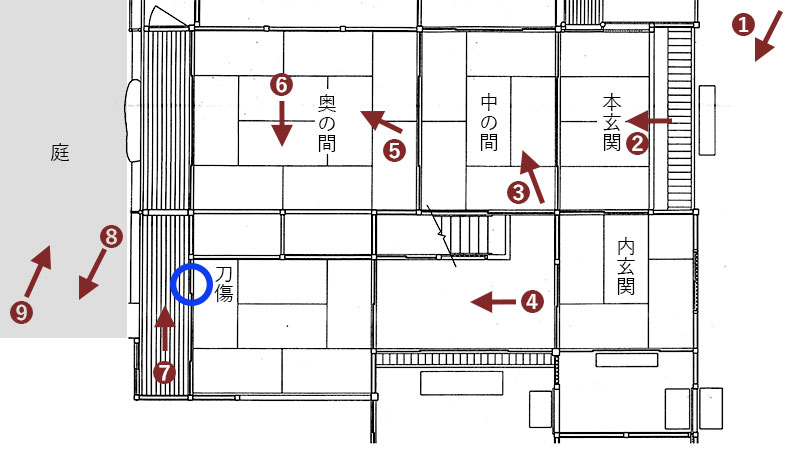
The Yagi residence still gives a compact sense of that standing. Behind its east-facing gate, the house faces south. A passage with an earthen floor runs beside the rooms; a separate formal entrance leads toward the more ceremonious part of the dwelling. This was a household equipped to receive people as well as accommodate private life.[1] Reusing it meant inheriting arrangements already made for circulation, reception, and residence.
A neighboring household supplied another link to government. According to the former Maekawa residence's history, the principal Maekawa family elsewhere in Kyoto worked as financial agents handling funds for court and shogunal institutions. Officials entrusted them with finding accommodation for the incoming corps. They offered a relative's large Mibu property, whose position near the city and Nijō Castle suited the assignment.[4]
Here the connection between official authority and private property was quite specific. The government did not first build a headquarters and then recruit a neighborhood around it. An existing intermediary identified existing accommodation. The relative's house became usable for an official purpose through a relationship that preceded the arriving men.
This also changes the meaning of “headquarters.” The early establishment was spread among separate properties. A large house could supply rooms, but no one doorway contained the whole organization. The task of turning lodged men into a working force still remained. Finding somewhere to sleep was only the beginning of deciding who could order them to stay and what they would do there.
2. Permission to remain
The men had come to Kyoto in 1863 with the Rōshigumi, a corps recruited in connection with Shogun Tokugawa Iemochi's visit. The shogun headed the military government based in Edo, while the emperor and imperial court remained in Kyoto. Disputes over foreign relations and political authority had made security in the court city an increasingly urgent concern. Kondō Isami and several of his associates came from the network of a swordsmanship school, rather than from a single established Kyoto office.[5]
The recruitment did not produce a durable organization all at once. When most of the Rōshigumi returned east, Kondō and others remained. They sought service under Matsudaira Katamori, lord of the Aizu domain and holder of the Kyoto security office known as Kyoto shugoshoku. A domain was a territory governed by a regional lord; Katamori's Kyoto appointment gave that particular lord responsibilities beyond his own territory.[5]
Kondō's account of his purpose is more revealing than a retrospective label of “pro-shogun.” In statements and a petition preserved among his writings, he presented the protection of the imperial court and the shogun as a common duty. He also invoked reverence for the emperor and resistance to foreign encroachment—the language of sonnō jōi, often encountered in accounts of his opponents. His enemies, as he described them, were men whose professions of loyalty concealed attacks on Tokugawa authority.[6]
Those were Kondō's political judgments, not neutral findings about everyone he opposed. They explain why competing activists could employ similar language while pursuing incompatible actions. The line between the groups did not divide people who acknowledged the emperor from people who had never considered him important. It concerned who was authorized to protect the existing relationship between court and government, and who threatened it.
Aizu's patronage gave the men who stayed a recognized place within Kyoto's security arrangements. The corps acquired the name Shinsengumi during that year's political upheaval.[5] Neither sponsorship nor a name, however, created new buildings. Their practical base continued to depend on the neighborhood that had accommodated their arrival. An official relationship above them sustained an increasingly consequential occupation below.
3. A guest establishment becomes a base
For the people already living in Mibu, the change could be substantial. The Maekawa property's custodial history states that, as the residence became a full headquarters under Aizu sponsorship, the resident family had to move to the principal family's premises elsewhere in Kyoto. The same account describes replacing wooden boundary fences with earthen walls.[4] Accommodation was becoming something more permanent and more defensive than a spare room lent to travelers.
The house's threshold was altered too. Its architectural interpretation identifies an additional projecting lattice window on the east side of the gate, installed after the corps arrived and subsequently removed. It also preserves a tradition that wooden clappers were sounded from a corner of the gate to summon men lodged around Mibu.[7] One change served observation; the other account describes assembly across a dispersed establishment.
Taken together, these details suggest how a residential neighborhood could function without becoming a single barracks enclosure. Men did not have to share one roof to respond as a group. What they required was a means of gathering, a place of command, and premises capable of supporting repeated occupation. A gate already connecting house and street could acquire additional work as a lookout and a point of summons.
The burden and the benefit belonged to different relationships. Aizu obtained the service of an armed corps; the corps obtained a base; a household, according to the property's account, lost the everyday use of its home. This one case cannot stand for every resident's experience. It does show why an account of official sponsorship alone leaves out something important: authorization did not make accommodation costless for the people providing it.
Nor did all the necessary activity fit indoors. Mibu-dera records that its grounds were used for martial and artillery training.[8] The temple supplied space of a different kind from a domestic room. Looking at house, gate, street, and temple together reveals a division of functions. The military establishment was made by joining those spaces, not by redesignating every part of Mibu as the property of the Shinsengumi.
4. Staying was not the same as agreeing
The arrangement could constrain the men serving within it as well as their hosts. In a letter of 1864, Kondō described his dissatisfaction with senior shogunal officials. He complained about unresolved questions and ineffective responses, and reported asking that his group be allowed to disperse. The answer, in his account, was that Kyoto's defenses were still too thin: they were asked to continue until stronger arrangements were in place.[9]
The request is striking because it belongs to the period before Ikedaya made the corps more widely known. Its continued presence was not simply the unfolding of a settled plan. Kondō could criticize the government he served and seek an end to the assignment, yet find that the need for his group's local service outweighed his proposal to leave. The letter records his understanding of that exchange; it does not give us the officials' complete deliberations.
Returning to Mibu after reading it, the houses look less like an inevitable birthplace preserved for posterity. They were the premises of a contingent arrangement that had continued. What had begun as accommodation for arrivals now supported a force whose departure was a matter for officials to discuss. The passage from volunteer gathering to sustained service can be traced through that difference.
Sponsorship also did not make the corps internally peaceful. In another early letter, Kondō reported the killing of a fellow member and the imposition of ritual suicide on another. He presented punishment within the group as part of maintaining its purpose.[6] This is direct evidence of how he described coercion among comrades, without requiring the later catalogue of lurid stories attached to individual rooms.
Mibu retains a particular reminder of that internal violence. Serizawa Kamo, an early leader, and his associate Hirayama Gorō were killed at the Yagi residence in 1863; their graves are among those identified at Mibu-dera.[8] The neighborhood housed not only departures on patrol but conflicts within the force itself. Its domestic scale brings the consequences close: the same kind of room that made lodging possible could also enclose violence between the lodgers.
5. From a detained man to a gathering at Ikedaya
The connection to Ikedaya began with an arrest. In 1864 the Shinsengumi detained Furutaka Shuntarō, an activist operating in Kyoto. The former Maekawa property's interpretation associates his interrogation with its storehouse. Later accounts made the treatment of Furutaka, and what he allegedly disclosed, central to the explanation of the raid that followed.[11]
The basic sequence leads from premises controlled by the corps to an inn elsewhere in the city. On the fifth day of the sixth month in the Japanese calendar, Shinsengumi members attacked men gathered at Ikedaya near Sanjō. Among those killed were Miyabe Teizō of Higo and Yoshida Toshimaro of Chōshū, representatives of the political opposition the corps was pursuing. Others were arrested.[10]
Exactly how to characterize the gathering requires more care. Historian Ikeda Yoshimasa's encyclopedia account describes it as a meeting to consider what to do after Furutaka's arrest. Other reference works emphasize plans for an uprising or attacks on leading figures. The Yamakawa historical dictionary explicitly presents the raid as undertaken on the allegation that opponents planned arson and assassinations.[10] These explanations should not be compressed into one fully demonstrated plan to burn Kyoto and abduct the emperor.
The distinction affects the story's direction. A rescue narrative begins with a city already destined for destruction and makes the attackers its necessary saviors. A history of policing instead has to follow how information was obtained, how danger was represented, and how a gathering became a target. It can establish the intervention and its deadly consequences without accepting every claim used to justify it.
Mibu and Ikedaya thus belong together for more than biographical reasons. The former supplied a base where a prisoner could be held and questioned; the latter was a meeting place entered by the force operating from that base. Political activity and its suppression both occupied ordinary kinds of premises. The difference was not visible in a building type. A house or inn became implicated through the people using it, the authorities pursuing them, and the decisions made about what their presence meant.
6. An incident travels farther than its participants
The raid made the Shinsengumi much better known. One indication of how the news moved survives in the documentary trail of a letter sent under Kondō's name to his adoptive father and other recipients. Kodaira's library exhibition identifies a copy dated three days after the encounter. Its account traces the report into the hands of an Edo information dealer, Fujiokaya, where it apparently circulated commercially.[12]
A communication to familiar readers could acquire a public life beyond the writer's immediate circle. That helps explain how an action inside one Kyoto inn became part of a reputation elsewhere. The report was an account from the force involved, however; wider circulation did not turn it into an independent investigation of the opponents' plans.
At the site itself, survival took a different form. Kyoto City's marker record identifies the Ikedaya location with a stone erected in 1927 by the Kyoto City Education Association. The original inn is gone.[13] There is no complete historical room in which to follow the confrontation from one participant's position to another's. The stone establishes an address of remembrance; it cannot settle disputed movements inside a vanished building.
Mibu retained more architecture, but the organization left its first establishment and moved to Nishihongwanji in 1865.[4] The neighborhood did not travel with it. Houses ceased to serve the same military function, while graves and remembered encounters remained attached to local ground. The duration of the corps' stay and the duration of the locality's responsibility for its remains were becoming very different things.
This uneven survival is why the two clusters should not be forced into the form of a single preserved compound. The surviving houses explain accommodation and adaptation. The Ikedaya marker locates an intervention whose rooms cannot be recovered by walking into a neighboring business. The relationship has to be reconstructed historically, not supplied by treating every present doorway as part of the same scene.
7. The neighbors inherit the history
At Mibu-dera, military memory now shares space with a continuing Buddhist institution. The temple's main hall was rebuilt after the fire of 1962 and dedicated in 1970. Its performance hall, by contrast, dates to 1856. These buildings belong to different phases of a religious life that cannot be reduced to the corps' brief residence nearby.[14]
The memorial area also contains several kinds of time. Kondō's bust was erected in 1971 through the actor Ueda Kichijirō; the adjacent tower commemorates hair associated with Kondō, not the burial of his whole body. A separate monument was erected by a Shinsengumi enthusiasts' association in 1995. Older graves, a twentieth-century portrait, and organized admiration occupy the same small precinct.[8]
Their coexistence does not require a single judgment on the men remembered. Mourning the dead, preserving a house, and assessing an armed organization's conduct are different activities. A grave can remain an object of care without making every explanation offered by the deceased historically conclusive. Equally, uncertainty about a famous story does not remove the household's documented role in accommodating the corps.
The Yagi and Maekawa properties make that role unusually tangible. They preserve the scale of the resources on which the early establishment depended: rooms already built, boundaries already established, local families already connected to officials. Their adaptation allowed men with a political mission to become a continuing presence in the city. At Ikedaya, that presence crossed another household's threshold in an act of armed intervention.
What remains is therefore more demanding than a collection of famous men's addresses. It is a history of how public force entered private space: first through arrangements for lodging, then through sponsorship and sustained occupation, and finally through the ability to pursue people into other premises. When the corps moved on, local custodians were left with the buildings, the dead, and the work of deciding how those brief and consequential years would be remembered.
Next topic · HO Guides
Toba–Fushimi: When the Road to Kyoto Became a Front Line
Crossings, occupied buildings, and competing orders in the fighting that opened the Boshin War.
Continue readingSources and NotesView sourcesHide sources
Materials were consulted on 16 September 2026. Japanese calendar dates are identified as such; the sixth-month date of Ikedaya is not presented as a Western June date. Contemporary writings are used through the specified transcriptions and excerpts, not an asserted inspection of autographs. Custodial histories are attributed where they carry detailed accounts of household experience. No current opening hours, prices, or unrestricted interior access are promised.
- [1]
Yagi residence, 「新選組 壬生屯所旧跡」, Kyoto City designated-property description, paragraphs beginning 「建物は」 and 「壬生地区は」. https://www.mibu-yagike.jp/tonsho/index.html . It identifies construction applications for the 1804 gate and Bunka 6 (1809) main residence, their orientations, entrances, and room arrangement. The linked modern visitor plan: https://www.mibu-yagike.jp/tonsho/img/heimenzu.jpg . Its numbered visitor route and marked sword scar are not treated as a documented 1863 movement sequence or independently authenticated forensic evidence.
Return to the reference ↑ - [2]
Kyoto City Historical Museum, stone-marker record NA070, 「新選組遺蹟」, introduction and monument fields. https://www2.city.kyoto.lg.jp/somu/rekishi/fm/ishibumi/html/na070.html . Used for the 1863 Rōshigumi arrival, Yagi and Maekawa lodgings, and the split between those returning east and those remaining. The monument itself dates to 1931, not the corps' formation.
Return to the reference ↑ - [3]
Yagi residence, 「八木家の歴史」, first historical paragraph, its Edo-period passage on the gōshi, village management, performances, and the gyōji office. https://www.mibu-yagike.jp/history/index.html . Used for the family's local administrative and performance-related responsibilities; its much earlier genealogical traditions and explanations of the family crest are outside this essay's argument.
Return to the reference ↑ - [4]
Former Maekawa residence, 「新選組と前川邸」, opening paragraphs on the principal family's financial work and accommodation assignment; paragraph beginning 「文久3年」 on the resident household's departure; boundary-wall paragraph; final historical paragraph on the move to Nishihongwanji. https://kyu-maekawatei.com/maekawatei/shinsengumi/ . The billet selection and household displacement are the custodian's historical account; the underlying Maekawa documents were not independently read. No universal claim about local consent, a precise compensation payment, or an authenticated escape tunnel is inferred. Its present access statement distinguishes private residence from limited access to specified areas.
Return to the reference ↑ - [5]
Tokyo Metropolitan Government, Cultural Properties, 「新選組ゆかりの地散策コース」, introductory section 「新選組とは」. https://www.syougai.metro.tokyo.lg.jp/bunkazai/week/shinsengumi/ . The introductory historical section was read, not every suggested excursion. Used for the sword-school network, the Rōshigumi mission, Aizu sponsorship, and the later naming of the corps. Its celebratory evaluations are not adopted. The word “police” in this essay describes an armed policing role under those arrangements, not a claim that the corps was a modern municipal police department.
Return to the reference ↑ - [6]
Kondō Isami, 「志大略相認書」 and its embedded petition to Aizu; letter provisionally dated to the beginning of the sixth month of 1863, addressed to Hagiwara Takajirō and others. Excerpts reproduced in Kodaira City Library, 「多摩と新選組」, section III, items 19–21, especially 「思想基盤としての尊王攘夷と、幕府に対する認識」 and the passage beginning 「既ニ同志之内」. https://library.kodaira.ed.jp/viewer/info.html?g=12&id=61 . The originals and the complete cited printed editions were not inspected. These are evidence of Kondō's professed aims and reports of internal punishment, not independent verification of the character or intentions of those he denounced. The excerpt's dating of one killing is not used to resolve competing chronologies.
Return to the reference ↑ - [7]
Former Maekawa residence, 「門・土間・納戸・雨戸」, 「長屋門」. https://kyu-maekawatei.com/shiseki/others/ . Used for the additional gate window and the property's account of summoning dispersed members with clappers. The latter is presented as transmitted practice, not a surviving duty log. The attributed handwriting on a shutter, alleged sword marks, and proposed underground exit are not used as authenticated personal traces.
Return to the reference ↑ - [8]
Mibu-dera, 「壬生寺と新選組」, 「新選組の結成」, 「壬生塚」 and named memorial entries, and 「新選組隊士等慰霊供養祭」. https://www.mibudera.com/shinsengumi.html . Used for training on temple grounds, the Serizawa and Hirayama graves and their Yagi association, the 1971 Kondō bust and hair memorial, and the 1995 monument. No precise reconstruction of the killing, inventory of all actual burials, or eyewitness status for the temple's entertaining anecdotes is claimed. The date of a modern commemorative service is not used to convert the historical raid date.
Return to the reference ↑ - [9]
Kondō Isami, letters dated Genji 1, fifth month, twentieth day (1864), identified as items 26–27 in Kodaira City Library, 「多摩と新選組」, section IV, URL in note 6. The long excerpt beginning 「未タ洛陽ニテハ」 was read together with both item descriptions. The passage reports requesting release and dispersal and being asked to remain until Kyoto was better defended. It represents Kondō's account of his exchange with officials; a separate official minute was not obtained. The host page has some garbled transcription characters, but the release request and response are legible and are also identified in the exhibition commentary.
Return to the reference ↑ - [10]
Ikeda Yoshimasa (池田敬正), 「池田屋事件」, 日本大百科全書; and 「池田屋事件」, 山川 日本史小辞典 改訂新版, reproduced on Kotobank. https://kotobank.jp/word/池田屋事件-30300 . See the complete two entries, alongside the other reference entries on the page. Ikeda characterizes the meeting as a response to Furutaka's arrest; Yamakawa identifies alleged arson and assassination plans as the stated basis for the raid. Used for this attributed difference and the secure event outline, not a precise casualty total, an agreed reconstruction of every plan, or a single-cause explanation of the later Kinmon conflict.
Return to the reference ↑ - [11]
Former Maekawa residence, 「新選組と前川邸」, paragraph beginning 「明けて元治元」, URL in note 4; Yamakawa historical dictionary entry, URL in note 10. The storehouse location is the property's identification. The fact of interrogation is separated from later stories of its exact techniques and from the assumption that everything allegedly disclosed was established by independent evidence. No graphic reconstruction is supplied.
Return to the reference ↑ - [12]
Kodaira City Library, 「多摩と新選組」, section III, item 24, 「元治元(推定)年六月八日 近藤周斉ら六名宛近藤勇書簡(写)」, URL in note 6. The exhibition identifies a copy and its circulation through Fujiokaya; it does not display the whole letter here. Accordingly this essay uses the circulation history without quoting or reconstructing the unread report's contents. The traditional-calendar day is three days after the raid's sixth-month fifth day.
Return to the reference ↑ - [13]
Kyoto City Historical Museum, record NA033, 「池田屋騒動址」, introduction, location, and inscription fields. https://www2.city.kyoto.lg.jp/somu/rekishi/fm/ishibumi/html/na033.html . It identifies the incident location and the 1927 monument. For replacement of the inn by a later building, see Kyoto school-trip information site, area sheet 8, 「本能寺、錦市場、建仁寺周辺」, printed p. 33 (PDF p. 2), entry 12, 「池田屋騒動跡」: https://shugakuryoko.kyoto.travel/information/pdf/32.pdf . The undated guide describes a modern building and stone marker at the location; its old visitor information and unqualified account of the opponents’ plans are not adopted. No precise demolition date or current business arrangement is inferred.
Return to the reference ↑ - [14]
Mibu-dera, 「境内」, entries 1, 「本堂」, and 2, 「大念仏佛堂」. https://www.mibudera.com/precincts.html . They distinguish the 1962 fire and 1970 dedication from the performance hall rebuilt in 1856. Architectural dates establish different surviving layers, not a claim that every feature of the precinct is unchanged from those years.
Return to the reference ↑