Read the article below. Interactive reading tools are available when scripts load.
Quick
Tokugawa Iemitsu was born in 1604, the eldest surviving son of Tokugawa Hidetada and Oeyo and a grandson of Tokugawa Ieyasu. He was first known as Takechiyo. The Tokugawa victory at Sekigahara was recent, and Ieyasu had not yet transferred the shogunal title to Hidetada. The family possessed extraordinary military power, but its form of hereditary government was still being constructed. Iemitsu therefore entered not a finished bureaucracy but a large household at the center of an unsettled political order. [22]
His wet nurse Fuku, later Kasuga no Tsubone, became an important figure around him. The household controlled access and helped shape the retainer relationships that would endure into his rule. A younger brother, Tadanaga, also gained a substantial place within the family, making succession and the discipline of Tokugawa kin consequential questions. [13][10]
Takechiyo took the adult name Iemitsu at his coming-of-age ceremony in 1620. In 1623 he received appointment as the third Tokugawa shogun at Fushimi Castle near Kyoto. This was a public succession recognized through the imperial court, not a title created by Edo alone. Ceremonies, audiences, processions, gifts, and the use of Nijō Castle displayed how Tokugawa military authority and court legitimacy interacted. Hidetada retired, but he did not disappear. Father and son governed within a dual structure in which the retired shogun retained substantial primacy. Iemitsu possessed the office and his own attendants while still learning to act inside authority shared with a living predecessor. The third shogunate began in 1623, but Iemitsu's personal dominance belongs especially to the period after Hidetada's death in 1632. [8][22]
In 1626 Emperor Go-Mizunoo visited Nijō Castle for five days. The expansion begun in 1624 was directed by Hidetada, the retired shogun; he and Iemitsu both received the emperor and offered gifts during the visit. The visit publicly joined imperial dignity to Tokugawa resources. It also made hierarchy negotiable: the emperor was honored within a castle built to represent military government. The relationship was familial as well as institutional. Iemitsu's sister Masako was the emperor's consort and later empress; their daughter would become Empress Meishō. Yet marriage did not erase conflict. [22][9]
The shogunate regulated court and clerical affairs, and in the Purple Robe Incident it cancelled imperial permissions for senior Zen monks to wear purple robes, marks of religious rank. Go-Mizunoo abdicated in 1629. His private reasons cannot be reduced securely to a single reaction. Nijō therefore preserves multiple phases. The 1626 complex was prepared for a specific imperial encounter; later alteration and survival changed what visitors see. The episode was not a harmonious meeting of two equal governments, nor proof that the court had become meaningless. It showed a shogunate powerful enough to stage reverence while defining many of the conditions under which reverence occurred. [8][9][23]
Iemitsu's younger brother Tadanaga, first called Kunimatsu, was not merely a child who lost a nursery contest. He became a high-ranking lord with major territories, including Kai and Suruga. Stories that Hidetada and Oeyo preferred him, and that Kasuga no Tsubone appealed to Ieyasu on Iemitsu's behalf, became central to later succession narrative. They remain traditions rather than a complete documented explanation. By 1623 Iemitsu's succession was public: he became the third shogun. Tadanaga's later crisis concerned the discipline of an adult daimyo (a territorial warrior lord) and a member of the ruling family. [1][24]
Tadanaga was confined in Kai in 1631. After Hidetada’s death in 1632, his territories were confiscated and he was held at Takasaki. His compelled death followed in Kan’ei 10, recorded as 1633 in Japanese era-year chronology. The punishment showed that kinship to the shogun did not protect a territorial lord from deprivation or death. [1][24]
After Hidetada died in 1632, Iemitsu became the senior Tokugawa ruler. Councils and officials carried decisions beyond his household. The rōjū, senior councillors, and wakadoshiyori, junior councillors supervising groups of direct retainers, developed more regular responsibilities during his reign. Inspectors monitored conduct. These offices supported personal rule through an organization rather than an isolated command. [13][22]
Iemitsu also advanced men who had grown up in his own service, including Matsudaira Nobutsuna, while retaining experienced seniors. The regime transferred, reduced, or destroyed daimyo houses and demanded reliable succession. Such actions enforced shogunal supremacy but also created displaced retainers. Discipline produced the rōnin (a warrior without a current lord) problem that would become especially visible in 1651. Iemitsu's authority was therefore institutional and personal at once: the shogun chose, punished, and received reports, while councils made his power repeatable beyond any single audience. [21][22]
In 1634 Iemitsu returned to Kyoto in a progress of extraordinary scale. Daimyo, direct retainers, guards, servants, horses, porters, and suppliers made the shogun's movement visible across the roads. A figure of about 300,000 participants is often repeated, including in official heritage timelines, but it should be treated as a conventional estimate rather than an exact count. The procession displayed hierarchy: who traveled near the shogun, who furnished troops, whose emblems could be seen, and where each group lodged. [8][22]
It also imposed material burdens. Food, fodder, boats, rooms, road work, security, and transport labor had to be assembled by many communities. At Nijō Castle and within Kyoto's ceremonial world, Iemitsu presented himself as the uncontested Tokugawa ruler after Hidetada's death. This was his last Kyoto visit. No shogun returned until 1863, when the political meaning of such a journey was very different. The 1634 progress was not proof that everyone admired him. It was power made mobile, witnessed by people whose reactions ranged beyond the archive's reach. [8]
Ieyasu had been enshrined at Nikkō in 1617. Iemitsu’s rebuilding in 1634–1636 transformed the existing Tōshōgū into a much larger dynastic monument. The monk Tenkai helped shape its religious program, Akimoto Yasutomo supervised the works and master carpenter Kōra Munehiro led building. Domain contributions and many workshops made the shogun’s command into a sacred center proclaiming Tokugawa continuity. [5]
Daimyo resources were mobilized. Dutch and other imported objects and the later reception of Korean envoys locate Nikkō within wider diplomatic and material circuits. The site has phases: 1617 enshrinement, 1634–36 rebuilding, later additions, repeated repair, modern conservation, and living worship. Vivid restored color does not make Yōmeimon or the main shrine a modern replica. [5]
The 1635 warrior-house regulations made alternating attendance a general obligation for major daimyo. Lords were to spend prescribed periods in Edo and return to their domains, while wives and family members generally remained in the shogunal city. Iemitsu did not invent attendance from nothing; earlier service and residence practices were codified into a more regular system. Sankin-kōtai tied politics to roads, post stations, ships, lodgings, urban residences, and household budgets. It displayed service and helped the shogunate monitor lords, but it also moved information, fashions, goods, servants, and expenses across regions. [3][4][22]
The requirements varied by category, route, exemption, and later regulation. Hakone Sekisho, a checkpoint on the Tōkaidō road between Edo and Kyoto, makes the mobility regime visible. It strictly inspected women leaving Edo, reflecting the political sensitivity of daimyo-family residence. It did not mechanically perform the familiar slogan “guns in, women out” in equal form. [3][4]
In late 1637 rebellion spread across the Shimabara peninsula and neighboring Amakusa islands on Kyūshū in western Japan. Peasants, rōnin, former retainers, and Christian communities gathered under leaders whose most famous figure became the young Amakusa Shirō. Heavy taxation, the demands created by Matsukura castle building, local cruelty, crop distress, dispossession, and suppressed Christian identity interacted. The rebels occupied the abandoned Hara Castle. An initial shogunal assault failed and commander Itakura Shigemasa was killed. Iemitsu's government then placed Matsudaira Nobutsuna in command of a much larger coalition drawn from domains. Dutch maritime assistance formed one limited part of the siege. After exhaustion and scarcity weakened the fortress, the final assault ended in mass killing. The shogunate punished Matsukura Katsuie, who was later executed, acknowledging catastrophic lordly misconduct even while destroying the rebels. [13][14][22][15]
Persecution had begun well before the Shimabara siege. In the 1620s Iemitsu’s government was already using executions and local investigation to enforce bans on Christianity. The 1623 mass execution at Edo belongs to his accession year, well before the Shimabara rebellion. Persecution was not merely a reaction to 1637. Temples increasingly certified that people belonged to accepted religious communities, while magistrates, domains, villages, neighborhoods, and families became responsible for identifying suspected Christians. In Nagasaki and elsewhere, e-fumi required people to step on Christian images. [18]
Such acts tested public compliance, not the recoverable truth of inward belief. Iemitsu's reign advanced religious investigation and temple affiliation, and the office of temple-and-shrine magistrate took shape in 1635. But the nationally regularized system of annual temple guarantees and religious-status registers became more comprehensive after his death, through the 1664 requirement for domain religious-investigation officials and the 1671 religious-status population registers. He helped build a persecuting infrastructure; he did not personally finish every later form of it. Hidden Christian survival demonstrates the gap between registered identity and conviction. [18]
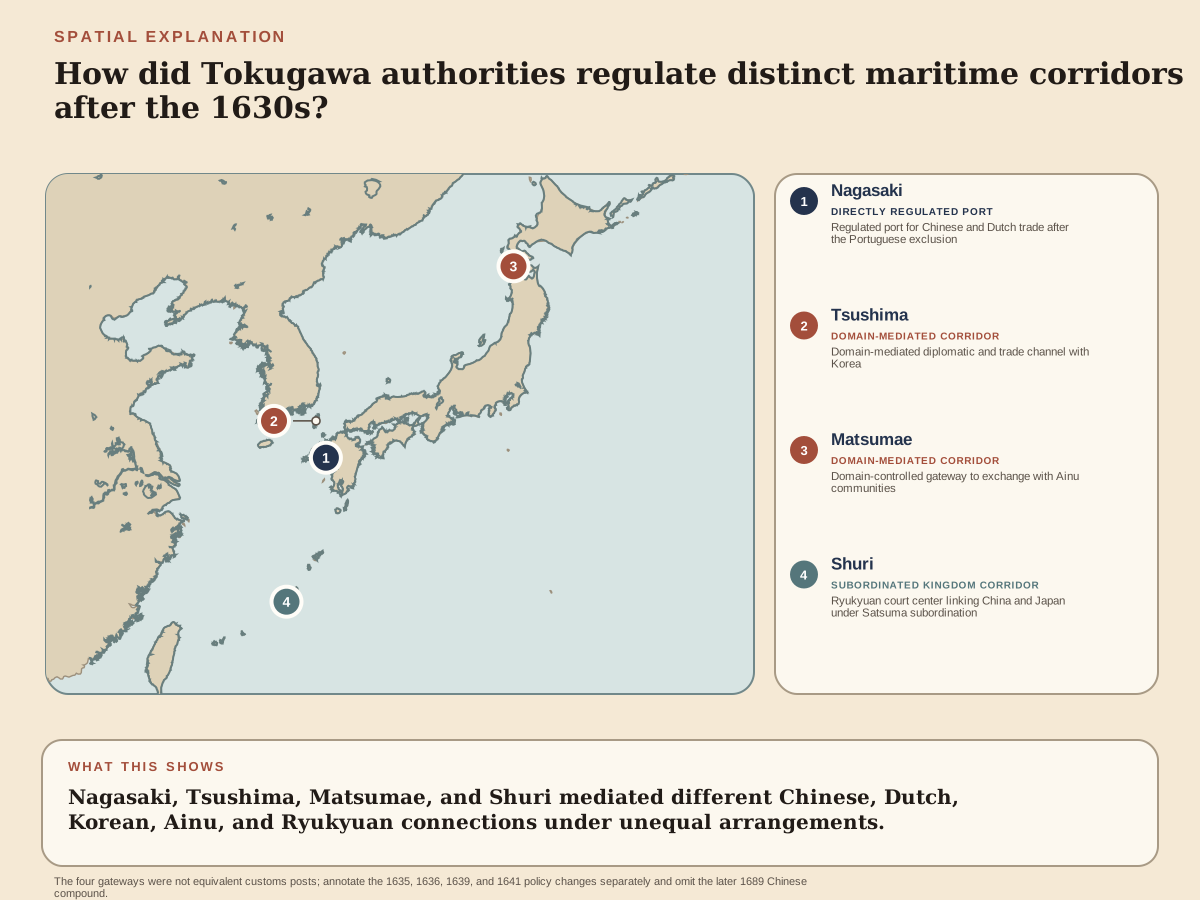
Iemitsu's government tightened maritime controls in stages. In 1635 it prohibited Japanese overseas departure and return. Dejima, an artificial island in Nagasaki harbor financed by twenty-five merchants, was completed in 1636 to house Portuguese residents. The Portuguese were expelled in 1639. In 1641 the Dutch trading post moved from Hirado to the vacated island, where residence and trade were regulated. Chinese merchants continued to trade at Nagasaki; their later confinement in the Tōjin yashiki did not begin until 1689. [14][2]
Other contacts passed through regional intermediaries. Tsushima handled relations with Korea; Satsuma controlled exchanges with Ryukyu, the island kingdom centered on Okinawa; and Matsumae mediated trade with Ainu communities, Indigenous peoples of the northern islands. The later label sakoku, or “closed country,” can obscure these continuing channels. Contact remained possible, but authorized routes gave the shogunate and its regional agents greater control over who traveled and traded. [2]
The birth of Ietsuna in 1641 gave Iemitsu a prospective successor. His mother, Oraku, had entered the women's quarters on Kasuga no Tsubone's recommendation around 1633. Kasuga was the former wet nurse Fuku; her continuing relationship with Iemitsu gave her influence over access and household appointments. [10]
Iemitsu's principal wife was Takatsukasa Takako, daughter of a Kyoto court noble. She entered Edo Castle in 1623 and formally married him in 1625. Wife, heir's mother and wet nurse had different roles within the household. Kasuga helped organize the Ōoku, the castle's women's residential and service establishment, which developed further under Ietsuna. [13][10]
By the 1640s Tokugawa supremacy rested on a layered order often called the bakuhan system: the shogunate controlled decisive relationships while domains governed much of their own territory. The later scholarly label is useful, but Iemitsu did not issue one document announcing a complete “bakuhan system.” Records helped make hierarchy governable. In 1641 the shogunate commissioned the Kanei shoka keizuden, a large compilation of warrior-house genealogies completed in 1643 under Ōta Sukemune, with the scholar Hayashi Razan as his deputy. It covered roughly fourteen hundred houses. [11][22]
Genealogy established claims of descent, service, marriage, and rank, but the compilation also contains errors and interested submissions. An official archive was a governing instrument, not a transparent mirror. Domains still collected taxes, issued law, maintained retainers, and managed towns and villages. The shogunate regulated lordship and demanded attendance while relying on domain governments to carry out many policies. The Kan'ei famine of 1641–42 also made the rural economy supporting lords' revenues an urgent concern during Iemitsu's own reign. Iemitsu's achievement was not replacing every local authority. It was making lords act within a Tokugawa framework whose demands were predictable enough to repeat and severe enough to matter. [12][22]
The 1630s attendance obligations were also remaking Edo, now Tokyo. Lords’ households and retainers needed residences and provisions in the governing city. Their mandated presence helped draw trade and labor toward the Tokugawa center. The 1638 castle tower dominated later images of Iemitsu's flourishing city. The Edo-zu byōbu, a painted folding screen, depicts the tower, streets, shops, river landings, processions, and figures associated with his reign. The museum reads its tower as the 1638 structure; a library survey reports a reading of the earlier 1623 tower. The painting's exact production date remains uncertain. [25][16][17]
The screen combines a political image with evidence of the city’s growth. Domain households drew provisions and labor toward Edo, making the capital depend on merchant and transport networks. That concentrated urban life also brought danger from fire. The Great Fire of Meireki destroyed the tower in 1657, six years after Iemitsu’s death and under his son Ietsuna. [25][17]
Iemitsu died in 1651; contemporary records give the traditional twentieth day of the fourth month. His body was buried at Nikkō in the fifth month, near the sacred landscape he had enlarged for Ieyasu. The Taiyūin mausoleum began construction in 1652 and was completed under his son Ietsuna; it is a posthumous creation, not a building Iemitsu finished for himself. Ietsuna inherited the shogunate at eleven by contemporary age count. Senior figures including Hoshina Masayuki, Sakai Tadakatsu, Matsudaira Nobutsuna, and Abe Tadaaki maintained government around the child ruler. [13][20][5]
Soon afterward the Keian conspiracy associated with Yui Shōsetsu exposed fear of rōnin and of a succession vulnerable to attack. The government relaxed restrictions on adopting an heir at the end of a lord's life, reducing house extinctions that produced masterless retainers. Historians often describe a transition from Iemitsu's “martial rule” to more “civil rule” under Ietsuna. The contrast is useful only if treated as gradual rather than an overnight moral conversion caused by one plot. Ietsuna's government banned junshi—retainers' suicide upon a lord's death—in 1663. Much later, Chikanobu's 1894–95 Chiyoda no Ōoku prints gave the castle's women's establishment a nostalgic afterlife. They depict a remembered institution, not Iemitsu's household as witnessed during his life. [21][22][20]
Classic
Tokugawa Iemitsu was born in 1604, the eldest surviving son of Tokugawa Hidetada and Oeyo and a grandson of Ieyasu. The family had won at Sekigahara in 1600 and Ieyasu had received the shogunal title in 1603. Hidetada became shogun, the head of the warrior government, in 1605, while his father remained politically active in retirement. The infant’s position belonged to this expanding family order in Edo, present-day Tokyo. Through Oeyo, an Azai woman with Oda connections, he also inherited ties to houses defeated and absorbed during the wars of unification. [22]
His childhood name, Takechiyo, had also been Ieyasu's. It presented the boy as a continuation of the ruling house before he could take part in government. Fuku, his wet nurse and the woman later known as Kasuga no Tsubone, provided intimate care and would remain influential into his adult life. Household service could become a route to political office: Matsudaira Nobutsuna, who entered Iemitsu's service as a child, eventually became one of his senior councillors. The heir grew up among people whose careers would develop alongside his own. [13][10]
His younger brother Tadanaga would receive substantial territories and remain an important member of the family. Their later rivalry gave storytellers a way to explain how Iemitsu emerged as the heir. The familiar claim that he had been born a shogun belongs to retrospective accounts, not to a recoverable childhood declaration. At his birth, even the Tokugawa settlement remained unfinished. [22]
The imperial court still conferred rank, while territorial lords maintained their own administrations. The Toyotomi house, which had dominated Japan before Ieyasu's victory, still possessed Osaka Castle and an alternative claim on warrior loyalty. Its destruction in 1615 lay ahead. Iemitsu's security depended on settlements made by his father and grandfather; his eventual inheritance would test whether their authority could pass through a third generation.
At his coming-of-age ceremony in 1620, Takechiyo took the adult name Iemitsu. He received his appointment as the third Tokugawa shogun at Fushimi Castle, near Kyoto, in 1623. The imperial appointment mattered because warrior supremacy did not abolish the court. The shogun's office existed within a political language of rank and authorization whose ceremonial center remained Kyoto, the imperial capital. Tokugawa force could constrain the court, but it also sought court titles for its own hierarchy. Nijō Castle made that relationship architectural. It was a fortified Tokugawa residence in Kyoto, a place for audiences and display near the imperial city. Visitors now encounter surviving and reconstructed phases, but in 1623 it served the living politics of succession. Iemitsu's journey gathered daimyo—territorial warrior lords—and their attendants into movement. A procession was not decoration added to government. It arranged precedence, consumed provisions, occupied roads, exposed bodies to view, and made distant power temporarily local along the route. [8][9]
Receiving the title changed Iemitsu's formal status. Orders, audiences, and service could be organized around the third shogun. His own household men gained greater importance, and the possibility of a stable father-to-son transfer became visible for a second time. Yet Hidetada remained the senior ruler. Retired authority was familiar in Japanese politics, and Tokugawa practice had an immediate model in Ieyasu's relationship with Hidetada. Residence, seal, office, and title did not necessarily identify the one place where final political weight lay. The division was not a modern written constitution with an exhaustive list of powers. Some decisions can be attributed through documents; other judgments emerged from consultation, access, family hierarchy, and accepted deference. Saying “dual rule” names the condition without pretending every boundary was fixed. [8][22]
For Iemitsu, this period joined independence to supervision. He could receive lords as shogun while knowing that senior officials and daimyo had served his father and grandfather. Authority had to be inhabited before it could be personalized. For daimyo, the succession posed tests. They renewed obligations through attendance, gifts, rank, construction, and military availability. Those practices helped turn personal loyalty to Ieyasu into service to a continuing Tokugawa house. For the court, the event confirmed both relevance and constraint. Go-Mizunoo and court society conferred forms of rank the Tokugawa valued, yet the military government increasingly regulated court conduct, temples, marriages, and appointments. Cooperation and domination occupied the same ceremony. Women were present in this politics through marriage and household relations even when investiture narratives center men.
Iemitsu’s sister Masako had become Emperor Go-Mizunoo’s consort, linking the houses while placing a Tokugawa woman inside court politics. The 1623 appointment gave Iemitsu an active office without removing Hidetada’s senior authority. Father and son represented different layers of the same household government. Only Hidetada’s death in 1632 would leave Iemitsu without a retired ruler above him. [8][22][9]
In 1626 Emperor Go-Mizunoo spent five days at Nijō Castle, the Tokugawa residence in Kyoto. Historian Fujii Jōji's examination of construction correspondence attributes the major expansion begun in 1624 to the retired shogun Hidetada, rather than to Iemitsu acting alone. Father and son both received the emperor. On the first day Iemitsu went to the imperial palace, then his procession preceded the emperor's journey to the castle, where Hidetada and Iemitsu met him at the middle gate. Gifts and entertainments followed on successive days; the emperor twice ascended the castle tower. [9]
Although Iemitsu held the shogunal title, the retired father remained senior. The event represented a Tokugawa house across generations, not a solitary ruler already free of supervision. Masako's marriage joined the houses at the level of reproduction and ceremony. She should not be treated only as a diplomatic object. As imperial consort and mother, she navigated court rank, Tokugawa expectations, patronage, and religious life. Her daughter later reigning as Meishō made the alliance dynastic in an unexpected form. Kinship did not eliminate jurisdictional struggle. The shogunate had issued regulations for the court and for religious institutions. In 1627 it invalidated imperial permissions for Zen clerics to wear purple robes, signs of high religious rank. Monks who continued to protest were exiled in 1629. This confrontation became known as the Purple Robe Incident. That conflict demonstrates a crucial asymmetry. [22][9][23]
The court retained the authority to confer rank and the cultural centrality that made Tokugawa attendance meaningful, but the military government could discipline the material and institutional consequences of court action.
Historical disagreement · How should the purple-robe dispute be understood?
Go-Mizunoo abdicated in 1629. Later accounts often connect the abdication directly to humiliation over the robe dispute and Tokugawa interference. Historian Ono Shinji's reference account describes the dispute as a severe blow long thought to have driven the abdication. Alongside that dynastic reading, Takano Toshihiko's account emphasizes the government's assertion of legal precedence and its effort to bring major Zen temples under control.
These explanations illuminate the conflict; neither establishes one private motive for Go-Mizunoo's departure.
The same caution applies to Iemitsu's motives. Honoring the emperor could be sincere within early modern political culture while also serving domination. “Propaganda” is too thin if it implies that ceremony was false. Effective rule often depends on performances participants regard as consequential. The castle visible today is not an untouched container from one week in 1626. [23]
The surviving castle brings together several periods of building. Rooms and objects prepared for the imperial visit were later moved, altered or lost; modern conservation has added another layer. The 1626 encounter must be placed within its own political circumstances. It brought an emperor whose titles the Tokugawa valued into a residence whose scale demonstrated their resources. The disputes that followed show how the same relationship could support both ceremony and coercion. [8][9]
Retelling the brothers as a favorite and an unwanted child gives a human shape to succession. It also compresses decades of institutional development into a domestic fable. In a familiar account, the parents favor Kunimatsu—the childhood name of Tadanaga—until Kasuga secretly appeals to Ieyasu on Takechiyo's behalf. The National Archives presents this intervention as a reported tradition, rather than an established record of how the succession was decided. There was a real hierarchy to settle. The eldest son's claim carried weight, but household decisions and the approval of senior rulers remained important. Ieyasu's authority could clarify intention, but no single conversation explains every subsequent step. Tadanaga did not vanish after Iemitsu's selection. He received territories, offices, and the title of dainagon (a senior councillor at the imperial court). He governed as a daimyo (a territorial warrior lord) and occupied a place close enough to the shogunal line to attract attention. [1][24]
Tadanaga’s conduct brought complaints and increasingly severe discipline. In 1631 he was ordered into confinement in Kai, now Yamanashi Prefecture. Hidetada died in 1632; that year Tadanaga lost his territories and was placed at Takasaki in what is now Gunma. The sequence ended with his compelled death in Kan’ei 10, recorded as 1633 in Japanese era-year chronology. His punishment made shogunal supremacy concrete within the ruling family itself. Later allegations about particular acts vary, but the deprivation and death were real political outcomes. [1][24]
Ieyasu's surviving sons had founded the Owari, Kii and Mito branches, later known as the Three Houses. These collateral lines remained available around the shogunal succession after Tadanaga's removal. Explaining his fall through the parents' affection alone overlooks this wider family settlement. Accounts written within the victorious house cannot settle precisely how much either parent favored one boy over the other. [1][24]
Iemitsu's responsibility cannot be dissolved into “the system.” Orders passed through councils and senior men, but the ruling authority was his. At the same time, attributing Tadanaga's fall to private jealousy alone mistakes a public disciplinary action for hidden psychology. The surviving archive is structurally tilted toward the victorious house. The case established a grim proposition: Tokugawa kinship conferred rank but not an independent right to challenge the shogunal settlement. The punishment warned the collateral branches that their high rank remained subject to the ruling shogun.
Hidetada's death removed a living senior whose experience and status had shaped every major decision. The change was psychological only in ways the evidence cannot fully recover, but it was institutionally visible. Requests, judgments, appointments, and punishments could now converge on Iemitsu without a retired shogun above him. The immediate handling of Tadanaga showed one form of power: exclusion backed by force. But a government that relied only on exemplary destruction would remain fragile. It also needed routines for information, consultation, drafting, verification, and enforcement. The rōjū were senior councillors responsible across major affairs; the wakadoshiyori (a Tokugawa junior councillor responsible for defined groups of retainers and officials) supervised important groups of direct retainers and related business; inspectors watched conduct and reported. [13][22]
Titles, membership, jurisdiction, and working practice developed through precedent. Iemitsu's former pages and close attendants mattered because long service built trust. Matsudaira Nobutsuna, a childhood attendant, became a rōjū in 1633 and would later command the response to the Shimabara revolt. Such advancement also concentrated opportunity among those close to the ruler. Older men remained necessary. Doi Toshikatsu, Sakai Tadayo, and others carried knowledge from Hidetada's period. Iemitsu did not replace one whole government with childhood friends. He combined generational promotion with inherited experience. Councils limited and enlarged him simultaneously. Consultation meant that policy was not simply an unmediated command. It also enabled one judgment to reach distant lords, ports, temples, cities, and villages through standardized channels. Records were another source of rule. [13][22]
Registers, house genealogies, maps, reports, and precedent allowed the government to compare claims. Documentation did not guarantee truth. Officials selected categories, local agents supplied information, and powerful houses could shape what entered the archive. Daimyo punishment remained central. Confiscation and transfer signaled that possession of a domain depended on recognized conduct and succession. The regime could cite disobedience, misconduct, lack of an approved heir, or earlier political risk, with grounds varying from case to case. The social cost accumulated in retainers who lost service when a house was extinguished. Some found new masters; others became rōnin (a warrior without a current lord). A policy designed to eliminate unreliable lords could multiply armed men detached from stable household income. Women and children of displaced houses also bore consequences, although political narratives usually record the male lord and land total. [21][22]
Relocation, confinement, household separation, lost marriage prospects, and reduced support extended punishment beyond the named offender. Institutionalization should not be confused with humanitarian moderation. A predictable machinery can administer severe coercion efficiently. Under Iemitsu, routinization and force grew together. Inspection also created uncertainty within government. Informants could pursue grudges, officials could conceal failure, and numerical reports could reward exaggeration. Expanding surveillance increased available information without ensuring that the summit received an unbiased picture of provincial conduct. Nor was the bakufu (a warrior government headed by a shogun) identical to all government in Japan. Domains retained tax systems, courts, laws, and officials. Villages managed obligations through local structures. The shogunate governed this layered order by demanding service and reserving decisive powers, not by staffing every settlement from Edo.
After 1632, Iemitsu could promote trusted attendants while retaining men who had served his father. That combination gave his decisions experienced channels of enforcement. It also left him dependent on reports and judgments made by officials below him, even when the final authority was his.
The scale of Iemitsu's 1634 progress has become part of its legend. The often-cited total of roughly 300,000 conveys immensity, although the surviving record does not provide an exact count. Different counting boundaries—warriors, attendants, laborers, temporary suppliers—can change what the number means. Exactness is less important than organization. Daimyo contingents assembled according to rank and obligation. Banners, weapons, liveries, horses, and formation converted political relationships into a visible order along the road. The shogun's own person could be difficult to see. Screens, guards, palanquins, distance, and protocol protected him. Spectators often encountered authority through sound, dust, heralds, equipment, controlled space, and the passage of other people rather than through an intimate view of Iemitsu. [8][22]
Roads and post stations were political infrastructure. They arranged relays, lodging, transport, permits, and communications. A spectacular journey tested whether these systems could support an abnormal concentration of demand. Local communities paid in labor as well as wonder. Porters carried loads; farmers supplied fodder; merchants found provisions; inns displaced other travelers; officials repaired surfaces and bridges. Some costs were compensated, others imposed, and the experience differed by place and status. Women were present as residents, suppliers, servants, elite household members, and observers, though the official procession is often counted through armed men. Their absence from military lists is not absence from the event. Kyoto required another kind of choreography. The court, temples, urban elites, and Tokugawa officers had their own ranks and spaces.
Iemitsu's display had to dominate without pretending the imperial city held no authority worth visiting. His sister Masako and her daughter Meishō linked shogunal and imperial families. Meishō's accession as a reigning empress in 1629 did not turn the court into a Tokugawa department, but it made the dynasty's family presence unprecedentedly visible. Nijō Castle served as a fixed stage for mobile power. Its rooms and gardens received a political body produced on the roads. The castle's heritage sequence today should not collapse the 1626 imperial visit and the 1634 shogunal progress into one timeless golden interior. The procession also communicated after it passed. Drawings, records, memories, expenditure accounts, and later narratives transformed movement into durable reputation. Apparent eyewitness detail may come through sources shaped by patronage and commemoration.
No shogun made another Kyoto visit until 1863, during the crisis at the end of Tokugawa rule. The long interval makes the 1634 journey especially prominent in later memory. Its political display depended on domain contingents and on the labor of communities along the route. The records of that display do not establish a single response shared by everyone who watched or supplied it. [8]
Ieyasu's 1617 enshrinement at Nikkō came before the monumental environment now associated with Tōshōgū. Iemitsu inherited a functioning shrine rather than beginning a new cult. The 1634–1636 rebuilding changed scale, density, and visual program. Elaborately decorated gates and corridors ordered the approach to the main shrine. Iemitsu supplied command, resources, and political purpose. He did not draw and execute every element. Akimoto Yasutomo's administrative supervision and Kōra Munehiro's building leadership show named agency below the shogun, while thousands of less recoverable workers remain behind the finished surfaces. Tenkai, a senior Tendai Buddhist monk, connected Tokugawa memory to religious institutions and ritual. [5]
His role should not be reduced to mystical manipulation. Clerical learning, temple organization, printing, land, pilgrimage, and ceremony made deification durable. Daimyo participation converted hierarchy into material. Contributions and assigned labor made the shrine a statement that regional lords helped construct the sacred center of the house above them. Reverence was therefore also obligation. The program was not purely “Japanese” in a sealed sense. A Dutch chandelier and other objects entered through controlled exchange. Korean envoys visited Nikkō. Motifs and materials belonged to wider East Asian and maritime worlds even as the shrine proclaimed Tokugawa identity. The famous carvings should not be isolated as mascots. The Three Monkeys form one panel within a life-cycle sequence. Yōmeimon's hundreds of carvings operate as a threshold. [5]
The Sleeping Cat marks the route toward the quieter inner mausoleum. Their spatial work matters as much as souvenir fame. The historic buildings have survived through repeated repairs. Lacquer, pigment, gold, roofing, and damaged members need conservation. Brightness is not proof of modern fabrication, and age is not authenticated only by fading. The shrine remained a religious site. Visitors entered an institution where Ieyasu was ritually present, not merely a palace of political art. Calling everything propaganda can erase belief, practice, and clerical agency; calling everything devotion can erase coercive financing and dynastic strategy. The project followed Iemitsu's 1634 Kyoto display and preceded other system-defining measures. Monument, procession, and regulation were different media for the same problem: how to make one house's supremacy appear ordered, inherited, and more durable than a living ruler. [5]
Craft knowledge also traveled. Building and decorative techniques moved with specialists and workshops. The shrine concentrated expertise that no shogunal decree could create instantly, then helped transmit standards through maintenance and later building work. Nikkō also reorganized landscape and logistics. Timber and stone had to reach the mountain site over roads supported by regional transport and lodging. The visible shrine condensed a much larger geography of work. Iemitsu later received burial at Nikkō, but his mausoleum, Taiyūin, was built after his death under Ietsuna.
Alongside the journeys and shrine works, attendance requirements were being tightened. Alternating attendance is often explained as a device to impoverish daimyo or keep their families as hostages. Both ideas identify real forms of control, but neither is a complete account of a system built from older service obligations and repeatedly revised after 1635. The 1635 revision of the Buke shohatto, regulations for warrior houses, made sankin-kōtai—alternating attendance at the shogun's seat in Edo—a more regular obligation. Attendance in Edo demonstrated subordination and placed lords within the shogun's ceremonial field. Absence and delay became political facts rather than private travel choices. Residence divided elite households. A lord moved between domain and Edo; wives, heirs, attendants, and servants often remained in the city. The language of hostage logic is appropriate when it names coercive security, but these residents also formed households, patronage networks, religious ties, and urban communities over long periods. [22]
Travel required labor. Porters and packhorse handlers carried the processions' loads; post stations provided relays and lodging. Large processions could disrupt local capacity while also bringing business. Effects were uneven rather than uniformly enriching or ruinous. Costs were politically useful because they limited discretionary resources, yet economic exhaustion was not a simple written objective applying identically to every lord. Procession size itself became regulated, and domains sought efficiencies while preserving rank. Edo changed as residences multiplied. Materials, food, water, fuel, servants, and retainers had to support populations whose presence was mandated by politics. The attendance system therefore helped make a governing city from the household geography of domains. Routes carried more than obedience. Provincial goods and news traveled with the households. [3][4]
Hakone Sekisho was a staffed road checkpoint on the Tōkaidō, the main route linking Edo and Kyoto. Established at its current location in 1619, it operated before the 1635 attendance regulations. Officials scrutinized women departing Edo, checking travel papers and personal descriptions. The checkpoint's own account specifies that it did not inspect incoming firearms; the familiar shorthand “guns in, women out” does not describe an identical procedure at every gate. Inspection was gendered bureaucracy. Female officials known as hitomi-onna took part in examining women travelers. The procedure made elite-family control ordinary administrative work and subjected bodies to different scrutiny according to sex, status, direction, papers, and affiliation. The site visible now is reconstructed. Archaeology, an 1865 repair record discovered in 1983, documentary research, and traditional techniques informed rebuilding opened in stages from 2004 to 2007. [3][4]
Attendance requirements changed over the following generations, with exemptions and adjustments to frequency and burden. In Iemitsu’s reign, the 1635 regulations made the obligation more regular. Travel documents and gate officials connected the rule to the movement of actual households. The system joined a lord’s standing in Edo to the people and resources needed for his journey. [22]
Shimabara, a peninsula on Kyūshū in western Japan, and the neighboring Amakusa islands had complex political and religious histories. Christian communities survived earlier conversions and later prohibitions; former warrior households had been displaced; new lords imposed fiscal and building demands. These layers made the uprising more than a sudden reaction to one order. Matsukura rule in Shimabara became notorious for taxation and brutality. The construction of Shimabara Castle symbolized ambition whose costs were transferred downward. Official local history connects those burdens to the conditions of revolt, while later narrative amplified individual tortures in ways that still require source criticism. Crop difficulty and hunger sharpened pressure. A tax demand is not experienced as an abstract percentage when households lack food. Villagers faced local officials and creditors before they ever encountered the shogun's government. [15]
Christianity mattered as faith, community memory, symbols, and a category of persecution. Crosses and Christian leadership helped unite participants, but not every rebel can be assigned the same belief or motive. Some sought survival, revenge, release from taxation, restoration of status, or security within collective force. Rōnin and former retainers supplied military experience. Amakusa Shirō became a charismatic emblem, yet reducing the rebellion to a miraculous teenage commander turns a socially diverse movement into legend. Contemporary and later representations shaped his image differently. Hara Castle gave the rebels defensible ground and a shared enclosure. Families as well as fighters gathered there. A siege against a fortified population cannot be narrated only as a battle among armed men. The first shogunal command failed. [13][14][22][15]
Itakura Shigemasa died during an assault, revealing that overwhelming political authority did not guarantee competent operations. Matsudaira Nobutsuna reorganized the siege. Domain forces surrounded the site, supplies diminished, and intelligence and defection altered the balance. Dutch assistance, including fire from a ship, is historically important but did not by itself decide the outcome. Its later symbolic weight exceeds its limited operational duration. When Hara fell, the victorious forces killed on a massive scale. Exact totals vary with source and category, and formulaic numbers should not be offered as census precision. The evidentiary certainty lies in comprehensive, punitive slaughter rather than in one perfect figure. The shogunate later executed Matsukura Katsuie. Punishing a lord for misrule was exceptional and demonstrated that daimyo authority had limits. [13][14][22][15]
It did not restore the dead or make the suppression protective governance. Terazawa authority in Amakusa was also reduced, and regional administration changed. The regime learned that local extraction could produce a crisis large enough to require nationwide military mobilization. Iemitsu did not command at Hara in person. Orders and reports passed through councillors and generals. That distance should clarify, not erase, responsibility. The shogun owned the political decision to crush the resistance and the system that mobilized forces. The coalition army also tested domain cooperation. Lords who might otherwise compete had to provide men and supplies under shogunal direction. Hara demonstrated the military capacity of the shogunate and its cooperating domains, even as operational delay exposed their coordination problems. Later Tokugawa stability is often measured by the rarity of major war. Shimabara shows the price at the threshold of that peace. A government can suppress open conflict so successfully that its founding acts of mass violence disappear behind the calm that follows. [15]
The persecution that framed Shimabara had begun long before the 1637–1638 siege. In the 1620s Iemitsu’s government was already intensifying anti-Christian policy inherited from earlier rulers. Iemitsu's reign belongs to a long sequence of bans, martyrdoms, expulsions, apostasies, local investigations, and diplomatic anxieties rather than one sudden policy after Shimabara. The Edo execution of 1623 made prohibition public at a moment of shogunal succession. Bodies were punished before crowds and assembled lords. The violence communicated that religious affiliation could be categorized as political defiance. Missionaries and Japanese believers faced different risks, while converts differed in status and commitment. The records preserve accused believers unevenly across sex and social rank. Official records often identify them at the moment of accusation rather than through full lives. E-fumi, an image-trampling test used to identify suspected Christians, made compliance physical. Stepping on an image could be recorded as proof of non-Christian status or apostasy. [18]
A recorded act of compliance does not establish what a person believed while under threat. Rewards for information and collective responsibility extended surveillance through communities. A neighbor, relative, village head, temple priest, or local official could become part of enforcement. The state did not need one central investigator in every settlement when it could make social units answerable for their members. Temples acquired a certification role. Affiliation could demonstrate that a household belonged to permitted religious structures, making Buddhist institutions part of population governance. This does not mean every priest embraced persecution equally or that all parishioner relations began only as police measures. The 1635 establishment of temple-and-shrine magistrates strengthened central supervision of religious institutions. [18]
Supervision of temples and shrines extended beyond Christianity to their lands, appointments and disputes. Religious investigation also developed beyond Iemitsu's reign. Historian Ōkuwa Hitoshi's reference account distinguishes early, locally varied methods from the 1664 order for domains to appoint religious-investigation officials and the 1671 religious-status population registers. These later measures helped turn anti-Christian inquiries into recurring household registration. Danka were households affiliated with a Buddhist temple; terauke was the temple's certification of that affiliation. Neither describes a uniform nationwide system completed by Iemitsu alone. [18]
Survival exposes administrative limits. Communities later called hidden or clandestine Christian preserved prayers, objects, kin practices, and ritual adaptations in forms shaped by isolation and local society. Some appeared outwardly within Buddhist registration while sustaining other commitments. Confession records demand caution as well. Statements could be produced through torture, bargaining, translation, formula, and fear for relatives. A detailed confession may reveal the questions and categories of interrogators more securely than it reveals an uncoerced theology of the accused. Women often maintained household ritual and transmitted memory, though interrogation records may reduce them to relatives of male suspects. Children inherited both practices and official suspicion. Persecution operated through generations. The institution could know registrations, performances, accusations, and confessions. It could compel bodies and punish communities. [18]
It could not directly inspect conscience. The difference between recorded status and inward belief is not a romantic exception; it is a basic evidentiary boundary. Iemitsu's responsibility lies in expanding a system that made religious identity a matter of coercive public proof. Its administrative reach was sustained through punishment and compelled conformity, with severe consequences for believers and their households. [18]
Maritime restrictions developed alongside religious persecution in the 1630s. The government narrowed foreign contact while strengthening controls within Japan. A single “closing of Japan” in 1639 erases orders beginning in 1633, the 1635 restriction on Japanese overseas departure and return, the construction of Dejima, the Portuguese ban, and the Dutch relocation in 1641. Japanese subjects lost major freedoms. Overseas departure was restricted, and return could be prohibited under severe penalty. Existing maritime communities, mixed families, traders, sailors, and converts experienced the policy differently from an inland lord reading an order. The Portuguese connection combined commerce with missionary history in shogunal eyes. Exclusion after Shimabara joined religious security to maritime regulation, though Portuguese traders were not identical to rebel participants. The regime treated the channel as an unacceptable risk. Dejima embodied controlled proximity. Nagasaki merchants financed and constructed the artificial island from 1634 to 1636 for Portuguese residence. [14][2]
The project depended on urban capital, land-making labor, officials, and rents. Calling it simply a government prison omits the merchant arrangement. After the 1639 exclusion the island temporarily lost its original occupants. In 1641 the Dutch factory was moved from Hirado to Dejima. This sequence matters because the famous Dutch Dejima was a reuse of infrastructure built for another community. Dutch access did not imply equality. Movement, residence, trade, religion, women entering the compound, documents, and periodic journeys were regulated. The Dutch accepted constraints to preserve commerce and supplied information within the relationship. Chinese trade also continued through Nagasaki. Projecting the Tōjin yashiki compound backward would be an error: Chinese residents were not confined there until 1689. The institutions of one later shogunate cannot be assigned to Iemitsu because they fit the familiar image of seclusion. [14][2]
Other “mouths” connected the polity outward. Tsushima mediated relations with Korea; Satsuma used Ryukyu, the island kingdom centered on Okinawa, as a subordinated but distinct diplomatic and commercial channel; Matsumae mediated trade with Ainu communities, Indigenous peoples of the northern islands. These routes had different law, violence, cultural brokerage, and political fictions. Information itself became a regulated import. Reports from Dutch merchants and other intermediaries could alert Edo to wars, dynastic changes, shipping, and religious expansion. Restriction was therefore partly an intelligence system: fewer authorized channels could be watched and compared more closely. Korean embassies and Ryukyuan missions brought foreign representatives to Edo; Dutch merchants supplied goods and reports from abroad. Restriction selected pathways rather than abolishing exchange. The term sakoku requires its own chronology. The influential Japanese formulation emerged around 1801 through Shizuki Tadao's rendering and adaptation of a European account associated with Engelbert Kaempfer. [2]
Applying the term backward is common and sometimes useful, but it is not Iemitsu's program title. “Isolation” also hides regional agency. Tsushima, Satsuma, Nagasaki, and Matsumae possessed specialized knowledge the central government needed. Brokers translated language, protocol, price, and political expectations. Central control depended on peripheral expertise. Coercion remained fundamental. Christians were persecuted, returnees endangered, foreign residents confined, and Ainu and Ryukyuan relations structured by unequal power. Replacing “closed country” with “open country” would be another simplification. What closed was uncontrolled access as the shogunate defined it. What remained open were authorized corridors whose participants could be watched, taxed, used, and expelled. The system's power lay not in silence from abroad, but in deciding who could carry the outside world inward.
In 1641, while maritime policy and religious investigation were being reorganized outside the castle, the birth of a son gave Iemitsu a prospective successor. The inner household had been central to his rule long before this event. Fuku, later Kasuga no Tsubone, had cared for him as a wet nurse and remained an influential attendant. Her proximity to the ruler gave her a part in managing access and the household arrangements on which succession depended. [10]
Iemitsu's principal wife was Takako, daughter of the court noble Takatsukasa Nobufusa. She entered Edo Castle's western compound in 1623 and formally married him in 1625. Their union connected the shogunal household with the aristocracy in Kyoto. Takako later lived separately from Iemitsu, but that separation does not establish the private motives attributed to him in later accounts.
The mother of the future fourth shogun was another woman, Oraku. She entered the inner quarters around 1633 on Kasuga's recommendation and gave birth to Takechiyo, the future Ietsuna, in 1641. Oraku was the heir's birth mother, Takako the principal wife, and Kasuga the senior attendant whose influence helped bring Oraku into the household. Ietsuna's birth gave these arrangements a consequence beyond Iemitsu's own lifetime.
The Ōoku was the women's residential and service establishment inside Edo Castle, including the shogun's wife, concubines and attendants. Kasuga helped form its organization during Iemitsu's reign; it developed further under Ietsuna and later shoguns. The Tokyo National Museum's 2025 account distinguishes this formative work from the more elaborate institution familiar from later Edo history. Rules dividing inner and outer space gave senior attendants influence over who could approach the ruler, while junior servants performed much of the daily work. [13][10]
Kasuga's standing depended on a long relationship with Iemitsu and on her position within this household hierarchy. Access could bring opportunities for relatives and clients, but her influence did not amount to ruling in his place. By his son's birth in 1641, the inner quarters linked the care of the ruler to the continuation of the dynasty.
Historians call this relationship a bakuhan order: the shogunate, or bakufu, governed alongside the domains, or han. Historical government was built through changing relationships among the shogunate, domains, court, temples, shrines, cities, villages, and status communities. The shogunate reserved powers that defined the summit. It recognized or destroyed houses, controlled castle construction, approved important marriages, prescribed attendance, managed major foreign relations, issued general warrior rules, and demanded military and construction service. Domains retained substantial administrative life. Lords and their councillors assessed land, collected obligations, judged disputes, maintained forces, managed resources, and issued local rules. Their autonomy was real but conditional. A domain could govern internally without possessing independent sovereignty equal to the shogunate. Information linked the layers. Reports traveled from villages to domain offices and from domains to Edo. [22]
Maps, land surveys, registers, genealogies, petitions, and incident reports translated local complexity into forms higher authorities could compare. The Kanei shoka keizuden demonstrates the political work of memory. Commissioned in 1641 and completed in 1643, it organized the ancestry and service claims of roughly fourteen hundred warrior houses. Ōta Sukemune directed the compilation, with the scholar Hayashi Razan as his deputy. They turned family narratives into an official reference. Genealogy could validate rank and loyalty. It connected current officeholders to founders, battles, marriages, and grants. By choosing what counted as a house and which line deserved record, the compilation helped define the political society it appeared merely to describe. Its errors are equally important. Families submitted interested accounts; compilers reconciled inconsistent traditions; missing evidence could be filled or misread. [11]
The reference was useful precisely because the government could not hold every family's history in personal memory. Its authority also had limits. The National Archives notes that compilers sometimes lacked documents and depended on remembered or transmitted accounts. An official compilation could preserve mistakes as well as service claims. The submitted lineages therefore have to be read as evidence of how houses represented their past, not as unquestionable proof of every ancestor. [12]
The same years brought the Kan'ei famine of 1641–42. Historian Takagi Shōsaku connects this crisis to renewed concern for the rural economy on which lords' finances depended. In his account, reconsideration of harsh government had begun within Iemitsu's reign, not only after his death. The genealogy project and the famine placed different demands on the governing center: preserving warrior rank required reliable records, while preserving its revenues required attention to the villages that supported it.
The roughly fourteen hundred recorded houses each had a place within a hierarchy the shogunate needed to recognize and govern. A central reference helped officials compare their claims, while much of everyday administration remained with the domains. Iemitsu's reach grew through those relationships rather than through an Edo official posted to every village. [22]
The city supplying these households had also been growing throughout Iemitsu's reign. Edo's expansion began before him, through Ieyasu's castle-town construction and Hidetada's expansion. The third shogun inherited earthworks, canals, neighborhoods, and political ambitions already remaking the bay landscape. Alternating attendance multiplied demand. Daimyo required residences; retainers needed housing; wives, heirs, servants, guards, artisans, and suppliers lived in the city even when a lord returned to his domain. Political obligation became urban population. Residences distributed domains across Edo. They were homes, offices, warehouses, ceremonial spaces, and nodes linking provincial administrations to the shogunate. Fire, marriage, childbirth, discipline, and consumption inside them were public political matters. The castle remained the center, but not because everyone saw the shogun. Gates and moats organized access; offices received documents; waiting rooms sorted rank. Much of governing consisted of controlled distance from the ruler. [25][17]
The 1638 tower gave this center a monumental vertical image. It later burned in the Great Fire of Meireki in 1657 and was never rebuilt. The destruction belongs six years after Iemitsu's death, so its fame must not create a false final scene in his life.
Historical disagreement · Which Edo Castle tower appears on the screen?
The Edo-zu byōbu, a painted folding screen, preserves a city associated with Iemitsu's flourishing rule. Its large castle, processions, rivers, shops, shorelines, and anonymous laborers make political spectacle coexist with daily movement. The museum identifies its tower with the one completed in 1638. An NDL-hosted library survey reports another reading that identifies the depicted tower as the earlier structure completed in 1623.
Identifying the scenery and dating the painting are related but different questions; the museum's gallery acknowledges several production-date theories without choosing one.
Water defined capacity. Wells, channels, canals, and waterworks supplied drinking, washing, firefighting, construction, and industry. Systems associated with Kanda developed in phases; attributing one complete modern network to a single order would repeat the lone-founder error.
Food arrived through domain tribute, coastal shipping, river craft, fish markets, wholesalers, shops, and household provisioning. A warrior capital depended on merchants whose status ideology placed them below warriors but whose logistics made warrior residence possible. Fire was structural. Dense wooden building, kitchens, lamps, workshops, wind, and seasonal dryness created recurring danger. Fire response before the famous post-1657 reforms was uneven and relied heavily on demolition, guards, domain forces, neighborhood practice, and rebuilding. Labor was unequal. Skilled artisans could gain opportunity from massive projects, while compulsory service and domain assessments transferred costs. Servants and porters made elite ease visible by carrying its material weight. Urban status categories organized residence and obligation without creating perfectly sealed populations. Work, credit, worship, entertainment, illness, and fire crossed official boundaries. [25][17]
The city had to be governed through negotiated neighborhoods because lived movement exceeded the map's social compartments. Women lived in the daimyo residences and townspeople's households, working as servants, managers and traders as well as maintaining families. Describing the city only as shogun, daimyo, and male merchant erases much of its permanence. Foreign relations entered the streets. Korean and Ryukyuan envoys and Dutch representatives processed toward the shogunal center under different protocols. Edo's claim to govern external channels became public performance inside the city. Urban growth exceeded intentional design. Neighborhood custom, informal markets, religious precincts, entertainment, crime, disease, and migration created a society no castle plan contained. Officials governed through local intermediaries because direct oversight was impossible. Iemitsu's Edo was therefore not merely a backdrop to his policies. It was the material consequence of gathering political society around one house. Its scale demonstrated Tokugawa success while producing fire, supply, policing, and population problems inherited by every later shogunate.
Iemitsu's death ended a reign of twenty-eight years. Official chronology places his death on the twentieth day of the fourth month in the contemporary Japanese calendar, with burial at Nikkō soon afterward. His choice of Nikkō joined him to Ieyasu's sacred center while preserving hierarchy between grandfather and grandson. Taiyūin's construction began in 1652 under Ietsuna and reached monumental form after Iemitsu could direct it. The son, officials, clerics, designers, and workers made the father's memory architectural. Ietsuna was the first Tokugawa shogun to inherit as a child. Formal succession succeeded: no rival seized the office, and councillors continued government. That continuity is evidence that institutions developed under Iemitsu could survive his person. It was also a moment of danger. The Keian conspiracy associated with the military teacher Yui Shōsetsu and other rōnin was discovered within months. [13][20][5]
Rōnin were not created by Iemitsu alone. War, succession, domain change, dismissal, and economic difficulty produced masterless warriors across decades. Yet severe Tokugawa confiscation policy had extinguished houses and released retainers, making the problem partly an unintended consequence of disciplinary government. The plot made that contradiction visible. A regime had reduced daimyo autonomy to prevent organized resistance while helping create mobile men with military skills, grievances, and uncertain livelihood. Police action could suppress conspirators without removing the structural source. In 1651 rules on deathbed adoption were relaxed. Allowing an heir to preserve a house could reduce automatic extinction and the displacement of retainers. This was a practical adjustment to political risk, not simply an act of compassion. The familiar transition from budan, or martial government, to bunji, or civil government, organizes later interpretation. [21][22][20]
The distinction between martial and civil government describes a change of emphasis rather than a complete break. Iemitsu had already governed through records, councils, law, ritual, and clerical institutions, not force alone. Ietsuna's regime still punished, regulated status, and preserved coercive structures. Policy change accumulated through adoption rules, reduced house destruction, prohibitions on certain warrior practices, and new responses to urban disaster. The councillors bridge the supposed divide. Matsudaira Nobutsuna served both shoguns and managed Shimabara, the Keian crisis, and later the Meireki fire. Sakai Tadakatsu and Hoshina Masayuki helped make a child succession functional. Personnel continuity complicates a simple change of political species. Five retainers followed Iemitsu in death by junshi, suicide upon the death of a lord. [21][13][22][20]
Ietsuna's government prohibited junshi in 1663, although the ban did not immediately end the practice. Such measures support the familiar distinction between Iemitsu's martial consolidation and his son's more civil government. Fujino Tamotsu's account of Ietsuna emphasizes collective leadership around the child successor. Takagi Shōsaku, writing about Iemitsu, places a reconsideration of harsh policy earlier, after Shimabara and the Kan'ei famine. The difference is one of emphasis and timing; councils and coercion existed under both rulers. The officials who had enforced Iemitsu's authority now helped preserve it while changing some of its methods. [21][13][22][20]
In 1894–95, Toyohara Chikanobu's Chiyoda no Ōoku prints gave the castle's women's establishment another afterlife. The Tokyo National Museum describes their scenes as nostalgic, also shaped by the contemporary imperial household. They portray a remembered institution, not Kasuga's quarters as witnessed during Iemitsu's life.