Attraction
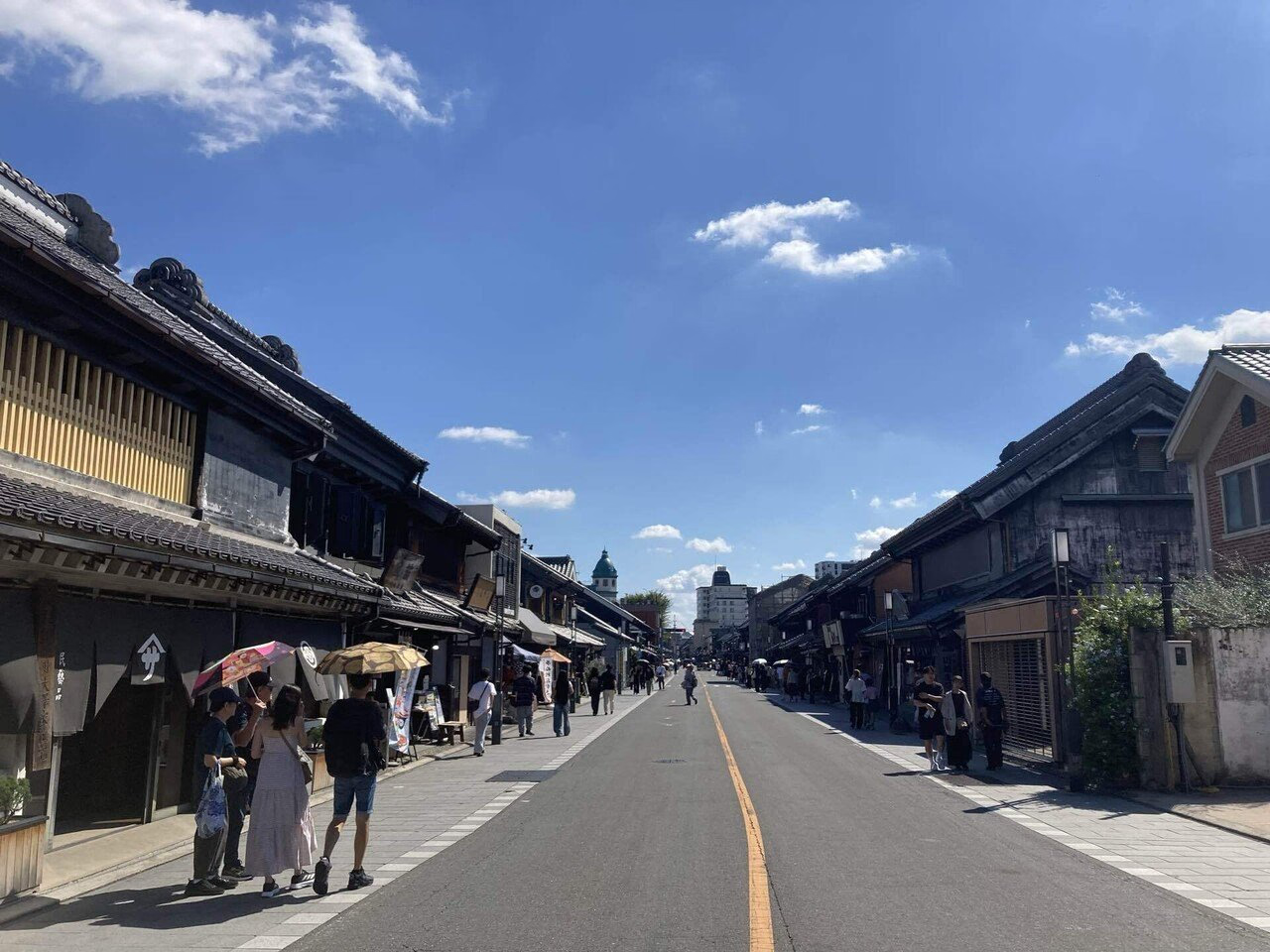
The heavy walls, tiled roofs and closable openings adapt storehouse construction to an urban merchant street where fire could move rapidly from plot to plot. Much of what now appears timeless therefore records a practical response to a specific modern disaster. Individual buildings differ in date and detail, so compare several facades rather than treating the district as one architectural unit. Look for black plaster, deep eaves, substantial roof tiles and shutters capable of sealing openings. Active shops and traffic are not simply intrusions into a preserved set: commerce remains the street's organizing function. The strongest view includes multiple neighboring plots, showing how merchants balanced fire protection, display and competition along the same narrow road. Preservation has also changed the district by selecting, repairing and adapting buildings for continued use. That process deserves attention alongside the 1893 reconstruction. A cafe or shop inside a protected facade may represent continuity of commercial purpose even when the merchandise, fittings and ownership are new.
Current visibility
The place-specific feature discussed as “Kurazukuri Street” is anchored by the streetscape, the storehouse, and the documentary evidence, but today's access or operating condition at Kawagoe requires a current official check.
Attraction
The tower rises above a narrow lane rather than a broad square, so locating its base is as revealing as photographing its silhouette. Its scheduled bell remains part of the town's soundscape, although exact ringing times belong to current visitor information. The landmark embodies continuity through replacement: Kawagoe preserved a civic role, a recognizable form and an audible rhythm, not an untouched set of early timbers. The tower mattered because it made time public and audible across the castle town; rebuilding it quickly restored urban function as well as symbolism.
Current visibility
The place-specific feature discussed as “Toki no Kane” is anchored by the bell tower, but today's access or operating condition at Kawagoe requires a current official check.
Attraction
This is present-day heritage through use: the district is valuable not because commerce stopped, but because commercial traditions and old-town identity continue to be performed through ordinary buying and selling. Kashiya Yokochō is a compact lane of confectioners rather than a preserved residential street. Shopfronts, smells and the close scale of the lane show how old-town identity is sustained through active trade.
Current visibility
At Kawagoe, “Kashiya Yokocho” is grounded in present on-site evidence—the present landscape and the streetscape—without implying that every historical layer survives as fabric.
Attraction
Inside, tatami rooms, corridors and structural rhythm reveal administration and formal reception rather than tower defense. Compare this low, controlled interior with the vertical bell tower and massive merchant storehouses elsewhere in town. The contrast separates political, civic and commercial architectures that the label 'Little Edo' can otherwise flatten into one nostalgic image. Urban heritage often survives unevenly. Here, the missing castle is as important as the surviving palace fragment: the modern city occupies a space once structured by moats, enclosures and administrative buildings.
Current visibility
“Honmaru Goten” can still be read at Kawagoe through the corridor, the administrative landscape, and the interior; the visibility claim concerns that setting, not a past moment preserved intact.
Attraction
The transferred rooms are traditionally associated with Tokugawa Iemitsu and Kasuga no Tsubone, but their broader value is the material link between Kawagoe and the shogun's capital. Read thresholds, painted interiors and room sequence as elite architecture, then contrast them with the public street life of the warehouse district. Current entry and photography rules should be checked at the temple. Kawagoe's identity as 'Little Edo' is not only visual imitation: political and religious links to the Tokugawa center were materially embedded in sites such as Kitain.
Current visibility
The surviving setting at Kawagoe anchors “Kitain”; its physical context is the interior, the streetscape, and the present landscape.
Attraction
The Kawagoe Festival Museum keeps the city's float tradition legible outside the annual October event. Its display hall presents full-scale working floats rather than miniature substitutes, while films and changing demonstrations explain music, movement and neighborhood participation. Museum hours, displayed floats and live accompaniment are variable, so check the official schedule. The permanent value is the connection between preserved street architecture and a festival that still activates those same streets.
Current visibility
At Kawagoe, “Kawagoe Festival Museum” remains readable across the museum display and the streetscape; visibility belongs to the landscape relationship described in the body.
Attraction
The Osawa House is an unusually early surviving kurazukuri merchant building, dating to 1792. Its thick earthen construction predates the wave of fire-resistant rebuilding that followed Kawagoe's great fire of 1893, making it a useful reference point for the later streetscape. Rather than reading every dark warehouse facade as identical, compare the house's proportions, shutters and commercial frontage with neighboring buildings. The structure shows that kurazukuri was an established urban solution before disaster made it dominant. Current interior access should be checked separately; the exterior alone helps distinguish an individual historical building from the district's broader preserved image.
Current visibility
The Ōsawa House can be assessed from its thick earthen exterior, shutters, proportions, and commercial frontage; current interior entry is a separate question.
Attraction
Taisho Roman Street prevents Kawagoe from being reduced to a single Edo-period image. Its early twentieth-century shopfronts and street scale represent a later commercial city, positioned between the station side of town and the kurazukuri district. Walk it as a transition rather than searching for one definitive monument. Facades, signs and the width of the street reveal how Kawagoe continued to modernize while older merchant buildings remained in use nearby. The contrast is historically valuable: preservation here is not a frozen set but an urban sequence in which Edo-derived, Meiji and Taisho-period fabrics occupy adjacent blocks.
Current visibility
Taishō Roman Street remains legible through its early twentieth-century façades, signs, street width, and transition toward the kurazukuri district.
The Five Hundred Rakan at Kitain
Attraction
Kitain's stone rakan form a dense community of Buddhist disciples rather than a row of interchangeable statues. Produced over decades from the late eighteenth into the early nineteenth century, the figures vary in posture, expression and interaction. Move slowly enough to notice pairs that converse, laugh, rest or handle objects. Their individuality is the reason the group deserves separate attention from Kitain's Tokugawa-linked buildings. Weathering has softened many surfaces, so observation should focus on gesture and relationship rather than a hunt for one supposedly comic face. Admission and photography rules belong to current temple information. The traditional name 'Five Hundred Arhats' is conventional: the surviving group is commonly counted at roughly 540 statues.
Current visibility
Kitain's stone rakan form an outdoor group whose weathered gestures and relationships remain visible; current admission and photography rules should be checked separately.
Attraction
Kawagoe Hikawa Shrine adds the ritual life of the castle town to a group otherwise dominated by merchant architecture. The shrine has long been associated with the domain and with the Kawagoe Festival, whose float tradition carries urban neighborhoods into public performance. Within the precinct, contemporary customs connected with relationships and good fortune are highly visible, but they should not eclipse the institution's historical role. Read the shrine as a point where governance, community festival and personal prayer meet. Seasonal displays and specific ceremonies change, so permanent interpretation should remain focused on the shrine's place within Kawagoe's civic geography.
Current visibility
Kawagoe Hikawa Shrine remains visible through its precinct and ritual setting, with its festival connection linking it to the former castle town; no present castle compound is claimed.