The Checkpoint Compound and Coercive Control
Attraction
Hakone Sekisho should not be introduced by pretending the buildings survived from the Edo period. They did not. The site was dismantled after the checkpoint system ended, and the present complex was reconstructed after an 1865 repair record was discovered in 1983 and archaeological excavation began in 1999. Buildings opened in stages from 2004, with the full restoration completed in 2007. The historical value lies in how transparently documentary and archaeological evidence were used to rebuild the system. Here, authenticity comes from evidence and location, not from pretending reconstruction is original fabric.
Current visibility
Hakone Sekisho's checkpoint compound was rebuilt from repair records and archaeology and completed in stages through 2007; none of its buildings should be presented as untouched Edo-period fabric.
The Tokaido Passage beside Lake Ashi
Attraction
Sekisho worked because geography and administration reinforced each other. Hakone sat on one of the most important roads into and out of Edo, and the surrounding terrain helped concentrate movement through a controllable point. The checkpoint was not simply a gatehouse standing beside a road. It was one component in a broader Tokugawa transport system of roads, post stations, travel permits and political surveillance. The landscape explains why the institution could function here. Political control becomes much easier when geography channels people into one inspectable route.
Current visibility
The surviving setting at Hakone Sekisho anchors “The Tokaido Passage beside Lake Ashi”; its physical context is the road and path, the administrative landscape, and the documentary evidence.
Travel Permits, Weapons and Departing Women
Attraction
Tokugawa checkpoints are often summarized as 'incoming guns, outgoing women.' Hakone's own official interpretation adds an important correction: Hakone did not inspect incoming guns in the same way that slogan implies, but it did inspect women leaving Edo very strictly. The asymmetry matters. Women connected to daimyo households were politically sensitive because their residence in Edo formed part of the hostage logic underpinning Tokugawa control. A memorable phrase becomes more useful when the local rule is restored.
Current visibility
At Hakone Sekisho, “Travel Permits, Weapons and Departing Women” is grounded in present on-site evidence—the documentary evidence—without implying that every historical layer survives as fabric.
The Women's Inspection Room and Hitomi-onna
Attraction
Hakone employed female officials known as Hitomi-onna to inspect women travelers. That detail is easy to sensationalize, but the more important point is institutional. The Tokugawa state created a specific role, staffing structure and procedure for controlling women's movement through the checkpoint. The presence of women inspectors shows how political surveillance was normalized into ordinary administrative work rather than appearing only during crises. It also makes visible why travel permits and identity mattered differently depending on who was moving. A state becomes powerful when exceptional control turns into routine procedure.
Current visibility
The women's inspection room is visible as part of Hakone Sekisho's evidence-based reconstructed compound; it is not surviving Edo-period fabric.
Evidence-Based Reconstruction
Attraction
Hakone is unusually useful for teaching how reconstruction works. The restoration relied on a detailed 1865 repair record discovered in 1983, excavations from 1999 to 2001 and additional documents describing furnishings. Traditional tools and building techniques were deliberately used in the rebuilding. This does not convert modern timber into Edo-period original fabric. Instead, it lets the site state clearly what is reconstructed and why. The builders did not attempt to disguise new material as untouched Edo fabric. Excavated postholes fixed building positions, while repair documents guided dimensions, materials and room use. Traditional tools and techniques helped reproduce construction logic, and reconstructed furnishings show how officials occupied the compound. Visitors should therefore evaluate correspondence to evidence rather than surface age alone. Compare exposed timber, earthen walls and room arrangements with the site's diagrams, noting which conclusions come from archaeology and which from written records. This is a reconstructed historical environment whose credibility depends on transparent method.
Current visibility
The rooms, furnishings, and timberwork used to explain the checkpoint are evidence-based reconstructions; excavated positions and the 1865 repair record guide their form.
Attraction
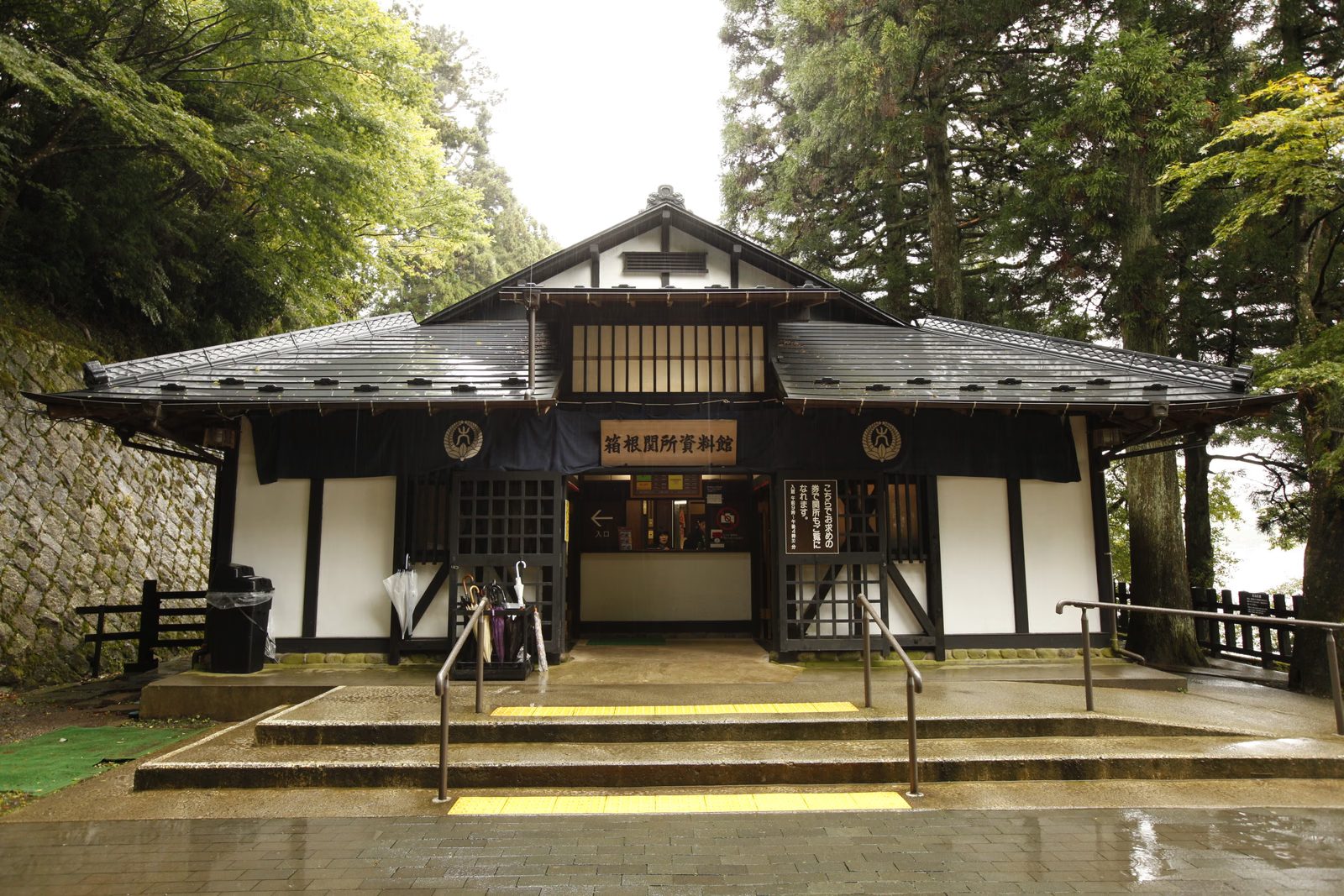
The museum supplies documents, objects and historical context that the reconstructed compound cannot carry by architecture alone. Exhibits explain checkpoint administration, travel permits, inspection and the wider network of Tokugawa barriers. Use it to test the simplified stories encountered in popular culture, especially the belief that all travelers were examined identically. Displays and loans may change, so the publication text should promise the institution rather than a particular object. Current admission, opening hours and photography rules require live verification.
Current visibility
At Hakone Sekisho, visitors can identify the material focus of “Hakone Sekisho Museum” through the museum display, the documentary evidence, and the administrative landscape; this does not promise unrestricted handling or close viewing.
Kyoguchi Gate and Edo-guchi Gate
Attraction
The gates mark the Kyoto and Edo sides of the checkpoint, turning a road into a bounded administrative interior. Walk the compound in one direction, then look back to see how each gate frames departure differently. Their names preserve orientation within the Tokaido network rather than merely labeling two similar entrances.
Current visibility
The present precinct at Hakone Sekisho still carries “Kyoguchi Gate and Edo-guchi Gate”; visitors can ground the text in the gate sequence, the road and path, and the administrative landscape.
Attraction
O-Bansho was the checkpoint's principal administrative building, where ranking officials worked and inspections were organized. Room hierarchy, raised floors and reconstructed furnishings show bureaucracy as spatial practice. Compare official seating positions with the areas assigned to travelers. Mannequins are interpretation aids, not surviving historical figures or proof of one exact daily scene.
Current visibility
O-Bansho is an evidence-based reconstructed guardhouse whose room hierarchy and furnishings interpret checkpoint administration; no original officials or daily scene survive.
Attraction
The lookout above the checkpoint extends surveillance beyond the gate line. From the elevated position, Lake Ashi, road and compound can be read as one controlled corridor. The climb is part of the evidence, but access may be difficult. Compare the broad view with the narrow inspection spaces below; state power operated through observation at several scales.
Current visibility
The place-specific feature discussed as “Toomi Bansho Lookout” is anchored by the gate sequence, the road and path, and the corridor, but today's access or operating condition at Hakone Sekisho requires a current official check.
Stone Walls and Lakeside Boundary
Attraction
Stone retaining walls and the lakeside edge helped contain the checkpoint within difficult terrain. They matter because the barrier was not only a row of rooms; landform, water and constructed boundaries restricted bypass. Follow the wall line toward the shore and notice where modern paths soften an environment originally designed to make unmonitored movement difficult.
Current visibility
“Stone Walls and Lakeside Boundary” can be assessed from the exterior at Hakone Sekisho; the on-site cues are the stone walls and the road and path, and routine interior entry is not implied.