Read the article below. Interactive reading tools are available when scripts load.
Quick
Taira no Kiyomori was born in 1118 and was raised as the son and heir of Taira no Tadamori. His mother's identity is less secure: later genealogical and narrative lines connect her or her sister to the court woman known as Gion no Nyōgo. The famous claim that retired emperor Shirakawa was Kiyomori's biological father appears in later tradition and cannot bear the weight of established fact. [3][4]
The legend made extraordinary advancement seem to reveal hidden imperial blood. A stronger explanation begins with accumulated family service. Kiyomori inherited court access, western provincial connections, maritime experience, armed followers, and rivals from Tadamori and his grandfather Masamori. That was a major platform, not a guarantee of supremacy.
Kiyomori entered court rank and guard-related office while young, with appointment chronology placing him at fifth rank in 1129. He later held central and provincial posts, including service connected to Higo and Aki. When Tadamori died in 1153, Kiyomori inherited leadership of a house already active around cloistered government and western Japan.
Rank did not make him a ceremonial noble detached from force. Provincial office connected central authorization to income, appointments, disputes, transport, and armed enforcement. Household succession brought brothers and half-brothers whose interests did not always coincide. Kiyomori's ascent began by converting inherited access into a broader, repeatable family position.
Before Kiyomori's famous harbor projects, his family had developed western provincial and maritime connections through service, anti-piracy operations, estate management, and exchange around Kyushu and the Seto Inland Sea. Foreign ships and goods normally entered through regulated networks centered on Dazaifu and Hakata; ceramics, medicines, books, textiles, metals, coins, and information then moved east.
Kiyomori later deepened these routes, but he did not invent trade with Song China or create Ōwada anchorage from nothing. Maritime power depended on sailors, merchants, pilots, port communities, provincial officials, temple networks, warehouses, and security. His importance lay in joining this existing world more closely to court and family strategy.
The Hōgen conflict of 1156 divided the imperial family, the Fujiwara regent house, and warrior lineages. Kiyomori supported reigning emperor Go-Shirakawa; his uncle Taira no Tadamasa supported retired emperor Sutoku. Minamoto no Yoshitomo fought beside Kiyomori while Yoshitomo's father Tameyoshi stood on the other side.
The victorious coalition won quickly in Kyoto. Afterward, the court ordered executions: Kiyomori killed or supervised the killing of Tadamasa and his sons, while Yoshitomo executed Tameyoshi and brothers. Victory brought Kiyomori Harima and advancement, but not independent warrior government. It demonstrated how central authority could make armed houses enforce judgment against their own kin.
In late 1159 Fujiwara no Nobuyori and Minamoto no Yoshitomo struck while Kiyomori was away on pilgrimage. They seized Go-Shirakawa and Emperor Nijō and killed the statesman Shinzei. Kiyomori returned, negotiated within a capital holding two captive sovereign centers, received authority after Nijō escaped to his side, and defeated the coalition.
Yoshitomo died while fleeing; captured followers and relatives were punished. His twelve-year-old son Yoritomo was exiled rather than executed. Later tradition credits Ike no Zenni's plea with mercy, but the full sentencing decision is unrecoverable. Heiji made Kiyomori Kyoto's strongest warrior leader without eliminating every Minamoto line or making him sole ruler.
After Heiji, Kiyomori advanced through court institutions, culminating in appointment as daijō-daijin, grand minister, in 1167. He resigned after a short tenure. In 1168 serious illness led him to take Buddhist vows under the name Jōkai; recovery did not remove him from politics.
Title, residence, provincial influence, family offices, marriage, and armed followers reinforced one another. Rokuhara in Kyoto became associated with the Taira political household, but Kiyomori did not create a separate shogunate there. Go-Shirakawa, the reigning sovereign's household, aristocrats, temples, and Taira relatives retained independent capacities. His power was greatest as a network, not as one office.
Kiyomori and the Taira made Itsukushima Shrine a major family devotional center. In 1164 family members dedicated the sumptuous scripture set known as the Heike nōkyō. The surviving group includes thirty-three scrolls; Kiyomori's dated prayer statement and contributions by leading relatives anchor the offering materially.
The scrolls combine copied scripture, decorated paper, pigments, metal, calligraphy, painting, binding, and ritual presentation. They show devotion, wealth, artistic labor, and family coordination more directly than later tales about Kiyomori's beliefs. The shrine buildings visible now include later repairs and reconstructions; object and architectural dates must remain separate.
In the 1170s Kiyomori spent increasing time at Fukuhara near Ōwada, an old anchorage at the eastern end of Inland Sea routes. Records connect Kiyomori and Go-Shirakawa with gifts and correspondence involving Song coastal officials. Kobe historical research associates Kiyomori with a privately financed harbor intervention in 1173 and a larger public project in 1180 that warfare probably prevented from being completed as planned.
Later tradition credits stone-filled boats and an artificial island made through heroic engineering. Such stories preserve the memory of difficult construction, not an audited blueprint. Harbor power depended on collective labor, coastal conditions, ships, merchants, and administrators. Exchange widened Kiyomori's resources; it was neither unrestricted modern commerce nor his personal invention.
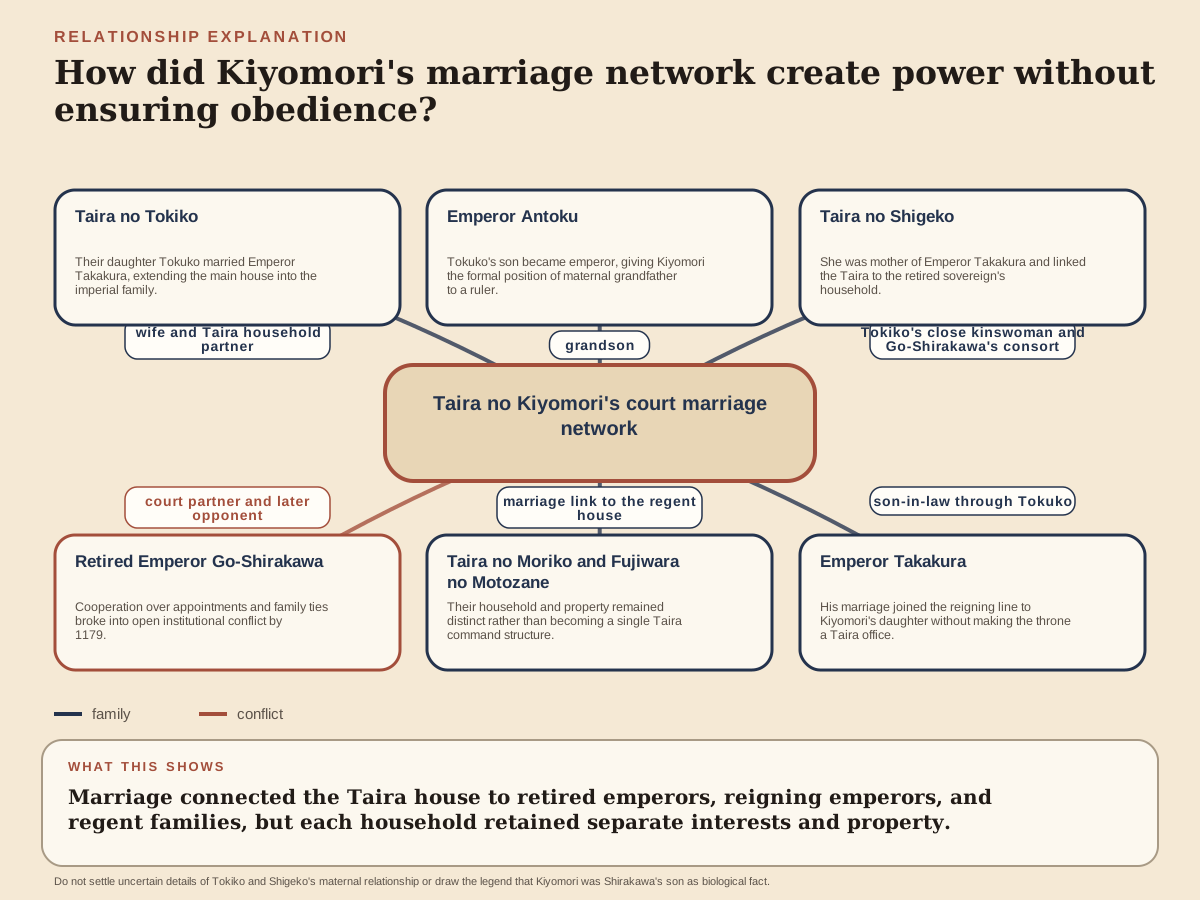
Kiyomori's political household depended on women and relatives with distinct routes. His wife Taira no Tokiko was sister or half-sister to Taira no Shigeko, who became Go-Shirakawa's consort and mother of the future Emperor Takakura. Kiyomori's daughter Moriko married regent Fujiwara no Motozane; daughter Tokuko later married Takakura. His eldest son Shigemori carried senior office and military responsibility.
These relationships linked the Taira to cloistered, reigning, and regent households. They did not make one obedient family machine. Property, inheritance, motherhood, office, and patronage gave Tokiko, Shigeko, Moriko, Tokuko, sons, brothers, and in-laws their own stakes. Kiyomori coordinated a family government whose power and internal tensions came from the same network.
Kiyomori's daughter Tokuko entered Emperor Takakura's household in 1171 and became empress in 1172. She gave birth to Prince Tokihito in 1178. In 1180 Takakura abdicated and the child acceded as Emperor Antoku, making Kiyomori maternal grandfather of the reigning sovereign.
The arrangement used an established court strategy rather than inventing a warrior monarchy. Maternal relatives could guard, staff, and benefit from a child emperor's household. But Takakura, Tokuko, attendants, Go-Shirakawa, ritual officers, and aristocrats did not become puppets without interests. The apparent summit of Taira power made every dispute over the family look like a dispute over succession and the realm.
Kiyomori and Go-Shirakawa had cooperated for years because each could use the other's military, court, and dynastic resources. The death of Shigeko in 1176 weakened a major personal bridge. In 1177 the Shishigatani affair led Kiyomori to punish figures associated with an anti-Taira conspiracy. In 1179, after Shigemori and Moriko died and disputes intensified over offices and inherited property, Kiyomori brought armed forces into Kyoto.
The coup removed or reassigned numerous officials, confiscated or redirected positions and estates, and confined Go-Shirakawa at Toba, halting his cloistered government. Kiyomori did not abolish court institutions; he coerced and restaffed them. The act revealed both unprecedented power and dependence on the very court order he was overriding.
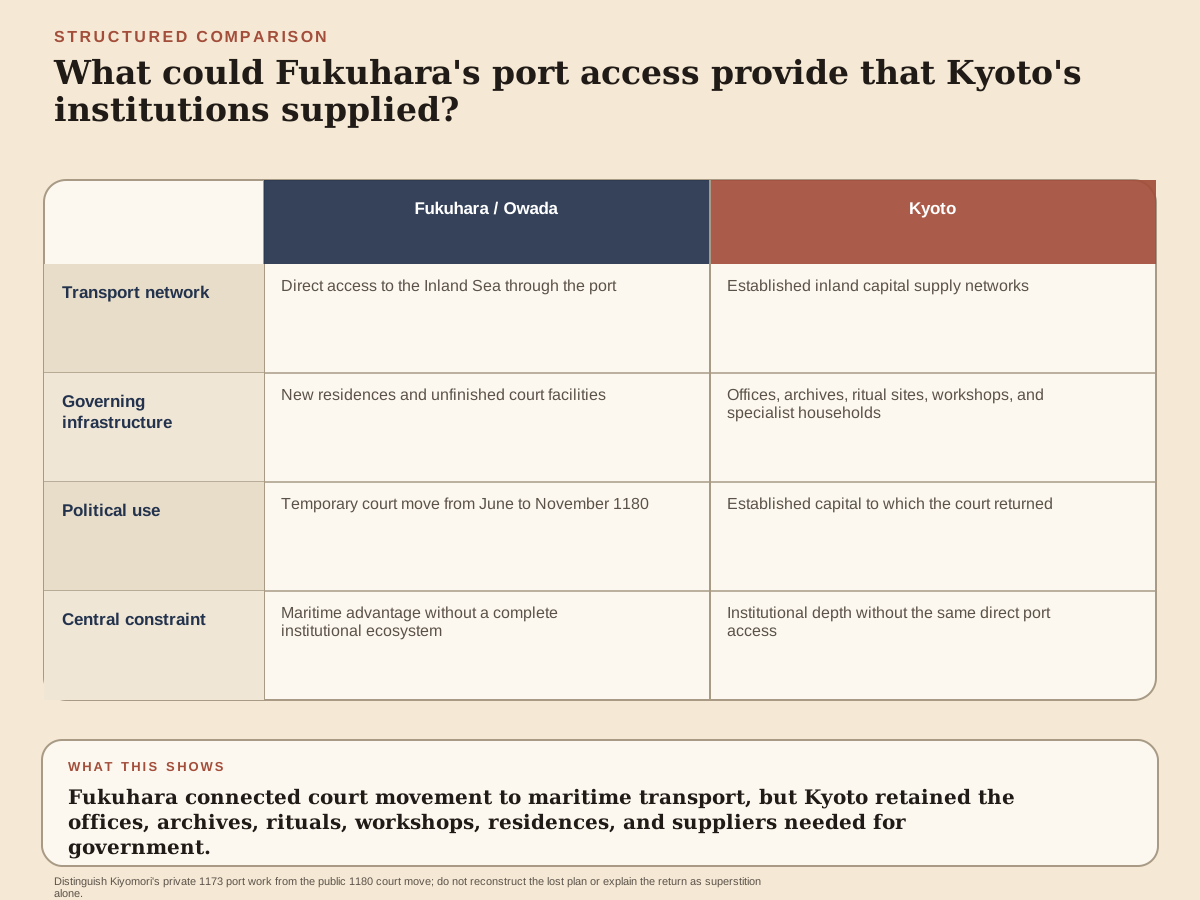
After Prince Mochihito's failed rising in 1180, Kiyomori moved Antoku, Takakura, Go-Shirakawa, and the court to Fukuhara near his maritime base. The move began in June and was reversed in November. Fukuhara offered western routes, Ōwada anchorage, Taira residences, and distance from hostile Kyoto institutions.
But a capital was more than sovereign bodies. Aristocratic residences, offices, temples, markets, workshops, roads, water, ritual sites, archives, suppliers, and service communities had accumulated around Kyoto. Construction and land allocation at Fukuhara could not reproduce them quickly, especially during war. Kiyomori could order the court to move; he could not command an urban system into immediate existence.
Late in 1180 Kiyomori's government sent forces led by his son Taira no Shigehira against Nara religious institutions that had resisted the Taira and supported opposition. Fighting and fire destroyed much of Kōfuku-ji and Tōdai-ji, including the Great Buddha Hall. People died as buildings, images, texts, residences, and stored resources burned.
The expedition was a coercive Taira operation for which Kiyomori bears command-level responsibility. Whether troops intended from the outset to burn entire temple complexes, or fire used during night combat spread catastrophically, remains disputed across sources. Uncertain intent does not erase foreseeable risk, material destruction, or the political decision to attack a dense sacred and urban landscape.
By late 1180 the conflict had escaped Kyoto's immediate control. Yoritomo survived Ishibashiyama, built an eastern coalition, and faced Taira forces at the Fuji River; Kiso Yoshinaka and other actors developed separate regional fronts. “Minamoto” did not describe one command. Kiyomori's court could issue condemnation and mobilize armies, but local land, kinship, supply, and service networks sustained resistance.
War overlapped with drought, disrupted transport, requisition, and the famine later associated with Yōwa. Kiyomori died of acute illness in 1181 before the crisis ended. Court diary confirms death and contemporary judgment more securely than the Heike's burning-fever spectacle. At death he could not know the Taira would leave Kyoto in 1183 or lose at Dan-no-ura in 1185.
After Kiyomori died, Munemori, Tomomori, Shigehira, Tokiko, Tokuko, and other Taira figures continued the war. The coalition withdrew from Kyoto in 1183 and was defeated at Dan-no-ura in 1185; Emperor Antoku and many relatives died. Kiyomori did not witness those events.
Defeat ended the court coalition he had built, not every Taira life or institution. Tokuko survived and entered a distinct religious memory; Yorimori and other lines continued; Itsukushima and the Heike nōkyō preserved devotion and art. The Tale of the Heike later made Kiyomori an unforgettable vehicle of power, violence, arrogance, and impermanence. That literary afterlife is evidence of reception, not the entire man.
Classic
Exceptional-paternity stories solve social surprise. If a warrior reaches the highest aristocratic office, hidden imperial descent can make the ascent feel natural rather than historically disruptive. The story also supplies the moral symmetry of concealed privilege eventually becoming visible power.
Appointment compilations treat Kiyomori as Tadamori’s son. His maternal identity and the story of Shirakawa’s paternity belong to a less uniform body of narrative and genealogical evidence.
Historical disagreement · How much weight can a birth tradition bear?
The Hyōgo literary museum’s account points to a relic-transmission genealogy that names Gion no Nyōgo’s sister, rather than Nyōgo herself, as Kiyomori’s mother. It treats this variant as reason not to dismiss imperial paternity as merely a Heike invention. Akamatsu Toshihide’s 1970 study reaches a different judgment: rereading the Heike and that genealogy, he interprets the imperial-son story as a product of the developing Nyōgo narrative. [3][4]
Disagreement about how the tradition developed is not independent proof of biological parentage. Tadamori’s recognized son and heir remains the secure household position from which to explain Kiyomori’s career. [3][4]
Political fatherhood matters independently of genetics. Tadamori raised Kiyomori within his household, secured or transferred opportunities, and positioned him as principal heir. Servants, siblings, clients, property, and reputation followed the recognized house. Medieval power did not wait for a DNA question that sources cannot answer.
The maternal uncertainty is also gendered archival evidence. A court woman might be identified by service name rather than personal name; her sister or dependant could disappear within a patron's household. Later narrators preserved the prestigious male possibility more vividly than the woman's recoverable life. Biography should not make her absence permission to romanticize Shirakawa.
Kiyomori's grandfather Masamori and father Tadamori had served retired sovereigns, undertaken provincial and maritime security work, and established western ties. Their success showed that an armed house could convert dangerous service into court rank and provincial benefit. It also exposed the family to competition with other military lineages and older courtiers.
Succession was made through relationships before it appeared as an office list. Taira no Kiyomori's conventional life dates are 1118–1181 and his recognized political father was Taira no Tadamori. These constraints deepen 1118 | Tadamori's Son and the Imperial-Father Story by showing how maternal lines, spouses, children, retainers, and rival branches could preserve a regime or turn one death into an institutional crisis.
Early advantage was substantial. Kiyomori did not begin as a landless outsider who conquered Kyoto by merit alone. Yet advantage remained conditional: a patron could die, a court coalition could fall, a provincial appointment could end, and a failed military choice could lead to execution.
The birth legend belongs in the canonical corpus as reception, because it shaped how generations understood Kiyomori's social crossing. It cannot serve as a hidden fact silently explaining his career. The more historically revealing question is how a recognized Taira heir learned to operate where retired sovereign, provincial office, maritime route, court ritual, and armed force met.
Beginning with Tadamori rather than Shirakawa also preserves causation. Kiyomori's later power emerged through Hōgen and Heiji victory, marriage networks, offices, property, religious patronage, maritime infrastructure, coercion, and dynastic opportunity. A secret father explains none of those mechanisms. It only makes their outcome look prewritten.
The archive is therefore strongest when it identifies recognized household position and weakest when it claims access to conception. That asymmetry must control the narrative.
Rank placed a person in a hierarchy of access and honor. Office authorized service, created fees and patronage, and made claims legible to other elites. A guard title did not mean autonomous command of the palace, but it connected the young Kiyomori to the institutional language through which future advancement would be measured.
The 1129 promotion attracted notice precisely because his house was rising across a social threshold. Contemporary diary tradition registers surprise at the favor shown to Tadamori's son. That reaction is stronger evidence of unusual advancement than the later solution of hidden imperial paternity.
Provincial appointments were not salaried jobs in a modern bureaucracy. A governor or related officeholder operated through deputies, local officials, estate managers, tax claims, judicial petitions, and armed agents. Income and influence could be converted into followers, gifts, religious patronage, and leverage at court.
Western provinces mattered to the Taira. Masamori and Tadamori had gained experience in maritime policing and links to Kyushu and the Inland Sea. Kiyomori's association with Aki and later Dazaifu-facing office placed him near routes through which goods and information moved between the continent, Hakata, the Inland Sea, and the capital region.
Household continuity did not mean family unanimity. Tadamori's wife Fujiwara no Muneko, later known as Ike no Zenni, was mother of Yorimori and held her own network. Kiyomori's brothers and half-brothers acquired different patrons, properties, and degrees of inclusion. Later “Heike” power can conceal these internal lines.
Succession in 1153 therefore transferred a portfolio rather than a crown. Kiyomori received recognized precedence, veteran retainers, provincial connections, court relationships, and responsibility for dependants. He also inherited the need to distribute benefits among relatives whose cooperation could not be assumed forever.
Court and military capacity reinforced each other. Patronage enabled appointments; appointments funded households; households supplied force; successful force protected patrons. The cycle was powerful but vulnerable to political realignment. An armed service failure could destroy the rank structure that success had built.
The surviving sources stand at unequal distances from the event. Appointment chronology places young Kiyomori at fifth rank and in a guard-related office in 1129, with later central and provincial advancement. In 1129–1153 | Rank, Province, and the Inherited Taira Platform, agreement can secure a sequence without securing every motive, while divergence reveals where later political or literary needs entered the record.
Religious and ceremonial literacy was part of the same preparation. A house near retired sovereigns had to sponsor rites, exchange gifts, observe precedence, and maintain residences. “Warrior” did not describe an alternative civilization outside court culture. It described one kind of elite capacity increasingly embedded within it.
By Tadamori's death, Kiyomori was neither an obscure soldier nor ruler of Japan. He was the adult head of an ascending service house with unusually diverse assets. The next crisis would test whether those assets could survive a civil conflict that split imperial, Fujiwara, Minamoto, and Taira kin lines alike.
Land revenue remained fundamental, but ships moved value differently. Imported objects could become court gifts, ritual materials, medical resources, or prestige goods. Copper coin affected exchange. Books and Buddhist texts carried knowledge. A vessel also brought news of continental conditions and relationships beyond one estate's harvest.
The sea was not open commercial space governed by modern free trade. Foreign relations, Dazaifu authority, elite permission, temple intermediaries, and private dealing overlapped. Categories such as “official” and “private” are useful only if they do not impose a later customs state on twelfth-century practice.
Taira maritime service had coercive roots. Suppressing or classifying piracy meant deciding which armed maritime actors were enemies, clients, carriers, or local authorities. Campaign reports celebrated pacification, but coastal communities did not necessarily see central enforcement as neutral order.
Provincial office converted route knowledge into political resource. An officeholder could appoint deputies, protect merchants, collect revenues, hear disputes, and cultivate local warrior houses. These capacities were distributed among family members and agents; Kiyomori did not personally stand on every quay or inspect every cargo.
Aki connected him to Itsukushima Shrine and the western Inland Sea. Religious patronage could sanctify travel, create family solidarity, and host court visitors. The later Heike nōkyō was therefore not an isolated burst of piety but material expression within a long regional relationship.
Ōwada, near present-day Kobe, already served as an anchorage on the eastern end of the Inland Sea route. Earlier authorities attempted repair, and later generations rebuilt it again. Harbor history is cumulative because silting, storms, construction limits, and changing vessels repeatedly alter what works.
Maritime wealth must not become a single-source legend of limitless profit. The exact volume of Kiyomori's trade and personal return is difficult to calculate. Taira wealth also came from provincial appointments, estate holdings, court households, and marriage property. Sea exchange widened the portfolio; it did not replace land.
The routes influenced political geography. A family with western provinces, ports, ships, and Itsukushima devotion could imagine Fukuhara as a center connected toward Kyushu and the continent rather than merely distant from Kyoto. That possibility would become explicit only later.
Kiyomori's innovation was therefore integrative. He connected service at the central court to provincial and maritime mechanisms inherited from his family. The same integration produced vulnerability: when civil war spread, ports, ships, food routes, and western alliances became military necessities that opponents could contest.
Institutional power becomes visible in repeated procedure. Masamori and Tadamori built Taira access through cloistered-government service, provincial appointments, western connections, and maritime security before Kiyomori led the house. The importance of Western Provinces and the Inland Sea | Power Was Already Maritime lies not only in who stood highest, but in how decisions moved through councils, documents, messengers, jurisdictions, and people able to obstruct or implement them.
This distinction also protects the agency of maritime communities. Their knowledge did not become Kiyomori's personal knowledge merely because his household profited from the routes they maintained.
The war was dynastic before it was “Taira versus Minamoto.” Sutoku and Go-Shirakawa had competing sovereign claims and households; Fujiwara Yorinaga and Tadamichi carried a regent-house struggle; temples, courtiers, and warriors entered different alignments. Lineage names did not dictate sides.
The record of violence requires separate levels of responsibility. The 1156 Hōgen conflict divided imperial, Fujiwara, Taira, and Minamoto households; Kiyomori and Yoshitomo supported Go-Shirakawa while Tadamasa and Tameyoshi opposed them. After Hōgen, Kiyomori executed or supervised the execution of his uncle Tadamasa and Tadamasa's sons under court judgment, while Yoshitomo executed Tameyoshi and brothers. For 1156 | Hōgen Victory and the Execution of an Uncle, authorization, field command, participation, punishment, and later commemoration are related but not interchangeable; keeping them distinct prevents both heroic compression and automatic collective guilt.
Kiyomori and Yoshitomo were military partners on the winning side. Later rivalry can make this cooperation look unnatural, but both sought survival and advantage through the authorized coalition. Their forces made urban combat decisive; court actors supplied the cause and postwar classification.
War tales developed councils, speeches, night-attack debates, feats, and lament. Court diaries and appointment records secure actors and consequences more firmly than every scene. The literary texts reveal how later generations made civil conflict morally intelligible, especially through filial and kin tragedy.
Postwar execution was the sharper boundary. Capital punishment had been uncommon in central political practice for centuries, though coercive death never disappeared from society. The victorious government revived or openly deployed it against rebels. Ordering kinsmen to carry out sentences bound military service to a terrible proof of obedience.
Kiyomori's uncle Tadamasa and Tadamasa's sons had pursued a different Taira household route. Their deaths removed rivals and enlarged Kiyomori's precedence, but saying only that he benefited sanitizes the act. The court made his service politically valuable by making it personally destructive.
Yoshitomo faced a comparable burden with Tameyoshi and brothers. The shared mechanism matters: the government did not merely reward victorious warriors; it compelled them to break defeated branches. Future Minamoto–Taira hostility cannot explain a violence both houses first performed within themselves.
Rewards then redistributed provincial capacity. Harima was a wealthy and strategically important appointment. Revenue and authority could strengthen Kiyomori's house, followers, and western network. The link between battlefield success and provincial benefit made armed service a route to durable institutional position.
Yet no warrior class seized sovereignty. Go-Shirakawa and court allies decided legitimacy, punishment, and office. Kiyomori's importance increased inside their order. “Beginning of warrior rule” is useful only as a long structural view; as an event description, it erases who authorized whom.
Hōgen showed both opportunity and dependence. Force could transform rank and property, but only if joined to a winning court claim. Kinship could mobilize followers, yet it could not prevent a lineage from splitting. Kiyomori emerged stronger because he chose successfully and accepted the costs demanded by victory.
Those costs were not confined to elite genealogy: confiscation, troop movement, urban fire, and postwar punishment reached dependants whose names rarely enter the tales.
Nobuyori and Yoshitomo initially controlled people and places through seizure. Go-Shirakawa's residence was attacked; Shinzei fled and was killed; both the retired sovereign and the reigning Nijō were confined. Military action aimed at authorization infrastructure, not merely rival barracks.
Kiyomori was reportedly on the Kumano route. Pilgrimage and politics were not separate worlds: elite travel involved armed attendants, religious obligations, roads, and news networks. Returning safely required judging whether to fight, bargain, or withdraw while the capital's legitimate centers were under another coalition's control.
The Nijō household's escape to Rokuhara changed the legal and symbolic balance. Once the reigning emperor stood within Kiyomori's protection, the opponents could be classified as rebels against authorized order. Go-Shirakawa's position still mattered, but the two sovereign centers had different followers and interests.
Chronology limits the temptation to read the ending backward. In the 1159 Heiji conflict, Nobuyori and Yoshitomo seized Go-Shirakawa and Emperor Nijō and killed Shinzei while Kiyomori was away. Taken in the order required by 1159–1160 | Heiji and the Politics of Two Sovereign Centers, these developments show a field of changing options rather than a destiny already visible at the beginning.
War-tale scenes turn the recovery into clever deception and heroic combat. Their tactics may preserve historical elements, but speeches and perfect sequences are not contemporary operations logs. Court and institutional evidence more securely establish captivity, escape, authorization, defeat, and appointments.
Yoshitomo's coalition was not “the Minamoto” acting as one clan. Other Minamoto served different patrons or survived outside it. Nor was Kiyomori defending one stable court party: former allies of Nijō and Go-Shirakawa could shift after Shinzei's death. He navigated division rather than commanding a unified state.
Punishment again reorganized households. Nobuyori was executed; Yoshitomo was killed during flight; sons and supporters met different fates. Yoritomo's exile later became the most consequential survival, but in 1160 it was a severe sentence imposed on a child of the defeated leader.
Ike no Zenni's intercession belongs to an enduring later account. Her own household position and the possibility of advocacy should not be dismissed, yet the story cannot reveal the entire judicial calculation. Age, kinship, status, political risk, and patronage may all have mattered.
Kiyomori's gain was structural. With Yoshitomo's central coalition broken, the court had fewer military houses able to balance the Taira in Kyoto. Kiyomori gained rank and opportunities while continuing to work through sovereign households, appointments, and law.
Heiji therefore created predominance, not sovereignty. The strongest armed leader still needed court authorization and cooperation. His next task was to turn emergency advantage into a family position able to survive changes between Nijō, Go-Shirakawa, and future rulers—a project that would depend as much on women and marriage as on soldiers.
The distinction explains why victory produced years of coalition-building rather than an immediate new constitution. Military success changed bargaining power; it did not abolish the bargaining field.
The appointment proved social and institutional crossing. A man from a house identified with military service entered the summit of the daijōkan rank order. Court society recognized the Taira head not merely as an enforcer but as one of its highest aristocrats.
The office did not function like a modern prime ministry. Deliberation, appointment, ritual, document production, household government, and cloistered rule were distributed. Go-Shirakawa could issue and mediate through his own household; the reigning emperor had attendants and allies; regent families retained property and prestige; temples commanded land and mass action.
Kiyomori's short tenure may reflect the office's ceremonial weight, political calculation, and the greater utility of less bounded influence. Resignation freed a position without dissolving his rank, kin network, provinces, property, or military clients. Formal office crowned accumulated capacity; it did not create or contain all of it.
Rokuhara demonstrates household geography. Taira residences, dependants, clerks, guards, and visiting petitioners concentrated in eastern Kyoto. A residence could serve family life, audience, storage, administration, and mobilization. It was a node within the capital, not an independent national bureaucracy.
The family was internally structured. Kiyomori's eldest son Shigemori accumulated office and military responsibility; other sons and brothers followed different routes. His wife Taira no Tokiko led a powerful household whose siblings connected the family to Go-Shirakawa. Benefits could bind relatives while unequal distribution generated resentment.
Temple and shrine history makes the political field larger, not less concrete. Kiyomori became daijō-daijin in 1167, resigned after a brief tenure, and continued to exercise influence through other channels. Kiyomori took Buddhist vows as Jōkai during serious illness in 1168 and did not thereby withdraw permanently from politics. For 1160–1168 | Court Aristocrat, House Leader, and Tonsured Power, sacred authority moved through people, documents, provisions, buildings, and repeated rites, so neither private belief nor state command alone explains the result.
The 1168 illness exposed bodily contingency. Taking vows was a serious religious and social response to the possibility of death. The name Jōkai and tonsured status changed his public form. Recovery allowed continued activity, showing that renunciation did not necessarily erase property or political responsibility.
Buddhist identity was not simply hypocrisy contradicted by later violence. Elite patrons could fund sutras, temples, and rites while commanding coercion. The tension is real, but historians should not assume premodern actors experienced religion and power as mutually exclusive categories.
Kiyomori's ascent also depended on labor beneath elite titles. Provincial deputies gathered revenue; scribes authenticated orders; messengers crossed routes; craftsmen supplied residences and gifts; guards enforced access; women arranged households and marriage. Calling it personal dictatorship hides the machinery.
By 1168, Kiyomori had transformed the Taira position while remaining inside a plural court order. The most durable extension would come from household reproduction and maternal kinship. That strategy created a bridge to Go-Shirakawa and the imperial line—and eventually concentrated rivalry around the same bridge.
It also made succession inseparable from women's health, residence, and property, conditions that formal office lists alone cannot represent.
An object records coordinated work. Someone prepared paper, ground pigments, laid gold or silver, copied texts, painted frontispieces, mounted scrolls, transported them, and conducted dedication. Patrons supplied resources and intention, but artisans and ritual specialists made the offering physically possible.
The set is often described as thirty-three scrolls, including Lotus Sutra-related books and additional texts. Individual colophons and the Kiyomori prayer establish 1164. Later repairs, including early seventeenth-century replacement elements, show that even a secure twelfth-century object has a conservation history.
Itsukushima joined sacred landscape to maritime movement. The island shrine stood along routes important to the Taira's western connections. Court visitors who traveled there experienced devotion in a Place where the family's ships, regional relationships, and artistic resources were visible.
Calling the offering propaganda alone would misunderstand religious action. Kiyomori and relatives could seek protection, merit, family continuity, and salvation sincerely. The same act displayed their capacity to assemble elite culture. Sincerity and political effect are not opposites.
The dedication was collective. Shigemori, brothers, and other relatives contributed. That matters because later narrative centers the family on Kiyomori's will. The scroll set instead shows a house performing unity through distributed participation. Each written portion and name placed a person within shared devotion.
Family unity in ritual did not eliminate hierarchy. Kiyomori's prayer and patron position framed the group; resources were unequal; women and artisans can be less visible in the surviving naming. The object preserves some participants with extraordinary clarity while leaving others anonymous.
The shrine's architecture requires phase control. Kiyomori's patronage profoundly shaped its importance and design history, but fires, storms, rebuilding, elite donations, and conservation changed the complex. Visitors should not be told that every present beam or corridor physically witnessed the 1164 dedication.
Objects and built space alter the historical question. In 1164 Kiyomori and other Taira family members dedicated the Heike nōkyō at Itsukushima; the surviving group contains thirty-three scrolls and a dated Kiyomori prayer text. Their value in 1164 | Itsukushima and the Material Labor of Taira Devotion lies in convergence with chronology, not in visual drama alone. Construction, custody, rebuilding, and loss distribute agency beyond the named protagonist and keep later fabric distinct from the first phase.
Itsukushima also complicates the later image of Kiyomori as exclusively hostile to religion. Patronage at one institution and violence against others could coexist because temples and shrines were not one political bloc. Devotion did not guarantee nonviolence; conflict with a monastery did not prove disbelief.
The material layer therefore resists both saint and tyrant. It establishes sustained religious investment and extraordinary cultural production without acquitting coercion elsewhere. Kiyomori's historical world included aesthetic refinement, ritual fear, family ambition, and armed power at the same time.
The scrolls' survival has its own political history. Repairing, treasuring, classifying, and exhibiting them required later patrons and institutions; preservation is not the same event as creation. Their present brilliance therefore joins twelfth-century manufacture to centuries of custody, while the dated colophons keep those layers distinguishable.
The first discipline is chronology. Ōwada existed before Kiyomori. Earlier government had attempted repair, and the harbor remained vulnerable to winds, waves, sediment, and insufficient shelter. His interventions belong to a long sequence of construction and rebuilding rather than a creation from empty coast.
The second is institutional plurality. Song shipping normally reached Hakata and Dazaifu-facing networks. Court permission, provincial administration, temples, merchants, shipowners, and private intermediaries overlapped. Kiyomori could cultivate contacts and redirect goods without possessing a modern customs authority.
Contemporary chronology records exchanges of gifts and letters between Mingzhou officials and Go-Shirakawa or Kiyomori around 1170 and 1173. These contacts show high-level participation. They do not by themselves quantify annual cargo, personal profit, or a national trade balance.
Imported goods mattered differently. Ceramics entered elite consumption; medicines could confer practical and prestigious value; books and sutras moved religious knowledge; textiles and fragrances enriched gift culture; coin circulated beyond one lord's treasury. Maritime exchange connected economic, diplomatic, ritual, and cultural systems.
Harbor building required uncelebrated labor. Stone had to be quarried, transported, sunk or laid; timber and earth moved; boats coordinated; food supplied; damage repaired. Legends of people carrying stones or sacrificing objects compress a social project into a founder's will.
Kobe municipal research distinguishes a 1173 private project from the larger 1180 initiative, while warning that the latter may not have reached intended completion. That distinction prevents “Kiyomori built the harbor” from becoming a single undated claim. Archaeology and text can establish elite activity without revealing a complete master plan.
Fukuhara's residences added political use. Go-Shirakawa and court figures visited; ceremonies and entertainments could occur near the maritime base. Kiyomori did not abandon court politics when he moved physically west of Kyoto. He extended court relationships into another landscape.
Maritime ambition also had military implications. Ships carried troops and supplies; ports linked western supporters; control of routes could sustain a mobile court. These assets helped the Taira after Kiyomori's death, but they did not make the sea uncontested or compensate automatically for eastern land coalitions.
Kiyomori's significance lies in integration at scale. He made harbor, foreign exchange, family property, religious patronage, and sovereign visitation parts of one political geography. The achievement was historically specific: aristocratic, regulated, household-centered, labor-intensive, and inseparable from coercive control of routes.
Physical evidence keeps the narrative from floating free of labor and place. Taira western wealth and capacity drew on provincial office, anti-piracy/maritime service, Hakata and Inland Sea connections, estates, and court households; Song trade was one component. For 1170–1180 | Song Exchange, Ōwada, and the Limits of Harbor Legend, scale and survival matter as much as intention: the remains identify what people made or used, while later repair prevents the surviving site from becoming a frozen photograph of the original moment.
Archaeological imports support high-status consumption near the maritime base, but a recovered ceramic cannot by itself name Kiyomori as purchaser. Object, context, and patron attribution remain separate claims.
The first disappearance is women's institutional position. Tokiko headed a major household, bore children, sponsored religion, and linked siblings. Shigeko's relationship with Go-Shirakawa gave her continuing access and made her son Takakura central to succession. Their kinship connected Kiyomori to the retired sovereign through more than military service.
Source form determines what can safely be claimed. Kiyomori's wife Tokiko was closely related to Shigeko, Go-Shirakawa's consort and mother of the future Emperor Takakura. Kiyomori's daughter Moriko married Fujiwara no Motozane, making regent-house property and widow inheritance central to later conflict. That distinction is central to Tokiko, Shigeko, Shigemori, and a Family Government: an appointment, inventory, diary notice, accusation, and later tale may all preserve information, but they do not carry the same authority or answer the same question.
Shigeko was not simply Kiyomori's agent in Go-Shirakawa's residence. As consort and later imperial mother, she had her own attendants, property, ritual obligations, and interest in her son's position. Her ability to mediate likely helped sustain cooperation between powerful men whose objectives overlapped without becoming identical.
Moriko's marriage to Fujiwara no Motozane connected the Taira to the regent house. After his death, questions concerning inherited estate holdings became politically explosive. Property attached to a woman and marriage could move enormous resources while remaining vulnerable to intervention by natal kin, marital kin, and the retired sovereign.
Tokuko's marriage route would eventually make Kiyomori maternal grandfather to an emperor. Yet in this chapter she remains a daughter entering a demanding court household, not a guaranteed womb for succession. Her attendants and later choices belong to her own person narrative.
Sons differentiated military and household succession. Shigemori was not merely obedient heir; he held office, cultivated relationships, and became a possible mediator between Kiyomori and Go-Shirakawa in later narrative and politics. Munemori, Tomomori, Shigehira, and other sons acquired different commands and reputations.
Brothers and half-brothers also varied. Yorimori's maternal connection to Ike no Zenni and Go-Shirakawa contributed to a route distinct from Kiyomori's direct descendants. He ultimately survived the family's western defeat. That future warns against treating “Taira fate” as identical for every branch.
Family appointments were mechanisms of continuity. Offices generated income and authority; marriage created access; children gave claims to future households; residence networks transmitted information. Concentration also excluded older aristocrats and rival warriors, turning family success into others' material loss.
The network depended on mortality. A mediator's death could release property disputes; a childless marriage could fail its expected function; an heir could predecease Kiyomori. Political designs built through bodies and relationships remained biologically and emotionally precarious.
Kiyomori's achievement was coordination, not omnipotence. He aligned many household routes long enough to dominate central distribution. The cost was that every inheritance, marriage, birth, death, or sibling grievance could become a constitutional event. The family was the regime's infrastructure and its most exposed fault line.
Genealogical charts make these links look stable after the fact. In life, pregnancy, illness, widowhood, competing maternal houses, and uncertain inheritance repeatedly reopened them.
The Fujiwara had long used daughters' marriages and maternal kinship to link a family to succession. Kiyomori entered that political grammar. The innovation was not the mechanism itself but the scale at which a military-service house now used it alongside provincial, maritime, and coercive resources.
Tokuko's status required a whole household. Ladies-in-waiting, nurses, ritual specialists, physicians, scribes, property managers, and courtiers supported pregnancy and birth. A son did not emerge from Kiyomori's strategy alone. Maternal risk and women's labor made dynastic planning possible.
Prince Tokihito's birth in 1178 transformed expectations but did not predetermine accession. Infant mortality, competing princes, Go-Shirakawa's preferences, Takakura's health, and court procedure remained relevant. Celebrations demonstrate hope and mobilized wealth; they do not prove everyone accepted the future.
Succession was made through relationships before it appeared as an office list. Tokuko entered Takakura's household in 1171, became empress in 1172, and gave birth to Prince Tokihito in 1178. Prince Tokihito acceded as Emperor Antoku in 1180, making Kiyomori maternal grandfather of the reigning child. These constraints deepen 1171–1180 | Tokuko, Takakura, and the Infant Emperor Antoku by showing how maternal lines, spouses, children, retainers, and rival branches could preserve a regime or turn one death into an institutional crisis.
Accession in 1180 created overlapping household rule. Antoku was too young for personal government, but calling him a puppet collapses the people and offices acting in his name. Tokuko was imperial mother; Takakura became retired sovereign; Go-Shirakawa remained an older retired sovereign under constraint; Kiyomori was maternal grandfather and dominant house head.
These positions did not form a neat constitution. Each had attendants, property, prestige, and channels for commands. Kiyomori could control access and appointments through military pressure, yet ritual validity and aristocratic cooperation remained necessary. The child emperor intensified rather than removed institutional plurality.
Takakura's agency deserves protection. His cultural, religious, and personal relationships were not reducible to his mother's or father-in-law's plans. His abdication occurred amid pressure and crisis, but a biography of Kiyomori cannot consume his interior life.
Tokuko likewise cannot be only the bridge between men. She endured pregnancy, ceremonial obligations, court scrutiny, and later flight. Her survival after Dan-no-ura gave her a religious and memorial afterlife distinct from the Taira men who died. This chapter attaches her to a shared succession Event without appropriating it.
Maternal kinship concentrated opposition. Rivals could frame Taira appointments and property as seizure of the throne; Taira supporters could frame resistance as danger to the reigning sovereign. When Prince Mochihito rebelled, competing royal legitimacy would give local grievances a wider language.
The summit was fragile because it depended on a child and on forced cooperation after the relationship with Go-Shirakawa had broken. Kiyomori had achieved the most prestigious possible connection, but the family now had fewer political exits: loss of control threatened both household advantage and the emperor whose identity legitimated it.
Antoku's accession date is therefore a dynastic threshold, not a moment when all effective government passed into one grandfather's hands.
The premise is wrong. For much of the 1160s and 1170s, Kiyomori and Go-Shirakawa shared advantage unevenly. The retired sovereign needed military and administrative capacity; the Taira needed appointments, legitimacy, property decisions, and access. Cooperation could be intense without eliminating rivalry.
Shigeko embodied a household connection between them. As Tokiko's sister or half-sister and mother of Takakura, she linked succession interests. Her death removed a mediator with standing in both networks. No single death caused the rupture, but it altered how conflicts could be contained.
The Shishigatani episode of 1177 brought punishment upon Fujiwara no Narichika, the monk Shunkan, Saikō and others in Go-Shirakawa’s circle.
Historical disagreement · A discovered plot or an intervention over Enryaku-ji?
The familiar account makes a secret anti-Taira meeting at Shishigatani and Yukitsuna’s disclosure the cause of Kiyomori’s crackdown. Kawai Yasushi’s 2021 study rejects that reconstruction. He argues that Kiyomori intervened to stop an armed attack on Enryaku-ji by Go-Shirakawa and his close retainers, treating the secret-plot story circulating among courtiers as rumor rather than an established occurrence. [2]
The punishment of Saikō, Narichika and their associates remains central. What changes is the action it answered: Go-Shirakawa’s involvement in a temple conflict is not the same proposition as his participation in the dramatized conspiracy meeting. [2]
Kiyomori’s repression weakened that circle and narrowed the space for negotiation between the two centers of power.
Shigemori's death in 1179 mattered institutionally as well as personally. He had carried senior Taira office and relationships with the retired sovereign's sphere. The later Heike turns him into a moral counterweight to his father; court evidence supports importance without making every filial speech verbatim.
Moriko's death reopened control of enormous regent-house property connected to her marriage with Fujiwara no Motozane. Scholarship identifies this inheritance struggle as a direct mechanism behind the coup. Go-Shirakawa's intervention threatened Taira control and showed how marriage property could become a contest between sovereign and family households.
Personnel conflict compounded property. Appointments could displace Taira clients or promote opponents. Kiyomori's armed entry in November 1179 answered not one insult but a perceived attempt to dismantle the house's institutional base. The coup was preventive from his perspective and aggressive in its operation.
Several dozen officials were dismissed, exiled, confined, or otherwise displaced in received accounting. Exact lists and categories require source care, but the scale is clear. The action reorganized court office through military pressure rather than a new written constitution.
The surviving sources stand at unequal distances from the event. Kiyomori's daughter Moriko married Fujiwara no Motozane, making regent-house property and widow inheritance central to later conflict. Shigemori, other sons, brothers, women, affines, retainers, and distinct maternal lines formed a plural Taira household rather than one frictionless bloc. In 1176–1179 | From Partnership with Go-Shirakawa to Armed Coup, agreement can secure a sequence without securing every motive, while divergence reveals where later political or literary needs entered the record.
Go-Shirakawa's confinement suspended his effective cloistered government; it did not erase his status, memory, contacts, or future agency. Kiyomori still required sovereign forms for appointments and succession. The prisoner remained a political center whose liberation opponents could invoke.
The coup marks the height of coercive capacity and the collapse of negotiated legitimacy. Kiyomori could compel the capital to function under new personnel, yet coercion concentrated previously separate grievances. The more he secured family property and succession by force, the easier it became for rivals to present resistance as restoration of public order.
The timing matters. Prince Mochihito and Minamoto no Yorimasa had used royal authorization and temple support against the Taira. Their uprising failed, but it showed that Kyoto and nearby religious networks could generate rebellion. Moving the sovereign households west could improve security and alter the political field.
Fukuhara was not empty. Kiyomori maintained residences there; Go-Shirakawa and court figures had visited; imported ceramics and elite archaeological traces support high-status occupation. The nearby anchorage connected the site to Inland Sea shipping and Taira western resources.
Maritime logic did not make it a finished capital. Court ceremony depended on particular halls, shrines, temples, routes, and personnel. Aristocrats needed residences appropriate to rank. Documents and officials had to move. Markets, craftsmen, laborers, and food supply could not be created simply by relocating the emperor.
Evidence and interpretation · A projected capital and surviving remains
Kobe’s account distinguishes the first plan for a capital around Wada from the later attempt to build around an imperial residence at Fukuhara. The southern site lacked sufficient space between mountains and sea; the plan shifted rather than producing a complete new city in one step. [1]
Excavation does not remove every uncertainty. The Gion site is associated with an elite residence that may have belonged to Kiyomori or someone close to him. A proposed city, a relocated court and excavated buildings are related evidence, but they do not supply an exact map of one finished capital. [1]
The move imposed costs unevenly. Court families had to construct or improvise residences; local inhabitants faced land and labor demands; suppliers followed uncertain demand; religious institutions lost proximity to court ritual and influence. Resistance was material, not merely sentimental attachment to Kyoto.
Go-Shirakawa's presence was coerced. Moving a confined retired sovereign did not neutralize his legitimacy. Takakura reportedly experienced strain; Antoku was an infant; Tokuko and women's households had to relocate attendants and ritual needs. “Kiyomori moved the court” compresses many bodies under command.
War worsened feasibility. Eastern and provincial risings required troops, information, provisions, and decisions. A government trying to create a capital while fighting on expanding fronts divided its resources. The anticipated larger Ōwada project likewise appears not to have reached planned completion.
The material record supplies a check that narrative sources cannot provide by themselves. Kobe historical research associates Kiyomori with a 1173 private harbor repair and a larger 1180 public project probably not completed as intended during war. These traces establish capacity, sequence, and collective work; they do not identify every hand, purchaser, plan, or private purpose attached to what survives.
Returning to Kyoto in November was therefore not proof that the idea lacked all rationale. It was evidence that institutional gravity, resistance, construction limits, and war outweighed maritime advantage. Kiyomori could reverse course because political survival mattered more than consistency.
Fukuhara remains historically significant as an alternative geography. It shows the Taira order looking west and seaward rather than treating Kyoto as the only imaginable center. Its failure reveals that political space is produced by accumulated institutions and communities—not by a powerful man's preference or a line on a map.
The return also restored proximity to hostile institutions. Reversal solved the immediate logistical crisis without undoing the political grievances that had made relocation attractive.
The conflict had a longer institutional history. Kōfuku-ji and Tōdai-ji held land, armed communities, ritual prestige, and political ties. Monastic actors were not unarmed spectators outside politics. Some supported Prince Mochihito's cause or resisted Taira demands; Nara forces threatened routes and authority.
Recognizing temple agency does not justify collective destruction. Monasteries were also schools, archives, workshops, residences, hospitals of ritual care, storehouses, and sacred sites serving wider populations. Armed monks, ordinary clergy, workers, dependants, pilgrims, and nearby residents did not share equal responsibility.
Shigehira held operational command in the received record, with Tomomori and other Taira forces involved in the campaign context. Kiyomori authorized or directed the suppression at regime level. Shared Event architecture separates their routes without allowing the house head to disappear behind his son's name.
Accounts describe fire used for illumination or attack during combat, then wind or density carrying flames. War tales and temple traditions intensify catastrophe through moral causation and large death counts. Court and temple evidence confirms extensive burning more securely than every tactical detail or number.
Intent has levels. Kiyomori may not have ordered “burn every hall,” yet sending armed forces to punish major monasteries made fire and civilian loss foreseeable. Command responsibility includes the target, force, timing, and failure or inability to contain the outcome—not only a recovered sentence expressing desire for total destruction.
Material loss was vast. Tōdai-ji's Great Buddha Hall and much of the precinct burned; Kōfuku-ji also suffered severe destruction. Sculptures, scriptures, documents, ritual implements, and buildings represented centuries of labor and patronage. The fire changed what later generations physically inherited.
The event immediately reshaped Kiyomori's reputation. Destroying great Buddhist centers supplied opponents with a moral language of sacrilege and karmic punishment. His death soon afterward could then be narrated as cosmic judgment. That reception had political force without becoming medical proof.
Rebuilding reveals the scale of destruction and the plurality of recovery. Chōgen later mobilized court, Yoritomo, provinces, craftsmen, continental knowledge, donors, and labor over years. Present Tōdai-ji features belong to later reconstruction phases; they are not untouched survivors of Kiyomori's attack.
This chapter refuses two absolutions. Religious institutions cannot be made passive merely to demonize Kiyomori, and their political participation cannot make the burning an ordinary battle with no ethical remainder. A historically responsible account preserves agency, disputed intent, command hierarchy, physical loss, and the lives caught between them.
Ritual language should not conceal administrative mechanism. In December 1180 a Taira expedition led by Shigehira attacked Nara religious forces and fire destroyed much of Kōfuku-ji and Tōdai-ji, including the Great Buddha Hall. The significance of December 1180 | Nanto Burning and Command Responsibility lies partly in how religious legitimacy was produced and verified through institutions, while miracle, doctrine, patronage, and coercive authority retain different evidence states.
The later punishment of Shigehira likewise belongs to another actor's route and to the victors' settlement; it cannot retroactively settle Kiyomori's precise intent in 1180.
Central government worked through provinces, estates, local officials, and armed households rather than a uniform chain. An order from Kyoto could classify rebellion and authorize punishment, but implementation depended on people whose interests might favor resistance, delay, or negotiation.
Yoritomo built authority in the east by connecting disputes and promises to a returnable center. Chiba, Kazusa, Miura, Hōjō, and other houses joined for distinct reasons. His coalition was not the automatic awakening of a Minamoto class. Kiyomori faced an institutional competitor forming through local service relationships.
The Fuji River withdrawal became a literary emblem of Taira weakness, including the famous waterfowl panic. Tactical details vary, and army figures are not audited counts. More securely, the expedition withdrew without breaking Yoritomo, demonstrating the difficulty of sustaining a distant campaign.
Yoshinaka created another center in Shinano and the north-central routes. He was not Yoritomo's subordinate and would later compete with him. Other regional rebellions in Kyushu, Kinai, and elsewhere had local causes. Kiyomori's enemy field was plural, forcing the Taira to divide command and supply.
Campaign chronology disperses agency across a coalition. Taira no Kiyomori's conventional life dates are 1118–1181 and his recognized political father was Taira no Tadamori. In 1180–1181 | Regional War, Famine, and Death before an Ending, command depended on routes, provisions, messages, local adhesion, and the willingness of other houses to act. Victory or defeat cannot by itself prove a single prior plan.
Food conditions made every campaign harder. Drought and poor harvest reduced available grain; requisition for armies and building could intensify scarcity; fighting and transport disruption hindered distribution. The famine conventionally called Yōwa's continued after Kiyomori's death, so it cannot be attributed to one ruler alone.
Contemporary and near-contemporary records describe bodies in Kyoto and criticize the burden of construction and military provisions during scarcity. Elite strategy operated inside an environmental and social crisis that killed people with no control over succession.
Kiyomori's last illness came amid these failures and pressures. The exact diagnosis remains uncertain. Later medical proposals can be hypotheses, not recovered clinical records. The Heike transforms extraordinary heat into karmic fire, making the destroyer of temples burn before death.
That scene is culturally central and historically powerful as reception. It links Nanto, arrogance, impermanence, and approaching Taira fall. It is not a thermometer reading or proof that moral causation produced fever. Court diarist Kujō Kanezane's death notice and assessment provide a different elite contemporary view, itself not neutral.
At death, Kiyomori still left considerable assets: the child emperor, central offices, western provinces, ships, armed relatives, and religious-political ties. His inability to see the ending is essential.
Calling him a failed shogunate founder imposes the successor's architecture. Kiyomori did not try to create Kamakura's eastern gokenin order. He embedded armed household power at the summit of court office, cloistered government, maternal kinship, regent property, western provinces, religious patronage, and maritime exchange.
That form achieved extraordinary reach. A Taira head became grand minister; family women connected the house to Go-Shirakawa, Takakura, and Antoku; relatives held high office; ports and foreign goods entered political strategy. The model cannot be dismissed simply because it lost a later war.
Its weaknesses were equally specific. Benefits concentrated in kin networks; property and personnel conflicts alienated established elites; the 1179 coup replaced negotiation with force; control of Kyoto did not create uniform command over eastern landholders; succession depended on fragile households; coordination centered heavily on Kiyomori.
After his death, the family continued rather than collapsing immediately. That four-year struggle demonstrates institutional resources and the agency of later leaders. Munemori made decisions; Tomomori and Shigehira commanded; Tokiko and Tokuko carried the imperial household; sailors, warriors, attendants, and western communities sustained movement.
Dan-no-ura must not be projected into Kiyomori's last consciousness. It also cannot be reduced to deserved punishment. Antoku was a child; women, attendants, and ordinary combatants faced capture or death; survivors entered religious life or new patronage. Dynastic catastrophe was not a moral diagram.
“Taira extinction” is inaccurate. The particular Heike court coalition was destroyed, while other Taira branches survived, including people not fully aligned with Kiyomori's direct line. Names, lands, and descendants continued in changed forms. Political defeat and genealogical disappearance are different claims.
The material record supplies a check that narrative sources cannot provide by themselves. Present Itsukushima fabric and the scroll set contain later repair/conservation phases and cannot all be treated as untouched 1164 material. Read within 1181 and After | A Lost Regime, Surviving People, and the Heike Kiyomori, these traces establish capacity, sequence, and collective work; they do not identify every hand, purchaser, plan, or private purpose attached to what survives.
The Heike monogatari created the most durable Kiyomori. Its opening meditation on impermanence, episodes of arrogance and sexuality, religious violence, fever, and downfall made his life a moral architecture. Multiple textual lines and performance traditions developed over time; there is no single transparent tale identical to events.
Other memories complicate him: Itsukushima patron, maritime innovator, Kobe founder figure, tyrant, family patriarch, court aristocrat, and transitional warrior. Local monuments and modern representations add further layers.
Kiyomori's historical significance is multiplicity. He showed that military houses could become court aristocrats without ceasing to command force, that women and property could make household government national, and that maritime geography could enter central strategy. He also showed how coercive concentration could turn partnership into isolation. The lost regime remains historically real precisely because it was not a primitive version of the one that replaced it.