Map: GSI Japan Rokuhara on Kyoto's eastern side was repeatedly remade as a place of popular religion and warrior power. Rokuharamitsu-ji preserves a tenth-century principal image, a fourteenth-century Main Hall, medieval sculpture, and objects connected with urban devotion. Around it, the residences of the Taira and later the Kamakura government's Rokuhara Tandai disappeared beneath the modern neighborhood. The area therefore joins unusually strong surviving temple evidence with political institutions that must be recovered from archaeology, documents, place memory, and a relocated stone marker.
Kūya's Urban Buddhism and the 951 Foundation
Attraction
Rokuharamitsu-ji traces its origin to the preacher Kūya and a temple first called Saikō-ji. Tradition connects the foundation with public response to epidemic disease, chanting, and the distribution of a medicinal drink. The exact narrative has devotional form, but it preserves a historically important image of Buddhism practiced in streets among ordinary residents rather than only inside elite monasteries. Rokuhara's location near routes, burial grounds, and dense settlement made that public orientation meaningful. The temple's later political neighbors should not erase its older identity as an institution of urban ritual and popular participation.
Current visibility
The operating temple occupies the historic institution's site; its present precinct is much smaller and later than the tenth-century foundation.
The 1363 Main Hall: Survival through Rebuilding
Attraction
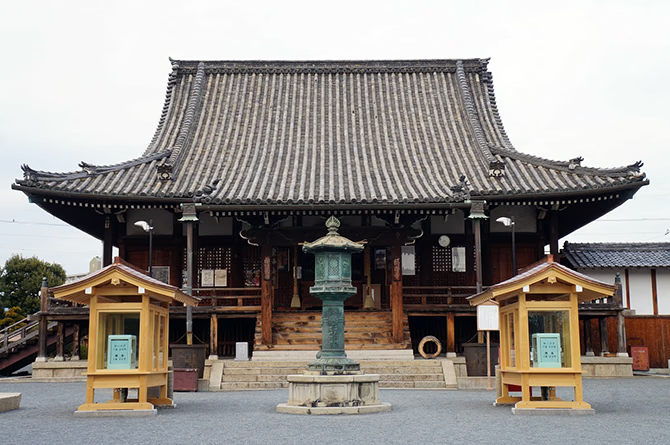
The current Main Hall dates to a 1363 rebuilding campaign and is designated an important cultural property. It is therefore neither Kūya's original hall nor a modern replica. Its fabric embodies the temple's repeated exposure to urban fire and war, followed by repair under new political patrons. A major conservation project in 1969 again renewed the structure. Reading those phases avoids a false choice between original and reconstructed: medieval buildings often survive through replacement of parts, structural intervention, and continued use. The hall gives Rokuhara a rare standing architectural anchor amid political sites that have otherwise disappeared below the modern city.
Current visibility
The medieval Main Hall is visible within the active precinct; worship, conservation, and temple rules govern interior use.
Kūya's Speaking Body in the Reiwakan
Attraction
The celebrated standing portrait of Kūya was carved by Kōshō in the thirteenth century. Six small Amida figures emerge from its mouth, giving sculptural form to the six syllables of the nenbutsu. The image is not a literal portrait made from life; it is a later visual argument about voice, movement, poverty, and public preaching. Display in the Reiwakan allows unusually close study of sandals, staff, gong, exposed knees, and the line of figures. Its historical value lies in how medieval sculptors translated an earlier preacher's remembered practice into an immediately legible body.
Current visibility
The statue is held in the Reiwakan collection; current opening, admission, conservation, and possible object movement should be checked.
The Lost Taira Rokuhara District and the Kiyomori Image
Attraction
By the late Heian period, the Taira established residences and military power across Rokuhara. The modern temple preserves a seated monk image traditionally identified as Taira no Kiyomori, but the surrounding palaces do not survive. The sculpture and the district must therefore be related without making one prove the exact location of the other. Kiyomori's image presents a restrained Buddhist figure, contrasting with hostile literary portrayals. Around it, streets and archaeology recall a household network whose concentration near the eastern approaches to Kyoto joined family residence, armed organization, court access, and religious patronage.
Current visibility
The Kiyomori image is in the Reiwakan under current display conditions; Taira residences are lost and known through the wider district, records, archaeology, and markers.
Rokuhara Tandai: A Lost Western Government Office
Attraction
After the Jōkyū War of 1221, Hōjō Yasutoki and Tokifusa remained in Kyoto to manage the settlement. Their presence developed into the Rokuhara Tandai, which supervised relations with the court, western warriors, public order, communications, and relevant disputes. The institution did not abolish the court; it placed a permanent warrior authority nearby. Its buildings vanished after the office fell in 1333. A stone marker now at Rokuharamitsu-ji identifies the history but was moved there in 2011, so it is not an in-situ foundation stone. The surviving object is administrative geography, not architecture.
Current visibility
No Tandai office building survives. A relocated marker and the documented neighborhood identify the institution's area without fixing every wall or gate.
Clay Stupas and the Archaeology of Popular Devotion
Attraction
Thousands of small clay stupas and a wider body of ritual material emerged during work at Rokuharamitsu-ji. National heritage records group these with printing blocks, seals, offering vessels, nenbutsu instruments, costumes, and objects used in annual observances. The finds shift attention away from famous rulers toward repeated acts performed by less individually documented worshippers. They also demonstrate that the temple's history is partly below ground and in stored collections, not only in celebrated sculpture. Political regimes changed around Rokuhara, while devotional practices accumulated through humble, numerous objects that rarely enter conventional narratives of warrior government.
Current visibility
The archaeological materials are preserved collections; exact objects on public display vary, while the excavated contexts are no longer exposed in the precinct.