HO Guides
Sanjūsangen-dō: A Thousand Images, One Assembly
Surviving figures, workshop inscriptions, and a rebuilt hall reveal how a vast Buddhist ensemble could accommodate different makers and different centuries.
Quick · About 2 min
The story in five points
A short route through the argument. Follow a point into Classic for its context and sources.
An imperial foundation outlived its first household
Rengeō-in’s hall began in 1164 within Go-Shirakawa’s residence, supported by Taira no Kiyomori. After the 1249 fire, rebuilding under Go-Saga produced the hall dedicated in 1266: another generation accepted responsibility for the earlier religious ensemble.
Read in contextReconstruction incorporated older bodies
The flanking thousand include 124 figures surviving from the foundation. Replacement carvings joined these older images in a shared religious order; continuity did not require every statue to have the same date, face or workshop origin.
Read in contextMany arms expressed compassionate capacity
Thousand-Armed Kannon represents assistance reaching beyond an ordinary body’s limits. Tankei’s large seated reconstruction image establishes a focus, while standing ranks extend the same presence through the hall; concentration and abundance work together.
Read in contextA collective commission still needed individual checks
The Kei, In and En sculptural lineages contributed to rebuilding. Inscriptions record makers and completed inspections; the Chōkai inscription on a statue now at Chōkō-ji connects that particular object to the larger Rengeō-in undertaking.
Read in contextCare depends on distinguishing the members
The hall’s bays and central icon organize the multitude spatially. Later conservation numbered individual statues, making particular treatment traceable; changes in guardian placement also show that preserving an assembly involves relationships as well as individual wooden bodies.
Read in context
Opening
Twenty-eight of the rebuilt Kannon images at Sanjūsangen-dō bear an inscription recording a completed inspection and the name Chōkai. Another statue with the same words now belongs to Chōkō-ji, a temple in Hyōgo Prefecture. There, the writing is on the projection beneath the left foot that fits into the pedestal: a record attached to the making of the image, rather than a label intended for worshippers.[1]
The inscription gives a human scale to an overwhelming commission. Someone could contemplate a thousand sacred figures together; someone else had to check a particular one.
Sanjūsangen-dō's standing images include survivors of its twelfth-century foundation and replacements made after a thirteenth-century fire. Several sculptural workshops contributed to the reconstruction. Yet the result is encountered as a single devotional assembly. What enabled all those separate carvings to belong together? The answer begins with the hall's place inside an imperial residence, then moves closer—to the bodies, their makers, and the arrangements that joined them into a whole.
1. A hall inside a much larger household
The building's formal identity is the main hall of Rengeō-in. It was founded in 1164 within Hōjūji-dono, the residence of the retired emperor Go-Shirakawa, with support from Taira no Kiyomori. The long Buddhist hall was one element of a larger establishment, not a solitary monument set apart from the political and domestic life of its patron.[2]
A retired sovereign could continue to participate in government. His residence therefore needed to accommodate relationships extending beyond a private household. At Hōjūji-dono, Buddhist buildings and protective shrines also gave religious provision a substantial presence. The nearby Shin-Hiyoshi and Shin-Kumano foundations belonged to this wider undertaking; they were not interchangeable names for Rengeō-in.[3]
The surviving hall can make that original balance difficult to imagine. Its size commands attention, while most of the residence that once supplied its setting has disappeared. We see an exceptional building more readily than the establishment of which it formed a part.
Hōjūji, the separate temple nearby, and Go-Shirakawa's adjoining mausoleum retain another connection with that establishment. The mausoleum is under imperial administration, while the temple maintains religious remembrance of the sovereign. Their relationship preserves a funerary geography rather than a complete set of palace rooms.[3]
The building at Sanjūsangen-dō also belongs to a later moment than its founding patron. Fire destroyed the first hall in 1249. Reconstruction under the retired emperor Go-Saga culminated in the dedication of the present hall in 1266. The national building record identifies that thirteenth-century structure and subsequent repairs, including alterations to the entrance porch in 1649–51.[4]
Thus the great task of replacing the lost images was undertaken after Go-Shirakawa's lifetime. A foundation associated with one sovereign became a responsibility accepted in another generation. The builders were recovering a religious ensemble whose significance had outlasted the household that first commissioned it. Their task was more particular than putting an impressive collection into any available large room: they were rebuilding Rengeō-in.
2. Rebuilding did not mean starting from nothing
The rebuilding had something to work with. The thousand standing figures in the flanking ranks include 124 images from the original 1164 ensemble. Most of their companions belong to the Kamakura-period reconstruction. These older survivors gave the renewed assembly a material connection with the founding commission.[5]
This made the work different from supplying a thousand new statues to a new institution. The survivors had to retain a place within a much larger body of replacement work. Continuity could be achieved by incorporating them, even though the completed ensemble would no longer consist entirely of carvings from the same campaign.
The arithmetic also needs care. Five hundred standing Kannon are arranged on each side of the great seated central image. An additional standing figure is placed behind the central image. Consequently, the national designation covers 1,001 standing statues, separately from the seated icon. The familiar phrase “a thousand and one Kannon” can conceal that extra figure when it counts only the two flanking groups and their centre.[6]
The crucial historical relationship is not a puzzle about catching out a popular number. It is the coexistence of an intended large arrangement and individual objects with different histories. Counting tells us how the group is constituted; dating and inscriptions tell us how it was made.
The standing images broadly share their subject, scale, and presentation, but their faces and carved folds vary. Their differences need not disrupt the assembly. The identity they share as Kannon establishes a common religious role, while their placement supplies a common spatial order. A row can be coherent without every face being a duplicate.[2]
For the makers of the replacements, this meant joining an existing undertaking. The older figures were already part of its history. They could remain within the renewed whole rather than being replaced simply to make the dates match. From the completed ranks, reconstruction emerges as an act of inclusion: restoring the scale of the commission while carrying forward part of its earlier material life.
3. What a thousand hands were for
Kannon, the Japanese name for Avalokiteśvara, is the bodhisattva associated with responding to suffering. A bodhisattva is a being devoted to helping others towards awakening. Here Kannon appears in the Thousand-Armed form, multiplying the means of assistance within each figure before the figures themselves are multiplied across the hall.[7]
The imagery does not usually require a literal thousand carved arms on every statue. Kyoto National Museum's explanation of a standing image from this ensemble describes forty subsidiary hands, each standing for twenty-five, together with the principal pair joined before the chest. The convention gives the many-armed form a readable body while preserving the significance of a thousand.[7]
This is a visual argument about capacity. Many hands extend around one body; many images occupy one hall. The viewer encounters repetition at two different scales. To describe the result only as a display of wealth would leave its chosen subject unexplained. Resources made the commission possible, but the images address a religious hope about aid reaching beyond the limits of an ordinary body.
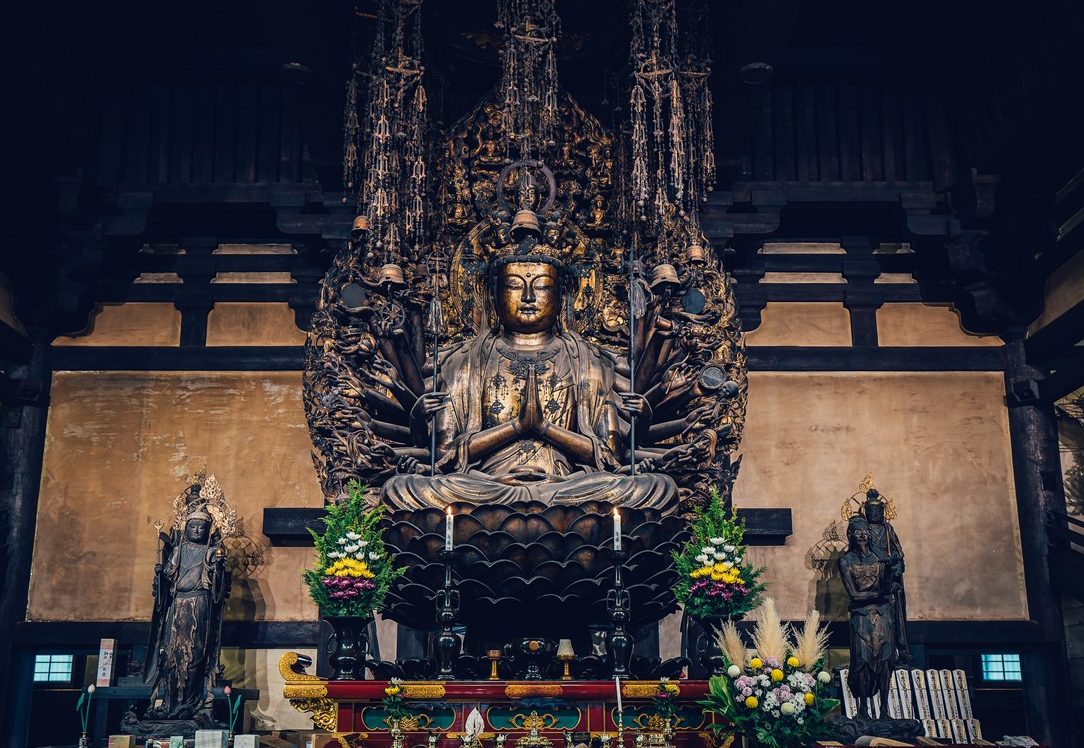
The central seated Kannon brings that hope into focus. The national catalogue dates Tankei's image to 1251–54. It belongs to the reconstruction, not to the surviving twelfth-century group. Built from joined cypress components and finished with lacquer and gold leaf, it has crystal eyes and a body much larger than the standing figures.[8]
In a documented frontal photograph, its main hands meet at the chest while the subsidiary arms spread around them. The seated body occupies a lotus pedestal, and a tall, elaborate halo rises behind it. The physical arrangement concentrates the eye on one figure even as its multiple arms enlarge its reach.[9]
The central icon and the flanking ranks consequently perform different work. One establishes a focus; the others extend the presence of the same compassionate being through the interior. The result combines concentration with abundance. Its unity depends on that relationship, rather than on giving every statue the same dimensions or making every part compete equally for attention.
4. Several workshops, one undertaking
Tankei was the eldest son of Unkei, one of the celebrated sculptors of the preceding generation. Kyoto National Museum identifies him as a leader of the reconstruction. His name helps locate responsibility, but the wider inscription record prevents the commission from becoming the work of a single pair of hands.[7]
The national register lists names preserved on foot projections, pedestals, and other parts of the standing images. They include Tankei, Kōen, Ryūen, In'e, and others. Its explanatory entry identifies contributions from the Kei, In, and En traditions—the three principal sculptural lineages represented in the rebuilding.[5]
These lineages were networks of trained makers, not three factories producing identical stock. Their participation brought different bodies of experience into the same commission. A name attached to an image makes a particular contribution traceable; it does not tell us that its named master personally carved every surface.
Joined-wood construction also changes how we should imagine the work. A figure built from fitted components is not the result of releasing an entire body, with all its projecting limbs, from one enormous trunk. Separate parts must become a structurally and visually intelligible figure. The construction method permits work on components, while their eventual fit remains a demand of the whole. The surviving descriptions establish this method; they do not preserve a complete allocation of tasks within each workshop.[8]
The inspection inscriptions add a further relationship. Making an image and recording that it has been checked are different activities. At Chōkō-ji, the same Chōkai inscription found on twenty-eight reconstructed images in Kyoto helped identify a statue as a former member of the Rengeō-in undertaking. A small record on a concealed joint connects an object now elsewhere to a particular body of work.[1]
The wording records completion of an inspection; it does not list the tests or tell us how often a carving was sent back for alteration. Even within that limit, it reveals something more precise than the general observation that many craftsmen were needed. The project included a way of acknowledging a check on individual images. The devotional total was being assembled one identified image at a time.
5. The building gives the number a shape
A thousand carvings need space, but space alone does not make them an assembly. The hall stretches approximately 120 metres along its north–south axis. The standing images occupy stepped ranks to either side of the seated centre. Their arrangement extends laterally and rises in depth, allowing the multitude to be presented as an ordered field.[2]
The popular name describes an architectural division. Sanjūsangen-dō means the hall of thirty-three bays: the spaces between columns in its inner core. The whole building has thirty-five bays along its length, because an additional bay lies beyond each end of that core. A bay is a structural interval, not a fixed modern unit such as a metre.[4]
This distinction gives the name a physical meaning. The repetition of columns organizes the enclosure in which the repetition of figures is encountered. Neither needs to be understood as a single unbroken surface. A visitor can register the long whole and then attend to a bounded part of it.
The centre interrupts that repeated order productively. Tankei's larger seated figure prevents the length from becoming an undifferentiated procession of equivalent bodies. The two flanking groups establish a relationship across it. The architecture gives the multitude room; the central image gives it an axis.
The guardian figures supply another layer. Twenty-eight protective deities and the Wind and Thunder Gods accompany Kannon. Their identities belong to the religious composition, rather than to a collection of expressive statues added solely for variety.[10]
Their placement has itself been reconsidered. The temple's published account describes a rearrangement in 2018 that brought four guardians around the central Kannon. Two of them, Basusen and Daiben Kudokuten, had previously stood in the line with the other guardians. The explanation relates their closer position to their particular roles beside Kannon.[9]
Moving a guardian changes a relationship without requiring a new statue. The episode makes the assembly's organization unusually clear: which figures belong nearest the central icon is a question about religious meaning as well as visual balance. Care for the ensemble includes attention to those relationships, not simply to the survival of each wooden body.
6. Caring for the whole requires finding the individual
Once the ensemble had been rebuilt, its individual histories continued. The national conservation database records a major campaign in 1936–56 and another long sequence beginning in 1973. Myōhō-in's account reports completion of the latter project in March 2018, after forty-five years.[11]
The repair bibliography breaks that large undertaking into groups of numbered images. Its entry for 2014 covers numbers 848–898; the 2017 entry covers 979–1001. These are references to documented work on identifiable objects, not an account in which “the thousand statues” disappear into one collective item.[11]
That administrative scale is revealing. To care for an ensemble, conservators must distinguish its members. A problem in one image cannot be located by knowing only that there are many similar figures. Numbering enables records of treatment to remain associated with the particular object concerned. It is one way of making a very large group manageable without treating its members as interchangeable.
This does not make a twentieth-century conservation record the same thing as Chōkai's medieval inspection. Their purposes, methods, and institutional settings differ. What connects them here is the need to address individual material objects within a collective undertaking. The record hidden beneath a foot and the numbered repair entry each resist the anonymity suggested by the view of a thousand figures together.
The temple also documented an interpretive system introducing individual images in Japanese and English after the conservation campaign. A screen could single out one figure for a day, while a searchable guide explained identities and names. Its stated purpose was to help worshippers form a closer relationship with the images.[12]
An individual introduction does not have to diminish the multitude. It supplies another scale of attention. The ranks establish abundance; a named or numbered figure gives the eye somewhere to pause. Looking at one closely can reveal the carving, identity, and history that the large arrangement initially conceals.
7. What remained of the imperial commission
Go-Shirakawa's palace is not recoverable simply by walking around the surviving hall. Hōjūji and the mausoleum preserve other parts of the area's religious memory, while Sanjūsangen-dō contains a monumental undertaking that was materially renewed after its founding patron had died. The historical area holds these related places without turning them into one intact twelfth-century residence.
Within the hall, continuity has a more exact form. Earlier images remained within the reconstructed ranks. Later makers supplied new bodies with a common religious identity. Joined components became figures; different workshops contributed to one commission; a central icon and its companions gave the multitude order. Subsequent care had to distinguish the objects whose collective presence it sought to preserve.
The result is not best understood as either the work of one great sculptor or the anonymous output of a vast workforce. The inscriptions preserve contributions and checks. The shared subject and arrangement explain why those contributions could become a whole.
Sanjūsangen-dō gives a thousand images a setting in which they can be apprehended together. The small writing beneath a foot reminds us what that achievement required: however immense the assembly, a particular image still had to be made, fitted, and examined.
Next topic · HO Guides
Imakumano: Bringing Kumano to the Capital
A ceremonial walk, a festival diary, and a theatrical memory reveal how a shrine gave distant devotion a working place in Kyoto.
Continue readingSources and NotesView sourcesHide sources
Sources consulted 16 September 2026. Historical dates identify the events or objects discussed, not current viewing arrangements. The standing ensemble and the central seated image are counted separately.
- [1]
Agency for Cultural Affairs, Nationally Designated Cultural Properties Database, “木造千手観音立像(本堂安置),” Chōkō-ji (朝光寺), object 201/00011899, inscription field and explanatory paragraph: https://kunishitei.bunka.go.jp/bsys/maindetails/201/00011899. It transcribes “実検了/長快(花押)” on the left-foot tenon, identifies twenty-eight matching inscriptions in the Kamakura reconstruction group at Myōhō-in, and assigns the Chōkō-ji image to the 1251–66 undertaking. Kato City, municipal newsletter, January 2011, p. 24, “加東の文化財”: https://www.city.kato.lg.jp/material/files/group/2/16p_08985608.pdf, explains the foot projection's fit into the pedestal. See the catalogue and newsletter; the original inscription was not inspected or independently authenticated. “Completed inspection” translates the inscription, not a recovered specification of inspection procedures. No route or date for the statue's removal from Kyoto is asserted.
Return to the reference ↑ - [2]
JTB Foundation, Japan Travel Resource Database, “三十三間堂(蓮華王院),” historical introduction and paragraphs describing the hall, central icon, and standing ranks: https://tabi.jtb.or.jp/res/260013-/. It supports the 1164 Go-Shirakawa/Kiyomori commission, approximate length, two groups of five hundred, stepped arrangement, and variation among the carvings. The foundation's interpretive account is used alongside the national building and sculpture records, not as a contemporary construction ledger. Spatial conclusions about a coherent ensemble of different images are this essay's analysis of those documented relationships.
Return to the reference ↑ - [3]
“第57回 法住寺,” published interview with Hōjūji's abbot Akamatsu Keisuke (赤松圭祐), 1200年の魅力交流, opening historical dialogue and the discussion of the temple and Go-Shirakawa mausoleum: https://1200irori.jp/content/interview/detail/guests57. Used narrowly for the larger residence's religious foundations, the separate present temple, and adjoining imperial-administered mausoleum. Its devotional stories, psychological interpretations, and reconstruction of a privileged original viewing position are not adopted. The writer did not interview the abbot. No present building here is identified as an intact room of Go-Shirakawa's residence.
Return to the reference ↑ - [4]
Agency for Cultural Affairs, Nationally Designated Cultural Properties Database, “蓮華王院本堂(三十三間堂),” object 102/1747, structural fields and full explanatory paragraph: https://kunishitei.bunka.go.jp/heritage/detail/102/1747. The entry, citing Kokuhō jiten, vol. 4 (2019), identifies the 1266 dedication, thirty-five structural bays and thirty-three-bay inner core, subsequent repairs, and the 1649–51 porch alterations. The 1249 fire and Go-Saga's sponsorship are also stated in the JTB Foundation account, note 2. These are building-history summaries, not the full restoration reports. No current roof form is used to reconcile differences between brief web descriptions.
Return to the reference ↑ - [5]
Agency for Cultural Affairs, “木造千手観音立像(蓮華王院本堂安置),” object 201/3514, count, inscription field, and “詳細解説”: https://kunishitei.bunka.go.jp/bsys/maindetails/201/3514. It records 1,001 standing figures, 124 from the 1164 foundation, names on foot tenons and pedestals, and contributions by the Kei, In, and En lineages. The detailed description's reference to three images “exhibited here” belongs to the source's earlier explanatory context; it is not treated as a current loan or display notice. Named attribution does not establish that one person executed every part of a statue.
Return to the reference ↑ - [6]
Kyoto National Museum, Torarin blog, entry of 29 July 2016, discussion with curator Asanuma (淺湫) of “千手観音立像 妙法院蔵,” especially the explanation of the additional figure behind the principal image: https://www.kyohaku.go.jp/old/jp/torarin/blog/2016/07/160729.html. For the curatorial discussion; see also the national count in note 5. Compare the separate central-image record in note 8. Thus 1,001 standing images are not the same total as one seated image plus a thousand standing images. The essay does not infer that every figure occupied the same position throughout the temple's history or promise unobstructed sight of the rear image.
Return to the reference ↑ - [7]
Kyoto National Museum, same 2016 curator discussion, passages on Tankei, his relationship to Unkei, his role in the reconstruction, and forty subsidiary hands representing twenty-five each. For the broader iconographic principle of multiple arms allowing Avalokiteśvara multiple simultaneous acts of assistance, see The Metropolitan Museum of Art, “Eleven-Headed Avalokiteshvara, the Bodhisattva of Infinite Compassion,” accession 1987.146, introductory curatorial paragraph: https://www.metmuseum.org/art/collection/search/38959. The Met object is a separate Thai bronze, not part of Rengeō-in; its description supplies a general religious explanation, not evidence of direct influence on this Japanese commission. The comparison of bodily multiplication and the hall's repeated images is the writer's interpretation, not a quotation from a recovered founding dedication.
Return to the reference ↑ - [8]
Agency for Cultural Affairs, Cultural Heritage Database, “木造千手観音坐像〈湛慶作/(所在蓮華王院本堂)〉,” object 177792, artist and date fields: https://online.bunka.go.jp/db/heritages/detail/177792. It supplies Tankei and 1251–54. For joined cypress construction, lacquer and gold leaf, and crystal eyes, see JTB Foundation, central-image paragraph, note 2. The essay explains only the implications of assembled components; it does not reconstruct a medieval workshop's division of labour, glue recipe, working speed, or assembly sequence. Conflicting reported heights in short descriptions are not repeated. The national entry's unavailable image is not claimed as a viewed photograph.
Return to the reference ↑ - [9]
“第58回 三十三間堂,” interview with Gotō Dōjun (後藤道順), temple religious-affairs officer, 1200年の魅力交流, discussion of the central Kannon and the 2018 rearrangement: https://1200irori.jp/content/interview/detail/guests58. The frontal photograph: https://1200irori.jp/assets/images/_wp/2022/03/s-2021_1211_0931-e1647925515767.jpg. It supports the described hands, lotus pedestal, halo, and surrounding figures. The arrangement's religious explanation is attributed to the temple; this is not an independent reconstruction of the original medieval positions. The essay omits the interview's differing statue-height figure and broad gendered characterizations of sculptural styles.
Return to the reference ↑ - [10]
Agency for Cultural Affairs, “木造二十八部衆立像(所在蓮華王院本堂),” object 201/252: https://kunishitei.bunka.go.jp/bsys/maindetails/201/252; and “木造〈風神/雷神〉像(所在蓮華王院本堂),” object 197300: https://online.bunka.go.jp/db/heritages/detail/197300. They identify the twenty-eight and the separate pair as Kamakura-period works owned by Myōhō-in. Their protective relationship with Kannon is explained in the temple interview, note 9. No claim about the single original author of all thirty figures or the exact transmission route of each deity is required here.
Return to the reference ↑ - [11]
Tokyo National Research Institute for Cultural Properties, conservation bibliography, “木造千手観音立像(蓮華王院本堂安置),” record fac000000786: https://www.tobunken.go.jp/conservation-arts-crafts/ccp_fac/fac000000786.html. See the relevant table entries, including the 1936–56 report and the Kyoto National Museum repair-report series entries for 2014, vol. 15, numbers 848–898, and 2017, vol. 18, numbers 979–1001. This is a bibliography of reports, not a claim that their complete contents were read. Myōhō-in, “千手観音群像の新解説・紹介事業,” undated one-page project account hosted by the Japan Travel and Tourism Association: https://www.nihon-kankou.or.jp/home/bunka-tagengo2023/pdf/2020-1-17_myohoin.pdf. It explicitly reports forty-five years of repair ending in March 2018. The explanation of numbering's practical value is the writer's inference from these object-specific records, not a reconstruction of undocumented treatment methods.
Return to the reference ↑ - [12]
Myōhō-in, “千手観音群像の新解説・紹介事業,” same one-page document as note 11, explanatory text and illustrations of the introduced displays. It describes daily selection of an individual figure and a Japanese/English searchable interpretive guide. The essay reports the documented project and its stated devotional purpose, not a test of the equipment's present operation or a claim about measured visitor response. The comparison with medieval individual-image records concerns the scale of attention, not institutional continuity between medieval inspection and modern conservation.
Return to the reference ↑