Read the article below. Interactive reading tools are available when scripts load.
Quick
Ashikaga Yoshimitsu was born in 1358, the son of the second shogun Yoshiakira and Ki no Yoshiko. His grandfather Takauji died in the same year. The child was known by a name written 春王, rendered in modern accounts as Shun'ō or Haruō. He was Yoshiakira's third son but became the eldest surviving candidate for succession. The principal-wife household of Shibukawa Kōshi and the attendants who protected Ashikaga children also shaped his upbringing.
The shogunate already existed, yet war between the Northern and Southern Courts remained active. When Southern-aligned forces entered Kyoto in the early 1360s, Yoshiakira fled and the small child was removed for safety. Temple history preserves a vivid account of clerical disguise and shelter before transfer to Akamatsu protection; its core illustrates real evacuation logistics, while its precise scenes should retain a source label. Yoshimitsu did not inherit a pacified country. His infancy belonged to a mobile household whose title, capital, servants, and physical survival could still be separated by war.
Yoshiakira died in 1367. Yoshimitsu inherited the Ashikaga house and was appointed the third shogun in 1368, aged ten in elapsed years and eleven by traditional counting. A title could secure dynastic continuity, but it could not make a child direct armies, hear land cases, or balance the great shugo.
Hosokawa Yoriyuki became the central guardian and kanrei, coordinating government with senior warriors and experienced administrative officials. “Kanrei” is best understood here as the shogun's deputy and political intermediary, not as an imperial regent who legally replaced the officeholder. Clerks continued to draft and authenticate orders; shugo mobilized provincial force; the Northern Court supplied ranks and ritual; household retainers controlled access to the boy. Yoshimitsu learned government from inside an arrangement that depended on Yoriyuki without belonging to Yoriyuki alone. His later authority should not be projected backward to 1368, and Yoriyuki's work should not disappear merely because his pupil eventually dismissed him.
By 1379 resentment against Hosokawa Yoriyuki had gathered among Shiba Yoshimasa, Toki Yoriyasu, and other powerful warriors. A failed campaign against Southern forces intensified criticism. Armed political pressure reached Kyoto in the Kōryaku Coup, and Yoshimitsu removed Yoriyuki from the kanrei position, replacing him with Shiba Yoshimasa.
This was neither a simple coming-of-age ceremony nor proof that Yoshimitsu had controlled everything behind the scenes. A coalition strong enough to threaten the government forced a choice. Yoshimitsu preserved the shogunal center by sacrificing the guardian whose administration had sustained it, then prevented the victorious faction from owning the office permanently. Former Hosokawa networks were not erased, and Yoriyuki later returned to political usefulness. The episode trained Yoshimitsu's mature method: accept the reality of great shugo power, change personnel before opposition becomes a single anti-shogunal front, and make rival houses seek final recognition from the shogun. Centralization began as survival through balance, not absolute command.
Across the 1370s Yoshimitsu developed the Ashikaga residence on Muromachi Street into the principal shogunal headquarters. Known as Muromachi-dono and, for its garden, Hana no Gosho—the Palace of Flowers—it joined residence, audience space, offices, gates, pond, and ceremonial setting. Different accounts attach 1371, 1378, or 1379 to stages of completion and occupation; the estate should be treated as a phased project, not a building created in one instant.
Location changed politics. The shogun, court nobles, major temples, markets, artisans, and shugo residences occupied the same city. Petitions, gifts, intelligence, ceremonies, and personnel could move through short routes, while access and seating made hierarchy visible. Water diverted for the pond, timber, plants, guards, kitchens, and displaced or incorporated urban land made beauty an administrative expense. The palace was later damaged and abandoned; a marker and excavated remains identify the site today. “Muromachi shogunate” preserves the residence's name, not its vanished material fabric.
In 1382 Yoshimitsu began Shōkokuji beside the Muromachi palace with Zen leaders including Shun'oku Myōha and Gidō Shūshin. The project received imperial sanction and entered the Gozan network. It could train monks, conduct rites, host scholarship, draft documents, and connect the shogunate to diplomatic and cultural expertise.
The monastery was also an exercise of power over land and labor. Residents near the selected site were relocated. Provincial lords supplied contributions; the Kōno helped transport timber; builders, carvers, metalworkers, painters, cooks, and monks turned patronage into structures. The complex was dedicated in 1392, burned almost completely in 1394, and was rebuilt again; its enormous seven-story pagoda burned after lightning in 1403. Present Shōkokuji is the product of later fires and reconstruction, not Yoshimitsu's compound preserved. Religious commitment, political centrality, cultural production, coercion, and material risk all belonged to the same institution. Calling the temple merely propaganda or purely private faith would lose how it actually worked.
Yoshimitsu strengthened the shogunal center by intervening in succession and territorial disputes among major shugo, then using rival houses to enforce his decisions. The Toki conflict of 1389–90 reduced one regional bloc. In 1391 Yamana forces that had helped against the Toki were themselves defeated in the Meitoku Rebellion. In 1399 Ōuchi Yoshihiro's resistance ended in the Ōei Rebellion at Sakai. Confiscated provinces and offices were redistributed rather than absorbed into one centrally administered state.
These outcomes show strategic power, not an absolute monarch with a national standing army. Yoshimitsu depended on shugo who expected reward for suppressing other shugo. Local family divisions, inherited rivalries, disputed appointments, and fear of encirclement gave the center opportunities. Some sources portray him as deliberately provoking every target; evidence supports manipulation and selective pressure but not omniscience. Even Imagawa Sadayo's later recall from long service in Kyushu involved regional alliances and changing confidence, not a simple purge. Centralization meant making great lords seek the shogun's judgment while preventing any coalition from becoming safely independent of it.
In 1392 Southern Emperor Go-Kameyama left Yoshino, returned to Kyoto, and transferred the regalia to Emperor Go-Komatsu. Yoshimitsu led the political process that ended fifty-six years of rival courts. Military exhaustion, the weakening of Southern regional networks, intermediaries, and negotiated assurances all contributed; a signature by the shogun did not alone dissolve the division.
The settlement is often described as promising alternation between descendants of the two lines. Later succession did not alternate as Southern supporters expected. The exact legal form and enforceability of the assurances require care, but the resulting grievance is historically real. Go-Kameyama received treatment as a retired sovereign while his branch lost practical access to the throne. Regalia transfer mattered because custody supported Go-Komatsu's claim, yet objects did not erase people, documents, or memories attached to Yoshino. Reunification strengthened Yoshimitsu by removing a rival royal banner that provincial opponents could use. It was a negotiated end to competing courts, not a neutral historian's proof that every earlier Northern or Southern claim had been right. [2]
Yoshimitsu rose through aristocratic offices while remaining head of warrior government. Court diaries record his entry into ceremonies and ranks that surprised some nobles; in 1394 he reached daijō-daijin, grand chancellor. His marriage to Hino Nariko and later relationship with her Hino relatives linked the Ashikaga household to people experienced in court access, writing, and ritual. Hino Yasuko would become especially important in his final years.
These offices were not decorative titles pasted onto “real” military power. Court rank ordered audiences, clothing, procession, appointment, and national ritual. Yoshimitsu supplied money and coercive protection while court specialists supplied precedents and forms he could not invent alone. He increasingly used ceremonies modeled on sovereign or retired-sovereign practice, creating an authority that crossed warrior and aristocratic categories. Scholars disagree over whether his final aim was to seize the throne or place a son in the imperial line. Evidence supports extraordinary boundary-crossing and deliberate ritual elevation; it does not reveal a completed secret plan. Court collaboration, dependence, resistance, and innovation must remain visible together. [1]
In 1394 Yoshimitsu transferred the shogunal office to his young son Yoshimochi. In 1395 he resigned the grand chancellorship and took Buddhist orders. He nevertheless remained the dominant political actor, controlling residences, patronage, senior relationships, diplomacy, and major decisions.
The separation of office from effective authority was not a modern retirement trick invented from nothing. Retired sovereigns, religious vows, house heads, and senior kin offered precedents for exercising power after formal resignation. Installing Yoshimochi secured a fourth Ashikaga succession while allowing the father to operate above the daily title. Clerical status opened different ritual and institutional roles; it did not make wealth, retainers, or political memory disappear. Yet Yoshimochi was more than an empty signature. He acquired a household, office, advisers, and future interests, and after 1408 he reversed parts of his father's diplomacy and ceremonial program. The arrangement solved immediate succession and multiplied long-term centers: a reigning shogun, a retired father, and other sons whose status Yoshimitsu might elevate.
In 1397 Yoshimitsu acquired the former Saionji villa at Kitayama and transformed it into a vast palace of residences, ritual buildings, gardens, ponds, and the relic hall later called the Golden Pavilion. Governmental activity shifted from Muromachi to this estate. Court nobles, shugo, clerics, performers, merchants, and foreign envoys could be received within a landscape designed to order what they saw and where they stood.
Kitayama reused an older aristocratic and religious site rather than beginning on empty ground. Construction required property transfer, water, timber, stone, metal, gold, transport, artisans, attendants, and continuous income. Hino Yasuko's household and the positions of Yoshimochi and Yoshitsugu made the palace a dynastic space as well as Yoshimitsu's personal retreat. Emperor Go-Komatsu's elaborate visit in 1408 demonstrated how close Yoshimitsu's ceremonial role had moved toward that of a royal senior. After his death, much of the palace disappeared and the site became Rokuonji. The current temple preserves landscape relationships and later structures, not the entire government complex of 1397.
The building now called the Golden Pavilion was the relic hall, or Shariden, of Yoshimitsu's Kitayama palace. Its three levels combined residential and Buddhist architectural vocabularies, with gilded upper surfaces and a sacred function. “Kinkakuji” is the popular name of the later temple; its formal name is Rokuonji.
The structure that descended from Yoshimitsu's period survived later wars and repairs but burned in 1950. The present pavilion was reconstructed in 1955 using detailed records, including drawings made during the 1904 repair. It is therefore neither a random modern imitation nor the original material building touched by Yoshimitsu. The pond, garden relationships, archaeological evidence, documentary plans, repaired fabric, and reconstructed hall carry different kinds of continuity. This post-1912 information belongs here solely because a current Places user must know what is physically present. It does not extend Yoshimitsu's historical actions beyond 1408 or make the reconstruction evidence for his private aesthetic intention.
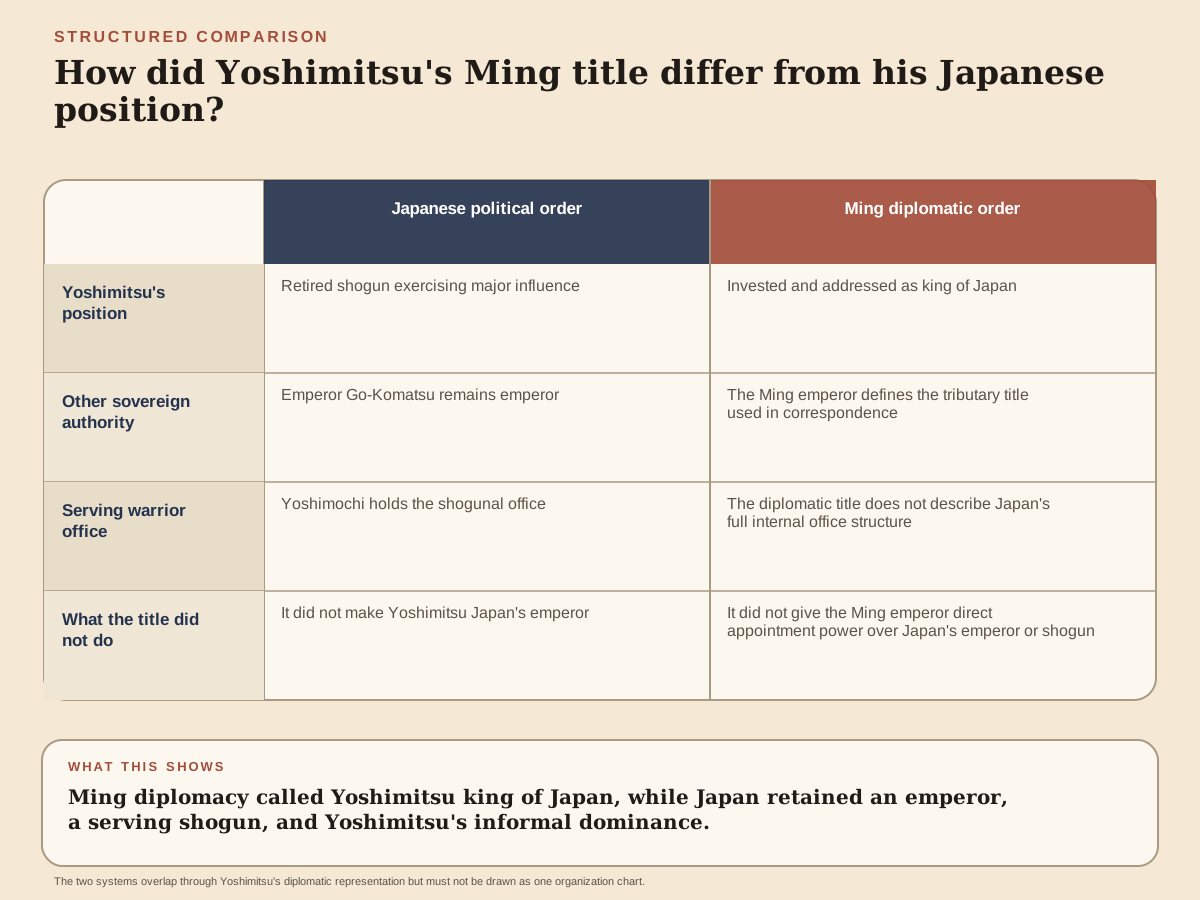
In 1401 Yoshimitsu sent a mission seeking formal relations with Ming China. Court specialists helped prepare the writing, while clerics and Hakata commercial expertise helped carry the mission. After a dynastic change in China, the Yongle court recognized Yoshimitsu within Ming diplomacy as “King of Japan,” sent investiture objects, and authorized an exchange system.
The title acknowledged a real hierarchy in the documents presented to the Ming emperor; it should not be euphemized into modern equality. It also did not turn Japan into a Ming province or replace Emperor Go-Komatsu inside Japanese law. Yoshimitsu did not use the Ming reign title and calendar as the domestic basis of government, and many courtiers, warriors, and clerics criticized the posture he accepted abroad. The arrangement made him the recognized external partner able to sponsor official missions, manage piracy-related demands, and obtain trade. Yoshimitsu used different political identities in different systems: retired shogunal ruler, Buddhist patron, high court figure, and Ming-invested king. They interacted without becoming one universal office.
The Ming court issued Yoshimitsu a set of tally documents in 1403, and regulated missions operated from 1404. The tallies helped officials distinguish approved ships from unauthorized claimants by comparing numbered seals and records. They are often imagined as two halves of one broken token, but research describes stamped papers verified against a retained register rather than a simple split object.
Licensed missions combined diplomacy, gifts, tribute, and commercial cargo. Chinese copper coins, silk, ceramics, books, paintings, and other objects entered Japanese networks; Japanese goods and regional products traveled outward. Profit did not flow into one shogunal treasury untouched. Merchants financed and operated shipping, temples supplied literate agents, ports and shugo claimed shares, and cargo could be lost to weather or violence. The system gave Yoshimitsu authority to select missions and respond to Ming demands concerning piracy. It did not end all raiding or make private maritime exchange disappear. The “tally trade” was a political technology for authenticated access within the tribute relationship, not a modern free-trade agreement.
Yoshimitsu's patronage brought performers, Zen monks, court poets, painters, gardeners, craftsmen, and imported objects into close contact. In 1374 he saw Kan'ami's troupe at Imakumano and favored the young Zeami, helping sarugaku performance enter elite court-warrior spaces. Patronage gave resources and access but also exposed performers of lower social standing to rivalry, moral criticism, and dependence on a powerful household.
The later term “Kitayama culture” groups developments in Noh, linked verse, Gozan literature, ink painting, garden and architectural display, tea and object appreciation, and the reception of Song, Yuan, and Ming goods. Yoshimitsu did not invent them alone. Monks wrote, performers revised, courtiers supplied forms, merchants moved objects, artisans made settings, and attendants classified and displayed collections. His power was catalytic: he concentrated people and resources and made certain practices central to political society. It was also selective and coercive, because patronage elevated some troupes and objects over others and monument building extracted labor. Culture here is a network of creation, status, exchange, and exclusion—not the decorative reward after politics ended.
In 1408 Yoshimitsu received Emperor Go-Komatsu at Kitayama and arranged an extraordinary coming-of-age for his favored son Yoshitsugu using forms compared with those of an imperial prince. Soon afterward Yoshimitsu fell ill and died on the sixth day of the fifth month, conventionally converted to 31 May 1408. He was forty-nine in completed years and fifty-one by traditional counting. No precise modern diagnosis is secure.
The court moved to honor him with a title associated with a retired or cloistered emperor, but Yoshimochi and senior warriors declined it. Yoshimochi remained shogun and reclaimed practical supremacy, while Yoshitsugu became a political danger rather than the certain heir to a new royal order. By 1411 Yoshimochi suspended the Ming relationship his father had built. These reversals do not make Yoshimitsu's court, diplomacy, or centralization unreal. They show how much depended on one person's household, ritual position, and ability to balance shugo. He left a stronger shogunate and a disputed question about intended sovereignty, not a constitutional system capable of reproducing his exact supremacy automatically.
Classic
Yoshimitsu's birth joined two kinds of continuity. His father Yoshiakira had inherited the shogunal office from Takauji, so a third generation made the Ashikaga claim look dynastic. Yet Takauji's death in the same year removed the founder before he could become a living guardian to the child.
The mother matters. Ki no Yoshiko was the daughter of an official connected with Iwashimizu Hachiman Shrine. Her position joined the boy to a household and religious-administrative network not captured by an Ashikaga male genealogy. Surviving narrative tells much less about her daily agency than about senior warriors; that asymmetry is an archival limit, not proof that motherhood had no political function.
Yoshiakira's principal wife, Shibukawa Kōshi, occupied another household position. Accounts credit her with raising Yoshimitsu and his brother. Biological maternity, principal-wife status, residence, nurses, and succession recognition could therefore be distributed among different women and attendants.
The childhood name is written 春王. Modern romanization varies, commonly Shun'ō or Haruō. Preserving the written form and noting the reading issue is more accurate than implying that one English spelling opens direct access to how every contemporary pronounced it.
He was not Yoshiakira's first male child, but earlier brothers did not survive to carry the line. Medieval succession depended on survival, maternal and household standing, recognition, and the ability of retainers to organize around a candidate. “Third son” and “heir” can both be true at different points.
The political world remained divided. The Southern Court at Yoshino possessed royal leaders and provincial allies. Northern sovereigns in Kyoto supplied the Ashikaga with office and ritual legitimacy. Great shugo and the Kamakura branch of the family held military resources that a Kyoto residence could not simply command.
In 1361 Southern-aligned forces under Kusunoki Masanori and other commanders again threatened or entered the capital. Yoshiakira withdrew. A shogunal child became a security problem requiring concealment, trusted escorts, and a defensible receiving household.
Shōkokuji's later institutional history preserves a specific story: the boy was sheltered by a Kenninji cleric, dressed as an acolyte, and transferred to Akamatsu Norisuke's fortress in Harima before returning. The broad evacuation accords with the military crisis. Exact duration, costume, and perfectly ordered sequence belong to temple transmission and should not be narrated without that label.
The episode exposes the infrastructure of dynastic survival. Guards had to know routes; clerics could cross boundaries soldiers could not; a regional warrior supplied refuge; messengers coordinated return; servants carried food and clothing. The “young shogun” survived through people later political narrative tends to make anonymous.
It also demonstrates that Kyoto was not yet permanently secured. The capital's court, temples, workshops, and markets made it indispensable, but armies could still force the Ashikaga center out. Yoshimitsu's later investment in residences and temples becomes intelligible against that vulnerability.
None of this gives the child a remembered policy. A later ruler who ended the court division can easily be imagined as learning unity from flight. The evidence records the flight, not the infant's conclusion from it.
The proper beginning is therefore neither golden-palace destiny nor helpless childhood. Yoshimitsu belonged to a dynasty with a recognized office, household network, and powerful allies. He also belonged to a civil war in which those resources had to be moved, hidden, and defended before they could be inherited.
Yoshiakira's death created more than a family bereavement. The head of the Ashikaga house was also the holder of a court-appointed military office and the central patron for retainers expecting reward. Delay or dispute could invite another Ashikaga branch or a powerful shugo to redefine succession.
Yoshimitsu's recognition solved the identity of the heir. Court rank and shogunal appointment made that decision public. The two common ages—ten and eleven—reflect elapsed-year and traditional counting rather than contradictory biographies.
Recognition did not give the boy adult capacity. Audiences, documents, ceremonies, instruction, and security could be arranged around him, while policy required experienced actors. The office remained active through a household and council rather than through a child's solitary will.
Hosokawa Yoriyuki occupied the crucial position. Yoshiakira had relied on him and sources associate the dying shogun with entrusting Yoshimitsu to his care. The precise deathbed scene is less secure than the institutional outcome: Yoriyuki acted as guardian and leading deputy for more than a decade.
The kanrei connected the shogun to great vassals and administrative process. He coordinated councils, commands, appointments, and military policy. Translating the office simply as “regent” risks importing the legal relation between an emperor and a Fujiwara regent. Yoriyuki operated inside warrior government and depended on Ashikaga legitimacy.
Other people made that government work. Bugyō families managed petitions and documents. Senior shugo supplied military advice and bargaining power. Household officers arranged access. Zen clerics offered education and ritual support. Court nobles managed ranks and ceremonies that positioned the boy in Kyoto society.
Yoriyuki also faced the unfinished Southern war. Imagawa Sadayo, later known as Ryōshun, was sent to Kyushu to attack Southern positions. Regional policy therefore depended on commanders who could spend years building coalitions far from the young shogun.
Guardianship created patronage. Offices and favorable decisions accumulated around Hosokawa clients, while excluded Shiba, Toki, and other houses could describe Yoriyuki's administration as factional domination. Every successful deputy generates people who fear his success will become hereditary.
The child was not politically absent. He participated in ceremonies, received instruction, learned names and precedents, and served as the point in whose authority decisions were issued. Over time, access to him became access to a developing judgment rather than to a seal held by guardians.
The Northern Court also had interests. It wanted stable military protection and financial support; the Ashikaga wanted appointments and ritual recognition. A minor shogun made court-warrior cooperation more dependent on intermediaries, not less important.
The succession shows why personal and institutional history must remain separate. Yoshimitsu the child could not have designed the government of 1368. The shogunal office, clerical staff, Hosokawa leadership, shugo coalition, court connection, and family name allowed rule to continue around him.
That continuity preserved future choice. Because Yoriyuki kept the regime operating, Yoshimitsu survived long enough to develop independent authority. Because Yoriyuki built his own network, the eventual transition could not be a quiet moment when a tutor simply stepped aside.
Yoriyuki's long guardianship had produced order and enemies together. Hosokawa relatives and clients benefited from appointments and access. Other great houses could regard every policy failure as proof that the deputy had converted service to the Ashikaga into government by his own faction.
Military disappointment sharpened the accusation. Campaigns against Southern-aligned forces in Kii and Izumi did not produce the success expected, and some participating lords resisted Hosokawa direction. Failure exposed the limits of a deputy whose authority depended on cooperation from rivals.
Shiba Yoshimasa, Toki Yoriyasu, Kyōgoku, Yamana, and others did not form a modern party with one program. They shared enough opposition to Yoriyuki to coordinate pressure. Each also expected offices, provinces, or restored standing if the Hosokawa monopoly broke.
Armed withdrawal to home provinces and the possibility of troops near Kyoto made the dispute coercive. A petition backed by regional armies is not merely advice. The young adult shogun faced the danger that supporting Yoriyuki could unify several houses against the Ashikaga center.
Removing Yoriyuki conceded the coalition's immediate demand. Shiba Yoshimasa took the kanrei role, and appointments shifted. This outcome confirms that shugo could compel change; it does not show that they had replaced Yoshimitsu as the common source of legitimacy.
Yoshimitsu's agency lay partly in controlling the settlement. He could classify the former guardian's fall, preserve some people and records, and allow rival houses to compete for recognition. The shogun survived as the office through which victory became personnel policy.
Court rank advanced at the same moment. The University of Tokyo's publication of the court diary Gogumaiki highlights aristocratic surprise as Yoshimitsu entered offices and ceremonies with unusual speed. Court integration gave him another hierarchy not reducible to kanrei politics.
The coup did not eliminate Hosokawa power. Yoriyuki withdrew and took religious status, but reconciliation and later service remained possible. Total destruction would have strengthened the victorious Shiba-led side and deprived the regime of experienced clients.
Nor did Shiba control become final. Rotation among Shiba, Hosokawa, and Hatakeyama lines would define the kanrei office more strongly. Alternation prevented one deputy house from claiming that government naturally belonged to it, while competition also made policy factional.
Yoshimitsu learned that personnel could be a weapon. A house elevated against one rival might later become too strong. Office, provincial appointment, court rank, family succession, and military accusations supplied different levers for changing the balance.
This method required information. Bugyō records, court diaries, envoys, household attendants, and rival reports helped the shogun judge whether a lord was isolated or protected. The image of a single mastermind understates how uncertain such intelligence could be.
Later victories make the coup look like the first act of an inevitable dictatorship. In 1379, Yoshimitsu still needed the men who had forced out his guardian. He had gained freedom from one dependency by entering a new negotiation with several armed houses.
The transition was real nonetheless. The shogun was no longer merely the child around whom Yoriyuki governed. He had made a decision that reallocated the center and had demonstrated that factions could win against a minister without winning the Ashikaga office itself.
Ashikaga authority had previously operated from several Kyoto residences and campaign settings. Establishing a principal palace on Muromachi Street concentrated access. The house of the shogun and the place where government happened became harder to separate.
Sources give different dates for construction or completion. Shōkokuji's history associates an early stage with 1371; Japan Search and the national multilingual site guide emphasize 1378 or 1379. These need not be forced into a false conflict if acquisition, building, expansion, occupation, and recognition as headquarters occurred in phases.
The compound faced a busy urban street. Its position near the court and aristocratic residences placed warriors inside Kyoto's social field rather than in a distant military capital. The period name “Muromachi” later grew from this address.
Government did not require rooms labeled like modern departments. An audience hall, gate, corridor, guard station, writing room, kitchen, stable, and garden could each perform political work. Which entrance a visitor used and how long a petitioner waited indicated status before any judgment was spoken.
Bugyō and clerks needed places to receive documents, compare precedents, draft orders, and protect archives. Senior shugo required residences and retinues nearby during service in Kyoto. Court nobles came for consultation, ceremony, patronage, and negotiation.
The garden was not outside politics. The large pond and abundant plantings made the estate famous as Hana no Gosho. Water management connected the elite enclosure to channels and users beyond its walls. Flowers, stones, fish, buildings, and seasonal maintenance required specialized labor.
Display could make rank legible. A reception route showed guests what the house could command: rare objects, ordered attendants, controlled views, and people assembled from different social worlds. Beauty was a medium of coalition management as well as personal pleasure.
The palace also consumed and displaced. Land had prior owners and users. Construction demanded timber, tiles, transport, and compulsory or negotiated contributions. Household splendor rested on urban workers whose names rarely appear in court diaries.
Fire and war remained threats. Dense wooden neighborhoods could carry flame, and a political residence was a military target. Guards protected gates, but no wall could make the shogun independent of the city's food, money, and information.
Proximity to the imperial court produced mutual influence. Yoshimitsu learned aristocratic ceremony and supplied resources to court events. Courtiers gained access to a military patron. The relation was not the absorption of one society by the other; it was a shared and unequal urban ecology.
The residence did not replace provincial government. A document still required shugo, local warriors, estate managers, and village compliance to act beyond Kyoto. Muromachi centralized the point of petition and arbitration more effectively than it centralized enforcement.
Later destruction separates site from fabric. The palace suffered in fifteenth-century wars and disappeared. Modern visitors encounter a stone marker, city blocks, excavation evidence, and museum objects—not Yoshimitsu's halls intact.
This Place distinction is historically productive. The lost palace explains how power was staged, while its absence prevents a present reconstruction from silently becoming medieval evidence. Muromachi survived most durably as a political name because the government once made an address into an institution.
Zen institutions supplied capacities warrior offices did not reproduce by themselves. Monks trained in literary Chinese could compose formal texts, interpret continental conventions, maintain correspondence, teach, classify objects, and move through transregional religious networks. Ritual promised protection and memorial benefit. A monastery gathered these functions into a durable corporate body.
Yoshimitsu's relationship with Shun'oku Myōha and Gidō Shūshin belonged to personal religious practice and public patronage. Temple records present a pious foundation story. That account is valuable evidence for institutional memory, but it does not let an editor measure private sincerity from ceremonial language.
Imperial sanction mattered. The proposed name connected Yoshimitsu's high court office with a Chinese terminology, while authorization placed the temple inside courtly as well as shogunal order. The monastery's foundation joined identities rather than declaring that the military house no longer needed the emperor.
The chosen land lay beside the Muromachi palace. Proximity made monks and texts accessible to the government and enlarged the landscape under Yoshimitsu's patronage. It also required people already living there to leave. Shōkokuji's own history records relocation across rich and poor households.
Construction reveals the regime's reach. The Kōno network transported timber from Iyo. Shugo and other lords were required or invited to contribute. Roads, rivers, ports, carts, draft animals, and storehouses converted provincial resources into a Kyoto religious monument.
Named patrons did not build halls with their hands. Carpenters calculated joints; roofers prepared materials; carvers and painters made sacred interiors; metalworkers cast fittings; laborers shifted earth; cooks sustained crews. Monks organized residence and rites. The archive distributes recognition unequally across this workforce.
The intended scale was extraordinary. Halls, gates, residences, and later the Great Buddha complex made Shōkokuji a visible counterpart to the palace. The temple's ranking in the Gozan world positioned the shogunate within a hierarchy of Zen establishments.
Gozan monks became important to diplomacy, but the relation was not automatic from the first foundation meeting. Different missions used aristocratic writers, merchants, non-Zen clerics, and Zen specialists. The temple built a pool of literacy and continental expertise the regime could draw upon selectively.
Completion in 1392 aligned with the year the court division ended. The coincidence strengthened the image of ordered rule, although the temple's construction had begun a decade earlier and the political settlement had many causes.
Fire destroyed the compound in 1394. Monumentality could not defeat wood, cooking flame, wind, and dense residence. Rebuilding required another extraction of resources and showed that institutional commitment was measured through repeated labor, not one dedication.
The seven-story pagoda completed in 1399 projected scale across Kyoto, then burned after lightning in 1403. Its disappearance is as important as its height. Later descriptions and archaeology must stand in for a structure no visitor can see.
By 1407 much had been restored, but subsequent centuries brought more fires, war, and contraction. The current Dharma Hall and precinct represent later physical phases. A guide must not point to a surviving building and call it Yoshimitsu's untouched work.
Shōkokuji was therefore neither decorative annex nor disguised ministry. It was a religious corporation whose monks, estates, buildings, and texts made forms of shogunal authority possible. Its coercive foundation, devotional aims, scholarship, diplomacy, and repeated destruction must remain in the same history.
The answer was rarely direct confrontation by an isolated center. The shogunate shaped which branch of a family received recognition, which rival received an appointment, which conduct counted as rebellion, and which allies could keep confiscated territory after victory.
Great shugo were indispensable because they mobilized provincial warriors, collected resources, and enforced orders. Their strength also meant that several allied houses could challenge Kyoto. Yoshimitsu's central position existed only if he prevented their interests from aligning permanently against him.
The Toki house controlled a formidable regional network. An internal succession and authority dispute allowed the shogunate to favor one claimant and order action against another. Yamana forces participated in suppressing the Toki side, expecting gain and recognition.
Success made the Yamana more dangerous. Their provincial holdings and family branches produced a bloc later remembered through the phrase “lords of one-sixth of the realm.” The phrase is rhetorical rather than a cadastral statistic, but it captures contemporary anxiety about concentrated shugo power.
In the Meitoku conflict of 1391, divisions within the Yamana and pressure from Yoshimitsu's circle helped turn a dominant family against itself and the shogunate. Fighting reached Kyoto, so the supposedly centralizing government remained physically vulnerable to the lords it was disciplining.
Yamana Ujikiyo died, other branches submitted, and holdings were redistributed. Yoshimitsu did not replace every provincial agent with a salaried official. He rewarded houses that had fought for him, deliberately preserving the delegated structure that could later create another threat.
The Ōuchi offered a comparable western problem. Their maritime and provincial base, service in earlier campaigns, and participation in the 1392 settlement gave Yoshihiro influence. By 1399 distrust, commands, and alliance choices culminated in resistance at Sakai.
Sakai was a port and commercial center, so siege affected merchants, supplies, ships, and urban inhabitants as well as named warriors. Yoshihiro's death and defeat allowed another redistribution of offices. The shogun's authority expanded through the destruction of a former ally.
Imagawa Sadayo presents a quieter test. After decades of campaigning and administration in Kyushu, he was recalled in 1395 and replaced. Scholarship shows that Yoshimitsu supported him longer than a simple jealous-shogun story suggests; regional cooperation deteriorated, and the center eventually changed its agent.
Personnel control could therefore take several forms: recognize a rival heir, revoke a commission, demand residence, order a coalition, declare disobedience, or accept submission. War was one instrument inside a larger process of classification.
The shogun also needed bugyō and court support. Confiscation had to become documents; new holders needed rank and boundaries; defeated followers petitioned for survival; temples and estates contested seizures. Victory without record-making would produce another round of private occupation.
Later narratives admire Yoshimitsu as a master manipulator who deliberately induced each target to revolt. He clearly exploited division and sometimes increased pressure. But attributing every opponent's choice to his hidden design denies those opponents agency and makes risky wars appear guaranteed.
His achievement was more precise. He repeatedly arranged a field in which no great house could be certain that its relatives and neighbors would stand with it against Kyoto. The cost was a government that continued to depend on rewarded shugo. Central authority rose by managing decentralization, not by abolishing it.
By 1392 the Southern Court was weaker than it had been under Go-Daigo. Major commanders were dead, Kyushu networks had been reduced, and Ashikaga alliances controlled more routes and resources. Weakness made negotiation more likely; it did not make Go-Kameyama a private individual with nothing to exchange.
The Southern sovereign retained a court, regalia claims, offices, documents, and the capacity to legitimate regional resistance. As long as those remained separate, any shugo conflict could acquire an alternative royal authorization. Yoshimitsu had strong reason to seek agreement rather than endless pursuit into defensible terrain.
Negotiation required intermediaries trusted enough to carry proposals without immediately exposing the weaker side. Warrior houses with Southern contacts, court figures, and religious channels participated. Ōuchi Yoshihiro is often connected to the process, illustrating how a great shugo could help create the central peace before later becoming Yoshimitsu's enemy.
Go-Kameyama came to Kyoto and delivered the regalia to Go-Komatsu. The transfer gave a material and ceremonial form to reunification. It did not independently decide whether every object was authentic or which prior transfer had been lawful; those questions had already been instruments of dynastic politics.
Treatment of Go-Kameyama as a retired sovereign allowed the settlement to avoid representing him simply as a captured pretender. Residence, income, attendants, and honor mattered to the dignity and practical survival of the former Southern household.
Succession was the settlement’s most consequential unresolved arrangement.
Evidence and interpretation · A succession condition and its enforcement
The alternating-succession condition has a documentary trail: the Tondabayashi city history attributes it to the Konoe family documents and illustrates a copy of a Yoshimitsu letter. It places the condition alongside the transfer of the regalia and arrangements for the two lines’ revenues. This is more specific than a promise remembered only in later storytelling. [2]
A recorded condition is not the same as an arrangement that every participant accepted and could enforce. The continued Northern-line succession shows that alternation did not follow; it does not, by itself, recover the intentions of each party in 1392. [2]
In practice Go-Komatsu later transmitted the succession within the Northern-derived line. Southern descendants did not receive the alternating access they expected. The unfulfilled arrangement helped sustain later discontent and claims; reunification did not make the Southern lineage vanish biologically or politically overnight.
Yoshimitsu gained more than peace. With one court in Kyoto, he could coordinate military appointment and imperial rank without every judgment facing an institutional royal competitor. The shogunate became the broker through which the reunited order had been achieved.
The emperor was not thereby turned into a shogunal employee. Court ritual, succession, aristocratic offices, and religious authority continued to have their own procedures and interests. Yoshimitsu's influence was extraordinary because he operated inside these systems as well as over warrior networks.
Provincial effects were uneven. Southern documents and local loyalties did not evaporate on the day of transfer. Some fighters submitted, others sought terms, and old grants remained evidence in land disputes. Administrators had to reconcile competing legal pasts.
The name “Meitoku settlement” is more useful than “Southern surrender” when it keeps coercive inequality and negotiated conditions visible together. Go-Kameyama acted from a weakened position, but he still made a political exchange. Yoshimitsu led from strength, but he still required recognition and procedure.
Later official history would privilege the Southern Court's legitimacy, while the reigning imperial line descended through the Northern branch. That long contradiction demonstrates why 1392 did not settle historical truth by force.
For Yoshimitsu it removed a structural threat and confirmed brokerage. For Go-Kameyama it preserved status while ending a separate court. For Go-Komatsu it consolidated succession.
Military command could compel action, but it could not by itself establish every hierarchy recognized in Kyoto. Court rank placed Yoshimitsu inside a genealogy of offices, garments, audiences, and ritual roles whose authority had accumulated over centuries.
His promotions accelerated around and after the 1379 political crisis. The Gogumaiki of Sanjō Kintada records courtly astonishment as Yoshimitsu moved from high counselor and guard command into ministerial status, sponsored events, and entered palace space in unusual ways.
A diary is positioned evidence. Kintada observed from aristocratic interests, worried about precedent, and also sought Yoshimitsu's assistance for his family. His surprise reveals a changing boundary; it is not an opinion poll of every noble.
The Hino house helped operate that boundary. Yoshimitsu married Hino Nariko in the 1370s. Her relatives possessed court literacy, family connections, and access that made the alliance useful to both sides. A political marriage did not make Nariko merely an instrument; her household position shaped patronage and communication even where the archive withholds a complete biography.
Hino Yasuko, related to Nariko, later became Yoshimitsu's principal wife and received exceptional standing. Women of the Hino network connected residence, court ceremony, religious patronage, children, and information. Male-office narrative often credits Yoshimitsu for a relationship these women and their attendants made practical.
The court also needed resources. War and divided estates had weakened income. Yoshimitsu could fund accession, repair, procession, and ritual. Financial dependence increased his leverage but did not transfer the emperor's entire office to the shogunate.
Ritual was a political technology. Seating, costume, escort, music, timing, and architectural approach placed bodies into rank. When Yoshimitsu adopted forms associated with regents, retired sovereigns, or imperial guardians, participants experienced a reordered hierarchy before any theorist named it.
Thomas Conlan describes this as ritual mimesis used to assert sovereign authority. “Mimesis” does not mean a theatrical fraud. Repetition of authorized forms could produce real political relationships, especially when the performer also controlled military and material resources.
Tension with retired Emperor Go-En'yū demonstrates that the court was not passive. Access, appointments, property, and rumors generated conflict. The details come through diaries with personal and gendered biases, so sensational accusations should not replace institutional analysis.
After Go-En'yū's death, the young Go-Komatsu ruled in a setting where Yoshimitsu increasingly acted as guardian and principal political sponsor. The reunification of 1392 amplified that position by removing the rival Southern court.
The grand chancellorship in 1394 placed Yoshimitsu at the summit of the old ministerial hierarchy. He soon resigned it, showing that the office's value did not lie in a permanent daily job description. Attainment converted rank into a precedent and personal status he could carry beyond tenure.
Historical interpretation · Sovereign practice and a plan to seize the throne
Late ceremonies, Hino Yasuko’s status and Yoshitsugu’s treatment raise the question of whether Yoshimitsu sought dynastic replacement. Thomas Conlan offers another way of framing the issue: imitation and appropriation of sovereign ritual could establish practical authority through the court. His account of ritual mimesis therefore asks what Yoshimitsu could do, not only whether he intended a future seizure of the throne. [1]
This distinction does not settle his private intention. The absence of a completed seizure cannot prove that he lacked ambition; exceptional ceremony cannot by itself demonstrate a complete plan to replace the dynasty. [1]
The rigorous conclusion is substantial without mind reading. Yoshimitsu made military, shogunal, aristocratic, Buddhist, and diplomatic hierarchies meet in his person. He did so through court collaboration and pressure. The resulting authority approached sovereign practice while stopping short of evidence that fixes one final constitutional destination.
The shogunal title carried great value, but it also carried routines and expectations. Audiences, appointments, campaigns, and petitions attached the holder to a defined institutional position. A leader whose personal authority already exceeded the office might gain flexibility by transferring it.
Yoshimochi was a child, as Yoshimitsu had been at his own accession. Installing him prevented uncertainty over the principal line and allowed retainers to direct future service toward a recognized fourth shogun. Dynastic repetition made the Ashikaga office look more durable than one ruler's achievement.
Yoshimitsu did not lose his network with the document of resignation. Great shugo had negotiated with him through wars and settlements. Court nobles owed or sought patronage. Clerics, merchants, and household officials knew which residence could deliver decisions. Authority stored in relationships survives a title change.
His resignation from daijō-daijin and tonsure in 1395 added another identity. Buddhist status could provide ritual prestige, monastic relationships, and a form of senior withdrawal familiar from retired emperors and warrior leaders. Tonsure was not equivalent to political death.
The analogy to cloistered rule is useful if bounded. Yoshimitsu was not an emperor who had abdicated the throne, and Yoshimochi was not his reigning royal child. Yet medieval actors understood that formal retirement might create a senior center outside ordinary office.
Residence mattered. The retired leader continued to receive visitors, issue or approve policy through personal communications, and direct household resources. Government followed the person and his access network even as routine shogunal acts bore the son's status.
The kanrei and senior shugo had to navigate both centers. Appealing to Yoshimochi could prepare influence with the future independent ruler; appealing to Yoshimitsu could secure immediate result. Competing gates created opportunity and danger for administrators.
Hino relationships also carried continuity. Court-connected women and relatives helped coordinate ceremonies, patronage, and family standing. Succession was a household project, not only a transfer between male officeholders.
Other sons made the structure more complicated. Some could enter religious institutions; Yoshitsugu would later receive extraordinary court treatment. At the time of the 1394 transfer, his eventual role was not yet a completed plan, so later rivalry should not be backdated as certain.
Yoshimochi's youth limited immediate independence but did not erase his political formation. He learned which policies were identified with his father, which senior lords resented them, and which religious or diplomatic choices could be changed once the balance shifted.
The father's continuing supremacy thus contained an expiry problem. It depended on Yoshimitsu's personal ability to make senior figures cross the formal distinction. No routine rule guaranteed that the next retired shogun would command in the same way.
The transfer also complicates modern titles. Calling every action after 1394 “the shogun's policy” can misidentify the actor. Yoshimochi held the office; Yoshimitsu often supplied the decisive authority.
Resignation was therefore both institutionalization and personalization. It secured inheritance of the title while demonstrating that the strongest power could stand outside it. The tension became visible only after Yoshimitsu's death, when Yoshimochi inherited freedom rather than his father's exact program.
Kitayama offered distance without isolation. It lay north of central Kyoto amid an established aristocratic landscape and routes connecting temples, hunting ground, water, and mountain views. Guests traveled outward from the city into a setting Yoshimitsu could choreograph more completely.
The land had a history before him. Saionji Kintsune had developed an earlier villa and temple complex there in the Kamakura period. Later Saionji decline left the property available for transfer. Yoshimitsu inherited pond, memory, and elite geography even as he rebuilt the site on a different scale.
Calling the acquisition a simple purchase can hide power imbalance. A former courtly family yielded a prestigious estate to the strongest political figure of the age. Documents and later temple history establish transfer; the full negotiations and experiences of every affected resident are less visible.
Construction began in 1397. The complex included domestic, ceremonial, and religious functions arranged around water and controlled views. The relic hall received exceptional attention, but it was one building in a larger palace system.
Government followed Yoshimitsu. Envoys and petitioners came to Kitayama; major decisions and receptions occurred there. A retired shogun's residence could become the operative center because access to the person mattered more than the formal location of Yoshimochi's office.
The estate made hierarchy spatial. Approaching guests crossed thresholds, waited in designated rooms, observed selected objects, and entered landscapes in a prescribed order. An imperial visit required an even more exact choreography of route, rank, screens, music, food, and attendants.
Hino Yasuko's later elevation was integrated into this world. In 1406–07 she was positioned as a maternal figure to Emperor Go-Komatsu and received the title Kitayama-in. Her status shows that Yoshimitsu's near-royal authority was constructed through a woman's ritual relationship as well as his own offices.
Yoshimochi held the shogunate but did not control Kitayama's symbolic field. Yoshitsugu, another son, received unusual promotion and a coming-of-age rite modeled on princely practice. The palace became a place where competing futures inside the family could be staged.
Foreign diplomacy also entered the landscape. Ming envoys could be received in a setting filled with continental objects and Buddhist references. The place translated external recognition into domestic spectacle without making the Ming title the legal basis of Japanese office.
Material production was enormous. Carpenters and gardeners shaped buildings and ponds; metalworkers and lacquerers made surfaces; gilding consumed skill and precious material; kitchens supplied large entourages; guards and stable workers sustained daily operation. “Yoshimitsu built Kitayama” is patronage shorthand.
Water and vegetation required maintenance beyond dedication day. Storms, silt, fire, plant death, and roof decay made display continuous labor. The same resources that impressed guests were resources unavailable for other households and institutions.
Go-Komatsu's 1408 visit confirmed Yoshimitsu's extraordinary rank, but it did not constitute an imperial abdication. The emperor visited a politically dominant subject whose wife had acquired quasi-maternal status. Ritual resemblance and constitutional identity must not be collapsed.
After Yoshimitsu died, Yoshimochi dismantled or repurposed much of the palace, and the surviving religious foundation became Rokuonji. The conversion shows how closely the complex depended on its patron's living household.
Kitayama belongs to political history because it made personal authority operational. It gathered domestic succession, Buddhist patronage, court ceremony, foreign reception, art, labor, and administration into one landscape. Its later transformation is evidence that the system was powerful and not fully transferable.
The first correction is naming. Yoshimitsu did not build a temple formally called Kinkakuji as a standalone monument. He built a relic hall within the larger Kitayama palace. After his death, the site developed as the Zen temple Rokuonji; the brilliance of the pavilion gave the whole temple its popular name.
The relic hall's function was Buddhist. Sacred relics and images occupied a vertical structure that also served as political display. Religious use, pleasure, reception, and authority were not separate modern zoning categories within the palace.
The three levels employ forms now described through courtly residential, warrior residential, and Zen sacred vocabularies. Such labels help visitors notice difference, but they can oversimplify a building whose components were altered and interpreted across centuries.
Gold made the upper stories visible across water and associated extraordinary material expenditure with sacred and political brilliance. The precise extent, thickness, and renewal of gilding changed through repairs. Present gold should not be treated as an untouched sample from 1397.
The pavilion survived the Ōnin War when much of the former palace and temple landscape suffered. Survival did not mean stasis. Roof, timber, finish, images, and surrounding buildings required repair under different temple administrations.
In 1950 an act of arson destroyed the building. Kyoto City's heritage documentation notes that it had been the sole major Yoshimitsu-period building surviving there and lost its protected designation with destruction. This modern Event belongs to object history, not to medieval biography.
Reconstruction was completed in 1955. Detailed drawings made during the 1904 repair allowed builders to reproduce the known form closely. Craftsmen still had to select new timber, recreate joints, make finishes, and interpret records. “Exact replica” describes an aim and measured correspondence, not identity of material.
The garden provides another continuity. Pond, islands, stones, borrowed scenery, paths, and sight lines retain medieval origins while also passing through maintenance and redesign. A living garden cannot remain materially frozen for six centuries.
Archaeology and documents supply evidence the current building alone cannot. Foundations, excavated objects, old plans, repair records, temple archives, and descriptions reveal the absent palace around the surviving landscape. Visitors otherwise risk imagining the pavilion always stood alone in a modern photograph.
The 1950 fire also transformed cultural memory. Reconstruction became a national heritage project, and later gold renewal and fire protection shaped the surface and safety systems seen today. These additions are authentic parts of the Place's history even though they are not medieval.
Current Rokuonji remains a functioning religious institution, not only a tourism image. Monks, administrators, conservators, gardeners, guides, worshippers, and visitors continue to produce the site's meanings and pressures.
For the 1912 historical boundary, the distinction is essential. Yoshimitsu's principal narrative ends in 1408. The 1950 and 1955 dates are admitted only by the explicit present-day Places exception, because otherwise a visitor would be falsely told that the visible timber is six hundred years old.
The answer to “Is it original?” must therefore resist a yes-or-no trap. The location, spatial concept, documentary form, religious lineage, pond setting, and institutional memory possess continuity. The current structural material dates from reconstruction. Historical rigor lies in naming each layer rather than choosing one to cancel the others.
Formal relations had been obstructed by war, piracy, and disagreement over who could represent Japan. Earlier Ming contacts with Southern actors complicated the question. By 1401 Yoshimitsu had ended the two-court division and defeated major shugo resistance, making his claim to conduct external diplomacy more credible.
The mission itself reveals mixed expertise. The foreign ministry's joint-history research notes that court writers rather than the expected Gozan Zen establishment prepared the document, while Jishū-related clerics and a Hakata merchant served important mission roles. Diplomatic capacity did not belong to one institution.
Sea travel required ships, pilots, interpreters, provisions, investment, and permission at ports. A letter from Kitayama could not reach the Ming court without commercial and maritime people whose political visibility was lower than their operational importance.
The Chinese dynastic transition from Jianwen to Yongle changed the receiving court. Recognition associated with the Yongle emperor placed Yoshimitsu inside a tributary and investiture framework in which the Ming emperor stood above foreign kings.
Yoshimitsu accepted that form. He benefited from a title, seal, garments, recognition, and the possibility of licensed trade available through the hierarchy.
Nor should hierarchy be mistranslated into provincial administration. Ming officials did not appoint Japanese shugo, hear Kyoto land suits, collect local taxes, or replace Go-Komatsu. Investiture defined the relationship at the external court; it did not make Yoshimitsu a Chinese county governor.
Domestic reaction proves that contexts did not merge. Court nobles and some warrior and temple figures objected to language of submission. Their criticism drew on ideas of Japan's dignity, imperial order, and the risks of placing a military leader under foreign authority.
Yoshimitsu did not replace Japanese era names with Ming reign years or use the Ming calendar as the domestic constitutional calendar. This negative evidence limits the claim that investiture re-founded Japanese sovereignty.
The title nevertheless affected internal politics indirectly. Ming envoys, objects, documents, and commercial access could be displayed at Kitayama. Control of diplomacy signaled that no Southern claimant or independent shugo could easily present himself as the sole external ruler.
Piracy was part of the negotiation. Coastal raiding involved heterogeneous groups and could not be ended by one shogunal order. Ming demands gave Yoshimitsu reason to pressure western lords and maritime networks, while suppression promises helped legitimate official missions.
The relation was personal and institutional at once. Ming recognition named Yoshimitsu, but it also established procedures successors could use. When Yoshimochi later suspended missions, he demonstrated that the policy had not become an irreversible Japanese constitutional rule.
“King” also creates translation risk. It was a title inside the Ming world order, not a perfect equivalent of emperor, shogun, or modern head of state. Replacing each with the other destroys the political work done by their difference.
Yoshimitsu's diplomacy is therefore best understood as jurisdictional bilingualism. He accepted subordination in the formal language of one external system while remaining extraordinarily dominant in a domestic order headed ritually by a Japanese emperor. The arrangement was profitable and prestigious, but also controversial because its identities could never be made entirely consistent.
The underlying problem was identity at distance. A ship arriving on the Chinese coast could claim to represent Japan, but local officials needed evidence that the claim belonged to the recognized partner. Pirates or private traders had incentives to imitate official status.
In 1403 the Yongle government provided a numbered set commonly described as one hundred tallies. Joint historical research explains that these were not simply wooden or paper halves snapped apart and matched like a puzzle. Stamped documents and a retained ledger allowed officials to compare impressions and numbers.
Verification began before departure. Yoshimitsu's administration had to decide who could organize a mission, which document accompanied it, who represented authority, and which cargo was permitted. Control of the paper meant control of access to a valuable route.
A mission was not one homogeneous state ship. Merchants supplied capital and commercial knowledge; shipowners and sailors supplied vessels and navigation; interpreters and clerics handled language; elite sponsors negotiated shares; guards addressed violence; port communities provisioned departure.
The sea imposed costs no title could remove. Storm, grounding, disease, piracy, delay, and political change at the destination could destroy investment. Profits must be understood against voyages that failed or never returned.
Tribute and trade were intertwined. Ceremonial gifts traveled to the Ming court, return gifts expressed imperial hierarchy, and commercial goods could be exchanged under authorized conditions. Separating a pure diplomatic cargo from a pure private cargo imposes a modern distinction the mission deliberately joined.
Chinese copper coin mattered because Japanese markets used imported currency extensively. Silks, ceramics, books, paintings, medicines, and luxury objects entered temples, court households, warrior residences, and merchant exchange. Their value could be monetary, ritual, scholarly, or visual.
Japanese exports included manufactured and regional goods, commonly including swords, sulfur, lacquered or crafted objects, fans, and other products whose mix varied by mission. Production connected mine, workshop, merchant, and port to the foreign court.
Yoshimitsu's government gained gifts, prestige, customs-related benefits, and patronage opportunities. It did not receive every commercial margin. Temples and merchants could become major beneficiaries, and provincial lords controlled roads and ports necessary for cargo movement.
The tally also made exclusion legible. An unapproved ship could be rejected as illegitimate even if its merchants possessed valuable cargo. Diplomatic monopoly therefore redistributed opportunity within Japan and made access dependent on political relationships.
Piracy remained a contested category. “Wokou” could describe groups of different origin and composition, not a single national navy of raiders. Yoshimitsu could order suppression and deliver captives or assurances, but coastal control depended on western shugo and maritime communities.
Official trade did not replace all other contact. Smuggling, unofficial exchange, Korean routes, Ryukyuan connections, and local commerce continued. The tally system created a privileged corridor inside a broader sea.
The first phase was also fragile. Yoshimochi later stopped official relations, while Yoshinori revived them. That interruption demonstrates that the system depended on political choice and domestic acceptance, not only on economic benefit.
The tallies are important because they joined an external empire's verification needs to an internal ruler's monopoly claims. Their administrative detail prevents the trade from becoming a vague story of “opening to China.” It was controlled mobility built from paper, seals, ledgers, ships, people, and risk.
The phrase usually identifies concentration rather than solitary authorship. Yoshimitsu controlled money, residences, invitations, ranks, diplomatic access, and the attention of elite audiences. These resources could change the future of an art without composing a play or carving a bracket.
The 1374 performance at Imakumano is a key example. Kan'ami led a sarugaku troupe; his young son Zeami attracted Yoshimitsu's attention. Shogunal patronage gave the performers unusual access to courtly language, clothing, poetry, and audiences.
The social crossing provoked criticism. Performers occupied a lower and mobile status, while the ruler's favor ignored expectations about rank. Sources and later biographies sometimes sensationalize personal attachment. The secure history is sustained patronage and access; exact sexual or emotional intimacy is not required and is not recoverable from gossip.
Zeami's later artistic and theoretical achievement belonged to training, troupe practice, competition, religious thought, and changing audiences. Yoshimitsu created conditions for development; he did not write Zeami's works or determine every aesthetic choice.
Zen monks supplied another field. Gidō Shūshin, Zekkai Chūshin, and Gozan communities cultivated literary Chinese, poetry, historiography, ritual, and continental communication. Their texts could serve devotion, diplomacy, personal expression, and institutional reputation.
Court aristocrats brought waka, linked verse, music, costume, and ceremony. Warrior patronage did not replace court culture with something purely military. It placed court specialists in new relationships of dependence and influence.
Imported objects acquired meaning through selection and display. Paintings, ceramics, textiles, books, and writing associated with the continent moved through trade and monastic networks. Collectors and attendants identified quality, arranged rooms, repaired objects, and recorded ownership.
Early dōbō attendants served the shogunal household in personal and practical roles and increasingly acted as cultural advisers. Their status and names complicate a simple division between noble connoisseur and anonymous servant.
Architecture required design knowledge shared among patrons, master carpenters, monks, and craftsmen. Gardens required earthwork, hydrology, stones, plants, and maintenance. Gold, lacquer, pigment, and textile involved specialized supply chains.
Linked verse and performance also created political encounters. Participants accepted rules, took turns, displayed learning, and judged one another. Cultural competence could establish intimacy or humiliate a rival without a battlefield.
“Kitayama culture” is a later historical label that uses Yoshimitsu's final residence as an organizing symbol. Not every practice began at Kitayama, and not every producer entered the palace. The label is useful if it gathers networks without claiming a uniform style.
Patronage redistributed status. The Kanze troupe benefited, while rivals competed for attention. Shōkokuji rose within Zen hierarchies, while other temples lost property or influence. Imported objects gained prestige partly because the ruler displayed them.
The political and aesthetic cannot be separated cleanly. A Noh performance could delight, memorialize, teach, and stage hierarchy. A painting could be devotional, diplomatic, collectible, and financially valuable. A garden could assist contemplation and manage an audience.
Yoshimitsu's cultural role was therefore immense but relational. He made a court in which people who would otherwise occupy different institutions worked before one another. The resulting forms outlived him because creators and organizations could adapt after his patronage ended—even when Yoshimochi preferred different people and policies.
The final months concentrated the ambiguity of his rule. Emperor Go-Komatsu's visit to Kitayama placed the retired shogunal ruler at the center of an imperial-scale ceremony. Hino Yasuko's status as a maternal figure to the emperor made the household relation resemble royal kinship without making her his biological mother.
Yoshitsugu's coming-of-age soon afterward used forms comparable to an imperial prince and brought rapid court promotion. The ceremony is strong evidence that Yoshimitsu was elevating a second son beyond ordinary warrior precedent.
Historical disagreement · Did Yoshimitsu seek the imperial throne?
What destination did he intend? Some historians infer a plan to displace the imperial line or place Yoshitsugu near the throne. Others argue that ritual supremacy and family elevation did not require literal usurpation.
Because Yoshimitsu died before the sequence continued, neither later failure nor ceremonial resemblance can alone settle the question.
His illness was sudden. Sources describe symptoms through medieval categories and political observation; a confident modern diagnosis would add certainty without improving the institutional explanation.
The traditional date is the fifth-month sixth day of Ōei 15, converted to 31 May 1408 in a modern calendar. Since he was born in September 1358, he had completed forty-nine years. Traditional Japanese counting made him fifty-one.
No first-person reconstruction belongs at the deathbed. Even if attendants recorded actions, the dying person's private awareness cannot be recovered. The consequence can be narrated without inventing a final verdict on his life's ambition.
The court considered or initiated a posthumous honor associated with a retired cloistered emperor. That response confirms how close Yoshimitsu's status had moved to royal categories. It does not prove he had legally become emperor while alive.
Yoshimochi, supported by Shiba Yoshimasa and other senior figures, declined the honor. Refusal restored a boundary and allowed the reigning shogun to distance his government from the most controversial implication of his father's ceremonial program.
The succession of practical power was not a new appointment: Yoshimochi had held the shogunal office since 1394. Yoshimitsu's death removed the senior center above him. The same arrangement that had once seemed to reduce the son's significance now enabled a rapid institutional continuation.
Yoshitsugu's exceptional status became dangerous. He did not peacefully inherit Yoshimitsu's superior position and was later destroyed amid accusations connected with rebellion. His fate demonstrates that princely-style elevation without an agreed succession rule created vulnerability.
Kitayama also changed. Much of the palace was dismantled or lost, while the religious foundation developed as Rokuonji. The landscape's dependence on Yoshimitsu's living court became visible when the court stopped assembling there in the same way.
Foreign policy changed more slowly but decisively. Yoshimochi initially inherited the relationship, then ended the official Ming missions in 1411 amid domestic criticism of their hierarchy. Trade's value had not vanished; political acceptance had.
Other achievements persisted. One imperial line remained in Kyoto, the shogunal succession continued, Shōkokuji and Gozan networks survived, administrative staff retained records, and major shugo still recognized a central Ashikaga office. Yoshimitsu had not built only a personal illusion.
What failed to reproduce was the convergence of all hierarchies in one body: former shogun, Buddhist ruler, grand court figure, imperial household guardian, Ming-invested king, cultural patron, and arbiter of shugo. Yoshimochi could inherit institutions and reject the convergence.
Yoshimitsu's death therefore supplies the strongest test of his centralization. The regime did not collapse, proving durable institutional growth. Its policies and ceremonial ceiling changed immediately, proving that extraordinary personal authority had exceeded what the office alone could transmit.