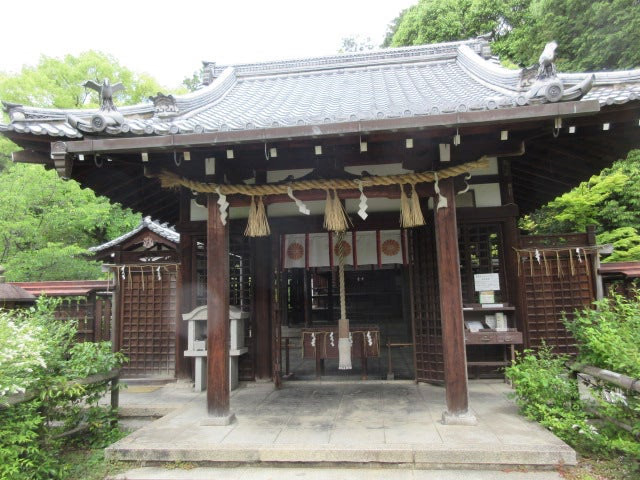
A Kyoto Kumano Shrine for Go-Shirakawa
後白河法皇と新熊野神社
Attraction
Go-Shirakawa founded Shin-Kumano Shrine in 1160 as the protective shrine of his Hōjūjidono residence, while the nearby Sanjūsangen-dō served the same complex as a major Buddhist foundation. The shrine's name is written 'new Kumano' but read Imakumano, expressing a Kyoto counterpart to the older sacred centres of the Kii Peninsula. This was not a casual copy of a distant cult. Go-Shirakawa's repeated Kumano pilgrimages and retired-emperor government made the shrine part of the political and religious landscape of late Heian Kyoto. The present compact site is therefore a surviving institutional fragment of a much larger palace-temple world.
Current visibility
The functioning shrine is visible, but the wider Hōjūjidono complex no longer survives as one enclosed site.
The Honden Recovered After Wartime Decline
本殿
Attraction
The shrine declined after the Ōnin War and later fighting, then recovered through early Edo-period patronage. Its present Honden was rebuilt in 1673 under Prince Dōkan, a son of the retired emperor Go-Mizunoo. The building follows Kumano-zukuri, a sanctuary form associated with Kumano worship, and the shrine and Kyoto heritage authorities identify it as an important, relatively rare example. The structure should not be presented as the untouched 1160 foundation; its value lies in the way seventeenth-century reconstruction restored a late Heian institution through an architectural form that maintained the connection to Kumano.
Current visibility
The sanctuary exterior can be seen from the precinct under shrine rules; entry into the sacred interior is not implied.
The Yōgō Great Camphor Tree
影向の大樟
Attraction
A vast camphor tree dominates the shrine entrance. Shrine tradition says it was brought from Kumano and planted at the foundation under Go-Shirakawa; the shrine estimates its age at about nine centuries. Known as the Yōgō Great Camphor, it is understood as a place where divine presence manifests and is also worshipped through names associated with the camphor deity and Benzaiten. The City of Kyoto has designated the tree a natural monument. Its historical importance does not depend on proving every foundation legend botanically: the living tree visibly connects natural growth, transmitted memory, and continuing prayer at the same precinct.
Current visibility
The living tree is visible in the public precinct; protective boundaries around roots and branches should be respected.
The Imakumano Sarugaku Performance and Noh Patronage
今熊野猿楽
Attraction
A stone memorial in the precinct marks the celebrated Imakumano sarugaku performance of the 1370s. Kan'ami and the young Zeami performed before the shogun Ashikaga Yoshimitsu, whose subsequent patronage helped the Kanze performers enter elite court and warrior networks. Sources differ by one year in converting the era date—the Kyoto municipal marker uses 1374, while one shrine study and the current event chronology use 1375—so the Guide does not force false precision. The durable point is the encounter and its consequences. The marker commemorates a turning point in patronage, not a claim that fully developed Noh was invented in a single afternoon.
Current visibility
The modern commemorative stone is visible in the precinct; the exact medieval performance space is not preserved as a stage.
A Compact Sacred Geography of Kumano
京の熊野古道
Attraction
The precinct arranges the deities of the Kumano Twelve Gongen with subsidiary shrines and a symbolic group of Kumano pilgrimage deities behind the Honden. The shrine's guide explains this arrangement through a mandala: the Kyoto site compresses a distant sacred geography into a form that worshippers could approach within the capital. This is more than a list of small shrines. It preserves the logic of medieval shrine-Buddhist combination, in which kami were interpreted through Buddhist counterparts and pilgrimage space could be reproduced through images, names, and enclosures. Visitors can read the compact arrangement while recognizing that it interprets Kumano rather than replacing the peninsula's actual pilgrimage landscape.
Current visibility
The subsidiary shrines and precinct symbolism are visible under normal shrine conditions; sacred enclosures should not be entered without permission.