HO Guides
Imakumano: Bringing Kumano to the Capital
A ceremonial walk, a festival diary, and a theatrical memory reveal how a shrine gave distant devotion a working place in Kyoto.
Quick · About 2 min
The story in five points
A short route through the argument. Follow a point into Classic for its context and sources.
Kumano reached Kyoto through people
Go-Shirakawa founded Imakumano in 1160 beside his residence. Clerical appointments connected this protective shrine with the Kumano centres; bringing the gods closer also required specialists who could sustain their religious procedures in a new setting.
Read in contextA shorter pilgrimage still required preparation
Tadayoshi’s recorded 1344 visit began at purification lodging and proceeded on foot with guides and attendants. Its ordered approach followed Kumano procedure, showing how sacred connection could be enacted locally without making the urban journey identical to the long pilgrimage.
Read in contextFestivals depended on practical arrangements
Kenshun’s 1355 diary records religious entertainments, lodging, a viewing stand and performer summons. Clerics, warriors and performers supplied different contributions; the shrine provided an occasion for them to meet, rather than a famous name sufficient to produce an event.
Read in contextPatronage meant resources and attendance
A 1356 imperial directive assigned land for offerings and requested prayers through the administrator. A later court exchange arranged and confirmed a steward’s attendance: support became specific obligations carried through people, provisions and communication.
Read in contextPerformance entered an established institution
Kan’ami and Zeami’s encounter with Yoshimitsu belonged to a shrine already capable of joining performance and influential audiences. The surviving sanctuary dates to 1673, and the 1980 Noh memorial gives that theatrical memory a later, deliberate material form.
Read in context
Opening
In 1344, Ashikaga Tadayoshi approached Imakumano on foot from a place of ritual preparation elsewhere in Kyoto. Five sacred horses headed the procession. Shrine clerics served as guides, while Tadayoshi and his attendants wore ceremonial clothing associated with purification. The diary that records the visit explicitly relates its procedure to that of the main Kumano sanctuaries.[1]
Tadayoshi was the younger brother of the shogun, Ashikaga Takauji. His destination was not the distant sacred region on the Kii Peninsula, but a shrine in the capital. The journey was shorter; the occasion still required preparation, order, and people who knew what to do.
Imakumano's name announces a relationship: “new Kumano.” Its history shows what gave that relationship substance. How did a Kyoto counterpart to a distant sacred place acquire a religious life of its own? Processions, offerings, appointed clerics, and performances provide an answer more revealing than resemblance alone.
1. A new shrine, an existing devotion
The retired emperor Go-Shirakawa founded the shrine in 1160 near his Hōjūji-dono residence. Kumano already mattered to him as a destination of pilgrimage. The new foundation brought its deities into the religious setting of his Kyoto establishment, where the shrine served a protective role.[2]
Kumano denoted a group of sacred centres, rather than a single building that could be copied and finished. Its worship connected local deities, Buddhist institutions, and practitioners who guided journeys through the mountains. Bringing Kumano into Kyoto consequently involved relationships with religious specialists as well as a dedication to the gods.
The deities could be described as gongen: manifestations of Buddhist beings who appeared as local gods to aid worshippers. That vocabulary helps explain why Buddhist monks appear in the shrine's history without having crossed into an entirely unrelated religious institution. Here, divine identity and human administration both connected forms of worship that a modern visitor might initially separate. The shrine's dedication supplied a local presence for Kumano's gods; its clerical relationships supplied people responsible for serving them.[3]
Kakusan, a monk of Mii-dera who had guided imperial Kumano pilgrimages, held a supervisory office linking the new shrine with the three Kumano centres. The scholar Suzuki Shōei's account identifies this overlap of offices. A person familiar with the older pilgrimage institution also held responsibility at its Kyoto counterpart.[3]
That arrangement supplied continuity through personnel. An imperial patron could authorize a foundation, but authorization did not itself provide knowledge of religious procedure. The overlap placed such knowledge within reach of the new establishment. Its connection with Kumano could be enacted by people, rather than expressed only by the name over a gate.
The foundation tradition supplies a material counterpart. Kyoto's official account describes earth and timber brought from Kumano, with pebbles from the Nachi shore laid in the sacred precinct. These details present the new ground as physically connected to its source. They belong to the transmitted account of the foundation; the later procession offers a separately documented instance of how Kumano practice was performed here.[4]
The shrine is now encountered apart from the great residence that once surrounded its founding purpose. Nearby Sanjūsangen-dō belonged to that larger imperial undertaking, but its thousand Kannon and Imakumano's deities served different religious settings. Understanding their shared patron does not require turning them into one institution. Imakumano's particular work was to give Kumano a place in the capital.
2. The shorter journey still had a form
Nearly two centuries after the foundation, Tadayoshi's visit made that connection through conduct. The entry in Moromoriki, a court diary, records his departure from a purification lodging near Higuchi and Higashinotōin. He continued on foot. The detailed procession record places shrine guides ahead of him and attendants behind.[1]
This was a journey organized before anyone arrived at the sanctuary. A starting place, distinctive clothing, an ordered company, and the mode of approach separated it from an ordinary movement across the city. The shrine's location shortened the distance to the destination without removing the process of approaching it religiously.
The guides had a practical place in that process. They came from the shrine, and their position in the order preceded that of the prominent visitor. The arrangement assigned a role to religious expertise within an occasion attended by a leading figure in the military government. His public standing did not make a guide unnecessary.
The diary calls the procedure that of the main mountain. This gives “another Kumano” a meaning beyond a compressed landscape. The Kyoto site provided somewhere for an established form of approach to have a local destination. A relationship to a remote centre was expressed through a sequence of actions in the capital.
That does not make the urban visit a complete equivalent of every experience of a long pilgrimage. The useful finding is more concrete: Tadayoshi's recorded visit retained organized preparation and guidance. Sacred distance could be negotiated through ritual as well as measured along roads.
The institution also needed occasions that drew several kinds of participants together. A diary written eleven years later brings us from a formal approach to the less predictable business of a festival.
3. A festival does not run on a famous name
In the sixth month of 1355, the monk Kenshun recorded several days at Imakumano. On the fifteenth he watched a genkurabe, a display or contest associated with ascetic practice, and ennen, entertainments performed in a religious setting. He stayed in a lodging at the shrine. His entry for the seventeenth records sarugaku.[5]
Sarugaku was a developing performance tradition encompassing acting, song, and movement, from which Noh would emerge. It existed alongside other forms, including dengaku, whose performers also developed song-and-dance drama. The modern category “Noh” can make that earlier performing world look more uniform than it was.[6]
Kenshun's record retains some of its practical variety. The seventeenth-day entry notes the dengaku performers' failure to appear the previous day and a separate summons. Performers had to be called and arrive; a festival name alone could not supply a performance.
The audience also had arrangements. Kenshun watched from the shrine administrator's viewing stand, and warrior visitors attended. The diary records two horses presented in connection with the occasion, one on Kenshun's behalf and another from the shrine administrator. Amano Fumio, the historian who reproduces the entries, reads these as gifts to the performers.[5]
The distinctions within that small record are important. An administrator had a place from which guests could watch. A cleric could attend, lodge nearby, and make a gift. Performers occupied another role: they supplied something that the assembled patrons had come to see. The shrine furnished an occasion in which those different contributions could meet.
No famous theatrical discovery is needed to explain why this matters. Here is a documented performance before the later encounter associated with Kan'ami and his son Zeami. It shows the shrine already accommodating religious observance, entertainment, influential spectators, and gifts. We need not invent an anonymous crowd or an exact stage plan to recognize the workings of an organized event.
Nor does one diary entry establish an unchanged annual programme. What it preserves is an actual instance of the institution's capacity to assemble people for several purposes. Imakumano's religious identity gave the occasion its setting; the occasion required work beyond naming the gods.
4. Land, prayers, and someone expected to attend
An imperial directive of 1356 approaches the shrine from another direction. Emperor Go-Kōgon granted the site of Hosshō-ji for Imakumano's offerings. The document calls for prayers for the long continuance of the imperial throne and directs that the shrine's religious community be informed. Its recipient was the bettō, the clerical administrator responsible for the establishment.[7]
The instruction joins a material provision to recurring religious work. A grant could help sustain offerings; an administrator had to communicate what was required; the community was expected to undertake the prayers. “Imperial patronage” becomes a set of connected actions rather than a general atmosphere of prestige.
The wording also places religious benefit at the centre of the relationship. The emperor supported a foundation from which prayers were sought. The document records that expectation, not evidence that the prayers produced a measurable political result. For the history of the shrine, its value is the named provision and the responsibilities it addressed.
Royal participation could also involve the attendance of someone other than the sovereign. In 1373, the court diary Gukanki records a request from Emperor Go-En'yū that Tokimori, a steward in the Konoe household, attend Imakumano's Sixth-Month Assembly. The next entry acknowledges that he had gone and records imperial approval.[8]
This was not simply a note that an important person liked the shrine. A request passed through named intermediaries, attendance followed, and the result was reported. The observance occupied a place in the practical business of a court household.
The diary entries fall in the seventh month, despite the assembly's conventional name. A ritual title and its execution were not always identical in calendar terms. Here, too, the records restore activity to a label: the important thing was arranging participation on the occasion actually being held.
Taken together, the grant and the attendance exchange show two ways of keeping a religious foundation active. Resources could be assigned to offerings; people could be directed towards an observance. The shrine's older connection with a retired emperor had acquired subsequent relationships with living patrons, mediated through clerics and household officials.
5. The performance remembered afterwards
Against this background, the celebrated Imakumano performance becomes less like an event that occurred in an empty place. Kan'ami, the leader of a sarugaku troupe, and his young son Zeami performed before the shogun Ashikaga Yoshimitsu in the 1370s. Yoshimitsu's subsequent patronage became important to their careers. Noh's histories remember the encounter as a consequential opening to elite support.[9]
One brief recollection is preserved in Sarugaku dangi, a compilation of Zeami's discussions assembled by his son Motoyoshi in 1430. It associates Yoshimitsu's first viewing with Kan'ami's performance at Imakumano and says that Zeami was twelve. The account was recorded decades after the event, within a collection that combines recollection, teaching, and editorial arrangement.[10]
The recollection is valuable without being a complete event report. Modern accounts differ between 1374 and 1375, partly because of the debated year of Zeami's birth. The precise location within the Imakumano area has also been disputed. The surviving shrine is the established place of commemoration; its present grounds do not contain an authenticated original performance stage.[11]
Amano's study asks whether the shrine's Sixth-Month Assembly supplied the occasion. Kenshun's earlier diary gives that proposal substance: sarugaku and prominent spectators demonstrably came together at the shrine. It does not, however, establish that the later performance occurred at the same festival. That remains a reconstruction of the circumstances, rather than a dated programme naming Kan'ami's troupe.[11]
The stronger conclusion is about the institution's capacity. A shrine with ritual observances, clerical hosts, and established relationships with patrons could provide more than physical space for a performance. It could furnish an occasion on which performers met an audience assembled through other relationships. The 1355 diary demonstrates that possibility independently of the uncertain details of the famous encounter.
The artistry still belonged to the performers. Kan'ami drew on several contemporary forms, and Zeami's later work developed Noh's combination of song, dance, and drama. A new patron could enlarge opportunities without supplying all the artistic knowledge that went into the work. Imakumano belongs to that history as a setting for encounters, not as the single room in which a finished art was invented.[9]
6. What the surviving precinct makes visible
The shrine's later fabric preserves its Kumano identity in a different way. Kyoto City's architectural record dates the present main sanctuary to 1673. Entered from its gabled end, it has an outer space one bay deep and an inner sanctuary occupying the remaining two bays. The record identifies the form with that of the Shōjōden at Kumano Hongū.[12]
The connection is therefore architectural as well as nominal. The building arranges an approach from an outer to an inner sacred space. It does not reproduce the whole mountainous region; it gives worship a bounded setting in Kyoto. Its seventeenth-century date locates another renewal of the relationship, long after the imperial foundation and medieval performances.
The great camphor tree offers a more immediately personal connection with the founder. Tradition attributes its planting to Go-Shirakawa. The city's natural-monument account records that tradition but also allows a later origin, after the destruction associated with the Ōnin War. Its exceptional size is real; the emperor's personal act remains a transmitted attribution.[13]
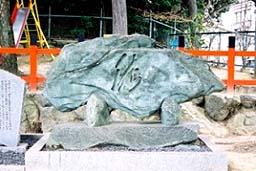
The performance memorial has a firmer date. Erected in 1980, it bears the character for Noh, selected from Zeami's handwriting in the treatise Kakyō. The historian Hayashiya Tatsusaburō supplied the explanatory inscription. A modern committee gave an older theatrical memory a permanent marker within the shrine.[14]
The selection of handwriting is especially apt. A performance disappears as an occasion; Zeami's written work offers a trace that can be reproduced. The stone brings that trace to the place commemorating his early encounter with a patron. It is a deliberate modern connection between a surviving body of writing and a remembered event, rather than a remnant of the medieval stage.
7. A place for things to happen
Imakumano's religious life depended on more than bringing a sacred name northwards. A guide could lead a prepared visitor through a formal approach. A grant could support offerings through the shrine's administration. A festival could bring performers, clerics, and warrior spectators into one occasion. Court messages could turn a relationship of patronage into someone's actual attendance.
These activities explain what the Kyoto foundation made possible. They brought Kumano devotion into the capital through people who had duties, places to go, and occasions to arrange. The shrine did not need to become the entire Kii Peninsula in miniature to sustain a meaningful relationship with it.
The celebrated performance belongs within that working history. Its precise circumstances remain less secure than the later stone suggests, but the shrine's capacity to host performance and patronage has an earlier documentary life. The famous names sharpen our interest; they need not erase the people who prepared, guided, summoned, hosted, and gave.
Tadayoshi's walk makes the point without requiring a theatrical revelation. The destination had been brought closer. Reaching it still meant taking part in an ordered religious occasion. Imakumano gave that occasion somewhere in Kyoto to arrive.
Next topic · HO Guides
Sanjūsangen-dō: A Thousand Images, One Assembly
Surviving figures, workshop inscriptions, and a rebuilt hall reveal how a vast Buddhist ensemble could accommodate different makers and different centuries.
Continue readingSources and NotesView sourcesHide sources
Sources consulted 16 September 2026. Medieval Japanese month and day references below are source locators, not converted Gregorian dates. The shrine's religious administration is distinguished from the uncertain circumstances of the famous 1370s performance.
- [1]
Moromoriki (師守記), Kōei 3/5/17 (1344), passage and procession record discussed in Amano Fumio (天野文雄), “今熊野猿楽の実現—義満台覧の背景をめぐって,” Machikaneyama Ronsō: Aesthetics 22 (1988): 1–20, p. 5: https://ir.library.osaka-u.ac.jp/repo/ouka/all/48149/mra_022_001.pdf; repository identifier https://hdl.handle.net/11094/48149. See the quoted medieval text and surrounding account, and the image on p. 5. They give the purification lodging, walking approach, clothing, guiding clerics, five sacred horses, and explicit relation to “本山” procedure. The body paraphrases this record; it does not invent weather, dialogue, barefoot travel, a complete route, or an identical experience to the long Kii pilgrimage. The complete diary manuscript and the original procession document were not independently examined. The shogunal family relationship is contextual identification, not a claim that Takauji accompanied this visit.
Return to the reference ↑ - [2]
Kyoto City, designated cultural-property description, “新熊野神社本殿,” first entry: https://www2.city.kyoto.lg.jp/bunshi/bunkazai/siteisyasinn/kennsetumei02.htm. It identifies the 1160 foundation as Hōjūji-dono's protective shrine. Suzuki Shōei (鈴木昭英), “新熊野社,” Sekai daihyakka jiten, revised edition, Heibonsha, reproduced by Kotobank, first paragraph: https://kotobank.jp/word/%E6%96%B0%E7%86%8A%E9%87%8E%E7%A4%BE-1146849. Complete entry read, with only the paragraph about the assigned shrine used for its institutional history. Neither foundation nor later shrine is merged with Kyoto's two other Kumano shrines. Go-Shirakawa's Kumano devotion and the shrine's location are also discussed by Amano, pp. 3–4.
Return to the reference ↑ - [3]
Suzuki, “新熊野社,” first paragraph, note 2, on Kakusan, Mii-dera, the Kumano supervisory office, and the local clerical administration. The explanation of personnel connecting the foundations is a limited inference from those documented offices, not a reconstruction of Kakusan's daily programme. For the meaning and Kumano application of gongen, see Yonei Teruyoshi, “Gongen shinkō,” first two paragraphs, Kokugakuin University, Encyclopedia of Shinto: https://d-museum.kokugakuin.ac.jp/eos/detail/?id=9020; and Satō Masato, “Honjisuijakusetsu,” opening definition and paragraph identifying Kumano Gongen: https://d-museum.kokugakuin.ac.jp/eos/detail/?id=8529. The essay explains the pertinent religious relationship without assigning a single doctrine to every medieval worshipper or reproducing a complete Kumano deity correspondence chart.
Return to the reference ↑ - [4]
Kyoto City Tourism Association, official Kyoto Tourism Navi, “新熊野神社,” historical introduction: https://ja.kyoto.travel/tourism/single01.php?category_id=7&tourism_id=233. The account identifies earth, timber, and Nachi-shore pebbles in the founding narrative. This is used as a transmitted account of reproducing sacred ground, not as an independently examined twelfth-century transport record. The same entry's unqualified dating and venue for the later performance, and its named reconstruction patron, are not adopted without the qualifications supplied elsewhere.
Return to the reference ↑ - [5]
Kenshun sōjō nikki (賢俊僧正日記), Bunna 4, sixth month, days 15–17 (1355), medieval entries reproduced in Amano, p. 14, with his discussion on pp. 14–15, URL in note 1. See the text and image on p. 14. The entries specify the religious entertainments, lodging, sarugaku, dengaku nonappearance the previous day, viewing stand, warrior visitors, and two horses. The body distinguishes the record's terse sequence from Amano's explanation of the horses as gifts to performers. It does not specify a missing troupe's reason, assign all the performances to Kan'ami, or infer an unchanging annual programme. The precise original diary volumes were not read beyond the reproduced passages. Genkurabe is explained at the level of an ascetic display or contest; no unseen feat or supernatural result is described.
Return to the reference ↑ - [6]
Nohgaku Performers' Association, “Q&A,” “能と狂言はどう違うの?,” first three paragraphs: https://www.nohgaku.or.jp/encyclopedia/faq.html. Used for the developing dramatic forms within sarugaku, the separate dengaku tradition's song-and-dance theatre, and the danger of projecting a single later category backwards. The essay does not reproduce the page's broad evaluative contrasts between the emotional or social character of Noh and kyōgen. These are general terms for interpreting the diary, not identification of particular plays performed at Imakumano in 1355.
Return to the reference ↑ - [7]
Go-Kōgon's imperial directive, Enbun 1/9/18 (1356), Shin-Kumano Shrine Documents, as transcribed in Amano, p. 4, URL in note 1. It grants the Hosshō-ji site for offerings and instructs the shrine administrator to communicate the requirement of prayers for “宝祚之長久.” The body paraphrases the public-domain directive, not an unpublished modern translation. It does not claim that every service was carried out or produced political security. The reading Hosshō-ji for 法性寺 was checked against Sōda Toshihiro, “ほっしょうじ/法性寺,” Shinsan Jōdoshū daijiten: https://jodoshuzensho.jp/daijiten/index.php/%E6%B3%95%E6%80%A7%E5%AF%BA. This is not the similarly pronounced 法勝寺 of the Six Victory Temples. The original shrine document, land boundaries, and resulting accounts were not inspected.
Return to the reference ↑ - [8]
Gukanki (愚管記), Ōan 6/7/4–5 (1373), quoted in Amano, p. 17, with the earlier identification of Tokimori's household role on p. 5. They record the request for the Konoe household steward's attendance, subsequent confirmation, and court approval. The festival's name is “新熊野六月会” although the diary entries are in the seventh month. No reason for this timing is invented. Amano suggests a prayer purpose for the attendance; that private-purpose inference is not asserted in the body. The complete diary and surviving originals of the exchanged messages were not separately read.
Return to the reference ↑ - [9]
Japan Arts Council, “大成と発展,” Invitation to Nohgaku, sections “大和四座と観阿弥” and “世阿弥と室町幕府”: https://www2.ntj.jac.go.jp/unesco/noh/jp/history/history2.html. Used for the father–son relationship, Yoshimitsu's patronage, Kan'ami's incorporation of elements from other performing traditions, and Zeami's later artistic and theoretical work. The essay does not adopt broad claims that no elite patronage existed before this encounter, the patron's unrecorded feelings, or a ranking of artistic quality. Compare the Nohgaku Performers' Association, “能が武士の芸能になるまで,” section “室町時代初期〜中期”: https://www.nohgaku.or.jp/journey/media/samurais-art, used for its stated 1375 chronology, not as independent proof of the exact venue.
Return to the reference ↑ - [10]
Sarugaku dangi, section 21, the short medieval passage reproduced at the opening of Amano, p. 1; It links Kan'ami's Imakumano performance to Yoshimitsu's first viewing and states that Zeami was twelve. Japan Arts Council, “申楽談儀,” Cultural Digital Library: https://www2.ntj.jac.go.jp/dglib/contents/learn/edc9/zeami/gyouseki/sarugaku01.html. The two-paragraph explanation supports Motoyoshi's compilation in 1430 and its editorial character. The essay paraphrases the displayed medieval passage; it does not claim to have read the entire compilation or a complete modern translation. Twelve is the source's historical age statement, not a calculation of age in completed modern years.
Return to the reference ↑ - [11]
Amano, introduction, pp. 1–2, and section 3, especially pp. 14–19, URL in note 1. See pp. 1, 2, 14 and 17. The author distinguishes the recollection from the lack of contemporary details, discusses 1374/1375 in relation to Zeami's birth chronology, and considers Shin-Kumano Shrine, Shin-Hiyoshi, or the broader Imakumano area as competing venue identifications. His festival-context proposal is presented as a scholarly reconstruction, not as a confirmed programme. The essay's principal institutional evidence is the earlier diary, grant, and attendance record, not a presumed solution of this dispute. Kyoto City's modern marker uses 1374, note 14; the performers' association uses 1375, note 9. This is not explained away as a Gregorian conversion of one known performance date.
Return to the reference ↑ - [12]
Kyoto City, “新熊野神社本殿,” complete relevant entry, URL in note 2. It explicitly gives Kanbun 13 (1673), gable-end entry, three-bay depth divided into one outer and two inner bays, and the comparison with Kumano Hongū's Shōjōden. The body uses the documented plan relationship, not an inference from an unviewed photograph or a promise of sanctuary entry. The current HO Guide's 1663 was not followed. No start/completion distinction is invented to reconcile that discrepancy, and no complete 1160 building is claimed to survive.
Return to the reference ↑ - [13]
Kyoto City, designated natural-monument descriptions, “新熊野神社の大樟”: https://www2.city.kyoto.lg.jp/bunshi/bunkazai/siteisyasinn/tennnennsetumei.html. The municipal account records the imperial-planting tradition while allowing an origin after the Ōnin War. The essay neither assigns a definitive botanical age nor treats the tree as an independently authenticated witness of a fourteenth-century performance. No dated municipal measurement is presented as a newly measured 2026 dimension.
Return to the reference ↑ - [14]
Kyoto City, stone-marker record HI008, “今熊野猿楽,” location, 1980 erection data, and full transcribed inscriptions: https://www2.city.kyoto.lg.jp/somu/rekishi/fm/ishibumi/html/hi008.html. The linked photograph: https://www2.city.kyoto.lg.jp/somu/rekishi/fm/ishibumi/jpg/hi008a.jpg. The inscription identifies the 16 October 1980 committee undertaking and Hayashiya Tatsusaburō's selection of “能” from Zeami's autograph Kakyō. The autograph itself was not inspected. The modern marker's confident claims about 1374, precise location, the tree's witness, and the adoption of Noh as official shogunal entertainment are not treated as contemporaneous documentation. The writer's discussion concerns the modern act of commemoration, not certification of every historical statement carved on the stone.
Return to the reference ↑