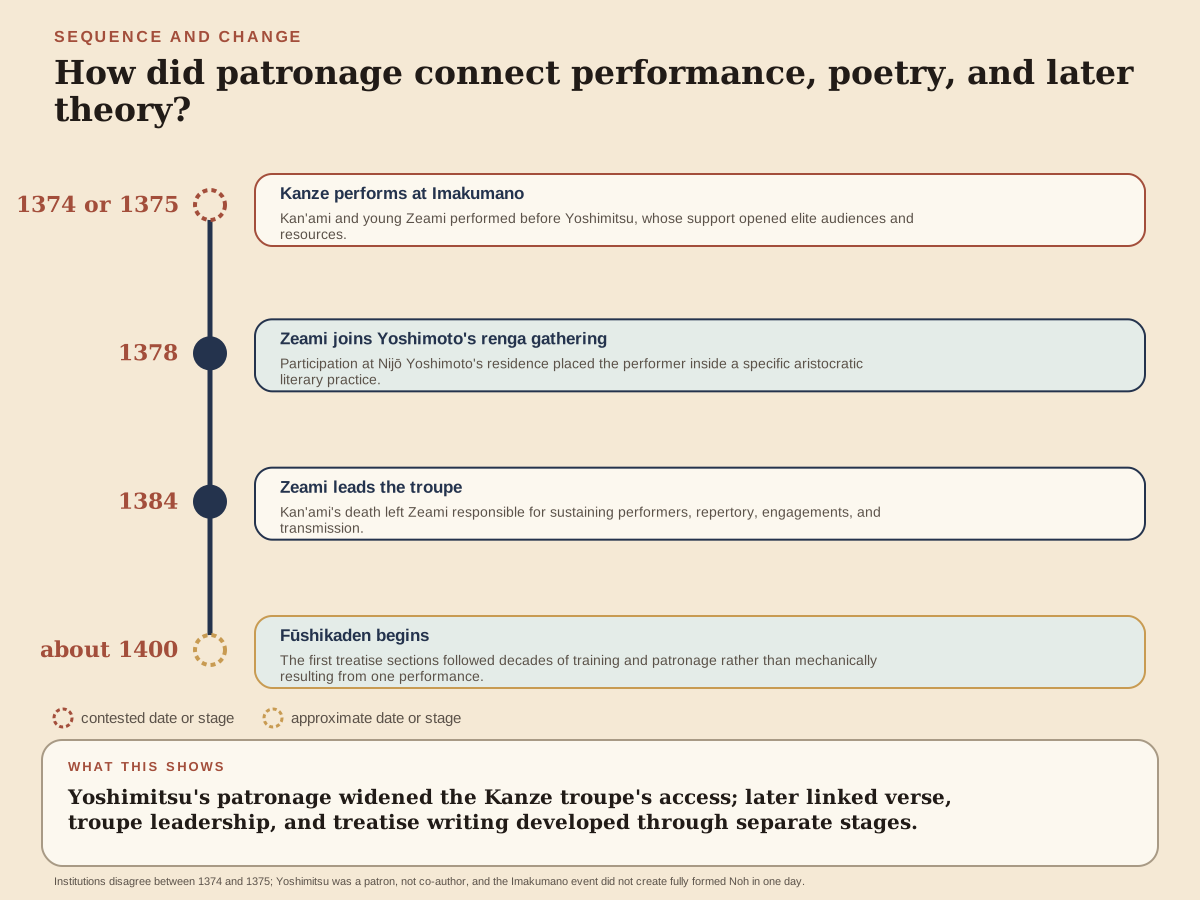
Kan’ami and his young son, later known as Zeami, performed at Imakumano in Kyoto before shogun Ashikaga Yoshimitsu. Institutional chronologies differ between 1374 and 1375. The occasion brought the Kanze performers under Yoshimitsu’s patronage and opened access to court and warrior audiences.
In the mid-1370s, Kan’ami and the young Zeami performed at Imakumano in Kyoto before Shogun Ashikaga Yoshimitsu. The shogun’s interest brought the Kanze troupe into a new circle of patronage and audiences.
Accounts differ over the precise year. The Japan Arts Council gives 1375, noting the age recorded in Shūgaku Dangi, a later record of discussions of Zeami’s teachings. Nabari City’s historical introduction gives 1374. Both place the encounter at Imakumano and connect it to Yoshimitsu’s support; the difference does not alter the sequence of the young performer’s career.
Yoshimitsu headed the military government centered in Kyoto. His attention could bring resources and prestige unavailable through regional engagements alone. It also placed the performers in contact with courtly learning and judgments formed outside their original professional setting.
Favor brought the regional troupe before spectators close to the political center. It did not give performers the hereditary status of court nobles, or turn access to an elite stage into something their household could own. Changes in a ruler’s preferences would later have practical consequences for engagements and succession.
Kan’ami already led an established troupe and had adapted elements of other performance traditions, including the rhythms of kusemai. The performance therefore presented work developed through earlier practice. Shogunal support changed the troupe’s standing and opportunities; it did not create the art from an empty beginning.
The young performer also entered aristocratic cultural circles. Nijō Yoshimoto gave him the name Fujiwaka, and he later participated in Yoshimoto’s linked-verse gathering. Such contacts joined professional performance to elite literary practice. Zeami’s treatises followed many years later, with the first sections of Fūshikaden dating to about 1400.
The event marks a relationship that sustained further training, composition and performance. Exact-year disagreement and retrospective accounts of Yoshimitsu’s response should remain distinct from that documented development. Neither a single successful appearance nor a later founding legend is sufficient evidence that Noh’s forms were complete on that day.
In 1378, the young performer took part in a linked-verse gathering at the residence of Nijō Yoshimoto, a court noble and poet. Linked verse, or renga, was composed by participants contributing successive verses. Here courtly learning had a specific social setting: Zeami was participating in poetry with an eminent practitioner, not merely watching educated spectators from the stage.
Yūgen, a quality of subtle, suggestive depth, belonged to earlier discussions of poetry. Zeami applied it to the effect of performance. His plays used poetic language to bring a character’s emotions and the surrounding scene together.
For a newcomer to nō, the idea is easier to grasp through what the actor attempts. A role need not communicate everything through direct, literal imitation. Controlled movement and a carefully shaped voice can suggest an emotion or presence that the audience completes through its own attention.
Zeami’s contribution was to make inherited aesthetic language part of practical teaching. Refinement had to be embodied by a performer, not merely named by a critic after the event. Training and judgment determined whether it appeared in a particular role before particular spectators.
Kan’ami died in 1384. Zeami assumed responsibility for the Kanze troupe, inheriting the work of sustaining a professional household as well as its reputation. He had to develop performers capable of carrying the repertory forward.
An admired appearance could not by itself keep the troupe active. Its members needed further engagements and skills that could be reproduced. Zeami’s own artistic development was therefore bound to the problem of teaching others.
The change in 1384 gives his writing a practical context. He was not simply recording thoughts for an unknown public. He was helping sustain an art inside an organization for which he was responsible. The playwright, actor, teacher, and household leader were connected roles. His later worries about succession grew from the same need to ensure that performance could continue after an individual master was gone.
Zeami was born around 1363, the son of the performer Kan’ami. He grew up in the Kanze troupe in Yamato, the region around modern Nara. Its work belonged to sarugaku, a medieval performance tradition from which nō developed. Nō combines acted roles with chant, instrumental music, and dance.
Zeami joined dramatic writing to an unusually sustained theory of the performer’s art. Plays such as Izutsu give memory a presence on stage; his teaching asks how an actor can continue to move audiences as age and circumstances change. Both developed within the working tradition he inherited from Kan’ami and the Kanze troupe.
Performing lineages carried nō forward while his writings circulated more narrowly among heirs and disciples. The publication of Sixteen Treatises of Zeami in 1909 brought that teaching to a wider public and changed his standing as a theorist. His influence belongs both to the continuing stage tradition and to texts recovered centuries after his lifetime.
His first training was within a working household. Performers had to sustain engagements and audiences as well as pass skills to the next generation. Temple and shrine occasions connected their art to religious settings, while travel brought them before different spectators.
Kan’ami was changing the art his son learned. He incorporated the rhythm of kusemai, a popular form of sung dance, into sarugaku. This gave his troupe a rhythmic resource beyond its inherited dramatic impersonation. Zeami grew up with a repertory that could absorb another performance tradition rather than simply repeat an established model.