Read the article below. Interactive reading tools are available when scripts load.
Quick
Ashikaga Takauji was born in 1305, the son of Ashikaga Sadauji and Uesugi Kiyoko. He was not Sadauji's only son, and Kiyoko was not the principal wife. An older half-brother initially stood ahead of him, while his full younger brother Tadayoshi would become his closest collaborator and eventual rival. Sources and later traditions associate his birth with more than one place, so no single birthplace should be presented as certain.
The Ashikaga were powerful Kamakura retainers who claimed prestigious Seiwa Genji ancestry and controlled a network of lands, marriage ties, family branches, and military followers. That position gave a child of the house unusual possibilities, but it did not make rebellion his inheritance. The family's rank depended partly on service to the Hōjō-led bakufu. Kiyoko's Uesugi connections and the people who maintained residences, estates, horses, documents, and religious observances also formed the material world from which Takauji later acted. His infancy supplies a political setting, not evidence of a future plan.
Takauji entered court rank in 1319 and grew into leadership within a house still embedded in the Kamakura order. His early personal name was written 高氏, commonly understood to include a character associated with Hōjō Takatoki. He married Akahashi Tōshi, also known as Nariko, a daughter of Hōjō Hisatoki and sister of the last regent, Hōjō Moritoki. Their marriage linked Ashikaga succession directly to the ruling network. Their children included Yoshiakira and Motouji, both essential to the later regime.
These ties were not decorative. Nariko headed an important household, bore heirs, and survived the dangers created by her husband's later defection. In 1331, while the mourning for Sadauji was not yet complete, the bakufu ordered Takauji to campaign against Emperor Go-Daigo's rebellion in the west. He obeyed. Later opposition should not turn that service into camouflage. Before 1333, the Ashikaga gained position through bakufu office, Hōjō marriage, and military duty even while retaining resources and interests of their own.
In 1333 the bakufu again sent Takauji west as Go-Daigo's supporters expanded their rebellion. Instead of restoring Kamakura control, he declared for the imperial side and redirected the forces he could command against the bakufu's Kyoto headquarters. His decision was one of the decisive changes in the Genkō War.
The reversal cannot be explained by one surviving confession of motive. The Hōjō government's military position was deteriorating; imperial messages and ranks could legitimize defection; Ashikaga prestige and grievances made leadership imaginable; and warriors around Takauji had their own risks and expectations. His principal wife Nariko and young children were tied to the Hōjō center in the east, so changing sides exposed his household as well as himself. It is possible to identify preparation and political communication without claiming a lifelong secret plan. Takauji chose within a crisis whose outcome was not yet guaranteed, then converted a bakufu commission into the force that attacked its western command.
Takauji's immediate target was Rokuhara Tandai, the bakufu institution that supervised Kyoto, watched the court, heard disputes, and coordinated western security. Joined by other anti-bakufu forces, his army attacked in May 1333. Rokuhara's commanders abandoned Kyoto with Hōjō personnel, soldiers, and royal figures associated with the existing succession order; their flight ended in defeat and mass death on the road east.
The capture of Rokuhara removed Kamakura's principal western command and gave the imperial coalition access to Kyoto's administrative and symbolic center. It also exposed records, residences, warehouses, and routes that had made bakufu authority practical. Takauji was a leading agent, not the sole destroyer of the Kamakura government. Akamatsu forces and other combatants had already strained the capital, while Nitta Yoshisada's separate advance against Kamakura would prove essential. Takauji's achievement was operationally specific: he turned a bakufu field force into the force that broke its Kyoto institution.
After the bakufu fell, Go-Daigo rewarded Takauji with rank, offices, and the character 尊, changing the written form of his name from 高氏 to 尊氏. Takauji was a leading military beneficiary of the Kenmu government, but he did not simply become its chief minister. Court offices, ad hoc tribunals, provincial appointments, and reward procedures brought aristocrats, warriors, temples, and imperial princes into a new and unstable arrangement.
Takauji's brother Tadayoshi went to Kamakura with Prince Nariyoshi and developed an eastern administration. Ashikaga retainers gained posts, while Takauji's wife Nariko and their sons connected family survival to the emerging order. Prince Moriyoshi, who had commanded anti-bakufu resistance, became a dangerous rival; he was removed from military office, arrested, and sent to Tadayoshi's custody. These conflicts were political choices, not proof that cooperation had always been fraudulent. Takauji needed imperial legitimacy and Go-Daigo needed warrior enforcement, but each also built networks capable of acting without the other.
In 1335 Hōjō Tokiyuki rallied supporters, defeated Kenmu forces, and took Kamakura. Tadayoshi withdrew. During the retreat Prince Moriyoshi, held in his custody, was killed. Tadayoshi bears direct institutional responsibility for the prisoner, but surviving evidence does not justify assigning Takauji a documented personal order or converting every later dramatic detail into fact.
Takauji requested authority and military office for an eastern campaign, then moved before receiving all that he wanted from Go-Daigo. He defeated Tokiyuki and retook Kamakura. Instead of immediately returning to Kyoto, he distributed rewards and organized warriors through his own network. This was not yet the mature Muromachi bakufu, but it created an alternative center able to recognize military service and enforce decisions. The crisis forced a constitutional question into the open: could the Kenmu court control its most powerful commander when his family base and eastern followers were under attack? Takauji's answer in practice was that Ashikaga survival could not wait for complete court authorization.
Go-Daigo ordered forces under Nitta Yoshisada and Prince Takanaga against Takauji and Tadayoshi. Contemporary documents show the brothers classified as enemies; the partnership of 1333 had become civil war. Takauji's army defeated loyalist forces at Takenoshita and Hakone, advanced west, and briefly entered Kyoto in early 1336.
Some war narratives describe Takauji withdrawing from command, cutting his hair, or hesitating to fight the emperor before returning to battle. These episodes illuminate how later authors represented divided loyalty, but their exact scenes and dialogue cannot be treated as transparent psychology. The conflict involved rival systems of reward, eastern control, family survival, imperial command, and the competing military leadership of Takauji and Nitta. Go-Daigo was not merely betrayed by an irrational favorite, and Takauji was not simply liberating “the warriors” from a court that had no warrior support. Both sides assembled mixed coalitions. Takauji's first seizure of Kyoto proved temporary, showing that battlefield success had not yet supplied stable political legitimacy.
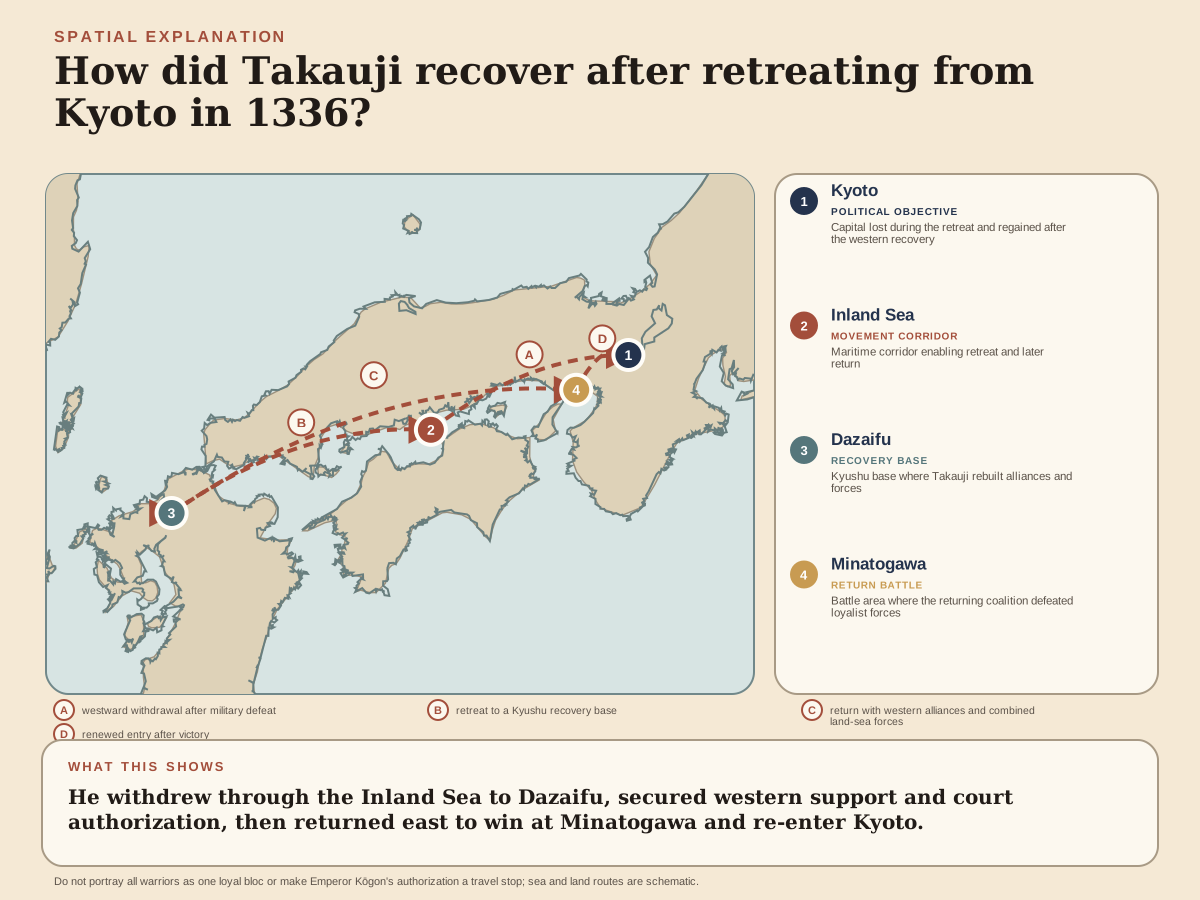
Driven from Kyoto, Takauji withdrew through the Inland Sea to Kyushu. Defeat did not end his cause because western warrior networks, maritime transport, and authorization from the retired Jimyōin-line emperor Kōgon allowed him to rebuild. At Tatarahama he defeated a larger opposing coalition and gathered forces for an eastward return.
In July 1336 the Ashikaga advance met Go-Daigo's defenders near the Minato River. Kusunoki Masashige was killed, Nitta Yoshisada withdrew, and Takauji entered Kyoto again. Later literature made Minatogawa a moral drama centered on Masashige's perfect loyalty and Takauji's treason. The battle's secure political significance does not depend on accepting every speech or tactical exchange preserved in war tales. It joined land armies, ships, local houses, court authorization, and rapidly changing allegiance. Takauji survived because his defeat had not destroyed his network; he won because western and Kyushu allies converted movement and supply into a new coalition. His second entry opened the way to a rival court, not uncontested possession of Japan.
Takauji supported the accession of Emperor Kōmyō in Kyoto under the Jimyōin line, with retired Emperor Kōgon as a crucial royal patron. Go-Daigo later left Kyoto for Yoshino and maintained that his own line possessed legitimate sovereignty. The division created competing courts rather than two modern states. Each depended on households, documents, regalia claims, temples, provincial allies, and armed enforcement.
The Ashikaga also sought a governing program. A seventeen-article text known as the Kenmu Shikimoku was produced in response to Takauji's questions by experienced legal figures including the Nikaidō brothers. It addressed the location and conduct of government and is often treated as a founding law of the Muromachi bakufu, although scholarship also emphasizes its form as advice rather than a simple unilateral code. A surviving autograph vow dated August 1336 provides unusually direct material evidence of Takauji's religious and political crisis. Neither object authorizes invented inner speech. Together they show a commander seeking legal memory and sacred discipline while constructing a rival order.
In 1338 the Northern Court appointed Takauji seii taishōgun. The title placed him in a lineage of warrior command and publicly recognized Ashikaga leadership, but it did not cause a complete shogunate to appear on the appointment day. Offices, judicial practice, revenue, provincial enforcement, and relations with powerful shugo continued to develop through war.
Takauji's authority remained distributed. Tadayoshi managed much of the regime's judicial and administrative work; court officials made imperial government function; commanders enforced claims in the provinces; and household members such as Nariko and the heir Yoshiakira sustained succession. Even the word “Muromachi” can mislead if it projects the later government of Yoshimitsu backward onto 1338. Takauji held Kyoto and the shogunal title while the Southern Court remained active and local wars continued. The appointment mattered because it turned a victorious coalition leader into an officeholder recognized by the Kyoto court. It was a constitutional milestone, not a certificate that all of Japan now obeyed one finished military state.
Takauji's government survived by appointing shugo and other commanders who could recruit forces, police roads, pursue enemies, and enforce claims in provinces where the center had no standing administration. These officers were not yet the fully territorial lords of later centuries. Their wartime powers overlapped with estate proprietors, local warriors, provincial offices, temples, and the competing commands of the Southern Court.
Military finance transformed land. Emergency levies and, from the Kannō era, measures allowing portions of estate income to support warriors could protect the regime while reducing what temples, aristocrats, and cultivators received. Application varied; “half-tax” was not one permanent nationwide confiscation. Takauji and Tadayoshi also supported a network of Ankokuji temples and memorial sites for the war dead, linking provincial patronage to political order. A shogunal document became effective only when a local agent could identify the property, survive rival claims, and collect from people working the land. The early Muromachi polity was therefore a chain of negotiated enforcement, not a capital issuing commands to uniform provinces.
For much of the early regime, Tadayoshi handled a large share of judicial and administrative business while Takauji stood at the center of military patronage and final approval of rewards. Kō no Moronao served as an exceptionally powerful commander and executive. This arrangement is often called a dual government, but it was not a fixed chart with every function neatly divided between two brothers.
Documents show changes over time, overlapping signatures, delegated decisions, and the importance of clerks and retainers who made commands effective. Takauji's mother Kiyoko and wife Nariko managed property and household continuity; Yoshiakira was prepared for succession; Motouji later represented the family in Kamakura. Tadayoshi also developed his own clients and promoted Takauji's son Tadafuyu, whom he adopted. Legal claimants could prefer Tadayoshi's procedural authority, while warriors seeking reward approached Takauji and Moronao. The system expanded capacity by giving several leaders recognized routes to decision. It also allowed disagreements over justice, service, and personnel to harden into rival political networks.
In 1349 conflict between Tadayoshi and Kō no Moronao broke the regime's working balance. Moronao's pressure forced Tadayoshi from government, and Yoshiakira took a larger administrative role. Tadayoshi escaped, allied with the Southern Court, and defeated Takauji's forces. A 1351 settlement was followed by the killing of Moronao and his brother Moroyasu by men associated with Tadayoshi's side.
The brothers soon fought again. Takauji temporarily made terms with the Southern Court in order to isolate Tadayoshi, defeated him, and received his surrender. Tadayoshi died suddenly in 1352. Later suspicion that he was poisoned—sometimes made into a direct accusation against Takauji—must remain suspicion, not fact. The disturbance allowed Southern forces to exploit Kyoto, seize royal persons, and recover regalia, showing that Ashikaga civil war altered imperial legitimacy as well as warrior politics. The Event was not a private family tragedy that interrupted an otherwise finished government. It redistributed provincial alliances, elevated Yoshiakira, damaged legal continuity, and proved that early Ashikaga authority was a coalition capable of dividing into rival states.
After Go-Daigo died in 1339, Takauji supported Musō Soseki's plan for a Zen monastery in his memory. Tenryūji received support from Takauji, Tadayoshi, and retired Emperor Kōgon. When estate income proved insufficient, a trading mission to Yuan China helped finance construction; the main complex was dedicated in 1345. Religion, foreign trade, land, labor, and former enemies met in one foundation.
Takauji also sponsored memorial institutions across the provinces and, in 1354, a large hand-copied Buddhist scripture project involving monks from Kyoto, Nara, and Kamakura. The surviving object commemorates Go-Daigo, Takauji's parents, and people killed in the wars while seeking peace. It cannot prove that every political act was compassionate, nor should commemoration be dismissed as hypocrisy because Takauji had fought those he mourned. Medieval memorial practice could address danger from the dead, karmic responsibility, public order, and genuine grief at once. The present Tenryūji and Tōjiin landscapes contain later reconstruction; their fourteenth-century meanings must be separated from the buildings visitors see today.
Takauji died in Kyoto in 1358, on the thirtieth day of the fourth month in the contemporary calendar. He was fifty-two by elapsed-age counting, fifty-four by traditional Japanese reckoning. A precise modern diagnosis should not be asserted from the available record. He was buried and memorialized at Tōjiin, a temple associated with Musō Soseki and Ashikaga patronage; its present buildings are later than Takauji because the site repeatedly burned and was rebuilt.
Yoshiakira succeeded as shogun, while Motouji anchored Ashikaga authority in Kamakura. The Southern Court remained active, Tadafuyu remained an opponent, and powerful shugo retained their own bases. Takauji left a durable office and coalition, not the mature system later associated with Yoshimitsu. His reputation also remained divided. Loyalist history classified him as the betrayer of Go-Daigo, while some late Meiji historians reopened questions about his statecraft and context. In 1911 official preference for Southern Court legitimacy sharpened the public politics of that judgment. None of these later classifications changes the fourteenth-century evidence; each changes which evidence readers were taught to value.
Classic
Takauji entered a house with high status but no guarantee that status would belong to him. The Ashikaga traced themselves to the Seiwa Genji and possessed the kind of pedigree that could command respect among warriors. Genealogy mattered because it shaped marriage, rank, ceremonial precedence, and the language through which later military leadership could be justified. It was not a prophecy that the family would found a new government.
His father, Sadauji, served the Kamakura bakufu as a major hereditary retainer. Service linked the household to Hōjō authority, supplied offices and opportunities, and protected its holdings. The same relationship also placed a well-resourced lineage close enough to central power to accumulate an independent following. Dependence and capacity were not opposites.
Takauji's mother, Uesugi Kiyoko, came from another warrior house with courtly origins and important eastern connections. Research on her surviving records shows that she cannot be treated merely as a name in a male genealogy. A mother could manage property, sponsor religion, maintain correspondence, and connect sons to her natal kin. The documentation does not allow a complete reconstruction of Kiyoko's household, but it establishes a political and material presence that later heroic biography often suppresses.
Sadauji had a principal wife of higher household standing, and an older son initially preceded Takauji. Medieval succession was not a mechanical rule of first birth, yet maternal rank and recognition mattered. Deaths, adoptions, health, alliances, and a father's decisions could reorder the heirs. Takauji's later emergence therefore resulted from family contingency rather than an uncontested position fixed in 1305.
Tadayoshi, born to Kiyoko after him, shared maternal ties and upbringing while developing a distinct political identity. Calling him simply Takauji's assistant would erase the independent clients and legal authority he later acquired. Their common childhood is poorly documented; their adult division of power is much better known.
The precise birthplace remains disputed. Ashikaga in Shimotsuke, Uesugi-linked territory in Tanba, and other locations appear in different traditions and arguments. A birthplace can become important to local memory and modern heritage, but competing claims should remain visible rather than being resolved by narrative confidence.
The child's world depended on many people whose names rarely enter chronicles. Estate officials turned rights into rice and coin. Grooms maintained horses; smiths and armorers supported military households; nurses and attendants cared for children; clerics performed rites; messengers connected eastern and western properties. Family power was produced through this labor before it could appear as a command on a battlefield.
Later accounts sometimes give the Ashikaga a long-hidden ambition to restore Minamoto shogunal rule. Such stories are intelligible after 1338, when Takauji held the title of shogun. They are weak evidence for what Sadauji or an infant son intended decades earlier. Prestige provided a repertoire of claims, not one predetermined program.
The strongest opening is therefore institutional and deliberately incomplete. A second son was born into a lineage both loyal to Kamakura and capable of acting beyond it. Maternal and paternal networks gave him resources; household contingency moved him toward succession. Nothing in the surviving evidence lets the adult founder speak from the cradle.
The young Ashikaga leader entered public life through the institutions that already existed. Court rank gave a warrior honor recognizable in Kyoto as well as Kamakura. Bakufu duty placed him within military chains of command. Household succession required the support of relatives, retainers, and estate managers rather than a solitary declaration of adulthood.
His early name, Takauji written with the character 高, is conventionally linked to Hōjō Takatoki. Name characters could signal patronage and hierarchy. The later change to 尊氏 under Go-Daigo would advertise a new political relationship, but neither name made its bearer a passive possession of the donor.
Marriage created a still denser bond. Akahashi Tōshi, often called Nariko in modern accounts, was the daughter of Hōjō Hisatoki and sister of Hōjō Moritoki. Moritoki became the final shikken, or regent, of the Kamakura bakufu. Takauji was thus not an outsider waiting at the gate; his wife belonged near the center of the Hōjō political family.
Nariko's importance exceeds genealogy. She was Takauji's principal wife and the mother of multiple children, including Yoshiakira and Motouji. Those sons later anchored Kyoto and Kamakura branches of Ashikaga rule. Their upbringing, protection, household personnel, and marriage futures made Nariko's position part of regime construction before any regime existed.
The marriage also created danger. When Takauji defected in 1333, close family members in the east could become hostages or targets. Sources differ in their narrative details, but the structural risk is clear: rebellion cut through a household tied by blood to the government being attacked.
Sadauji's death further complicated the transition. Takauji inherited leadership while ritual obligations and family reorganization were still active. In 1331 the bakufu ordered him west against Go-Daigo, reportedly before the funeral observances were complete. Obedience demonstrated that Kamakura could claim military service even at a moment of private loss.
Campaigning required more than personal allegiance. Takauji had to mobilize branches, mounted followers, equipment, provisions, and travel routes. Retainers served the Ashikaga while the Ashikaga served the bakufu. These nested loyalties allowed a command to produce an army, but they also meant the army's cohesion might follow the house if its leader later changed sides.
Nothing here proves uncomplicated affection for Hōjō rule. Powerful vassals could resent decisions, compete for rewards, protect local rights, and calculate future advantage. Yet political tension differs from a decades-long secret conspiracy. The evidence for Takauji's pre-1333 intention is far thinner than the evidence for his active participation in bakufu order.
Go-Daigo's first rebellion failed in 1331, and Takauji returned to the eastern political world. The emperor was exiled, loyalists remained active, and Kamakura appeared to have survived. A later founder-centered story can treat this as the last pause before destiny. At the time, continued Hōjō government remained a plausible future.
Early service also gave Takauji knowledge that would become valuable in revolt. He knew how bakufu armies were summoned, where Kyoto command operated, which houses could shift, and how messages traveled. Acquired capacity does not reveal when a decision was made.
The responsible distinction is between position and purpose. By 1331 Takauji was a ranked warrior, husband within the Hōjō family, father of heirs, head of a major house, and proven commander. Those facts explain why his later choice mattered. They do not show that every oath and campaign before it was false.
By early 1333, resistance to Kamakura had become geographically dispersed. Go-Daigo had escaped exile. Prince Moriyoshi and regional warriors maintained opposition. Akamatsu Norimura and other forces threatened routes near Kyoto. Reports arriving at Kamakura did not describe one centrally controlled imperial army, but they did reveal that suppression had failed.
The bakufu responded through familiar procedure: it summoned vassals and dispatched a major commander west. Takauji received men and authority because the government still regarded Ashikaga service as usable. That confidence gave him the operational position from which betrayal became consequential.
Defection was not a private change of opinion. Orders had to be rewritten, allies informed, followers persuaded or compelled, and targets selected. Some warriors might interpret the move through loyalty to the house; others through hostility to the Hōjō, hope of reward, or recognition that Kamakura was losing control.
Imperial authorization supplied a language larger than Ashikaga interest. Go-Daigo's side could confer rank, recognize claims, and frame action as service to a sovereign wrongfully opposed. Such authorization did not guarantee land or victory, but it reduced the appearance that Takauji was merely a rebellious vassal.
The personal cost was real. Nariko was a Hōjō woman by birth. Their sons were still children. Family members and associates in Kamakura lay within reach of a government that could punish kin for a commander's treason. Later Ashikaga success should not erase this hostage logic.
Why did he accept the risk? Sources and later chronicles supply grievances, omens, secret commitments, and calculations with different levels of credibility. None opens an unmediated record of his mind. The balance of military opportunity, dynastic prestige, resentment, communications from the imperial coalition, and fear for the future can be reconstructed; their private weighting cannot.
Nor should the Hōjō collapse be assumed at the moment of choice. The bakufu had survived previous uprisings and commanded extensive eastern resources. Kyoto could be retaken if other vassals remained loyal. Takauji did not know that Nitta Yoshisada would soon penetrate Kamakura and complete the institutional catastrophe.
The decision also altered the meaning of his army. Men summoned under bakufu authority now marched in the Ashikaga leader's new cause. This exposes a weakness in delegated government: central power depended on intermediary houses whose followers might obey the intermediary first.
Go-Daigo and Takauji entered the same Event from different positions. The emperor needed a warrior coalition able to break institutions he could not attack from the palace. Takauji needed an authority that could reclassify revolt as loyal service. Their purposes overlapped without becoming identical.
After victory, both sides benefited from telling the reversal as moral clarity. Imperial history could portray a great warrior recognizing rightful rule. Ashikaga memory could present its founder as responding to sovereign command rather than abandoning a patron at the moment of weakness.
The evidence supports a narrower and more demanding conclusion. Takauji made a deliberate, organized, dangerous turn in April 1333. It transformed the western campaign and exposed his family. It was neither a spontaneous mood nor the final step of a plan demonstrated from childhood. The decision became decisive because other actors made the bakufu's defeat real.
Rokuhara was not merely a fortress. From its Kyoto base, the bakufu monitored imperial and aristocratic politics, managed military security, communicated with Kamakura, and exercised jurisdiction in western disputes. Its buildings, officials, messengers, files, and armed retainers joined eastern military government to the capital.
That institutional density made it a strategic target. Go-Daigo's coalition could not securely reclaim the court while a functioning Kamakura command remained nearby. Takauji could not prove his reversal through declaration alone; he had to destroy the body that had issued and enforced the old order.
Kyoto was already under pressure. Akamatsu Norimura and other loyalist forces had fought in the region. Monastic and aristocratic networks carried intelligence. Residents faced requisition, movement of troops, fear of fire, and uncertainty over which authority would control gates and roads.
Takauji's arrival changed the balance because his men came with the organization of a major bakufu expedition. They knew military procedure and possessed numbers, equipment, and recognized commanders. A government had armed the force that now attacked its own western headquarters.
The assault should not be reduced to one heroic breach. Units approached through different routes, local knowledge mattered, and defenders had to judge whether reinforcement or safe retreat remained possible. Once confidence failed, an administrative center could collapse faster than its formal powers suggested.
The Rokuhara commanders attempted to withdraw east with retainers and court figures tied to the succession order recognized by Kamakura. This mobile column shows that legitimacy traveled with people and regalia-related claims, not only buildings. Its destruction near the routes out of the capital ended the possibility of simply relocating Rokuhara command.
Accounts of the flight and deaths come through chronicles with dramatic conventions as well as institutional records. Numbers, speeches, and perfectly staged final moments require caution. The broad sequence—abandonment, pursuit, defeat, and the disappearance of the command—is secure.
Control of Kyoto yielded material advantages. Officials could be approached or replaced; correspondence intercepted; storehouses and residences occupied; ranks and proclamations issued within a capital no longer policed by Kamakura. Court households that had waited could now align more openly.
It also created immediate burdens. Troops needed food and discipline. Confiscated property raised competing claims. Former officials had knowledge the victors needed. The removal of one jurisdiction did not automatically decide who would hear every case or pay every servant.
Takauji's role grew through visibility. A commander who had delivered Kyoto could demand reward and attract warriors looking for a patron. Yet Go-Daigo's restored court possessed the authority to classify that action as loyal service. Neither partner could yet dispense with the other.
Kamakura itself did not fall because Rokuhara fell. Nitta Yoshisada led the eastern assault, local houses chose sides, and Hōjō leadership perished in a separate theater. Treating all of 1333 as Takauji's personal conquest would erase the coalition that made his decision successful.
The deeper transformation concerned trust. Bakufu rule had depended on sending great vassals to act at distance. Rokuhara's fall demonstrated that delegated force could reverse direction and carry administrative knowledge to a new sovereign. Institutions disappear not only when walls are taken, but when the people who connect command to obedience cease to believe the center can protect or reward them.
Victory created an administrative flood. Warriors demanded reward for fighting; former Hōjō lands had to be identified; old claims reappeared; temples and aristocrats sought restoration; provincial offices required appointment; and rival participants offered incompatible accounts of service. No founder could settle this by ceremony alone.
Go-Daigo's government created and adapted offices to process the work. Its surviving records show experimentation rather than a simple attempt to abolish warriors and return to an imagined ancient court. The problem was scale, conflicting rights, limited enforcement, and the political priority given to different claimants.
Takauji received conspicuous honor. The emperor granted the character 尊, producing the name by which he is remembered. He obtained high rank and important posts. Such favors publicly bound a military victor to the restored sovereign and distinguished him from other commanders.
Honor did not place him at the center of every decision. Go-Daigo relied on court officials, imperial relatives, clerics, provincial appointees, and other warriors. Takauji's absence from some central structures has sometimes been read as deliberate exclusion; it also reflects the plurality and improvised form of the new government.
The Ashikaga built capacity within that plurality. Retainers entered offices and received claims. Petitioners approached Takauji because he could recommend, protect, and mobilize. His residence and correspondence became an alternative route through which warriors hoped to make victory pay.
Kamakura was especially important. Tadayoshi went east with Prince Nariyoshi, an imperial child whose presence gave the administration dynastic authority. The arrangement paired an Ashikaga commander with a royal figure, much as the old bakufu had combined warrior government and court legitimacy in another form.
This eastern position was not yet a declared independent shogunate. It did, however, give Tadayoshi experience with judgments, security, and eastern retainers. It also protected an Ashikaga base far from the daily court at Kyoto.
Prince Moriyoshi complicated the alliance. He had fought for Go-Daigo through religious and regional networks and possessed his own claim to military leadership. His conflict with Takauji cannot be reduced to personality: both represented competing paths for organizing the warriors who had overthrown Kamakura.
Go-Daigo removed Moriyoshi from the office of shogun and authorized his arrest. He was delivered to Tadayoshi's custody in Kamakura. Later narratives allocate blame differently and dramatize intrigue, but the emperor's role in the political removal should not disappear behind a story of Ashikaga kidnapping.
Nariko and the next generation also belonged to this construction. Yoshiakira could become an heir in Kyoto-centered politics; Motouji would later anchor Ashikaga authority in the east. In 1334–35 these futures were not fixed, yet protecting children, attendants, and estate income already shaped the household's calculations.
Many warriors remained dissatisfied. Delay or reduction in reward could feel like betrayal after costly service. Yet “warriors” were not one policy bloc: a judgment favorable to one house harmed its local rival, and a restored estate for a temple might dispossess a military steward.
The Kenmu partnership was therefore real and unstable. Go-Daigo transformed Takauji's revolt into legitimate service and gave him offices unavailable from a dead bakufu. Takauji supplied military reach and a channel to armed households the court could not directly command.
Rupture was not automatic on the day of reward. It became likely as each side used the partnership to strengthen a different governing network, and as the eastern crisis of 1335 forced Takauji to decide whether imperial permission or Ashikaga survival would control his next campaign.
The Nakasendai uprising revealed how little 1333 had settled in the east. Hōjō Takatoki was dead and the bakufu abolished, but Hōjō kin, former retainers, local clients, and memories of the old order survived. Hōjō Tokiyuki could turn those remnants into a fast-moving military challenge.
Kamakura still mattered after losing its government. Roads converged there; warrior houses possessed residences and documents; temples and shrines held estates; the city carried the memory and logistical infrastructure of military rule. Capturing it gave Tokiyuki more than symbolic revenge.
Tadayoshi's administration could not hold. In the withdrawal, Prince Moriyoshi remained a prisoner whose existence carried political danger. He might become a rallying point, be recovered by allies, or expose the unresolved conflict between Go-Daigo's princes and Ashikaga commanders.
Moriyoshi was killed in custody. The broad fact and Tadayoshi's custodial responsibility are secure. Chronicles supply scenes and motives with differing emphases. A chain extending from Takauji's personal instruction is not established strongly enough to narrate as fact, while Go-Daigo's earlier authorization of arrest must remain part of the causal history.
News of Kamakura's fall confronted Takauji in Kyoto. He sought appointment and authority to move east. The surviving sequence indicates that he departed without receiving the full formal authorization he requested. This was more than impatience: a commander claimed that military emergency licensed action before sovereign procedure was complete.
Travel east required rapid mobilization. Ashikaga branches and allied houses supplied men; roads and post stations supplied movement; warriors joined in anticipation of reward. The court's orders could frame the enemy, but Takauji's household made the force operational.
Tokiyuki's initial success did not last. Takauji's coalition defeated the Nakasendai army and recovered Kamakura. Victory protected family interests and removed a serious threat to the new order. It also gave Takauji the strongest claim to decide what the victors deserved.
Reward was government. To confirm land or office was to judge whose account of fighting counted, whose prior right could be displaced, and whose future service would be secured. When Takauji issued or backed rewards in the east, he did not merely share spoils; he built jurisdiction.
Returning immediately to Kyoto would have placed those decisions under closer imperial review. Remaining in Kamakura kept followers near their claims and made Ashikaga documents a practical source of protection. The court could see the same acts as usurpation that warriors saw as necessary payment.
This tension should not be translated into a modern dispute between civil and military government. Go-Daigo's order also depended on armed enforcement, and Takauji continued to seek courtly titles. The question was which combined court-warrior network could decide and implement claims.
The crisis multiplied responsibility. Tokiyuki chose revolt; local houses changed sides; Tadayoshi lost the city and disposed of a prisoner; Takauji moved without full permission; Go-Daigo attempted to preserve command. No single personality produced the rupture.
After Kamakura's recovery, each side had reason to distrust the other. The emperor faced a commander who had proved he could act, reward, and remain outside Kyoto. Takauji faced a court that could condemn the very autonomy through which he had rescued the east.
The Nakasendai Rebellion is therefore not just a prelude to the “real” war. It is the Event in which emergency action became administrative precedent. Takauji won a campaign and discovered that the power to protect his following required a governing center the emperor could not fully supervise.
Go-Daigo could not allow Kamakura to become permanently independent under a commander acting without full permission. If Takauji retained the east, distributed rewards, and ignored recall, other provincial leaders might imitate him. The issue concerned the reach of restored government, not wounded royal pride alone.
The emperor issued orders identifying Takauji and Tadayoshi as targets. Documentary survival matters here: the existence of anti-Ashikaga commands establishes public rupture even when chronicle scenes surrounding them are uncertain. Law, rank, and military mobilization moved together.
Nitta Yoshisada was a logical field leader. His attack on Kamakura had helped destroy the old bakufu, and his own following competed with Ashikaga prestige. Prince Takanaga supplied dynastic presence. Their army was therefore neither purely courtier nor merely Nitta private force.
Takauji mobilized a comparable mixture. Ashikaga relatives, eastern warriors rewarded after Nakasendai, local houses, and men fearful of losing claims made his cause effective. Some may have understood their service as loyalty to Takauji; others as defense against Nitta rivals or imperial review.
Battles around Hakone and Takenoshita opened the road west. Terrain, winter movement, defections, intelligence, and local guides mattered alongside named commanders. Victory enlarged Takauji's following because uncertain houses often waited to see which coalition could protect them.
Chronicles describe a moral crisis in which Takauji withdrew, sought religious refuge, or hesitated to raise arms against the emperor. Different texts and later retellings arrange these episodes to explain how a formally loyal warrior could fight a sovereign who had renamed and rewarded him.
There may have been genuine hesitation. Religious acts and temporary withdrawal were available political practices as well as expressions of feeling. But private conscience cannot be reconstructed from perfected speeches, and reported tonsure should not be made the single cause of renewed command.
Tadayoshi and other retainers could press the military argument: defeat would destroy the house and expose its adherents. Command was distributed enough that Takauji's personal pause did not stop the coalition from possessing interests of its own.
The advance to Kyoto in early 1336 looked like vindication, but holding a capital required more than entering it. Go-Daigo's court could relocate, issue commands, and activate commanders elsewhere. Monasteries and city districts could support or obstruct the occupiers. Food and discipline became immediate problems.
Takauji also lacked a fully secured alternative court. Fighting under the broad idea of restoring order did not answer who could appoint him, validate confiscations, or settle imperial succession. Military success was running ahead of constitutional construction.
Loyalist forces regrouped. Kitabatake Akiie advanced from the northeast, Nitta remained active, and other imperial networks converged. Takauji was driven from Kyoto. The first occupation lasted too briefly to become government.
This reversal is important because later founding narratives naturally make 1336 a straight road toward the shogunate. In reality Takauji could defeat the first army sent against him and still lose the political center. His survival required retreat, new authorization, and a wider western coalition.
The break was thus produced by interacting claims: imperial supremacy over appointments and reward, Ashikaga responsibility to followers, Nitta-Ashikaga competition, and the inability of either side to trust the other's enforcement. A personal betrayal occurred, but it became historic because institutions and thousands of dependent people moved with it.
Takauji's retreat after losing Kyoto could have become a terminal flight. The army had suffered reversal, uncertain allies might defect, and the imperial court could describe pursuit as lawful punishment. Survival depended on keeping commanders, communications, and a destination intact.
The Inland Sea was a political corridor. Ships carried warriors, horses where possible, provisions, messages, and news among ports and island routes. Maritime families and coastal temples mattered as much as roads. Retreat by water allowed Takauji to avoid some loyalist concentrations and reach western supporters.
Authorization from retired Emperor Kōgon gave the Ashikaga cause an imperial connection before the Northern Court was fully established. Kōgon belonged to the Jimyōin succession excluded by Go-Daigo's new order. His support did not erase Go-Daigo's reign, but it allowed Takauji to claim he opposed one royal government with another royal mandate rather than rejecting kingship itself.
Kyushu was not empty territory available to a famous visitor. The Shōni, Kikuchi, and other houses had local rivalries, estate interests, and prior alignments. Takauji had to enter those conflicts. Recruitment grew from promises and relationships, not from universal warrior solidarity.
At Tatarahama, the apparent numerical balance in narrative sources should be treated cautiously. What matters is that Takauji's smaller or initially weaker coalition defeated opponents and transformed regional survival into renewed momentum. Victory persuaded additional houses that he could still reward and protect them.
The return east combined separate columns and fleets. Food, horses, arrows, repairs, guides, and coordinated timing were the hidden architecture of the campaign. A commander who could not maintain these systems would lose followers before reaching Kyoto.
Go-Daigo's coalition also adapted. Nitta Yoshisada held major responsibility, while Kusunoki Masashige had become a trusted commander through earlier resistance. Other warriors and imperial princes supplied forces. The defense was not a ceremonial court standing alone against a national military class.
Minatogawa took place where maritime and land routes approached the capital. Later versions emphasize Masashige's proposal to avoid direct battle, his obedience to an unwise imperial command, and a final exchange with his brother. These elements became central to loyalist memory, especially in later centuries, but their textual layers must be distinguished from the secure outcome.
Masashige died; Nitta withdrew; the defensive line failed. Takauji's victory opened the route to Kyoto and removed a commander whose later reputation would become far larger than the evidence for his lifetime political position.
Takauji's role should not be reduced to defeating Masashige personally. He commanded a coalition built by Tadayoshi, regional allies, maritime carriers, and household officers. Minatogawa was an institutional battle between networks that could each invoke royal authority.
Entering Kyoto a second time differed from the first occupation. Takauji now possessed western alliances, a surviving authorization associated with Kōgon, and the experience of having lost the city. He could begin constructing court and legal arrangements designed to last.
Yet Go-Daigo still had followers, regalia claims, sons, religious networks, and the ability to relocate. Nitta remained in the field. The city was secured more firmly, but sovereignty was not resolved by one battle.
The campaign demonstrates the danger of reading backward from 1338. Takauji did not found a government simply because he was destined to win. He escaped a genuine defeat by using geography, rival royal legitimacy, local conflicts, and the credibility of future reward. Contingency did not disappear; he organized it better than his opponents during these months.
Takauji did not abolish the court. He helped activate a rival branch of the imperial family. Kōgon had previously reigned under Kamakura's succession settlement and retained household authority after Go-Daigo's restoration displaced him. His Jimyōin lineage supplied a royal alternative with its own genealogy and supporters.
Kōmyō's accession in Kyoto created an institutional center able to confer office, rank, and the title Takauji would later receive. Calling this court a puppet captures Ashikaga military influence but erases royal agency, aristocratic offices, ritual requirements, estate interests, and the dependence of warriors on courtly validation.
The relationship was reciprocal and unequal. Takauji's army protected Kyoto and constrained political choices. Kōgon and Kōmyō supplied forms of authority the Ashikaga could not manufacture from military command. Each side needed the other without controlling every decision the other made.
Go-Daigo briefly negotiated from a position of defeat but escaped the arrangement and established a court at Yoshino. His claim rested on his understanding of regalia, succession, continuing sovereign authority, and loyal service. The Southern Court possessed fewer immediate metropolitan resources but remained politically active.
“Northern” and “Southern” describe court locations and later historical categories, not fixed territorial nations. Provincial houses might change allegiance, recognize documents selectively, or use the division to pursue local conflicts. Competing sovereignty widened the market for military support.
Takauji's August 1336 autograph vow survives as a designated cultural object. Its physical handwriting, date, religious form, and transmission give it evidentiary value independent of later narrative. It shows the founder acting through Buddhist commitment during a violent transition.
The Kenmu Shikimoku supplied another kind of artifact. Takauji presented questions concerning government to experienced men associated with Kamakura legal administration. Their response was arranged in seventeen articles and drew on memories of earlier warrior rule, present disorder, and ideals of disciplined administration.
Historical disagreement · Was the Kenmu Code promulgated law or advice?
Its form matters. Popular summaries call it the Muromachi bakufu's founding constitution. Some historians accept a promulgated legal role; others stress that the surviving text reads as an advisory opinion delivered to Takauji.
The dispute should be preserved because it changes how institutional foundation is imagined.
Advice can still govern. A consultation selected precedents, named disorders, and made a program available to officials. Even if it was not a code issued in the manner later textbooks imply, it helped Ashikaga leaders present their order as lawful repair rather than private conquest.
Reliance on former Kamakura expertise also complicates the word “new.” Takauji had helped destroy the bakufu, yet his government reused legal knowledge, personnel, petition forms, and expectations developed under it. Restoration and inheritance operated together.
Kyoto provided access to courts, artisans, temples, markets, residences, and archives. It also exposed the regime to urban violence, expensive ceremony, and competing aristocratic claims. Choosing the capital as the center differed from the Kamakura model and required continuing negotiation.
At this stage, neither “Northern victory” nor “Southern legitimacy” describes the full state. One court held Kyoto; another preserved resistance. Takauji acquired documents and appointments, but his authority still depended on campaigns and coalition maintenance.
The legal beginning is consequently plural. It consisted of an imperial accession, a retired sovereign's patronage, a rebel emperor's escape, an autograph religious object, consultation with jurists, and thousands of local decisions about which document to obey. No single proclamation created the Muromachi government in one day.
Takauji possessed military authority before 1338. He had taken Kyoto, distributed rewards, directed commanders, and helped establish a court. The appointment did not suddenly teach him how to lead warriors. Its value lay in classification, precedent, succession, and the convertibility of force into office.
Seii taishōgun carried memories of earlier commanders and, above all, the Kamakura arrangement in which Minamoto and later shoguns stood at the formal center of warrior government. Takauji's Ashikaga genealogy made association with Minamoto precedent politically useful, though historical continuity was constructed rather than automatic.
The Northern Court conferred the title. This fact tied military office to the royal institution Takauji protected. If the court were treated as wholly fictitious, the appointment would lose the legitimacy for which he needed it. If the court were treated as militarily independent, the conditions enabling the appointment would disappear. Mutual dependence is the more accurate model.
A title also ordered hierarchy among warriors. Great shugo and Ashikaga relatives had their own armies and territorial interests. Recognizing Takauji as shogun provided a common point through which rank, reward, and command could be negotiated, even when compliance remained conditional.
It aided succession. A household whose head held a recognized office could prepare an heir to inherit more than private lands. Yoshiakira's future depended on retainers, court acceptance, and practical experience, but his father's appointment gave the line a durable constitutional claim.
What the title did not supply was revenue. The government needed land assignments, levies, control of facilities, gifts, and cooperation from provincial agents. It could not pay every follower from one central treasury.
Nor did it automatically create a bureaucracy. Tadayoshi and trained legal officials handled petitions and judgments; scribes drafted documents; seals and handwriting authenticated them; messengers delivered decisions; local warriors decided whether enforcement was possible. Institutional growth remained labor-intensive.
The Southern Court continued to appoint commanders and issue competing claims. Provincial conflict meant a warrior might possess documents from both sides or change allegiance when military conditions changed. Takauji's shogunal title was powerful precisely because sovereignty remained contested, not because contest had ended.
Kyoto itself was a negotiated center. The shogun needed access to royal ceremony, major temples, artisans, moneylenders, and aristocratic knowledge. Urban presence also required residences, guards, supplies, fire control, and relations with communities that did not become Ashikaga vassals.
Later generations would develop offices, ceremonial routines, and the Muromachi residence from which the period takes its common name. Using their mature form to describe 1338 creates an institutional mirage. Takauji's government was still itinerant in some functions and dominated by wartime necessity.
The appointment nevertheless changed political imagination. It said that warrior rule could be rebuilt around the Ashikaga while remaining joined to a court in Kyoto. Destroying Kamakura had not ended the shogunal form; it had made its custody contestable.
Takauji was therefore both founder and inheritor. He founded a durable Ashikaga claim and a new Kyoto-centered coalition. He inherited personnel, legal memories, ranks, and expectations from Kamakura and the imperial court. His office bound those elements before they had become a stable system.
The most accurate measure of 1338 is neither empty title nor completed state. It is a threshold: Takauji's force had acquired recognized form, and his household had acquired a future office to defend. Everything required to make that form durable—provincial bargains, internal discipline, revenue, and dynastic peace—remained unfinished.
The regime traveled through appointments, documents, people, and armed capacity. A shugo received authority connected to provincial security, military mobilization, pursuit of designated enemies, and supervision of warriors. The office already existed under Kamakura, but civil war expanded the situations in which its holder could intervene.
Appointment did not equal territorial ownership. Within one province, a shugo might confront old aristocratic or temple estates, imperial claims, provincial governors, local stewards, village communities, and warriors bearing documents from rival courts. Jurisdictions lay on top of one another rather than inside clean borders.
Takauji needed shugo because the Ashikaga household could not station a central army everywhere. Delegation allowed a provincial commander to recruit quickly and adapt to local conditions. It also gave that commander followers and revenues that might later support resistance to Kyoto.
Orders worked through authentication. Scribes selected formulae, seals or signatures established origin, messengers delivered papers, and local witnesses identified boundaries. A favorable judgment with no enforcing ally could remain an admired object rather than an effective settlement.
War finance made enforcement more intrusive. Armies consumed rice, fodder, cloth, weapons, transport, and lodging. Commanders sought access to estate income because promises alone could not maintain mounted followers through repeated campaigns.
Measures commonly grouped under “half-tax” allowed military authorities in certain wartime conditions to divert portions of estate produce. Their chronology, geographical reach, exceptions, and later development matter. They should not be narrated as Takauji cutting every estate in Japan into two equal shares from the first day of his shogunate.
For proprietors, diversion threatened the income that sustained court households, temple ritual, repairs, and employees. For warriors, it could be the difference between service and insolvency. For cultivators, overlapping demands could mean multiple collectors claiming the same harvest under different documents.
Local people were not passive units of revenue. Villages negotiated, concealed, petitioned, fled, resisted, or allied with a protector. Estate managers interpreted orders in light of seasons and boundaries. The archive tends to preserve elite claims better than the labor that made payment possible.
Religious policy entered the same provincial geography. Takauji, Tadayoshi, and the Zen master Musō Soseki promoted Ankokuji temples and associated memorial arrangements for those killed in the conflict. The network joined prayer for peace to estate patronage, clerical appointment, and visible Ashikaga presence.
One early donation connected with Takauji commemorated Hōjō Takatoki and other dead. That act complicates a simple victor's religion. The founder could destroy an order politically while sponsoring rites for its defeated people, without restoring their government or relinquishing their lands.
Temples themselves were material institutions. They required sites, buildings, timber, fields, labor, monks, and continuing income. A memorial program could produce spiritual meaning and political claims at the same time. Neither function cancels the other.
The Southern Court operated through comparable local relationships. Its commanders granted recognition and mobilized opponents of Ashikaga allies. A provincial house might change court affiliation when a rival secured the shugo office, making “loyalty” inseparable from local competition.
Takauji's central problem was therefore productive dependence. Strong provincial agents extended his government, but their strength prevented simple centralization. Later Muromachi shugo domains grew from this wartime field, yet their mature form should not be projected backward.
The early polity existed wherever an Ashikaga-linked document, commander, religious foundation, or reward could be made effective. Its map was uneven and revisable. Kyoto was its legitimating center; the provinces were where its claims either became government or remained paper.
Tadayoshi's administrative importance is not a literary invention. Surviving documents demonstrate that he decided disputes, directed officials, and exercised broad authority during the regime's first years. A cultural-property explanation accompanying Takauji's 1336 vow summarizes a period in which Tadayoshi handled nearly all authority except Takauji's final approval in matters of reward.
Takauji's role in reward was not narrow. Reward joined land, status, military obligation, and personal allegiance. Final approval positioned him above commanders whose service needed recognition and made his household the emotional as well as legal center of the coalition.
Tadayoshi cultivated a different reputation around justice and Kamakura precedent. Petitioners valued predictable procedure because civil war produced confiscation, overlapping grants, and opportunistic seizure. His officials could present Ashikaga rule as an adjudicating government rather than a league of victors.
Kō no Moronao prevents an easy two-person diagram. As a senior Ashikaga houseman and military commander, he implemented policy, led armies, managed retainers, and gained influence close to Takauji. His clients did not fit comfortably inside a pure Takauji-war/Tadayoshi-law division.
Functions also overlapped. A land case could determine a warrior's capacity to campaign. A military reward could overturn a proprietor's legal claim. Appointment of a shugo affected policing and taxation. Every important decision crossed the categories modern historians use to describe it.
The allocation changed. Absence, campaign, illness, political pressure, and the growing role of Yoshiakira shifted who authenticated or reviewed decisions. A formula visible in one series of documents should not be made timeless for the entire 1336–49 period.
Household women supplied continuity across these public routes. Uesugi Kiyoko possessed property and issued dispositions; her religious and estate acts connected maternal kin to the brothers. Akahashi Nariko protected the principal line and the interests of her sons. The archive makes their agency narrower than that of male officeholders, not nonexistent.
Yoshiakira learned to operate among Kyoto court and military personnel as the intended successor. Motouji's eventual eastern role created a second geographic anchor. Succession planning had to keep the Ashikaga name above the very division that made administration possible.
Tadayoshi's adopted relationship with Tadafuyu was especially consequential. Tadafuyu was Takauji's son, but his status and paternal relationship were politically difficult. Tadayoshi's patronage gave him a route to command and a clientele that could later oppose Takauji.
Personal relationships mattered without replacing institutions. A slight in access, suspicion about an appointment, or preference for one retainer could alter which cluster of officials trusted which brother. Yet resentment became dangerous because each cluster already controlled documents, followers, and claims.
The dual arrangement solved a real problem. One founder could not lead campaigns, hear petitions, supervise Kyoto, manage provincial appointments, and secure succession alone. Dividing labor allowed the regime to process more of the disorder produced by its own wars.
It also obscured ultimate authority. If Tadayoshi issued justice but Takauji could reward the soldier who ignored it, which route prevailed? If Moronao's military success protected the government while his enemies accused him of violating proper order, could Tadayoshi discipline him without weakening the shogun?
Historical disagreement · How separate were the Ashikaga brothers’ powers?
Later scholarship has rightly revised any model that turns the brothers into two sovereign departments.
“Dual government” remains useful when it identifies distributed leadership and distinctive networks. It misleads when it suggests stable boundaries accepted by everyone.
The early Ashikaga order was held together by coordination among brothers, heirs, household women, jurists, and commanders. That made it more capable than a personal dictatorship and more vulnerable than a unified bureaucracy. The Kannō Disturbance began when the channels that shared power became armies that contested it.
By 1349, Tadayoshi and Moronao represented more than two difficult personalities. Tadayoshi's authority rested on adjudication, experienced officials, and clients who feared that military patronage was overturning lawful claims. Moronao's power rested on successful command, executive access, and warriors who believed the regime survived because it rewarded action.
Moronao moved against Tadayoshi and applied military pressure close to the shogunal center. Tadayoshi was forced from effective government and entered religious retirement. Yoshiakira replaced or absorbed important administrative functions, showing that the conflict immediately changed dynastic training as well as personnel.
Retirement did not dissolve Tadayoshi's network. He retained contacts, grievances, and the capacity to flee. Tadafuyu, his adopted son and Takauji's biological son, had built influence in western regions despite Takauji's hostility. Their relationship converted a disputed family status into an alternative line of command.
Tadayoshi sought alliance with the Southern Court. This reversal was not an ideological conversion that erased years of service to the Northern order. Yoshino could legitimate resistance to Takauji; Tadayoshi could supply experienced warriors to Yoshino. Each used the other's need.
The military balance shifted rapidly. Tadayoshi defeated Takauji's coalition in the Settsu region and forced negotiation in 1351. Officials and warriors had to decide whether documents issued before, during, or after his removal still carried force.
The settlement did not protect the Kō brothers. Moronao and Moroyasu were killed while in the custody or reach of forces connected to Tadayoshi's allies. Chronicle descriptions assign speeches and moral judgments, but the political outcome is firm: the commanders who had displaced Tadayoshi were eliminated.
Reconciliation between the Ashikaga brothers remained unstable. Tadayoshi's western and eastern clients did not vanish, Yoshiakira had acquired authority, and mutual fear made compromise difficult. Fighting resumed across regions rather than at one household gate.
Takauji then negotiated with the Southern Court. The agreement temporarily displaced or suspended the Northern Court's position and allowed him to turn royal legitimacy against his brother. This maneuver demonstrates that court allegiance could be a weapon inside bakufu conflict rather than a permanently fixed identity.
After defeating Tadayoshi, Takauji accepted his surrender. Tadayoshi died soon afterward in 1352. The timing naturally generated suspicion. Later sources and historians have discussed poisoning, but no evidentiary chain permits publication to say that Takauji ordered his brother murdered.
Uncertainty should not soften responsibility for the conflict. Takauji chose alliances, retained Moronao until the confrontation became unmanageable, fought Tadayoshi, and benefited from the removal of a rival center. What remains unproved is the specific mechanism of death.
The Southern Court also acted on its own opportunities. Its forces entered Kyoto and seized retired Northern sovereigns and regalia. The Ashikaga use of Yoshino thus opened a legitimacy crisis that Takauji could not simply close after his military purpose was served.
Provincial effects persisted. Houses that had joined Tadayoshi or Tadafuyu could not all be reconciled by one pardon. Shugo appointments and land grants changed. Former allies remembered which branch had protected their claims, and Tadafuyu remained a continuing opponent.
Administrative memory suffered. When rival leaders each issued judgments and rewards, archives preserved contradictions. Later officials had to decide which acts remained valid. Civil war produced not only dead commanders but competing legal pasts.
The disturbance reveals why founder-centered history is inadequate. Takauji survived and remained shogun, yet he did not simply master an internal rebellion. The death of his brother, the destruction of the Kō leadership, Southern intervention, and the rise of Yoshiakira remade the regime he had founded.
Go-Daigo's death did not end the Southern Court. His son succeeded at Yoshino, loyalist forces continued, and the question of legitimacy remained active. A memorial could not erase that opposition. It could, however, address the dead emperor within a Buddhist order that crossed political lines.
Musō Soseki was more than a private spiritual adviser. As a prominent Zen cleric, he linked court patrons, warrior households, monasteries, disciples, and continental religious prestige. His proposal gave Takauji a form through which former enmity could become a public act of repose.
Tenryūji was established at the former imperial villa site at Arashiyama. Place mattered: the landscape connected royal memory, religious practice, and a new Ashikaga-sponsored institution close to Kyoto. Naming, dedication, and ritual made the site political without reducing it to propaganda.
Retired Emperor Kōgon participated in support, while Takauji and Tadayoshi provided estates and patronage. Northern royal and Ashikaga resources thus commemorated the rival emperor whose legitimacy they had opposed. The arrangement reveals overlapping religious obligations beneath competing courts.
Estate income did not meet the enormous cost. Buildings required timber, roofing, transport, craftsmen, food for laborers, images, bells, manuscripts, and continuous monastic maintenance. Spiritual intention had to become material procurement.
Tadayoshi and Musō supported a trading ship to Yuan China, commonly called the Tenryūji ship. Commercial profit helped finance the project. Maritime risk, merchants, port officials, interpreters, and continental exchange therefore entered a monastery presented as an act of peace.
This was not a contradiction unique to Takauji. Medieval religious foundations routinely joined prayer, property, prestige, and economic enterprise. The analytical task is to show the connection rather than deciding that material interest cancels belief.
The temple's dedication in 1345 marked an institutional achievement, but the buildings later burned repeatedly. Present structures and gardens preserve complex phases of reconstruction. A visitor should not be told that every visible hall is the room Takauji knew.
The Ankokuji program extended commemoration provincially. Temples and memorial sites associated with peace for the war dead also placed Ashikaga patronage into local religious geographies. Implementation varied because existing temples, estates, and regional politics differed.
A surviving scripture set sponsored in 1354 gives material evidence beyond chronicle judgment. Monks connected with Kyoto, Nara, and Kamakura copied texts by hand. The project commemorated Go-Daigo, Takauji's parents, and the many people killed since the Genkō conflict, and sought peace for the realm.
Copying at that scale required paper, ink, exemplars, skilled hands, collation, storage, and transport. The object embodies a network of labor that a phrase such as “Takauji commissioned sutras” can hide. Sponsorship made the work possible; it did not make him its sole creator.
Private sincerity is not measurable from patronage alone. A ruler can be politically calculating and religiously committed in the same act. Takauji had reasons to pacify memories of Go-Daigo, cultivate Zen institutions, protect his parents, and confront responsibility for war.
Nor did memorial practice end violence. The scripture project followed the deaths of Moronao and Tadayoshi and occurred while conflict continued. Prayer for all the dead could coexist with new orders to fight. The contradiction belongs to the period rather than requiring editorial resolution.
Takauji's religious legacy is most rigorous when treated as government through objects and relationships. Monasteries, ships, estates, calligraphy, copied pages, monks, and royal patrons made reconciliation imaginable without pretending that the political divisions had disappeared.
Takauji died in Kyoto in 1358. The traditional date uses the lunisolar calendar, so a bare modern “April 30” can mislead; the secure formulation preserves the fourth-month thirtieth day and year unless a conversion system is stated. Traditional age counted him as fifty-four, while elapsed years make him fifty-two.
Sources associate his final illness with particular descriptions, but retrospective diagnosis is not necessary to explain the transition. The evidentiary boundary is death, place, date, and succession—not an imagined last sensation or clinical certainty unavailable to contemporaries.
Tōjiin became his burial and memorial temple. Takauji had supported the institution in connection with Musō Soseki, and its name was associated with his posthumous Buddhist identity. Fire and rebuilding mean that the modern precinct is a layered place, not an untouched container from 1358.
Akahashi Nariko survived as a central member of the founding household. Reducing succession to father and son would hide the principal wife whose Hōjō birth, children, attendants, property interests, and long experience linked the destroyed Kamakura elite to the new Ashikaga line.
Yoshiakira inherited the shogunal position and a more difficult administrative education than a peaceful heir would have received. The Kannō Disturbance had already forced him into major responsibility. He inherited documents and offices along with unresolved clients and contradictory rewards.
Motouji represented Ashikaga authority in Kamakura, establishing an eastern line whose interests could not always be managed from Kyoto. The geographic division gave the dynasty reach and planted future tension between centers.
Tadafuyu remained outside reconciliation. His biological connection to Takauji, adoption by Tadayoshi, and regional following carried the founder's family conflict beyond the deaths of both brothers. A completed-state narrative has no place for him; the actual succession did.
The Southern Court survived at Yoshino and through provincial allies. Northern royal persons and regalia had been disrupted during the Kannō crisis. Takauji's death therefore did not close the legitimacy question that had helped make him shogun.
Shugo had acquired wartime authority and provincial clients. They were essential to continuation but constrained central command. The later Muromachi government would manage them through offices, marriage, residence, ceremony, coercion, and selective destruction—tools not yet assembled into Yoshimitsu's system.
Takauji's durable achievement was a political grammar: an Ashikaga shogun centered near the Kyoto court, supported by warrior appointments, judicial traditions, provincial shugo, and religious patronage. Its clauses remained disputed, but successors did not have to invent the sentence anew.
Historical disagreement · How did Takauji’s reputation change?
Reputation became another battlefield. Southern loyalist narratives and the later moral authority of figures such as Kusunoki Masashige made Takauji the exemplary rebel against a legitimate emperor. This interpretation preserved a real betrayal while often flattening succession conflict, Northern Court agency, and Go-Daigo's own political choices.
Late Meiji historical writing began to revisit Takauji as a political actor rather than only a moral type. Yamaji Aizan's 1909 treatment is one marker of that reassessment.
Reinterpretation did not automatically produce neutral history; it reflected new arguments about nation, state formation, and historical agency.
In 1911 the Japanese state intervened in a textbook dispute by affirming Southern Court legitimacy. The decision fell within a modern imperial political context and strengthened the official moral vocabulary through which Takauji was condemned. It did not make Northern documents unreal or settle every fourteenth-century question for historians.
The publication endpoint must keep event and reception separate. In 1358, a founder died leaving an inheritable but fractured regime. By 1911, later institutions had converted that contested life into a lesson about loyalty. Neither layer should speak for the dead man, and neither should erase the other.