

Skip to content
Chronicle

Search History Omakase

Start typing to search.

    Illustration for The Kannō Disturbance Divides the Ashikaga Government

    1350–1352 | Muromachi period

    The Kannō Disturbance Divides the Ashikaga Government

    観応の擾乱

    Choose a reading depth

    Overview

    The Kannō Disturbance grew from conflict within the government of Ashikaga Takauji. His brother Tadayoshi administered judgments and confirmations of rights, while the shogunal deputy Kō no Moronao directed military followers. Their responsibilities overlapped over rewards, service and possession during the wider civil war. A simple division into reformers and conservatives cannot account for every participant’s alignment.

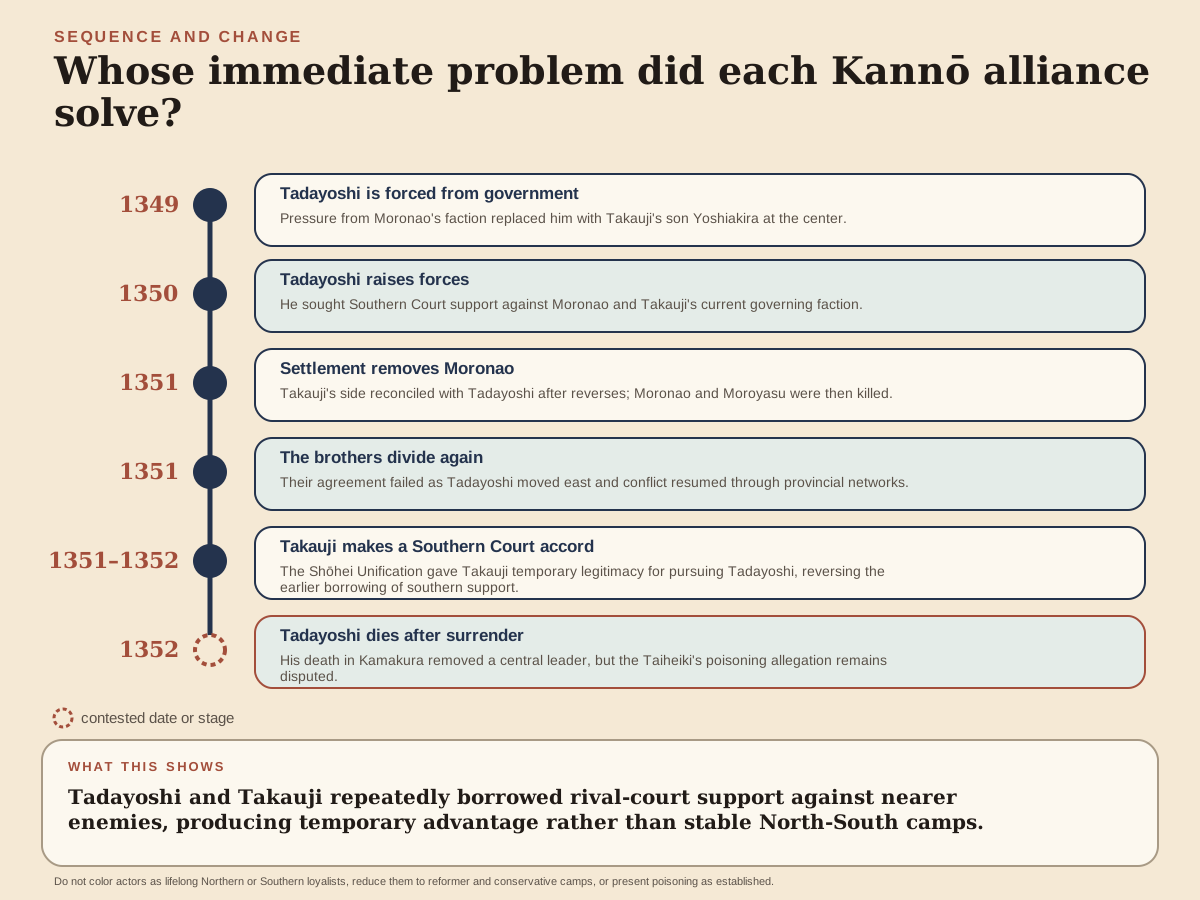
    In 1349, pressure from Moronao’s faction forced Tadayoshi out of central government. Takauji’s son Yoshiakira took his place. Tadayoshi entered religious life, then raised forces in 1350 and sought Southern Court support. Provincial governors and local warriors joined different camps; Tadayoshi’s adopted son Tadafuyu maintained another important network in western Japan.

    After reverses, Takauji’s side reached a settlement in 1351. Moronao and his brother Moroyasu were killed, but the brothers’ reconciliation did not hold. Tadayoshi moved through Tsuruga and continued the struggle before going east. Takauji obtained a temporary accord with the Southern Court, the Shōhei Unification, and pursued him. Tadayoshi surrendered and died in Kamakura in 1352. The Taiheiki’s poisoning allegation remains disputed.

    Local conflicts attached themselves to the central division. In 1351, a coalition supporting Tadayoshi expelled a governor’s deputy in Wakasa and intruded into Tara estate. Propertyholders and cultivators faced armed intervention while authority changed hands. Tadayoshi’s death removed a central leader but did not immediately stop his followers’ wars or reunite the imperial courts.

    Read The Kannō Disturbance Divides the Ashikaga Government

    Read the article below. Interactive reading tools are available when scripts load.

    Quick

    The Kannō Disturbance Divides the Ashikaga Government

    The Kannō Disturbance grew from conflict within the government of Ashikaga Takauji. His brother Tadayoshi administered judgments and confirmations of rights, while the shogunal deputy Kō no Moronao directed military followers. Their responsibilities overlapped over rewards, service and possession during the wider civil war. A simple division into reformers and conservatives cannot account for every participant’s alignment.

    In 1349, pressure from Moronao’s faction forced Tadayoshi out of central government. Takauji’s son Yoshiakira took his place. Tadayoshi entered religious life, then raised forces in 1350 and sought Southern Court support. Provincial governors and local warriors joined different camps; Tadayoshi’s adopted son Tadafuyu maintained another important network in western Japan.

    After reverses, Takauji’s side reached a settlement in 1351. Moronao and his brother Moroyasu were killed, but the brothers’ reconciliation did not hold. Tadayoshi moved through Tsuruga and continued the struggle before going east. Takauji obtained a temporary accord with the Southern Court, the Shōhei Unification, and pursued him. Tadayoshi surrendered and died in Kamakura in 1352. The Taiheiki’s poisoning allegation remains disputed.

    Local conflicts attached themselves to the central division. In 1351, a coalition supporting Tadayoshi expelled a governor’s deputy in Wakasa and intruded into Tara estate. Propertyholders and cultivators faced armed intervention while authority changed hands. Tadayoshi’s death removed a central leader but did not immediately stop his followers’ wars or reunite the imperial courts.

    Moronao was the son of Kō no Moroshige, in a family established among the Ashikaga’s hereditary retainers. His birth year is unknown. He served closely beside Ashikaga Takauji when the Ashikaga rebelled against the Kamakura government in 1333. The regime’s fall briefly placed Takauji and his men within Emperor Go-Daigo’s restored government. Moronao served in the Zasso Ketsudansho, an institution handling disputed claims, and in the Kubodokoro, a court-service body whose precise functions remain unclear. These posts put an Ashikaga retainer within the new government’s administrative arrangements.

    Classic

    Conditions behind Kannō Disturbance Divides the Ashikaga Government

    The Kannō Disturbance grew from conflict within the government of Ashikaga Takauji. His brother Tadayoshi administered judgments and confirmations of rights, while the shogunal deputy Kō no Moronao directed military followers. Their responsibilities overlapped over rewards, service and possession during the wider civil war. A simple division into reformers and conservatives cannot account for every participant’s alignment.

    Moronao was the son of Kō no Moroshige, in a family established among the Ashikaga’s hereditary retainers. His birth year is unknown. He served closely beside Ashikaga Takauji when the Ashikaga rebelled against the Kamakura government in 1333. The regime’s fall briefly placed Takauji and his men within Emperor Go-Daigo’s restored government. Moronao served in the Zasso Ketsudansho, an institution handling disputed claims, and in the Kubodokoro, a court-service body whose precise functions remain unclear. These posts put an Ashikaga retainer within the new government’s administrative arrangements.

    In 1335 a Hōjō rising displaced Ashikaga forces from Kamakura, and Takauji moved east to recover the family’s position. Moronao remained beside him as an executive dealing with the business of the campaign and household. Takauji’s eastern position became a rival source of recognition for warriors and their service. Moronao transmitted his lord’s decisions as that conflict widened into war against Go-Daigo’s government. By late 1335 Moronao was already performing functions associated with the ruler’s executive.

    The Ashikaga established a regime in Kyoto in 1336, supporting the imperial line later known as the Northern Court. Go-Daigo’s competing Southern Court continued from Yoshino. Takauji formally received the shogunal title in 1338. As shitsuji, the ruler’s senior executive, Moronao relayed commands and matters requiring Takauji’s attention. He also held posts examining rewards and handling land disputes. The tasks brought his authority into the same estates and provincial relationships on which the new government depended.

    Kannō Disturbance Divides the Ashikaga Government in motion

    In 1349, pressure from Moronao’s faction forced Tadayoshi out of central government. Takauji’s son Yoshiakira took his place. Tadayoshi entered religious life, then raised forces in 1350 and sought Southern Court support. Provincial governors and local warriors joined different camps; Tadayoshi’s adopted son Tadafuyu maintained another important network in western Japan.

    After reverses, Takauji’s side reached a settlement in 1351. Moronao and his brother Moroyasu were killed, but the brothers’ reconciliation did not hold. Tadayoshi moved through Tsuruga and continued the struggle before going east. Takauji obtained a temporary accord with the Southern Court, the Shōhei Unification, and pursued him. Tadayoshi surrendered and died in Kamakura in 1352. The Taiheiki’s poisoning allegation remains disputed.

    Local conflicts attached themselves to the central division. In 1351, a coalition supporting Tadayoshi expelled a governor’s deputy in Wakasa and intruded into Tara estate. Propertyholders and cultivators faced armed intervention while authority changed hands. Tadayoshi’s death removed a central leader but did not immediately stop his followers’ wars or reunite the imperial courts.

    The immediate settlement

    Moronao headed an office examining reward petitions and transmitted Takauji’s grants and donations. Rewards could consist of rights over land and income, placing a new beneficiary against existing holders or occupiers. Civil war made the gap between a recognized claim and effective possession especially serious. Implementation orders directed provincial governors and other agents to enforce grants that could otherwise remain ineffectual. Checking the grant and arranging its execution therefore formed substantive parts of the executive’s work. The center relied on people with military and local resources to carry a decision beyond the document.

    A document preserved in Wakayama orders action over the estate-steward rights in Kusumi, a district of Kii Province. Such rights concerned administration and income from the land. The grant came from Takauji in 1342; Moronao’s implementation order followed in 1345. Addressed to a Fujinami warrior, it instructed him to act jointly with a Yuasa leader and put the beneficiary’s representative in possession. The property had formerly been associated with Akahashi Moritoki of the fallen Hōjō regime. A grant made by the new government thus required particular local men to transfer rights that had belonged within the old ruling network. The interval between grant and order is preserved, though the document does not establish the date or outcome of actual enforcement.

    Historian Kameda Toshitaka’s research treats implementation orders as a response to the difficulty of realizing rewards during civil war. Initially a recipient often submitted a further petition to obtain an implementation order after receiving the grant. Issuance without that additional petition became more common over time. The system continued to develop after Moronao’s death and became part of the later executive office. In Moronao’s own period, the Kusumi order shows its dependence on named provincial actors working together. Their authority to execute the decision supplied something the grant alone could not provide. Their participation also connected the distribution of rewards to changing local alliances.

    The event's longer afterlife

    The executive who relayed Takauji’s grants also led forces against the Ashikaga government’s enemies. In 1338 Moronao defeated Kitabatake Akiie at Ishizu, in Izumi Province near present-day Sakai. Akiie’s death removed an important Southern Court commander. The war continued, and southern forces again challenged control around Kyoto and its neighboring provinces. Moronao’s office and military command gave him both a role in recognizing service and a direct place in the campaigns that generated claims for rewards.

    In 1347 Southern Court forces under Kusunoki Masatsura defeated earlier Ashikaga attempts to suppress them in Kawachi and nearby areas. The government then sent an army led by Moronao, his brother Moroyasu and other commanders, including Sasaki Dōyo. The campaign aimed to break the southern forces and advance on their court at Yoshino. At Shijōnawate in 1348, the Ashikaga army defeated Masatsura and his supporters. Masatsura and his brother Masatoki died in the defeat. Moronao proceeded toward Yoshino, where his forces burned the Southern Court’s residence. Emperor Go-Murakami withdrew to Anō in the mountains of present-day Nara Prefecture.

    Sources and notes

    1. 福井県史年表1351–1400 · Fukui Prefectural Archives
    2. 足利直義感状1338 · Kyoto Tachibana University
    3. 高師直 — 日本大百科全書 · 池永二郎 (Ikenaga Jirō)
    4. 執事 — 世界大百科事典 / 日本大百科全書, selected Muromachi office · 小川信 (Ogawa Shin)
    5. 室町幕府執事高師直施行状(館蔵品1066) · 坂本亮太 (Sakamoto Ryōta), curator
    6. 室町幕府執事施行状の形成と展開――下文施行システムを中心として · 亀田俊和 (Kameda Toshitaka)
    7. 南北朝期室町幕府仁政方の研究 · 亀田俊和 (Kameda Toshitaka)
    8. 南北朝期室町幕府研究とその法制史的意義――所務沙汰制度史と将軍権力二元論を中心に · 亀田俊和 (Kameda Toshitaka)
    9. 観応の擾乱 — 世界大百科事典 / 日本大百科全書 · 小川信 (Ogawa Shin); 佐藤和彦 (Satō Kazuhiko)
    10. 四條畷の戦い · 奥富敬之 (Okutomi Takayuki); Britannica editorial institution
    11. 『太平記』の世界:悪役の代名詞にされた高師直 · Japan Arts Council
    12. 応仁の乱の前には「観応の擾乱」があった — page 3 · 亀田俊和 (Kameda Toshitaka)
    13. 足利尊氏 — 日本大百科全書, selected regime chronology · 佐藤和彦 (Satō Kazuhiko)

    About these sources

    Reading preferences

    Text size
    Glossary intensity

    Choose how much explanation appears as you read.

    Saved on this device. All terms remain available in the glossary.

    Browse the glossary →
    History Omakase

    Opening reading…