HO Guides
Minatogawa: The Monument Before the Shrine
An inscription, a portable rubbing, and a newly designed sanctuary gave a medieval defeat successive public forms.
Quick · About 2 min
The story in five points
A short route through the argument. Follow a point into Classic for its context and sources.
Separate the battle from its memorials
Masashige’s defeat in 1336, Mitsukuni’s monument in 1692 and the shrine’s foundation in 1872 were separate events. The battlefield extended beyond the later precinct, whose grave and traditional death place preserve particular commemorative identifications.
Read in contextThe inscription makes a moral argument
Mitsukuni’s brief front inscription identifies a loyal subject; Zhu Shunshui’s longer reverse places Masashige within an account of loyalty and filial duty. Zhu acknowledges incomplete evidence even while composing praise. The monument’s confident moral judgment is not documentary completeness.
Read in contextPaper carried selected memories
A rubbing could transport the monument’s lettering while leaving its physical surroundings behind. The Hagi example copies the short declaration, omitting Zhu’s fuller argument and evidential cautions. Its precise carrier remains uncertain, despite a proposed connection with Chōshū coastal defence.
Read in contextA shrine required new decisions
Competing proposals preceded the Kobe shrine. Its planned precinct incorporated the grave and traditional death place, while designers considered different architectural forms. An old commemorative subject did not supply a ready-made sanctuary or determine the eventual design choice.
Read in contextThe surrounding city kept changing
A contemporary print placed the new shrine beside traffic and telegraph wires. Later river engineering, a park statue and postwar reconstruction added further layers. These objects preserve different relationships with the battle; they do not collectively authenticate medieval troop positions.
Read in context
Opening
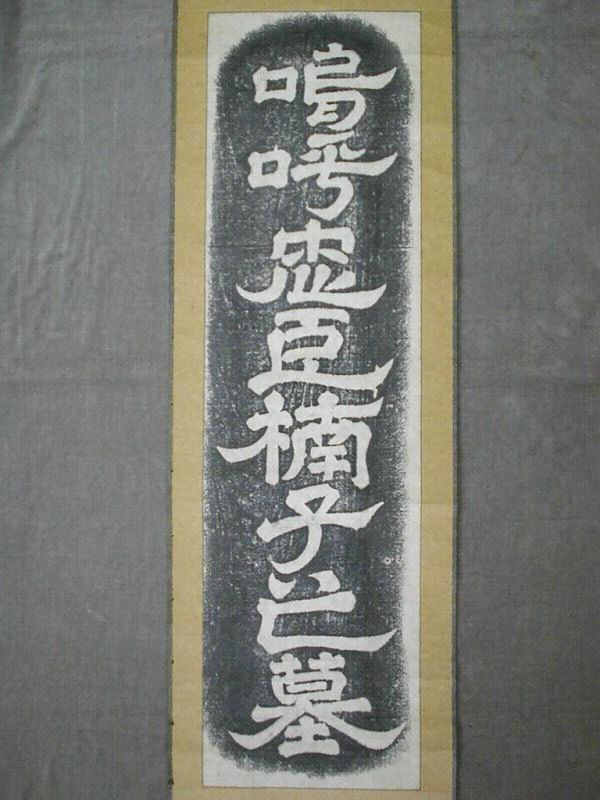
A hanging scroll in Hagi Museum reproduces the writing on a grave monument in Kobe. Pale characters stand against the dark surface of a rubbing. They identify Kusunoki and call him a “loyal subject.” There is no battle scene, military map, or account of how he died. The judgment is the inscription's principal information.[1]
Its calligraphy originated with Tokugawa Mitsukuni, who commissioned the monument in 1692. The shrine now surrounding the grave was founded in 1872. The battle being remembered had taken place in 1336.[2]
These dates identify three different acts: a death in war, the erection of a monument, and the establishment of a religious institution. The interval between them is the substance of Minatogawa's history. A battlefield did not become a shrine all at once. Particular words, objects, and decisions about land gave one interpretation of the past a durable location. Copies then allowed something of that location to travel.
1. A battle larger than the precinct
Kusunoki Masashige died after the fighting at Minatogawa in 1336. He had fought for Emperor Go-Daigo against the forces of Ashikaga Takauji. The conflict reached across the Hyōgo area of present-day Kobe, where Nitta Yoshisada's forces also confronted Takauji's advance from the sea. It was not confined to the ground later enclosed by Minatogawa Shrine.[3]
The two principal memorial locations inside that enclosure concern what followed the fighting: the traditional place of Masashige's death and his grave. The grave monument stands in the southeastern part of the precinct; the remembered death place is towards the northwest. Their separate positions became important to the later layout.[4]
A hill outside the shrine, Egeyama, carries another association. A marker identifies the place traditionally described as Masashige's headquarters. Its function in the memorial landscape differs from that of a tomb. One points towards command during the fighting, another towards the keeping of the dead. Reading them together preserves the breadth of the battlefield's remembered geography.
That geography remains partly traditional. The shrine's account locates Masashige's final moments in a house after the fighting and retells the celebrated exchange with his brother. Such stories supplied later commemoration with scenes and words; they do not make the marked ground an intact medieval room. The precinct preserves a history of identification and reverence, rather than a complete physical record of the last hours.[3]
The distinction becomes especially clear at the tomb. Its most prominent object belongs to 1692, more than three centuries after the battle. To understand what the stone says about 1336, it is necessary to read the work done in that later year.
2. The front gives a name; the back makes an argument
Mitsukuni's monument stands on a turtle-shaped stone support above a square base. The form raises the inscribed face into a substantial memorial object. On the front are the eight characters copied in the Hagi rubbing. On the reverse is a longer text by the Chinese scholar Zhu Shunshui.[5]
The two sides ask for different kinds of reading. The front can be apprehended as a short declaration: an expression of lament, an attribution of loyalty, a name, and a grave. It tells the reader how the person buried here is to be regarded. The longer text supplies an argument for the commemorative interpretation.
Zhu begins with loyalty and filial duty, comparing their place in human society with the sun and moon in the heavens. The opening establishes a moral order before turning to Masashige. His subject is therefore introduced as an example within a larger account of obligation, not simply as the losing commander of a particular battle.[6]
The text does not hide the difficulty of assembling the man's history. Near its beginning, Zhu says that a general view of Masashige's deeds is hard to obtain. Near its end, he returns to the writer's shortage of evidence that can be trusted. Those admissions sit within an encomium—a composition of praise—whose moral language is much more confident than its claim to documentary completeness.
Between them, the narrative connects service to the royal house, counsel left unused, death, and the continuation of obligation through a family. Its treatment of defeat depends on separating the outcome of the campaign from the constancy it attributes to Masashige. The death can serve the argument precisely because success in battle is not made the sole measure of the conduct being commemorated.
This is Zhu's construction of the remembered life, not an independent finding about the private intentions of Masashige or his opponents. As writing placed on a monument, it has a further history. The appended inscription identifies the piece as an encomium engraved in place of a conventional epitaph. A text of praise was made to speak at a grave.[6]
That choice gave the location an account that outlasted any one visitor's knowledge. Someone approaching the stone did not have to reconstruct every movement of the army before encountering its intended lesson. The short front supplied a portable phrase; the back offered a fuller moral narrative. Both belonged to a seventeenth-century act of commemoration.
Mitsukuni's date also prevents that act from being treated as a product of the Meiji state. The monument was already old when a new shrine was proposed. Later patrons inherited a named moral example in an established place; they did not invent either the stone or its wording when they acquired the surrounding land.
3. The stone could remain while its writing travelled
The Hagi rubbing gives this inheritance a material route beyond Kobe. Its museum catalogue connects the object tentatively with a retainer sent to Hyōgo after the Chōshū domain received coastal-defence duties from the shogunate in 1858. The precise carrier is not identified. The catalogue also records that Yoshida Shōin visited the grave and bought a rubbing of the same inscription.[7]
The object matters even without a complete itinerary. Paper could carry the arrangement of the inscribed characters away from the grave. Hung elsewhere, it retained the monument's short statement while dispensing with the stone's weight, base, enclosure, and immediate surroundings.
Its dependence on the place remained visible in what it reproduced. A rubbing of a grave inscription is not simply a newly composed sentence about loyalty. It refers back to words fixed on a particular memorial. The original location supplies part of the copied object's identity, even when that object is encountered far away.
The copied face is selective, too. It contains neither Zhu's full argument nor his comments about incomplete evidence. What travels on this sheet is the compressed declaration on the front. Someone possessing the rubbing receives a different amount of information from someone reading around the stone.
This does not establish a uniform response among everyone who obtained one. It explains the mechanism by which the same memorial could participate in more than one setting. A stone established a place for remembrance; a paper impression made its lettering available for repeated contemplation elsewhere. The grave's influence did not require the grave itself to move.
4. The shrine needed land, and the land needed a plan
A shrine to Masashige was not inevitable in precisely this location. The institution's own history records an 1864 proposal by Shimazu Hisamitsu for Minatogawa, followed in 1867 by Tokugawa Yoshikatsu's proposal for a site at Kaguraoka in Kyoto. In 1868, Itō Hirobumi and other local officials, working with the Kobe merchant Kitakaze Sōemon, advanced the petition that led towards the shrine in Kobe.[8]
The alternatives expose a distinction between honouring a person and maintaining the physical associations of his death. A sanctuary elsewhere could have taken Masashige as its sacred subject. The Minatogawa project instead incorporated the grave and the traditional death place into its ground.
The shrine's account describes a rectangular precinct with those two locations at opposite ends of a diagonal. That decision made earlier memorial geography a condition of the new institution. The shrine was not merely placed near a grave for convenience; its perimeter was organized to contain both remembered points.[9]
The relationship changed their setting. Separate places associated with death and burial became parts of a planned religious compound. The new enclosure could join them without claiming that they had originally been two rooms within one medieval building.
Architecture still had to be chosen. Architectural historian Fujihara Keiyo found three proposals in the government record of the project: two using the Kasuga form and one using the Shinmei form. These were established shrine-building types, offered as alternatives for a sanctuary that had no medieval shrine building to reproduce. A Kasuga proposal was eventually built. The study does not establish why that final choice was made.[10]
The alternatives are revealing even without a recovered explanation from the decision-makers. Commemoration of an old event required a new design. The subject's antiquity did not determine every roof, entrance, or proportion in advance. Drawings and official decisions intervened between an intention to honour Masashige and a building in which worship could take place.
When the shrine was established in 1872, it therefore combined inherited memorial points with newly planned architecture. The medieval event provided the reason for the institution, but not its completed form. The form belongs to the choices of people living more than five centuries later.
5. A new landmark with wires in front of it
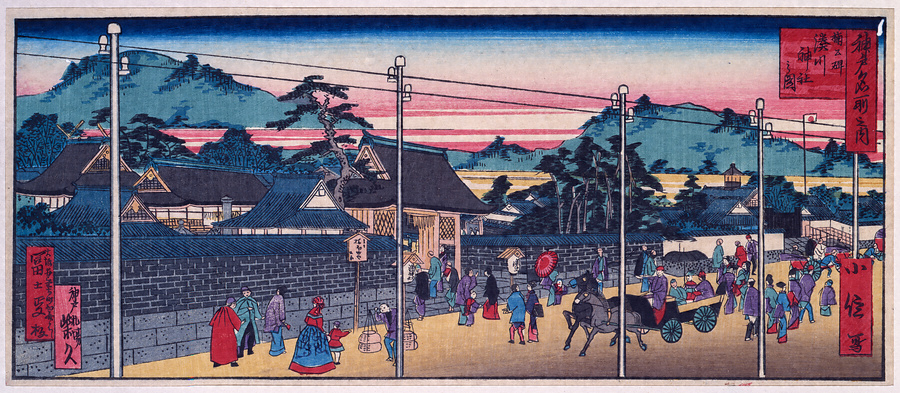
A colour woodblock print made around 1872–1874 shows how quickly that new institution entered another kind of representation. Hasegawa Konobu's View of the Nankō Monument and Minatogawa Shrine, now in Kobe City Museum, names both the older monument and the new shrine among the sights of Kobe.[11]
The image is filled with things other than a medieval warrior. A long wall stretches across the foreground, with buildings rising behind it and people near an entrance. Telegraph poles and wires cut across the view. A horse-drawn carriage travels along the road. The shrine belongs to a busy street scene rather than an isolated landscape of battle.
The arrangement gives the reader two ways to approach the place. The title directs attention to commemoration; the foreground presents circulation through a changing city. The old subject and the new urban setting occupy the same sheet without needing to look the same age.
This differs sharply from the Hagi rubbing. The rubbing reproduces an inscription while removing its surroundings. Konobu's print supplies surroundings—walls, traffic, people, buildings—and makes them part of the shrine's public image. One carries away a statement from the monument; the other offers a view of the place that has developed around it.
The print is an artist's composition, not a count of visitors or a measured survey of the street. Its usefulness lies in the combination it deliberately makes visible. The shrine could be represented through contemporary urban movement while retaining a title that pointed back to the older grave monument. A medieval death had become part of the imagery of a modern city.
The difference between these objects also keeps “public memory” from becoming an abstraction. It could take the form of particular characters on paper or a coloured scene offered among views of Kobe. Those forms selected different information and invited different kinds of attention. Neither required a reader to stand on the battlefield before encountering its remembered name.
6. The river moved; the remembered battle did not
The urban landscape continued changing after the shrine was built. Work to redirect the Minatogawa began in 1897, and the river tunnel was completed in 1901. The former channel was subsequently filled, and Minatogawa Park opened on it in 1911. A statue of Masashige by the sculptor Saitō Sogan was erected in the park in 1935.[12]
This is an unusually direct transformation of a battlefield's setting. The river whose name identified the fighting no longer followed the same course. A new civic space occupied former river ground, and that space acquired another monument to the person already commemorated at the shrine.
The park's statue and the grave monument belong to different acts of public placement. The grave stele gave a remembered burial a named, inscribed focus. The later statue established a figure within a park created through urban engineering. Its relevance to the battle did not depend on marking the exact spot at which Masashige had stood.
Egeyama's headquarters marker makes another claim, pointing towards a traditional military position. These objects should not be combined into a map in which every modern monument automatically represents an authenticated troop location. They preserve different relationships between the city and the conflict: a place attributed to command, a remembered death place, a grave, and later public images.
The distinction does not make the landscape empty of history. It makes its history more extensive. The rerouted river records the work of a growing city, while the monuments record decisions about what should remain identifiable within it. The name Minatogawa could continue to organize remembrance even as the physical watercourse changed.
The shrine is central to this network, but it cannot contain it all. Its walls gather two particular memorial locations. Beyond them, hills, former river ground, and streets preserve other parts of the relationship. The battle's memory is both concentrated and distributed: strongly attached to one institution, yet not reducible to that institution's footprint.
7. What the present sanctuary inherited
The principal sanctuary now standing is another reconstruction. The shrine records its destruction in the Kobe air raids of 1945 and the completion of new buildings in 1952. The present sanctuary uses reinforced concrete. Its roofed composition differs from the early Meiji sanctuary discussed in the design proposals.[13]
That later rebuilding adds a further interval to the story. A fourteenth-century battlefield, a seventeenth-century monument, a nineteenth-century foundation, and a twentieth-century sanctuary occupy the same historical place without becoming one continuous piece of fabric. The stone's older language can remain while the building through which a visitor approaches the institution is replaced.
In 1951, the grave monument and the traditional place of death were designated national historic sites. That designation identifies their importance to the recorded landscape; it does not convert every scene in later retellings into archaeological evidence.[14] The history of commemoration remains part of what is being preserved.
Minatogawa is consequently a place to read in more than one direction. Looking back from the shrine leads to the memorials around which it was planned. Looking outward from the monument leads to rubbings, urban prints, and other markers. Those objects show how an interpretation could acquire both a fixed address and forms capable of circulating beyond it.
The defeat of 1336 did not provide a complete programme for everything that followed. Mitsukuni's inscription named a moral example; Zhu's text supplied its argument; later petitioners and builders gave the remembered places a new institutional setting. The surviving record allows those actions to be examined separately. The shrine inherited a monument before it became a monument in its own right.
Next topic · HO Guides
Shitennō-ji: Leaving a Name at the Gate of Paradise
Inside a medieval gateway, small parcels preserved the connections Osaka families hoped would extend beyond their lives.
Continue readingSources and NotesView sourcesHide sources
Web materials were consulted on 16 September 2026. Inscriptional praise is attributed to its authors and commissioners, not adopted as this essay's judgment of political loyalty or dynastic legitimacy. Historical numbered months are not silently converted to Gregorian dates. The text concerns how commemoration acquired material forms; it does not reconstruct the entire battle, identify exact troop positions from modern markers, or claim uninterrupted political meaning across different regimes.
- [1]
Hagi Museum, “楠木正成墓碑銘拓本,” Cultural Heritage Online record 217540, object description; See the 900-pixel photograph. The visible eight-character text reads 嗚呼忠臣楠子之墓. The catalogue's prose has 氏 where the image and shrine transcription have 子; the essay follows the latter. The moral term is the inscription's, not an independent assessment.
Return to the reference ↑ - [2]
Agency for Cultural Affairs, “楠木正成墓碑,” record 210720, historical designation description: Mitsukuni, 1692, location and form; Minatogawa Shrine, precinct introduction, for its 1872 foundation; Kobe City's account in note 3 for the battle year. These are separate dated events, not stages of a single building project.
Return to the reference ↑ - [3]
Kobe City, Hyōgo Ward, “尊氏 正成と戦の時代”, “本間孫四郎遠矢碑” and “楠木正成本陣の碑”; Minatogawa Shrine, “楠公史跡”, “殉節地” and the explanation of service to Go-Daigo. The essay uses the basic conflict and marked traditions, not the shrine's weather, exact company count, dialogue, or judgments of character. Egeyama's headquarters identification remains traditional.
Return to the reference ↑ - [4]
Agency for Cultural Affairs, record 210720, note 2, locates the monument in the southeastern precinct and the traditional death place towards the northwest. Minatogawa Shrine, “楠公史跡,” opening paragraph, explains their later incorporation. The designation photograph was viewed, but no tomb contents, surviving medieval house, or independent battlefield survey are claimed.
Return to the reference ↑ - [5]
Minatogawa Shrine, “楠公史跡,” subsection “嗚呼忠臣楠子之墓,” on the three-part base, turtle-shaped support and stele, Mitsukuni's front inscription, and Zhu Shunshui's reverse text; see also the cultural-property description in note 2. Conflicting modern transcriptions of the reverse's calligrapher's surname are not resolved or reproduced. The discussion distinguishes the commissioner, front calligraphy, and author of the longer text.
Return to the reference ↑ - [6]
Zhu Shunshui, Encomium on Kusunoki Masashige, used as the Minatogawa monument's reverse inscription, original Chinese text and appended identification in “資料208 朱舜水『楠公碑陰記』”. See the complete original-language text, especially “忠孝著乎天下,” “蒐其行事不可概見,” “策雖善而弗庸,” the concluding “惜乎載筆者無所考信,” and “勒代碑文.” The host states that its transcription follows the rubbing reproduced in Ishihara Michihiro, Shu Shunsui, p. 238; that printed book and the original stele's reverse were not independently collated. Translation and structural analysis here are the author's. The public-domain text is treated as praise with explicit evidential limits, not a verified account of every military or political allegation. Its rankings and claims about participants' competence are not reproduced as historical findings.
Return to the reference ↑ - [7]
Hagi Museum, note 1, provenance paragraph. The retainer-carrier is conjectural; Shōin bought a similar rubbing, not demonstrably this one. The catalogue was read, not underlying retainer papers. Circulation does not establish a uniform political response.
Return to the reference ↑ - [8]
Minatogawa Shrine, “湊川神社の創建”, “伊藤博文と湊川神社創建” and “楠社設立の建議競争.” The selected proposals and petitioners are reported as the institution's history; its assertions of universal national agreement, individual inner motivation, and economic effects are not adopted.
Return to the reference ↑ - [9]
Same source, paragraph specifying the rectangle and diagonal; cross-checked with “楠公史跡,” opening. This is the institution's planning account; no exact area, landowner consent, or continuous medieval boundary is inferred.
Return to the reference ↑ - [10]
Fujihara Keiyo (藤原惠洋), “創建神社の意匠特性と復古主義的意匠の創出に関する考察—制限図様式と創建神社の意匠に関する研究”, Bulletin of JSSD 91 (1992): 61–68, pp. 63–64, Minatogawa subsection. They describe the three archived proposals, identify the built Kasuga alternative, and leave the selection rationale unresolved. The underlying Dajō Ruiten drawings were not independently inspected; the study's conjectures about regional style or the subject's influence are not presented as established motives.
Return to the reference ↑ - [11]
Kobe City Museum, “神戸名所之内 楠公碑湊川神社之図,” record 450860, attribution to Hasegawa Konobu and dating to 1872–1874; See the 900-pixel colour reproduction. Walls, entrance, buildings, telegraph lines, people, and carriage are observations of that historical image. The title names monument and shrine; the prose does not claim the actual grave stele is separately identifiable in the scene. No measured street plan, attendance total, or precise publication day is inferred.
Return to the reference ↑ - [12]
Kobe City, “湊川隧道”, paragraphs on the 1897 project and 1901 completion; Hyōgo Ward, note 3, “楠木正成の銅像,” on filling the old river, the 1911 park, and Saitō Sogan's 1935 statue. These establish successive changes to the urban setting, not the exact medieval riverbed or a modern reconstruction of battle positions. The shrine and park are separate locations within the distributed memorial landscape.
Return to the reference ↑ - [13]
Minatogawa Shrine, “境内施設,” subsection “本社社殿”, complete sanctuary description: 1945 loss, 1952 rebuilding, reinforced concrete, and yatsumune composition. See also the early Kasuga design in note 10. The essay uses the agreed year rather than trying to reconcile different dates for later building ceremonies. Neither original medieval fabric nor an unchanged Meiji sanctuary is claimed; postwar political attitudes are not inferred from reconstruction alone.
Return to the reference ↑ - [14]
Agency for Cultural Affairs, record 210720, designation date 9 June 1951 and paired description of monument and death place; Minatogawa Shrine, “楠公史跡,” identifies both as nationally designated historic sites. The designation is evidence of recognition and protection, not independent authentication of every traditional narrative attached to either location.
Return to the reference ↑