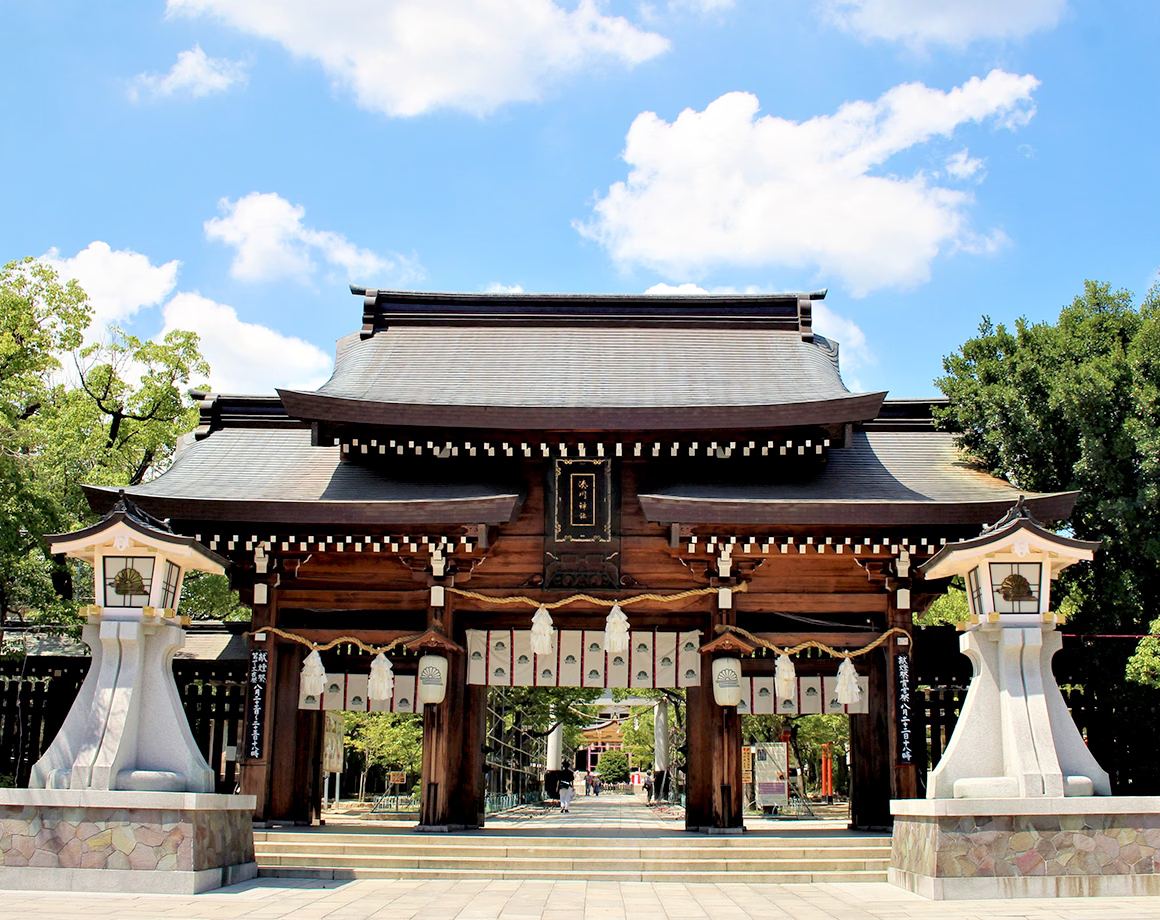
The 1336 Battle in an Urbanized Landscape
Attraction
Minatogawa was fought on the twenty-fifth day of the fifth month of 1336 in the Japanese calendar as Ashikaga Takauji advanced east after recovering military strength in Kyushu. Forces loyal to Emperor Go-Daigo, including Kusunoki Masashige, attempted to stop him in the Hyōgo area. Their defeat and Masashige's death removed a prominent loyalist commander and allowed Takauji to re-enter Kyoto, accelerating the division that became the Northern and Southern Courts conflict. The field extended beyond the present shrine grounds. Shoreline, river channels, roads, and hills have since been transformed by Kobe's growth, so the modern city must be read through dispersed markers and topography rather than as a preserved battlefield plan.
Current visibility
The battlefield is an urban historic area with markers; medieval terrain and troop positions are not preserved as a single visible field.
The Traditional Site of Masashige's Death
Attraction
Behind the Main Sanctuary, a secluded stone marker identifies the place traditionally associated with Masashige's final moments after the battle. The precise narrative of Masashige and his brother Masasue pledging future lives against the emperor's enemies comes from Taiheiki and later devotional retelling; it should not be treated as a verbatim record of a private exchange. The site's importance is nevertheless real. It anchors centuries of commemoration to a specific part of the former battlefield and is nationally designated as a historic site. The enclosure and solemn treatment seen today belong to memorial history, not to a surviving fourteenth-century house or battlefield structure.
Current visibility
The marked and enclosed death-place tradition is visible within the shrine grounds; no medieval building survives there.
The 1692 Grave Monument and Early-modern Loyalism
Attraction
Masashige's grave developed into a major place of memory long before the shrine existed. After earlier local and domain-sponsored care, Tokugawa Mitsukuni of Mito commissioned the present monumental stele in 1692. Its inscription praises Masashige as a loyal subject, while a text by the Ming loyalist Zhu Shunshui on the reverse places the monument within an intellectual world that linked history, moral example, and theories of legitimate rule. Pilgrims and later imperial loyalists copied or revered the inscription. The grave is thus not only a memorial to 1336; it is evidence for how Edo-period scholarship and political ethics remade a medieval warrior into an exemplary figure.
Current visibility
The grave monument is visible in its protected precinct and is a nationally designated historic site.
A Meiji Shrine Built around Two Earlier Memorial Sites
Attraction
Minatogawa Shrine was founded in 1872, more than five centuries after the battle. Campaigns for its creation gathered momentum around Masashige's already revered grave, and Itō Hirobumi and other officials helped obtain approval and define a precinct linking the grave with the traditional death place. The shrine became one of the new state's specially ranked institutions dedicated to loyal retainers. This chronology is essential. The shrine is not evidence that a medieval cult building stood here in 1336; it is a major document of Meiji memory politics, public subscription, and the use of selected historical figures to teach loyalty. Its creation also accompanied the rapid urban development of modern Kobe.
Current visibility
The shrine precinct is fully present as a modern institution; its planned relationship to the two earlier memorial sites remains legible.
The 1952 Sanctuary after Wartime Destruction
Attraction
The current Main Sanctuary and worship hall are postwar buildings. A large 1934 rebuilding was destroyed in the Kobe air raids of 1945, and the principal buildings were completed again in 1952 using reinforced concrete in a form then considered innovative for shrine architecture. That material history complicates any seamless image of an ancient sanctuary. The precinct carries medieval commemoration through an early-modern grave, a Meiji institution, and a postwar architectural envelope. Visitors can see continuity of worship, but not continuity of original fabric. The reconstruction also prompts a difficult question: how a shrine strongly associated with state loyalty before 1945 was re-established as a religious and civic landmark in postwar Kobe.
Current visibility
The current principal sanctuary is a visible 1952 postwar reconstruction; routine access to sacred interiors is not implied.
Egeyama and the Distributed Memory of the Battle
Attraction
The shrine does not exhaust the battlefield. At Egeyama, a monument marks the hill traditionally associated with Masashige's headquarters, while other markers, temples, place names, and a modern Masashige statue extend remembrance across Hyōgo and central Kobe. These features are not interchangeable. A hilltop headquarters tradition addresses military topography; a grave and death-place marker address commemoration; a twentieth-century statue expresses a later public image. Reading the network prevents the shrine precinct from shrinking a wide battle into one compound. It also reveals how Kobe repeatedly relocated and redesigned memorials as roads, parks, railways, and neighbourhoods changed around them.
Current visibility
The memorial network is distributed through public urban space; individual markers and park features remain visible, but their surroundings have changed substantially.