Read the article below. Interactive reading tools are available when scripts load.
Quick
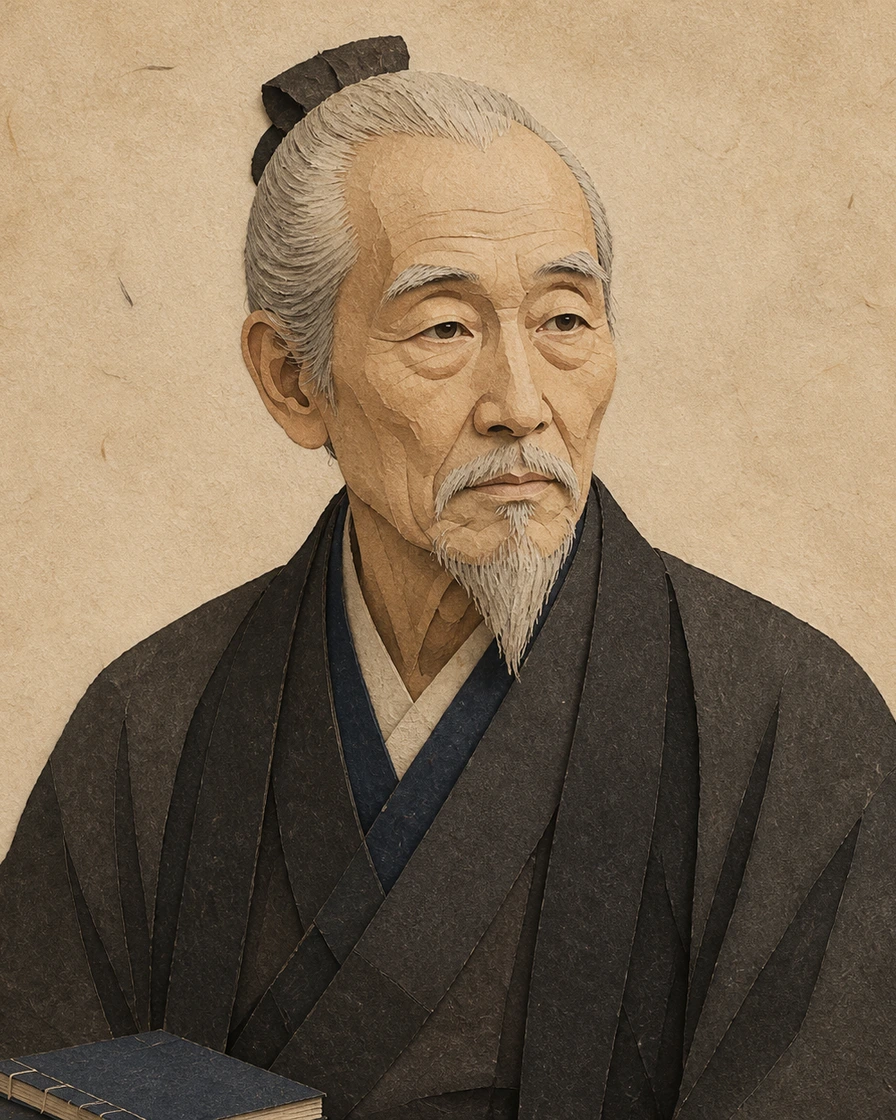
Sugita Genpaku was born in 1733 at the Obama domain's lower residence in Edo. A domain was a lord's governed territory and service organization under the Tokugawa shogunate. His father, Hosen, served it as a physician. When Hosen was reassigned, the family lived in Obama for roughly five years before returning to Edo.
He inherited access to medical education, household patients, books, and a recognized office path. He did not inherit a finished category called modern Western medicine. Domain doctors used Chinese textual traditions, Japanese clinical experience, surgery transmitted through several lineages, pharmacy, and observation in combinations that varied by teacher and case.
The shogunate had relaxed restrictions on non-Christian Western books in 1720, thirteen years before Genpaku's birth. That opening would matter to his generation. As a child, however, he belonged to a physician household whose position prepared him for established practice as well as later experiment.
As a young man Genpaku studied medicine and surgery under Nishi Gentetsu, a physician associated with a lineage of Western-derived surgical knowledge. He also learned within the Chinese-textual and Japanese clinical environment expected of a domain doctor. These resources coexisted; “Dutch” did not yet mean a complete alternative medical system that he could read directly.
In the early 1750s Genpaku entered service as an Obama physician. By the later decade he also practiced in Edo. His work involved patients, household authority, assistants, medicines, diagnosis, procedures, fees or stipends, and the risk that treatment would fail. Anatomical curiosity mattered because he already had a clinical profession, not because books allowed him to avoid one.
The domain office supplied standing and access while imposing hierarchy. A physician might treat retainers or the lord's family, maintain a permitted private practice, and cultivate colleagues across house boundaries. Genpaku's later translation work grew from that mixed position: he was a working early modern doctor enlarging the tools available within existing obligations.
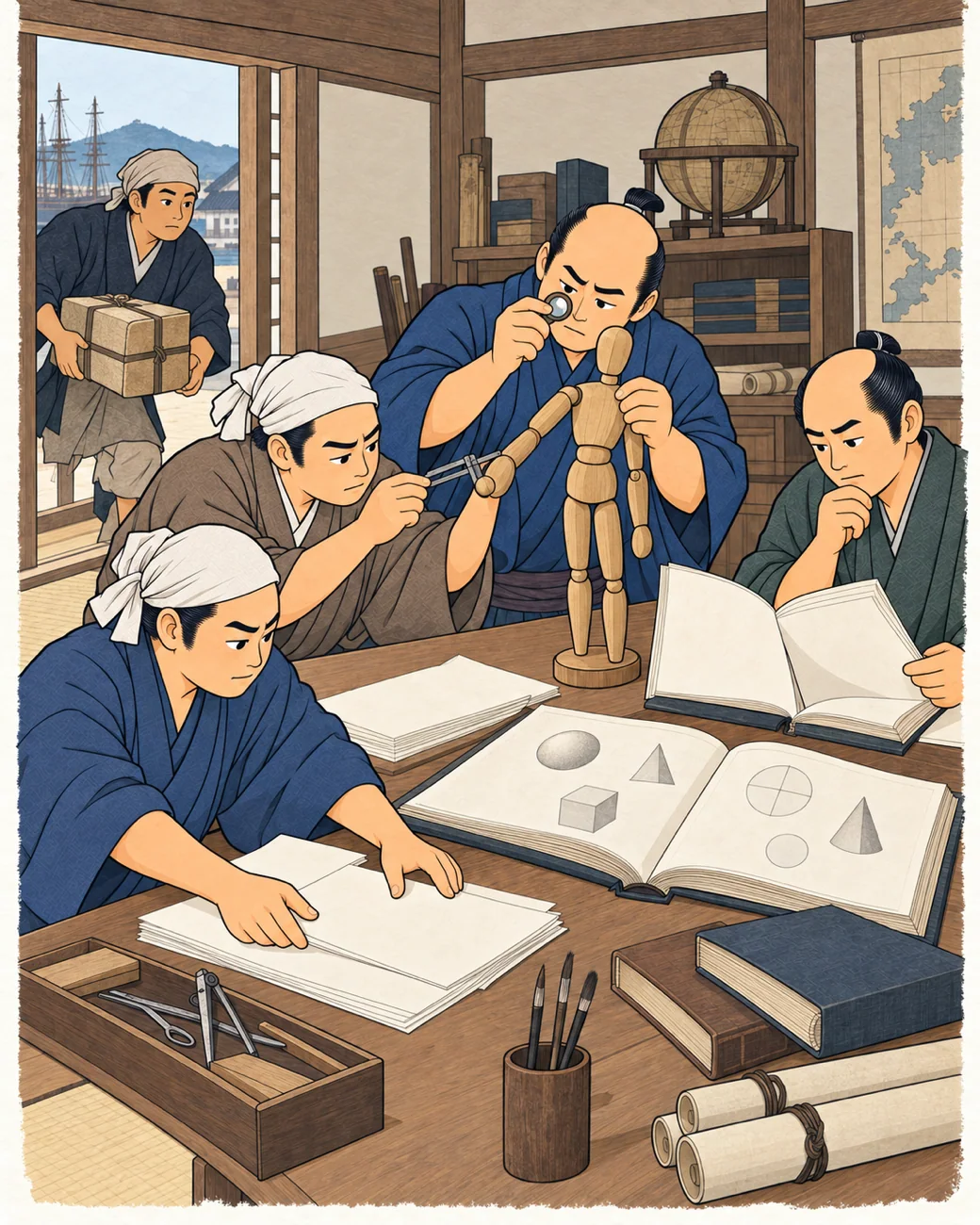
The Dutch anatomy book that Genpaku owned in 1771 reached Edo through a controlled chain. Dutch ships traded at Nagasaki, where officials and interpreters inspected exchange; merchants and scholars then moved permitted books inland. A 1720 policy had widened access to non-Christian Western works without creating free import. [1][2]
Nagasaki interpreters possessed language skills that most Edo doctors lacked. Genpaku could therefore acquire an illustrated medical book while remaining unable to read its prose securely. The combination of limited access, pictures, and incomplete language knowledge explains both the opportunity of 1771 and the difficulty that followed.
On the fourth day of the third month of 1771—18 April Gregorian—Genpaku, Maeno Ryōtaku, Nakagawa Jun'an, and others observed the opening of an executed woman's body at Kozukappara. They compared visible structures with plates in a Dutch anatomical book and found important correspondences more convincing than diagrams familiar from some inherited texts. [3][4]
The event was not Japan's first human dissection. Yamawaki Tōyō had observed one in Kyoto in 1754 and published Zōshi in 1759, and other observations followed. Nor did the famous physicians necessarily perform the cutting. Execution-ground workers from stigmatized communities carried out essential handling and explanation under the punishment system.
The woman's body was available because the state had executed her and denied ordinary control over her remains. Her popular nickname comes through later narration and does not restore consent or a full life. The observation encouraged translation, but one body could not validate every claim in a European book or prove the superiority of all Western medicine.
The book commonly called Tāheru Anatomia was the Dutch Ontleedkundige Tafelen, itself translated from Johann Adam Kulmus's German anatomical tables. Genpaku's team was therefore working from a European translation already several decades old, not from unmediated “Western science.”
Images made comparison possible before the group could read the prose securely, but a plate could not explain terminology, function, or the relations among structures.
The translators still had to select terms, redraw images, and adapt copperplate illustrations to a Japanese woodblock book. The source mattered because it gave the team a demanding object for comparison; publication required another chain of linguistic, artistic, and material decisions.
The translation was collective. Maeno Ryōtaku possessed the strongest Dutch competence and led much of the linguistic work. Genpaku brought medical urgency, organization, and determination to publish. Nakagawa Jun'an supplied another sustained medical collaborator, while other physicians and officials helped compare drafts and navigate the shogunal medical network.
Their roles were unequal but complementary: reading Dutch, testing anatomical sense, shaping Chinese-style technical prose, preparing images, and coordinating publication required different skills.
Maeno's name does not appear in the published book's formal credits, despite his central contribution. Later accounts often explain this through his dissatisfaction with accuracy and Genpaku's urgency, but the precise decision is not documented well enough to reduce to one motive. Restoring Maeno's role does not require making Genpaku merely a promoter or inventing a personal feud.
The translators lacked a modern Dutch–Japanese dictionary and a complete grammar. They worked through fragments: alphabet knowledge, terms learned from interpreters, images, repeated contexts, comparison among books, Chinese textual resources, and long discussion. A guessed noun could distort a sentence; an unfamiliar inflection could make the team assign an action to the wrong structure.
They used several strategies. Some words could be represented by sound. Some could be matched to existing medical vocabulary. Others required a descriptive Chinese-character compound or a new technical use. Terms later associated with nerves, cartilage, and arteries entered or stabilized through this work, but no single person invented every item alone.
Genpaku's 1815 memoir gives vivid accounts of difficulty, written about forty years after the meetings. Those images are valuable evidence of remembered method, not transcripts of each session. Translation succeeded through repeated approximation, not sudden inspiration. Its errors are evidence of an emerging linguistic technology whose most durable product was not only one book but the proof that a team could build reusable reading tools from incomplete resources.
In 1773 Genpaku and collaborators issued Kaitai Yakuzu, a small set of anatomical sheets that previewed the project. It could demonstrate usefulness, test reception, and make the larger work less politically abrupt. Describing it only as a secret censorship probe gives more certainty about motive than the evidence allows.
In 1774 Suharaya Ichibee published Kaitai Shinsho: four text volumes and a figure volume. Odano Naotake prepared major image work, while the publisher's shop, copyists, block cutters, printers, binders, and sellers made reproducibility possible. European copperplate shading and line had to be translated into woodblock technique; the Japanese illustrations were not photographic copies.
The book's printed role list distributed credit unevenly and omitted Maeno. Katsuragawa connections helped the work reach shogunal authority, reducing political risk and increasing prestige. Publication joined translation and image selection to block cutting, printing, binding, bookselling and official presentation. It turned the team's private conclusions into claims that other physicians could inspect, copy and challenge.
Kaitai Shinsho contained mistranslations, uncertain terms, and anatomical limitations. Genpaku knew that the book was not final. As Dutch study improved, he entrusted major revision to his student Ōtsuki Gentaku, who also learned from Maeno and built a more systematic language practice.
The revised work was substantially completed around 1798 but did not appear in print until 1826, nine years after Genpaku's death. This long gap separates intellectual completion, manuscript state, and public circulation. Later correction was not automatic; it required a new scholar, better resources, further comparison, production skill, and another publishing decision.
Acknowledging error clarifies the 1774 achievement. The first book created usable terminology, audience, and a target for criticism, but it could also transmit mistakes. Anatomy itself did not validate treatment, and a physician reading a flawed term might act with misplaced confidence. Genpaku's historical standing rests not on perfect first translation but on helping establish a process in which correction could become an expected scholarly task. The revised book belongs to Gentaku's agency as well as to the earlier commission.
After 1774 Genpaku's importance increasingly lay in organizing people. His household school, Tenshinrō, trained Ōtsuki Gentaku, members of the Sugita family, and physicians from several regions. Books, letters, referrals, and appointments carried learning farther than one classroom could.
Correspondence widened the network. Takebe Seian, an Ichinoseki domain physician, sent questions about Dutch medicine; Genpaku replied, and their exchange was later edited by Genpaku's adopted heir Hakugen as Oranda Iji Mondō in 1795. The published dialogue created a teaching resource from letters written across distance. [7]
Rangaku, or Dutch studies, was the study of European knowledge through Dutch-language books and intermediaries. It extended beyond medicine into language, astronomy, geography, natural history, the study of medicinal substances, art, and military knowledge. Gentaku's Shirandō became a new center with its own pupils. Genpaku helped form this network without controlling what later learners did with it.
The 1771 observation had consequences beyond the translation itself. Because dissections remained exceptional and commonly used executed bodies, officials controlled access while workers of stigmatized status handled remains at execution grounds. The resulting knowledge was therefore produced inside the Tokugawa punishment and status systems.
Genpaku and the published book gained credit that the executed woman and the people who performed the physical work did not. Better anatomy did not dissolve those inequalities or immediately make dissection routine in medical education.
This institutional limit belongs to the result of the 1771 event, not to an invented judgment of Genpaku's private feelings.
After Kaitai Shinsho, the older Nagasaki-to-Edo book route became part of a wider learning network. Dutch interpreters maintained practical competence, merchants moved books, and scholars such as Maeno and later Ōtsuki Gentaku carried language study into new circles.
Contacts at the Nagasaki-ya—the Edo lodging used by the Dutch delegation—offered limited opportunities for exchange under official protocol. Genpaku worked at the Edo end of this chain and depended on language specialists whose role became easy to overlook once a Japanese book circulated.
Rangaku grew when these routes supported language teaching, comparison among books, correspondence, and print. By this stage the story was no longer simply how one imported volume reached Genpaku, but how Japanese readers built practices that could continue without him.
Genpaku continued to work as a physician while translating, teaching, and writing. Patients and domain obligations did not disappear after 1774. His medical reputation attracted pupils and correspondence, yet surviving books reveal his public intellectual life more clearly than the outcomes of ordinary treatment.
A 1787 letter shows him asking the Kyoto–Osaka physician Kōishi Genshun to make a medical visit. The episode demonstrates consultation and dependence among doctors rather than solitary authority. His 1810 Keiei Yawa, structured as a dialogue with his shadow, reflected on medicine, learning, and conduct through a mixed intellectual inheritance.
Anatomical translation expanded what physicians could describe; it did not instantly provide effective drugs, anesthesia, antisepsis, or verified therapies. Genpaku remained a practitioner making decisions under uncertainty and within domain and household expectations. His major strength was connective: he joined clinical questions, books, translators, correspondents, pupils, and publishers. Calling him only the discoverer of anatomy erases the long medical labor before and after the famous publication.
In 1815, about forty years after Kaitai Shinsho, Genpaku completed the memoir now known as Rangaku Kotohajime. He described earlier Dutch learning, the Kozukappara observation, and the translation effort for a world in which Rangaku had become far more organized.
The text is indispensable and retrospective. It preserves people, methods, and remembered difficulty that other sources do not, but it also arranges a founding story from Genpaku's late-life position. Maeno, Nakagawa, interpreters, and earlier learners appear through his selection. Memorable dialogue and emotional sequence are not verbatim transcripts from the 1770s.
The work circulated in manuscript under variant titles and was associated with transmission to Ōtsuki Gentaku. It was not printed in Genpaku's lifetime. In 1869 Fukuzawa Yukichi and a Sugita descendant brought it into print under the title that became standard. The 1815 composition and 1869 publication are separate stages: the memoir records an origin story and also helped manufacture one.
Genpaku died in 1817 and was buried at Eikan'in in Edo. The works most important to his later image continued to change without him. Ōtsuki Gentaku's revised anatomy appeared in print in 1826, and Rangaku Kotohajime first reached print in 1869 through Fukuzawa Yukichi and a Sugita descendant.
Meiji readers used the memoir to connect Tokugawa translation with a national story of modern learning. That story preserved Genpaku while magnifying him. Dutch interpreters, Maeno, Nakagawa, Odano, publishers, penal laborers, patients, and later institutional reform could disappear behind the founder.
Archival work also reshaped the evidence: the Kinoshita family papers containing Genpaku letters were organized in 1909. By 1912 he was an established ancestor of medical and translation history, although modern biomedicine had been built through many later schools, reforms, teachers, clinicians, translators and patients. His durable legacy is not that one book completed modernization, but that collaborative translation, publication, correction and teaching became connected practices. [8]
Classic
Sugita Genpaku was born in 1733 at the lower Edo residence of the Obama domain. Obama was a small lordship in Wakasa, on the Sea of Japan, but like other domains it maintained residences in the shogun's capital. Genpaku could therefore be “of Obama” and born in Edo without contradiction. His birthplace was part of the system that required a lord and his retainers to operate in more than one city.
His father, Sugita Hosen, served the domain as a physician. This was an inherited professional setting as well as a family relationship. A domain doctor's household could provide books, teachers, patients, professional contacts and a route into service. In return, its members attended the lord's house and remained subject to decisions about appointment, residence and duty. Genpaku began with unusual access to medical learning, but not with professional independence.
When he was about eight, his father's reassignment took the family to Obama. They lived there for roughly five years before returning to Edo. These moves gave Genpaku experience of both the provincial castle town and the metropolitan community through which the domain conducted business. They were consequences of household service, not journeys chosen by a child in search of new medicine.
The medicine available to him cannot be divided neatly into an old Japanese system and a new Western one. Physicians read Chinese works and Japanese commentaries, learned clinical and surgical practices through particular teachers, prepared medicines and compared what they saw in patients. Methods varied among lineages and cases. Genpaku's later interest in Dutch books developed within this plural medical world rather than after a complete rejection of everything he had first learned.
One important change preceded his birth. In 1720 the shogunate relaxed restrictions on importing non-Christian Western books. That decision made a wider range of printed knowledge legally available, but books still had to pass through Nagasaki, interpreters, merchants and buyers before an Edo physician could use them. Genpaku was a beneficiary of the policy thirteen years later, not a participant in its creation.
Local memories of childhood illness and Genpaku's much later autobiography cannot provide the thoughts of the boy himself. The secure beginning is more useful: a physician's son moved between two centers of domain service and inherited both an occupation and access to books. His later career would test how far that inherited position could accommodate unfamiliar language, anatomy and methods of proof.
As a young man Genpaku studied medicine and surgery under Nishi Gentetsu, a physician associated with a lineage of Western-derived surgical knowledge. He also learned within the Chinese-textual and Japanese clinical environment expected of a domain doctor. These resources coexisted; “Dutch” did not yet mean a complete alternative medical system that he could read directly.
Medical learning in mid-eighteenth-century Japan was organized through households and teachers. A student copied texts, observed practice, learned drug preparation, discussed cases, and acquired authorization through a lineage. There was no single national curriculum that separated anatomy, surgery, and internal medicine in a modern way. Nishi Gentetsu connected Genpaku to a surgical tradition with knowledge derived partly from earlier European contact. “Western-style” here should not be confused with direct mastery of Dutch books or nineteenth-century institutional medicine. Techniques could be transmitted orally and in Japanese or Chinese-derived terminology across generations.
At the same time, Chinese medical works and their Japanese interpretations structured physiology, diagnosis, materia medica, and treatment. A surgeon did not become unable to use pulse, symptom, or drug knowledge because a foreign procedure entered the repertoire. Doctors selected among available practices according to training, patient, and reputation. Genpaku's domain appointment around 1753 formalized his occupational place. An inherited family route likely helped, but appointment still required recognized competence and service. The office provided stipend and access while making the physician answerable to a lordly household rather than to an autonomous scholarly institution.
Edo practice by the later 1750s added another economy. Town patients and warrior households could seek a doctor through referral. Payment, gifts, repeat visits, and reputation mattered. Assistants mixed medicines, maintained rooms, carried messages, and scheduled calls. Household members decided when to summon help and whether to follow advice. Clinical evidence was difficult to standardize. A patient might improve because of treatment, diet, rest, timing, or natural course. Another might die despite attentive care. Case memory could strengthen a doctor's confidence without producing controlled comparison. New anatomical knowledge would not instantly solve this evidentiary problem.
Surgery made bodily structure especially relevant. Wounds, swellings, fractures, abscesses, and surface operations demanded spatial judgement. Yet knowledge of internal organs did not automatically create safe procedures, anesthesia, antisepsis, or effective drugs. The later anatomical translation should not be credited with therapies it could not supply. Language also imposed layers. A physician could know that a Dutch-derived technique existed without being able to read the European source. Interpreters, teachers, diagrams, and Japanese summaries stood between object and practitioner. Genpaku's later frustration with unread books grew from this partial access. Domain service encouraged networks across institutional boundaries. Physicians met at patients' homes, exchanged books, wrote consultations, and sought teachers associated with other houses. The Obama connection linked Genpaku to Nakagawa Jun'an, while Edo offered access to Maeno Ryōtaku and Katsuragawa Hoshū.
The binary of conservative Chinese medicine versus progressive Dutch medicine also misstates chronology. Some physicians trained in older traditions supported direct observation. Some readers of Dutch works repeated claims they could not verify. Method did not belong automatically to a language. Patients themselves had agency. They chose among doctors, combined treatments, stopped medicines, relied on household remedies, and judged physicians through outcomes and social trust. A history centered only on texts turns people receiving care into passive evidence. Genpaku's early career therefore established both motivation and limit. He knew the practical consequences of uncertain anatomy, but he also knew that medicine required judgement beyond a picture. Translation later widened the evidence he could discuss; it did not replace the social and therapeutic world in which he worked.
The working doctor is the correct adult starting voice. He had reasons to seek better knowledge without knowing that one 1771 observation would reorganize his reputation. His professional continuity makes the later change historically credible.
The books that changed Genpaku's work arrived through a controlled chain. Dutch ships entered at Nagasaki; officials and interpreters inspected exchange; merchants and scholars moved permitted books inland; Edo networks bought, borrowed, copied, and discussed them. The 1720 relaxation under Tokugawa Yoshimune widened the legal opening for non-Christian works without creating free import. [1][2]
Nagasaki was a regulated contact zone. The Dutch factory, Chinese trade, magistrates, interpreters, brokers, carriers, and merchant houses organized exchange. Books passed through inspection, purchase, transport, and networks of trust. The 1720 policy associated with Yoshimune relaxed restrictions on Western books that did not promote Christianity, but officials still distinguished permitted knowledge from prohibited religion, and price and scarcity restricted who could acquire volumes.
Dutch interpreters in Nagasaki developed practical language ability through hereditary and occupational systems. They handled trade conversations, documents, objects, and visiting delegations. Edo scholars later celebrated self-instruction, but their access rested on vocabulary and contacts accumulated at the port. Before Genpaku, Yoshimune had directed Aoki Konyō and Noro Genjō toward Dutch learning. The annual Dutch embassy to Edo created another point of contact at the Nagasaki-ya lodging, where scholars could sometimes meet interpreters and visiting Europeans.
A medical book was also an expensive object. Paper quality, bindings, illustrations, shipping risk, and rarity affected value. Ownership could signal status and curiosity even when the text remained obscure. Borrowing or joint purchase distributed cost but could limit time for study. Images created partial access. A physician could identify bodies or instruments without understanding captions. Familiar Latin-derived forms filtered through Dutch might be unrecognizable in Japanese categories. A persuasive plate could attract confidence before its textual claims were tested. Grammar presented a deeper obstacle than word substitution. Word order, inflection, articles, compound terms, and technical definitions required patterns that a list of object names could not supply. Early learners often worked with thin lexicons and examples rather than a complete Dutch–Japanese dictionary.
The “closed country” label hides this controlled permeability. The shogunate severely restricted travel and diplomacy while preserving selected commercial and informational channels. Books could reach Edo before readers possessed the language to use them, which made interpreters, borrowers, and teachers unusually important. Genpaku's contribution was to organize those scarce resources around a public translation project.
The translation therefore began long before its first Japanese sentence: with policy at Edo, language work at Nagasaki, overseas printing, regulated trade, and the movement of an expensive book across Japan.
On the fourth day of the third month of 1771—18 April Gregorian—Genpaku, Maeno Ryōtaku, Nakagawa Jun'an, and others observed the opening of an executed woman's body at Kozukappara. They compared visible structures with plates in a Dutch anatomical book and found important correspondences more convincing than diagrams familiar from some inherited texts. [3][4]
The date belongs first to the contemporary calendar: the fourth day of the third month, Meiwa 8. Its Gregorian equivalent is 18 April 1771. Stating both systems prevents a modern reader from silently placing the event in early March weather and preserves comparison across archives. Kozukappara was an execution and burial ground, not a medical school. The shogunate's penal order determined which bodies could be exposed, who controlled them, and how remains were treated. Ekōin provided memorial functions nearby, but the executed did not enter this process as voluntary donors.
The body was that of a woman. Later accounts give her a criminal nickname, but the label is a product of punishment and recollection rather than an adequate identity. Repeating it as colorful detail can reproduce degradation without recovering her life. Genpaku, Maeno, Nakagawa, and other physicians attended. Their principal recorded action was observation and comparison. Workers associated with the execution ground performed much of the physical dissection and possessed practical knowledge of bodily parts. Status stigma helped erase their expertise from heroic translation history. That labor changes the verb. To say the scholars “dissected” can falsely place the knife in their hands and remove the people who opened and identified structures. “Observed a dissection” is more exact unless claim-level evidence establishes a particular physician's manual act.
The event also had predecessors. Yamawaki Tōyō obtained official permission for a Kyoto dissection in 1754, and Zōshi appeared in 1759. Additional regional observations occurred before 1771. Comparison with the Dutch plates supplied a strong local test. Certain visible structures aligned more closely with the imported images than with diagrams the physicians distrusted. The result could rationally increase confidence in the book as a guide to anatomy. It could not validate every page. One cadaver varied by age, sex, health, execution, decay, and handling. Some structures were difficult to expose. The European text itself represented an earlier anatomy tradition and contained limitations. Evidence was significant without being total.
The observation's ethical and epistemic dimensions are joined. State violence made the body available; marginalized labor made it legible; foreign print supplied comparison; elite doctors converted the encounter into a project. Removing any link produces a cleaner but less accurate origin story. Consent cannot be retroactively manufactured. It would also be misleading to impose every present institutional procedure as if eighteenth-century actors could simply have followed it. Historical ethics begins by describing power: the woman could not refuse, her family could not control the remains, and observers benefited from that dispossession.
The physicians' shock is known mainly through Genpaku's memoir, written decades later. The event itself is corroborated, but his polished account of what the observers felt is retrospective. Their decision the next day to begin translating made Kozukappara a turning point; three and a half years of language work, illustration, financing, permission, and printing still stood between that decision and a public book.
The book commonly called Tāheru Anatomia was the Dutch Ontleedkundige Tafelen, Gerardus Dicten's 1734 translation of Johann Adam Kulmus's German Anatomische Tabellen, first published in 1722. Genpaku's team was therefore working from a European translation already several decades old, not from an undifferentiated body of “Western science.” The Japanese nickname made the unfamiliar volume easier to discuss but obscured its author, translator, edition, and route into Japan. [4]
The book was already old enough to require context in 1771. European anatomy had continued developing after Kulmus. Its value in Japan did not depend on being the newest available statement; it depended on the precision and organization it offered relative to what the observers could access and test. Images created a bridge because visual arrangement could be compared with a body. This was not a universal language. A viewer could recognize an organ while misunderstanding scale, connection, or function. The plates also carried their own production history. Copper engraving allowed fine lines and shading. Redrawing was interpretation as well as reproduction.
Research on Kaitai Shinsho shows that its figure volume drew not only from the Dutch Kulmus book but from other European anatomical works available to Maeno, Nakagawa, Katsuragawa, Ishikawa, and their circle. The final book was a selected visual compilation, not a one-to-one facsimile. That plurality makes team ownership important. One collaborator's library could supply a missing view; another could compare terminology; an artist could decide how to render depth; a publisher could determine feasible size and cost. “Genpaku's pictures” would erase most of the work. The East–West contest also misrepresents Japanese medical history. Yamawaki's 1754 observation and 1759 Zōshi show domestic criticism and empirical interest before Genpaku's translation. Some earlier Japanese diagrams contained valuable observations; some European claims required correction.
What changed at Kozukappara was confidence in a particular comparative tool. Several structures appeared more accurately represented in the Dutch plates. That warranted investigation, not the conclusion that every European therapy surpassed every Japanese or Chinese practice. A better map of organs did not immediately produce anesthesia, antisepsis, or reliable cures.
The translation was collective. Maeno Ryōtaku possessed the strongest Dutch competence and led much of the linguistic work. Genpaku brought medical urgency, organization, and determination to publish. Nakagawa Jun'an, Katsuragawa Hoshū, Ishikawa Genjō, and other participants compared texts, anatomy, terminology, and drafts through networks crossing several domains and the shogunal medical house.
Translation required several competencies that no one participant fully possessed. Dutch grammar, anatomical knowledge, Chinese-character composition, Japanese readability, illustration, manuscript preparation, printing, and patronage formed a production system. Leadership shifted according to the problem. Maeno Ryōtaku had studied Dutch more deeply, including through Nagasaki contacts, and the group worked substantially at his house. When a sentence resisted, his linguistic judgement carried particular weight. Removing him from the story turns collective translation into false individual genius. Genpaku's role was different but not secondary in every sense. He organized colleagues, pressed the project toward a public outcome, coordinated medical and social relationships, and accepted responsibility for a book he knew would be imperfect. Without that work, stronger linguistic analysis might have remained manuscript or study.
Nakagawa Jun'an linked the project to the Obama domain physician network and appears as editor in the book. Katsuragawa Hoshū brought standing from the shogunal medical house and access to further books. Ishikawa Genjō participated in comparison. Their printed roles reveal differentiation but not every hour of work. Translation meetings were also supported by households. Rooms, paper, light, food, heating, messengers, and schedule required labor. Family members and servants enabled scholars to meet across years. Their names seldom appear on title pages, illustrating a second level of invisible production. The formal 1774 credits name Kulmus through phonetic representation, Genpaku as translator, Nakagawa as reviser, Ishikawa as consultant, Katsuragawa as reviewer, and Odano Naotake in relation to figures in surviving bibliographic descriptions. Maeno's absence is therefore conspicuous rather than a mere modern oversight.
Genpaku later explained Maeno's omission partly through their different attitudes toward publication: Maeno wanted greater linguistic certainty, while Genpaku accepted an imperfect first edition that could later be corrected. That account fits their known roles but remains retrospective; conventions of responsibility, political caution, and Maeno's own wishes may also have mattered. The secure facts are that Maeno led much of the Dutch work and that his name did not appear in the printed credits. [5][6]
Participants answered to different lords and offices, so regular collaboration depended on personal trust rather than a formal national institute. The later heroic pair of Genpaku and Maeno can still narrow the field. Nakagawa's sustained work, Katsuragawa's review and political connection, Ishikawa's consultation, and Odano's visual production each changed the book.
The translators lacked a modern Dutch–Japanese dictionary and a complete grammar. They worked through fragments: alphabet knowledge, terms learned from interpreters, images, repeated contexts, comparison among books, Chinese textual resources, and long discussion. A guessed noun could distort a sentence; an unfamiliar inflection could make the team assign an action to the wrong structure.
A dictionary is more than a list of equivalents. Technical translation needs grammar, definitions, examples, variant spellings, and knowledge of the subject. Genpaku's group lacked these resources in mature form, so each difficult sentence forced several kinds of inference at once. An anatomical plate could suggest that a label named a visible structure. Repetition elsewhere could test the guess. Word position might indicate whether it was an object, action, or quality. A known root could help, but Dutch inflection and compounds could conceal it from beginners. Maeno's stronger language knowledge gave the group an anchor, not omniscience. Interpreter-derived vocabularies were often commercial or practical rather than designed for anatomy. European proper names and Latin-derived terminology could appear inside Dutch prose, creating another language layer.
Chinese-character medical vocabulary offered both help and danger. An existing term gave educated readers immediate access, yet it might carry a physiology inconsistent with the European description. Reusing it could create a false equivalence. Rejecting every inherited word would make the book unreadable. The translators therefore employed multiple techniques. Phonetic transcription preserved foreign sound when meaning remained uncertain. Literal combination reproduced components of a foreign expression. Explanatory naming described a perceived form or function. Existing vocabulary could be narrowed or reassigned. Some terms associated with Kaitai Shinsho, including compounds now used for nerve and cartilage, became durable. Durability should not be confused with individual invention. Discussion, earlier texts, Chinese characters, later medical adoption, and revision all contributed to survival.
Terminology also had clinical stakes. A word used inconsistently across chapters could cause readers to mistake two structures for one. A clear diagram might partially repair the problem, while a poor woodblock or missing view could intensify it. Language and image quality were interdependent. Drafting was recursive. A provisional term entered a passage, later evidence challenged it, and earlier pages had to be reconsidered. Later accounts sometimes give a precise number of rewrites. Such numbers depend substantially on recollection and textual tradition. The safe historical conclusion is extensive revision across roughly three and a half years, not an invented ledger of every lost draft.
Genpaku's memoir famously uses memorable comparisons for the group's confusion. Those phrases have become part of national cultural memory. It can explain the underlying work—grammar, context, plate comparison, and repeated correction—in original language. Error was inevitable but not trivial. A flawed anatomical translation could miseducate physicians. The team had to decide which uncertainty to mark, which to resolve provisionally, and which to risk in print. Their methods deserve admiration alongside scrutiny of those decisions. The project also created social knowledge. Participants learned whom to ask, which book contained another image, how to work across domain schedules, and how to move a manuscript toward a publisher. Procedure became transferable even where a particular word failed.
The deepest achievement was therefore an emerging translation practice. Later scholars could start with accumulated vocabulary, grammars, and precedents rather than the same blank page. This infrastructure allowed criticism of the first book instead of requiring reverence for it.
In 1773 Genpaku and collaborators issued Kaitai Yakuzu, a small set of anatomical sheets that previewed the project. It could demonstrate usefulness, test reception, and make the larger work less politically abrupt. Describing it only as a secret censorship probe gives more certainty about motive than the evidence allows.
A manuscript could circulate among trusted colleagues, but its audience remained dependent on personal copying. Print multiplied consistency, widened reach, and attached visible responsibility. It also made errors harder to withdraw. The 1773 Kaitai Yakuzu preceded the full book. Its sheets offered selected figures and explanatory material under Genpaku and Nakagawa's names, with image work associated with Kumagai Motonori. It functioned as a preview and a practical experiment in rendering anatomy. Later tradition emphasizes its use to test official and social reaction. That interpretation is plausible because imported learning and images of opened bodies carried risk. The item can also be understood as promotion, proof of concept, and an independent educational object. One motive need not exclude the others.
The full 1774 book comprised a preliminary or figure volume and four text volumes. Bibliographic structure matters because “one translation” was physically five bound objects. Buyers could handle images and prose separately, and survival could vary by volume. Suharaya Ichibee accepted the commercial and political work of publishing. The shop had to obtain paper, commission carving, manage printing, bind copies, set a price, and distribute them. A scholar's willingness to publish was ineffective without a bookseller willing to risk capital and reputation. Odano Naotake's images were a central intellectual component. His relation to the Akita art world and Hiraga Gennai's transmission of Western techniques gave him tools for modeling depth. Yet the final images also answered to the limitations and possibilities of Japanese woodblocks.
Copperplate engravings could produce dense cross-hatching and fine tonal transitions. Woodblock cutters had to recreate or simplify these effects in raised lines. The process required interpretation by artist and artisan. A change in shadow might alter how a muscle or cavity appeared spatially. The figure volume also combined visual sources beyond the principal Kulmus book. Collaborators' libraries supplied alternate anatomical works. Selection could repair an omission or introduce inconsistency. Political circulation mattered. Katsuragawa's shogunal medical standing and the presentation of the book to higher authority helped legitimate the project. Printed credits converted collaboration into hierarchy. Genpaku's translator role became highly visible; Nakagawa, Ishikawa, Katsuragawa, and Odano received differentiated attribution; Maeno disappeared from the formal list. Bibliographic evidence must be read alongside process evidence.
Readers then became participants. A provincial physician could copy a term, compare a plate, criticize a passage, or adopt an error. Marginal notes in surviving copies show that books were used rather than merely admired. Public knowledge expands through disagreement as well as acceptance. Printing did not make the content clinically validated. The text offered anatomy and related explanations; it did not demonstrate that every treatment based on it worked. A prestigious book could encourage overextension precisely because its material form made uncertain claims look stable. Production history is part of factual history.
Kaitai Shinsho contained mistranslations, uncertain terms, and anatomical limitations. Genpaku knew that the book was not final. As Dutch study improved, he entrusted major revision to his student Ōtsuki Gentaku, who also learned from Maeno and built a more systematic language practice.
An imperfect medical book carries real risk. Readers may trust a printed term, teachers may repeat it, and diagrams may lend authority to a misunderstanding. The content and consequences of each error matter. At the same time, no translation made with the group's resources could be perfectly secure. Waiting for complete knowledge would have postponed circulation indefinitely. Genpaku chose to publish provisional work while later acknowledging the need for revision. That choice must be evaluated as a trade-off rather than celebrated automatically. Improved correction depended on institutions created after the first effort. Dutch vocabulary expanded, grammars and study methods became more systematic, more European books circulated, and a generation of pupils gained time to compare. The field could detect errors partly because Kaitai Shinsho had made common objects of debate.
Ōtsuki Gentaku embodied this next phase. His own school, writings, and networks extended Dutch learning beyond anatomy. The revision was not merely a servant's cleanup of the master's book. Genpaku entrusted him with Chōtei Kaitai Shinsho. This commission is evidence of self-correction and succession, but it should not make Genpaku the author of Gentaku's detailed decisions. The student compared sources, reconsidered terminology, and organized a larger work. The revised version was completed around 1798. Nearly three decades between these states show that better knowledge can remain inaccessible. Manuscript preservation, finance, image production, publisher interest, and political environment governed when correction reached readers.
The 1826 book was posthumous for Genpaku. He could commission and review stages while alive; he could not know the final printed reception or later copperplate supplements. Terminology correction was more than replacing wrong labels. A term had to coordinate with chapters, figures, later translations, and teaching. Changing a familiar word could improve accuracy while confusing readers trained on the first book. Standardization involved social negotiation. Some spatial descriptions and terms remained useful. A later superior edition does not make every earlier page worthless. Version history should identify what changed rather than use “full of errors” as a verdict.
Nor does an error prove the inferiority of early translators as people. It may reveal an unavailable word, a misleading source, a damaged plate, or a rational inference from limited examples. Error classification is more informative than moral scoring. Clinical boundaries are essential. Better anatomy can inform surgery and diagnosis, but it does not by itself establish an effective treatment. Translation errors and therapeutic uncertainties operate at different levels. A history of modernization that treats an anatomy book as an instant cure confuses them. Marking uncertainty, inviting correction, maintaining manuscript evidence, and assigning revision to more qualified readers are forms of responsibility. Public urgency and accuracy remain in tension, not opposition.
Genpaku's mature contribution was to let the book become revisable. Gentaku's contribution was to perform sustained revision and create a more systematic successor. The history is strongest when neither man is used to erase the other.
After 1774 Genpaku's importance increasingly lay in organizing people. His household school, Tenshinrō, trained Ōtsuki Gentaku, members and successors of the Sugita family, and physicians from several regions. Books, letters, referrals, marriages, adoption, and domain appointments carried learning farther than one classroom could.
A book can attract interest without producing competent readers. Durability required teaching routines, access to sources, correction practices, career pathways, and a social reason for pupils to continue. Genpaku's household school helped supply these functions. Tenshinrō was a private domain-physician household environment, not a modern university. Students entered through recommendation, residence, family relation, or professional travel. Curriculum varied with available books and teachers. Clinical work and household obligations could interrupt formal study. Ōtsuki Gentaku became the most important successor, but he did not learn only from Genpaku. Study with Maeno strengthened his Dutch, and later Nagasaki experience widened access. Multiple teachers allowed him to combine methods that the first translation team had held unevenly.
Family strategies also transmitted knowledge. Genpaku's adopted heir Sugita Hakugen and his sons participated in medicine and Dutch studies. Adoption secured household continuity where birth order or aptitude did not. Marriage linked medical families. Genealogy was an intellectual infrastructure as well as a domestic one. The archive suggests a large and geographically broad pupil network but lacks a complete standardized register. Claims of more than one hundred learners are plausible reconstructions from scattered sources, not an exact enrollment count comparable to a school census. Named careers should control the stronger conclusions.
Takebe Seian's correspondence shows distance learning before that term existed. Questions moved from Ichinoseki through intermediaries to Edo; answers returned; other relatives and pupils followed the connection. A rural or domain physician could join the field without permanent residence in Nagasaki. When Hakugen edited the exchange as Oranda Iji Mondō in 1795, private letters became public pedagogy. Editing selected sequence and wording; print extended audience. Gentaku's Shirandō then developed a distinct center. His writings on language and method, broad pupil group, and later official translation service made Rangaku more systematic. The successor institution was evidence that Genpaku's teaching worked precisely because it was not a replica of Tenshinrō. [7]
Social gatherings also created identity. The 1794 Shirandō New Year image shows a wide Rangaku circle marking a solar-calendar celebration. Such performance made affiliation visible. It did not mean all participants agreed scientifically or politically. The word Rangaku covered heterogeneous pursuits. Dutch served as a channel to European medicine, astronomy, geography, natural history, chemistry, and other subjects. Scholars could share language tools while belonging to different domain offices and intellectual traditions. Books remained scarce and uneven. Pupils copied excerpts, borrowed volumes, and learned from a teacher's library. Fire could destroy collections, and ownership concentrated authority. Teaching included management of material access, not merely explanation of concepts.
Network growth altered credit. The famous founder label made Genpaku a convenient origin, yet interpreters, earlier learners, Maeno, Nakagawa, Katsuragawa, provincial correspondents, and pupils all had independent lines. Rangaku had several beginnings depending on the question asked. This combination allowed knowledge to survive beyond one translation while preventing him from being the sole intellectual source of everything the network later produced.
Human dissection in Genpaku's Japan was exceptional and commonly tied to executed bodies. Officials controlled access, physicians attended under permission, and workers of stigmatized status handled remains at execution grounds. The arrangement made anatomical observation possible by assigning some dead people fewer claims over burial and bodily integrity than others.
Scientific value and coercive access can coexist. The Kozukappara observation gave physicians important evidence about anatomical structures. That value does not turn the means of access into voluntary participation or make the executed woman's identity irrelevant. Tokugawa penal rules differentiated punishments and the treatment of remains. Some executed bodies could be denied ordinary recovery or burial and used for sword testing or dissection. The state classified the body before a physician encountered it. Official permission shaped who could observe. Medical interest alone did not authorize opening any corpse. Domain and shogunal standing, magistracy, execution-ground administration, and practical scheduling determined the event. “Freedom of inquiry” would be anachronistic if it erased these permissions.
Physical dissection was associated with workers from outcast communities who performed penal and death labor. Their experience could include practical recognition of organs and cutting technique. Elite physicians benefited from knowledge that status ideology simultaneously degraded. The archive then reproduced the hierarchy. Named doctors wrote, published, taught, and received portraits. The dissector might survive through a late name or category, if at all. Restoring labor does not mean inventing speech; it means assigning the documented manual act to the people who performed it. The executed woman is similarly overexposed and underknown. Later narrative supplies a nickname associated with crime but little personhood. A responsible account need not repeat the name to create drama. It can record sex, execution status, absence of consent, and use as evidence while marking the biographical void.
Modern donor consent did not exist in this setting. That fact does not make ethics inapplicable. Historians can ask who had choice, whose family rights were denied, who gained status, and whose body or labor became an instrument. These are descriptions of power before they are verdicts. At the same time, a biography should not fabricate Genpaku's private response. His later memoir emphasizes intellectual discovery more than the woman's subjectivity. Silence may reflect the norms and purposes of the text; it does not prove every thought he had at the ground.
Subsequent dissections did not immediately normalize anatomy. They still required bodies, official arrangements, trained workers, artists, and observers. Institutional medical education using dissection expanded through later nineteenth-century change. Burial and memorial institutions add another layer. Ekōin was connected to prayers for the dead near the execution ground. Religious memorial did not cancel state dispossession, but it shows that treatment of remains was not understood only as neutral waste. Present commemoration must be dated. The observation monument at the site was established in 1922. It is evidence of twentieth-century medical memory, outside the principal narrative through 1912. Backdating it would make later honor seem available to the executed and workers in 1771.
The event can be admired for its comparative reasoning while also being examined as the use of a coerced penal body and stigmatized labor. Those facts belong to the same history.
Genpaku worked mainly in Edo, but the linguistic foundation of his Rangaku depended on Nagasaki. Dutch interpreters maintained practical competence; factory personnel and visiting surgeons brought books and objects; magistrates inspected exchange; merchants transported volumes; travelers such as Maeno and later Ōtsuki Gentaku carried learning back east.
Chapter 3 described the policy that allowed books to move. This chapter follows the people who turned that opening into usable knowledge. Hereditary interpreter families at Nagasaki accumulated Dutch through trade and official business. Merchants and domain retainers moved books inland. Maeno Ryōtaku travelled west to deepen his language study, and Ōtsuki Gentaku later learned in the circle of the Nagasaki interpreter and physician Yoshio Kōgyū before returning to Edo.
A permitted book could still be rare, expensive, incomplete, or difficult to interpret. Borrowing created access but limited study time; transport could damage a volume or separate plates from text. Genpaku's organizational skill mattered because he could bring together owners, readers, physicians, and publishers. It did not replace the port expertise embodied by Maeno and later Gentaku.
Gentaku then turned what he had learned into teaching at his Edo school, Shirandō. Knowledge moved from interpreter households to travelling physicians and private schools rather than directly from a European author to “Japan.” The annual Dutch embassy offered brief additional meetings at the Nagasaki-ya, but protocol and mediation limited access. What reached Edo was always a selection shaped by trade, regulation, price, and chance.
Rangaku scholars made further selections when they translated, excerpted, taught, and printed. Genpaku's achievement was to reorganize one regulated Dutch-language channel into a wider medical conversation. Nagasaki supplied language and objects; Edo collaboration turned them into books and schools.
Genpaku continued to work as a physician while translating, teaching, and writing. Patients and domain obligations did not disappear after 1774. His medical reputation attracted pupils and correspondence, yet surviving books reveal his public intellectual life more clearly than the outcomes of ordinary treatment.
Anatomy provides a map of structures. A physician can use that map to discuss injury, surgery, and bodily relations more precisely. The map does not by itself show which medicine cures fever, how infection spreads, or whether an operation's benefits exceed its dangers. Genpaku's career remained clinical because he held a domain office and treated patients in Edo. It also increased the cost of visible failure. A celebrated scholar still had to decide whether to intervene. Ordinary case outcomes are not recoverable in a complete series. Letters and writings preserve selected consultations, memorable examples, and professional advice. They cannot yield a modern success rate. Silence about unsuccessful patients should not become evidence that treatments worked.
The 1787 letter asking Kōishi Genshun to make a medical visit is useful because it resists the solitary expert image. Genpaku sought another physician's help. Consultation could bring different training, a second examination, or practical availability. It also acknowledged that reputation did not eliminate dependence. Patients and households participated in treatment. They described symptoms, decided when to summon a doctor, prepared medicines, monitored effects, and sometimes consulted competitors. Women often managed bedside care and drug schedules while remaining unnamed in physician-centered records. Domain status shaped access. A lordly or retainer household could command time and resources unavailable to poorer townspeople. A physician's duties might conflict with private practice. The social distribution of care cannot be inferred from a universal word like patient.
Genpaku's teaching joined clinical and textual work. A pupil might observe cases, copy a Dutch passage, prepare medicine, and carry a letter. Tenshinrō was therefore a household of practice as well as language. The exact balance changed across learners and years. His later writings did not abandon inherited medicine. Keiei Yawa, published in 1810, uses a dialogic literary form to reflect on medical learning and conduct. Its intellectual world combines observation, experience, Chinese learning, Dutch knowledge, and old-age judgement rather than announcing one victorious system. Health advice associated with Genpaku likewise belongs to early modern regimen, not present preventive medicine. Moderation, diet, activity, drugs, constitution, and moral conduct were discussed through available theories. A modern reader may find useful parallels without granting scientific validation to every mechanism.
Anatomical language could still alter clinical imagination. A doctor who saw organs in spatial relation might question older diagrams and describe wounds differently. That cognitive change is historically important even where no immediate cure followed. Translation also improved communication among doctors. Shared terms allowed a distant correspondent to specify a structure more precisely. But standardization remained incomplete, and readers could assign different meanings to the same new compound. Print began a conversation rather than ending it. The label evidence-based medicine should be avoided. Genpaku valued observation and correction, but he lacked modern trials, laboratories, statistics, regulatory systems, and clinical ethics. Similar aspirations do not make institutions identical.
His broad career is best understood through connection. He brought the problem exposed by patients to books, brought books to a team, brought the team to print, and brought printed problems to pupils. The physician and translator cannot be separated without losing why the work mattered.
In 1815, about forty years after Kaitai Shinsho, Genpaku completed the memoir now known as Rangaku Kotohajime. He described earlier Dutch learning, the Kozukappara observation, and the translation effort for a world in which Rangaku had become far more organized.
Late memoirs can preserve information no contemporary document records. Genpaku knew the participants, possessed papers, and had lived through the work. His account gives names, sequence, difficulty, and retrospective evaluation that make the translation intelligible. Forty years also changes memory. Repeated retelling stabilizes some episodes and drops others. Later relationships affect credit. A successful field makes early uncertainty appear as a necessary beginning. The memoir's clarity is partly an achievement of old age. By 1815 Rangaku had schools, reference works, prominent practitioners, wider subjects, and official uses. Genpaku wrote to readers who knew the outcome. He could frame small beginnings as precursors because the field now existed. Participants in 1771 did not possess that hindsight.
The text's variant manuscript titles matter. Before the familiar printed Rangaku Kotohajime, copies circulated under names rendered as beginnings of Dutch or Rangaku study. Title history shows that the object readers now treat as fixed passed through transmission choices. Association with Ōtsuki Gentaku connects memoir and succession. Giving or transmitting the manuscript to a leading pupil placed group memory in the hands of a network builder. The act made preservation possible while also locating interpretation within one lineage. Maeno's linguistic leadership is acknowledged, but readers still see the group through Genpaku's narrative. Nakagawa, Katsuragawa, interpreters, image makers, household labor, and execution-ground workers receive unequal space.
Its famous descriptions of translation difficulty are powerful literature. Original prose explains their evidentiary role without close-translating imagery that has been repeatedly anthologized. Contemporary checks include the 1773 Kaitai Yakuzu, the 1774 credits and physical books, correspondence, other participants' works, and later revision manuscripts. Where memoir and contemporary artifact differ, the difference becomes evidence about memory rather than a problem erased by preference. It also prevents its 1869 printed reception from being attached to Genpaku's living voice. Fukuzawa Yukichi and a Sugita descendant converted a lineage manuscript into a Meiji print object. The title Rangaku Kotohajime became standard through this later intervention.
Meiji readers could interpret Tokugawa translators as ancestors of national modernization. That reception preserved the work but encouraged teleology: 1771 becomes the inevitable first step to modern medicine and state power. The memoir itself did not live outside that later use. A source can therefore be both evidence and actor. It tells historians about early Rangaku, and its circulation organizes who receives founder status. Critical reading does not mean distrust of every detail; it means assigning each claim the support it actually has. Genpaku's late writing was an act of preservation under uncertainty. He could acknowledge failing memory while still selecting a coherent story. The historian's obligation is to use that gift without giving it sole ownership of the past it remembers.
Genpaku died in 1817 and was buried at Eikan'in in Edo. The works most important to his later image continued to change without him. Ōtsuki Gentaku's revised anatomy appeared in print in 1826, and Rangaku Kotohajime first reached print in 1869 through Fukuzawa Yukichi and a Sugita descendant.
Founder language creates a memorable human entry point. Few individuals connect so many phases of the Rangaku story. The word also compresses predecessors. Nagasaki interpreters maintained Dutch; Yoshimune's policy widened legal access; Aoki Konyō and Noro Genjō studied language; Yamawaki Tōyō observed anatomy; Maeno led linguistic work; Nakagawa and others built the translation. None is a mere preface to Genpaku. Death in 1817 ended Genpaku's agency. His burial at Eikan'in connected him to the Sugita family temple history. Later grave designation and public tourism must be dated rather than treated as continuous honor visible to him.
Ōtsuki Gentaku's Chōtei Kaitai Shinsho reached print in 1826. Assigning the printed outcome entirely to him would erase Gentaku and create posthumous intention. The 1869 printing of Rangaku Kotohajime was another transformation. Fukuzawa Yukichi and a Sugita descendant selected, titled, and published a manuscript for Meiji readers. Their intervention moved family and school memory into national print culture. Meiji modernization offered a powerful frame. Medical schools, translated curricula, foreign instructors, licenses, hospitals, military needs, public health, and laboratory sciences changed the profession. Genpaku could be cast as the origin of this system even though he had known none of its institutional form.
His continuing use of mixed medical traditions, domain service, health writing, household school, and uncertainty could look like residue rather than central context. The founder story also narrows ethics. The executed woman's body becomes a stepping stone; the stigmatized dissector becomes an assistant; patients become beneficiaries waiting for modernity. Restoring their agency makes the narrative less triumphant and more historically complete. Archive formation continued before 1912. In 1909 descendants organized the Kinoshita family papers containing letters from Genpaku and the Sugita network. The documents had survived through household custody before entering a form scholars could use. Archival labor was another stage of legacy production. [8]
By the cutoff, Genpaku's importance was real but mediated. Printed editions, school histories, family preservation, Meiji educational narratives, and emerging medical historiography had selected his image. Modern medicine cannot be assigned to a translator who died before the institutions that defined it. Later scholars expanded chemistry, pathology, surgery, pharmacology, and public health; governments reorganized training; patients and communities accepted, resisted, and paid for new systems. Calling Genpaku an important founder of Japanese Rangaku translation can be useful if the plural context is stated. Calling him the single founder of modern medicine creates causal ownership he did not possess. Scope and wording determine whether the title informs or mythologizes.
Post-1912 reception is deliberately bounded. No posthumous voice can reconcile these uses. Genpaku did not witness Gentaku's printed revision, Fukuzawa's edition, the 1909 archive work, or twentieth-century commemoration. Those actors own their choices. His legacy is a relational history, not an afterlife monologue. The strongest final assessment is process rather than origin. Genpaku helped turn controlled book access into collective reading, observed evidence into public translation, acknowledged imperfection into revision, and household teaching into wider networks. These connections mattered profoundly without making him the sole maker of what followed.