Read the article below. Interactive reading tools are available when scripts load.
Quick
In 1774, the Edo publisher Suharaya Ichibee issued Kaitai Shinsho, a translated anatomy work with four text volumes and a fifth containing introductory material and illustrations. Sugita Genpaku and Maeno Ryōtaku led the translation, with Nakagawa Jun’an, Katsuragawa Hoshū and other collaborators. The book made European anatomical descriptions and images available to readers who could not work directly from its Dutch source.
The project followed a dissection at Edo’s Kozukappara execution ground in 1771. Genpaku, Ryōtaku and Jun’an compared the body they observed with illustrations in the Dutch book commonly called Tāheru Anatomia. That edition translated a German work by Johann Adam Kulmus. The comparison encouraged them to undertake a translation, but agreement between a drawing and a body did not make the Dutch prose easy to understand.
The group had limited language resources. Ryōtaku’s Dutch knowledge was central to interpreting the source; Genpaku helped bring the work toward a publishable text. Their translation used literary Chinese, the scholarly written language available to Japanese medical readers. It required decisions about anatomical names as well as sentences.
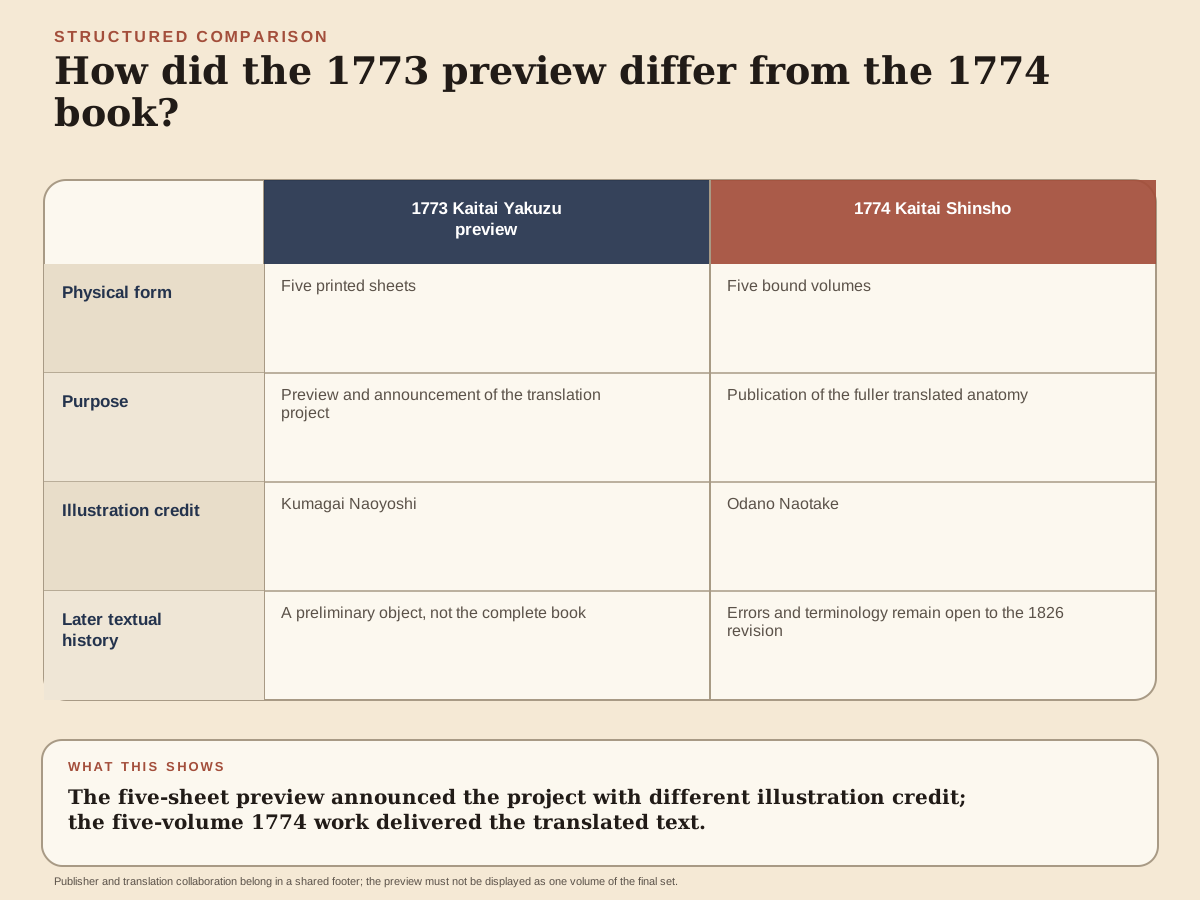
In 1773, they issued Kaitai Yakuzu, a five-sheet preview containing explanatory material and three anatomical plates. Kumagai supplied those drawings. The following year’s fuller work had illustrations by Odano Naotake, an artist from Akita; the preview and the book were distinct publications with different illustrators.
The 1774 publication gave the translation a form that could circulate beyond the working group. The group translated the main text but omitted the source’s notes, and errors remained in its rendering of the Dutch. Ōtsuki Gentaku’s later revised edition was published in 1826.
Genpaku recalled the project in the memoir now known as Rangaku Kotohajime, written in 1815. It preserves a participant’s account composed decades afterward. The printed preview and completed book supply contemporary evidence for the publication stages through which Dutch-language medical knowledge became available in a new scholarly form.
Classic
Kaitai Shinsho began with access to an imported anatomy book and an opportunity to compare it with a human body. Dutch books reached Japan through the restricted trading and interpreting networks centered on Nagasaki. Physicians could obtain knowledge through these channels, but the presence of a book did not supply the language skills needed to translate it.
The source used by Sugita Genpaku and his collaborators was the Dutch edition commonly called Tāheru Anatomia, derived from Johann Adam Kulmus’s German anatomy work. Its illustrations could be studied before all its prose was understood. The eventual Japanese publication therefore involved a chain from a German author, through a Dutch edition, to a translation prepared for readers in Japan.
In 1771, Genpaku, Maeno Ryōtaku and Nakagawa Jun’an attended a dissection at Kozukappara, an execution ground in Edo. They compared the executed person’s body with the Dutch book’s anatomical illustrations. The close correspondence encouraged the translation project.
Ryōtaku brought Dutch knowledge to the task, while Genpaku and other physicians contributed medical judgment and the work of preparing a text. They faced the problem of giving anatomical descriptions a usable scholarly form. Recognizing an organ in a plate was different from understanding a sentence about its structure or function.
Genpaku’s famous account of their early difficulties was written in 1815, long after the dissection and publication. His recollections preserve a participant’s view of the translation meetings and the labor of learning to understand the Dutch source.
Access had been developing before these physicians met. In 1720, Yoshimune relaxed restrictions on importing books unrelated to Christianity. Nagasaki interpreters learned medicine from physicians at the Dutch trading post, and Ryōtaku studied Dutch with Aoki Konyō and through contact with interpreters in Nagasaki. Imported volumes and language instruction consequently followed related routes. An anatomy book could reach Edo, while the ability to read it still depended partly on knowledge acquired elsewhere.
Chinese-derived medical writing and practice continued to provide the physicians' professional setting. Comparing an anatomical plate with a body posed a particular question about physical structures; it did not test every diagnosis or therapy in existing medicine. The collaborators' use of kanbun also kept the new work within a familiar scholarly language even as they struggled to render an unfamiliar source.
The group worked on translation after the 1771 dissection. Maeno Ryōtaku played a central role in interpreting the Dutch, while Sugita Genpaku pressed the project toward a text that could be published. Nakagawa Jun’an and Katsuragawa Hoshū contributed to the collaborative work and review. These roles make the book more than one physician’s solitary discovery.
The translation was written in literary Chinese, or kanbun, for Japanese scholarly readers. Anatomical descriptions required suitable terms and consistent relationships between text and illustrations. The group translated the source’s main text but omitted its notes. The result was an adaptation for a new readership, with choices about what to include as well as how to name it.
In 1773, before issuing the whole work, Genpaku and Jun’an published Kaitai Yakuzu. It consisted of five loose woodblock-printed sheets in a wrapper: introductory and explanatory material, followed by three anatomical plates. The wrapper announced the planned five-volume Kaitai Shinsho. This preview gave readers a sample of the project and made its intended publication visible a year before the full book appeared.
Kumagai supplied the drawings for the 1773 preview. The following year’s Kaitai Shinsho used illustrations by Odano Naotake, an artist from Akita. The two publications therefore differed in their images as well as their scale.
Suharaya Ichibee issued the full book in Edo in 1774. It comprised four text volumes and one containing introductory material and illustrations. Translation and review had reached a printed form that others could obtain and study. The publisher and the people producing its images and printed pages were part of the process that turned the group’s working material into a circulating book.
The limits of their language resources appeared even in descriptions of an identifiable part of the body. In his later memoir, Genpaku recalled the group's difficulty with a Dutch expression applied to the nose, which he rendered as furuhehhendo. They could identify the body part without understanding what the sentence said about it. The anecdote describes uncertainty in a translation meeting; its late composition does not make its dialogue a verbatim record of 1771. The work required repeated comparison between words, anatomical descriptions and illustrations, rather than simply replacing the source's labels with familiar names.
The preliminary sheets and the complete book made those decisions reproducible at different scales. Kumagai's three plates gave a sample; Odano's drawings accompanied the fuller anatomical descriptions. His work linked the publication to an artist trained in Western pictorial methods. Review, drawing and woodblock printing thus added further contributors and decisions after the initial task of interpreting Dutch. The printed book's credits recorded some of those roles but did not name every person who had helped understand the source.
The immediate outcome was a published anatomical work that could be read without deciphering the Dutch edition. Its text and pictures provided Japanese scholarly readers with descriptions they could compare, teach and question. Five bound volumes gave the work a different scale from the five-sheet preview of the previous year.
Ryōtaku’s central contribution to interpreting the Dutch is documented in histories of the project, but his name was absent from the published work. Genpaku’s name appeared in print, and his later memoir gave him a prominent place in its remembrance. Printed attribution and the record of collaboration preserve different parts of the project’s history.
Translation errors remained in the published work, and the decision to omit the source’s notes reduced its contents. The book supplied material for further study and revision. Ōtsuki Gentaku’s later retranslation addressed shortcomings in the first edition.
The printed work supplied a text and illustrations that could be studied beyond the original group. Its place in medical learning developed through circulation, teaching and later translation. Existing forms of medicine continued alongside study of European books.
Its concrete achievement was to move an imported source through collective interpretation, a preliminary printed sample and a fuller illustrated edition. Each stage widened what could be shared, while retaining limitations that later scholars would have to address.
Later medical works demonstrate the coexistence of approaches more concretely than a claim that one school replaced another. Mitani Kōki's Kaitai Hatsumō drew on a dissection witnessed in Kyoto in 1802 and belonged to efforts to reconcile anatomical observation with inherited explanations. Japanese physicians could take anatomy seriously while retaining other Chinese-derived ideas. The new book widened material available for argument and practice rather than announcing a common decision by the profession.
Commercial circulation also outlasted the first edition. A Kyoto bookseller's 1841 catalog listed both Kaitai Shinsho and its revised successor among Dutch-learning books for sale. Readers could acquire printed versions through the domestic book trade without obtaining the imported anatomy volume themselves. The surviving editions and catalog give specific evidence for this continuing route from translation to availability; they do not count how many physicians adopted its terminology or changed their treatments.
Kaitai Shinsho became an important work in rangaku, or Dutch studies: the study of knowledge obtained through Dutch-language materials and related networks. Its anatomical terminology and illustrations gave readers material for further medical study and translation. Printing allowed that work to travel beyond the people present at the original dissection and translation meetings.
Correction was part of its afterlife. Ōtsuki Gentaku undertook a revised and expanded translation, published as Jūtei Kaitai Shinsho in 1826. That edition included a substantial terminology component and new illustrations. Its existence shows that later study could build on the 1774 work while changing its language and contents.
The project also acquired a powerful remembered narrative. In 1815, Genpaku wrote the account now called Rangaku Kotohajime. Fukuzawa Yukichi published it in 1869, making a participant’s recollections available in print during the early Meiji period. The memoir’s later circulation helped establish the translation as a story about the labor of learning from foreign books.
The surviving Kaitai Yakuzu and Kaitai Shinsho provide a different kind of evidence. Their sheets, volumes, credits and images belong to the publications themselves. They fix the distinction between the preview of 1773 and the full work of 1774 more securely than a retelling that treats both as one dramatic moment.
The publication brought an imported anatomy book into a scholarly language Japanese readers could use. Translators, reviewers, illustrators and a publisher each contributed to that process. The surviving preview, full edition and Gentaku’s later revision preserve its successive stages of circulation and correction.
Teaching connected the translators to a subsequent generation. Gentaku studied with Genpaku and Ryōtaku after coming to Edo in 1778, traveled to Nagasaki and opened the Shirandō school in 1786 while serving as an Edo-based physician of the Sendai domain. Pupils including Inamura Sanpaku and Udagawa Genshin carried learning into further translation and teaching. These links crossed a port, the capital's scholarly circles and domain employment. They supplied institutional settings in which the published anatomy work could be discussed and improved.
Gentaku's revision also changed the images' means of reproduction. Its 1826 illustrated component replaced Odano's earlier woodblock illustrations with copperplate images prepared by Minagaki Yasukazu and engraved by Nakai Isaburō. A separate terminology work combined anatomical headings, renderings of original-language pronunciation, explanations and translator comments. Revising the book consequently involved its language, supporting apparatus and printed images. The 1774 edition remained a consequential starting point within a longer history of access, professional debate and republication, rather than the first arrival of all European medical knowledge.