Read the article below. Interactive reading tools are available when scripts load.
Quick
Books at Nagasaki were inspected for Christian teaching. Scientific works could be caught in that prohibition because their knowledge came from missionaries. Tianjing huowen, a Chinese-language work drawing on Western astronomy, was difficult to acquire under these restrictions. Scholars interested in calendar calculation had reason to seek a wider range of books.
In 1720, Yoshimune relaxed the rule for works whose contents were unrelated to Christianity, even when missionaries had written them. Chinese-language scientific texts could now pass a test that had previously excluded them. Christianity remained prohibited. Nagasaki’s inspectors and magistrates continued examining books and deciding what could enter.
Inspection produced documents as well as decisions. The hereditary Mukai book inspectors prepared summaries for the Nagasaki magistrate, who forwarded them to senior councilors in Edo to ask which works the government should purchase. A surviving 1754 set lists more than four hundred titles and notes missing pages and worn text. It shows the continuing work of selection after the relaxation.
Language remained a further obstacle. Genpaku’s later memoir describes Noro Genjō and Aoki Konyō learning from interpreters accompanying the annual Dutch delegation to Edo. Brief visits offered limited study time. Other learners copied vocabulary and illustrated books, traveled to Nagasaki and sought funding from their domains.
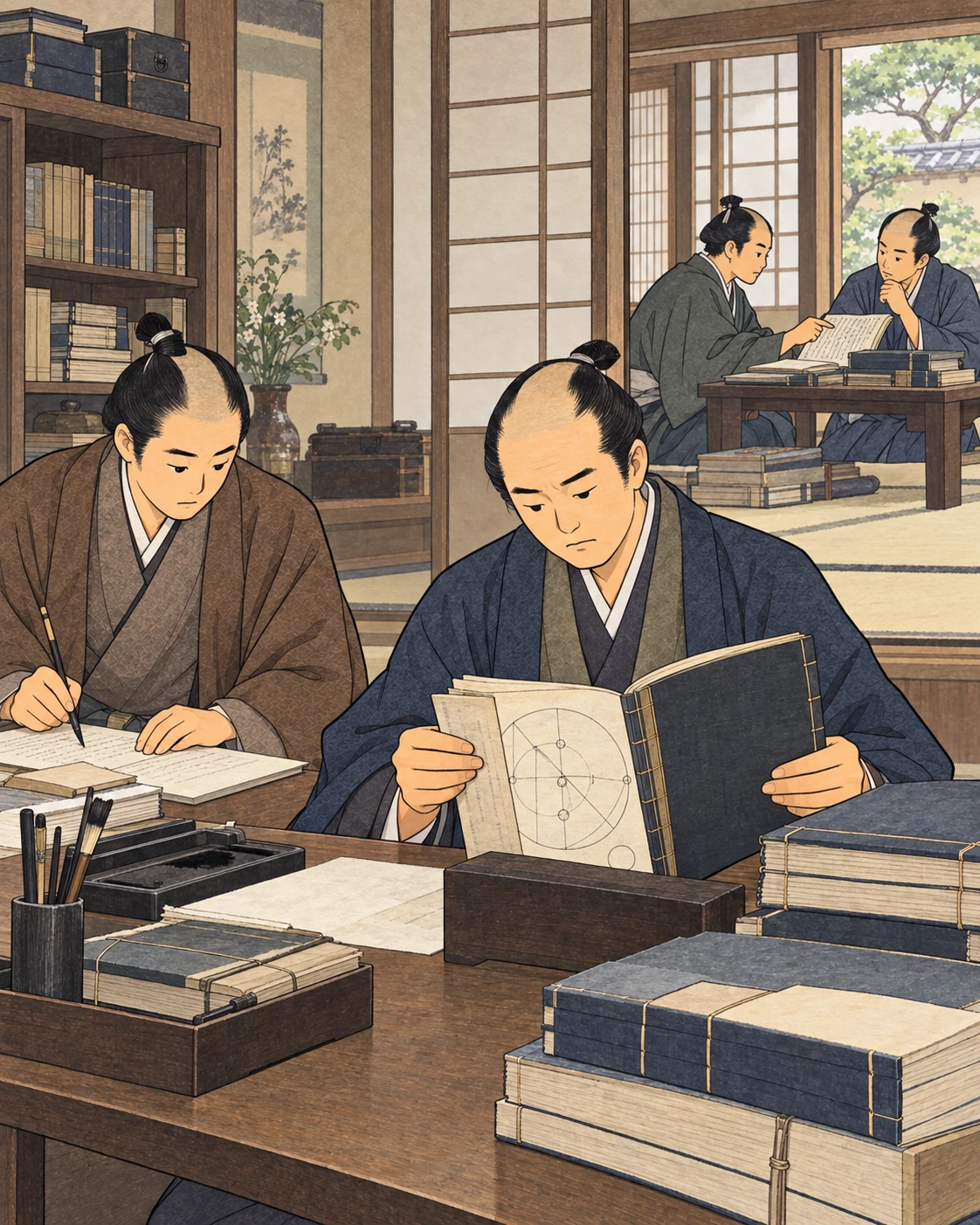
By 1771, Genpaku, Maeno Ryōtaku and Nakagawa Jun’an could compare an executed woman’s anatomy with Dutch illustrations and begin a collaborative translation. Their work required repeated meetings, terminology decisions and revision. The 1720 exception reduced a legal barrier; decades of procurement and learning made later books usable. Genpaku belonged to that later history, having been born in 1733.
Classic
Scientific books reached Japan through the trade controlled at Nagasaki. Some were written in Chinese while incorporating knowledge transmitted by European missionaries. A book’s language and subject could therefore cross the categories officials used to identify prohibited teaching.
Tianjing huowen drew on Western astronomy but fell within the restrictions, making it difficult to acquire. Japanese astronomers had already developed calendar methods and sought other sources for calculation. The demand for scientific books preceded Yoshimune’s decision.
The National Astronomical Observatory’s account identifies mathematician Takebe Katahiro as one of those said to have urged relaxation on Yoshimune. This links the policy to a particular scholarly concern, without making Takebe the sole author of it.
Nagasaki already had book inspectors. In 1685 Mukai Motonari drew attention to Christian passages in a Chinese astronomical work, after which the Mukai family held the office hereditarily under the magistrate. That inspection system was in place when Yoshimune changed the rule.
Earlier banned-book lists could combine Christian doctrine with works on geography, water engineering and mathematics. The change addressed this overlap between an author's religious affiliation and a book's subject. The commonly repeated date of 1630 for the first list has itself been questioned in a study of surviving copies and Dutch diaries; the earlier censorship regime is clear, but that date should not be used as a precise, uncontested beginning.
Chinese-language works had already crossed a linguistic boundary before reaching Japan. One concrete example is Wang Zheng's 1628 Yuanxi qiqi tushuo luzui, an account of Western machines produced with the missionary Johann Schreck. It presented mechanics through Chinese explanations and diagrams. A Japanese reader encountered a Chinese compilation and translation, not a Dutch book simply because its knowledge came from Europe. Its later Japanese translation shows why authorship alone could obstruct a work the government judged useful.
In 1720, Yoshimune permitted missionary-authored books when their contents were unrelated to Christianity. The exception widened the range of Chinese-language scientific works eligible to enter. Religious teaching remained prohibited.
Officials still needed to inspect incoming books. Permission depended on the contents of a particular work, so an author’s association with Christian missions ceased to be sufficient by itself to exclude every book.
The book inspector wrote a summary of the works examined and submitted it to the Nagasaki magistrate. The magistrate sent the information to the rōjū in Edo to ask whether the government wanted to purchase any of them.
A later surviving example makes the procedure visible. Mukai Motonaka summarized more than four hundred titles carried by Chinese ships in 1754, including works on the classics and government.
His descriptions noted publication dates and physical defects such as missing pages and worn text. These details allowed purchasers to assess the copies being offered, alongside the subjects they contained.
The four-volume summary records administration operating after the exception. It establishes a chain of inspection, description and official purchase; it does not supply an immediate 1720 import total.
Yoshimune also strengthened the institutions that used books. In the sixth lunar month of 1716, before his appointment as shogun in the eighth, he ordered the Momijiyama library's catalogue brought to him. A revised catalogue was compiled in 1720 and another in 1723. Books and records could be located, requested and studied through library officials rather than merely accumulated as possessions.
The library's scholars then supplied explanations and translations. Fukami Arichika and Katsurayama Yoshiki translated the Chinese work on Western machines into Japanese. In the same year as the import relaxation, Takase Gakuzan produced a study explaining the vocabulary of the Ming code at Yoshimune's command. These were different kinds of books, but both show the staff work that connected collection to government use. Acquisition did not imply that the shogun personally mastered every language or that each diagram became an implemented machine.
Inspection and library description were successive judgments. Mukai's summary could alert officials to a subject and a damaged copy; a catalogue could make the acquired work findable; a scholar could explain its terms. Passing the religious-content test meant permission under the rule, rather than certification that every assumption or conclusion in a scientific text was correct.
The exception made more scientific works legally available, while keeping their passage through official inspection. A volume arriving at Nagasaki could then be selected for government purchase or enter another collection. Admission and subsequent use were separate steps.
Genpaku’s memoir describes a second difficulty: reading Dutch. He recalls Noro Genjō and Aoki Konyō studying words and letters with interpreters accompanying annual delegations to Edo. The visitors’ short and busy stays limited the lessons.
The same memoir recounts the Nagasaki interpreter Nishi Zensaburō copying a borrowed dictionary repeatedly before receiving the book itself. Maeno later studied vocabulary in Nagasaki and returned with books. Their work gave other readers materials with which to begin.
Obtaining those materials also required support. Genpaku describes requesting domain funds to purchase an illustrated anatomical book he could not yet read. The account shows learners combining official or private access, money, copying and instruction to make imported works usable.
Genpaku separates earlier medical transmission from reading books. He describes practitioners learning operations by watching and recording recipes by ear, then working with substitute ingredients when foreign drugs were unavailable. A useful technique, an image and a readable explanation could therefore travel at different rates. Later interpreters sought permission to learn written Dutch because memorized speech was insufficient for complicated official business.
The resources available to learners also differed. A domain's support could buy a rare anatomical book, but money did not supply its grammar. A copied dictionary helped other people begin studying, while brief Edo visits restricted the time available to ask an interpreter questions. Genpaku's memoir even remembers some enthusiasts abandoning the slow work when livelihood or illness intervened. These accounts identify the labor and support separating an admitted volume from a community of readers; they do not establish universal access after 1720.
The policy’s later effects appear in particular projects. Genpaku, Maeno and Nakagawa compared anatomy with Dutch book illustrations in 1771, then began reading and translating together. Genpaku’s memoir describes the repeated meetings and the revisions needed before publication.
Other books assembled information from conversation as well as translated text. Morishima Chūryō’s Kōmō zatsuwa, published in 1787, gathered accounts heard from Dutch visitors and Dutch-learning scholars. Imported knowledge circulated through several forms of writing.
The 1720 exception belongs among the conditions that helped these projects develop. It permitted a broader scientific corpus within continuing controls, while later scholars supplied the language study and publication work. It offers no guarantee that readers understood every admitted work correctly.
Genpaku wrote his memoir in 1815 from within this later scholarly world. Born in 1733, he had no role in the 1720 decision. His recollections supply evidence of subsequent learning and collaboration, with the limits of a remembered account.
The anatomical translation involved choices that permission to import could not settle. According to Genpaku, the group began with diagrams of the body's exterior because they could identify those parts and match labels to descriptions. Unresolved passages were marked for later work. Repeated meetings, questions to visiting interpreters and comparisons with bodies enlarged their vocabulary; he revised the manuscript through several drafts before printing. The memoir gives differing counts of revisions, so an exact total would imply more certainty than its own wording supplies.
Different participants also pursued different ends. Genpaku wanted to publish an anatomical account useful to physicians; Maeno sought a wider command of Dutch. Their collaboration joined these aims without removing uncertainty from the translation. The 1720 decision reduced a legal barrier, while scholars, patrons, copyists and publishers determined which works became intelligible and circulated. Continued prohibition of Christianity and controlled foreign contact remained part of that environment. Genpaku's place in this story is as a later beneficiary and witness to subsequent learning, not as a participant in a decision made before his birth.