HO Guides
Shiroyama and Tsurumaru Castle: A Battlefield Made Public
How a former governing center, a defeated general and a wooded hill acquired new places in Kagoshima's civic life.
Quick · About 2 min
The story in five points
A short route through the argument. Follow a point into Classic for its context and sources.
The hill belonged to government
Tsurumaru combined a residence below with defensive ground on Shiroyama above. Its lack of a great keep did not make it undefended. The castle organized administration and protection across a landscape rather than concentrating both in one tower.
Read in contextSaigō had helped build the state he opposed
Saigō served the Meiji government and helped abolish the domains before returning to Kagoshima. His school reused the former castle stables. Its foundation in 1874 does not, by itself, prove a predetermined plan for rebellion.
Read in contextThe final stand followed a wider campaign
Government records stripped Saigō of rank during the rebellion. His forces returned after fighting and retreat elsewhere in Kyushu, then fell at Shiroyama in September 1877. Bullet-marked masonry preserves aspects of the conflict without reconstructing his final words.
Read in contextMourning and rehabilitation were separate
Katsu Kaishū commemorated Saigō in 1879, before the state’s 1889 pardon and posthumous rank. The 1937 uniformed statue presents his earlier military service against the landscape of defeat, without establishing a unanimous judgment on his career.
Read in contextPublic history required further changes
Park paths, a relocated school wall, Reimeikan museum and the reconstructed Goromon each altered the inherited ground. Together they make several pasts accessible; none restores the governing household, battlefield or city exactly as it once existed.
Read in context
Opening
The bronze Saigō Takamori standing below Shiroyama wears a military uniform. Erected in 1937 and made by the sculptor Andō Teru, the statue presents him upright, with a sword at his side. The hill behind belongs to the landscape where he died during the final assault against his forces in 1877.[1][12]
His clothing recalls another part of his career: service in the army of that same government. A document stripping him of official status during the rebellion still identified him by his general's rank. The later statue and the earlier order make different public statements about one man.[8]
The surrounding ground has undergone a comparable change. Shiroyama had protected the Shimazu residence at Tsurumaru Castle before it became a final insurgent position. It later opened as parkland, while the castle grounds accommodated new institutions. Following these changes explains how a place of government and civil war became somewhere people could commemorate, study and look out over their city.
1. The hill was part of the castle
Shimazu Iehisa began developing Kagoshima Castle, also known as Tsurumaru, around 1601. It governed Satsuma, the family's domain in southern Kyushu. Its two principal settings performed different work. The residence below Shiroyama accommodated the lord and the business of government; the hill behind it provided the military center. Other offices and retainers' residences occupied the adjoining town, which extended toward the sea.[2]
The castle's absence of a great keep does not mean that its main defensive component is missing from every view. Much of that component is the hill. Earthworks and dry ditches shaped access to the upper ground, while the residence occupied a more convenient setting for daily attendance and administration. Joining the two produced a castle whose organization was spread across the slope and its foot.[11]
A recent prefectural interpretation relates this arrangement to traditions of lordly residence and authority older than the great towered castles. It places the residence-and-hill configuration within forms of authority that did not depend on a tower.[3] The surviving arrangement is the firm starting point: residence below, defensive ground above. The precise weight that the builders gave to prestige, precedent and security remains a matter of historical interpretation.
At the entrance below, the Goromon was itself a substantial two-storey gate. Its bridge also preserves evidence of the domain's place within a larger political order. In 1810, Satsuma requested permission from the shogunate to replace the wooden bridge with a stone one.[4] Even an alteration at the entrance to the Shimazu residence could generate business between Kagoshima and the military government in Edo.
The request gives this governing center a more specific identity than a generic stronghold of independent warriors. Its lord administered a domain, but did so within relationships extending beyond it. Shiroyama and the palace were local components of that order. The changes of the nineteenth century would alter both the authority occupying the place and the uses available for its land.
2. A school on the stable ground
Saigō came from Kagoshima's domain society and became an important participant in the new Meiji government. He helped bring about the abolition of the domains, replacing the political framework in which the Shimazu had governed from the castle. His later conflict with the state therefore followed substantial work within it.[5]
The old residence changed hands in the same transition. Its principal enclosure entered army use. Then, in December 1873, fire destroyed the palace and Goromon.[6] Their disappearance preceded the rebellion. A visitor reading every absence at Tsurumaru as damage from Saigō's final campaign would place a later war where an earlier fire belongs.
Meanwhile, Saigō had left central government after a dispute over policy toward Korea. Back in Kagoshima, he established a school for young men, including those who had followed him home. The school opened in 1874 on ground formerly occupied by the castle's stables. Its stone boundary had served the earlier establishment before enclosing the new one.[7]
That reuse brought the political transition down to the level of a particular plot. A part of the lord's residential infrastructure became available for an institution formed around a former central official and his associates. The school did not occupy an untouched samurai world outside the changes of the Meiji period. It occupied property whose role was changing because the old domain government had ended.
The sequence also separates the school's foundation from the rebellion that followed three years later. A building established for education does not become evidence of a fixed plan for insurrection merely because people associated with it subsequently fought. What the site records securely is an organization, a gathering of returnees and an inherited place in which they could operate.
The castle's political geography was therefore being redistributed before fighting reached Shiroyama. Army use of the palace grounds and the school on the stable site were neighboring consequences of the same institutional break. Former domain space did not pass into one uniform new purpose.
3. The government removed a general's title
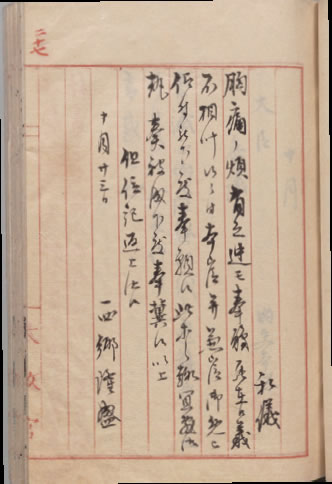
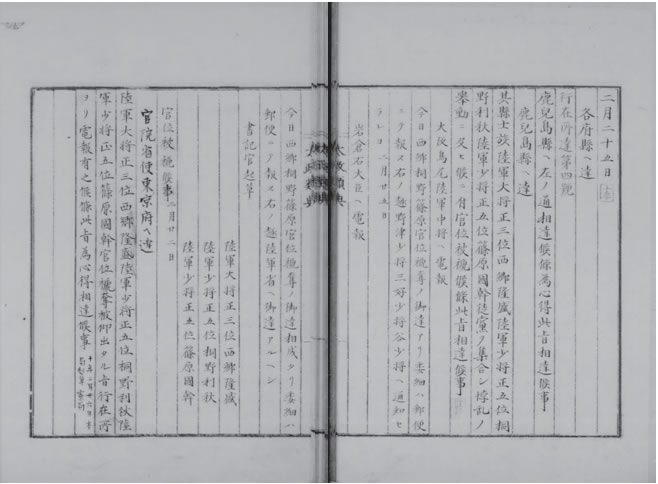
The National Archives preserves two documents that clarify Saigō's changing relationship with central authority. One is his resignation petition of 23 October 1873, submitted under the titles of army general, commander of the imperial guard and state councillor. The other records the deprivation of official rank after the rebellion began in 1877. It names him as General Saigō Takamori, holder of Senior Third Rank.[8]
The two records describe different acts. Asking to leave office was not identical to the later removal of official standing by the state. The titles appearing in the deprivation record are particularly important: the government was formally severing a relationship expressed in its own hierarchy.
Once the conflict became an armed rebellion, Saigō's earlier service could not determine his continuing official status. The order stripped rank from him and two other men. It translated a military and political rupture into an administrative act, making the change legible in a form that could be recorded and communicated.
This does not explain every decision that brought the school and its followers into war. It does establish why the conflict cannot be reconstructed simply as an encounter between a modern state and people who had never belonged to it. The state's records still had offices and ranks to remove. Some of the men now opposing it had previously held positions within the institutions conducting the suppression.
Saigō's forces left Kagoshima and fought across Kyushu before returning. Their campaign included the unsuccessful effort against Kumamoto Castle, then fighting and retreat farther south. By September 1877, the surviving insurgent force was back in Kagoshima.[9] Shiroyama became its final position, but the return was the end of a wider campaign, not the beginning of a war confined to this hill.
That wider movement explains another feature of the landscape. The school and old castle were places to which the defeated force returned, not a complete map of everything for which it had fought. Their local importance is strongest when kept within that larger sequence.
4. What the stones retained
Near the Goromon, depressions in the stonework contain remnants of bullets and shells. Excavated ammunition from the surrounding ground helped investigators identify many of these marks with the fighting of 1877. The prefecture's archaeological interpretation also finds evidence of firing from several positions.[10]
The damage makes the final conflict tangible without supplying a staged last moment. Gunfire affected the entrance area below the hill as well as the ground held above it. The old administrative frontage had become part of the fighting environment, although the timber gate itself had already burned four years earlier.
On Shiroyama, the defensive earthworks remained available to the returning force. The prefecture's hill guide locates an early insurgent headquarters on the upper earthwork and describes a later move toward the caves as the position deteriorated.[11] The sequence changes the meaning of the terrain: a feature inherited from the old castle could offer a position, but its availability did not restore the military circumstances under which it had first been made useful.
Government forces surrounded the insurgents. The final attack came on 24 September, when Saigō died and organized resistance ended.[12] The familiar locations associated with his death form part of the memorial landscape, but no precise reconstruction of his last words or movements is needed to understand the outcome. The force that had returned to the old domain center could no longer hold it.
The school had burned on 17 September. Its stone enclosure survived with damage from the fighting.[7] It thus preserved an awkward sequence in one piece of fabric: a boundary for the lord's stables, a boundary for the new school, and a surface struck during the campaign.
Afterward, the marks remained available to be read in different ways. They could serve as evidence of weapons and firing, or as reminders of the people associated with the place. The later work of commemoration would select and name these associations. The stones did not arrive with a complete public account already attached to them.
5. Mourning preceded rehabilitation
Saigō's death did not immediately reverse his official condemnation. Nor did condemnation prevent every attempt to commemorate him. In 1879, Katsu Kaishū, the former shogunate official who had negotiated with him over Edo Castle, paid for a memorial stone in the Tokyo area. Its inscriptions brought Saigō's verse together with Katsu's remembrance of him.[13]
This act occurred far from Shiroyama, but it helps establish the timescale of the memory later made visible there. An individual could preserve a relationship to Saigō before the state restored his standing. Mourning and official rehabilitation were separate processes, carried forward by different people and institutions.
In 1889, the amnesty accompanying the promulgation of the Meiji Constitution pardoned Saigō posthumously, and Senior Third Rank was bestowed on him posthumously.[13] The new recognition did not make the rebellion disappear from the record. It changed the status of the dead man within the state that had defeated him.
The 1937 statue below Shiroyama belongs to a still later stage. Its military dress offers a public image of Saigō that includes his official career rather than representing only the circumstances of his death. The city's inventory identifies both the sculptor and the commemorative association responsible for its establishment.[1]
Read together, the uniform and the site permit two parts of his life to remain visible: service to the new government and rebellion against it. This is an interpretation of what the monument presents, not evidence that every sponsor or viewer explained the combination identically. A statue selects a form in which a person will be encountered. It cannot supply a shared verdict on all that person's actions.
The result is especially distinctive here because the military image stands against the landscape of defeat. Moving the figure to an unrelated park would weaken that relationship. At Shiroyama, the terrain continues to recall an ending that the upright, formally dressed figure does not depict.
6. The public acquired a view
Commemoration was only one way the hill entered civic life. During the domain period, access by ordinary people had been restricted for security. In 1885, under prefectural governor Watanabe Chiaki, a park opened around the area now called Tanshōen. Its extent gradually increased.[14]
Opening a park changed the relationship between the hill and the people below it. Ground formerly associated with guarding a lord's residence became a place that the public could enter for other purposes. Remembering the war could coexist with walking, looking at vegetation and enjoying the prospect over Kagoshima.
The prefecture's historical account tentatively connects development of the present observation point with the crown prince's visit in 1907. Walking paths followed from 1910. A road project in 1931 brought opposition as well as construction.[14] Public access developed through particular interventions and disputes, rather than through the simple withdrawal of a guard from an unchanged castle landscape.
The imperial visit also adds a relationship beyond the commemoration of Saigō. A hill associated with the state's suppression of an insurgent force could subsequently provide a setting for a member of the imperial household to view the city. These uses were separated by decades; they need not be collapsed into one act of reconciliation to be historically connected.
The new routes also shaped what later visitors encountered. A path could bring the earthworks, a cave or a commemorative stone into a sequence of stops. The hill became readable through movement, but that movement was increasingly organized for a park. Present access should not be mistaken for the route of an attacking soldier or a member of the old lord's household.
The conflict over road building is a reminder that making this landscape public did not settle how it should be used. Access, preservation and construction could pull in different directions. The city inherited usable ground as well as a battlefield, and later decisions altered both.
7. A gate, a museum and a shifted wall
Changes continued at the foot of the hill. In 1955, widening National Route 10 required the private-school wall to be moved back slightly and reconstructed.[7] Its damaged stones were retained, but their position in the street changed. Preserving the reminder of the school was made compatible with a new demand for road space through an actual relocation.
Within the former principal enclosure, Reimeikan opened in 1983. The prefecture had planned the museum as a project marking the centenary of the Meiji era. Its scope encompassed archaeology, history, folklore and art, placing the domain and rebellion within a longer regional account.[15]
This new occupant changed what the enclosure offered. A center formerly used to conduct government became a place where evidence of several forms of government—and much else—could be collected and examined. Its subject was larger than either the Shimazu household or Saigō's last campaign.
Archaeology helps recover some of the earlier residence beneath that public setting. Excavation located part of the passage leading to its Noh stage, a setting for formal dramatic performance. The position matched the recorded palace plan, identifying a performance space visible from an inner reception room.[16] The find restores an activity that neither bullet marks nor the uniformed statue can adequately represent: people assembling for drama within a lordly residence.
The Goromon returned in a different form. A public-private project involving the prefecture, civic groups and business organizations completed its reconstruction in 2020. Historical images and surviving foundations informed the work, but the resulting timber gate is a modern building.[17] The palace behind it has not returned as an inhabited complex.
The reconstructed entrance, the museum and the shifted school wall therefore preserve different relationships to the past. One gives a lost architectural form a new physical presence. Another gathers evidence within the former enclosure. The third keeps damaged material while adapting its position to the modern city. None restores the political world that once occupied the whole site.
Shiroyama and Tsurumaru became public through these successive changes, not through one decision about how Saigō should be remembered. The hill retains the final battle; the uniformed statue recalls a career that preceded it; the palace remains recover an older governing household. Their coexistence makes Kagoshima's history harder to compress into a single last stand—and gives the city more than one past to encounter in the same ground.
Next topic · HO Guides
Sengan-en: Experiments at the Edge of a Garden
How a lord's estate brought ornamental landscapes, ceramic materials and industrial experiments into practical contact.
Continue readingSources and NotesView sourcesHide sources
- [1]
Kagoshima City, “西郷隆盛銅像,” public-monument inventory: creator, sponsoring association and 1937 establishment. The image supports the description of military dress and sword; it is a 1937 sculpture, not an eyewitness portrait or a record of clothing worn in the final battle. https://www.city.kagoshima.lg.jp/kensetu/kensetukanri/kouenryokuka/bunka/sports/shisetsu/saigotakamori.html
Return to the reference ↑ - [2]
Kagoshima Prefecture / Reimeikan, “鹿児島(鶴丸)城跡,” introductory identification; Kagoshima (Tsurumaru) Castle Ruins: General Information, p. 1, text and map. The foundation is expressed as around 1601 rather than a date for every component. https://www.pref.kagoshima.jp/ab24/cms/documents/kagosimajou/kagosimajou.html ; https://www.pref.kagoshima.jp/ab24/cms/documents/kagosimajou/documents/75816_20200321164813-1.pdf
Return to the reference ↑ - [3]
Kagoshima Prefecture, “天守を築かなかった城 鹿児島城,” leaflet linked from the castle symposium page, 2026, second PDF page. The connection with older residential and status traditions is the published interpretation, not a recovered statement of Iehisa's private intentions. https://www.pref.kagoshima.jp/ab10/documents/127148_20260318160309-1.pdf
Return to the reference ↑ - [4]
Kagoshima Prefecture / Reimeikan, Goromon Gate and the Stone Bridge, one-page English panel, bridge-history paragraph and reproduced 1872 photograph. The 1810 claim concerns a request for permission, not a separately established completion date. The panel's problematic metallurgical wording about the bridge ornaments is not used. https://www.pref.kagoshima.jp/ab24/cms/documents/kagosimajou/documents/75917_20200322093651-1.pdf
Return to the reference ↑ - [5]
National Archives of Japan, “あの日の公文書:9月24日 南洲忌,” career paragraph; National Diet Library, Portraits of Modern Japanese Historical Figures, “西郷隆盛,” biography. Used for government service and involvement in domain abolition, without adopting celebratory evaluations or reconstructing private motives. https://www.archives.go.jp/naj_news/15/anohi.html ; https://www.ndl.go.jp/portrait/datas/85
Return to the reference ↑ - [6]
Reimeikan, General Information, p. 2, army-use and fire paragraph; Reconstruction of the Goromon Gate, opening sentence. The English general-information panel awkwardly attaches 1872 to domain abolition; the essay does not adopt that dating. Both panels agree on the December 1873 fire. https://www.pref.kagoshima.jp/ab24/cms/documents/kagosimajou/documents/75816_20200321164813-1.pdf ; https://www.pref.kagoshima.jp/ab24/cms/documents/kagosimajou/documents/75922_20200322101021-1.pdf
Return to the reference ↑ - [7]
Kagoshima Prefectural Education Board cultural-property database, “私学校跡石塀,” record d-m-40060. The entry identifies: stable enclosure, school foundation in 1874, destruction on 17 September 1877, and 1955 relocation. National Diet Library biography in note 05 supplies the broad Korea-policy context. The school is not treated as proof of a predetermined plan for rebellion. https://k-bunkazai.com/cultural/d-m-40060/
Return to the reference ↑ - [8]
National Archives, “あの日の公文書,” captions and reproduced documents “西郷参議辞表” and “西郷隆盛外二名官位褫奪.” The document images are used with the archive's identifications and readings, not a new palaeographic edition. Submission of a resignation petition and subsequent deprivation of official rank are kept separate. The direct JACAR catalogue fetch failed; no unseen catalogue text is represented as read. https://www.archives.go.jp/naj_news/15/anohi.html ; https://www.archives.go.jp/naj_news/img/15/anohi02.jpg ; https://www.archives.go.jp/naj_news/img/15/anohi03.jpg
Return to the reference ↑ - [9]
National Diet Library, “西郷隆盛,” campaign paragraph; Kagoshima Prefecture / Reimeikan, “西南戦争の痕跡,” campaign summary. Used for the unsuccessful Kumamoto campaign, retreat and September return. Exact force sizes, casualty totals and a complete reconstruction of campaign decision-making are outside the evidence used here. https://www.ndl.go.jp/portrait/datas/85 ; https://www.pref.kagoshima.jp/ab24/cms/documents/kagosimajou/documents/75920_20200322100025-1.pdf
Return to the reference ↑ - [10]
Kagoshima Prefecture / Reimeikan, “西南戦争の痕跡,” complete one-page panel, especially the opening identification of ammunition and the paragraph on multiple firing positions. Text, close-up photograph and locator map inspected. The source attributes many marks to 1877, not every irregularity on every wall. https://www.pref.kagoshima.jp/ab24/cms/documents/kagosimajou/documents/75920_20200322100025-1.pdf
Return to the reference ↑ - [11]
Kagoshima Prefecture Cultural Promotion Division, 鹿児島城跡・山城ガイド, March 2025, p. 2, entries B, C and E. Used for earthworks, the headquarters location and reported movement toward the caves; the guide's speculation that Saigō consciously chose the old castle center is not adopted. https://www.pref.kagoshima.jp/ab10/documents/119666_20250304165030-1.pdf
Return to the reference ↑ - [12]
National Archives account in note 05, dated-event opening; Ota Ward / Katsu Kaishū Memorial Museum, “西郷南洲留魂詩碑,” “前史.” Both support 24 September 1877 and the end at Shiroyama. Their descriptions of suicide are not expanded into a final dialogue, exact route or disputed sequence of wounds. https://www.archives.go.jp/naj_news/15/anohi.html ; https://www.city.ota.tokyo.jp/shisetsu/rekishi/yukigaya_senzoku/saigoutakamori_ryuukonhi.html
Return to the reference ↑ - [13]
Ota Ward / Katsu Kaishū Memorial Museum, “西郷南洲留魂詩碑,” updated 18 November 2025, “前史,” “建碑由来” and “その後.” Used for Katsu's 1879 commemoration and the 1889 amnesty/posthumous rank. The Tokyo monument is an external comparison establishing chronology, not a monument relocated to Shiroyama; no claim of universal public agreement follows from legal rehabilitation. https://www.city.ota.tokyo.jp/shisetsu/rekishi/yukigaya_senzoku/saigoutakamori_ryuukonhi.html
Return to the reference ↑ - [14]
Kagoshima Prefecture, 鹿児島城跡・山城ガイド, p. 1, “眺められていた場所から眺める場所へ.” The first-page image fetch failed, so no visual claim is based on that page's illustrations. The 1885 park, tentative 1907 viewpoint association, 1910 paths and disputed 1931 road are kept chronologically distinct. https://www.pref.kagoshima.jp/ab10/documents/119666_20250304165030-1.pdf
Return to the reference ↑ - [15]
Kagoshima Prefecture / Reimeikan, “黎明館について,” institutional history and purpose, updated 3 June 2026. Establishes the centenary-project origin, 1983 opening and broad museum remit; that remit is not proof of a universally shared regional identity or a guarantee about a particular current display. https://www.pref.kagoshima.jp/ab24/cms/documents/reimeikannituite201708.html
Return to the reference ↑ - [16]
Kagoshima Prefecture / Reimeikan, Ruins of the Kirin-no-ma Room and the Noh Stage, complete one-page panel, including plan and excavation photograph. See the passageway's location and correspondence with the palace plan; the proposed acoustic function is not used as a measured performance result. No particular historical performance or audience is invented. https://www.pref.kagoshima.jp/ab24/cms/documents/kagosimajou/documents/75923_20200322101500-1.pdf
Return to the reference ↑ - [17]
Kagoshima Prefecture / Tsurumaru Castle Goromon Gate Construction Council, Efforts of the Tsurumaru Castle Goromon Gate Construction Council, p. 1, project account and chronology; Reimeikan, Reconstruction of the Goromon Gate, historical-record/foundation paragraph. The completion chronology was checked on the page image. Uses achieved completion in 2020, not the earlier panel's then-future target. Superlative size claims and an unqualified claim of perfect historical fidelity are omitted. https://www.pref.kagoshima.jp/ab24/cms/documents/kagosimajou/documents/84440_20210309163426-1.pdf ; https://www.pref.kagoshima.jp/ab24/cms/documents/kagosimajou/documents/75922_20200322101021-1.pdf
Return to the reference ↑