Map: GSI Japan The Kobe Naval Training Center site preserves a buried sequence of maritime infrastructure at the edge of the modern port. A ship-careening facility began here in the 1850s; Katsu Kaishū then directed the shogunate's naval training center, opened in 1864 beside his private academy; after the center closed, the ground became part of the early Meiji port and First Pier. Archaeology has recovered stonework and coastal engineering beneath later construction, while an anchor-shaped monument marks the association above ground. The center's buildings do not survive, and the monument is neither an excavated foundation nor an exact reconstruction. The site matters because institutional experimentation, technology transfer, harbor work, and later port modernization occupy the same transformed shoreline.
A naval campus buried under the port
Attraction
No Kobe Naval Training Center building stands above ground. Kobe City's investigations place the site beneath later waterfront development, where stonework and other coastal remains survive archaeologically. This invisibility is not a lack of history: it records how rapidly a Bakumatsu institution was absorbed into a growing modern port. The responsible present-day reading begins with the buried footprint and changed shoreline, not with an imagined academy courtyard. Excavation plans, protected features, and construction boundaries may also change what can be observed at any particular time.
Current visibility
The training center is not visible above ground; archaeological remains are buried, protected, or exposed only through authorized investigation and presentation.
From careening place to First Pier
Attraction
The site's sequence began before the training center. Kobe City identifies a ship-careening and repair facility established in the 1850s, followed by the shogunate's naval institution in 1864 and then the Meiji port's First Pier after 1868. These layers show continuity in practical harbor work even as political authority changed. Stone structures should therefore be dated and interpreted carefully rather than assigned automatically to Kaishū's school. The place links vessel maintenance, naval education, surveying, and commercial-port construction within one engineered shoreline repeatedly rebuilt for new purposes.
Current visibility
The chronological layers are known from archaeology and records; individual buried features are not all continuously exposed or attributable to one institution.
Katsu Kaishū's official center and private academy
Attraction
Katsu Kaishū directed the shogunate's Kobe Naval Training Center, opened in 1864, while operating a related private academy that drew ambitious men including Sakamoto Ryōma. The two organizations overlapped in personnel and purpose but should not be collapsed into one administrative body. Kaishū sought practical naval skills and a broader pool of talent at a moment when domain boundaries constrained political cooperation. The center's short life ended amid shogunal suspicion, yet its historical value lies in that experiment: technical training became a setting for new networks as well as state service.
Current visibility
Neither the official center nor the private academy building survives; their relationship is interpreted from records and archaeology rather than a standing classroom.
The anchor monument as an approximate marker
Attraction
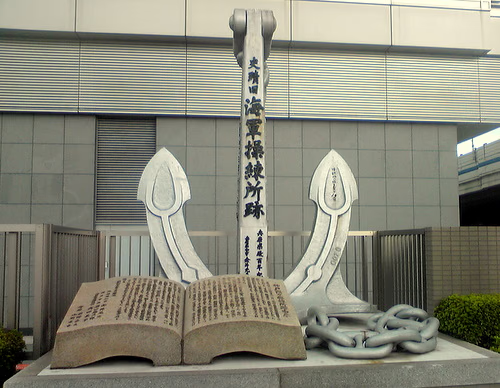
An anchor-shaped monument erected in 1968 gives the training center a visible presence near the waterfront. It is a commemorative marker, not an original anchor recovered from the school or a surveyed outline of its buildings. An earlier memorial created under Katsu Kaishū's direction had already been removed from the port and was relocated to Kinseidai near Suwayama in 1915. The two memorial histories demonstrate how Kobe preserved the institution through objects that moved or were newly designed while the actual shoreline site disappeared under port construction.
Current visibility
The 1968 monument is publicly visible, but it marks the association approximately and is not original training-center fabric.
Archaeology in an active construction landscape
Attraction
Kobe continues to investigate the naval-site remains as waterfront work proceeds. City notices describe re-excavation and plans for a temporary presentation targeted for spring 2027, but that schedule and the final viewing arrangement are not permanent facts. This is an active research and planning landscape, not an always-open archaeological park. The strongest historical promise is that new excavation can refine the site's boundaries and construction sequence. Any visit or publication should use the city's latest notice for closures, exposed remains, temporary exhibits, and the relationship between archaeology and ongoing port development.
Current visibility
Investigation and presentation are changing; the planned 2027 display, construction access, and exposure of remains require the latest Kobe City notice.