Read the article below. Interactive reading tools are available when scripts load.
Quick
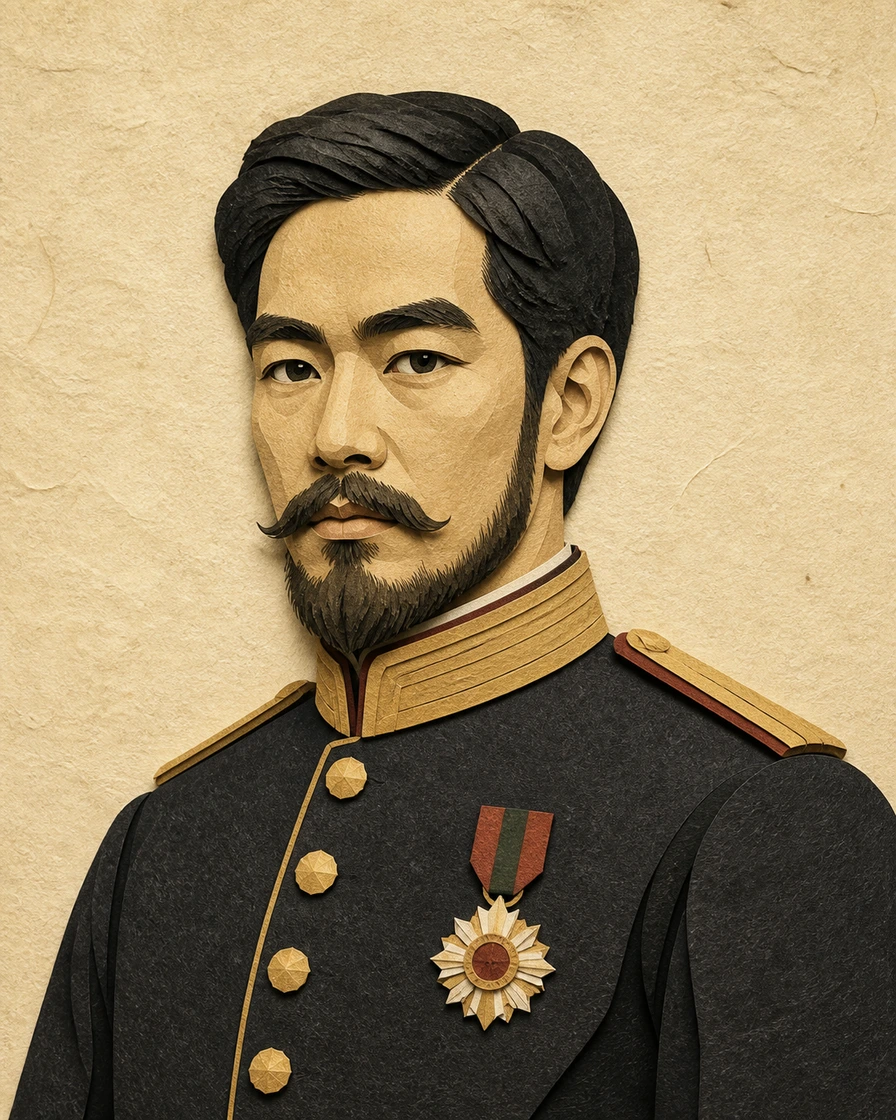
Prince Mutsuhito was born in Kyoto on 3 November 1852, corresponding to the twenty-second day of the ninth month of Kaei 5. He was Emperor Kōmei's second prince. His birth mother was Nakayama Yoshiko, a woman of the courtly Nakayama house, and the birth took place at her family's residence rather than inside a modern nuclear household. In childhood he was known by the title Sachi-no-miya. The court into which he was born had high ritual standing but limited command over the Tokugawa political and military system. [14]
The bakufu, the Tokugawa shogunal government headed by a warrior ruler, managed most foreign relations and military affairs. Treaty disputes made imperial approval increasingly important. Emperor Kōmei opposed aspects of treaty policy, while nobles and domain leaders disagreed over cooperation with, or resistance to, the shogunate. Mutsuhito studied classical texts, calligraphy and court ritual as adults contested the national use of his family's authority. Those preparations did not give the child a settled programme for Japan's future government. [18]
Emperor Kōmei died in early 1867. Mutsuhito succeeded on 13 February 1867, the ninth day of the first month of Keiō 3, at fourteen completed years of age. Tokugawa Yoshinobu still held the office of shogun, the warrior head of the government. Accession changed the sovereign, but it did not instantly abolish the bakufu or create the later Meiji government. The young emperor's court became the center of accelerated political bargaining. Court nobles, domain leaders, and Tokugawa officials contested offices, commands, and the meaning of imperial authorization. [8][9][18]
Yoshinobu returned governing authority later in 1867, yet the future of Tokugawa power remained disputed. Formal enthronement came only on 12 October 1868, after the Restoration government had been proclaimed and while the Boshin War—the 1868–1869 civil war between the new imperial government and Tokugawa supporters—was still being fought. Budget and preparation were constrained. The separation between succession and enthronement shows that sovereignty had legal and ritual phases, while war and administration moved on different schedules. Mutsuhito's assent and presence mattered. They did not make a teenager the sole designer of the decisions taken in his name. [8][9][18]
Early in 1868 a court-domain coalition announced the restoration of imperial government and created new central offices. Sanjō Sanetomi, Iwakura Tomomi, Saigō Takamori, Ōkubo Toshimichi, Kido Takayoshi, and many others supplied political planning, military command, documentation, and administration. The emperor gave the coalition a sovereign center, but the government was built by people and institutions distributed around him. Restoration was not a single peaceful transfer. Tokugawa forces still existed, domains retained governments and armies, foreign treaties remained in force, and revenue had to be found. [3][9]
Fighting at Toba–Fushimi gave the new coalition an imperial military claim and allowed it to advance east. Resistance continued as officials redesigned councils and jurisdictions. Mutsuhito attended ceremonies and authorized acts; the allies supplying forces and administration made those commands effective. The new government's national claim depended on both resources. [9][18]
On 6 April 1868 the young emperor proclaimed the Charter Oath. Its five articles promised broad deliberation, participation across status, opportunity for legitimate ambition, rejection of harmful custom, and the pursuit of knowledge. The ceremony joined innovation to imperial ritual: the sovereign swore before deities, while court nobles and domain lords participated in the new order. The words were not composed by the emperor alone. Yuri Kimimasa prepared an important draft, Fukuoka Takachika revised it, and Kido Takayoshi reshaped the final form. [7][12]
The Oath sought allegiance during civil war and left its principles broadly defined. It did not create an elected parliament or enforceable equal rights. Ministers later used it to justify reform, while advocates of representation invoked its deliberative promise against them. The imperial pledge became a durable standard precisely because its application remained open to argument. [17]
The Boshin War gave armed force to the new government's imperial claim. At Toba–Fushimi in January 1868, court authorization and imperial banners helped define the coalition as the imperial army. Tokugawa Yoshinobu withdrew to Edo, and government forces advanced east. Negotiation prevented a general assault on Edo Castle, but it did not end the war. An alliance of twenty-five northeastern and northern domains formed the Ōuetsu Reppan Dōmei, a regional alliance. Its members pursued regional security, negotiated treatment of Aizu, and interpreted loyalty differently from the victorious coalition. [18]
Aizu fell after severe fighting. Some Tokugawa forces continued to Hokkaido, where resistance at Hakodate ended in 1869. Soldiers, transport workers, farmers, townspeople, women, children, and religious institutions bore costs that proclamations do not capture. Supplies were requisitioned, buildings burned, families displaced, and local political choices constrained by armies. The emperor did not direct each campaign. His name, seals, banners, and appointments allowed commanders to classify force as legitimate. This was real political agency exercised through institutions, not personal battlefield command. [18]
The government renamed Edo as Tokyo, "eastern capital," in 1868. Mutsuhito visited the former Edo Castle, then returned to Kyoto. In 1869 he departed again on the seventh day of the third month in the Japanese calendar and arrived on the twenty-eighth. Government offices moved with the court, and repeated use of the former shogunal city made it the national political center. [8]
Empress Haruko, who had entered the palace through a dynastic marriage, moved to Tokyo in 1869 as part of the imperial household's institutional transfer. There was no single uncomplicated modern decree declaring that Kyoto had ceased to be capital in every sense. The government used journeys, renamed places, palace occupation, office movement, and delayed return to establish the new center. Kyoto retained dynastic, ritual, and emotional importance. The emperor's visible travel helped turn a Kyoto court into a national sovereign presence. It also depended on officials and local communities who prepared routes, lodging, security, food, and public ceremonies.
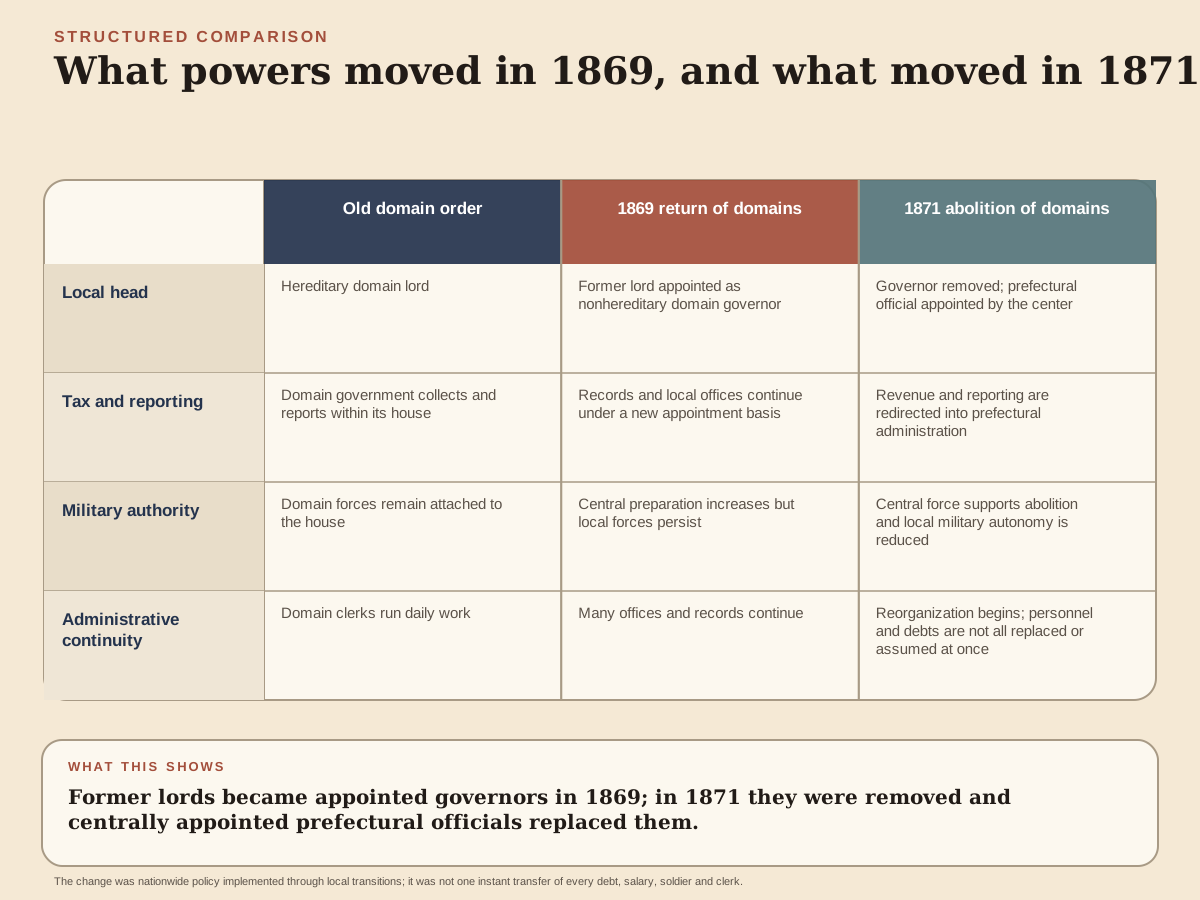
In 1869 the lords of Satsuma, Chōshū, Tosa, and Hizen petitioned to return their land and population registers to the emperor. Most other domains followed. Former lords were initially reappointed as governors, so the act changed legal ownership before it immediately changed every local administration. On the fourteenth day of the seventh month of Meiji 4—the Japanese-calendar date for 29 August 1871—the government abolished the domains and replaced them with prefectures. The decision was backed by an imperial guard formed largely from Satsuma, Chōshū, and Tosa forces. [7][8]
The initial prefectural units were consolidated, while officials absorbed domain debts, records and personnel. Former governors lost territorial control but retained privileged treatment. Regional imperial tours helped make the new center visible. Subjects encountered centralization through local officers carrying national orders and new obligations.
The early 1870s turned central authority into obligations imposed on households. A national conscription system announced in 1872 and implemented from 1873 required eligible men to serve, subject to exemptions and changing rules. It weakened the warrior monopoly on military status while placing time, health, and family labor at the state's disposal. The land-tax reform law of 28 July 1873 shifted revenue toward a cash payment assessed from land value. Certificates and surveys helped identify taxpayers and property, while cultivators faced risk when harvest prices and fixed monetary obligations diverged. [1][2][7]
Reform created a more predictable central revenue base, but disputes and resistance forced later adjustment. These measures emerged from ministers, military planners, finance officials, prefectural administrators, village authorities, surveyors, and the left-behind government operating while the Iwakura Mission, an official delegation studying the United States and Europe, traveled abroad. The emperor approved and represented the new system; he did not devise its cadastral methods or personally recruit its army. Modernization was not only schools, uniforms, and technology. It was the capacity to count land, collect money, register bodies, and punish refusal. [1][2]
When the Iwakura Mission leaders returned in 1873, they found a government transformed by reforms undertaken in their absence. After Korean authorities banned unauthorized trading at Japan's official compound in Busan and denounced Japanese conduct in May, Tokyo officials demanded a response. A proposed mission by Saigō Takamori, a senior councillor, to Korea became the focus of a wider struggle over foreign policy, spending, office, and the pace of domestic consolidation. On 15 October the cabinet provisionally accepted Saigō's mission. Ōkubo Toshimichi resigned two days later. Iwakura Tomomi, serving in a position that controlled access to the imperial decision, submitted an appeal against immediate dispatch. [16]
On 24 October 1873 Meiji accepted Iwakura's appeal and postponed dispatch indefinitely. Saigō and other councillors resigned, leaving a narrower leadership. Its intention is disputed. The conventional interpretation sees a possible route to war; historian Mōri Toshihiko argued for peaceful negotiation. Namihira Tsuneo presented both readings in 2010 without deciding Saigō's intention. The decision stopped immediate dispatch without ending the government's coercive ambitions elsewhere in Asia. [15][16]
The abolition of domains, stipends, and warrior privileges produced dislocation and protest. Rebellions erupted in several regions before 1877. In Kagoshima, Saigō Takamori's private-school network became a powerful center. After students seized government arsenals, Saigō advanced north in February with a large force. The government appointed Prince Arisugawa Taruhito commander. Yamagata Aritomo, Kawamura Sumiyoshi, officers, conscript units, police, transport laborers, and telegraph operators sustained the campaign. Fighting around Kumamoto and at Tabaruzaka was severe. Government numerical and logistical capacity eventually prevailed; the war ended in Kagoshima on 24 September. [16]
Saigō had been a leader of the Restoration and could be represented by followers as loyal to the emperor while opposing ministers and policies. The state classified his army as rebellion. That tension shows how imperial loyalty had become a political language shared by enemies. Mutsuhito received reports and authorized command, but he did not fight or direct daily operations. Victory demonstrated the central state's military reach and exposed its cost. The relationship with a former Restoration leader made the war a crisis of the imperial coalition, not a simple battle of old against new. [16]
The government promised a constitution in 1881 and created a cabinet system in 1885. Itō Hirobumi led constitutional study and drafting with Inoue Kowashi, Itō Miyoji, Kaneko Kentarō, foreign advisers including Hermann Roesler, and many officials. Their work passed through several drafts and detailed review by the Privy Council, an advisory body to the emperor. Mutsuhito attended nearly all Privy Council meetings on the constitution. He did not write the clauses, but he treated the settlement as an act of his reign and participated in the body that reviewed it. [3][8]
On 11 February 1889 he promulgated the Constitution of the Empire of Japan; it took effect with the opening of the Imperial Diet, the national parliament, on 29 November 1890. The Constitution joined strong imperial prerogatives to rules and institutions. The emperor was head of the empire and exercised powers under the Constitution. Legislation required Diet consent, and ministers countersigned imperial acts, yet cabinets were not responsible to the elected house and the electorate was limited. The Imperial Rescript on Education of 30 October 1890 similarly appeared in the emperor's voice but was drafted through Yamagata, Yoshikawa, Motoda, Inoue, and others. An April 1891 regulation required a place in schools for imperial portraits and a copy of the Rescript. The emperor sanctioned a constitutional order drafted by ministers and implemented through state institutions. [3][5][6][17]
War with Qing China began in 1894 after both China and Japan sent forces to Korea during the Donghak uprising and neither withdrew when the immediate crisis eased. Japanese armies and the navy won major victories. The Treaty of Shimonoseki in 1895 recognized Korean independence in a setting that increased Japanese influence, transferred Taiwan and the Penghu Islands, and imposed a large indemnity. Taiwanese forces and local volunteers resisted the Japanese takeover; colonial conquest continued after the treaty. Russia, Germany and France then forced Japan to give up the Liaodong Peninsula in the Triple Intervention. [7]
Competition with Russia, especially over Korea and Manchuria, led to war in 1904. An emergency imperial conference decided on rupture and war. Military commands planned operations; the cabinet, diplomats, Diet, taxpayers, industrial workers, medical services, and conscript households sustained them. Japan won important battles but suffered severe casualties and financial strain. The Treaty of Portsmouth in 1905 recognized Japanese advantages in Korea, transferred leases and railway interests, and awarded southern Sakhalin, but no indemnity. Public anger exposed the distance between victory reports and a limited peace. The emperor approved war and peace through the constitutional system and became the central symbol of mobilization. He was not a field commander or sole strategist.
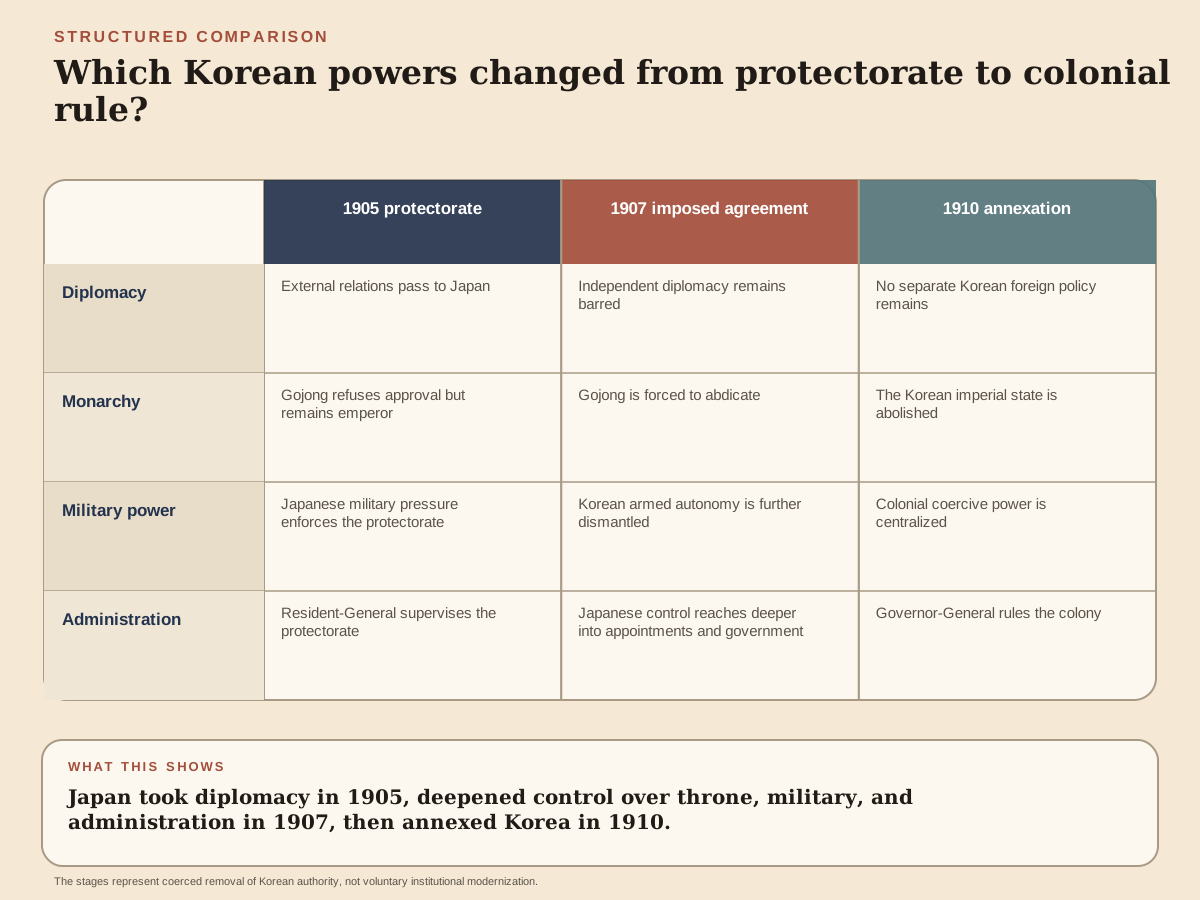
Japan used victory over Russia to deepen control over Korea. The 1905 protectorate agreement stripped Korea of diplomatic sovereignty and established a Japanese Residency-General. In 1907 the Korean emperor Gojong sent envoys to the Hague Peace Conference to challenge the 1905 agreement. Japanese officials and the Korean cabinet forced his abdication; Japanese control expanded, and the Korean army was disbanded. Resistance, including armed righteous-army movements, continued. In July 1909 the Japanese cabinet decided on annexation. After Itō Hirobumi's assassination that October, the policy did not begin from zero; the institutional sequence was already underway. Resident-General Terauchi Masatake and Korean prime minister Yi Wan-yong handled the final treaty process under conditions shaped by military and administrative coercion. [10]
The treaty was signed on 22 August 1910 and promulgated on 29 August. Korea became a colony ruled by a Governor-General with broad ordinance and coercive powers. The transfer was presented in treaty and imperial form, but it did not represent an equal voluntary union or popular Korean consent. Mutsuhito authorized annexation within the imperial constitutional system. Ministers designed policy and colonial institutions; officials and armed forces implemented them; Korean people resisted, adapted, survived, and recorded dispossession. The colony's police, courts and military command extended state power over people who had not consented to the annexation. [10][11]
Emperor Meiji died on 30 July 1912 at fifty-nine completed years. Yoshihito succeeded and the Taishō era began. The throne passed within a state equipped with constitutional institutions, national taxation and military forces. Its schools and public rituals had attached the sovereign to everyday life far beyond the Kyoto court where Mutsuhito began. [3][8][14]
His authority gave collective reforms a sovereign center. Those institutions increased education, administration and limited representation while supporting coercive taxation, war and colonial rule. Their achievements and burdens survived the ruler because they were built into the state that passed to his successor. [3][8]
Classic
The future Emperor Meiji was born in Kyoto on 3 November 1852, the second son of Emperor Kōmei. His birth mother, Nakayama Yoshiko, came from a court-noble household, and the birth took place at her family's residence. The prince was known in childhood as Sachi-no-miya. Family lineage, rank and residence distributed his upbringing across the imperial and Nakayama households. Nursing and daily care involved women and attendants whose work appears less fully in official chronologies than the future sovereign's descent. [14]
He received the personal name Mutsuhito when formally declared an imperial prince in 1860. "Meiji" would name his reign era and later become his posthumous designation. The Kyoto court conferred ranks, sanctioned appointments and conducted dynastic rites. The bakufu, the Tokugawa shogunal government headed by a warrior ruler, controlled most foreign relations and military policy, alongside the territorial governments of the domains. Imperial recognition mattered, but the court did not command their armies or administer the shogunate's lands.
The treaty crisis drew warrior envoys and armed protection into Kyoto. Kōmei opposed aspects of treaty policy and upheld his own ritual commitments. Those positions did not prescribe his son's eventual programme. Some nobles and domain leaders sought cooperation between court and shogunate; others used imperial loyalty to challenge the shogunate. Satsuma, Chōshū and Aizu were warrior-governed domains whose changing alliances affected access to the palace. In 1864 Chōshū forces fought at its approaches, and fire devastated much of Kyoto. The prince's house stood at the center of a political conflict that extended far beyond it. [18]
The prince was educated for dynastic and court responsibility through classical texts, calligraphy and ritual practice. Tutors and household members controlled much of the information reaching him. Recognition as heir reduced uncertainty about succession while increasing expectations surrounding his health and conduct. The fighting and petitions outside the household gave his person growing political value before he could exercise an adult ruler's judgment.
Recognition and instruction prepared Mutsuhito for dynastic office. They did not decide whether the country would be governed by a reformed shogunate, a coalition of domains or a new court-centered government. Adults controlled audiences and much of the information reaching him. His family's office was becoming a national resource, while his own powers and responsibilities were still being formed. Kōmei's death would make succession immediate before any national settlement had been secured.
Dynastic succession answered who occupied the imperial office; it did not answer who would govern Japan. Kōmei died on 30 January 1867. Mutsuhito succeeded on 13 February, the ninth day of the first month in the Japanese calendar. The Tokugawa shogunate still possessed its administrative hierarchy, domain relations, treaty responsibilities, troops, revenue, and offices. Tokugawa Yoshinobu's recent appointment as shogun, the warrior head of the government, gave the bakufu an energetic head whose reform program aimed at survival rather than ceremonial disappearance. The emperor's youth intensified mediation. Access to the sovereign passed through court office, ritual, documents, and advisers. Iwakura Tomomi, Nakayama Tadayasu, Sanjō Sanetomi, and other nobles did not all hold identical positions, while Satsuma, Chōshū, Tosa, Echizen, Aizu, and Tokugawa actors proposed different settlements. An imperial order was powerful, but the production, presentation, interpretation, and enforcement of that order were collective and contested. Yoshinobu's return of governing authority late in 1867 is often treated as a surrender to the new emperor. [8][9][18]
Yoshinobu's return of governing authority was also a bid to retain Tokugawa influence within a reorganized national government. The palace coup of 3 January 1868 abolished the shogunate and old court offices, but their troops and resources did not disappear. Fighting at Toba–Fushimi and the eastward campaign followed. Mutsuhito's formal enthronement took place on 12 October 1868 after Edo Castle had been transferred and while war continued in northern Japan. Accession secured dynastic succession; the later ceremony publicly constituted the reign amid an altered political order. [8][9][18]
A modern state did not replace a court overnight. Artisans, officials, courtiers, and ritual specialists assembled objects and sequences whose legitimacy depended on precedent, even as leaders sought forms compatible with new claims. Financial constraints expose the gap between sovereign symbolism and governmental capacity: a victorious name did not guarantee unlimited resources. Mutsuhito had completed fourteen years by Gregorian reckoning at accession. Japanese age conventions could describe him differently. More important than the number is the evidentiary consequence. A teenager could receive reports, perform ceremonies, approve acts, and develop judgment. He should not be treated as an empty object. But the source record does not warrant making him the private author of every court maneuver attributed to “the emperor.” [8][9]
The sovereign's assent mattered because rival coalitions competed to secure it. Opposing forces also claimed imperial loyalty, and institutions had not yet regularized how decisions reached the throne. The teenager occupied the office around which the new coalition could organize. His accession supplied a dynastic center; soldiers and administrators still had to establish the reach of its government.
Restoration language suggested return, but the government of 1868 could not simply reopen an old administrative manual. The Tokugawa system had organized domains, cities, roads, foreign relations, taxation, and status for more than two and a half centuries. The court possessed ritual and ranking institutions, not a ready bureaucracy capable of absorbing all those functions. Leaders therefore built new councils and offices while borrowing personnel, procedures, and records from both court and warrior government. The coalition's composition generated capacity and tension. Court nobles supplied access to imperial forms and palace politics. Satsuma and Chōshū contributed major armed forces and experienced activists. Tosa, Echizen, Hizen, and other domains contributed advisers and reform proposals. Former bakufu officials, foreign-language specialists, and local administrators remained necessary because expertise did not change sides automatically with a decree. [3]
The emperor's role operated through artifacts. Seals authenticated documents. Audiences ranked participants. Proclamations named enemies and loyalists. Banners carried imperial authorization onto battlefields. These were not empty symbols: they changed incentives and gave commanders a language for demanding obedience. Yet an order without messengers, troops, supplies, and local compliance could fail. Sovereign form and material enforcement were mutually dependent. The new government's frequent reorganization reveals uncertainty rather than incompetence alone. Leaders had to determine whether authority should lie in deliberative councils, ministerial offices, domain representation, or palace access. Titles borrowed from ancient models could be assigned new functions. Ideals of public discussion coexisted with secret planning and punitive action. No stable constitution settled the boundaries. Foreign powers imposed another constraint. [3][18]
Diplomatic representatives needed to know which government would honor existing treaties and protect foreign residents. The new authorities could denounce aspects of Tokugawa policy while still inheriting treaty obligations. Recognition required communication and control, not simply an imperial genealogy. Foreign affairs thus pushed the coalition toward centralization and documented continuity. Ordinary people encountered restoration through taxes, requisitions, troop movement, local proclamations, price disruption, and changed officials. Some communities negotiated or resisted. Rural and urban labor sustained armies and offices that elite political narratives describe abstractly. The emperor's public image could promise renewal while the burden of transition fell unevenly. The word “imperial” also concealed internal disagreement. Iwakura, Kido, Ōkubo, Saigō, Sanjō, and their allies did not possess one permanent program.
The 1868 coalition would later divide over foreign policy and constitutional timing. At this stage Mutsuhito's participation authorized appointments and ceremonies, while ministers designed new offices and commanders established compliance. The inherited throne became the legal center of a government assembled from court, domain and Tokugawa resources. Its claim reached beyond any one victorious domain, but enforcing it still required the forces and revenue those allies could supply. [9]
The Charter Oath was proclaimed on 6 April 1868, the fourteenth day of the third month in the Japanese calendar, after revisions by several officials. Yuri Kimimasa's proposal reflected political discussion in Echizen and the new government. Fukuoka Takachika revised language and structure. Kido Takayoshi made further changes that helped transform a program addressed to rulers into a more general statement of national principle. The ceremony joined their textual work to imperial promulgation. The emperor's oath before deities placed the articles within a ritual relationship between sovereign, heaven, ancestors, and polity. Court nobles and domain lords signed or pledged participation. In that setting, the words no longer belonged only to their drafters. They became a public standard claimed by the government and embodied in the sovereign act. [7][12]
The articles left room for disagreement. Broad deliberation did not specify an electorate or bind rulers to a vote. Seeking knowledge abroad did not choose a particular foreign model. The rejection of harmful customs required decisions about what should change. By swearing before deities with nobles and lords present, Mutsuhito gave these general commitments a sovereign form that the coalition could recognize without first settling their detailed application. [17]
War shaped its reception. Government forces were still fighting Tokugawa supporters, and leaders needed domains and officials to accept a new center. A declaration of open deliberation could distinguish the coalition from an image of closed hereditary rule while its armies imposed classifications of loyalty. Promise and coercion were not sequential opposites; they operated together. The Oath also circulated through writing, reading, copying, and explanation. Its fame today can make the original ceremony appear instantly national. In 1868 many people encountered government through local authorities rather than direct knowledge of five articles. Language had to be transmitted and interpreted across regions whose institutions remained intact. The distance between proclamation and social reality should remain visible. Later movements repeatedly returned to the Oath.
Officials invoked the Oath for state-directed learning and reform. Advocates of representation later emphasized its deliberative language, treating the founding pledge as an obligation ministers had not fulfilled. Imperial promulgation helped make that argument durable. The text could authorize the government's programme and furnish its critics with a standard for judging it. [17]
At Toba–Fushimi, the appearance of imperial authorization altered the political environment. Domain troops that might have regarded the conflict as one warrior coalition against another now confronted the risk of being named enemies of the court. The banners later remembered as decisive mattered because officers and soldiers inhabited a political culture in which imperial sanction carried consequences for loyalty, rank, family, and future settlement. Symbols did not win alone. Satsuma, Chōshū, and allied units supplied firearms, command, discipline, transport, and combat experience. Tokugawa forces suffered divided leadership and Yoshinobu's withdrawal. Messages had to travel; commanders had to believe and act on them. A banner had power through the institutions and expectations attached to it, not through cloth as magic. [18]
The eastward campaign combined negotiation and force. Saigō Takamori, Katsu Kaishū, Yamaoka Tesshū, imperial household women, senior lords, and city officials contributed to the settlement that transferred Edo Castle without the planned general assault. Yet fighting at Ueno followed, and northern resistance continued. Calling the entire Restoration “bloodless” converts one bounded urban outcome into national erasure. The Ōuetsu Reppan Dōmei was an alliance of northern domains opposing the western-led government's settlement. Twenty-five northeastern and northern domains joined a coalition concerned with the treatment of Aizu and the power of the western-led new government. Members issued appeals and pursued negotiations as well as military action. Some acknowledged the emperor while contesting the ministers and classifications acting in his name. This distinction shows why “imperial army” was a political achievement rather than a neutral description accepted everywhere. [18]
Aizu's defeat had human and memorial consequences. The victorious government controlled official categories, but local records and later regional memory preserve competing experiences. Civilian suffering remained part of these regional accounts even when victorious officials classified the conflict through loyalty and rebellion. At Hakodate, former Tokugawa naval and military personnel attempted a separate regime using skills and vessels inherited from the old order. Their final defeat in 1869 demonstrates that abolition at the capital did not instantaneously dissolve technical communities or armed command. The war lasted roughly a year and a half because material institutions survived legal declarations. The emperor's relationship to violence was mediated. Appointments and orders bore sovereign authority; victory expanded the territory where that authority could be enforced. Ministers and commanders chose operations, and soldiers performed them. [18]
The war extended sovereign authority beyond proclamations issued in Kyoto. Appointments and orders bore the emperor's name, while commanders selected operations and local people negotiated, resisted or endured them. Hakodate's defeat in 1869 brought organized resistance to an end. The new government had acquired territorial reach through armies and negotiated settlements; its next task was to replace the separate administrations whose resources had sustained those armies.
The 1868 decree renaming Edo as Tokyo announced a new political geography. “Eastern capital” placed the former shogunal city in relation to Kyoto rather than simply erasing the old center. The government's use of Edo Castle as an imperial residence converted the most visible Tokugawa site into a seat of sovereign rule. Reuse was more practical and symbolically powerful than building a capital from nothing. Travel made the claim observable. The first eastward journey brought the emperor along roads and through communities that had rarely encountered the court directly. Processions required advance planning, road repair, lodging, provisions, guards, animal and human transport, and rules for spectators. Local officials translated imperial movement into public order. The journey's image of sovereign presence rested on a large labor system. [8]
Mutsuhito returned to Kyoto after his first eastern visit. In 1869 he departed again on the seventh day of the third month in the Japanese calendar and reached Tokyo on the twenty-eighth. Government offices increasingly operated there, making the move durable through practice. His empress, Haruko, followed later that year. Their marriage had taken place on the twenty-eighth day of the traditional twelfth month of Meiji 1, in early 1869 by the Western calendar. Court attendants and household staff transferred the routines and objects needed to sustain imperial residence in the former Tokugawa castle.
Offices needed rooms, clerks, storage, and access to ministers. The former castle compound could supply space, but adaptation changed how court and government interacted. The palace was both residence and a node in administrative communication. Tokyo's residents experienced continuity and rupture. The city retained markets, neighborhoods, temples, waterways, and the enormous built legacy of daimyo (a territorial warrior lord) residence. Domain households were changing, warrior populations faced uncertainty, and new officials occupied old spaces. Naming the city did not instantly remake its economy. The relocation of court and government nevertheless redirected employment, ceremony, traffic, and investment. Kyoto did not become historically empty. Enthronement had occurred there; imperial tombs and ritual sites remained; court houses retained property and memory. The absence of one final capital-transfer sentence may frustrate a modern constitutional expectation, but it reveals how political centers form through practice.
Tokyo became the governmental center as the sovereign's household, ministries and diplomatic business settled there. Kyoto retained enthronement traditions, tombs and court property. The emperor's travel gave the change a visible sovereign presence, while officials organized routes and moved administration. Successive decisions about residence and return mattered more than any single uncomplicated declaration of capital transfer.
The 1869 petitions known as the return of lands and people registers used an imperial idiom: domains acknowledged that territory and population ultimately belonged to the sovereign. The four initiating lords were closely tied to the victorious coalition, and their action pressured other domains to follow. Yet the government reappointed most former lords as governors. This continuity reduced immediate disruption and shows that legal principle outran administrative replacement. Local power remained substantial. Domain governments possessed treasuries, debts, military units, schools, penal systems, tax records, storehouses, and experienced officials. The new center lacked enough personnel and money simply to replace all of them. Reappointment converted hereditary lordship into an office theoretically revocable by the center, but social deference and institutional habit did not vanish with the title. [8]
By 1871 leaders judged the intermediate arrangement insufficient. Before announcing abolition, the government assembled an imperial guard from the strongest coalition domains. This force supplied more than ceremonial protection. It reduced the risk that a dissatisfied lord could use domain troops to reject the order and reassured central leaders that their decree had an enforcement mechanism. The abolition announcement summoned governors to Tokyo and replaced domains with prefectures. Its apparent speed depended on preparation, political secrecy, and the expectation that resistance would fail. Compliance does not prove absence of coercion. The decision changed the conditions under which former lords calculated their futures, including compensation, residence, rank, and place within a new nobility. Administrative results were initially untidy. More than three hundred prefectural units reflected the inherited domain map and separately administered territories. [7][8]
Consolidation to seventy-two prefectures alongside the three urban prefectures of Tokyo, Kyoto and Osaka toward the end of 1871 was another intervention, changing boundaries and offices after the first reform. Later prefectural geography should not be backdated into the abolition decree. Fiscal inheritance created difficult choices. Domain debts did not disappear; warrior stipends burdened central finance; tax collection followed local systems; records varied in quality. Officials had to decide which obligations the state would recognize. Centralization could therefore transfer liabilities as well as authority. Former domain employees might be retained, dismissed, or moved, making institutional reform a household crisis. The emperor's name organized the legal fiction and political claim. Registers returned “to” him; governors held authority under him; prefectures formed his national administration. This was not fictitious in the sense of meaningless. It allowed leaders from rival domains to construct a center above their houses.
Mutsuhito's western journey in 1872 and subsequent regional tours made the sovereign more visible beyond the capital. Officials prepared inspections and public welcomes, presenting institutions and industries they wished him to see. These appearances helped attach the newly centralized administration to the dynasty. Local government still depended on officials absorbing records, liabilities and personnel from the old domains.
Centralization became durable when the state could obtain predictable revenue and military labor. Domain abolition gave Tokyo jurisdiction, but inherited local taxes and former-domain forces could not by themselves sustain a national administration. The conscription proclamation of December 1872 and ordinance of January 1873, followed by land-tax reform in July 1873, addressed those needs from different directions and met resistance because both reached into household survival. The conscription proclamation used a language of equal obligation that challenged hereditary warrior privilege. In practice, the ordinance classified eligible males, created exemptions, and depended on household registers and local officials. The replacement system touched agricultural schedules, care work, marriage prospects, and family continuity. Wealth and status could still shape avoidance or substitution, while poorer households experienced the loss of labor more sharply. Military service did not instantly create a uniform national army. [1][7]
Recruits required barracks, officers, weapons, food, medical systems, transport, and discipline. Former samurai supplied much of the officer and instructional capacity even as reform undermined their exclusive social role. Yamagata Aritomo and other military planners adapted foreign models within Japanese fiscal and political constraints. The emperor's image and oath could anchor loyalty, but drill and administration produced operational units. The land-tax reform law of 28 July 1873 converted a share of crop or locally assessed dues into a monetary obligation based on an official valuation. Certificates helped specify who was recognized as owner or taxpayer. Surveying required measurement, classification, mapping, and negotiation over boundaries. These procedures could strengthen certain property claims while weakening customary users whose rights did not fit the certificate. A fixed cash payment made state revenue less dependent on annual harvest quantity, but it transferred price and crop risk toward taxpayers. [1][2][7]
When rice prices fell or crops failed, the tax did not automatically fall in proportion. Cultivators might sell produce under unfavorable conditions or borrow money. Protests were not simple rejection of all reform; they often targeted rates, valuation, enforcement, and the distribution of burden. The timing reveals divided government. The Iwakura Mission, an official delegation visiting the United States and Europe, departed with leading officials and an agreement that the left-behind administration should avoid major changes. Nevertheless, the officials remaining in Japan pursued schools, conscription, calendar reform, judicial changes, and other measures. This speed reflected perceived urgency and generated the political conflict that exploded when mission leaders returned. Imperial authorization gave reforms national legality. Edicts and proclamations spoke from a sovereign center now presented as transcending domain. Mutsuhito also reviewed troops and appeared in military settings, helping attach the army to the dynasty. [1][2]
Yet the legal act did not determine the experience of a conscript or the valuation of a field. Local implementation could vary and produce abuse. The word “modernization” can hide this extractive dimension. A state capable of railways, schools, diplomacy, and industrial investment needed money and disciplined bodies. The same capacity could defend sovereignty and impose hardship. Success in building it is not evidence that burdens were accepted as fair. For the adult emperor, the reforms enlarged both authority and responsibility. His government could reach people who had previously dealt mainly with domain and village institutions. He received reports through ministers and ceremonies rather than direct access to every community. [1][2]
In May 1873 Korean authorities posted a ban on unauthorized trading at Japan's official compound in Busan and denounced Japanese conduct. Tokyo officials treated the notice as an insult.
Historical disagreement · What did Saigō intend as envoy to Korea?
Itagaki Taisuke advocated sending troops; Saigō Takamori, a senior government councillor, proposed going himself as envoy instead. One interpretation reads his anticipation of possible murder as preparation for a justification of war. Mōri Toshihiko argued for an intended peaceful embassy.
Namihira Tsuneo discussed both interpretations in his 2010 study without deciding Saigō's intention.
Returning mission leaders also challenged domestic reforms undertaken in their absence. On 15 October the council provisionally supported dispatch, concentrating a struggle over policy and the authority to decide it. [16]
That formal outcome did not end politics. Ōkubo Toshimichi resigned on 17 October, and Iwakura argued that the decision should be reconsidered. Chief minister Sanjō Sanetomi's illness and the assignment of Iwakura to act in the relevant court-facing role changed the channel through which policy was presented. Procedure itself became power. On 24 October Mutsuhito accepted Iwakura's appeal and ordered indefinite postponement. This act should not be explained away as automatic obedience. The emperor could have sustained the earlier decision. His choice altered government membership and policy. At the same time, he did not independently collect Korean testimony, military assessments, budgets, and factional positions. Advisers selected arguments and framed consequences. The resignations that followed—Saigō, Itagaki Taisuke, Gotō Shōjirō, Etō Shinpei, Soejima Taneomi, and others leaving central office in the wider crisis—reshaped politics. [15][16]
Some would pursue representative-government agitation; some returned to regional networks; later rebellions cannot be read as the direct expression of one identical motive. The decision prevented the immediate mission but did not eliminate expansionist thought or social conflict. Korea requires independent agency. The Joseon court had its own diplomatic language, domestic divisions, and responses to the new Japanese government. Japanese debate sometimes treated Korean recognition as a measure of Meiji legitimacy. The episode also exposes the absence of a settled cabinet constitution. Who could appeal over a council decision? What information must reach the sovereign? Were ministers collectively responsible, individually responsible to the emperor, or dependent on personal access? These questions would recur even after formal cabinet and constitutional arrangements appeared.
Mutsuhito made a consequential choice among incompatible recommendations. Iwakura had changed the channel through which the dispute reached him, and the decision then changed the leadership carrying out policy. Sovereign responsibility and ministerial intervention belonged to the same sequence. The records establish the outcome more clearly than a single private motive for the emperor's choice. [15][16]
Restoration politics had never been a single ideology. Saigō helped defeat the Tokugawa order, entered the new government, and resigned after the 1873 crisis. In Kagoshima he remained connected to former Satsuma warriors whose military identity and livelihood had been transformed. Private schools provided education, discipline, community, and an organization outside direct central control. The immediate path to war involved local action. Students seized weapons from government arsenals amid suspicion that authorities intended to remove them and reports of covert activity. Saigō then accepted leadership of an armed movement advancing north. Later devotion to his character can obscure the fact that thousands made decisions within a network and that his exact intention at each step is not fully recoverable. Earlier rebellions in Saga, Kumamoto, Akizuki, and Hagi had already shown former-samurai anger, different mixtures of political demand, and the government's willingness to suppress force. [16]
The Satsuma conflict was larger because the region possessed personnel, cohesion, and the prestige of Restoration veterans. It was not the spontaneous rising of all dispossessed warriors. Government command was distributed. Prince Arisugawa supplied imperial-household rank as commander. Yamagata and Kawamura managed major military responsibilities. Units included conscripts whose service had been controversial only a few years earlier. Police and former samurai fought alongside the new army. Telegraph lines transmitted information rapidly, while ships, rail segments, pack animals, porters, hospitals, and tax revenue sustained operations. The siege of Kumamoto Castle and fighting at Tabaruzaka tested both sides. Fortification, ammunition, weather, terrain, disease, and resupply mattered. A national army's success did not prove that conscripts were naturally superior to samurai; it showed the advantage of a state able to replace men, mobilize supplies, coordinate regions, and maintain a longer campaign.
Imperial loyalty remained contested because opponents could distinguish sovereign from government. Saigō's supporters might claim that corrupt or misguided ministers had blocked true imperial purpose. The government treated armed resistance to its orders as rebellion against imperial rule. This ambiguity had deep roots in Bakumatsu politics, when activists claimed loyalty while attacking officials acting under established authority. Mutsuhito's relationship to Saigō added emotional and political weight, but later legend should not supply private dialogue. Official records show sovereign authorization, reports, command appointments, and concern. They do not permit a dramatic two-man tragedy detached from the soldiers and civilians who suffered. Kagoshima residents experienced requisition, surveillance, battle, fire, medical crisis, and postwar punishment. Government victory enabled reconstruction and stronger central supervision. [16]
It also enlarged public debt and demonstrated the violence embedded in centralization. A heroic story of national unity hides those costs; a simple tyrant narrative hides the serious threat to a still-new state. The war's end on 24 September closed organized Satsuma resistance but not the political problem of participation. Former councillors pursued representative institutions through other means. The government further developed police, military, and information systems. Saigō's later reputation would be partially rehabilitated within the reign, but the conflict itself must remain a multi-actor civil war. For the emperor, victory confirmed that orders could mobilize forces beyond former domains. It also showed that men once essential to restoring his government could become its enemies without abandoning the language of loyalty. That contradiction belongs at the center of the Meiji state, not at the margin of one rebel's biography. [16]
The 1881 announcement of a future national assembly responded to political pressure while allowing the government time to control design. Itō Hirobumi studied European institutions, especially German constitutional arrangements, but the result was not a copied foreign charter. Drafters adapted models to an imperial dynasty, existing bureaucracy, peerage, military command, and leaders determined to prevent parliamentary dismissal of cabinets. Drafting was collective and iterative. Inoue Kowashi supplied central legal language and conceptual work. Itō Miyoji and Kaneko Kentarō contributed research, drafting, and explanation. Hermann Roesler and other foreign advisers offered comparative expertise. Work at Natsushima and later revisions left multiple documentary stages. This archive makes sole imperial authorship impossible, but it also makes “written by Itō” an incomplete shorthand. The cabinet system of 1885 preceded the Constitution. [3][8]
It created modern ministerial portfolios and a prime minister while locating appointment under the sovereign. This sequence matters: ministers did not wait for the Diet, the national parliament, to form a government, and the later constitution did not make them collectively responsible to an elected majority. Administrative executive power retained substantial independence from parliament. The Privy Council, an advisory body to the emperor established in 1888, reviewed the text article by article in repeated readings. Mutsuhito attended nearly every constitutional session. Attendance does not prove that he originated each clause or dominated discussion; it does refute a picture of total sovereign absence. He listened within a formal advisory setting and associated his office directly with the settlement. On 11 February 1889, promulgation used the form of an imperial grant. The Constitution took effect with the Diet's opening on 29 November 1890. The ceremony placed the Constitution within dynastic continuity and presented rights and institutions as secured by sovereign act. [3]
The text declared the emperor sacred and inviolable, head of the empire, and holder of sovereignty, while specifying that powers were exercised according to constitutional provisions. Ministers countersigned acts and bore responsibility; the Diet participated in legislation and budget, but prerogatives over command, appointments, convocation, dissolution, and emergency authority limited parliamentary reach. The electorate covered only a small tax-qualified male population at first. The House of Peers and House of Representatives possessed different bases. When budget conflict occurred, the government could invoke constitutional rules and prior appropriations. Calling the system democratic because it had elections hides exclusion; calling it unlimited absolutism hides legal procedures and bargaining that mattered. The Imperial Rescript on Education stated the moral duties expected of subjects. Yamagata Aritomo, Education Minister Yoshikawa Akimasa, Motoda Nagazane, and Inoue Kowashi participated in development and revision. [5][6][17]
The Rescript was issued on 30 October 1890. A school-equipment regulation dated 8 April 1891 required schools to designate a place for portraits of the emperor and empress and a copy of the Rescript. This was a specific administrative route by which imperial moral instruction entered school life; the regulation alone does not show how every school put it into practice. By the late 1880s and early 1890s, Mutsuhito's role operated through advisory councils, ministers and defined offices. Such procedures widened the reach of imperial acts without resolving who would answer for failure. [5][6][17]
The elected Diet would test the constitutional settlement through legislation and budgets. Mutsuhito's attendance at its review and his promulgation had attached the sovereign directly to a framework shaped by ministers and councillors. Political bargaining would now take place within those rules, rather than under the unsettled procedures of the accession crisis.
The Sino-Japanese War grew from a regional crisis, not an isolated imperial decision. The Donghak movement challenged the Korean government, which sought Qing assistance. Japan also sent troops under treaty claims. When Korean authorities and rebels reached an accommodation, neither foreign force simply withdrew. Japanese pressure on the Korean court, clashes with Qing forces, and competing claims over Korea produced war. Operational victory depended on institutions built over decades. Conscription supplied soldiers; taxation and borrowing supplied money; arsenals and imported technology supplied weapons; rail and shipping moved men and goods; telegraph systems coordinated reports. Army and navy commands pursued different operations. Medical workers and families absorbed illness and death. The emperor's proclamations could represent a unified national purpose, but that unity had a material price. [7]
The Treaty of Shimonoseki was negotiated by Itō Hirobumi and Mutsu Munemitsu with Li Hongzhang and Li Jingfang. Its terms included recognition of Korean “independence,” territorial cessions, commercial privileges, and indemnity. Russia, Germany and France soon demanded that Japan return the Liaodong Peninsula in the Triple Intervention, and Japan accepted, exposing limits to victory and deepening resentment toward European power. Taiwan makes triumphal compression especially dangerous. The treaty transferred sovereignty without the consent of the island's inhabitants. A short-lived republic, former Qing troops, local volunteers, and other forces resisted. Japanese military conquest and the establishment of a Governor-General transformed treaty paper into colonial rule. Death, disease, punishment, administration, and local negotiation belong to the same event as metropolitan celebration. After 1895, the indemnity and strategic gains supported further military and industrial development. [7]
Japanese influence in Korea increased while Russian power in Manchuria and the peninsula generated conflict. Diplomacy, alliances, intelligence, railway interests, and military planning narrowed alternatives. “National survival” and “imperial expansion” were not mutually exclusive descriptions; leaders could understand policy through both. In February 1904 an emergency imperial conference decided to break relations and go to war. The constitutional sovereign presided within a system of ministers and military chiefs. The decision was not generated by a popular vote, nor did Mutsuhito personally design campaigns at Port Arthur, Mukden, or Tsushima. Imperial General Headquarters and service commands handled operations while reports and ceremonies attached outcomes to the throne. Russia's vast resources and Japan's financial exhaustion made peace urgent despite battlefield success. At Portsmouth, Komura Jutarō's delegation accepted terms without an indemnity, gaining recognition of Japanese predominance in Korea, the Liaodong lease and railway interests transferred by Russia, and southern Sakhalin.
Public expectations had been inflated by censored information and victory rhetoric. The Hibiya unrest after the settlement revealed that mobilized imperial subjects could judge their government's peace as betrayal. The two wars altered subjecthood. Conscripts served far from home; families received notices and remains; patriotic associations organized aid; schools explained loyalty; newspapers constructed shared time. The empire also created colonial subjects whose relationship to the emperor was imposed through conquest and unequal institutions. One national community's integration could be another population's subordination. Mutsuhito's wartime role was active but mediated. He attended conferences, approved rescripts and appointments, received reports, and embodied command. Ministers, generals, admirals, diplomats, and bureaucrats could invoke his will, sometimes shielding their own choices. It would be wrong to absolve the institution because implementation was distributed.
Victory enlarged the territory and populations governed in the emperor's name. Korean, Chinese, Taiwanese and Russian actors shaped the conflicts and settlements. Soldiers and civilians bore consequences that metropolitan celebrations could obscure. The state's increased power widened its responsibility as well as its strategic choices.
Annexation in 1910 was the end of an institutional sequence. The 1905 agreement deprived the Korean state of control over foreign relations and created the Residency-General. Japanese officials then gained leverage over communication, finance, appointments, and security. Diplomatic language of protection concealed a loss of sovereign capacity that made later negotiation profoundly unequal. Itō Hirobumi, the first Resident-General, is sometimes presented as a moderate barrier to immediate annexation. His preferences and timing mattered, but the institution he led already reduced Korean autonomy. In 1907 Emperor Gojong sent three envoys to the Hague Peace Conference to contest the validity of the 1905 agreement. Japan treated this as a violation, and Japanese officials and the Korean cabinet forced him to abdicate; another agreement expanded Japanese supervision of internal administration, and the Korean army was dissolved. Disbanded soldiers joined or strengthened armed resistance in some regions. Righteous-army activity, petitions, journalism, educational organizing, and diplomatic appeals demonstrate Korean agency. [10]
Resistance was regionally varied and faced Japanese military suppression. Civilian communities could be caught between armed forces, surveillance, requisition, and punishment. The Japanese cabinet adopted an annexation policy in July 1909. This chronology matters because Itō's assassination at Harbin in October did not create the plan, even though Japanese authorities used the killing politically. Terauchi Masatake managed the final stage. Korean Prime Minister Yi Wan-yong signed in a setting where the state he represented had already lost key powers and Japanese forces constrained political action. The treaty dated 22 August was kept from immediate public circulation and promulgated on 29 August. Imperial instruments on the Japanese side and controlled court procedure on the Korean side gave formal shape to a coerced transformation. [10][11]
Legal form should be described accurately without being mistaken for free consent. Colonial government was designed outside ordinary metropolitan constitutional relations. The Governor-General answered through the imperial government and possessed broad authority, including ordinance power and command over coercive institutions. Police, courts, prisons, land administration, schools, and economic policy reorganized life. Colonial rule was not simply the extension of equal Japanese citizenship or prefectural administration. Mutsuhito's role lay at the top of this structure. The cabinet debated and decided; Terauchi and officials negotiated and implemented; military success over China and Russia created the geopolitical conditions; imperial sanction made annexation an act of the state. It is inaccurate to imagine the emperor privately drafting the policy. It is also inaccurate to isolate ministers so completely that sovereign authorization becomes morally empty. [10][11]
The constitutional architecture could diffuse accountability. Actions appeared as imperial acts, while detailed advice remained ministerial and colonial administration operated through specialized offices. Officials could claim service to the throne; public imagery could celebrate a growing empire; critics faced restrictions. The concentration of symbolism in one sovereign and distribution of practical action across institutions reinforced each other. Korean sources change the narrative's grammar. From Tokyo, policy could be described as protection, stabilization, or union. From the institutions losing authority, the process was forced annexation and national dispossession. These are not merely two subjective opinions about identical neutral facts. The measurable transfer of diplomacy, military control, law, and administration supports the description of sovereignty loss. The adult emperor could understand that annexation expanded the territory ruled in his name.
Japan's official language of protection and union did not restore the powers Korea had lost. Control over diplomacy, military institutions and administration passed under Japanese authority despite Korean resistance. Imperial instruments gave legal form to that dispossession. The colonial administration governed through institutions whose coercive reach differed from ordinary prefectural government in Japan.
Mutsuhito died on 30 July 1912, aged fifty-nine by completed years. Crown Prince Yoshihito succeeded him and the Taishō era began. The transfer preserved the Constitution, ministries and armed services beyond the man whose name had come to identify the era. His reign had begun amid uncertainty over whether the court would govern nationally. By its end, schools, military service and public ceremonies had made imperial authority part of daily life for subjects who had never seen him. [3][8][14]
The Privy Council advised, the Diet contested legislation and budgets, and military chiefs planned operations. Prefectural officials and colonial governors implemented decisions under very different conditions. Dynastic succession also depended on a household. On 31 August 1879 Ōki Takatō's diary recorded Yanagihara Naruko's delivery of an imperial prince, the future Yoshihito. Naruko was a court attendant, not Empress Haruko. Yoshihito was formally installed as crown prince in 1889 and succeeded in 1912. Care and instruction by court women, physicians and household officials connected that dynastic continuity to everyday work, largely outside the government's public constitutional ceremonies.
Tokyo became residence and governmental center. Regional tours made the sovereign visible elsewhere. War headquarters, schools, shrines, arsenals, railways, and colonial offices extended imperial presence into places the body never or rarely entered. The Constitution made this duality legal. It located sovereignty in the emperor and prescribed forms through which powers were exercised. Responsibility could be concentrated symbolically and dispersed administratively. Meiji's personal seriousness about constitutional duty did not solve that structural ambiguity. Japan avoided formal colonization, renegotiated aspects of unequal international standing, industrialized rapidly, and defeated major powers. These facts mattered to contemporaries. They do not cancel the unequal burdens of taxation and conscription, the suppression of rebellion, warfare's casualties, Taiwanese conquest, or Korean annexation. [3][8]
Nor does acknowledging violence require pretending the state had no popular support or institutional creativity. Source abundance is itself a product of the reign. Court diaries, council minutes, edicts, photographs, military reports, school materials, newspapers, and archives offer many views, but official preservation favors the state. Even photographs in the imperial collection cannot automatically prove what the emperor personally selected or saw. Public imagery records a relationship produced by photographers, attendants, gift systems, censors, publishers, and viewers. The funeral and burial belong to the transfer of sovereignty. Illness records do not establish a deathbed consciousness. Alleged last words and later emotional accounts require separate source criticism.
Mutsuhito did not single-handedly create modern Japan, and he was not an empty seal placed over other men's work. His office, choices, physical presence, and acceptance of constitutional sovereignty helped make a new state coherent. That state enlarged education, administration, representation, and national independence while expanding coercion and empire. The contradictions survived him because they were institutional, not merely personal. [3][8]