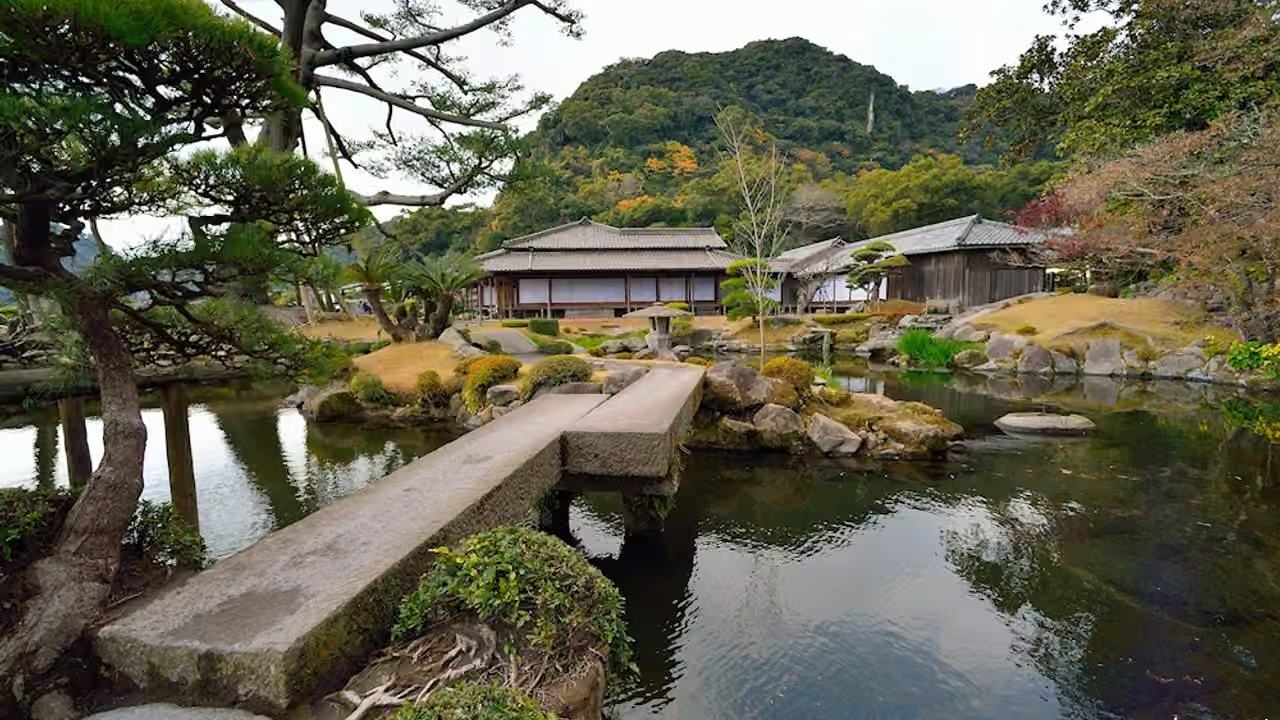
Tsurumaru Castle and the Administrative Center of Satsuma
Attraction
Tsurumaru Castle was established by the Shimazu as the governing center of Satsuma at the beginning of the seventeenth century. It relied less on a monumental keep than on a residential and administrative compound protected by moats, walls and Shiroyama behind it. The rebuilt Goromon gate restores the scale of the principal entrance but must be distinguished from surviving stonework. Damage visible in the walls is associated with the fighting of 1877, when the former domain center became part of a modern civil war. The site clarifies the political foundation inherited by Saigo and Okubo Toshimichi: both rose from a powerful domain with its own schools, offices and military resources before helping replace domains with a centralized state.
Current visibility
The feature discussed as “Tsurumaru Castle and the Administrative Center of Satsuma” is visible at Kagoshima: Shiroyama and Tsurumaru Castle in reconstructed form; the castle compound, the administrative landscape, and the moat explain what was recovered without implying original fabric.
Reimeikan and the Records Beneath Shiroyama
Attraction
Reimeikan stands within the former castle compound and interprets Kagoshima from archaeology through the modern period. Its models, documents and objects are essential because much of Tsurumaru's architecture has disappeared and the Satsuma Rebellion extended far beyond the city. Materials associated with Saigo sit within a broader history of Shimazu government, Ryukyu relations, domain education and Meiji change. This context prevents the final battle from consuming every earlier layer of the Place. The museum itself is a later building, not a restored palace, but its position is historically productive: evidence collected by a prefectural institution now occupies the administrative center of the abolished domain. The change from castle to museum expresses how local identity was reorganized within the modern state.
Current visibility
At Kagoshima: Shiroyama and Tsurumaru Castle, “Reimeikan and the Records Beneath Shiroyama” is grounded in present on-site evidence—the documentary evidence, the castle compound, and the museum display—without implying that every historical layer survives as fabric.
Shiroyama and the End of the 1877 Rebellion
Attraction
In September 1877, the surviving force of the Satsuma Rebellion made its final position on Shiroyama after retreating through Kyushu. Sites identified with Saigo's cave and death organize the modern memorial landscape, but markers cannot recover every movement with equal certainty. The terrain provides the strongest evidence: a steep hill above the old castle, enclosed by a much larger conscript army equipped and supplied by the Meiji state. Saigo died during the final assault, while government commanders including Yamagata Aritomo represented institutions that former Satsuma leaders had helped build. Shiroyama therefore resists the easy label of a last stand between tradition and modernity. It was a conflict within the making of modern Japan, fought by people whose careers and loyalties had crossed both sides of that transformation.
Current visibility
“Shiroyama and the End of the 1877 Rebellion” can still be read at Kagoshima: Shiroyama and Tsurumaru Castle through the memorial and the ground markers; the visibility claim concerns that setting, not a past moment preserved intact.