Read the article below. Interactive reading tools are available when scripts load.
Quick
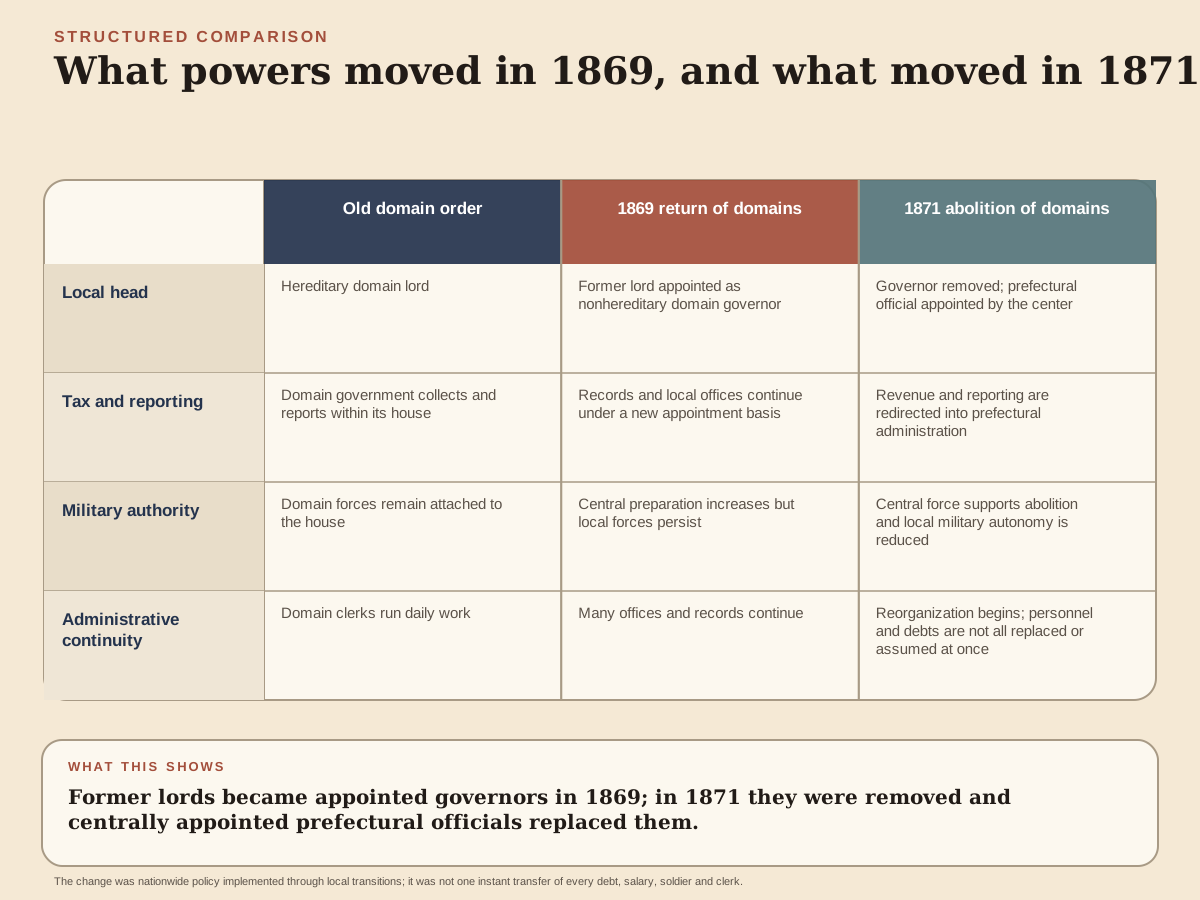
In 1869 the lords of Satsuma, Chōshū, Tosa and Hizen jointly petitioned to return their lands and people to the emperor. Other lords followed. The government accepted the returns, required domains still outstanding to comply, and appointed former lords as governors of their old domains. Their new office was nonhereditary, but local taxation and military institutions continued.
Two years later, the center assembled an imperial guard from Satsuma, Chōshū and Tosa. Leading officials prepared abolition with this military support in place. On the fourteenth day of the seventh month of the Japanese calendar in 1871, domain governors were dismissed and ordered to live in Tokyo. Prefectural officials appointed by the government replaced them.
The decree did not dismiss every local clerk. Orders required senior staff to continue existing business temporarily, with important questions referred to the center. In Kagoshima, subsequent instructions specified transfers of villages, land and current-year revenue to newly designated prefectures and required village-by-village reports to the Finance Ministry. Renaming an office was followed by reassignment of the resources it administered.
The initial system comprised three urban prefectures and 302 other prefectures. Repeated consolidation reduced the latter to 72; a 73-prefecture proposal was an intermediate plan. Old boundaries and detached territories therefore did not become today’s map in one step.
Former governors lost territorial command, while household and retainer stipends continued pending further reforms. Local orders regulated payment schedules and changed military employment. Prefectures became the framework for later taxation, recruitment and schooling, but those policies required additional legislation and implementation. Returning registers established imperial ownership in principle; abolition removed the former lords’ governing offices and made territorial reorganization a decision of the central government.
Classic
The restoration government ruled alongside domain administrations after the Boshin War. Domains still collected taxes and maintained troops, and former lords retained the officials who carried out local government. A declaration of national authority did not by itself place these institutions under one chain of command.
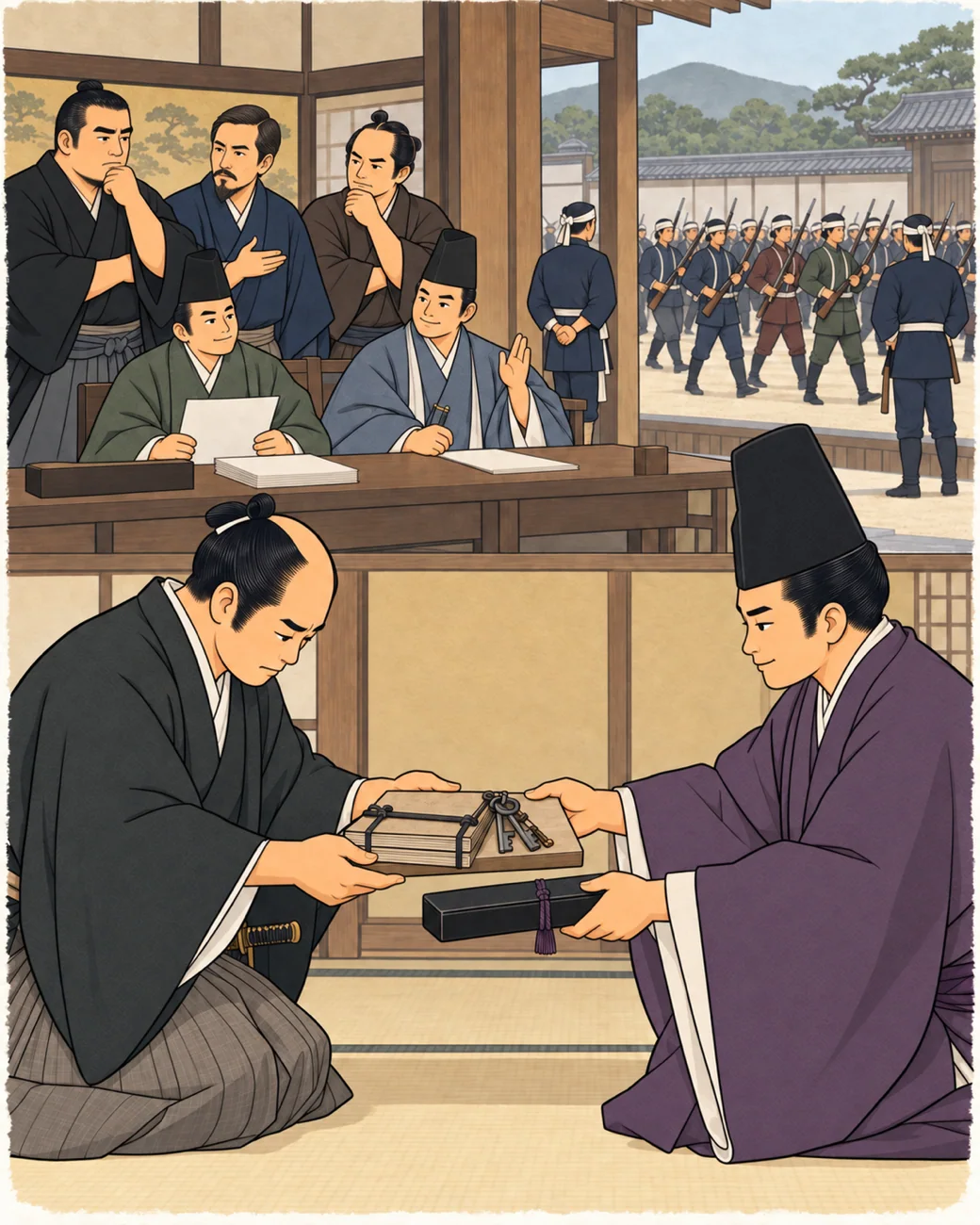
The 1869 initiative came from Satsuma, Chōshū, Tosa and Hizen. Their lords offered lands and population registers to the emperor. The petition addressed possession and political authority together: inhabitants and territory were presented as belonging to the sovereign rather than to individual hereditary houses.
The government accepted the returns and instructed domains that had not petitioned to do so. Former lords were then appointed governors of their previous domains. The office was formally nonhereditary and answerable to the center, while familiar personnel continued much local administration.
This arrangement left a practical gap. Domain governors and their administrations retained tax and military powers, whereas the national government sought unified orders. The later abolition decree explicitly described the difference between the new system’s name and its incomplete operation. The next reform would remove the governors who still stood at the head of those institutions.
Finance made the gap especially difficult. Domain governments carried borrowing obligations and issued paper money used in their own territories. Amagasaki's local records describe debts to merchants and villages, with interest payments burdening its budget. A village could therefore owe a merchant while also waiting for the domain to settle the money it had raised. Abolishing a government did not extinguish the claims of those who had supplied it. The center would have to investigate liabilities and choose which obligations to recognize, alongside acquiring authority over taxes.
The four leading domains also supplied a political starting point. Their participation in the new coalition made their joint petition more consequential than a declaration imposed on every hereditary house at once. Reappointment let the center assert sovereign possession while using the former rulers' administrative networks. The arrangement offered a way to proceed before a replacement apparatus existed, without proving that every lord understood abolition two years later to be the agreed destination.
In 1869 the government received petitions, authorized the returns and appointed domain governors. The former lord could remain in place, but his title now depended on appointment. The return was therefore followed by a temporary governing arrangement rather than immediate prefectural replacement.
Before abolition in 1871, an imperial guard was assembled from Satsuma, Chōshū and Tosa. Saigō Takamori, Ōkubo Toshimichi, Kido Takayoshi and other leaders prepared the change, obtaining approval from Sanjō Sanetomi and Iwakura Tomomi. The center had a military force available when it removed the domain governments.
The decree was issued on the fourteenth day of the seventh month of the Japanese calendar. It called for government orders to be brought under one authority and abolished the domains in favor of prefectures. Former governors were dismissed and required to reside in Tokyo; the center would appoint their replacements.
Accompanying instructions retained senior local staff temporarily. Routine business was to continue, and major decisions were to be submitted for central judgment. This provision kept offices operating during a change in their leadership and reporting obligations.
Kagoshima’s records make later transfers concrete. Newly designated prefectures were to receive the villages, lands and revenues previously administered by offices being abolished. Staff were to work under the incoming prefectural officers’ directions. Village land and assessed-production reports were required for the Finance Ministry.
Consolidation followed the initial creation of more than 300 prefectures. The government’s 73-prefecture proposal and the subsequent 72-prefecture arrangement belong to different stages. Administrative borders were redrawn through further orders, including the expansion of Tokyo’s jurisdiction. The abolition decree began this reassignment; it did not supply a permanent completed map.
The financial rules changed before the governors' offices disappeared. A governor's household allowance was set apart from the domain's governing expenditure. Amagasaki's account of the subsequent domain regulations describes separate allocations for the governor, military costs, administration, retainer allowances and debt repayment. Separating these purposes made household maintenance a specified entitlement, rather than treating all receipts as the lord's undifferentiated resources. It did not make debts or inherited personnel disappear.
The military preparation and the temporary staffing orders addressed different risks. The imperial guard gave the center support against opposition to abolition; continued local business prevented dismissal of the governor from suspending every office's work. Tokyo residence removed former rulers from their local governing posts, while their household allowances continued under other rules. Orders could thus remove a territorial head, preserve clerks and payments, and postpone further decisions about troops and finance. The original lunar date of abolition corresponds to August 29, 1871, in the Gregorian calendar.
The former lords no longer held domain governorships. Their departure for Tokyo removed hereditary heads from local office, while new officials served by central appointment. Territory could now be merged or reassigned without maintaining a separate domain government under its old lord.
For local offices, the result included a new destination for reports and decisions. Interim staff continued business under central instructions, and subsequent orders redistributed villages and tax revenues. Kagoshima’s requirement for village-by-village land reports shows the documentary work accompanying the change.
The reform did not cancel all stipends on the day of abolition. A later order in the Kagoshima records prescribed quarterly payments based on existing household and retainer allowances. Territorial office and stipend entitlement were treated separately, leaving further fiscal decisions for subsequent reforms.
Military conversion also required separate orders. Kagoshima records directed the dissolution of castle-town units while retaining their stipends and placed certain batteries and district troops temporarily under prefectural control. The end of a domain government therefore preceded completion of a uniform military system.
Debt settlement followed its own investigation. The Finance Ministry required reports on borrowing and domain notes, then distinguished obligations by their origin and date. Some debts were repudiated; others were converted into government bonds with different repayment terms. Domain notes were exchanged for government paper at assessed market values rather than simply treated as equal denominations of one currency. Creditors and note holders therefore faced a financial settlement in addition to the replacement of local officials. Taking responsibility for the process did not mean the state paid every old claim in full.
The former rulers' move to Tokyo also differed from the futures of their retainers. A house could retain elite standing and an allowance after losing territorial office, while its dependants lost particular military or administrative employment. The Kagoshima orders' continuing stipends and later efforts to provide work show why loss of office, loss of livelihood and eventual commutation of allowances must be kept separate. Nor did the 1871 decree incorporate every region by the same procedure: Ryukyu became a domain under a separate 1872 measure and was replaced by Okinawa Prefecture in 1879.
Prefectures gave the center officials and territorial units through which later policies could be applied. Conscription, land-tax reform and national schooling nevertheless depended on additional rules, personnel and local work. Abolition provided the administrative framework for them without accomplishing all their objectives at once.
The transition affected employment as well as borders. A subsequent Kagoshima notice anticipated people losing occupations and encouraged reclamation of available land, offering a period of tax exemption and requiring applicants to begin cultivation. This was one local response to livelihood problems accompanying changes in domain-run business.
Boundaries remained subject to revision. Tokyo incorporated communities outside its former jurisdiction, and the initial national list was repeatedly consolidated. A prefecture’s territory and the government receiving a village’s revenue could change through a further administrative order.
The sequence changed how local authority was assigned. In 1869 former lords continued through appointment; in 1871 their governing offices ended, with interim staff and later transfers maintaining administration. The central government gained the power to appoint governors and reorganize territory, while resolving military, stipend and livelihood questions through subsequent measures.
The change in ownership and control of buildings likewise continued beyond the decree. Himeji's conservation history describes the castle's transfer to military jurisdiction and the later removal of palace buildings, gates and other structures for barracks and military use. Keeping a site as a military establishment did not necessarily preserve its castle buildings. The surviving keep can obscure how extensively the surrounding seat of domain government was altered.
The power to consolidate jurisdictions also changed the position of communities within them. A village assigned to a new prefecture acquired a different reporting authority and destination for revenue; later mergers could change those arrangements again. The initial prefectural map was therefore part of a continuing administrative process. The sequence established central appointment and territorial reassignment, while later stipend reform and regional political activity showed that ending recognized domain governments did not end the interests or grievances of their former inhabitants.