Ports, power, and the remaking of everyday life · 1850s–1912
A schoolbook, a tax notice, a bundle of silk: ordinary things can open a large story. Between the 1850s and 1912, Japan’s rulers changed, its government reached further into everyday life, and its connections overseas acquired new force.
These changes did not arrive together, or benefit everyone equally. We will follow them from ports to offices, classrooms and workplaces—and across the sea to people brought under Japanese colonial rule.
8 short chapters26 reading unitsNo prior knowledge needed
New demands arrived in a country that already had connections.
02 / 26
Connected, but under controls
Before and after 1853
Japan was not an island sealed off from the world. Under the Tokugawa shogunate—the military government based in Edo—Dutch and Chinese merchants traded through Nagasaki, within tight restrictions.
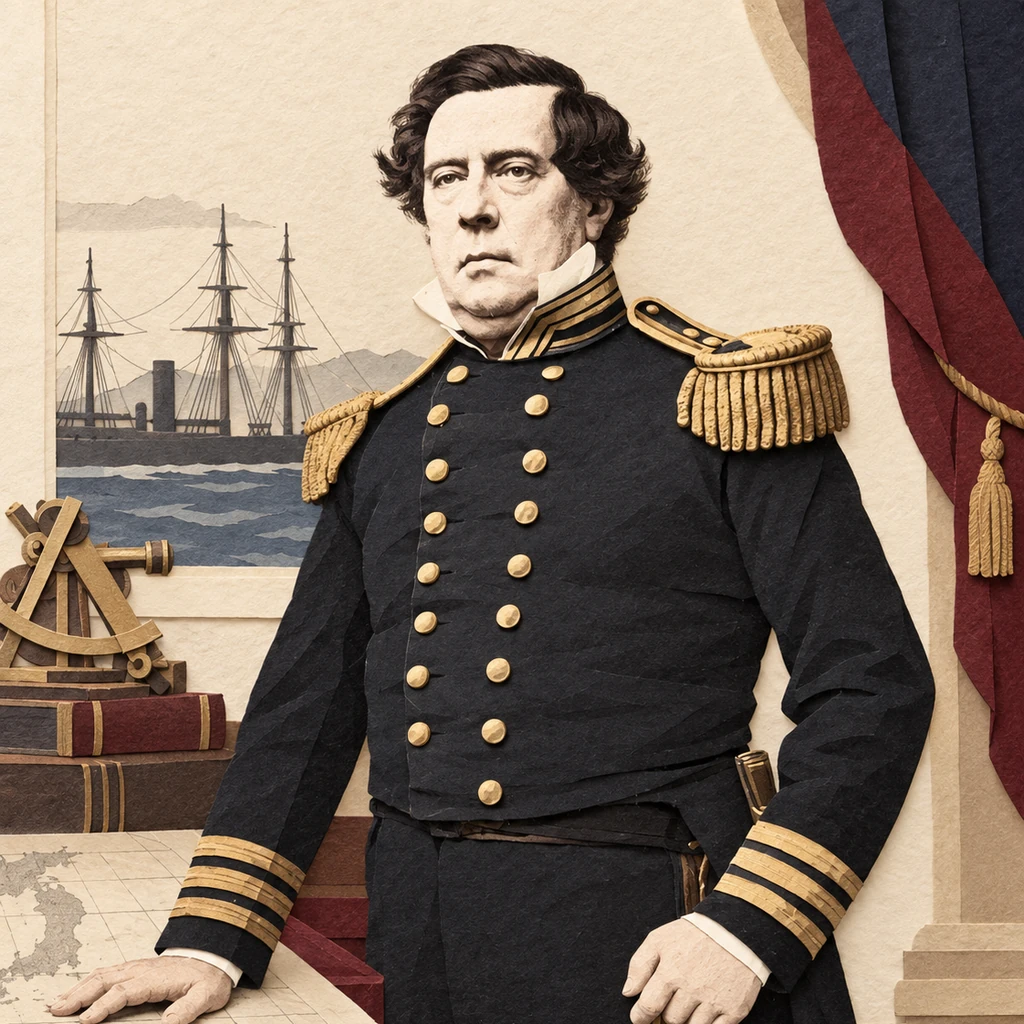
In 1853, American warships commanded by Matthew Perry entered Edo Bay. Their demands came with a display of force.
The change was not Japan’s first discovery of foreigners. It was a challenge to who could decide the terms of contact.
Sails and steam occupy the same vessel
An interpretive 1850s side-wheel frigate study, based on Susquehanna sources. Not an exact 1853 engineering reconstruction.
Above the hull
Masts and furled sails remain useful.
Beside the hull
A paddle wheel introduces a different source of movement.
The political problem
Force supports foreign demands; Japanese institutions still have to decide how to respond.
Not first contact
Dutch and Chinese trade through Nagasaki predated this arrival.
03 / 26
Two treaties, different doors
1854 and 1858
The 1854 agreement with the United States allowed American ships to obtain supplies at two ports. It was not yet a general commercial treaty.
Commercial agreements followed in 1858. They opened further ports and gave foreign powers privileges, including consular jurisdiction: their nationals could be tried by their own officials rather than Japanese courts.
To many critics, accepting unequal terms exposed a deeper problem. Could the shogunate still protect the country and speak for it?
Access to supplies is not the same as commercial access
1854American ships obtain suppliesShimoda and Hakodate
1858Commercial access and foreign privilegesConsular jurisdiction limits Japanese courts
Two different agreements; not a single switch from no contact to free trade.
Supplies
A ship can obtain what it needs without a general commercial arrangement.
Jurisdiction
Who judges a foreign national becomes a question of authority, not just cargo.
04 / 26
Pressure became a struggle over power
1850s–1860s
A treaty dispute could become a dispute about government. The shogun was not the only source of authority: regional lords controlled domains, while the emperor’s court remained in Kyoto.
Opponents challenged the shogunate in the emperor’s name. Yet opposition did not mean everyone agreed on what should replace it, or how to deal with foreign powers.
Perry’s ships intensified a crisis. Japanese rivalries, alliances and decisions shaped what happened next.
A demand from outside exposes disagreements inside
Relations are contested; this is neither three equal governments nor an inevitable chain from Perry to Restoration.
Different resources
Offices, imperial standing and regional military power.
Changing coalitions
Opposing the shogunate did not require agreement about the replacement.
Japan Becomes Modern
Chapter 2 / 8
Making a new government
A restoration still had to be fought over—and made to work.
05 / 26
A change of rulers, then a civil war
1867–1869
In 1867, the shogun returned political authority to the emperor. That did not settle who would govern. Early in 1868, a coalition around the court announced a new imperial government.
Fighting followed between its forces and supporters of the old order. This was the Boshin War, which continued into 1869.
The “restoration” was therefore more than a ceremony. Its leaders had to defeat resistance before they could turn their claim to rule into a working state.
A transfer, a declaration and a war are different events
1867The shogun returns political authorityWho will govern remains disputed
Early 1868A new imperial government is announcedIts claim meets armed opposition
1868–1869Boshin WarMilitary resistance must be overcome
Selected sequence; spacing does not measure time and the war is not represented as a peaceful handover.
Read the verbs
Returns, announces and defeats describe different work.
06 / 26
The emperor’s name was not an office staff
1868–1885
Emperor Meiji · 明治天皇
The new government ruled in the name of Emperor Meiji. His position gave the regime a source of authority beyond the fallen shogunate.
But he did not personally write every regulation or manage every department. Court figures, former domain leaders and officials developed policy, argued over it and put it into practice.
Government organization changed repeatedly. In 1885, a cabinet of ministers replaced the earlier council system: another step in deciding who did which work.
A source of legitimacy and the work of governing
A functional distinction, not a complete organisation chart valid throughout 1868–1885.
Emperor Meiji
The government acts in his name.
Offices
People must compose rules, decide among proposals and carry out decisions.
07 / 26
Edo becomes Tokyo
1868–1869
Edo → Tokyo · 江戸 → 東京
Edo had been the shogun’s city. Renamed Tokyo in 1868, it became the base of the new imperial government; the emperor established his residence there in 1869.
The name meant “eastern capital.” Kyoto, to the west, had long been the home of the imperial court.
Changing the name did not build a city from nothing. The new rulers took over an existing centre of population, communications and administration, including the former shogun’s castle.
The name changes; the built city is inherited
Overall west-to-east shift of the imperial residence, not a travel route or a modern legal-capital declaration. GSHHG physical coastline.
1868
Edo is renamed Tokyo.
1869
Imperial residence in the former shogun’s city.
Continuity
Roads, offices, population and the castle site do not begin from nothing.
Japan Becomes Modern
Chapter 3 / 8
From domains to prefectures
Changing a chain of authority changed who people answered to.
08 / 26
The governor no longer inherited a domain
1869–1871
In 1869, domain lords surrendered their lands and people to the emperor, but were initially appointed to govern their former territories.
The decisive change came in 1871. The government abolished the domains, removed their governors and appointed officials to run prefectures instead.
The important change was a relationship, not simply a new label on a map. A hereditary lord’s authority gave way to an appointment from the centre. Boundaries were reorganized further; today’s prefectural map did not appear overnight.
The important change is who appoints—and who remains
Before 1869Hereditary domain lordHouse and territory are linked
1869Former lords become appointed governorsTheir old territories remain for the moment
1871Domains abolished; governors removedCentrally appointed prefectural officials
A change in governing relationships, not an instant map of today’s 47 prefectures.
Do not skip 1869
Appointment begins before abolition.
Do not stop at a new name
Removing former lords from office changes who can hold the local post.
09 / 26
Government needed a local desk
From 1871
A rule issued in the capital still needed someone nearby to make it work. Prefectural and local officials became the link between central decisions and households.
The 1871 family-register law introduced nationally standardized rules for recording the population. Local registrars handled the work, and a nationwide register followed in 1872.
For a household, the new state was not only an emperor or a distant ministry. It could also be an official asking for names, relationships and information.
Information has to pass between people
Anonymous early-Meiji record-work study. Blank loose sheets are illustrative, not a facsimile of an 1872 family register.
Pointing hand
Information must be supplied or clarified.
Brush and paper
An official has to turn it into a usable record.
Names and relationships
The categories matter more than a decorative official costume.
Local work, national rules
The 1871 law leads to a nationwide register in 1872.
10 / 26
The tax bill now asked for money
Land-tax reform · 1873
The 1873 land-tax reform tied the tax to an assessed land value and made the holder of the land certificate responsible for paying it in money.
The amount did not rise or fall with that year’s harvest. This offered the government a more predictable claim on revenue, but a poor harvest could leave a landowning household struggling to find cash.
Changing how a tax was calculated also changed who carried the risk.
A smaller harvest does not automatically shrink this bill
Qualitative comparison within the 1873 reform principle. No invented household amount or permanently fixed rate.
Government
A more predictable claim on revenue.
Landholder
The obligation remains when the harvest disappoints.
Risk
The reform changes who must find money in a bad year.
Japan Becomes Modern
Chapter 4 / 8
Schools, soldiers and work
National ambitions entered the timetable of the day.
11 / 26
New schools, not the invention of learning
The school-system plan · 1872
Japan already had schools and educated people before the Meiji government. Domain schools, for example, had trained generations of samurai, and their teachers and graduates helped supply the new system.
The 1872 school plan aimed to spread education to boys and girls across the country. That ambition was larger than the schools immediately available.
Buildings, teachers and money had to be found. A national plan was the beginning of a difficult expansion, not proof that every child was attending.
The national plan and participation are different measures
Selected years from MEXT Table 2-4. Historical school participation—not daily attendance, literacy or graduation. Later calculation changes prevent an unqualified long series.
Expansion
Both later-year values exceed the earlier ones.
Uneven access
The gap between boys and girls remains visible.
No instant coverage
The 1872 plan did not put every child in a classroom.
The 1873 conscription system called men aged twenty for examination and selected recruits for military service. Soldiering was no longer reserved to the hereditary samurai class.
But a universal principle did not mean that every man served. The original rules included numerous exemptions, including some students, household heads and men able to pay a substitution fee.
For a family whose son was selected, building a national army meant losing his everyday presence and labour for years.
Eligibility for a system is not identical to serving
Simplified 1873 rule, not a statistical funnel or a complete legal decision tree.
Status boundary
Military recruitment is no longer confined to hereditary samurai.
Unequal routes
Some students, household heads and fee-payers are exempt under the initial rules.
Household effect
If selected, a son’s labour must be replaced or forgone.
13 / 26
Silk joined the countryside to the port
From the 1860s
Silk exports linked rural households to buyers overseas. Cocoons raised in the countryside supplied reeling workshops and mills, where workers drew out silk thread for sale.
Women’s skill was central to this work. Factory employment could bring wages and training, but also separation from home and a working day organized by an employer.
An export bundle therefore held more than a successful product. Behind it were farming, skilled hands, hours of work and decisions about a household’s future.
What changes between a cocoon and a bundle?
Material study: cocoons, open silk skein and compact hank enlarged independently—not a common scale, cultivar or measured output.
Cocoons
Rural households raise the raw material.
Fine parallel threads
Reeling combines cocoon filaments; re-reeling gathers them into a larger skein.
Ties and twist
Thread can be handled as a bundle without becoming thick rope.
The missing work matters
Heating, skilled reeling and finishing stand between these specimens. They do not transform by themselves.
An assembly widened political life without admitting everyone.
14 / 26
A constitution created an arena for argument
1889–1890
The constitution proclaimed in 1889 placed sovereignty with the emperor. It also established an Imperial Diet, which began meeting in 1890 and took part in making laws and approving budgets.
The Diet had two chambers: an elected House of Representatives and a House of Peers drawn from privileged and appointed groups.
Ministers were not simply chosen by the winning party. The result was a new arena for political argument, not government by all adult voters.
An elected chamber sits inside a larger constitutional order
Selected 1889 constitutional relationships. Not a claim that the winning party appoints ministers, or that the elected house alone controls lawmaking.
Emperor
Sovereignty is placed here.
Diet
Two chambers participate in laws and budgets.
Ministers
Their constitutional responsibility is not modern majority-party cabinet government.
Japan’s first House of Representatives election took place on 1 July 1890. Three hundred seats were contested, but only about one percent of the population was eligible to vote.
Voters had to be men aged twenty-five or older who paid at least fifteen yen in direct national taxes. Women and most men stood outside the electorate.
The date marks a real institutional change. The small share of eligible voters shows how limited that change remained.
The denominator changes what the number means
Approximate share, not 100 actual people or an exact census calculation. Total population includes people below voting age.
1 July 1890
The first House of Representatives election; 300 seats.
Required
Male, 25 or older, at least 15 yen in direct national taxes.
Petitions, political associations and public debate helped press the demand for a national assembly. The Freedom and People’s Rights Movement was part of that pressure, not merely an audience waiting for the government to act.
The new constitution recognized speech, publication and petition, but within limits set by law. Political activity could still be restricted.
Winning a place for debate and gaining a vote were different achievements. Neither meant that everyone could participate on equal terms.
Political action begins before—and extends beyond—a ballot
Selected channels of political activity, not invented slogans, equal access or unrestricted constitutional rights.
Outside institutions
People could press for a change before an assembly existed.
Inside institutions
Gaining a forum was not the same as giving everyone a vote.
Japan Becomes Modern
Chapter 6 / 8
Expansion before 1912
A stronger state also became a colonial power.
17 / 26
The map changed beyond Japan’s shores
1894–1910
Japan’s growing power included military expansion. Wars against Qing China in 1894–1895 and Russia in 1904–1905 altered its position in East Asia.
Taiwan came under Japanese colonial rule in 1895. Southern Sakhalin was ceded by Russia in 1905. Korea was annexed in 1910, after earlier Japanese encroachment on its independence.
These were not empty additions to a map. They were places where people already lived, and where Japanese authority brought new forms of control.
Three places, three dates—not empty space
Physical coastline only. Pins locate places; they do not show a complete empire boundary or every treaty possession. No part of Manchuria is coloured as annexed territory.
1 · Taiwan
Japanese colonial rule from 1895.
2 · Korea
Protectorate 1905; annexation 1910.
3 · Southern Sakhalin
Territory south of 50°N ceded in 1905—not the whole island.
People already lived here
A change of sovereignty changes claims over existing communities.
18 / 26
Taiwan and Korea followed different routes
1895 · 1905 · 1910
Taiwan was ceded by Qing China in the settlement after the 1894–1895 war. Japanese forces then had to impose their rule on the island.
Korea’s loss of independence came through a different sequence. In 1905, Japan took control of its foreign relations through a protectorate arrangement. Annexation followed in 1910.
A protectorate left a local government in place under outside control; annexation claimed the territory itself. Neither term should hide the loss of self-government.
Keep the two sequences separate
Taiwan · 1895Qing cession after warJapanese forces establish colonial rule against resistance
Korea · 1905Protectorate arrangementJapan takes control of foreign relations
Korea · 1910AnnexationJapan claims sovereignty over the territory
Institutional distinctions do not turn coercion into consent or make the two histories identical.
Protectorate
A local government remains under outside control.
Annexation
The territory itself is claimed.
Shared consequence
Loss of self-government matters beyond diplomatic terminology.
19 / 26
Look from the other side of the new boundary
Taiwan · From 1895
In Taiwan, the transfer of territory on paper did not produce peaceful acceptance. Japanese forces met armed resistance while establishing colonial rule.
The colonial state sought control over land and people, not simply improvements to transport or trade. Its rule also treated Taiwanese people differently from Japanese settlers.
Looking only from Tokyo turns expansion into a story of national achievement. Looking from the governed places conquest, inequality and resistance back inside the same history.
A treaty does not show the experience of being governed
A perspective diagram, not a battle reconstruction or claim that all Taiwanese reacted alike.
From Tokyo
Expansion can look like greater national power.
From Taiwan
Resistance, coercion and unequal treatment belong in the same account.
A new institution could be both an opportunity and a burden.
20 / 26
A place in school still had a cost
1872–1900
The early school system placed substantial costs on local communities and families. Resistance to those costs was one reason its expansion was difficult.
In 1900, public elementary tuition became free in principle. Removing that bill made the promise of schooling more practical, but did not make every household’s circumstances identical.
A school’s existence, the price of attending and a family’s ability to spare a child’s time were separate questions. “Education expanded” does not mean everyone experienced it in the same way.
A school needed things that had to be supplied
National Archives of Japan, School Equipment Standards, 8 April 1891, 類00570100-004. Complete selected scan; resized/compressed only. Reproduced with source credit under the archive’s reuse terms.
Left page · Article 11
Maps, a globe and a blackboard appear among prescribed equipment.
A prescription
The list shows what a school was expected to have—not that every school already had it.
Different dates
This is 1891, not the 1872 school plan. Public elementary tuition becomes free in principle in 1900.
Beyond tuition
Buildings, equipment and a child’s time remain different kinds of cost.
The government’s Tomioka Silk Mill began operating in 1872. It recruited women from different parts of Japan to learn machine-reeling techniques, with the intention that trained workers would carry those skills home.
The workers were therefore learners and potential instructors, not simply extra hands beside a machine. Knowledge moved through them.
Yet this was a particular model institution, not a picture of every factory. Training opportunities and disciplined employment could belong to the same working life.
Watch the hands—and then follow the thread
Early 1870s French-style reeling at Tomioka, interpretive study. Anonymous adult workers, not portraits; lower view enlarges the same operation.
In the basin
Several cocoon filaments gather into each working end.
At the guides
The worker monitors fine material and its path.
Behind
The two working ends return to wooden reels.
Beside her
Observation and explanation carry skills between people. Training can coexist with disciplined employment.
Consider how the changes might meet in one farming household. Cash was needed for land tax; school attendance took a child’s time; a selected conscript left work that someone else had to do.
Paid employment could help meet expenses, while also taking a family member away. The same reform could look different from an office and from a kitchen.
This is a way to connect the institutions—not a claim that every family followed one identical path.
The demands can meet at the same kitchen table
Hypothetical connection, not a documented family biography or a claim that everyone experienced all four at once.
Cash
A wage may help meet an obligation.
Time
Work away, study and military service can compete with labour at home.
Uneven effects
A benefit to one member can require adjustments from another.
Japan Becomes Modern
Chapter 8 / 8
By 1912: putting it together
Keep the connections, not a ladder of inevitable progress.
23 / 26
Change travelled through connections
1850s–1912
Return to the port. Foreign demand for silk reached inland producers; trained workers carried techniques between mills and home regions. Learning travelled with people as well as through government plans.
Now return to the local office. Registers, taxes and military recruitment connected households to a state with wider ambitions.
These threads reinforced one another, but not always smoothly. The modern state was assembled through decisions, work and disagreement—not delivered as one finished package.
The same workplace can send out two kinds of result
Tomioka’s model-training intention within the wider silk economy, not a route every factory worker followed.
A material route
Cocoons become an exportable product.
A knowledge route
A worker can become an instructor elsewhere.
Two directions
The capital and port are not the only destinations that matter.
24 / 26
Stop at the end of Meiji
1912
Emperor Meiji died in 1912. By then, the shogunate and domains had gone; prefectures, national institutions and an Imperial Diet shaped government. Schools and industrial work had become part of many more lives.
Japan had also established colonial rule overseas. Greater power did not mean equal treatment, either within the country or across its new possessions.
This is where our account stops. The arrangements in place by 1912 created possibilities and tensions, not a single inevitable future.
By 1912: stronger institutions, unresolved inequalities
GovernmentShogunate and domains have gonePrefectures, national offices and Diet remain
Daily lifeSchools and industrial employment expandAccess, costs and demands are uneven
Beyond JapanAn overseas empire existsColonial control does not give equal self-government
A stopping point, not a prediction that one later future was inevitable.
1912
The Meiji reign ends.
What follows
Later possibilities are outside this booklet’s scope.
25 / 26
Three connections worth keeping
Back through the book
Government reached the home through practical things: a register, a tax demand, a school rule or a call to serve. Learning moved through classrooms and workplaces, not only through orders from above.
New opportunities also came with new demands. A worker could gain a skill; a household could lose time or labour; people under colonial rule could experience change without gaining self-government.
Follow any one of these connections back through the chapters. Each opens a different view of the same transformation.
Use the connections to ask who gains—and who carries the cost
RegisterGovernment can identify a householdThe household must provide information
TrainingA worker can gain a transferable skillLearning happens within an employer’s discipline
EmpireThe Japanese state acquires wider powerGoverned peoples lose independence
A synthesis of this booklet’s examples, not an equation making all experiences equivalent.
Return to a concrete thing
A record, skein or boundary can expose a different relationship.
Japan Becomes Modern / Closing page
Follow one thread
A bundle of silk can lead from a family to a mill, and from a mill to the sea. A page in a register can lead from a local desk to the government in Tokyo.
Japan’s passage into the modern age was made of such connections. Keep the people inside the picture: those who learned and worked, those who governed, and those whose independence was taken away.
Follow one thread—and keep the people in view
An explanatory network, not a claim that every family supplied each branch.