Read the article below. Interactive reading tools are available when scripts load.
Quick
Murasaki Shikibu was probably born around 973, but neither her exact birth year nor her personal name is securely known. “Murasaki Shikibu” is a literary and service designation preserved by later records. [17]
Her father, Fujiwara no Tametoki, belonged to a learned but lower-ranking Fujiwara line. Sharing the Fujiwara name with Michinaga did not place her household at the same level of political power.
The asymmetry of the record is historical evidence. Male officials were repeatedly registered through office, while women were often identified through relatives, residences, or court roles.
The surviving record does not show what the unnamed girl expected her adult life to become.
Murasaki grew in a household where Chinese texts and official writing mattered. Her surviving works demonstrate substantial knowledge, though the exact course of her education is not recoverable.
Court convention associated formal Chinese writing more strongly with male office and kana, a phonetic Japanese script, with women's letters, diaries, poetry, and tales. Practice was more varied than that division suggests.
A learned woman could read beyond the expected range while managing how visibly she displayed it. Literacy was both capacity and social performance.
She did not need to become a male-style scholar-official to transform Chinese allusion, Japanese poetry, spoken narrative, and observation into a different literary field.
Around 998 Murasaki married Fujiwara no Nobutaka, an older relative within the wider Fujiwara kin field. They had a daughter later known by the court title Daini no Sanmi.
Nobutaka died around 1001, leaving Murasaki widowed. Marriage, childbirth, household change, and bereavement altered her material and social circumstances.
They do not establish a simple psychological formula in which grief produced The Tale of Genji. The work's beginning and development remain uncertain.
Her daughter's later career and Murasaki's own court service belong to what followed; neither turns bereavement into a complete explanation for the novel.
The exact date when Murasaki began The Tale of Genji is unknown. The work appears to have developed before and during her years in Shōshi's household.
In manuscript culture, sections could be copied, read aloud, requested, revised, and circulated before a modern-style final edition existed. Readers and scribes affected the work's social life without becoming its author.
Paper, ink, calligraphy, binding, illustration, and delivery required resources. Michinaga's household could support production, but patronage did not transfer authorship from Murasaki.
The work is therefore both an authored literary achievement and a collectively transmitted object.
Around 1005 or 1006 Murasaki entered the service of Shōshi, daughter of Michinaga and consort of Emperor Ichijō. The precise starting date and later continuity are not perfectly documented.
A nyōbō was neither an ordinary modern servant nor a male bureaucrat. Court women handled access, correspondence, ritual, clothing, education, entertainment, and cultural production within a consort's household.
Service placed Murasaki near imperial and regent-house politics while increasing the visibility of Genji. Shōshi remained patron and political actor, not a background for the author's career.
Proximity created opportunity and surveillance together. Rank, reputation, and every social gesture could be read by others.
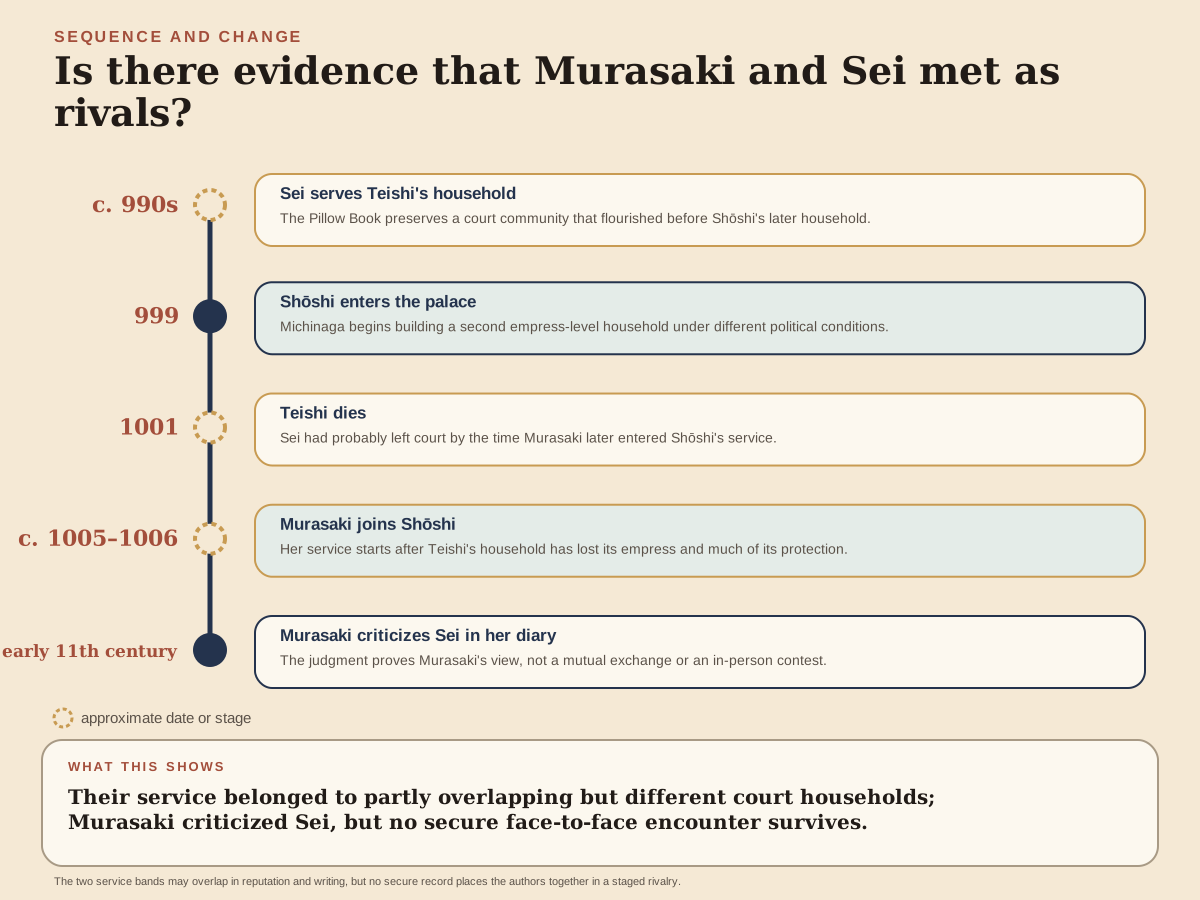
Empress Teishi and Empress Shōshi each supported notable communities of court women, but at different moments. Sei Shōnagon served Teishi before Teishi's death around the turn of 1001; Murasaki entered Shōshi's household several years later. [14]
Each household joined literary distinction to imperial marriage politics. Teishi's circle had flourished while her brothers held power. Shōshi's grew as Michinaga supplied resources and as her position strengthened, especially around the birth of an imperial son in 1008.
For Murasaki, service meant writing and reading among women whose work also included correspondence, ritual, clothing, and access to the consort. The two circles provide political and literary context; the evidence for a personal rivalry belongs to a later chapter.
In 1008 Shōshi bore Prince Atsuhira, later Emperor Go-Ichijō. Murasaki's diary records preparations, ritual, elite visits, and the women's household around the event.
Shōshi bore the physical risk. Midwives, attendants, nurses, monks, and physicians supplied care; Michinaga organized political and ceremonial resources.
The child's later accession made the birth central to regent-house history, but that outcome was not guaranteed in the delivery room.
Murasaki's observation remains her own limited position, not transparent access to Shōshi or the child.
After recording Shōshi's childbirth, Murasaki shaped her account around ceremonies, court visits, colleagues, learning, and her own conduct. The diary shows her continuing to observe and write inside Shōshi's household during the years around 1008–1010.
It is a first-person source close to events, but Murasaki selected scenes and positioned herself for readers. That combination makes the diary valuable: it preserves what one court woman saw and chose to make meaningful, rather than an unedited transcript of the palace.
Murasaki's work circulated within a Heian court where women composed poetry, exchanged letters, kept diaries, and wrote tales in kana. Her position in Shōshi's household gave her readers, materials, and occasions for literary exchange.
Exclusion from most formal offices helped channel elite women's learning into these forms without making them socially equal. Chinese learning and male readership still crossed the boundary, while copyists and patrons helped particular texts survive. Murasaki's authorship was individual; the conditions that made it visible were shared.
Across its long sequence, The Tale of Genji turned marriage, desire, rank, succession, aging, religion, and memory into consequences that unfold across generations. Murasaki used shifting viewpoints and the constraints of court life to show how intimate choices altered other lives.
The courtly setting reflects close knowledge of aristocratic institutions, but it remains fiction. Hikaru Genji is not a securely identifiable portrait of one real noble, and episodes cannot be treated as a ledger of what Michinaga, Shōshi, or Murasaki literally did.
The final ten chapters of Genji are set mainly in Uji after Hikaru Genji's death, shifting attention to a later fictional generation and a landscape away from Kyoto's center.
The river, distance, religious sites, and difficult movement make the real landscape part of the fiction's uncertainty.
The mainstream view still treats Murasaki as the principal author of Genji, although Yosano Akiko and some later scholars proposed that Daini no Sanmi or another hand contributed to the final portion. A 2025 computational study found the later chapters stylistically consistent with the earlier ones and judged single authorship the stronger explanation. That is substantial new evidence, not final proof in the absence of an autograph manuscript. [15]
Murasaki's diary includes a sharp assessment of Sei Shōnagon, who had served Teishi several years before Murasaki entered Shōshi's household. The comment reveals Murasaki's judgment and her own way of discussing learning and conduct.
There is no reliable evidence that Sei answered her or that the two women met. Their famous rivalry was enlarged by later commentary, education, illustration, and popular culture seeking memorable literary opposites.
After the best-documented years around 1008–1010, Murasaki's trace becomes sparse. Scholars disagree about how long she continued in Shōshi's service and whether later references securely identify her. [16]
Her daughter, Daini no Sanmi, later had a court and poetic career of her own. Murasaki may also have remained active after the most visible records end, but the surviving evidence does not support a continuous account of retirement, illness, or a final project.
Murasaki Shikibu's exact death year is unknown. Proposed dates range across the years after her documented court service, and none can be treated as certain. [17]
Her biography therefore ends without a secure final scene or a proven link between her death and the completion of Genji. The copying, illustration, interpretation, and commemoration that followed belong to later readers and makers.
After Murasaki's death, copyists, editors, commentators, painters, performers, printers, and teachers made Genji durable. No autograph manuscript survives; later textual traditions mediate the work.
Illustrated scrolls and commentaries selected scenes and interpretations. Early modern printing widened access while creating new textual and visual conventions.
By the Meiji era, literary history and national education reframed Murasaki for modern genres and institutions. Claims that Genji is the “world's first novel” are prestigious but definition-dependent.
By 1912 modern literary history was presenting Murasaki as a major national author. The global translation history that expanded afterward belongs to her readers and translators, not to her biography.
Classic
The woman now called Murasaki Shikibu was probably born around 973, but neither her exact birth year nor her personal name is securely known. “Murasaki Shikibu” is the name under which her writing and court service survived. Murasaki became associated with the literary world of The Tale of Genji, especially its heroine of that name; Shikibu referred to the Ministry of Ceremonial Affairs through a male relative's office. The label tells us how she was remembered, not what her family called her at birth. [17]
This uncertainty was not unusual for a woman at the Heian court. Male officials repeatedly entered records through appointments, ranks and public offices. Women could be central to aristocratic households yet appear under a father's office, a husband's rank, a residence or a court designation. The missing name is therefore evidence about the archive and its gendered habits before it becomes a mystery about Murasaki herself.
Her father, Fujiwara no Tametoki, is much easier to identify. He was a scholar-official trained in Chinese learning and belonged to a lower-ranking Fujiwara line. The shared surname did not place his household on the same level as the regent house led in Murasaki's adulthood by Fujiwara no Michinaga. Her family stood close enough to court culture to possess books, instruction and literary connections, but it did not command the offices, wealth or access of the most powerful Fujiwara branch.
That position helps explain both opportunity and constraint. A learned household could expose a daughter to Chinese texts and to the vernacular writing used extensively by court women. Paper, brushes, copying and messengers made literary life possible, while household relationships determined who could learn, exchange writing and eventually enter service. Gender shaped the acceptable display of learning: Chinese literacy could be useful, yet a woman who showed it too openly risked criticism for stepping beyond expected conduct.
Later anecdotes describe a remarkably intelligent girl who learned alongside, or more quickly than, a brother. They preserve an early reputation but cannot supply a detailed childhood curriculum or a child's own thoughts. Nor does exceptional learning by itself explain The Tale of Genji. Marriage, motherhood, widowhood, court service, the readers around Empress Shōshi, and years of composition and copying still lay ahead.
The responsible beginning is thus neither an invented personal name nor a childhood-genius scene. It is a girl born into a learned but politically secondary branch of a great lineage, in a society that preserved women's identities differently from men's. Her later work would make the designation “Murasaki Shikibu” famous across centuries, while the person behind it remained partly beyond the record.
Murasaki grew in a household where Chinese texts and official writing mattered. Her surviving works demonstrate substantial knowledge, though the exact course of her education is not recoverable.
Gendered norms regulate display as much as access. A household may expose a daughter to books while discouraging her from performing knowledge in the same manner as a son. Tametoki's career placed Chinese composition and classical study close to domestic life. Texts used for office did not cease to exist when an official returned to his residence. Children and attendants could hear recitation, see copying, and learn vocabulary. The exact lessons Murasaki received are not documented as a syllabus. Her writings nevertheless show familiarity too sustained to reduce to accidental overhearing. Allusion, historical analogy, and judgment depend on practiced reading.
The familiar contrast between men's Chinese and women's kana is useful only at institutional scale. Male officials used Chinese forms for government and scholarship; women developed powerful kana genres. It becomes false when treated as absolute biological division. Men wrote kana, women learned Chinese, and both moved among oral and written registers. Kana lowered some barriers to extended vernacular prose. It supported letters, diaries, tales, and poetry exchange without requiring a bureaucratic career. That opportunity did not create equality. Access to paper, leisure, education, and elite readers remained concentrated in court households.
Most women in the archipelago did not inhabit Murasaki's textual environment. “Women's literature” must not erase class. Within the court, knowledge could attract scrutiny. A woman judged too eager to exhibit Chinese learning might be described as unfeminine, proud, or socially clumsy. Murasaki's diary suggests awareness of such evaluation. It is an adult crafted text, not transparent proof of every childhood experience. Strategic modesty can coexist with intellectual confidence. Hiding knowledge in one setting does not mean lacking it.
Teachers need not have held a formal title. Fathers, brothers, readers, women companions, copied books, and literary exchange could all instruct. Scribes and material workers also belong to the educational chain. A classical text reached the household because someone produced, copied, stored, and transported it. Memorization mattered in a manuscript culture. Limited copies increased the value of repeated reading and oral recall. Chinese learning did not simply decorate Genji. It offered historical structures, vocabulary, and contrast that could be transformed within vernacular narrative.
Transformation is not translation. Murasaki did not merely pour a masculine curriculum into kana. She wrote within Japanese poetic convention, court speech, ritual knowledge, women's correspondence, and narrative traditions whose practitioners included many unnamed predecessors. Calling her uniquely educated can therefore exaggerate isolation. Other court women possessed varied literacy, and their conversations made a reading community. Her distinction lies in what survives and in the extraordinary scale and control of the work attributed to her, not proof that no woman around her could read learned texts.
The boundary she crossed remained socially active. Crossing it required judgment about audience and self-presentation. That tension later enters her diary, where learning becomes both resource and possible accusation. The historical explanation is thus institutional rather than miraculous: a learned household supplied access; gender norms shaped display; kana genres supplied space; Murasaki developed an unusual synthesis.
Around 998 Murasaki married Fujiwara no Nobutaka, an older relative within the wider Fujiwara kin field. They had a daughter, later known as Daini no Sanmi.
Biography seeks turning points because they make chronology feel causal. Marriage and death provide emotionally powerful markers. Murasaki's marriage to Nobutaka changed residence, kinship, obligations, and economic support. Their age difference and wider family connections shaped the household. The birth of a daughter added bodily risk, care work, and a new person whose future could not be known at birth. Nurses, attendants, relatives, and servants helped sustain mother and child. Their labor should not disappear beneath a single-author story.
Nobutaka's death around 1001 ended his agency and altered the household. Bereavement had social and fiscal consequences as well as emotion. Exact private response is difficult to recover. Poems and retrospective writing can express grief while remaining crafted for an audience. The chronology of Genji is itself uncertain. Some composition may have begun before court service; parts could have been developed across several years. The therapeutic-origin story simplifies both literature and grief. It makes a complex narrative the symptom of one private event.
It also risks treating widowhood as culturally productive only because a masterpiece followed. The life event mattered even without that outcome. Marriage may have expanded experience of adult households, correspondence, rank, and vulnerability. Such experience could inform writing without mapping one-to-one onto fictional episodes. Fiction transforms. It combines observation, inherited tale motifs, poetry, political structures, imagination, and response from readers. No character should be assigned as a disguised Nobutaka or Murasaki without evidence. Biographical keys can become unfalsifiable.
The daughter's existence also resists a solitary-widow image. Murasaki remained a mother within networks of care. Daini no Sanmi later developed her own court and poetic identity. She is not only evidence that her famous mother once married. Gendered records again shape visibility. A man's death might be chronologically noted through office; a woman's household transition may appear indirectly through poems or later genealogy. This unevenness invites imaginative filling.
The strongest causal statement is modest: widowhood changed Murasaki's circumstances before her clearer entry into Shōshi's service. It may have affected decisions and writing, but the exact path cannot be proved as one motive. Those states are especially vulnerable to emotional appropriation. Murasaki's adult agency remains visible through later action. She wrote, served, observed, taught, corresponded, and cared within altered conditions.
The distinction between condition and cause matters. Widowhood changed Murasaki's household, but it did not automatically produce a masterpiece. A daughter still had to be raised, writing continued over time, and court service remained a possibility rather than a predetermined next step.
The exact date when Murasaki began The Tale of Genji is unknown. The work appears to have developed before and during her years in Shōshi's household.
Murasaki remains the author of The Tale of Genji. Collective production should not be used to dissolve her creative responsibility. A manuscript began as physical marks on costly paper. Someone prepared ink, copied characters, dried sheets, assembled sections, and moved them between readers. An author could write portions at different times. Readers might know early sections while later ones remained unwritten or unstable. Requests for continuation could shape pace. Reading aloud could reveal effects different from solitary reading.
Copyists introduced variation deliberately or accidentally. A beautifully prepared copy could increase prestige while a hurried one might alter wording. The earliest complete authorial manuscript does not survive. Later textual history therefore depends on copies and families of readings. This loss makes an exact completion date difficult. A first historical notice of circulation is not automatically the date of origin. Murasaki's diary around 1008 provides evidence that the tale was known and copied in elite circles.
Michinaga appears within the production environment. His resources could obtain paper and mobilize skilled copying for Shōshi's household. That support was consequential. It should not become a claim that he commissioned every theme or owned the story. Shōshi was also a patron and reader around whom a literary circle operated. Her household created audience, time, competition, and material opportunity. Women readers were not passive recipients. Response, memory, discussion, and quotation gave the tale social force.
Men also read or heard it. Literary circulation crossed the convenient gender division between official Chinese and women's vernacular writing. The title and chapter organization have their own transmission history. Later readers encountered stabilized forms that may not reproduce every stage of early circulation. “Novel” is a useful comparative term but not the only category. Murasaki wrote a monogatari within Japanese tale and poetic traditions. Calling it the world's first novel can attract attention while imposing a later global contest. The label requires definition rather than automatic fact status.
The internal complexity of the work—many characters, generations, temporal shifts, poems, letters, and narrative perspectives—suggests sustained construction. Complexity does not prove a modern solitary desk routine. Court conversation and manuscript exchange could coexist with extraordinary individual design. Originality here lies in organization and transformation, not creation from cultural emptiness. Earlier tales, histories, poems, ritual, and social observation provided materials. Characters and scenes are discussed at high level only.
Keeping those roles distinct preserves both literary genius and historical infrastructure.
Around 1005 or 1006 Murasaki entered the service of Shōshi, daughter of Michinaga and consort of Emperor Ichijō. The precise starting date and later continuity are not perfectly documented.
The consort household was a political, ritual, educational, and material institution. Women inside it managed boundaries through which people, messages, and objects reached Shōshi. Some tasks were intimate: clothing, rooms, personal attendance, and company. Others connected directly to public ceremony. Letters and poems carried relationships. A woman skilled in language could help shape a household's response and prestige without holding a male ministry post. Literary knowledge also supported education and entertainment. Shōshi's circle read, copied, discussed, and commissioned texts.
Murasaki's Chinese learning could be useful in private instruction while remaining socially delicate in public display. Her entrance date is usually placed around 1005–1006. The evidence does not justify a false precision to the day. Nor does it prove uninterrupted service until a known retirement date. Court attendance could vary, and later records become sparse. Michinaga's role was structural. He built Shōshi's household as part of imperial marriage politics and supplied resources.
That political purpose did not make every woman a propagandist. Household members had judgments, rivalries, friendships, fatigue, and literary aims. Shōshi's own agency is central. She was daughter, consort, later imperial mother, patron, reader, student, and religious actor. Murasaki served her; she did not own her image or speak her mind in the biography. Emperor Ichijō's relation to the household also mattered. Imperial visits and attention changed its status and security.
Access was unequal. Screens, curtains, rank, and intermediaries structured who could see and address whom. Female attendants were therefore brokers of visibility. Their informal location could influence outcomes without formal votes. The term informal should not mean unreal. Advice and reputation often moved before documents reached public institutions. Service also exposed Murasaki to judgment. Clothing, calligraphy, reserve, learning, and alliances could all become material for commentary.
Her diary demonstrates observation of other women but must not be treated as neutral personnel evaluation. She wrote from a position and for possible readers. The household required physical labor beyond elite attendants. Laundering, food, heating, lamp care, cleaning, transport, and craft production sustained ceremonial brilliance. Those workers rarely receive the literary visibility of named court women. Restoring them as causal actors avoids a weightless palace. The tale's circulation benefited from this environment. Skilled readers and better materials increased its reach among influential people.
Yet service should not become the origin of every chapter. Composition may have begun earlier, and fiction transforms experience. The best model is reciprocal but unequal. Murasaki supplied writing and learned service; Shōshi's household supplied patronage, audience, and position. The designation attached to Murasaki also arose from this institutional world. Service names made women legible through role and relation, even as they obscured personal names. Her employment and later author identity cannot be cleanly separated from that naming system. Michinaga benefited politically from a brilliant consort circle without becoming author. Shōshi benefited culturally without becoming passive product.
This division of roles lets the court appear as a working institution rather than a salon floating above government and labor.
Empress Teishi and Empress Shōshi each supported notable communities of court women. Sei Shōnagon served Teishi; Murasaki served Shōshi.
Teishi's household flourished first. Sei's Pillow Book preserves a world of wit, ceremony, embarrassment, and acute observation around it. After Michitaka's death and the fall of Teishi's brothers, that household lost much of its political protection. Shōshi entered the palace in 999, and Michinaga used rank, wealth, and appointments to establish a second empress-level household around his daughter.
Murasaki joined Shōshi only around 1005–1006. Sei had probably left court by then, after Teishi's death in 1001. The two writers may have known one another by reputation or text, but there is no secure record of the face-to-face rivalry imagined in later retellings. Murasaki's diary does contain a severe criticism of Sei's display of Chinese learning. It proves that Murasaki judged her; it does not supply Sei's answer. [14]
The comparison is still revealing when its limits are kept clear. Teishi and Shōshi presided over households formed at different moments in Ichijō's reign, under different political pressures. Their attendants wrote in different genres and cultivated different public personae. Court women also copied texts, carried messages, judged clothing and verse, and managed access to their mistresses.
Later readers turned the two authors into opposites: wit against depth, extroversion against reserve. Their works support comparison, but not that simple duel. The historical relationship is asymmetrical: Murasaki's criticism survives, Sei's response does not, and their periods of service probably did not overlap.
In 1008 Shōshi bore Prince Atsuhira, later Emperor Go-Ichijō. Murasaki's diary records preparations, ritual, elite visits, and the women's household around the event.
For Shōshi, childbirth involved physical danger and dependence on care. Political significance did not make the body symbolic only. Midwives and women attendants possessed practical knowledge. They prepared rooms, monitored changes, handled objects, and managed access. Monks and ritual specialists addressed danger through prayer and ceremony. Their practices were historically real whether or not a modern historian accepts supernatural efficacy. Physicians could advise within the medical knowledge available. Exact diagnoses and bodily sensations remain outside Murasaki's authority.
Michinaga understood the dynastic stakes. A grandson could renew the maternal relationship supporting his house. He supplied resources, invited important people, and made celebration visible. That activity did not make him owner of Shōshi's labor or the infant's future. Emperor Ichijō's paternity and sovereign household also mattered. The child belonged to an imperial succession field, not a private Fujiwara genealogy alone. At birth, survival was uncertain. Recognition, health, other princes, and later political decisions stood between infant and throne.
Calling Atsuhira the future Go-Ichijō is useful retrospective identification. It must not become a prophecy spoken by participants. Murasaki's diary brings unusual observational detail. She describes movement, clothing, visitors, rites, and emotions as she selected them. Her nearness strengthens event evidence. It does not grant access to every room or mind. The writing itself was labor under pressure. A court attendant observed while participating and later organized experience into text.
The diary's account helped make the birth durable in cultural memory. Event and record are connected but not identical. Other women appear through Murasaki's judgments. Their actions should not be reduced to character sketches supplied by one colleague. The ceremonial surface required hidden work: washing, heating, food, lamps, textiles, messages, and cleanup. Household workers bore fatigue without the political rewards that followed a successful birth.
The birth linked literature to power because the same household produced an heir and supported writers. This does not turn Genji into a birth announcement or dynastic advertisement. Its fictional attention to vulnerability may resonate with court life, but individual scenes are not factual reports. Michinaga's narrative emphasizes grandfatherly political position; Murasaki's emphasizes witnessing, writing, and female household labor. Documentation also changes the event's afterlife. Official genealogy remembers the prince because he became emperor; the diary preserves the room around his birth. Neither source alone supplies a complete account, and their different emphases should remain visible rather than blended into one omniscient scene.
The event's outcome expanded Murasaki's environment. Shōshi's status rose, copying resources increased, and the household gained new ceremonial demands. Yet Murasaki remained an attendant and author, not the designer of succession. Her agency lies in service, observation, and composition. The strongest historical writing holds all scales together: one woman's body, one newborn, a network of care, a dynastic strategy, and a manuscript witness. None can be substituted for another, and no later accession should erase the uncertainty present in 1008.
The Murasaki Shikibu Diary centers on Shōshi's 1008 childbirth and court life around it, with later reflections on colleagues, learning, and self-presentation.
Proximity matters. Murasaki knew the household's rhythms and observed ceremonies unavailable to distant chroniclers. She could identify clothing, sequence, speech situations, and interpersonal tensions with practical knowledge. Her record therefore supplies evidence for court materiality and female service that official histories often omit. First person does not eliminate selection. Every entry includes what the writer noticed, remembered, considered appropriate, and chose to arrange.
Absence from the diary is not proof that an event did not occur. The text does not aim to inventory every day. Chronological coverage is concentrated rather than lifelong. It gives exceptional light around 1008–1010 and less elsewhere. The diary also contains reflective or letter-like passages. Genre changes within the work affect how statements should be read. Judgments of colleagues may reveal real tension, but they also construct Murasaki's own persona. Modesty, criticism, and isolation can perform social positioning.
This does not make them false. A positioned statement can be sincere and strategic together. Readers matter. Even writing imagined as private uses conventions learned from possible audiences. If the text circulated within or beyond Shōshi's household, reputational stakes shaped what could be named. Transmission matters too. The autograph does not stand before modern readers. Copies, divisions, and editorial traditions mediate wording and structure.
Translation adds another layer. English readers encounter choices of tense, tone, title, and social vocabulary. The diary's political observations should remain separate from Genji. One is an authored record connected to lived service; the other is fiction. They can illuminate each other's concerns without becoming a codebook. Similar themes do not turn a character into a court colleague. Murasaki's view of Michinaga is likewise partial. She could observe patronal behavior without knowing every policy or motive.
Her view of Shōshi is shaped by service. Loyalty and dependence neither erase truth nor guarantee completeness. Other women retain independent agency even when known only through her prose. A colleague's life exceeds the sentence describing her. The diary also documents labor through glimpses that can be analytically expanded. Textiles, rooms, copying, ritual objects, and food imply producers beyond the named court. Expansion must stop before invented testimony. Anonymous workers can be restored as necessary actors without fictional quotation.
The source is strongest when matched to the right claim: who attended, what sequence occurred, what Murasaki reported, and how she presented herself. It is weaker for universal statements about all women, private minds, or events outside her reach. Reading with these limits makes the diary more valuable, not less. It becomes a precisely located instrument rather than an impossible camera. Source criticism should also distinguish authorial time from event time. A passage may organize experience after the moment described, allowing reflection to reshape sequence. Near-contemporary composition improves proximity but does not eliminate memory, revision, or retrospective emphasis.
Women at the Heian court produced poetry, diaries, letters, and tales in kana, creating one of the richest surviving bodies of premodern Japanese writing.
Institutional barriers can redirect talent. They do not justify the barriers or determine one universal response. Male officials used Chinese forms for memorials, histories, law, scholarship, and diplomatic writing. Those forms were tied to office and education. Court women often worked through kana in letters, poetry, diaries, and tales. These genres could preserve experience overlooked by public records. Kana was not genetically feminine. Men used it, and women could read Chinese.
Its gender association arose through education, convention, role, and audience. That history matters more than a simple script binary. Poetic exchange made literacy social. A poem demanded response, timing, handwriting, paper choice, and knowledge of earlier verse. Letters moved through messengers and attendants. Privacy was never guaranteed because intermediaries handled material texts. Diaries could record experience while shaping reputation. Tales created fictional worlds in which social constraints became visible through imagined lives.
Murasaki's work emerged within this system, but its scale and narrative control remain distinctive achievements. Calling the period a golden age of women's writing can illuminate surviving masterpieces. It can also hide how few women had access to court resources. Class is decisive. Agricultural workers produced the surplus that gave aristocratic households time, paper, and education. Women outside elite networks left fewer written traces, not because they lacked experience worth recording but because preservation systems differed.
Within the court, rank also divided women. A high-status attendant and a laundress did not possess equal access to materials or readers. Patronage mattered. Consort households could gather talented writers because literary brilliance enhanced status and companionship. Competition mattered too, but not as a modern tournament. Reputation emerged through judgment, circulation, and memory. Copyists transformed private or small-group writing into more durable objects. Their mistakes and choices became part of textual history.
Paper makers, ink workers, brush makers, binders, painters, and conservators supplied the physical medium later labeled literature. Authorship should remain named where evidence permits. Restoring infrastructure does not mean declaring everyone coauthor of Murasaki's sentences. The gendered division also influenced content. Women near imperial households saw intimate ceremonies, relationships, waiting, and dependence from positions official histories rarely centered. Fiction could explore these structures without filing a petition. That indirectness was not political insignificance.
Nor should every tale be read as covert protest. Literary meaning remains plural and genre-specific. The phrase women's voice must therefore stay plural. Murasaki cannot stand for all female experience, and her judgments sometimes reproduce hierarchy. Her significance lies partly in demonstrating how constrained access can still produce complex subjectivity on the page. That subjectivity was not automatically emancipatory by modern standards. Court women could reproduce rank prejudice, evaluate one another harshly, and depend on aristocratic wealth. Historical recognition should neither idealize their world nor deny the expressive agency visible within it.
The system made the work possible; it did not make the work inevitable. Individual craft and collective conditions belong in the same explanation.
The Tale of Genji explores marriage, desire, rank, succession, dependency, aging, religion, and memory through fictional characters across generations.
Fiction depends on recognizable structures. Readers understand a character's danger because rank, residence, marriage, rumor, and imperial favor have consequences. Murasaki knew these structures through learning and court service. Her narrative can therefore show how dependence felt imaginable within elite society. That competence does not make every plot an encrypted event. Fiction selects, combines, compresses, and invents. Hikaru Genji has attracted proposed real-life models. Similarity to one noble, several princes, or established tale types does not prove identity.
A composite character can draw on social possibilities rather than one biography. Searching for a single key may reduce literary design to gossip. The women around Genji likewise cannot be assigned as disguised court attendants merely because emotional situations resemble court life. Such identification can violate historical people by treating literary harm or desire as confession about them. At the same time, refusing direct identification does not make the tale historically useless. Its assumptions reveal a social imagination.
Rank constrains movement. Marriage can remain ambiguous. Women depend on residences, messengers, attendants, and male recognition. Men also face succession, reputation, exile, aging, and the limits of favor. Power does not eliminate vulnerability. The narrative's temporal breadth allows consequences to unfold across generations. That structure offers analysis unavailable in an event chronicle. Poetry within the tale shows communication as stylized and interpretive. A message's meaning depends on allusion, paper, timing, and reply.
Religious themes also require care. Characters' renunciation, guilt, or hope belong to fiction, though they reflect available Buddhist concepts. They do not prove Murasaki's own belief at every point. An author can create positions she does not endorse. Narrative voice is similarly complex. The tale's judgments cannot be flattened into one autobiographical opinion. Readers within Shōshi's court may have recognized situations differently from readers centuries later. Reception changes which elements appear realistic.
Illustrations and commentaries then stabilized famous scenes. Visual familiarity can make fiction feel like documentary memory. A Fictional Place relation may be stored separately. Literary evidence works best when its claim type is explicit: a court practice can be plausible within fiction, an anxiety can be culturally imaginable, and a narrative pattern can reveal ideology. None of those categories alone proves that a named historical person performed the corresponding act. Uji is the clearest case. A real Place becomes setting; events occurring there in the tale remain fictional.
The distinction protects reuse. Historical Uji can connect to Yorimichi and Byōdō-in while literary Uji connects to Genji reception. Murasaki's achievement includes making social structures narratively thinkable. That claim is stronger than treating her as a reporter of hidden scandals. Fiction illuminates possibility, ideology, emotion, and form.
The final ten chapters of Genji are set mainly in Uji after Hikaru Genji's death, shifting attention to a later fictional generation and a landscape away from Kyoto's center.
Their authorship has also been debated. Murasaki remains the conventional and dominant attribution for all fifty-four chapters, but Yosano Akiko argued that Murasaki's daughter, Daini no Sanmi, wrote the later part; other scholars have tested differences of vocabulary and style. A 2025 quantitative study found the style of chapters 43–54 consistent with chapters 1–42 and judged single authorship the stronger explanation. Since no autograph manuscript survives, this is strong evidence rather than a mathematically final verdict. [15]
Uji existed within the political and religious geography of the Heian elite. Villas, routes, river crossings, temples, and local communities gave it histories independent of Genji. Murasaki selected it as the main setting for the final ten chapters. The choice used recognizable distance from Kyoto. River and road complicated access. Mist, water, hills, and religious withdrawal could support a different narrative atmosphere. These functions belong to literary analysis. They do not prove that every described sight reproduces a personal travel diary.
Authors can know a place through visits, reports, maps of memory, earlier texts, and social knowledge. Exact residence requires separate evidence. Popular biography often concludes that vivid setting proves long habitation. Vividness is not a tenancy record. The Uji Chapters continue after Genji's death through characters such as Kaoru, Niou, Ōigimi, Nakanokimi, and Ukifune. Their movements and suffering are fictional.
Kaoru, Niou, Ōigimi, Nakanokimi, and Ukifune are fictional characters, and their disappearances and romances are not events in Uji's civic history. The literary setting nevertheless had real consequences. Readers sought places associated with the tale, commentators proposed correspondences, and later communities marked chapter names in the landscape.
Uji City today promotes the literary connection. Such information is post-1912 and belongs outside Murasaki's principal historical narrative except as clearly bounded present-day context. Earlier reception through 1912 can enter the historical layer. Manuscripts, paintings, guide traditions, and Meiji reinterpretation made literary geography durable. Even “Uji Chapters” is a grouping transmitted by readers and chapter organization. Textual history should remain visible.
The real landscape changed. Bridges, channels, buildings, and paths were repaired or replaced across centuries. A modern view cannot be called exactly what Murasaki saw. Continuity and alteration coexist. The literary Uji also differs from Yorimichi's Uji. Byōdō-in materialized elite Pure Land patronage; Genji uses the area for fictional distance and uncertainty. One Uji need not be rewritten as contradictory realities for politician, author, and visitor.
The author-place boundary protects Murasaki too. It prevents a successful story from swallowing the sparse facts of her life. It also protects Uji's residents. A locality with agrarian, religious, transport, and political histories should not be reduced to scenery for elite fiction. Later literary commemoration added a powerful layer to the Place without replacing everything already there. Her historical achievement was choosing and transforming a known landscape within fiction. Later communities created the tourism map. The strongest ending lets readers visit Uji with two truths: the Place is historically real, and the characters who made it famous are not.
Murasaki's diary gives a severe assessment of Sei Shōnagon. She portrays Sei as clever but ostentatious in her Chinese learning and predicts that such display will end badly. The passage is valuable because it preserves Murasaki's own sharp voice, not because it proves a mutual feud.
The two women probably served at court at different times. Murasaki may have known Sei through reputation, circulating writing, or personal contact, but the evidence does not settle which. No surviving answer from Sei completes the exchange. The firm conclusion is therefore one-directional: Murasaki criticized her.
The passage also shows the risks surrounding women's learning. Murasaki herself knew Chinese, yet elsewhere in the diary she describes concealing that knowledge and teaching Shōshi privately. Her criticism may express genuine dislike, strategic modesty, competition over literary conduct, or some mixture of them. The text does not reveal a single private motive.
Later editors, teachers, and dramatists turned the authors into a memorable pair. That afterlife should not be mistaken for an eyewitness scene. The evidence supports a sharp judgment and a political-literary context; the reciprocal rivalry remains unproven.
After the best-documented years around 1008–1010, Murasaki's trace becomes sparse. One traditional reconstruction has her leave Shōshi's service in 1013 and return around 1018. A court record dated 5 January 1019 mentions a woman called “the lady of Echigo” acting as an intermediary for Shōshi; some scholars identify her as Murasaki, through her father's former provincial office, while others remain cautious. [16]
Fame is not the same as bureaucratic visibility. Modern celebrity produces interviews, contracts, photographs, and dated publications; Heian authorship did not. Murasaki's strongest documentary light comes from service in Shōshi's household and from writings associated with that environment. When attendance changed, the institutions generating references changed too. A woman did not automatically enter annual office lists for the rest of life. Later allusions may use service names that several women could share. Identification requires genealogy, chronology, and textual context.
These references do not produce a continuous final decade. They show why estimates of her service and death differ: a court designation may fit her without naming her uniquely, and silence after an appearance does not establish death. The most that can be said securely is that her clear documentary trace diminished after the years covered by her diary.
Her daughter, Daini no Sanmi, later appears as a court woman and poet. She inherited relationships and literary environment while retaining her own authorship. Using the daughter only to extend Murasaki's biography would repeat the gendered reduction the project seeks to avoid. Textual circulation continued through copies. A work can acquire new readers after the author's visible participation ends. Copyists may not record whether the author supervised them. Later variants cannot automatically be labeled her revisions.
Anthologists preserved poems under an author designation. Selection proves reception, not a complete life chronology. Genealogists preserved kinship unevenly. Their interests may privilege marriages and descendants over writing labor. Temple traditions and gravesites developed later associations. These require provenance and should not be used to manufacture a secure final residence. The gap also illustrates why “whole-person biography” cannot mean false completeness. A rigorous whole includes known absences.
For Murasaki, the absence is structurally informative. Women's careers outside formal office could become archivally dim even when socially active. Male writers can also disappear from records, but repeated appointment documentation often gives them more chronological anchors. The literary canon reverses the imbalance later. Murasaki's name becomes enormous while many details of the woman remain small. That reversal tempts biographers to treat the work as autobiography. Fiction then becomes a substitute archive.
Genji can illuminate her craft and imagined society, not supply dates of residence or death. A late textual layer may be ancient without being author-supervised, and a poem attributed to Murasaki may carry a different degree of confidence from the diary. The chapter therefore ends where the evidence fades, not at an invented farewell.
Murasaki Shikibu's exact death year is unknown. Different scholarly proposals and later traditions place it at different points after her documented court years. [17]
Reference works offer different conventional ranges because they weigh the disputed later notices differently. Dates such as 1014, 1025, or 1031 appear in modern accounts, but repetition does not make one of them secure when the underlying identification remains uncertain.
This uncertainty affects earlier interpretation. One cannot say with confidence that Murasaki witnessed every event of a reign if her survival is debated. One cannot assign late revisions of Genji to her merely because textual variation appears after 1010. Nor can a later poem automatically prove continued life without secure attribution. Service designations and textual transmission complicate identity. Burial and memorial traditions require the same boundary. A place associated centuries later may preserve reception rather than verified interment.
Present-day tourism can respectfully visit such a site while labeling the evidentiary status. Death itself is certain at the human level even when its date is not. At that point Murasaki ceased to write, serve, revise, or respond. This agency boundary is more important architecturally than false calendar precision. Later copies cannot be called author-approved unless evidence supports supervision. Later commentary cannot be put in her mouth.
No source authorizes a deathbed scene, a final illness, or a last revision of Genji. Her disappearance from surviving records cannot carry that narrative weight.
Her daughter survived as an independent person. She is not assigned a final conversation to solve her mother's uncertainty. Shōshi's household also continued. Later religious and political careers belong to Shōshi, not to Murasaki's imagined final awareness. The public narrative can explain the dispute in plain language. This is accessibility without simplification. Readers can understand that uncertainty results from preservation, not carelessness.
The uncertainty reflects gendered record-keeping, name ambiguity, manuscript loss, and selective later interest. The responsible endpoint is simple: her death date is unresolved, and everything that copyists, commentators, and readers later did with her work belongs to their agency, not hers.
After Murasaki's death, copyists, editors, commentators, painters, performers, printers, and teachers made Genji durable. No autograph manuscript survives; later textual traditions mediate the work.
Murasaki authored the work attributed to her. Canon formation is a different kind of agency exercised by later people. No autograph Genji manuscript survives. Modern texts depend on transmission through copies whose relationships scholars compare. Copyists preserved language while introducing variation. Their work was both conservation and potential change. Fujiwara no Teika's textual tradition became especially influential, but even an authoritative medieval copy belongs to a later editorial moment.
Commentators explained vocabulary, genealogy, chronology, ritual, and poetic allusion. Explanation enabled new readers while steering interpretation. Illustrated scrolls converted narrative into selected images. A scene made visible could become more memorable than many pages left unpainted. Painters, calligraphers, paper makers, and patrons shared production without becoming authors of the original tale. Performing traditions adapted characters and situations to other media. Adaptation demonstrates reception, not documentary evidence for Murasaki's life.
Printing widened circulation in the early modern period. Standardization and commercial distribution changed the scale and composition of readership. Scholars such as Motoori Norinaga offered influential interpretation within their own intellectual settings. Later readers inherited questions shaped by those settings. Women continued reading, copying, teaching, and rewriting the tale. Their work complicates any story in which one exceptional woman stands alone across a millennium. Men also claimed interpretive authority. Canonization crossed gender while remaining structured by education and institutions.
The historical Murasaki gradually became an image: learned woman, court observer, national author, world novelist, or romantic heroine. Each image selects traits suited to a later need. None should be mistaken for transparent recovery of the person. Meiji educational and literary categories brought new comparisons. “Novel” acquired modern disciplinary weight. Calling Genji the world's first novel can celebrate its scale and psychological complexity. The claim depends on how novel, world, and first are defined.
Other narrative traditions produce competing candidates. Translation began to make new readership possible, but the largest global translation history continues after 1912 and lies outside the principal narrative. Murasaki's Japanese text does not make every English rendering public property. It describes transmission through independent synthesis.
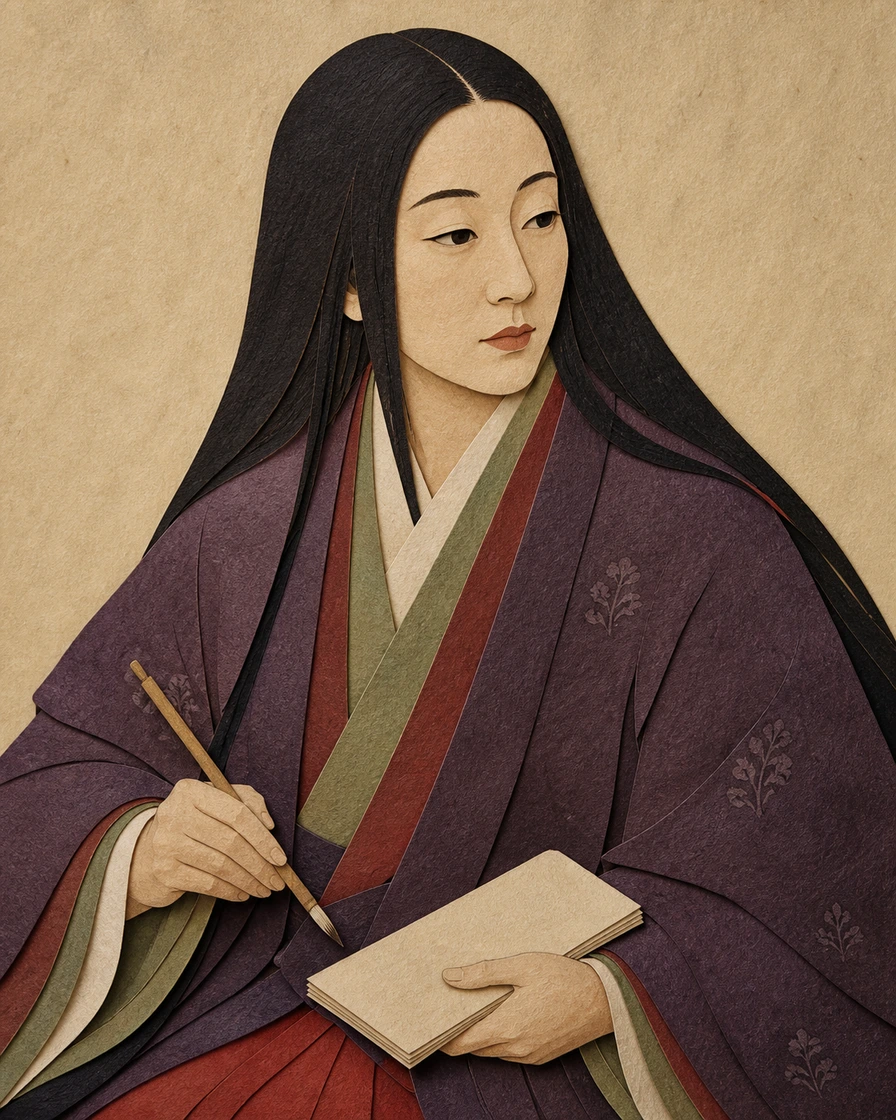
Places joined canon formation. Uji monuments and literary routes connected fictional geography with real visitation. Portraits created a visible “Murasaki” despite the absence of a securely life-like image. Conventional costume and setting communicate status, not facial documentation. It also distinguishes preservation from endorsement. A commentator, painter, or educator can make a work more durable while interpreting it through values Murasaki never articulated. Reception history records those interventions without treating them as completion of her intention. They relate, but they are not interchangeable. Later praise cannot supply a lost birth name or death date.
The many voices after death belong to readers and makers who transformed preservation into cultural power through 1912.