HO Guides
Rozan-ji and Murasaki's Grave: Giving a Writer an Address
A modern garden and an argument carved in stone reveal how two separate Kyoto sites locate the author of The Tale of Genji.
Quick · About 2 min
The story in five points
A short route through the argument. Follow a point into Classic for its context and sources.
Two addresses carry different histories
Rozan-ji’s Murasaki association concerns earlier residential ground, not surviving rooms where she wrote. The traditional grave enclosure is a separate place elsewhere in Kyoto; it belongs to posthumous remembrance rather than a recovered boundary of her household estate.
Read in contextA scholarly identification became a public marker
The residence association connects Murasaki with her great-grandfather’s estate. A 1965 monument made the identification visible, but its evidence includes a much later commentary, not an excavated writing room or proof that all her works were composed there.
Read in contextA modern garden created a literary setting
The Genji Garden deliberately evokes a Heian atmosphere rather than reconstructing Murasaki’s garden. A stone pairs her verse with her daughter’s, giving visitors actual writing to encounter without claiming that the poems originated beside that stone.
Read in contextThe grave tradition preserved disagreement
A medieval commentary paired Murasaki’s grave with Takamura’s. An 1869 monument rejected that interpretation while recording repairs; its confidence did not erase the paired tradition, and neither account establishes archaeological identification of the remains.
Read in contextReligious reception was varied
Stories of Takamura helping Murasaki in the underworld sit beside services for Genji’s participants, defences of fiction’s instructive value and veneration of the author as Kannon. These responses generated different ways to remember the writer rather than one universal judgment.
Read in context
Opening
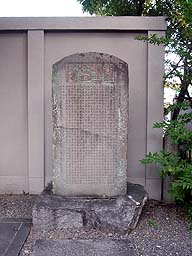
Beside the mounds traditionally identified as the graves of Murasaki Shikibu and Ono no Takamura stands a monument that disputes the pairing. Its inscription, erected in 1869, argues that damage made a single mound look like two. Local people had assigned one part to Takamura and another to Murasaki; the author of the inscription rejected their account.[1]
The disagreement has acquired a place of its own. A memorial intended to clarify a burial now helps record the uncertainty surrounding it.
Elsewhere in Kyoto, at Rozan-ji, stones identify Murasaki's residence site and a garden evokes the world of Genji. The temple and the grave enclosure are separate places with different histories. Together they raise a question more interesting than whether every marker should be believed: what kinds of work have given this elusive writer such definite addresses?
1. The temple came later
Murasaki Shikibu wrote The Tale of Genji in the early eleventh century. Her literary world concerns court households, relationships, and the consequences of time. The buildings now associated with her at Rozan-ji belong to much later centuries. The first useful act of recognition is consequently to separate the author from the architecture bearing her memory.[2]
Rozan-ji stands east of the Kyoto Imperial Palace grounds, but the temple began elsewhere. Its institutional history places its tenth-century foundation near Funaokayama and its move to the present site in the late sixteenth century. It dates major surviving halls to rebuilding in 1794, with connections to the imperial household. The institution had a religious history before acquiring this address and continued making buildings long after it arrived.[3]
Its association with Murasaki concerns the ground: a family residence has been located in the area subsequently occupied by the temple. It does not concern a room preserved inside a building in which she sat to write. A former house site can underlie a later institution without making that institution part of the former resident's own life.
That sequence gives the place two histories worth keeping. Rozan-ji's religious identity is not a disguise adopted by a literary museum. Conversely, the old residential association does not vanish simply because the household buildings have disappeared. The temple now provides a setting in which a claim about earlier ground can be stated and remembered.
The grave enclosure lies to the northwest, near Horikawa and Kitaōji. It is not a cemetery attached to Rozan-ji or the far end of the supposed family estate. Its markers concern a posthumous location, not the writer's domestic life. The two sites belong together in a history of remembrance, rather than within one recovered property boundary.[4]
2. A location acquires a public name
The residential claim begins with an ancestor. Kyoto City's marker record identifies the Tsutsumi residence of Fujiwara no Kanesuke, Murasaki's great-grandfather, beside the Kamo embankment. It locates the house through older street names and reports the tradition that Murasaki lived on the same ground. The connection between a family, a named residence, and a part of the city supplies the basis of the commemorated address.[5]
Rozan-ji credits the historian Tsunoda Bun'ei with the modern identification. In 1965, a monument naming the residence site was erected within the precinct. The city's record identifies the Palaeological Association as its sponsor. A historical interpretation had acquired a public object whose concise inscription announced the conclusion.[6]
There is a considerable compression in those few words. A statement on stone does not display the whole process of connecting old place names, family relationships, and later descriptions. The inscription makes the location easy to name, while leaving the strength and limits of the identification to be explained elsewhere.
Mitsuru Ishii, writing for Kanto Gakuin University, points specifically to the evidential limit. He describes the residential identification as based on the medieval Kakaishō, a commentary on Genji compiled centuries after Murasaki, rather than on excavation of her writing room. That leaves a meaningful family-site association, but not a demonstrated position for her desk or proof that all her works were composed within today's boundary.[7]
The marker's date is much less elusive than the circumstances of composition. It records a twentieth-century decision to identify and honour this ground. That is a historical event in its own right: people undertook to make a scholarly localization available to others who would encounter the place without reading the underlying argument.
A visitor can therefore ask two distinct questions here. Where does the evidence locate the household? How did that identification become part of the temple's visible character? The first remains an issue of historical geography. The monument gives a particularly clear answer to the second.
3. Making a garden after the book
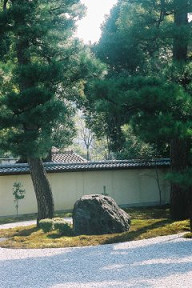
The Genji Garden belongs to the same commemorative moment. Rozan-ji associates its preparation with the 1965 residence marker and describes it as expressing the feeling of a Heian-period garden. White gravel and moss establish its principal surfaces; purple bellflowers supply a living association with Murasaki. This is an intentionally made literary setting, not a recovered plan of her household garden.[8]
Its name performs part of the work. Gravel, moss, and flowers do not identify a particular novelist unaided. Called the Genji Garden, they enter a relationship with the author and the imagined world of her book. The setting offers something to attend to where the actual residence can no longer be entered.
That relationship differs from reconstructing a scene in the novel. A fictional house has its own position within the story; the author's house has a place in her biography; a modern commemorative garden belongs to the book's reception. These can be brought into conversation without assuming that one was the original of the others.
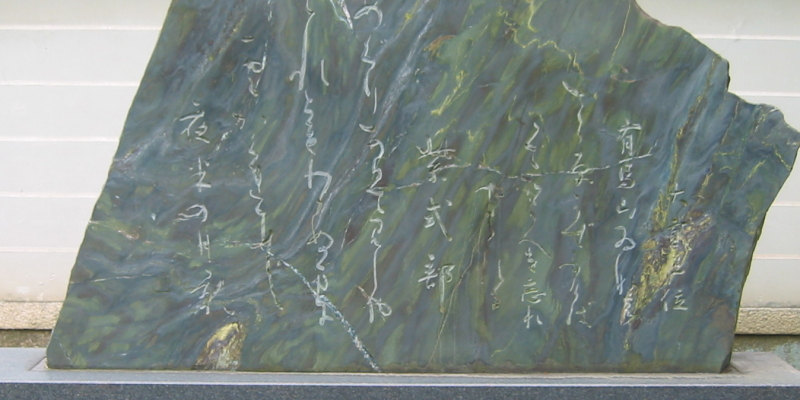
A stone carrying poems makes a more direct connection with language. Rozan-ji presents a verse by Murasaki beside one by her daughter, the poet known as Daini no Sanmi. In the photographed stone, the separate texts and names share a single irregular surface. The pairing supplies a literary family relationship in words, rather than through a reconstructed domestic tableau.[9]
Murasaki's poem compares a brief encounter with a midnight moon disappearing behind clouds before one can be certain of having seen it. Its movement is from recognition towards absence. Daini no Sanmi's verse hears wind in the bamboo grass and turns towards an insistence that the addressee has not been forgotten.[10]
Reading those verses requires no belief that they were composed beside this stone. Their historical words have been selected for a new setting. The residence marker says where an author is remembered; the poem offers something of what she made. The garden gives those acts of reading a place without manufacturing a surviving eleventh-century room around them.
4. A grave with a literary neighbour
The traditional grave has a different documentary depth. A fourteenth-century description in the Kakaishō places Murasaki's grave west of Takamura's, south of Byakugō-in, a subtemple of Unrin-in. Modern accounts connect that description with the enclosure near Horikawa–Kitaōji. The pairing was thus recorded long before the 1869 inscription challenged it.[11]
The earlier record establishes a history of attribution, rather than an archaeological identification of either person's remains. It gives later readers an arrangement to recognize: two names in relation to a religious precinct and to one another. The location is transmitted through a description of neighbouring things, not through a recovered burial certificate.
Takamura lived more than a century before Murasaki. Later stories supplied him with a second occupation beyond his actual court service: assisting Enma, the judge of the dead, in the underworld. A popular explanation of the graves uses that legendary access to account for their proximity. Murasaki, said to face punishment for the invented stories of Genji, could benefit from a neighbour able to intercede.[12]
The explanation creates an afterlife relationship between people who did not share a lifetime. Physical adjacency becomes assistance. It gives the arrangement a narrative purpose while leaving the historical circumstances of burial unproved. The medieval reference to the graves does not, by itself, establish when this particular rescue story arose.
There is also a reversal in the writer's position. At Rozan-ji, her literary accomplishment supplies the reason for commemoration. In the underworld story, making fiction supplies the alleged difficulty for which she needs help. The same work can support admiration and anxiety, and each response can generate a way of locating its author.
5. Fiction could call for prayers—and for defence
The rescue story is one response within a varied religious reception. It should not become a claim that all Buddhists condemned Genji or that Murasaki received a documented sentence from a historical religious tribunal.
The practices called Genji kuyō included dedicatory services for the author, readers, and even the tale itself. Their rationale could connect fiction with Buddhist concerns about falsehood and frivolous speech, while allowing the spiritual benefit of religious practice to be dedicated to those thought to need assistance. The concern could generate care for literature's participants rather than a simple prohibition on reading.[13]
An anonymous preface to Sino-Japanese poems on Genji, composed in 1291, offers another approach. It argues for the tale's instructive value and compares the use of fictional narrative with teaching through Buddhist parables. Wiebke Denecke's study and translation also draw attention to the preface's playful and unstable relationship with learned authority. It is a particular literary argument, not a creed accepted by every reader.[14]
At Ishiyama-dera, a separate temple associated with the author's memory, religious veneration could go further still: Murasaki was worshipped as a manifestation of the Buddhist saviour Kannon. That tradition coexisted within the wider reception of an author for whom prayers of salvation were also offered.[2]
Against this background, the traditional grave's helpful neighbour becomes one intelligible way of addressing a posthumous problem. The legend turns a concern about words into a relationship between two named people. Its function is explanatory and devotional. It supplies neither proof that their bodies occupy adjacent earth nor a single judgment that governed the whole religious life of the book.
The material location nevertheless gives the story persistence. A general argument about the moral status of fiction can be difficult to remember. Two grave names beside one another give the argument people, proximity, and a place at which it can be retold.
6. A repair intended to settle the question
The 1869 inscription starts from an entirely different relationship: claimed descent. Yokoyama Masakazu, a retainer of the Kanazawa domain, regarded Takamura as his ancestor. The text recounts his wish to identify the burial and his request that a kinsman investigate. Once a location had been reported in Murasakino, he commissioned a monument and repairs.[15]
The claim helped turn a patch of neglected ground into an undertaking. A family history supplied a reason to seek the grave; the reported discovery supplied somewhere to direct resources. The inscription's author then set out an account intended to preserve the connection between the ancestor, the patron, and the repaired site.
The account acknowledges an earlier intervention. During the Kansei era, 1789–1801, a man surnamed Hata had erected a marker for Takamura and made an approach. The later writer did not know much about him, but credited his action with making the grave recognizable. The story of recovery therefore already depended on an earlier act of marking.[16]
The disputed division of the mound was central to the new interpretation. The writer described an eroded corner that made one mass of earth appear to be two. He rejected the local identification of a separate Murasaki burial, invoking both the land's shape and the difference between the two figures' lifetimes. This was his argument for a single Takamura grave, not a finding established by an excavation.[1]
That argument sought to change what the ground meant. The repairs changed how it could be approached. The inscription records a stone enclosure, an improved way in, and the repositioning of Hata's earlier marker at the entrance, while asserting that the old appearance within the burial area had otherwise been retained.[16]
The distinction between interpretation and intervention is unusually clear. Someone could reject a story about two graves while preserving the earth that had prompted it. A path could make a site easier to identify without demonstrating who was buried there. Repair could give an attribution durable public form, even though the attribution remained open to disagreement.
The present recognition of both names makes the inscription's attempt to settle the matter especially revealing. Its confident rejection did not erase the paired tradition. Today the memorial is evidence of that argument as well as of the repairs it describes. Its patron wanted an ancestor located and honoured; the stone also preserved a competing account of Murasaki's place in the enclosure.
7. The address is renewed
Rozan-ji's residence claim acquired another marker in 2008. One face identifies Murasaki's house site; the other gives 1 November 2008 and dedicates the stone to the millennium of The Tale of Genji. The two inscriptions connect a claimed biographical location with an explicitly dated literary anniversary.[17]
That anniversary is not a newly discovered date on a wall of the lost house. It records a later occasion for making the author's association visible again. The 1965 and 2008 stones belong to separate acts, even though their principal message about the site is similar. Repetition here is part of commemoration's history, not another independent proof of the residence.
Compare this with the grave inscription's account of Hata. In each case, an earlier marker remains part of the story when somebody undertakes further memorial work. Yet the purposes differ. Rozan-ji's later stone renews a literary identification; the grave monument argues against one of the names already attached to the ground. Monuments can reinforce an account or try to redirect it.
The two Kyoto sites consequently offer more than two uncertain answers to a biographical question. They preserve identifiable acts of research, selection, planting, inscription, and repair. Those acts explain why the author's memory has places at which it can be encountered, even where the original house and the identity of the burial remain beyond direct inspection.
8. What can be encountered there
At Rozan-ji, a modern garden provides a setting for a residence association, while the poem stone returns attention to actual writing. Near Horikawa–Kitaōji, neighbouring grave names sustain a tradition that an imposing nineteenth-century inscription tried to reject. The surviving materials do not all tell the same story, and their differences are part of what makes these places historically useful.
Murasaki did not leave all these addresses for her readers. Later people connected her family to ground, her words to a stone, her reputation to a garden, and her imagined afterlife to a neighbouring courtier. Their decisions gave the writer a presence in parts of Kyoto whose material form had changed long after her death.
The most direct encounter at the temple may therefore be the smallest one: reading the few lines about a moon disappearing before it can be fully recognized. They do not prove where their author stood. They allow a later place of remembrance to contain something more particular than her name.
Next topic · HO Guides
Jakkō-in: The Work Left to the Living
At an empress's retreat in Ōhara, the work of mourning emerges from a literary encounter, a travelling poem, and a prayer preserved inside a sacred image.
Continue readingSources and NotesView sourcesHide sources
Sources consulted 16 September 2026. Rozan-ji and the traditional grave enclosure are treated as two separate components, not a walking route or a single original estate. Residence identification, traditional burial attribution, and dated acts of commemoration have different evidential status.
- [1]
Kyoto City, historical stone-marker record KI063, “参議小野公塋域碑,” erection data and the 1869 inscription's clauses beginning “而西北一角” and “故土人或謂”: https://www2.city.kyoto.lg.jp/somu/rekishi/fm/ishibumi/html/ki063.html. See also the city's paragraph-by-paragraph explanation, especially its third paragraph: https://www2.city.kyoto.lg.jp/somu/rekishi/fm/ishibumi/html/ki063_abst.html. The original public-domain inscription's exposed transcription contains encoding damage; the municipal explanation was used to clarify the argument, not presented as a newly deciphered original. The actual marker photograph: https://www2.city.kyoto.lg.jp/somu/rekishi/fm/ishibumi/jpg/ki063a.jpg. It does not independently authenticate the graves. The writer's rejection of the paired attribution is reported, not endorsed; the age difference cannot by itself disprove adjacent burials made at different times.
Return to the reference ↑ - [2]
The Metropolitan Museum of Art, The Tale of Genji: A Japanese Classic Illuminated, “Exhibition Galleries,” 2019, opening paragraphs and “Ishiyamadera Temple and Veneration of Murasaki Shikibu”: https://www.metmuseum.org/exhibitions/listings/2019/tale-of-genji/exhibition-galleries. Used narrowly for the early-eleventh-century literary context and the coexistence of prayers for salvation and veneration as Kannon. The writer does not adopt the page's disputed reconstructions of characters' private purposes, evaluative rankings, or claims about every reader. Ishiyama-dera supplies a separate comparative tradition, not proof that Murasaki wrote there.
Return to the reference ↑ - [3]
Rozan-ji, “沿革/略史,” two institutional-history paragraphs: https://www7a.biglobe.ne.jp/~rozanji/11ryakusi.html. The source locates the earlier foundation near Funaokayama, the move in the Tenshō period, and principal surviving halls in the 1794 rebuilding. The essay uses “late sixteenth century” for the move without repeating the page's inconsistent final year for that era or inventing an exact moving day. Temple buildings are not identified as Murasaki's residence. Institutional history and claims about imperial religious functions are not used as evidence of her personal association with the later temple.
Return to the reference ↑ - [4]
Kyoto City, KA039 residence-marker location, note 5, and KI063 grave-marker location, note 1. The two full municipal location records were compared. They place the components in the Rozan-ji precinct on Teramachi and in Murasakino Nishigoshoden-chō near Horikawa–Kitaōji respectively. The essay uses their separate urban positions, not a reconstructed eleventh-century property survey, measured walking time, or implication of shared present-day administration. No current admission arrangements are promised.
Return to the reference ↑ - [5]
Kyoto City, historical stone-marker record KA039, “紫式部邸宅址,” explanatory paragraph: https://www2.city.kyoto.lg.jp/somu/rekishi/fm/ishibumi/html/ka039.html. It identifies Fujiwara no Kanesuke's Tsutsumi residence south of Ōgimachi-kōji and east of Higashi-Kyōgoku-ōji, and states that Murasaki is traditionally said to have lived on the same ground. The city's qualification is preserved. The entry explicitly leaves her birth and death years uncertain; this essay supplies neither an exact life span nor a verified personal birth name. No detailed archaeological house plan is claimed.
Return to the reference ↑ - [6]
Rozan-ji, “紫式部,” paragraph crediting 角田文衛 and recording the November 1965 commemoration: https://www7a.biglobe.ne.jp/~rozanji/31sikibu.html. See also Kyoto City KA039, erection-year, sponsor, inscription and survey-note fields, note 5. The city attributes the 1965 date and Palaeological Association sponsorship to a Mainichi Shimbun unveiling report of 7 November 1965; that newspaper article and Tsunoda's complete original study were not independently read. The catalogue's photograph: https://www2.city.kyoto.lg.jp/somu/rekishi/fm/ishibumi/jpg/ka039a.jpg; its small text was not independently deciphered from the image. The temple page's assertions about UNESCO recognition, a precise birth name, a 1031 death, every work's place of composition, and fictional houses as biographical locations are not adopted.
Return to the reference ↑ - [7]
Ishii Mitsuru, “源氏物語ゆかりの地を訪ねて,” Kanto Gakuin University, 23 May 2024, opening discussion of Rozan-ji: https://kyousei.kanto-gakuin.ac.jp/news/faculty/mitsuru-ishii/column-5926/. Ishii distinguishes the later temple from the residence and identifies the modern localization's reliance on the much later Kakaishō, not an excavated writing room. This is an attributed scholarly teaching essay, not a full excavation report or an independent re-examination of Tsunoda's evidence. Its unrelated biographical, authorship and broad comparative claims are not used. The exact residence identification remains bounded accordingly.
Return to the reference ↑ - [8]
Rozan-ji, “源氏庭について,” “概要,” especially the 1965 paragraph and statement that the garden expresses a Heian garden's “感”: https://www7a.biglobe.ne.jp/~rozanji/32genjitei.html. Used for the modern creation, white gravel, moss, and the temple's association of purple bellflowers with Murasaki. The essay does not adopt a definitive botanical identification of every ancient asagao, a reconstruction of the author's garden, or a claim that a fictional Genji residence occupied this site. The analysis concerns how naming and selected materials make a literary setting, not a measured visitor-response study.
Return to the reference ↑ - [9]
Rozan-ji, “紫式部,” “源氏物語の世界,” verse transcriptions and actual photograph of the paired poem stone, URL in note 6; image: https://www7a.biglobe.ne.jp/~rozanji/images/30sikibu.JPG. The image supports the shared irregular stone and separate writing and names; the accompanying transcription, not a claimed independent reading of every cursive character, supplies the text. For Daini no Sanmi's relationship as Murasaki's daughter, see Hyōgo Prefectural Museum of Art, Net Museum Hyōgo Bungakukan, “大弐三位,” profile and poem entry: https://www.artm.pref.hyogo.jp/bungaku/jousetsu/authors/a2056/. No exact carving date, original autograph, or simultaneous composition by mother and daughter is asserted.
Return to the reference ↑ - [10]
Murasaki Shikibu, poem beginning “めぐりあひて見しやそれともわかぬ間に,” and Daini no Sanmi, poem beginning “有馬山ゐなの笹原風吹けば,” public-domain Japanese texts displayed by Rozan-ji, note 9. The English descriptions are the writer's paraphrases of the verses, not borrowed modern English translations. The mother–daughter contrast follows the wording about a vanishing encounter and not forgetting; it is not a reconstruction of an exchange between the two women. A particular recipient, scene of composition, or moment in the author's biography is not inferred from the commemorative stone.
Return to the reference ↑ - [11]
Keihan Group, K Press, “今こそ知りたい 紫式部の面影を探して,” installment “紫式部の最期にまつわる言い伝え,” dated 5 December 2024, paragraph identifying Yotsutsuji Yoshinari's Kakaishō and its grave-location description: https://www.keihan.co.jp/k-press/murasakishikibu/. The complete relevant installment was read, not every unrelated excursion on the page. It reports the medieval placement west of Takamura's grave and south of Unrin-in's Byakugō-in. The original commentary manuscript or complete critical edition was not inspected. Used as a clearly limited report of an earlier attribution, alongside the municipal record of the later dispute, not as archaeological proof or a guarantee that every present feature occupies an unchanged medieval position.
Return to the reference ↑ - [12]
Keihan, same installment, two following paragraphs about Takamura and the explanation of the paired graves, note 11; Kyoto City KI063, introductory account of Takamura's later underworld legend, note 1. The essay reports a modern retelling of later tradition, without assigning the rescue story the date of the Kakaishō or treating it as a verified relocation of remains. Takamura's ninth-century life and Murasaki's early-eleventh-century literary activity do not imply a historical meeting. General assertions that fiction was universally condemned are qualified using notes 13–14.
Return to the reference ↑ - [13]
Thomas Harper and Haruo Shirane, eds., Reading The Tale of Genji: Sources from the First Millennium (Columbia University Press, 2015), chapter 4, “Obsequies for Genji,” opening p. 177. That actual page was read as a PDF page image in the excerpt hosted at Boston University: https://www.bu.edu/wll/files/2019/11/07-Denecke-Preface-to-Sino-Japanese-Poems.pdf. Only this opening of chapter 4 was available in that excerpt; the complete chapter was not read. It explains Genji kuyō, merit dedication, and the relationship with concerns about falsehood and frivolous speech. The file also contains a preceding contribution by Denecke; that does not make the chapter 4 introduction her work. The essay does not claim that such rites were performed at this particular grave on an undocumented date.
Return to the reference ↑ - [14]
Wiebke Denecke, introduction and translation of the anonymous “Preface to Sino-Japanese Poems on The Tale of the Shining Genji, 1290–1291,” in Harper and Shirane, Reading The Tale of Genji, pp. 171–176, same university-hosted PDF as note 13. The preface's comparison with instructive Buddhist parables is on pp. 173–174; the introduction discusses the work's ambiguous and partly parodic treatment of scholarly authority. Used as one counterexample to a uniform condemnation of fiction, not an agreed religious verdict or proof about either burial. Neither the Japanese manuscript nor the complete anthology was independently read.
Return to the reference ↑ - [15]
“参議小野公塋域碑,” 1869, first portion of the transcribed inscription, from “慶応四年夏” through the account of commissioning the text, Kyoto City KI063, note 1; municipal explanation, first paragraph. The passage recounts Yokoyama Masakazu's claimed ancestry, a kinsman's search, and his request for a commemorative inscription. These claims remain attributed to the monument. The writer does not independently certify the genealogy, identify an excavated body, or convert a patron's report into proof that the ancient grave had been found.
Return to the reference ↑ - [16]
Same 1869 inscription, clauses on “寛政中有秦某者,” “今合施以石欄,” “但秦氏所植標移置,” and the concluding appeal for future care; municipal explanation, paragraphs 2, 4–5, URLs in note 1. The readable public-domain clauses were compared with the city's explanation where the online transcription is garbled. They record the earlier Hata marker and approach, the later enclosure and path, the movement of the earlier marker, and the stated wish to preserve the older appearance. These are the inscription's account of interventions, not an independently reconstructed works ledger or proof that every component survives unchanged. The stone's date is 1869, not 1894; its historical third-month date is not converted to a Gregorian month. Analysis of interpretation versus physical repair is the writer's reading of the documented actions.
Return to the reference ↑ - [17]
Kyoto City, historical stone-marker record KA177, “紫式部邸宅址,” full record, especially the west and east inscriptions: https://www2.city.kyoto.lg.jp/somu/rekishi/fm/ishibumi/html/ka177.html. It transcribes “紫式部邸宅址” and “平成二十年十一月一日/源氏物語千年紀記念,” and explicitly distinguishes this marker from KA039. The body treats the 2008 anniversary as the monument's stated purpose, not an exact date of completing Genji or new evidence about the eleventh-century house. The comparison with the 1965 monument is a comparison of two dated commemorative acts, not a count of independent proofs of residence.
Return to the reference ↑